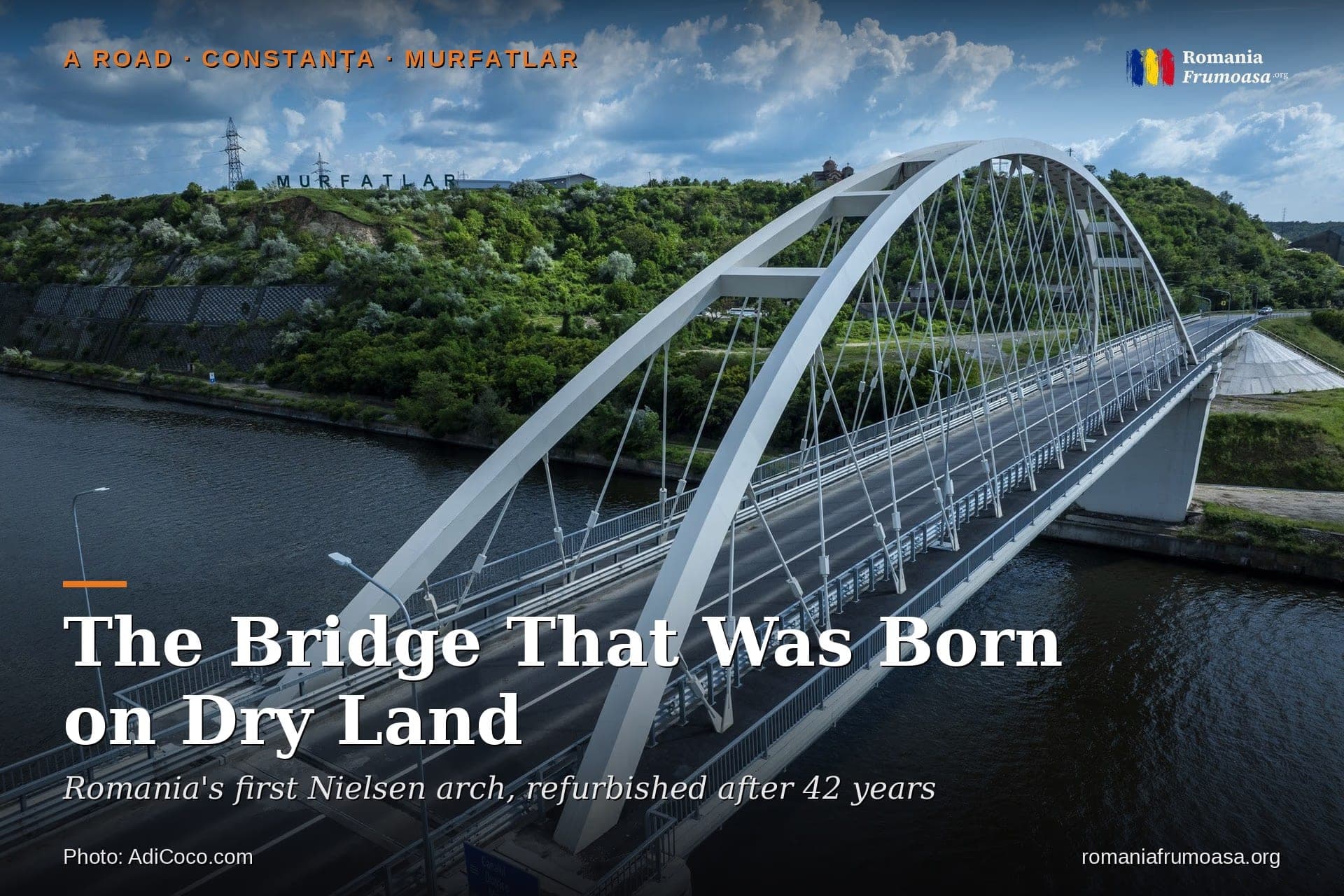
In 1983, at Basarabi, a bridge was assembled on the bed of a canal that held no water, then lifted fifteen metres into position. The water came only afterwards. Forty-two years on, Romania's first Nielsen structure gleams once more above the Danube–Black Sea Canal — after its first known major overhaul.
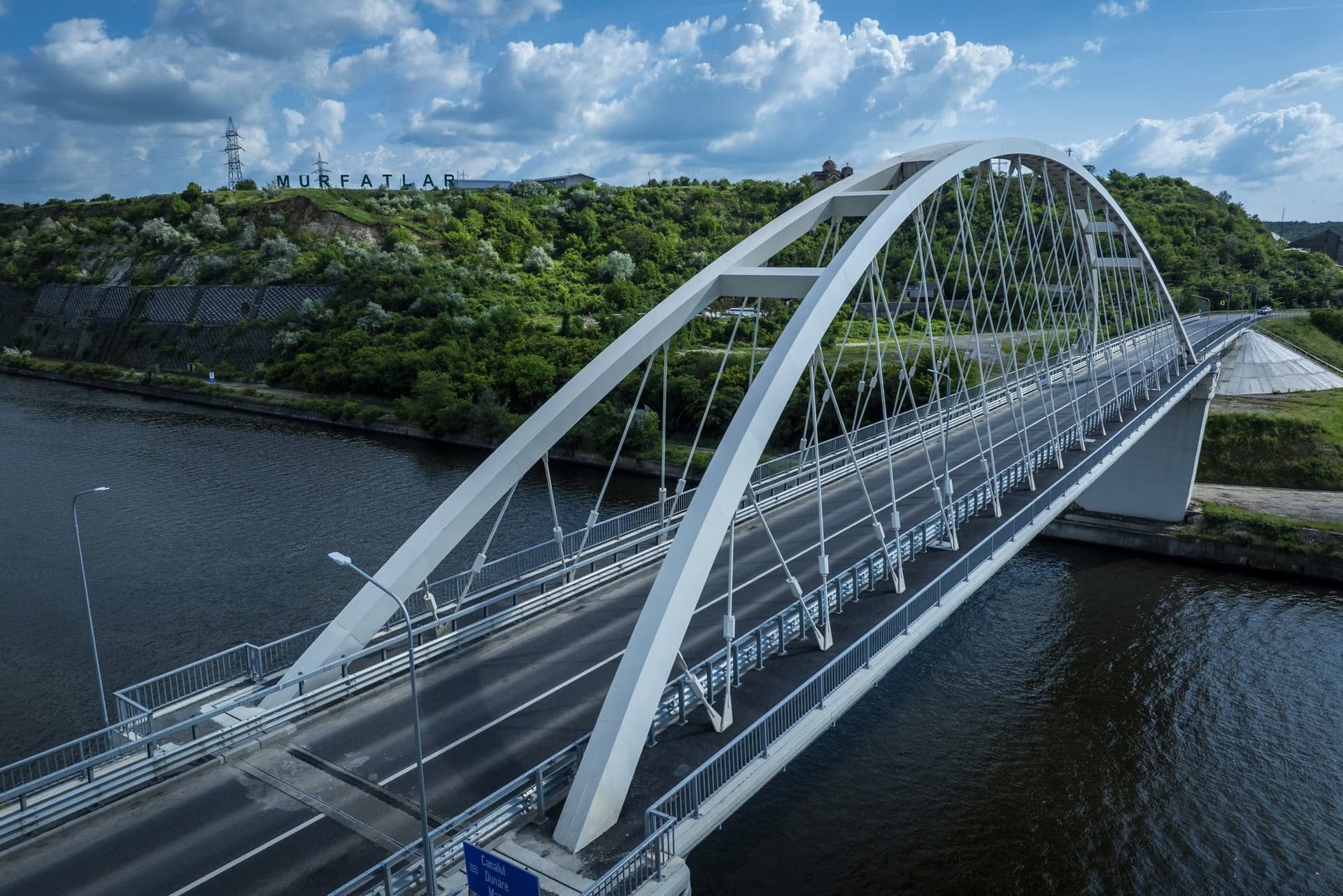
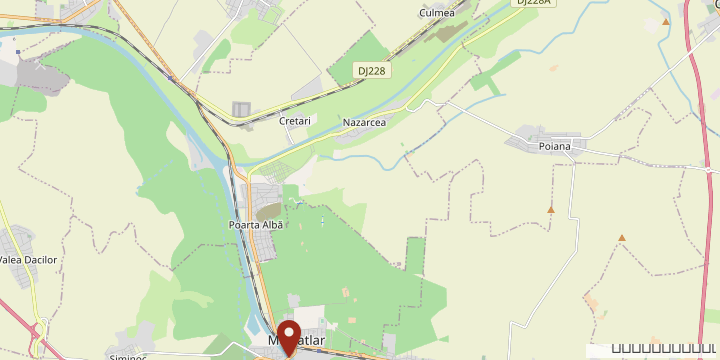
On the parapet of the Murfatlar bridge stands a blue sign of the kind that announces rivers: three stylised waves and a name — "Danube – Black Sea Canal". It is an almost comic formality: the water below is not a river the road happened to meet, but the other way round. The road was here first. DN3, Dobrogea's old highway, ran through Basarabi long before anyone cut the hill in two and brought the Danube to Constanța through the town's back yard.
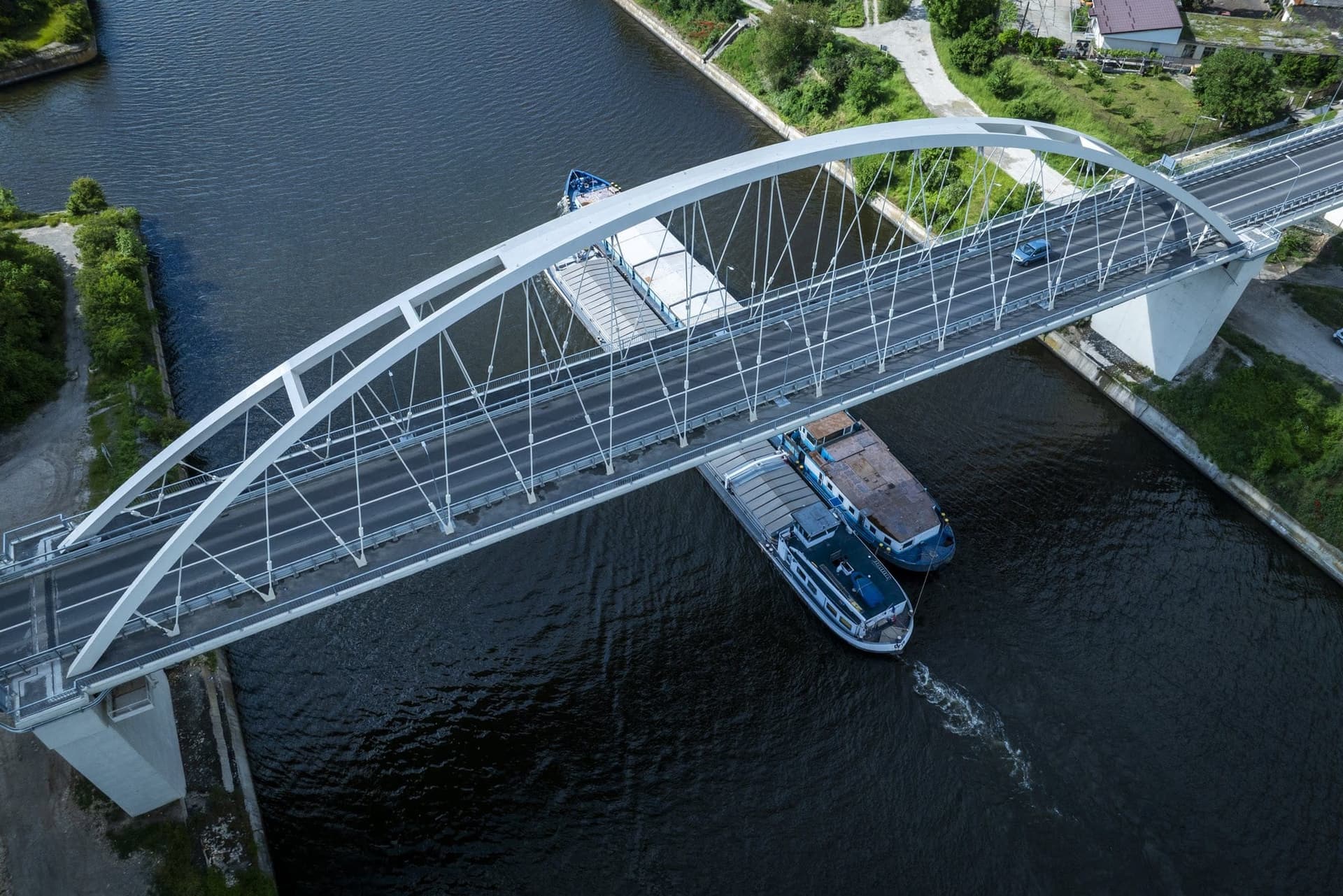
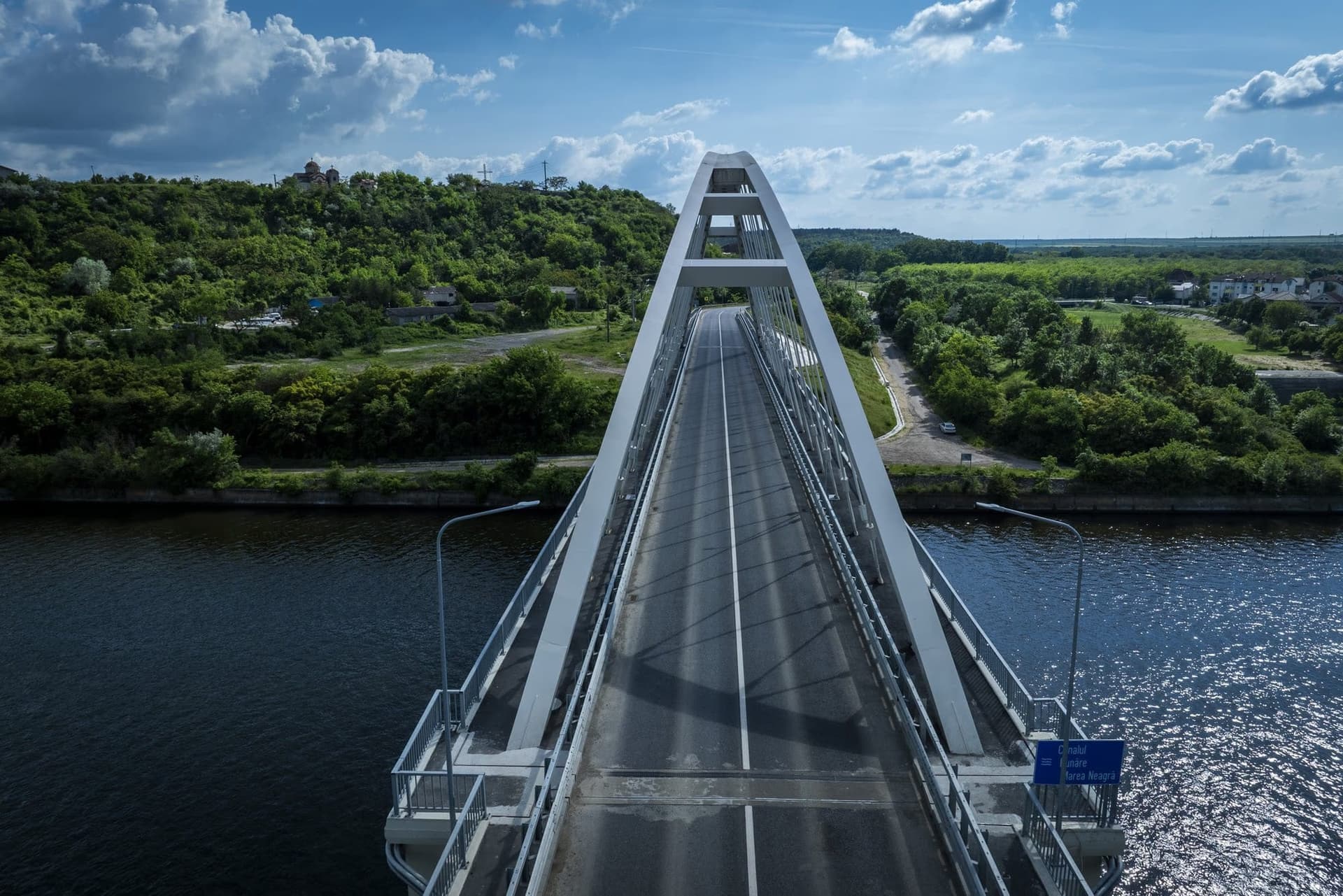
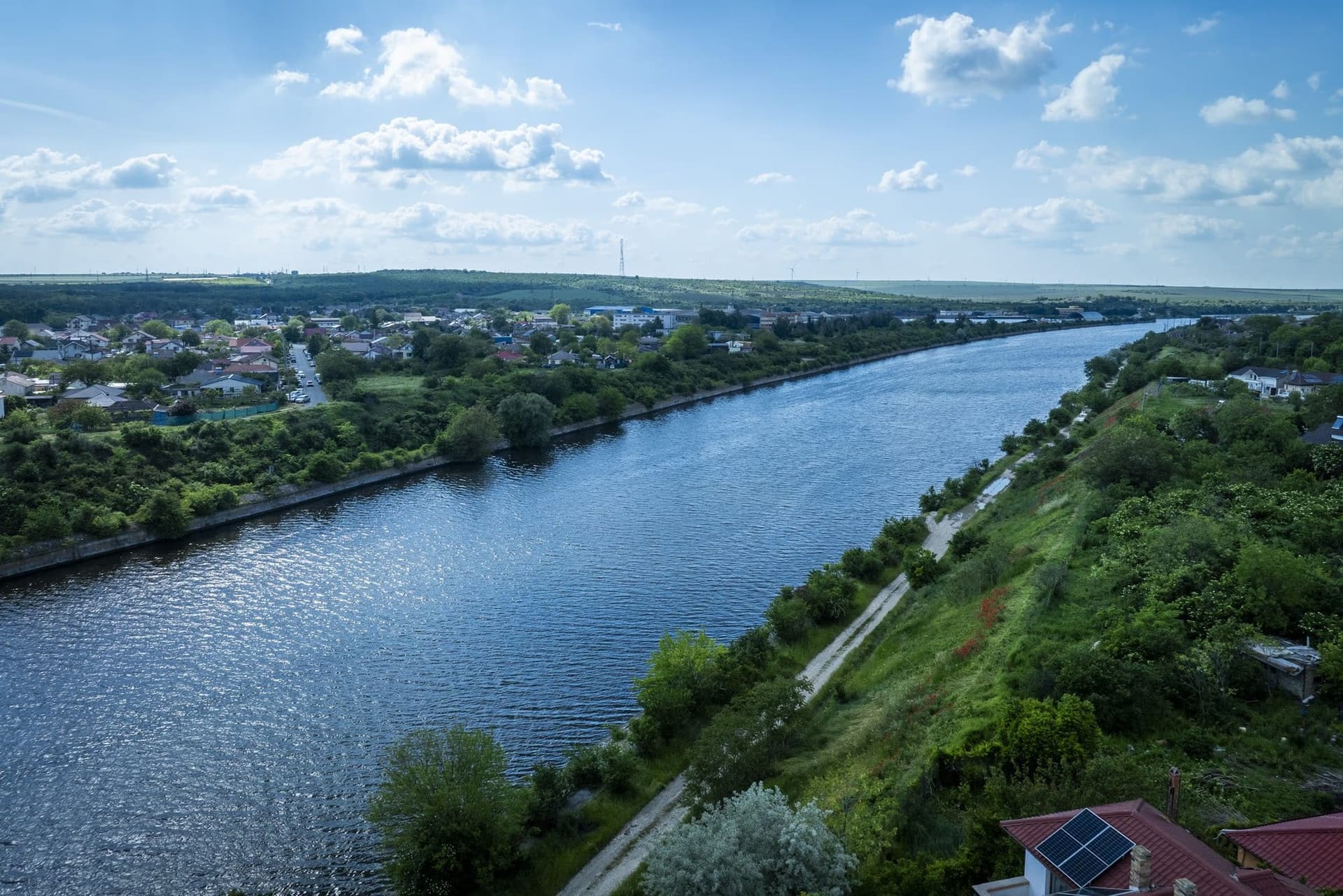
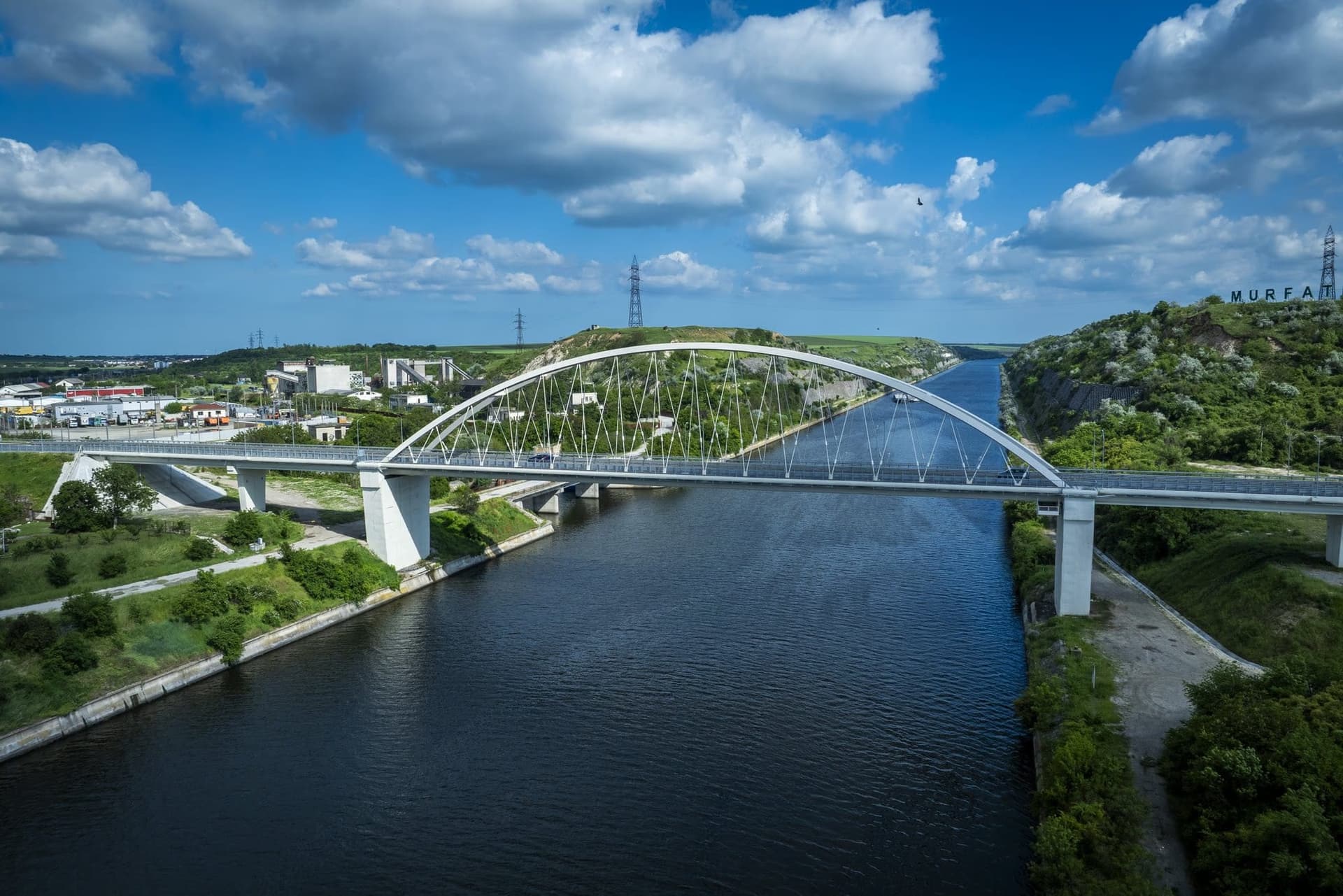
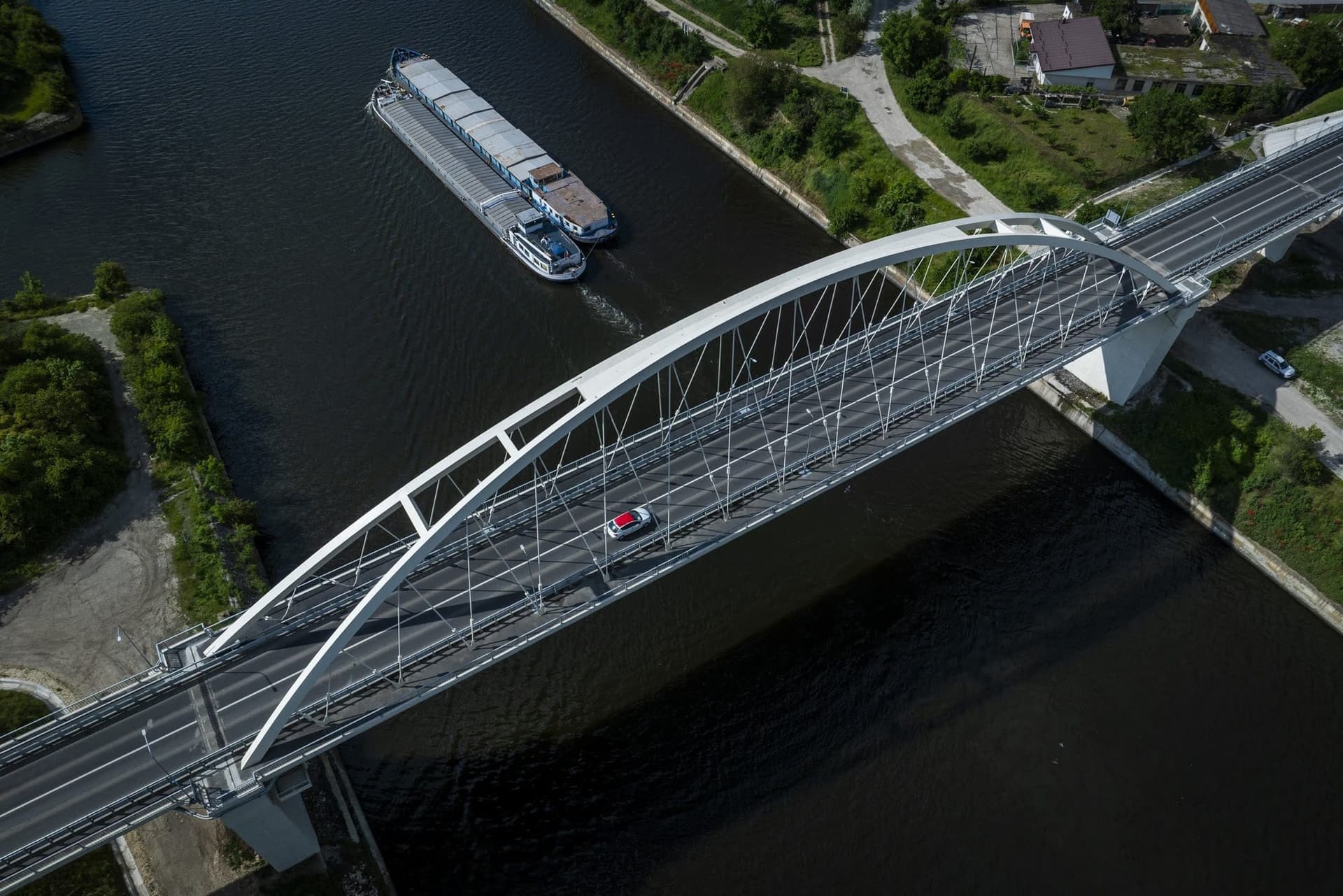
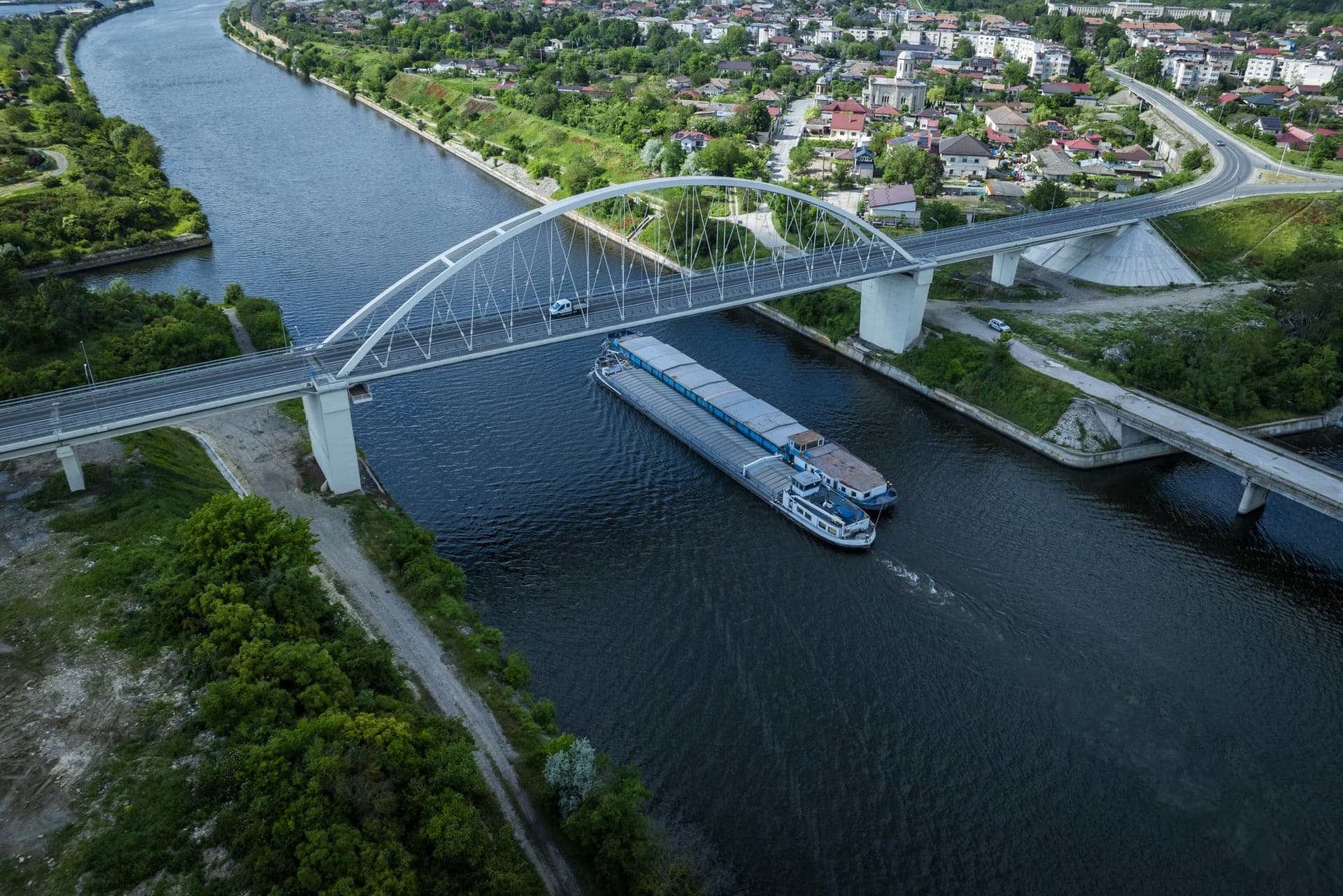
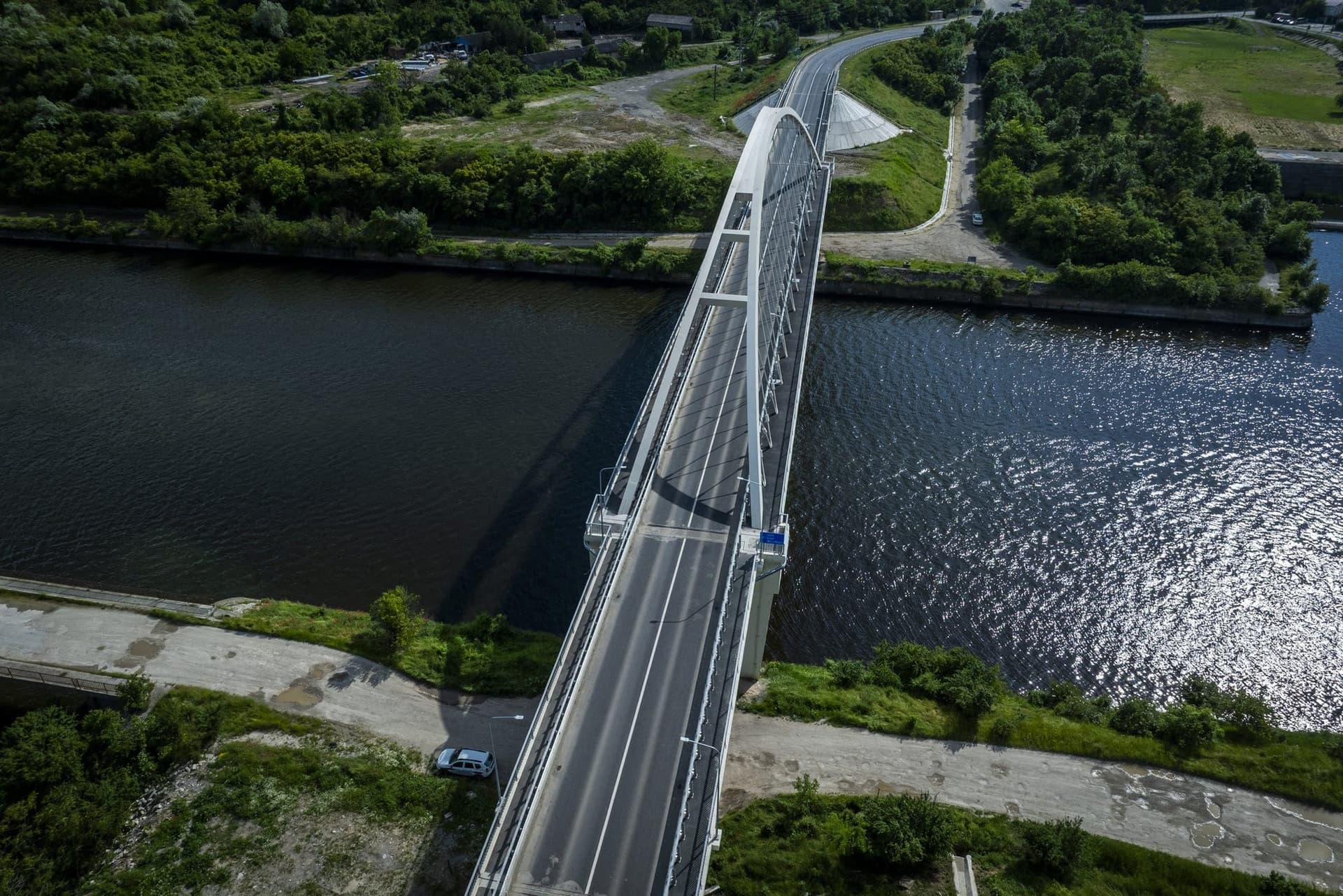
I reached the bridge on a Saturday in May, three days before an anniversary for which I saw not a single poster: on 26 May 1984, 42 years ago, Nicolae Ceaușescu inaugurated the Danube–Black Sea Canal. Below, a laden barge slid towards Cernavodă without a sound. Above, the bridge's arches — white, freshly painted, still carrying the smell of a site only just wound up — crossed against a sky of summer clouds like the tilted strings of a harp.
A Steel Net Above the Water
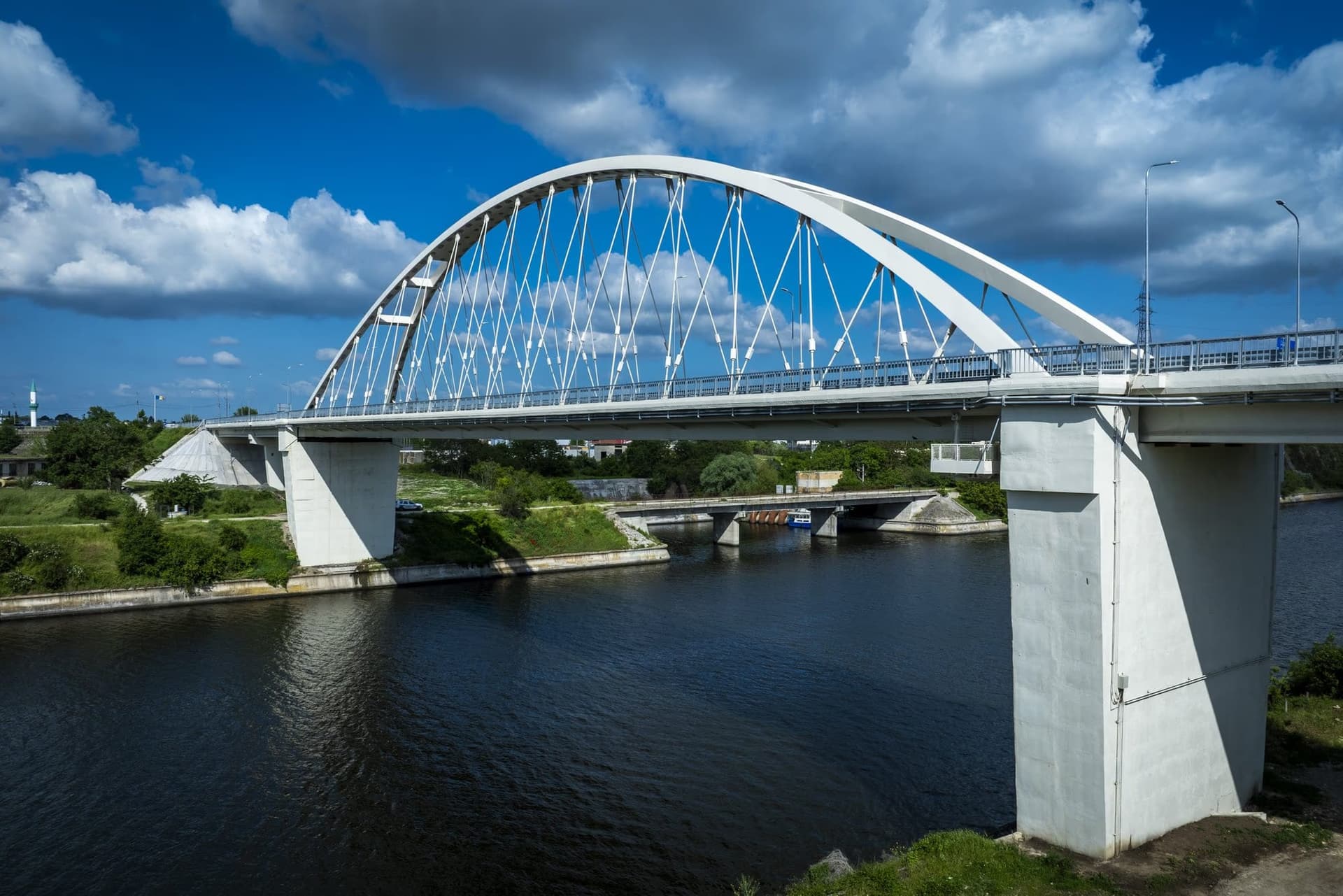
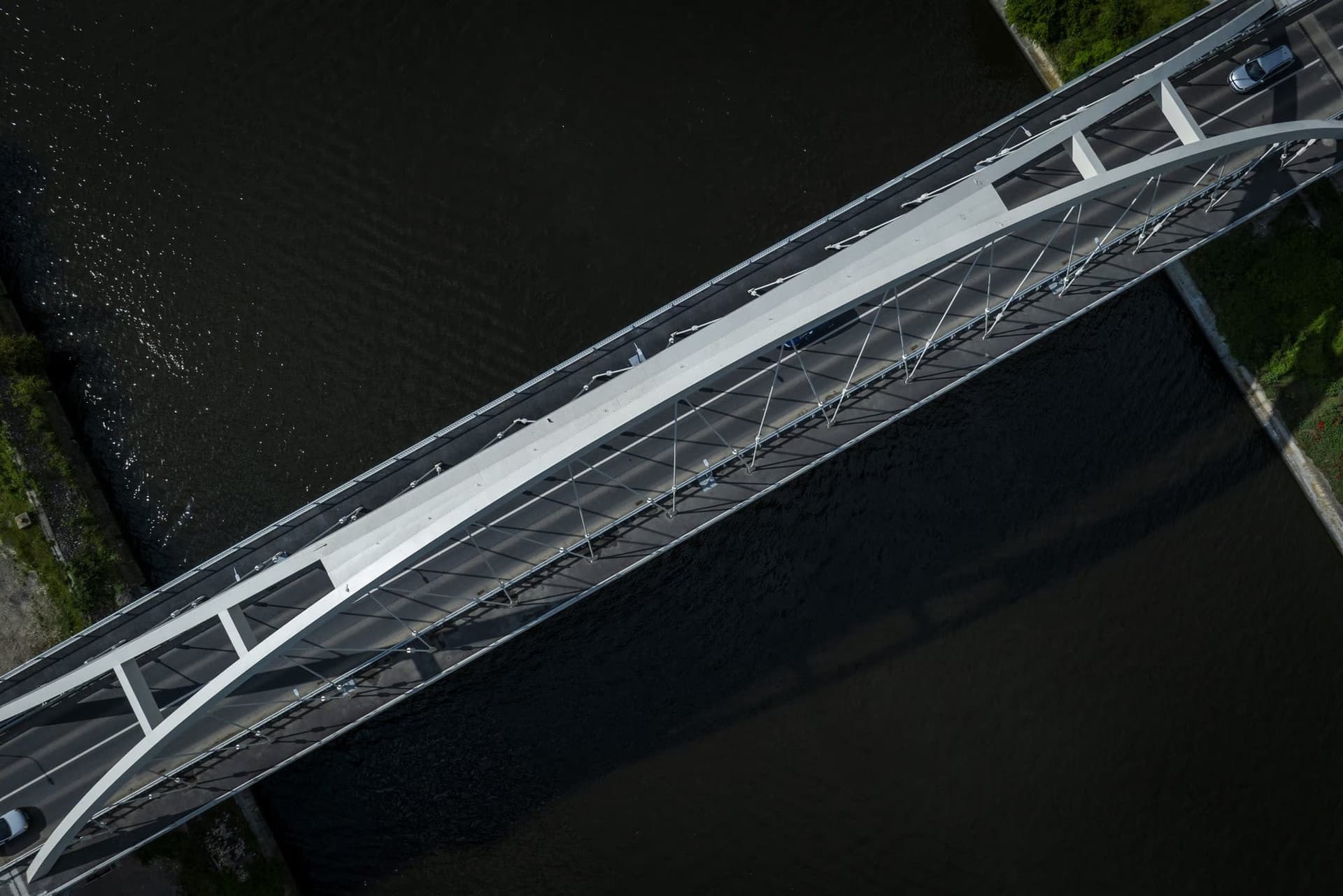
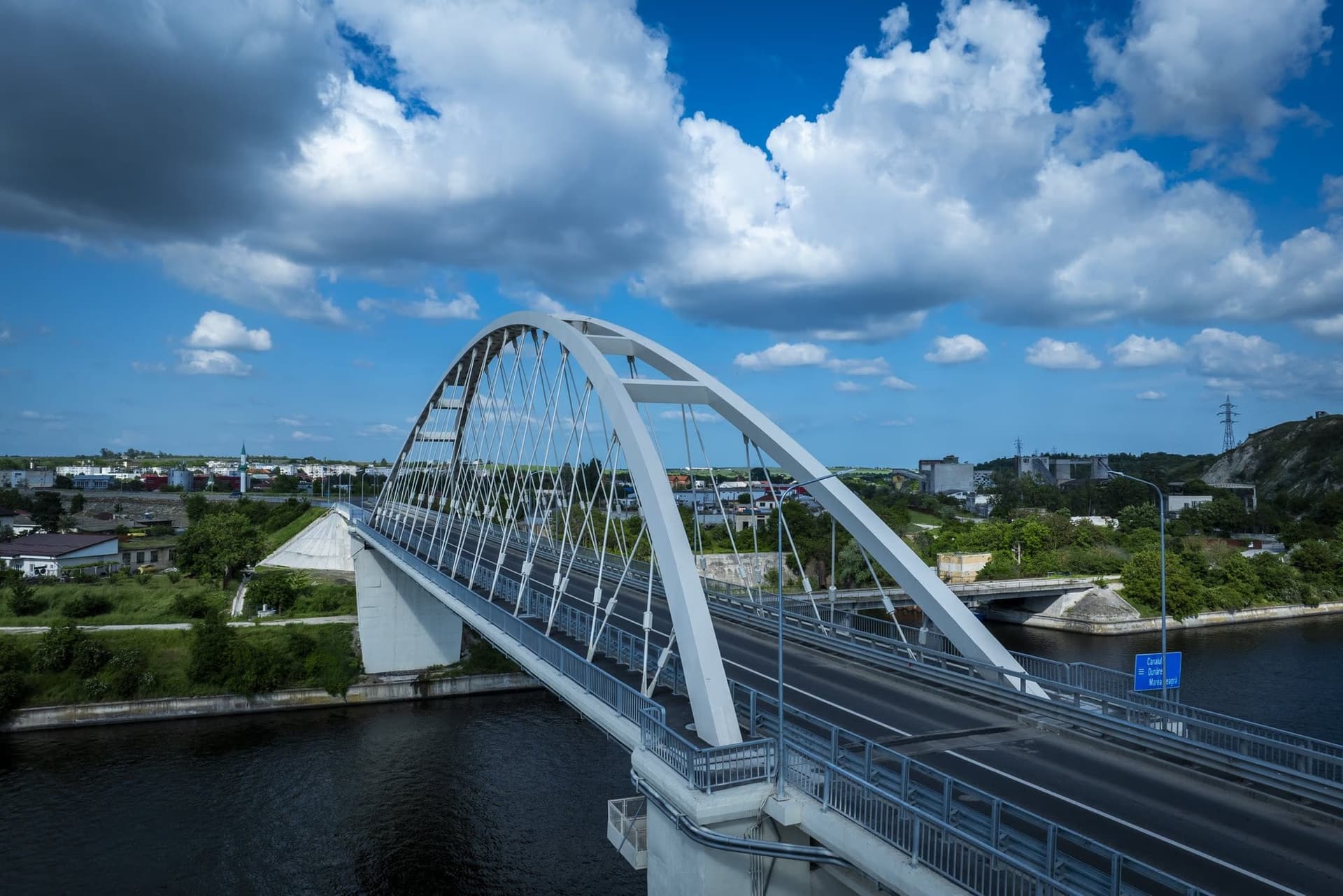
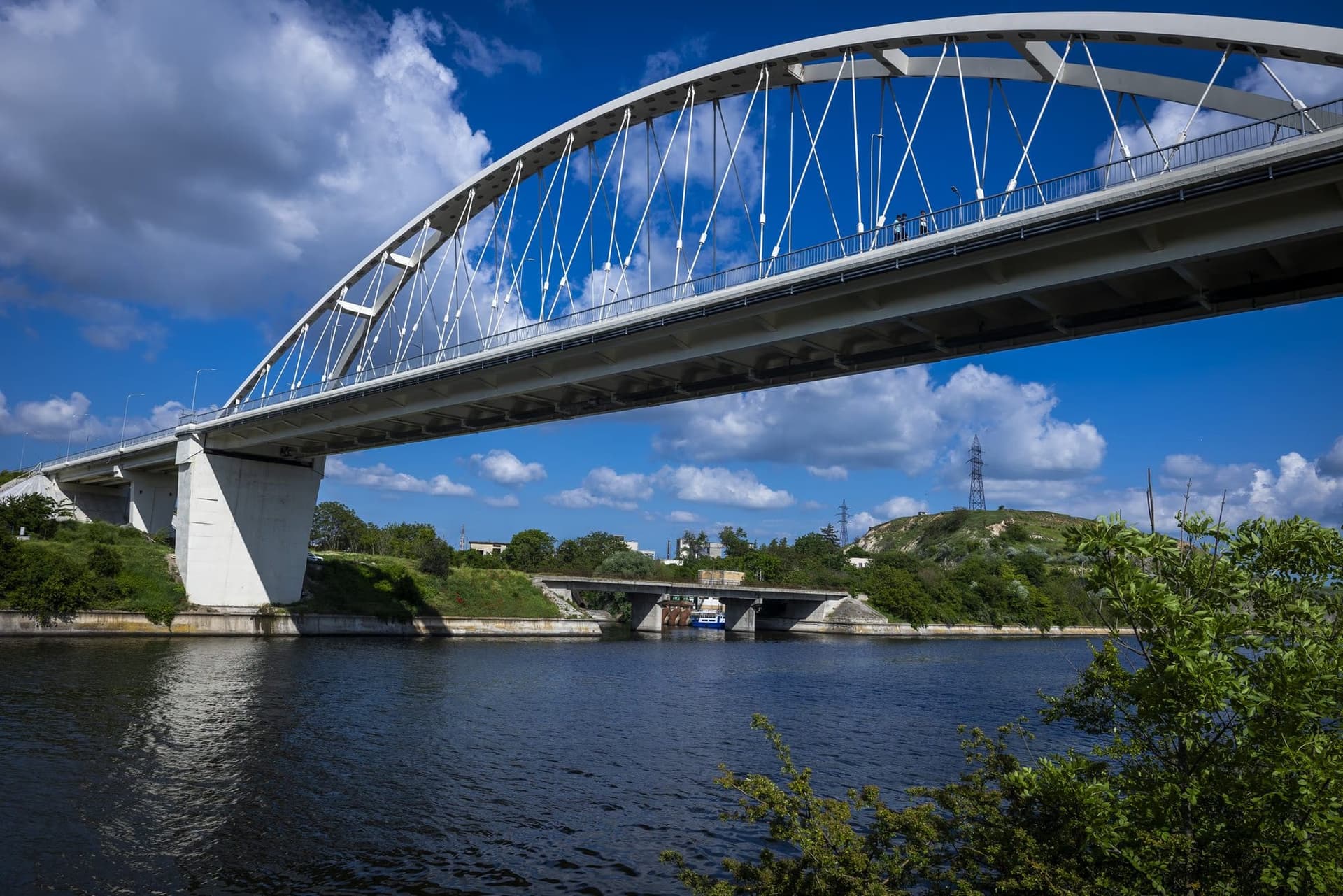
Seen from the bank, the bridge looks simple: a white arch over water. The secret is in the way the arch and the roadway keep each other company. The arch works in compression, like a vault; the girder at deck level works in tension, like a bowstring. Together they form a closed system — a tied arch, or bowstring — that delivers only weight to its bearings, with no lateral thrust; which is why the bridge needs neither massive abutments nor a single pier in the water. The navigable channel's 90 metres remain entirely clear.
The roadway's weight climbs into the arch through hangers. And here lies Murfatlar's peculiarity: the hangers do not drop vertically, as on ordinary arch bridges, but are inclined, arranged in crossing triangles — hence the structure's netlike pattern. The solution is called Nielsen, after the Danish engineer who patented it, and the Basarabi bridge, with its 103 m span, was the first of its kind built in Romania. The inclined hangers work like the diagonals of a truss: they stiffen the deck and stop it flexing when the load sits askew — a lorry in one lane only, say.
First the Bridge, Then the Water
The story of its construction is one of the least-known pages of Romanian engineering. When work on the Canal resumed in the 1970s, the IPTANA institute — appointed general designer of the entire scheme — formed a dedicated team, "Canal Bridges": eight engineers, four technicians, three draughtsmen. For the three new road crossings of the future waterway, the team chose three different solutions, all national firsts: at Medgidia, a Langer arch with vertical hangers; at Agigea, the country's first cable-stayed bridge on a national road; at Basarabi, the Nielsen system.
And the erection was worthy of the premiere. The steel deck was not launched across the water, for the simple reason that the water did not yet exist: it was assembled down below, on the bed of the future canal, among the pier foundations, then raised with its concrete slab some fifteen metres on hydraulic jacks — jacked upward on progressively cast supports, the Romanian "sub-concreting" method — until it reached its final level. Only then came the water. At Medgidia, where the canal had already been dug, the 1,200-tonne deck floated to its place on 24 military pontoons. Every bridge on the Canal has, in other words, its own erection legend.
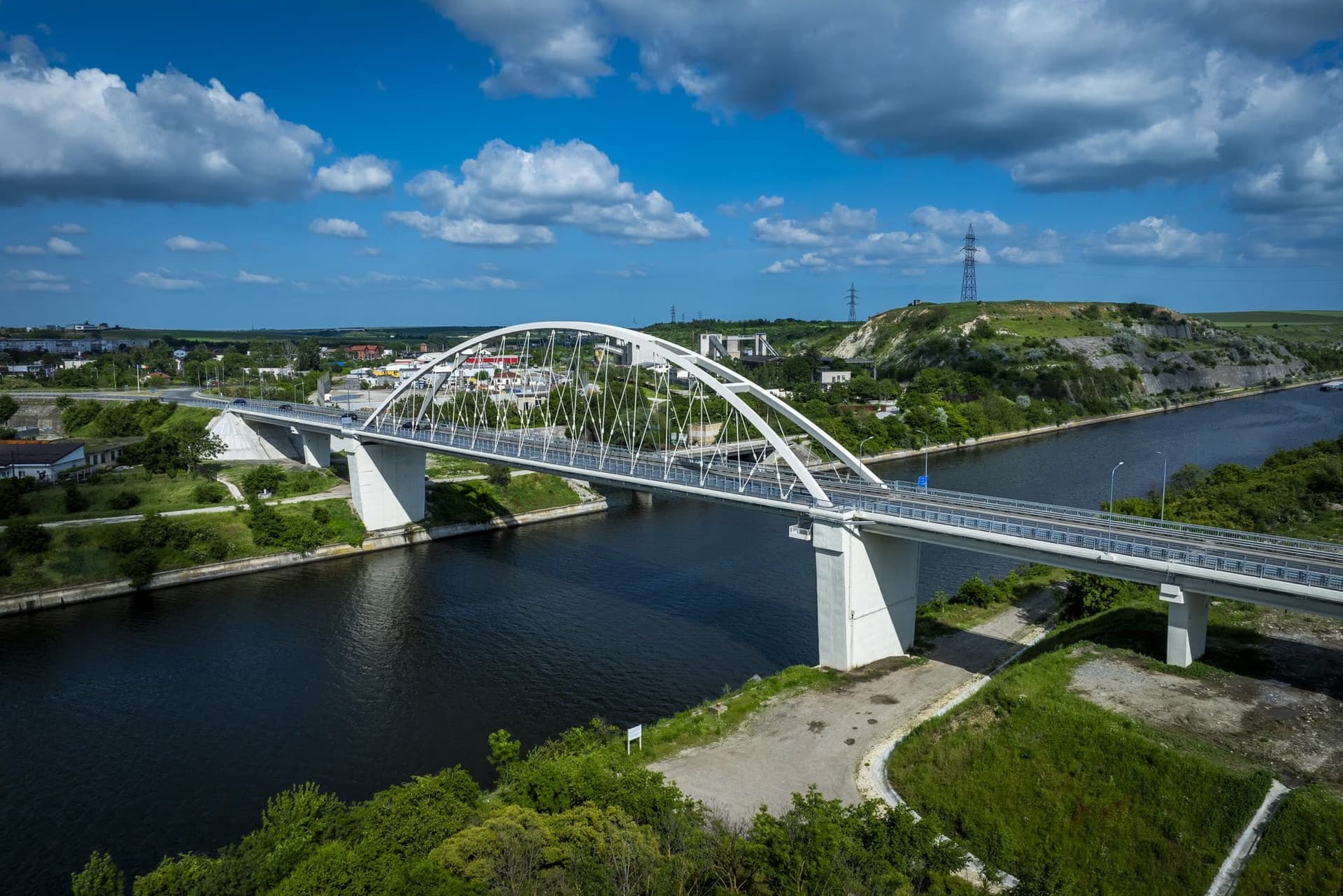
The Basarabi bridge was finished in 1983. A year later, on 26 May 1984, the water passed officially beneath it. The original scheme had in fact provided for more bridges: two of them — at Cumpăna and at Cernavodă station — were struck off the list by Ceaușescu himself, in the name of economy, and would be built only after 1990, in other times and with other money.
Four Decades of Silence
What happened to the bridge over the next forty years? Almost nothing — and that is precisely the story. In all the research for this article I found no public trace of any major repair between 1984 and 2018: no contract, no tender, no press release. Only in 2019 did a technical survey commissioned by the road authority deliver a diagnosis: condition "relatively good" — but with water seeping through the joints, rust on the box-section arches and at the hanger anchorages, deterioration on the piers. Nothing dramatic, the survey said; all of it, though, forty years overdue.
A bridge like this is designed to live a century. But that holds only for the skeleton: the carriageway, the waterproofing, the expansion joints and the bearings — the parts the deck sits on — have service lives of a few decades and need renewing periodically, the way a car gets new brake pads. At Murfatlar, the first change of pads came after 42 years.
The rehabilitation followed the patient rhythm of Romanian administration: survey in 2019, studies in 2022, tender in October 2023 — four bids — winner announced in February 2024, works order issued on 13 January 2025. The contract, awarded to the Geiger Transilvania – Pod-Proiect Iași consortium, is worth 18.9 million lei before VAT, European money from the Transport Programme, nearly a quarter below the initial estimate. From 16 January 2025 traffic crossed on a single lane, under temporary lights, and by the end of June 2025 the works had reached 64%. The bearings were replaced, the cracks injected, the carriageway, joints, parapets and lighting all renewed.
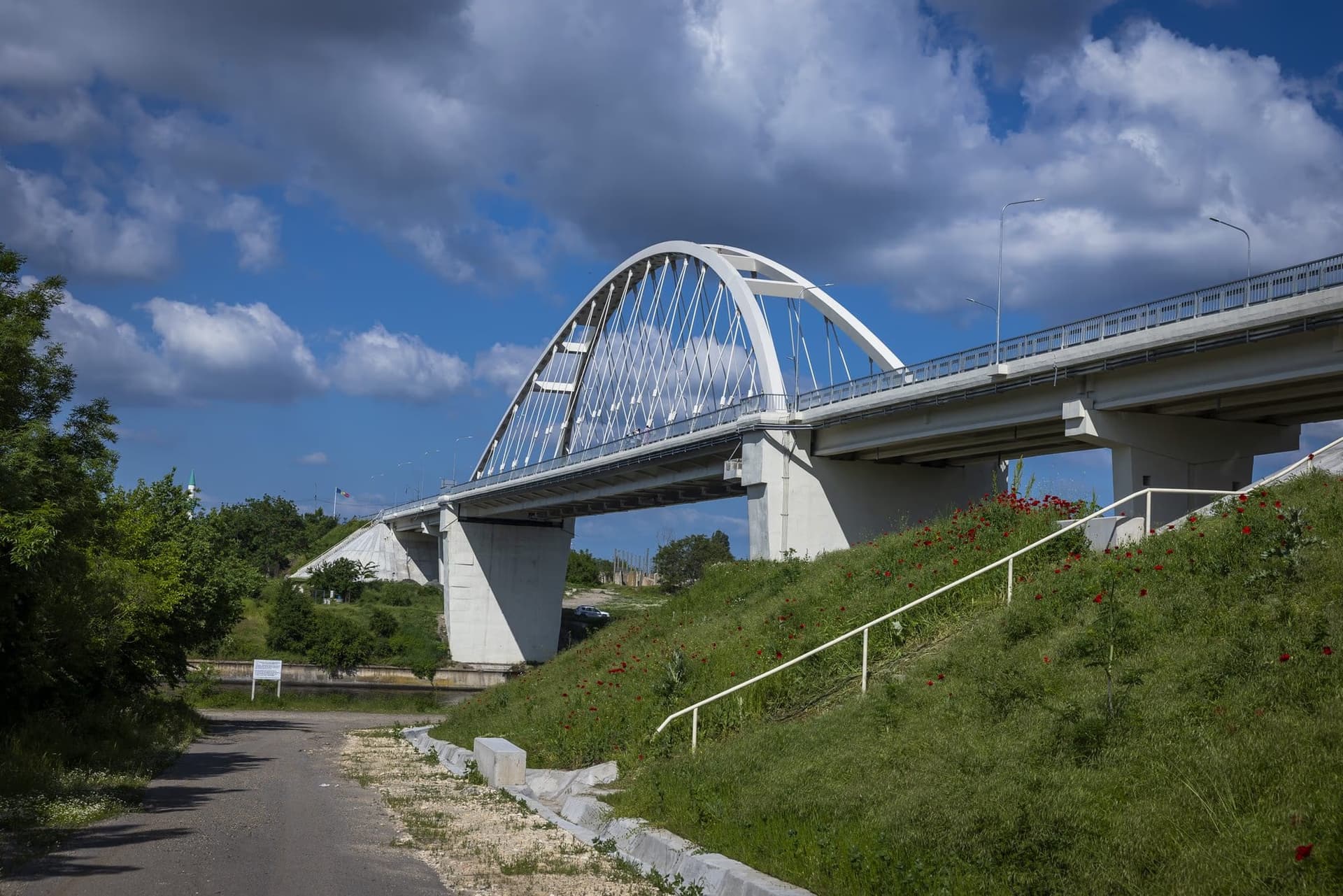
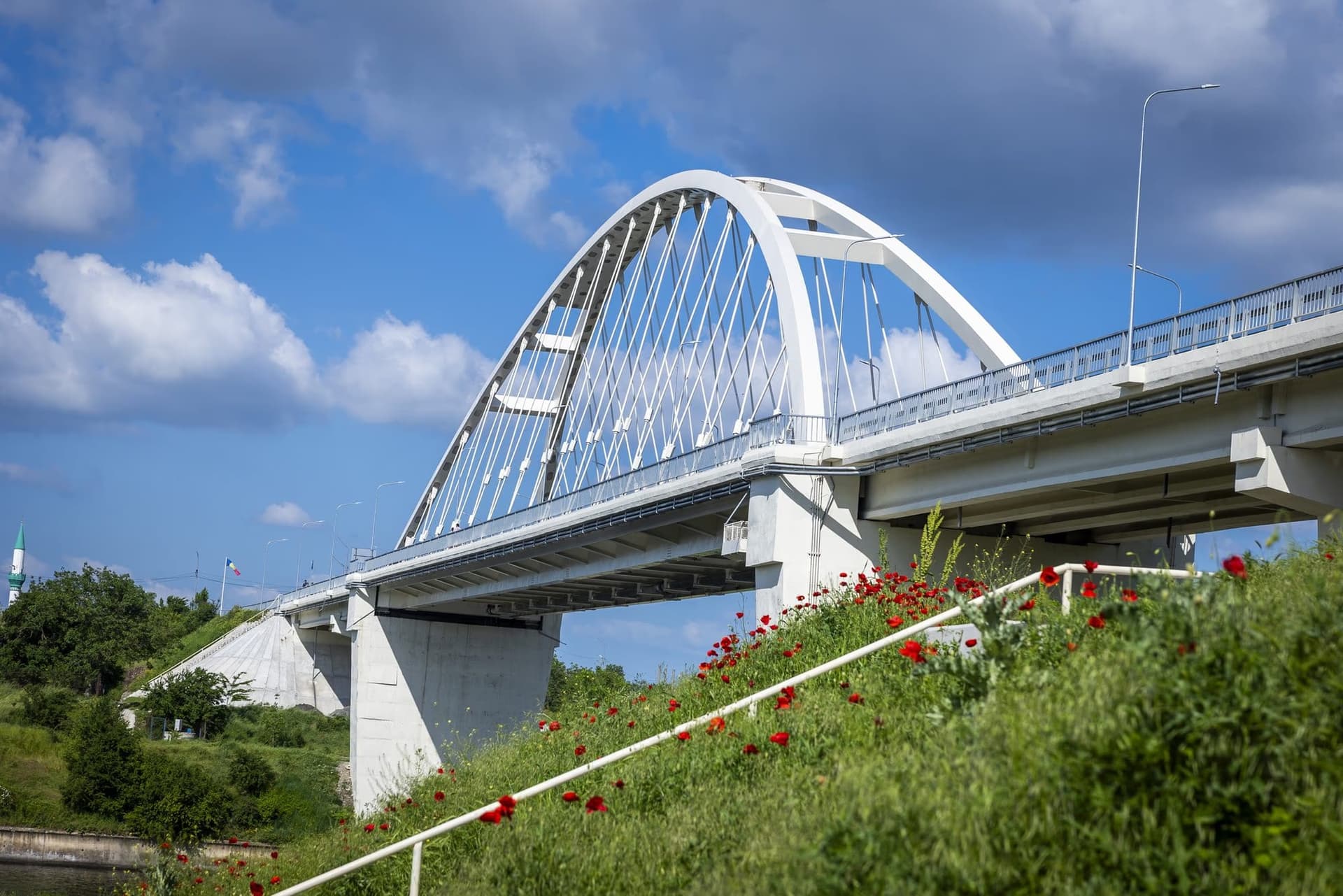
In May 2026, when I walked onto the bridge, the site had vanished: fresh paint from end to end, smooth asphalt, the traffic lights gone, both lanes open. What I found nowhere — not even by the time this article was published — was any official word of completion: no acceptance notice, no ceremony, no ribbon. A national-first bridge went into repair with press releases and came out of it in silence — as if the administration itself could not quite believe it had finished, ahead of schedule, something it had waited four decades to do.
The Family on the Canal
The Murfatlar bridge is not alone. Nine bridges now cross the main canal — from the combined crossing at the Cernavodă lock, road above and railway below, to the cable-stayed "Apolodor" in the port, with its record 200-metre span — and five more cross the northern branch towards Midia. But its true siblings are those of the 1983–1987 generation: Medgidia, Agigea, Poarta Albă, Ovidiu. All designed by the same IPTANA team, all falling due in the same decade. Ovidiu was rehabilitated between 2022 and 2024, after the project had lain forgotten in a drawer for ten years. Poarta Albă entered the works the same week as Murfatlar, with the same contractor. At Agigea, the stays had to be replaced in their entirety, in a rehabilitation that dragged on for six years. The golden generation of Romanian bridges is ageing in step — and the bill for deferred maintenance arrives, as it always does, all at once.
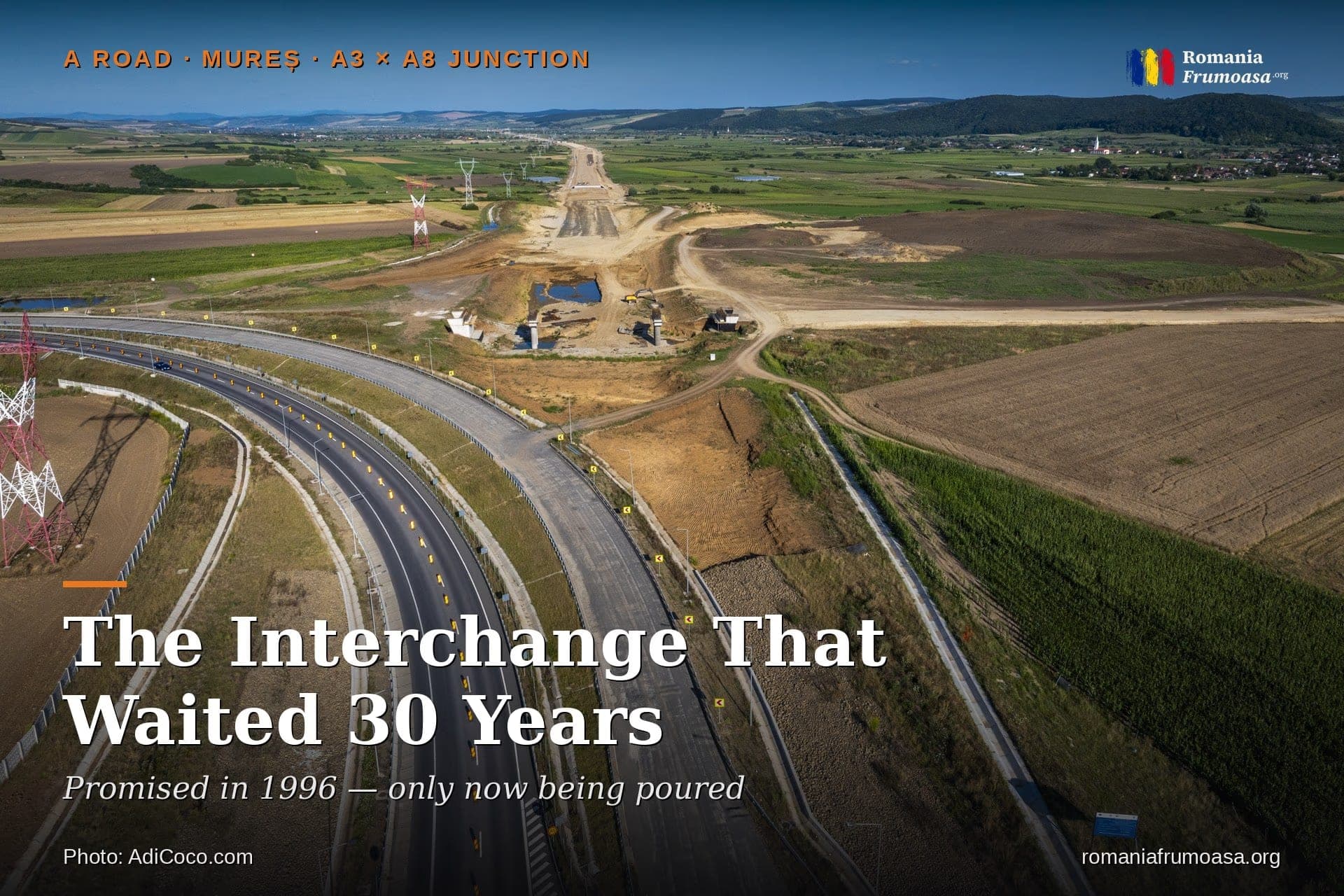
It is a pattern the roads repeat at another scale: Romanian infrastructure is patient with decades, like the motorway interchange at Târgu Mureș, which waited thirty years for its chance. The Murfatlar bridge was lucky: it was built well enough to afford the wait.
The Back of the Letters
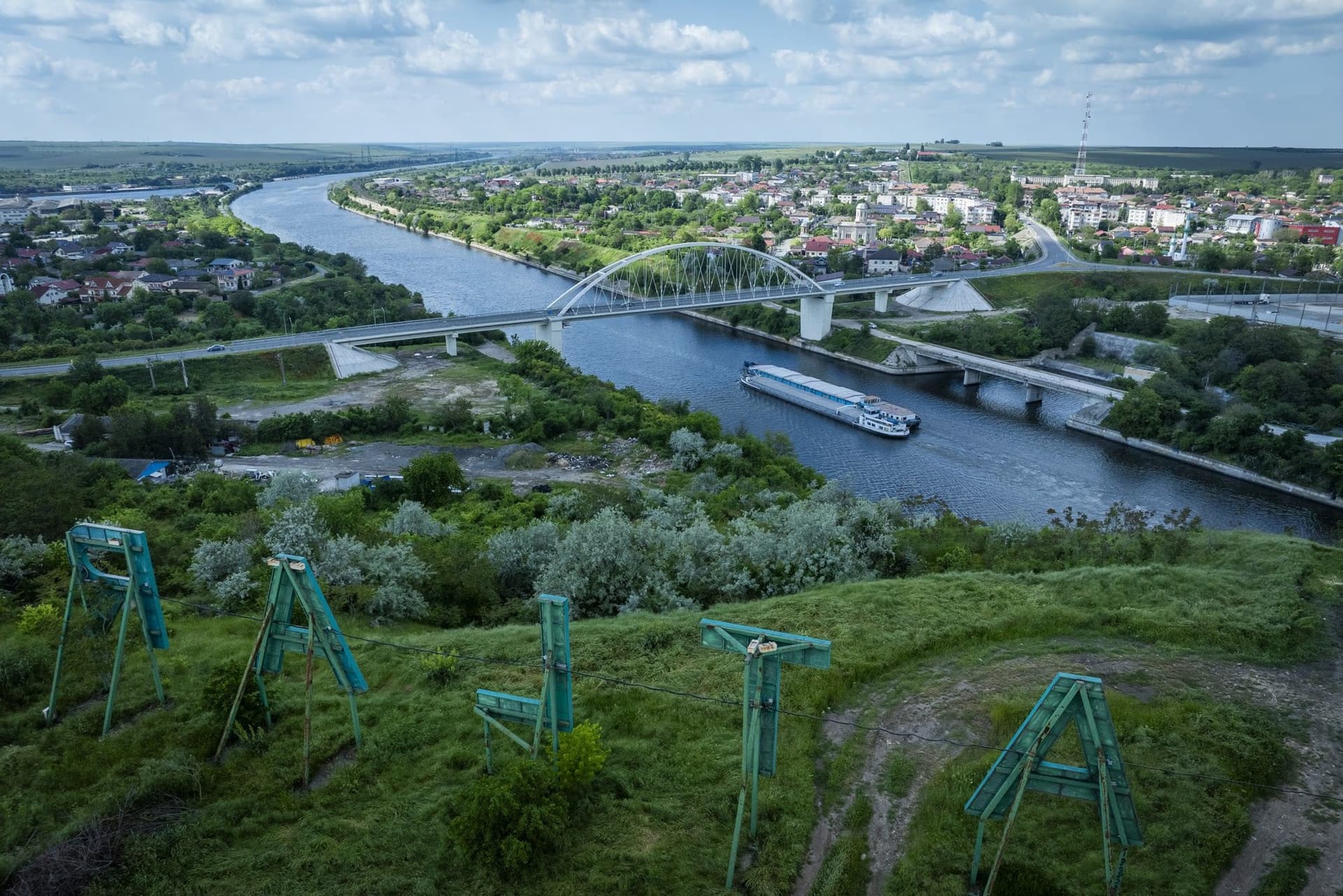
From everywhere in town — and from the bridge — you can see the inscription on the white limestone cliff: MURFATLAR, giant letters set on the slope, Hollywood-style. I flew the drone up behind them. From the front, a name. From behind, the truth: green steel skeletons, welded profiles, props driven into the hillside and a cable tying them all together, like a washing line strung across the crest. Up close, the letters stop reading as letters at all — they become structures, each with its own foundation and its own bracing.
It struck me as the most honest closing image. Because this is what everything that looks simple from a distance looks like from behind — a name on a hill, a white arch over water: a structure that has to be designed, anchored, painted and, every so often, repaired. Below, indifferent, the odd grain barge slides on, beneath the bridge that was born on dry land and learned to wait: first for the water, then forty years, then the fresh coat of paint.
Reportage by Adi Coco · RomâniaFrumoasă — A country, seen slowly
Sources:
DRDP Constanța — Traffic restrictions on the DN3 bridge (CNAIR press release, Jan. 2025)
TED / Publications Office of the EU — rehabilitation procurement record
Revista Construcțiilor — "Road Bridges over the Navigable Canals" series (V. Popa, 2021–2026)
Agerpres — Documentary: 35 years since the inauguration of the Danube–Black Sea Canal
CTnews — Four bids for the rehabilitation of the DN3 bridge at Murfatlar (Oct. 2023)
Telegraf Online — CNAIR director: works must be completed by September (Jun. 2025)
Ziua de Constanța — Two major bridges in Constanța County under rehabilitation (Feb. 2025)
CN Administrația Canalelor Navigabile — navigation chart, Table 4: bridges on the CDMN and PAMN