Reportage · Urban art · StreetWise 2026 · Lujerului underpass, Parcul Liniei, Bucharest
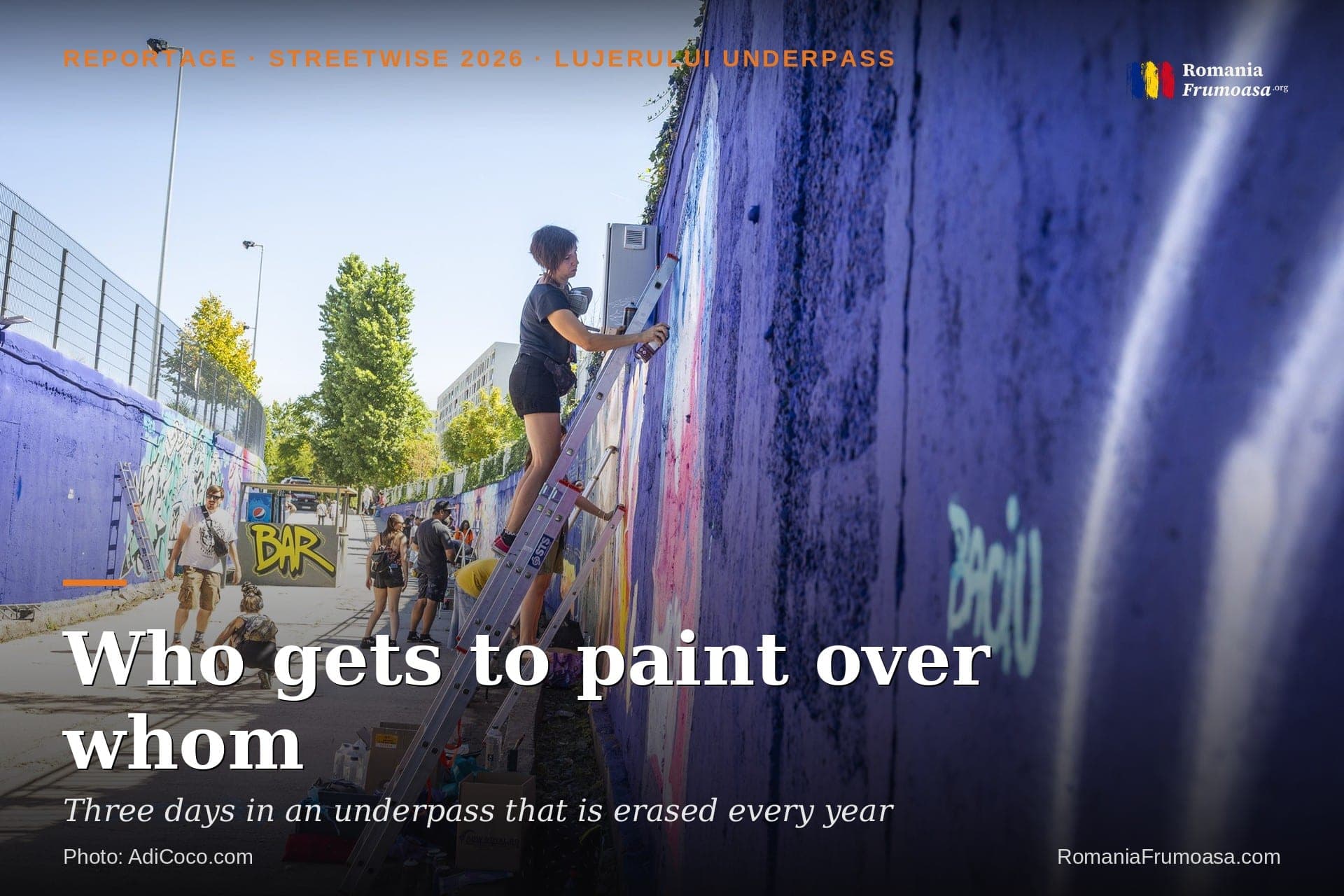
More than a hundred artists painted for three days in the railway underpass beneath Lujerului, at the second edition of the StreetWise festival. When they arrived, the wall was blue: nothing was left of anything painted there last year.
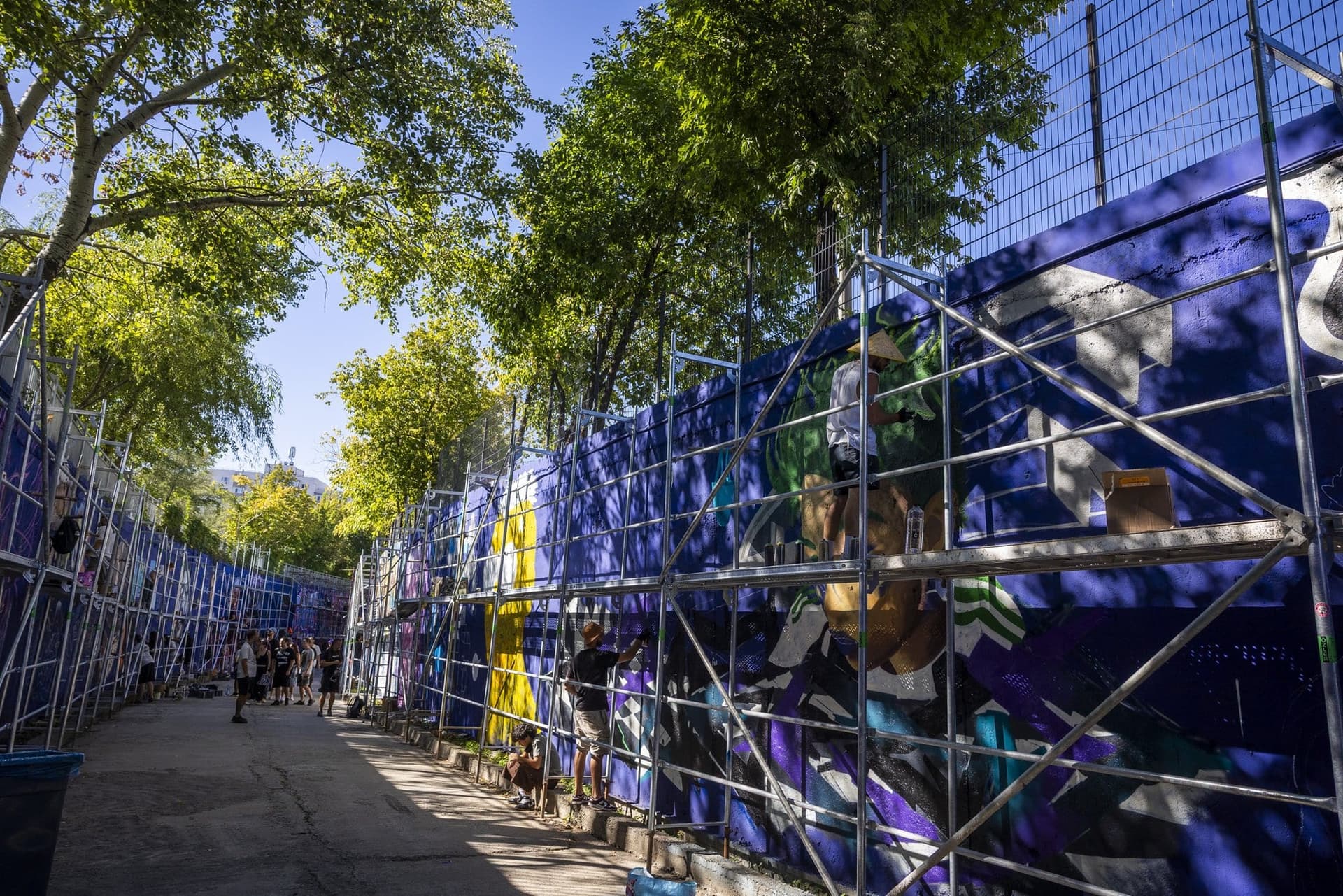
The wall was blue.
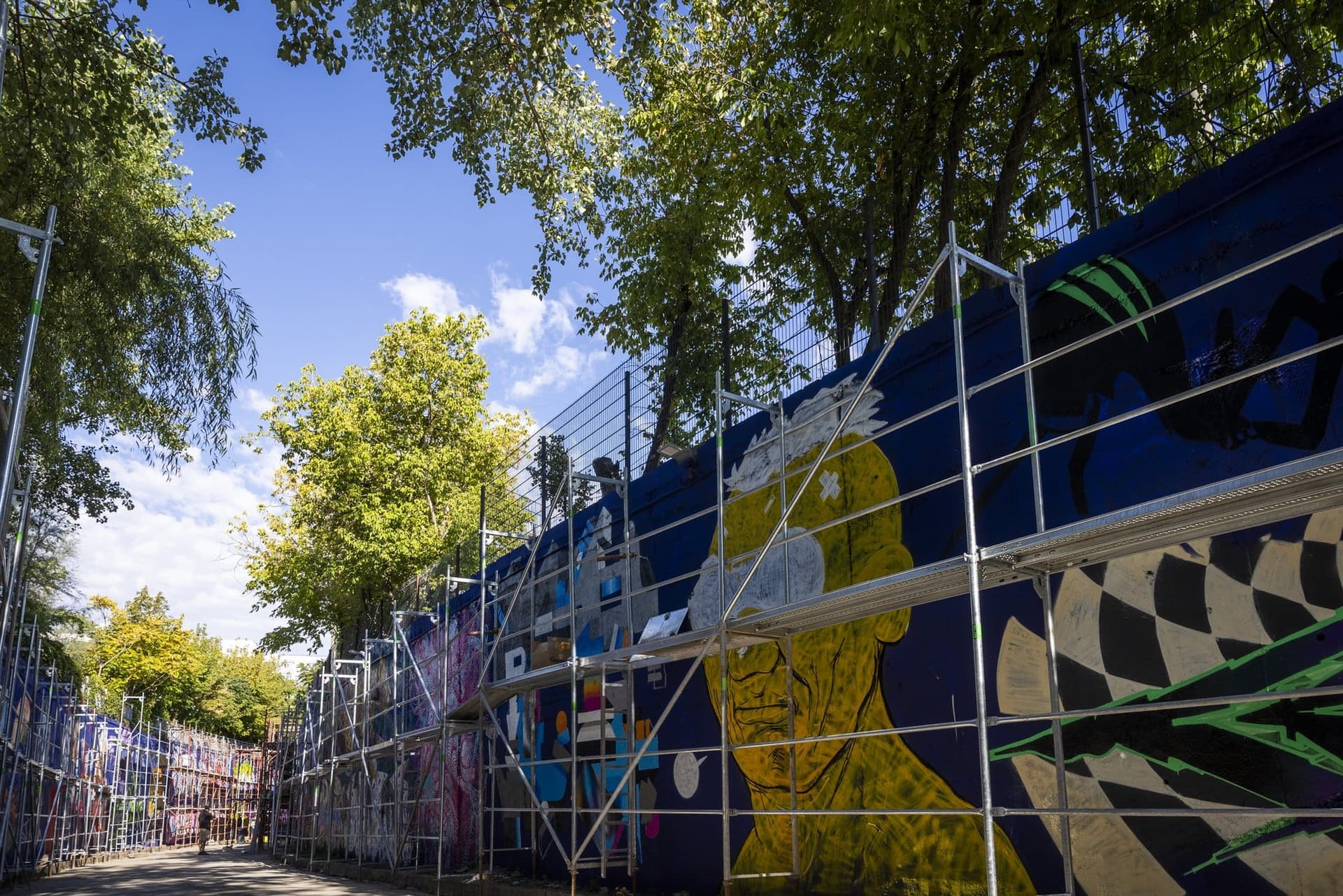
Some two hundred and fifty metres of concrete, rolled from the ground up in a uniform blue with nothing showing through it. When they arrived on Friday morning, they tell me, there was nothing along all that length but a single white tag, written quickly by whoever got there first.
Last year, on these same walls, a hundred-odd people painted for three days. Nothing is left of that work. Not a section, not the edges, not a corner forgotten under a scaffold. Nothing.
This is the first thing you learn in the Lujerului underpass, at the second edition of the StreetWise festival, and it changes everything you think you are looking at. Because in a culture built around the question of who gets to paint over whom, here nobody went over anybody. The wall had been taken back to zero before a single artist arrived.
What was on the wall ten months ago
I filmed the underpass last November, on a Sunday at midday, walking it from one end to the other. The wall was a different colour then — a washed-out blue-grey, almost gone, nothing like this year's cobalt — and the pieces from the first edition stood along it, one beside the next.
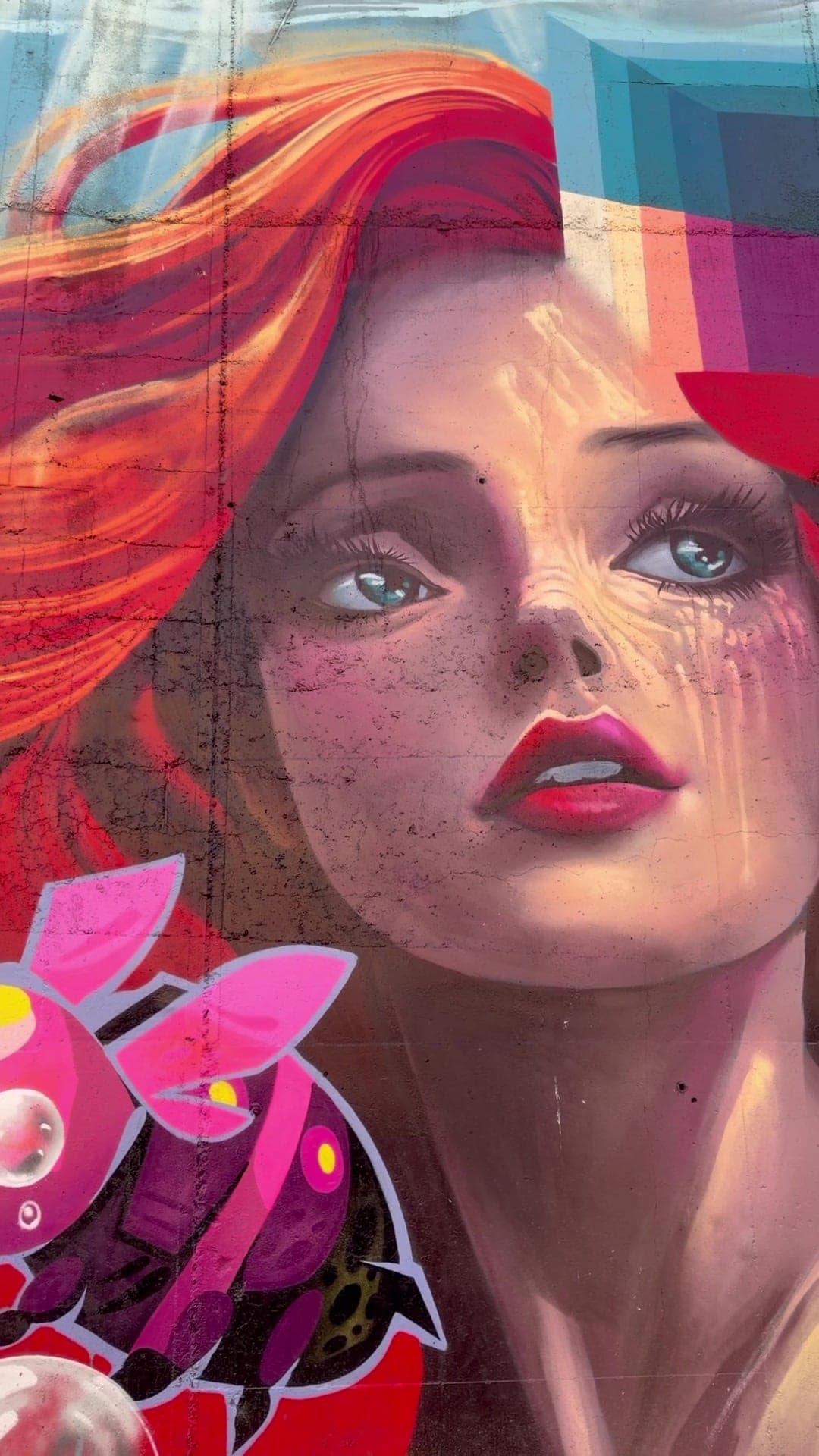
There was a portrait several metres high, a woman with red hair and air bubbles around her. A green skull with mushrooms growing out of it. Rats in respirator masks, one with a can in its paw, one with a roller on the end of a pole. A boy in a yellow jumper, signed and dated 2025. A black spiral made entirely of eyes. A cheeseburger under a cone of light, with "My Precious" written above it. And, on a blue section, four words that no longer existed in September: live or scroll ~ your call.
All of it went under the roller before the second edition.
Five from Târgu Mureș, three of them gone
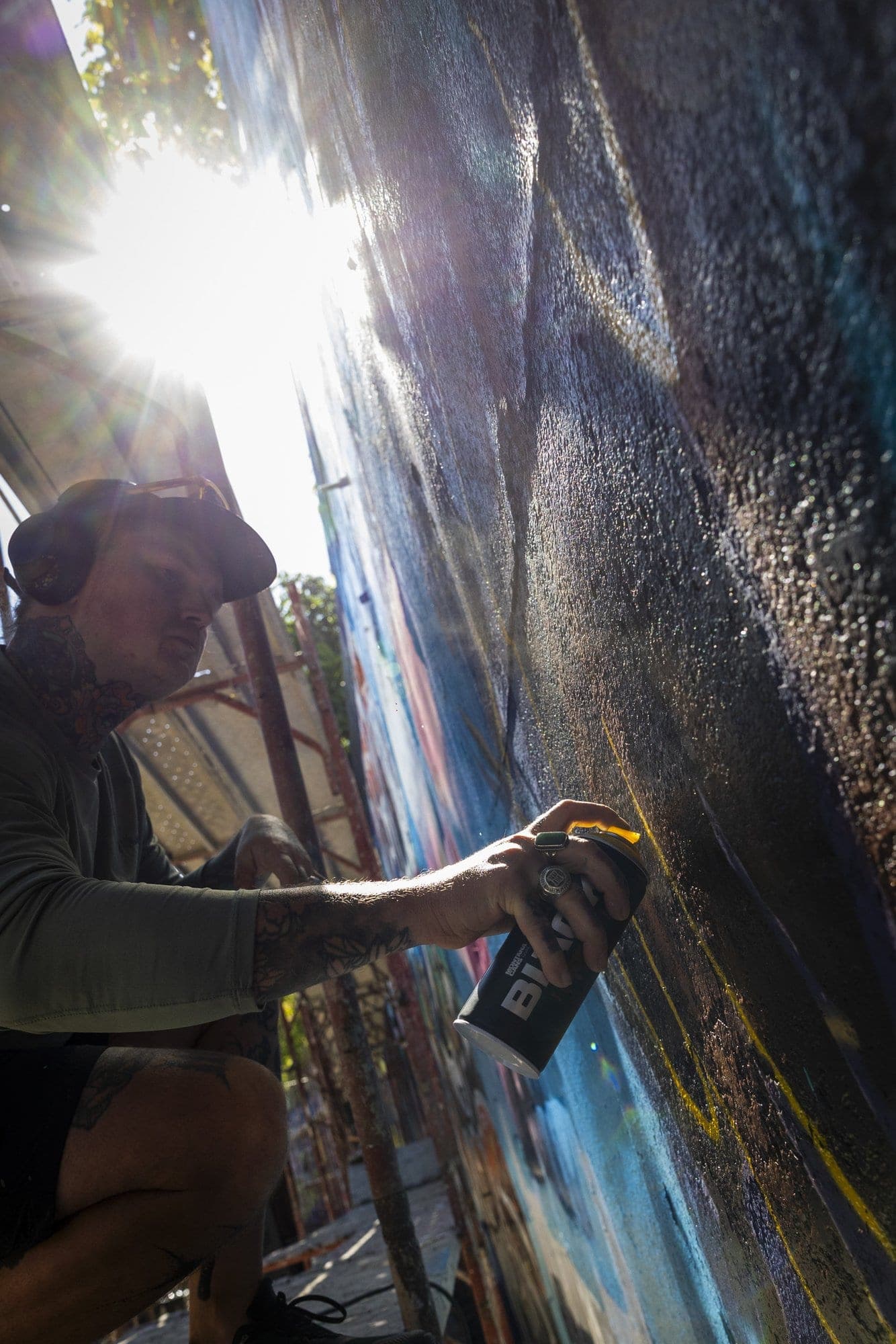
Szász István has sunglasses pushed up on his head, arms covered in tattoos and a respirator mask hanging around his neck. Without being asked, he apologises for having forgotten his Romanian since he moved away. You can't hear it: he speaks cleanly, without an accent, and the only trace of seven years in Vienna is a short pause before the occasional word. He works there in a tattoo studio and has been tattooing for nearly sixteen years.
He goes to graffiti festivals once or twice a year, mostly in Austria. This one, he says, is the best he has been to — and the reasons he gives are not about art: the wall is big, and the organisers put up scaffolding.
He came here with his crew, seven of the eleven of them making it to Bucharest. Five are from Târgu Mureș, and three of those five stopped living there long ago. They were given some thirty metres of wall by Răzvan, one of the organisers, who divided the underpass between the crews. Last year they painted on the other side, facing the stage.
"When we got here and looked at the wall we said, oh no, it's too big. But actually, it isn't enough."
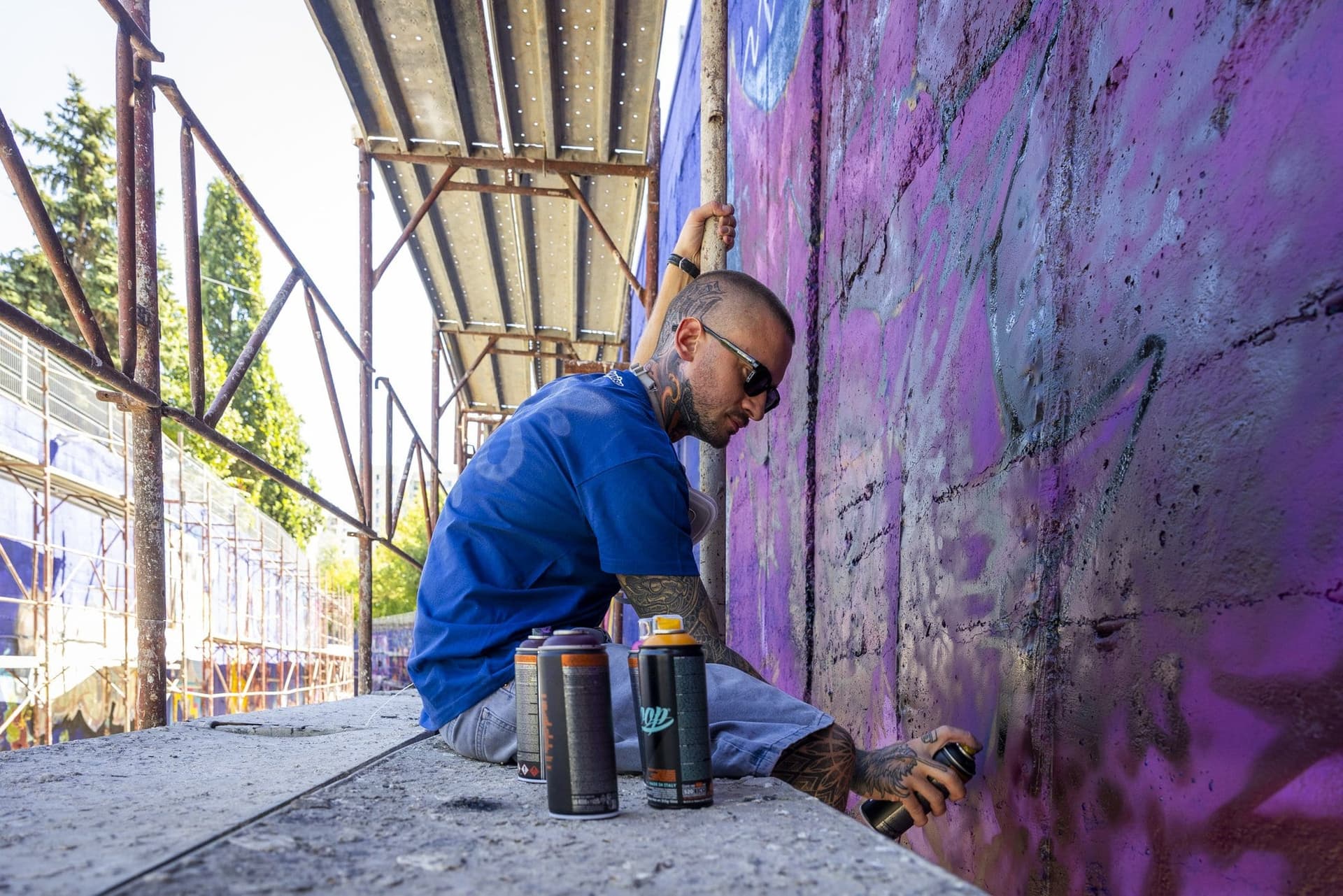
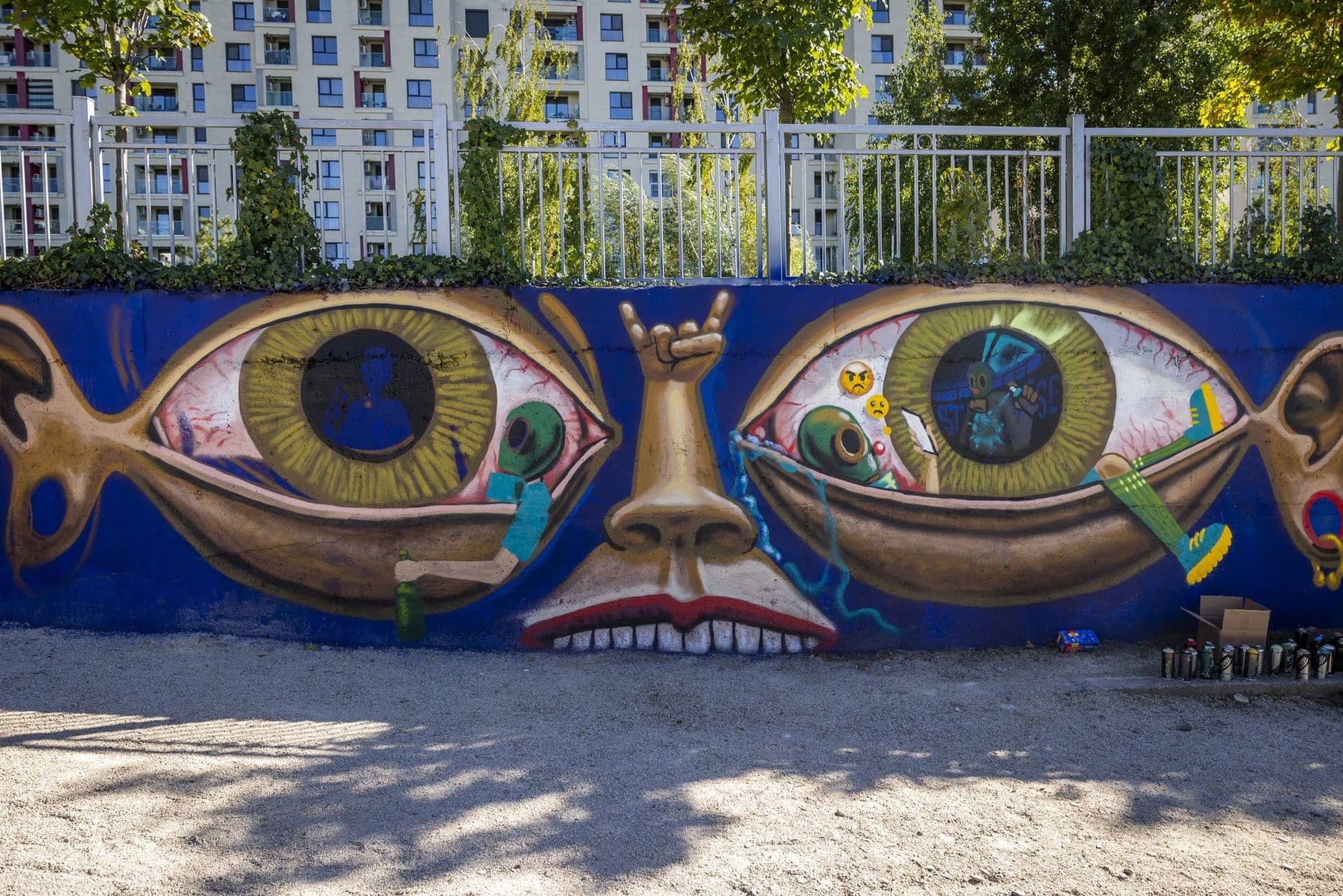
His crew went with an underwater theme. He is doing an octopus, one of the others a Neptune. Another crew further along is working in green. Nobody gave them a common theme.
The trade begins on paper
The working day starts at ten, when the DJs come on. They mix their morning sets for an underpass that, at that hour, holds nobody but the people on the scaffolding. Under the music you hear the hiss of the cans, and the smell of paint gathers between the walls and does not leave until evening: the tunnel is blocked at one end and has nowhere to draw.
The sun decides who works in comfort. The western wall is in shade for the second half of the day, the one opposite is not, and those who were given sections on the good side know they were lucky.
What you see on the wall is the last stage. Before it come the sketches.
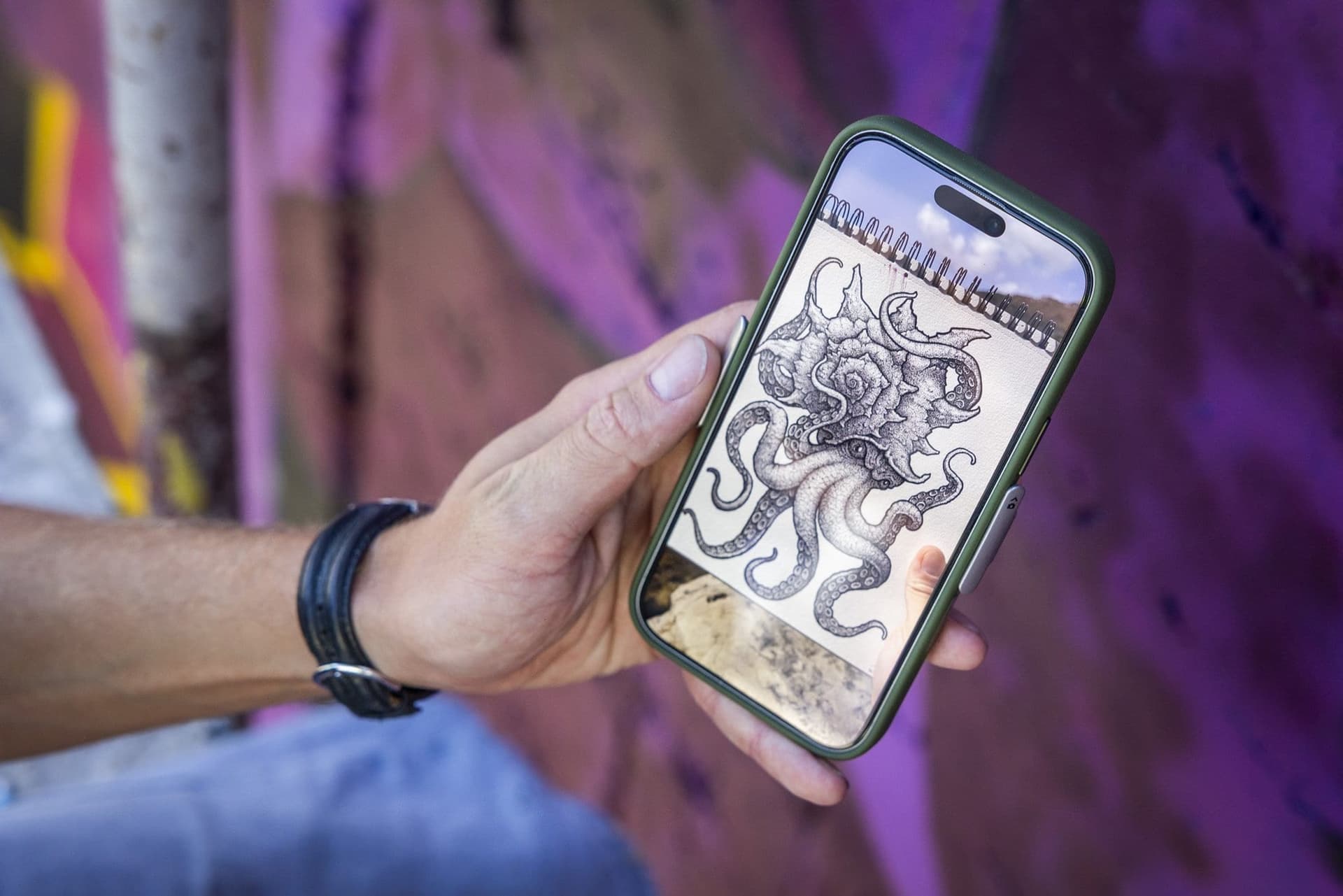
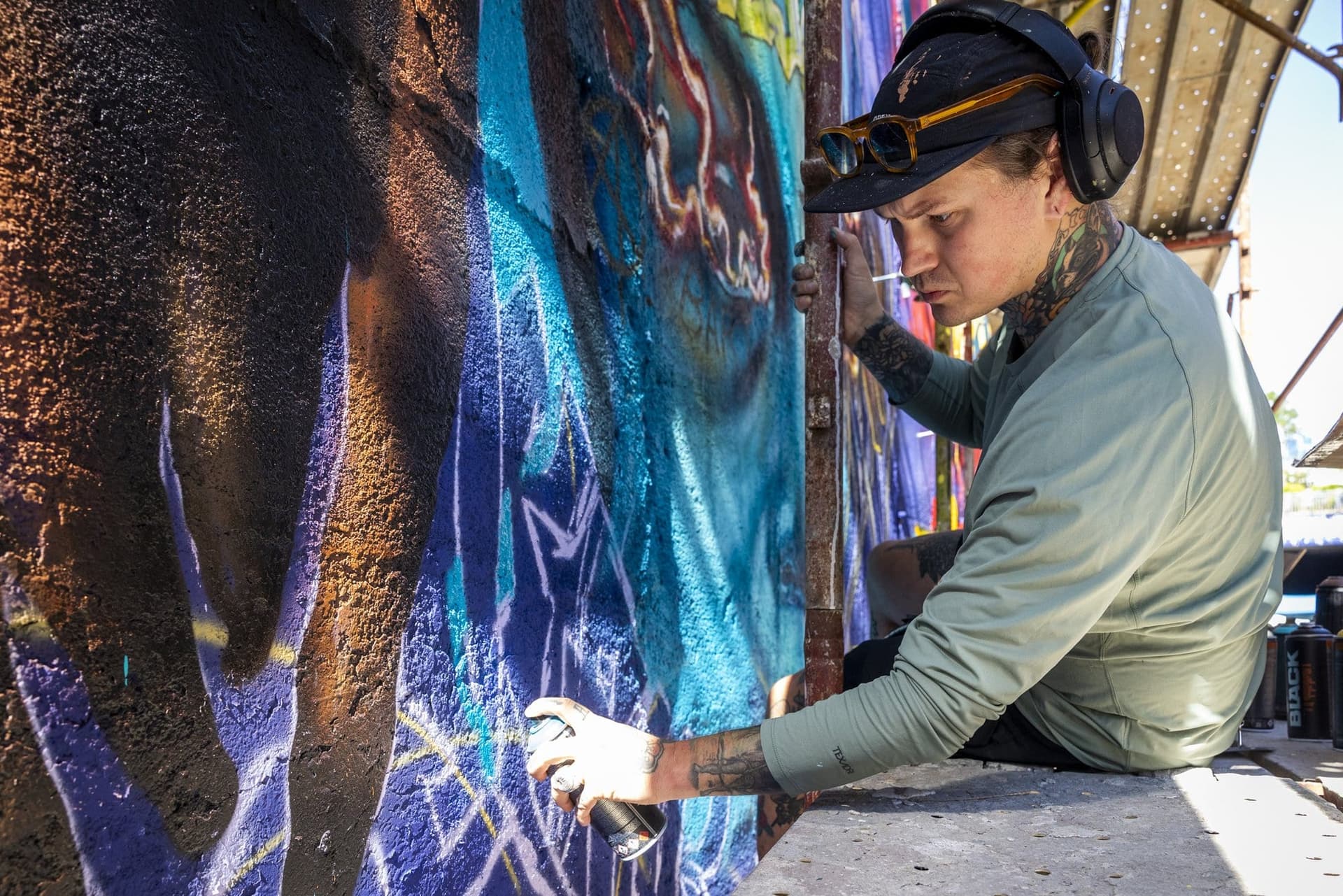
Szász works from a drawing prepared at home, black and white, which he keeps on his phone and pulls out of his pocket a few times an hour. Others draw on the spot, with a marker, on pads of paper propped against the concrete ledge.
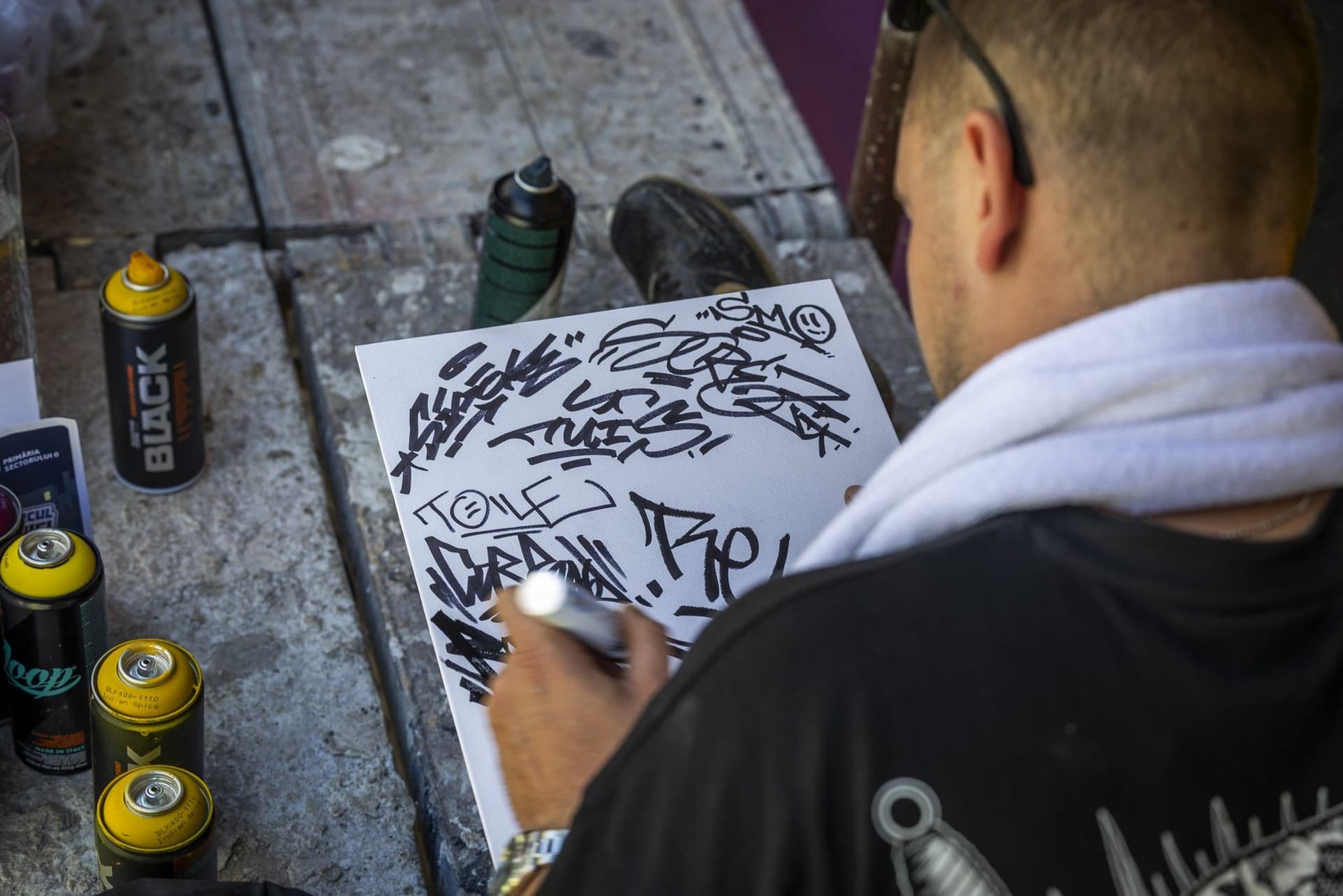
A writer counts a piece in cans the way a house painter counts a room in buckets. Szász was given thirteen by the festival and needs twenty. He brought the rest from home, and whatever is left he cannot take back: pressurised paint does not fly. He gives it to someone here.
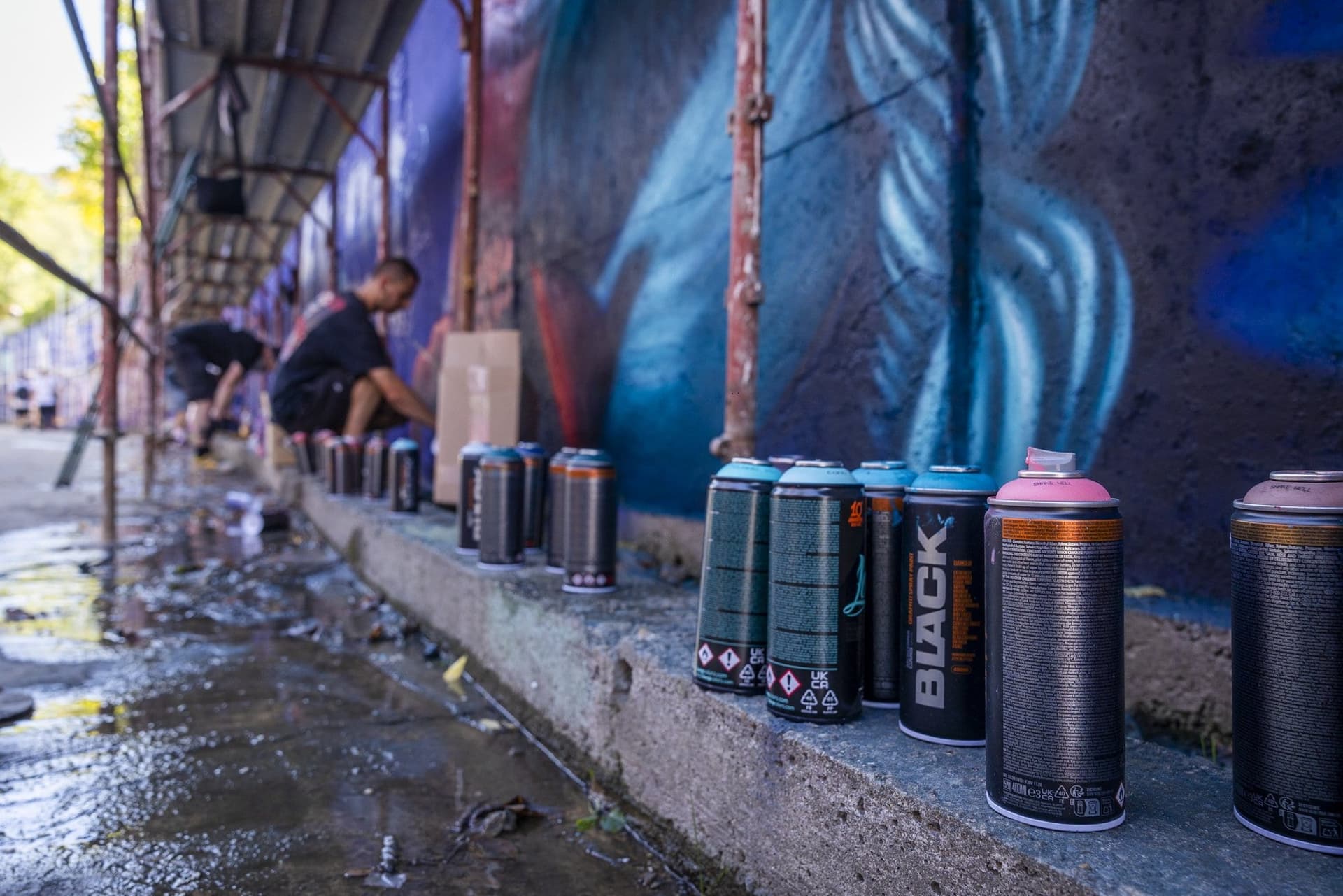
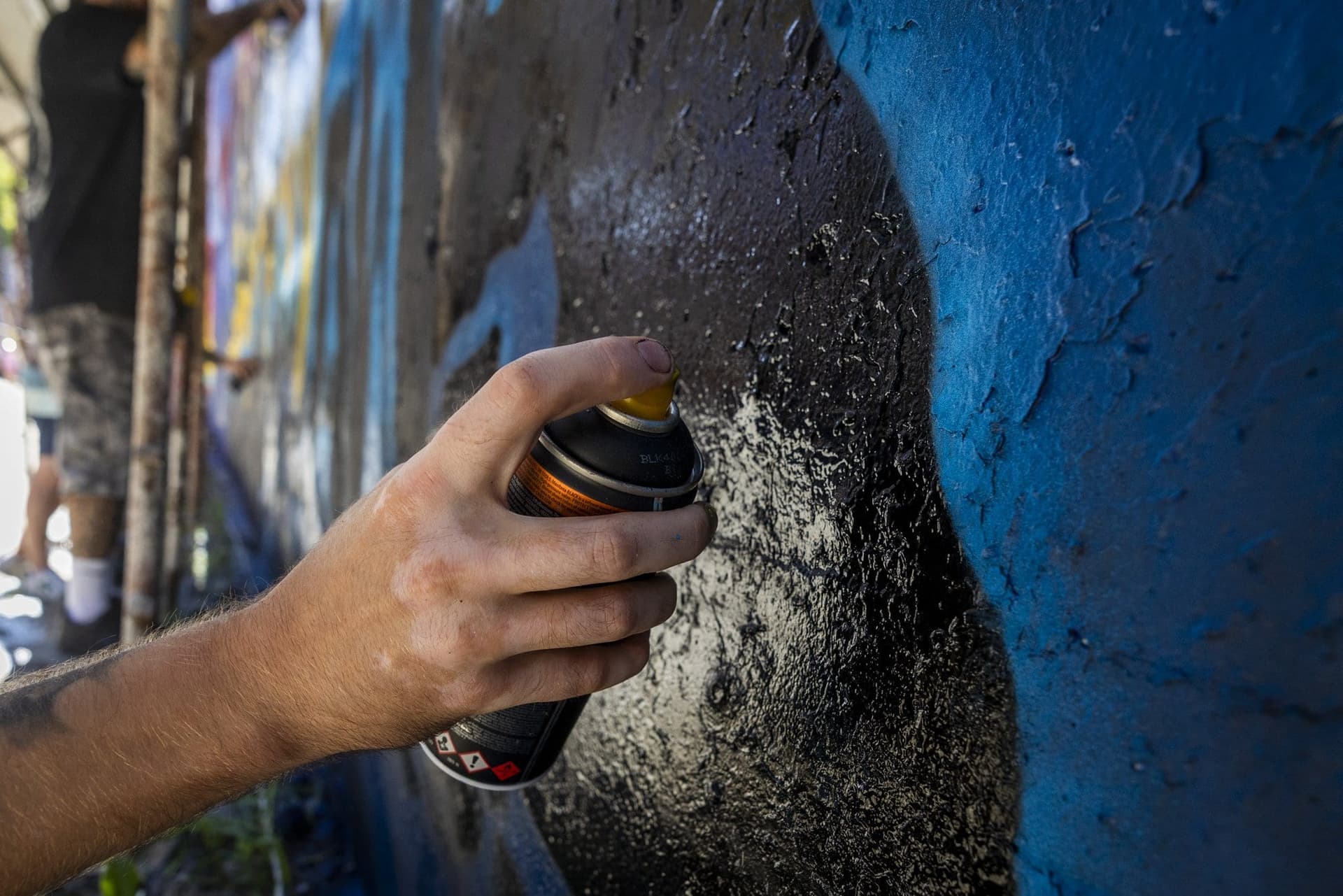
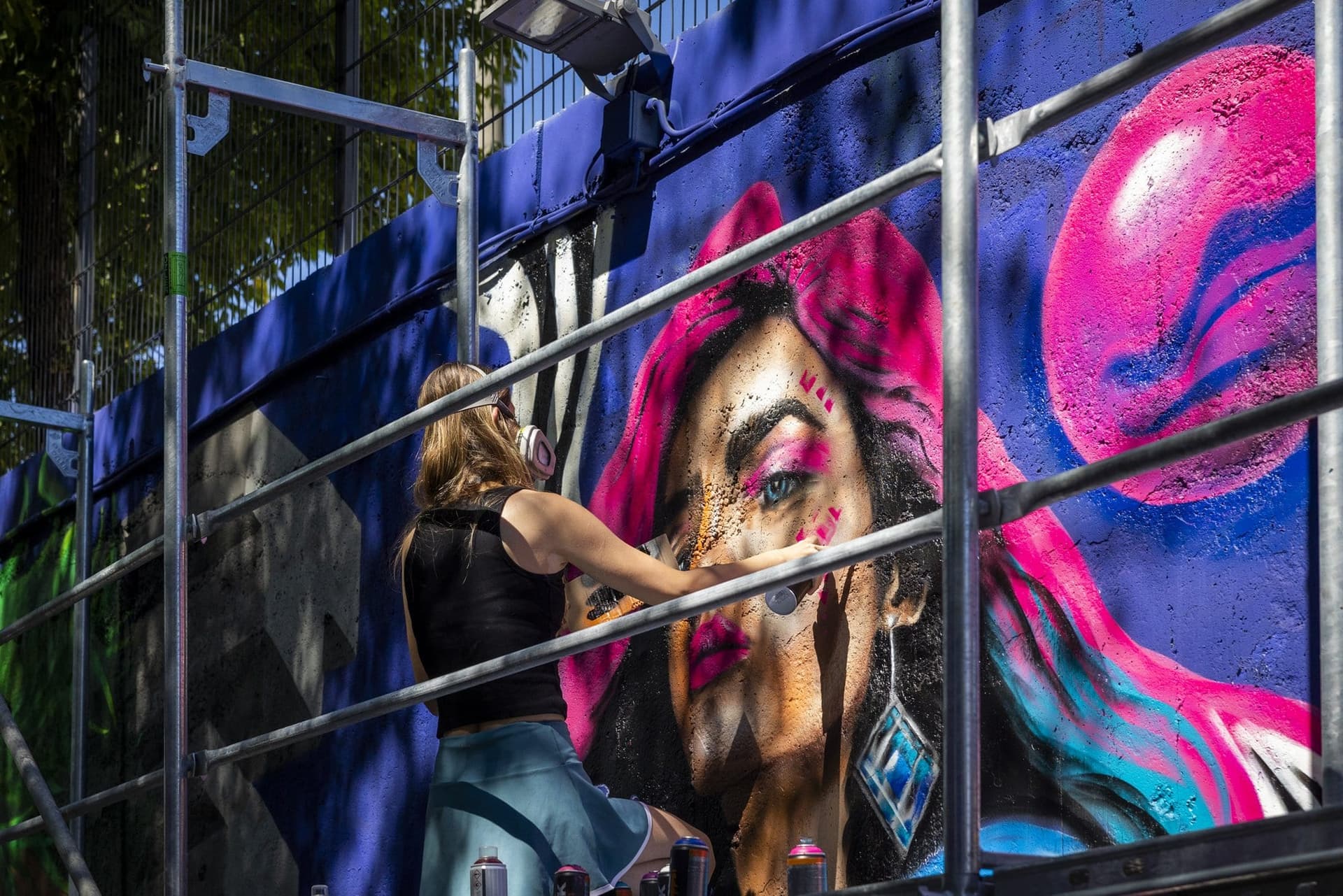
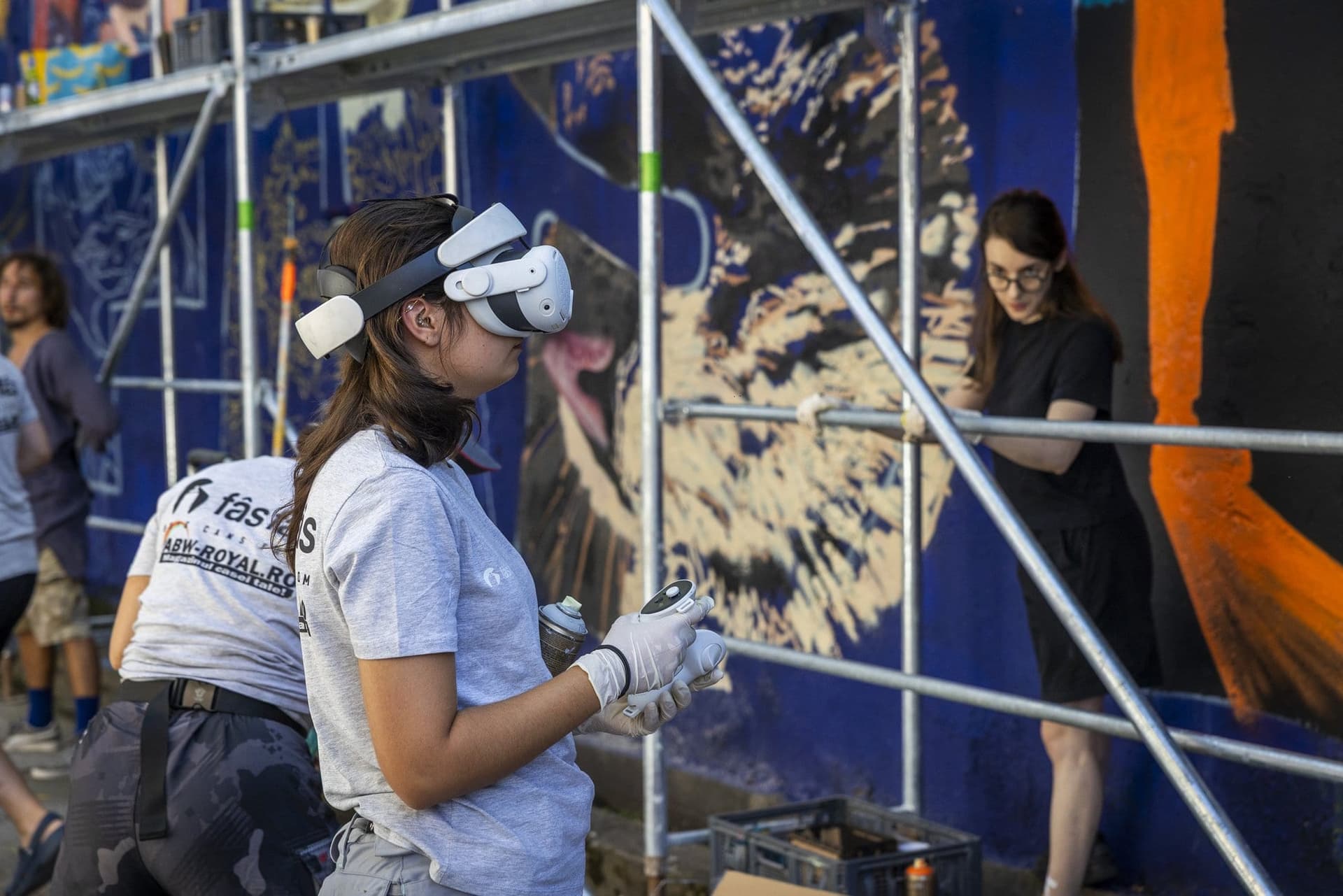
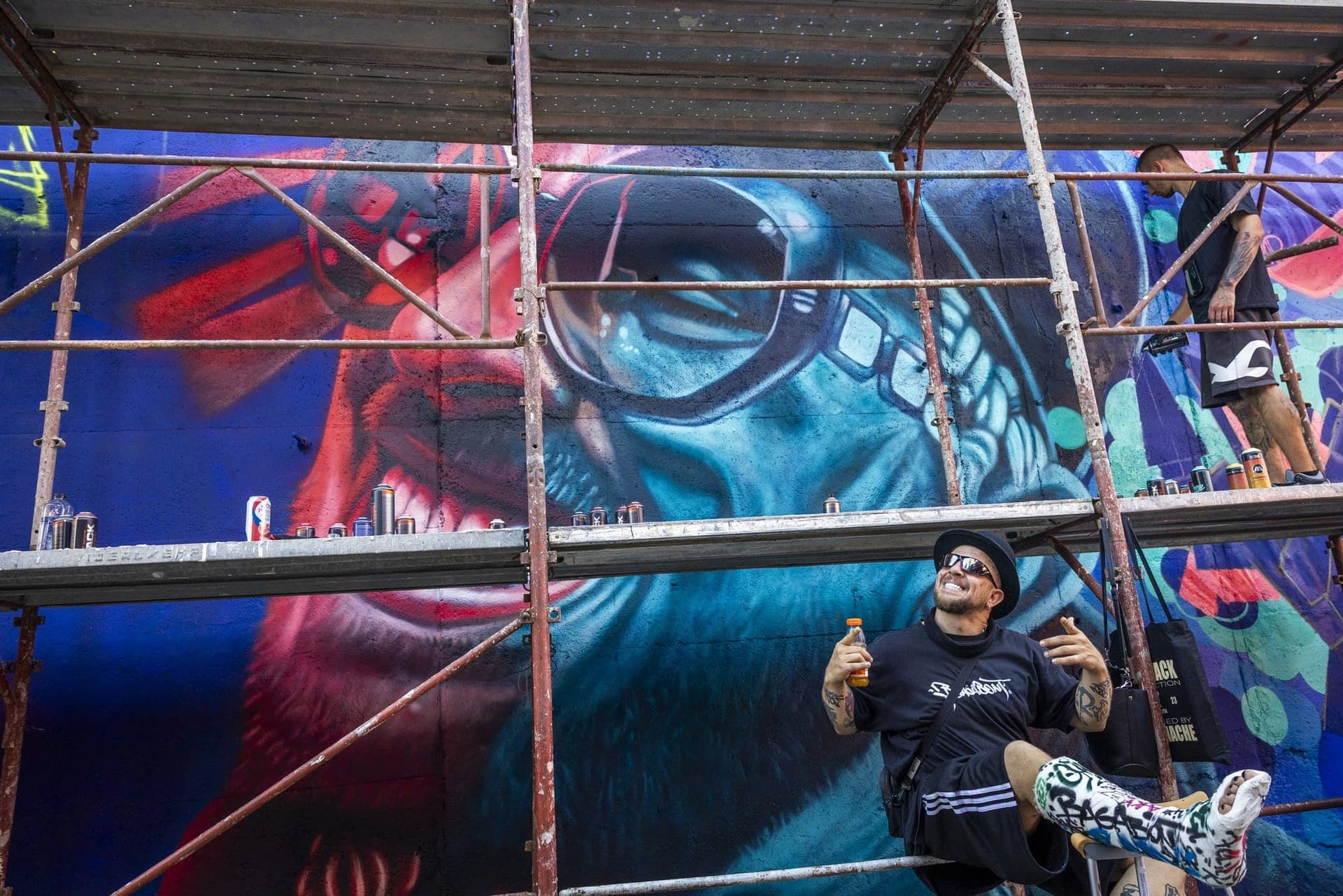
A young woman is painting with a virtual reality headset over her eyes and a work glove on the hand holding the can. It is not a demonstration. She is from Fâs Fâs — a crew of six from Bucharest, named after the hiss a spray cap makes — who say they are among the first to have moved their projection work onto VR. Before, they used a video projector, the classic method: you throw the sketch onto the wall, outline it, paint over it. Except a projector needs darkness, and a commercial job has a deadline and has to move at midday too.
"We need to be able to use any part of the day, not just the evening," says Alexandra, who has worked with the crew since the end of 2023. The headset shows her the drawing laid over the real wall, to scale, at any hour. She had never touched one before, and it took her a few weeks to get used to moving around on scaffolding with it on her head.
The comments about the headset don't come from other artists, she says, but from clients: "Oh, I could do that too." Briana, who joined the crew in March, doesn't disagree: "You could! Anyone can do these things." I tell her you still have to know how to draw. "Anyone can buy a colouring book," she laughs. "It depends what you do with it afterwards."
Within the crew, each has their own hand. Briana works with a brush, on the small details that take patience. Gabriel Daraban, who founded the group, does the backgrounds — "I'm the one with the flowers." Andrei does faces in spray. Alexandra says she tries to do a bit of everything and is still learning. "She just steals the trade," Briana laughs.
A few metres further down, a girl of about seven is painting a stretch of wall as high as she can reach, watched by a colleague of her father's. Her father, meanwhile, was working on the top level of the scaffolding.
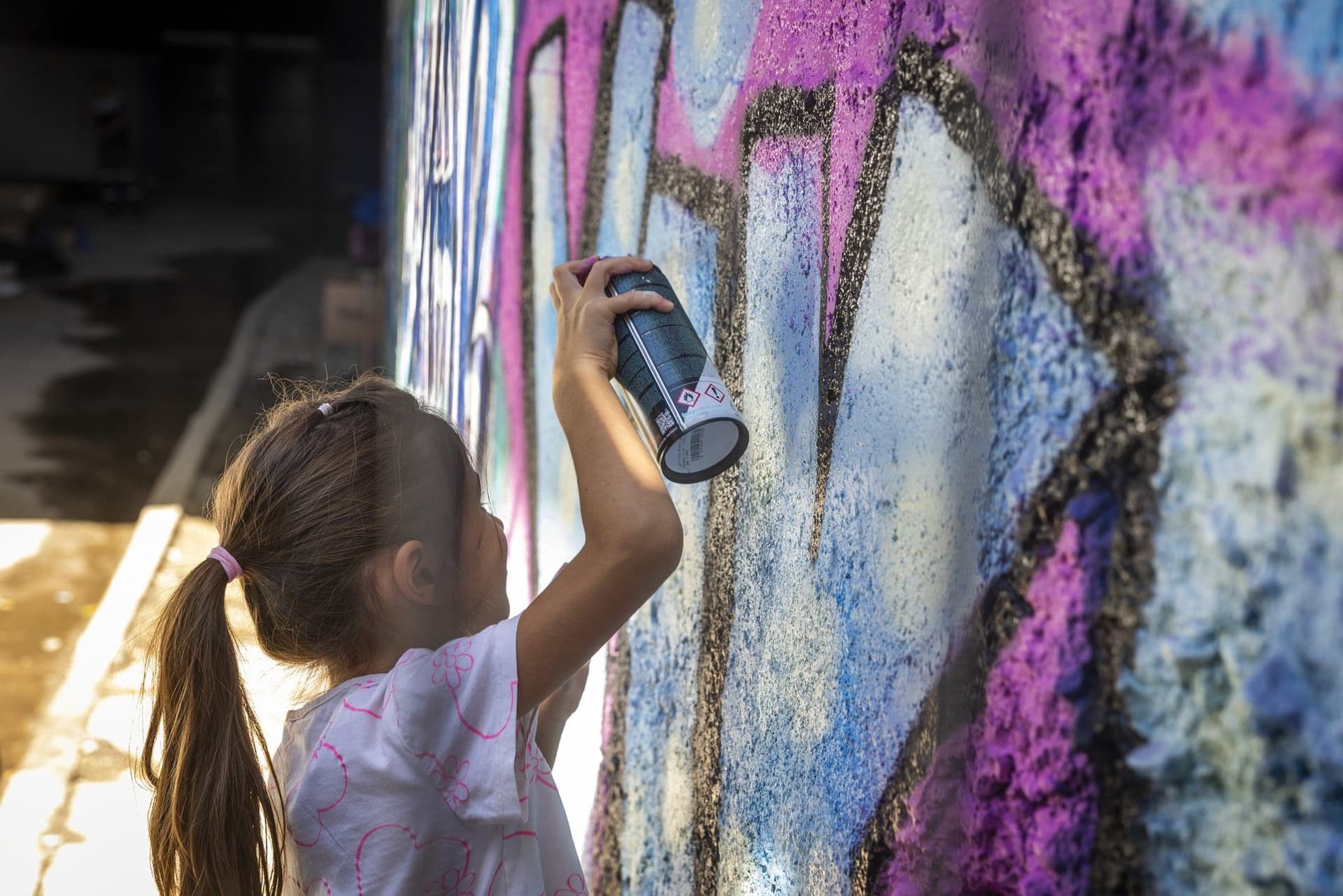
Children at the wall are not a weekend exception. "Everyone comes here with their family," says KSELE. "Everybody thinks we're vagrants and whatever, but we have families, we're responsible people. And everybody comes with a packed lunch." Some put other things off to be here, others drop the children at nursery in the morning and come afterwards. He is forty and paints alongside people he has known for twenty-five years, and now they meet up with their wives too.
The unwritten rule — and what becomes of it at a festival
In graffiti there is a rule nobody writes down and everybody knows, from Malmö to Militari, the district these walls sit in: you can cover someone else's work only if you go up a step. A piece over a tag, something bigger over something smaller, more time and more risk over less. The other way round is not done.
Two Swedish researchers, Erik Hannerz of Lund and Jacob Kimvall of Konstfack, spent years among writers describing exactly this mechanism. The people they spoke to call breaking it an unforgivable act. They also observed how it comes to that: a wall only becomes important once it fills up. While there is empty space, you go into the empty space. When there isn't, you go over. The hierarchy does not come from whoever administers the wall, but from the surface itself.
The rule spares nobody. In October 1986 Keith Haring painted a stretch of the Berlin Wall at Checkpoint Charlie, invited by a museum, over the work of a Frenchman who had been painting there for two years. That same night, someone else rolled Haring's work over in grey.
In the Lujerului underpass, that rule was broken by nobody. The wall was not covered by artists, one over another, with a can in hand. It was rolled over, uniformly, before they arrived.
At eight on Sunday morning, the last day, there was already someone on the scaffolding. KSELE is forty, has been painting walls since 2001 and worked for a while as a graphic designer in an agency before going back to painting walls full time. Last year he painted a leaping tiger at the mouth of the underpass, a paint roller in one paw and a spray can in the other. The tiger no longer exists.
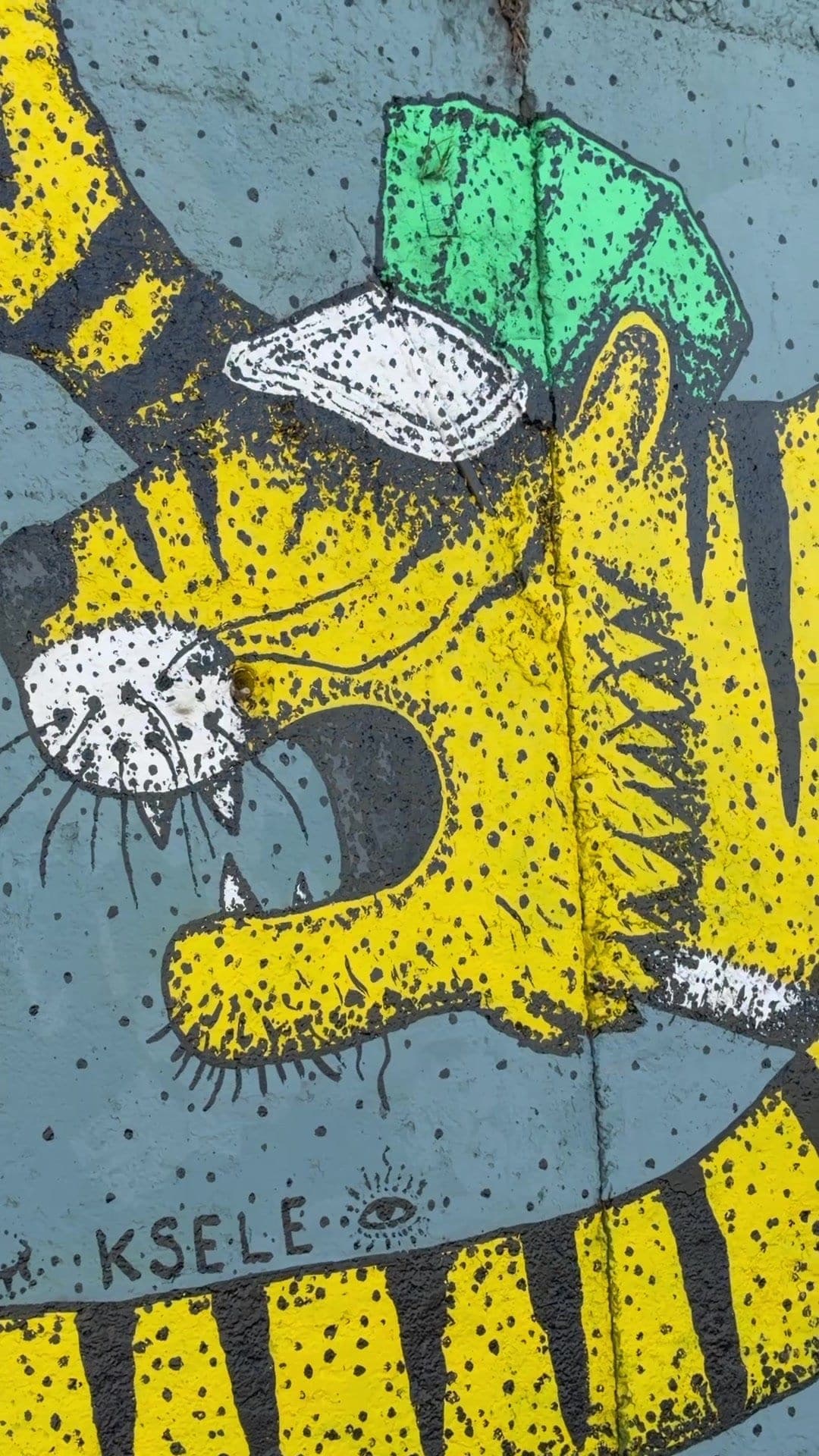
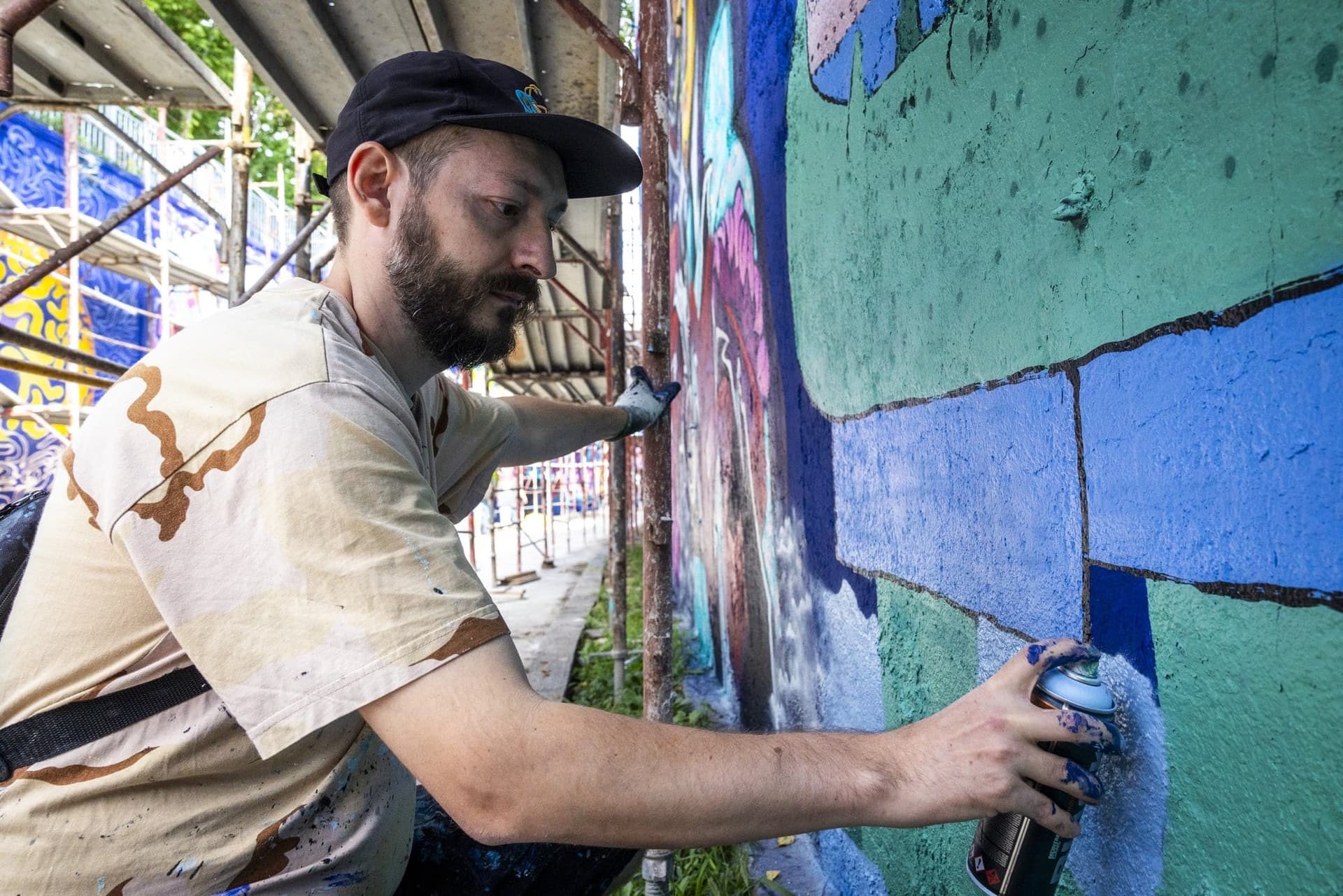
"You invest time, energy and soul, you make a piece. You've archived it, you file it away and you move on."
He does not say it with resignation, he says it as a rule of the trade. Then he immediately adds the part that bothers him: "This street art is ephemeral. Of course you always want to keep it longer." Before last year's festival he had worked five weeks, Monday to Sunday, on a single mural. For that one he proposed a UV protective varnish to the owners, because the sun eats the red first: on any older mural, red is the first colour to go. Since then he also looks at which way a wall faces before he accepts a job. North is best, he says. It doesn't burn your colours.
That unwritten rule exists, he confirms, and everybody knows it. Only at a festival wall there is nothing left for it to regulate, because everyone knows from the start what comes next.
"Well, obviously. I mean that's the point, next year something else gets done."
And about festivals in general, wherever they are: "If they're in the same location, they get erased."
So it is neither a breach nor an accident. At a festival wall a second understanding operates, on top of the street's, and those who come know it in advance: you paint knowing it will be erased. KSELE has seen the mechanism elsewhere too. In Bordeaux, on a wall that is repainted in rotation, with a bench placed directly in front of it, as in a museum kept outdoors.
Not everyone carries it the same way. Dima Potapov, who also painted here last year, in this same stretch, with two friends, says it without a trace of regret.
"Everything we do is super temporary. Ephemeral, to put it properly. And it's absolutely fine if it survives a day or two. So I don't have that ego of coming back to repair it, if somebody writes over the top."
The Fâs Fâs crew painted last year on exactly the spot they are standing on now. There were three rats. Today a piece is going over them made of six different styles, one from each member, shown separately but together, under the crew's letters.
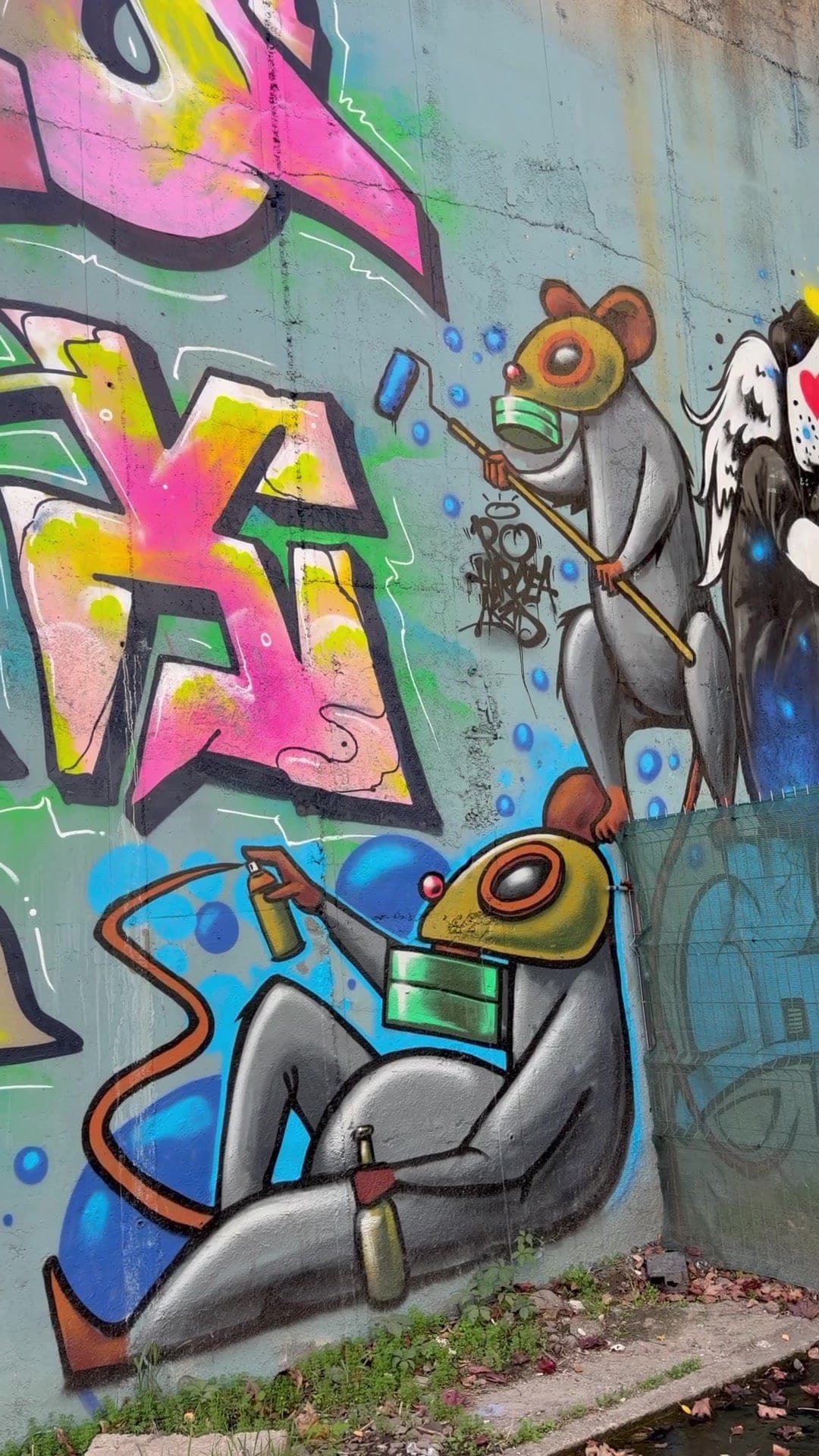
I ask them what it is like to paint over your own work. "It's a very interesting feeling, but we have to learn not to get so attached to the drawings," says Briana. "It's nice that every year we make something better. The photos stay and we can see the progress."
And Alexandra: "I've learned that art is temporary, street art especially. And I think that's part of what's beautiful about it, that you value it while it's there."
Three ways of carrying the same thing. One archives his pieces and tries a protective varnish. One doesn't come back to repair, if someone writes over the top. The others photograph and measure the progress from one year to the next.
The first edition had taught them something else as well. Last year the artists were essentially given a wall they were allowed to write on. The paint, the tools and the rest they brought themselves. This year they had scaffolding along the whole length of the underpass and thirteen cans each. The difference between the two editions is measured exactly like that.
What the Lujerului underpass was before Parcul Liniei
The underpass is an industrial remnant. A railway line ran beneath it serving the factories in the area, and the tunnel was built towards the end of the 1980s. After 1990, along with the factories, the line fell out of use.
What followed was seen by everyone living nearby: years in which the trench between the walls was where people threw sofas, tyres, bin bags and everything that no longer fitted at home.
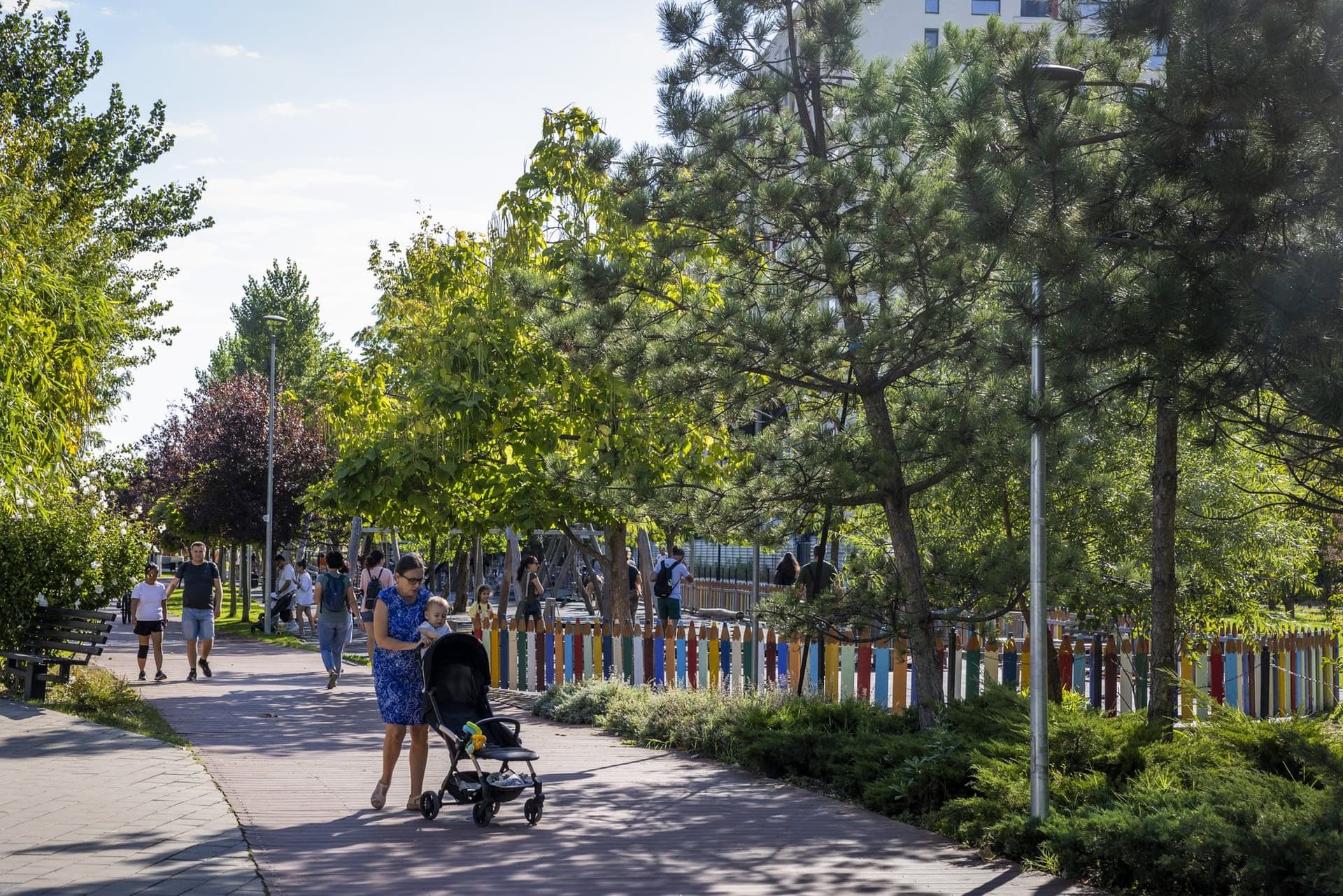
The Sector 6 district council took the tracks over from CFR, the national railway operator, and from 2023 began turning the corridor into a linear park, in phases. The first opened in June 2023, the second in 2024, and work on the third began in July 2025. Today the corridor is a path where people walk with children and bicycles, and the underpass is its painted end.
The tunnel is blocked at one end. The work inside is not visible from the street, nor from the park, unless you get very close.
"You have to practise somewhere"
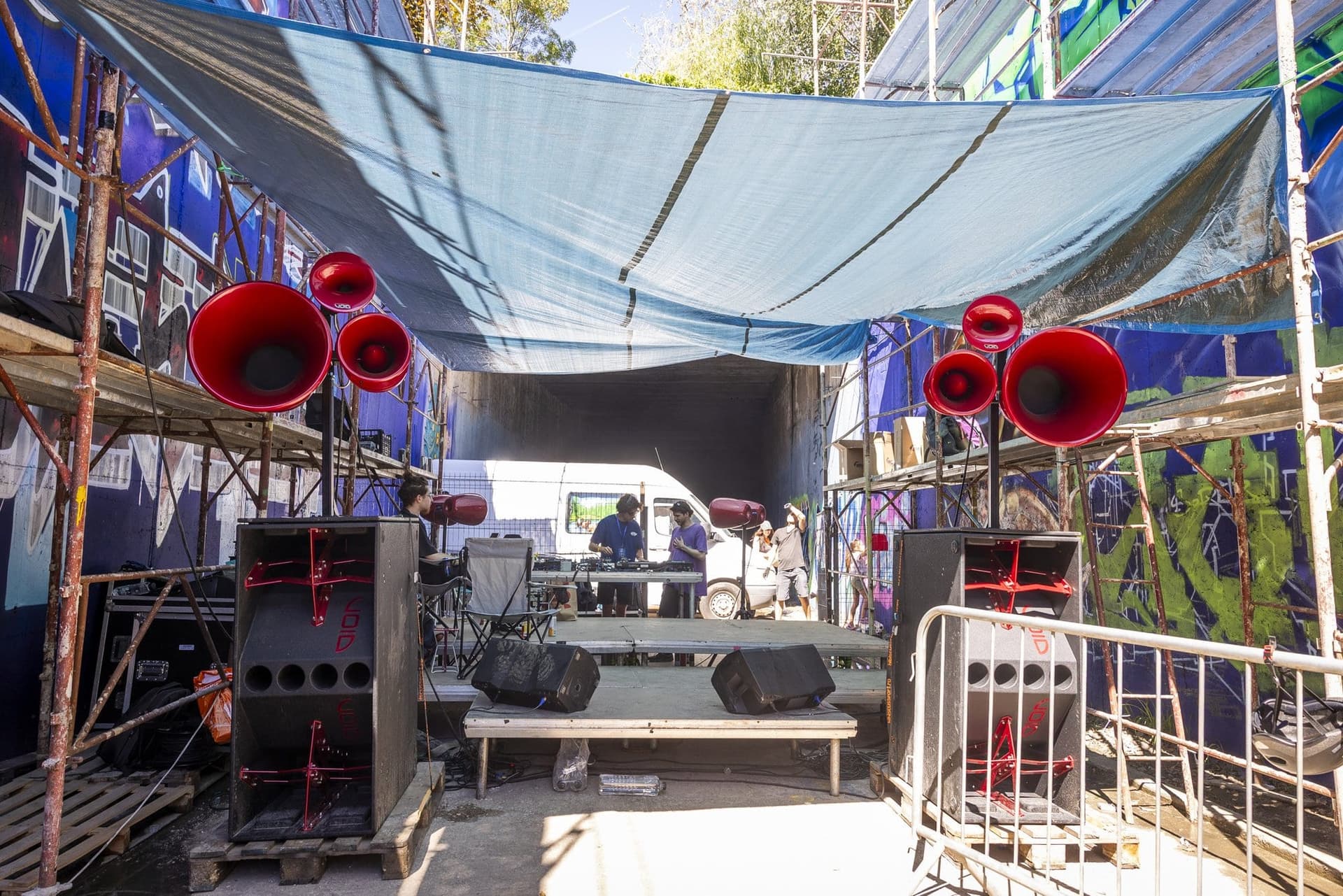
In the evening, in the underpass, Macanache played. The stage is set up right there, between the walls, with speakers and red horns fixed to the scaffolding.
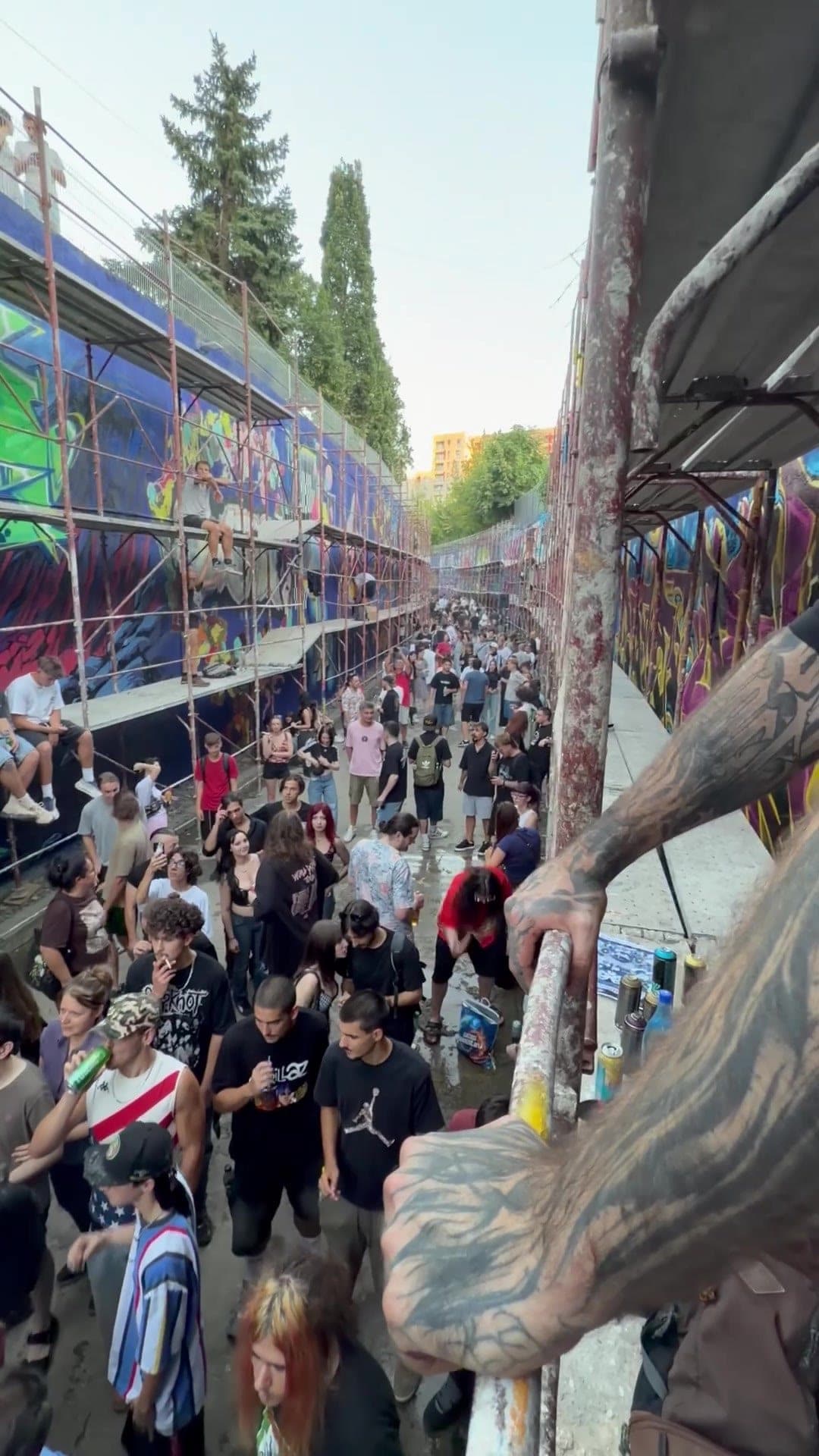
By about half past seven, the corridor fills. Footage shot from above, from the scaffolding, by Szász István shows the underpass full from one wall to the other, several hundred people packed onto the strip of concrete where cyclists were riding that morning. And above them, on the boards, the painting carried on: his arm comes into frame, braced against a scaffolding pole, while below him the crowd presses towards the stage.
For Macanache it is not the first time here. He spent time in the area and drew on these walls himself, years ago, "when you didn't have to be quite such a master of drawing".
"I messed about too, I practised too. You have to practise somewhere."
On the difference between a concert hall and a railway tunnel he has the theory of a man who has played in both. On a stage, in a hall, he feels he has to be someone other than he is. People seated in rows, as at the theatre, cannot give him back the energy he needs in order to pass it on to them.
"It's an exchange of energy, a back-and-forth, really, on stage."
And on the link between his music and what gets painted on the walls: there are people who come from the same place he does, nearly all his friends draw, nearly all of them make music. "And rather than get into trouble, we might as well make art."
There isn't much room under the sun
From the outside, three days of wall look like a community party. Dima Potapov, who has been painting for some twenty-two years and has lived off it for fourteen, describes something else.
"The scene is actually pretty toxic and aggressive."
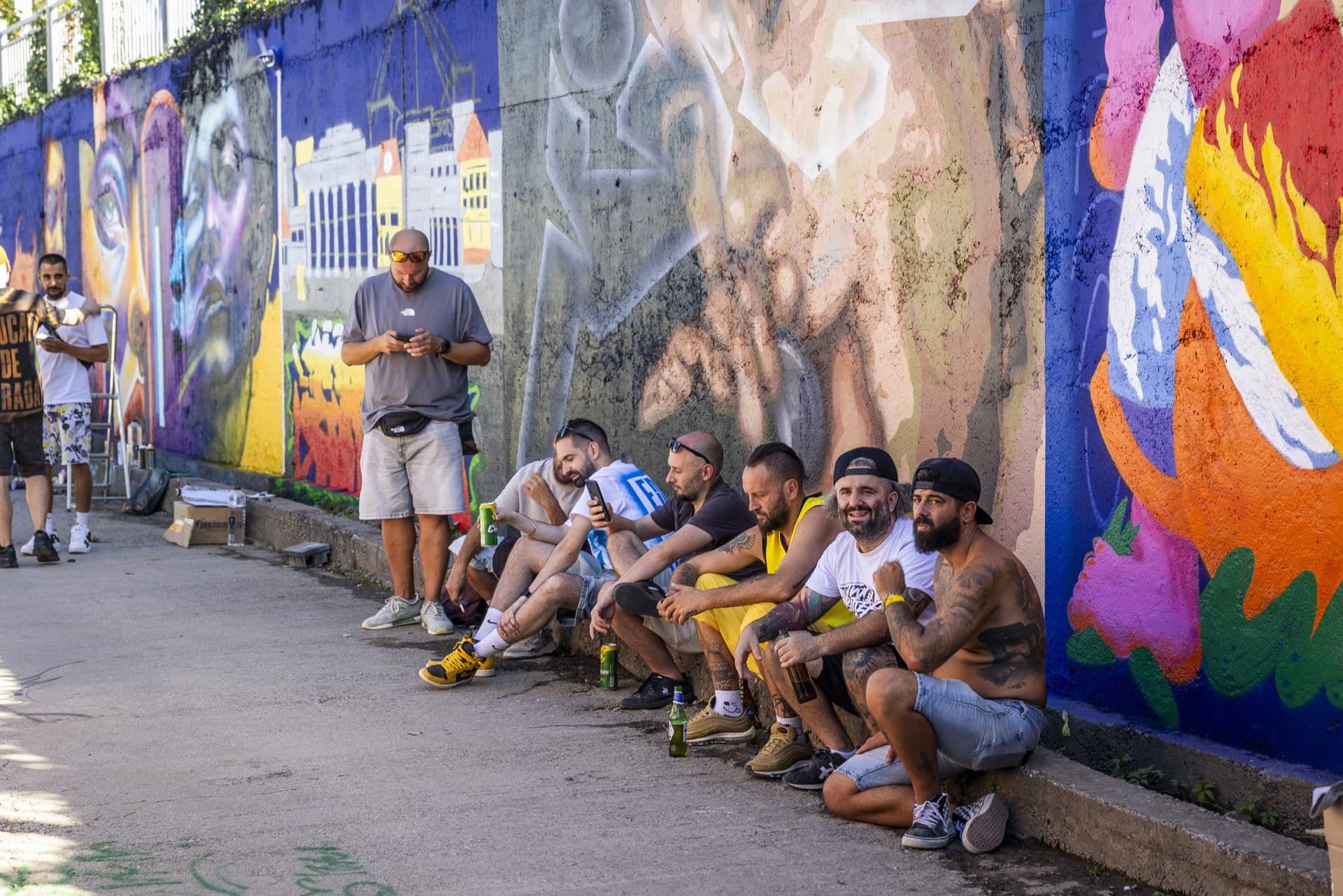
His explanation is economic, not temperamental. The market is small, prices get undercut, and the money from paid work is what keeps your paint stock going for the things you do for free. "There isn't much room under the sun. I mean there is, but it's limited. And competition is very high — which is why a lot of people don't much like each other."
It isn't the wall these people are after in two hundred and fifty metres of tunnel and three days of programme. It's seeing each other face to face.
Dima is from Chișinău. He studied criminal law, went to a Romanian-language school although his family are ethnic Russians, and he believes he is the first in the family to speak Romanian. Last year he bought a flat in Bucharest, but works mostly back home in Moldova, because, he says, you stay where the work is. The reason he travels so much is simple and he says it without softening it: in the Republic of Moldova there is no market. To keep from standing still, you move. He has been to more than sixty countries and goes to festivals uninvited as well, because the places are limited anyway and because, if a spot is left free, he fills it with his own paint.
From that position, as a man with something to compare it to, he says the festival here is at the level of a Meeting of Styles, that it is unusually relaxed in its organisation and that the location, as a location, is unique. But the thing he praises most emphatically is something else, and it appears in no photograph: at StreetWise, less experienced artists are accepted too.
"Usually at a festival the ones on their first road, the ones just coming in, aren't accepted. And for them it's very difficult, because they have no way to test themselves, to connect, to promote themselves, to learn something from someone."
And that, he adds, matters more than it seems at a moment when "in the contemporary world, with social media, communities usually close up and become less friendly."
The Fâs Fâs crew say the same thing from the commercial side. There is a market, but nothing comes by itself, and for a long time the problem was that artists did not present themselves as professionals. They now work mainly with companies and avoid private clients: a fencing hall, a dance studio that has not opened yet, Salvați Copiii — the Romanian branch of Save the Children — and two refuse trucks painted for a services company, which ended up at a trade fair in Munich. Alexandra is on the payroll, Briana is a freelancer.
They don't get to many other festivals. Not because they wouldn't want to, they say, but because there aren't many.
Who pays
At the entrance to the underpass, on a stretch of wall painted outside the tunnel, are the names of those who supplied the paint and the money, in letters made with the same care as everything else. Beside them, a bar and a chest freezer.
The same wall says what was used: Coral Blue, "the official paint of StreetWise 2026", alongside a spray brand and two other sponsors.
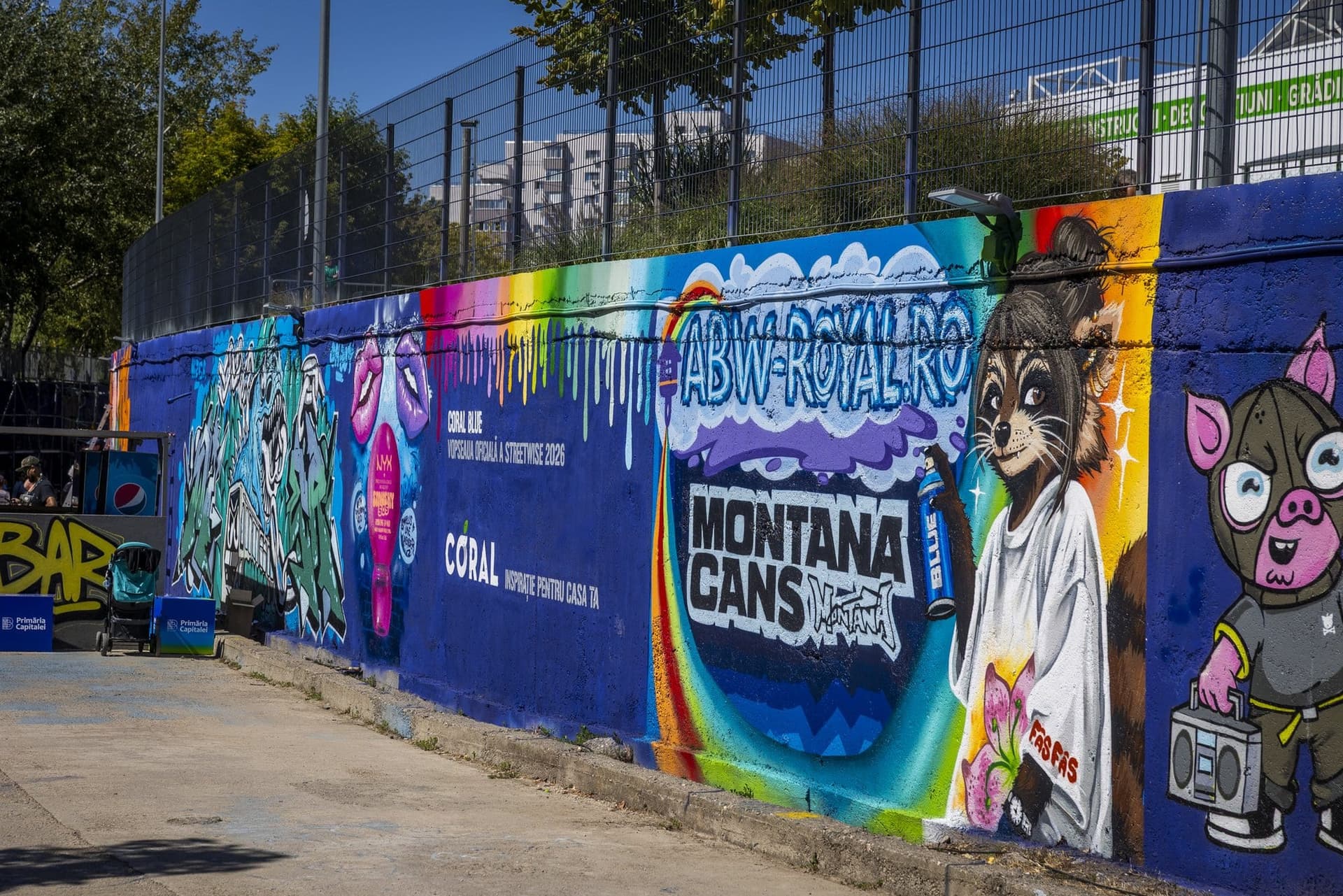
The festival is organised by Asociația Graffiti and co-financed by the Sector 6 district council and by Bucharest City Hall, through ARCUB, the city's cultural centre, under its "București în premieră" grant programme. The sum actually contracted appears in no public document. Nobody says officially what a festival like this really costs: people with experience of similar events put it at thirty-five to forty thousand euros. These are estimates, not invoices.
What is known for certain is written on the wall at the entrance. The rest, in the pockets of those who bring their own cans.
Fifty metres away
Some fifty metres from the tunnel, on a concrete fence everyone walks past, there are the same letters. No scaffolding, no cans provided, no sponsors on the wall and no three-day programme.
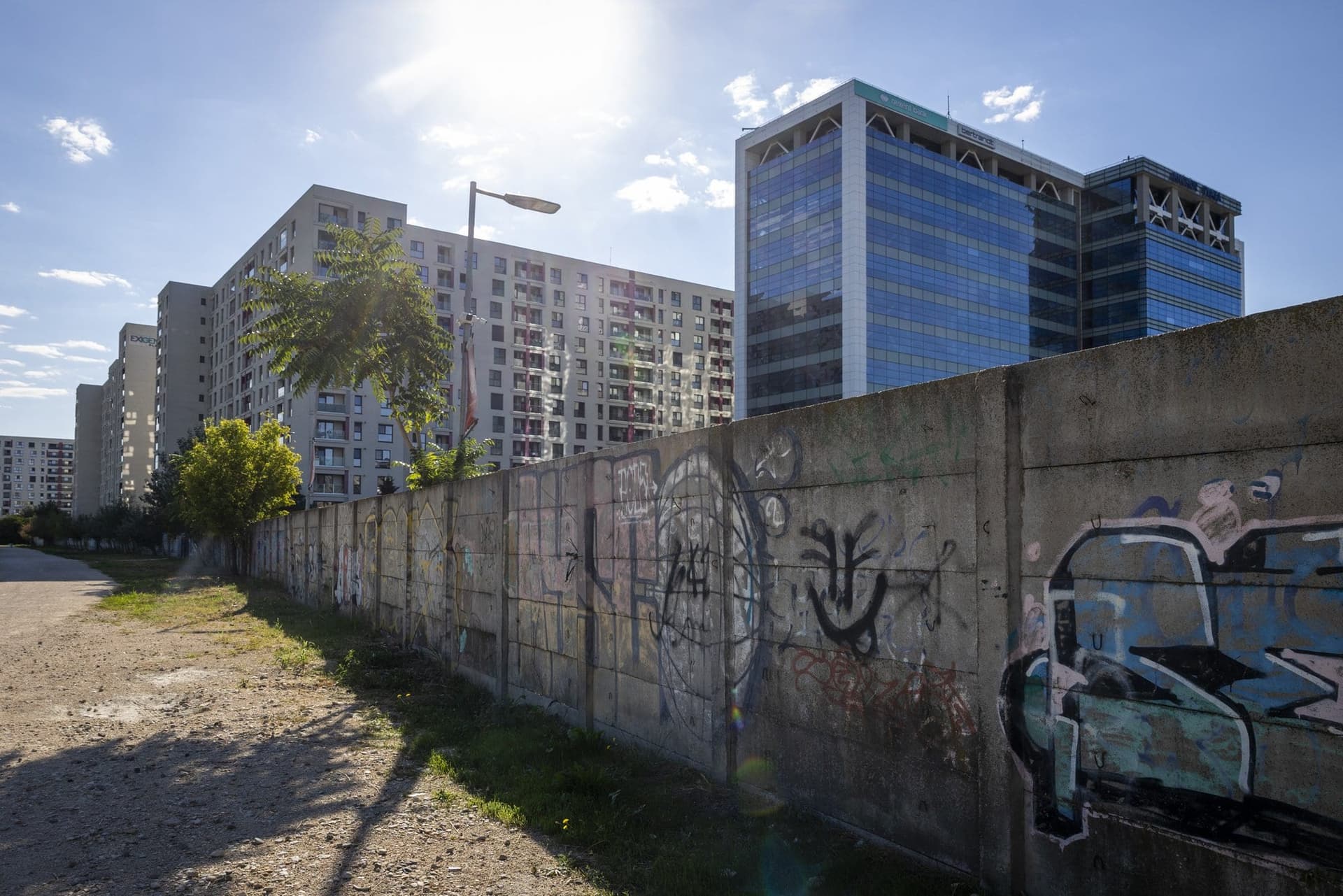
For writing there, the law provides a fine of between 3,000 and 6,000 lei — roughly 600 to 1,200 euros — plus an obligation to return the surface to its original state within fifteen days. For writing in the tunnel, the same quantity of letters and the same hands, you get thirteen cans a head and scaffolding is put up for you.
Szász was caught once, at thirteen, in the centre of Târgu Mureș, with a can taken from his father. He made the news and, he thinks, the paper as well. They didn't fine him, because he was a child.
"Normally I only do legal work. Where it's allowed. It isn't worth the fine, a criminal file or anything like that. I do it as a hobby, out of passion."
KSELE, who no longer considers himself a writer and has worked on murals for years, does not defend everything that gets put on walls. There are written rules too, he says, not only unwritten ones: no churches, no listed monuments. When a kid wrote on the Romanian Athenaeum, Bucharest's main concert hall, people in the scene were the first to object.
But he refuses to lump it all together. He quotes someone whose phrasing stayed with him: writers don't destroy, they point at what's wrong with society. Where something is abandoned, that's where the letters appear.
"I don't think anyone goes over a building if it looks good, it's been done up and everything's clean."
You can check it by walking through central Bucharest, past the boarded-up doorways on Calea Victoriei, the city's main historic avenue. It is the only answer I got to the question of why the letters appear on the fence fifty metres away and not on the renovated blocks across from it.
What is known and what isn't
On the beginnings of writing on walls in Romania there is no archive, only memory. The texts circulating online about the 1990s have no notes and no bibliography, and the oldest of them is from 2011 and appears to be the source of all the others. ERPS, one of the first, says he started in 1994 and that by 1997 the community was gathering in Parcul Tineretului, a large park in southern Bucharest.
On what happens to a wall painted over endlessly, by contrast, the best description does not come from a book. KSELE describes seeing a man in Budapest, at a Meeting of Styles, prising a piece off the wall: the layer of paint had grown so thick that it broke off in plates.
"So the walls basically put on weight."
A French sociologist, David Pontille, who followed both the writers and the crews that clean up after them for years, arrives at the same conclusion by another route: neither the writing nor the removal returns the wall to its previous state. The wall never goes back to zero.
In the Lujerului underpass, this year, someone proved otherwise with a roller and a few dozen litres of blue.
Then the wall stays there, in a tunnel blocked at one end, which nobody sees unless they go in. It will stay like that for a year.
Beyond the junction, Macanache had told me before the concert, past the Carrefour, there is another stretch of underpass, about the same size, where the rails are still down. There might still be a piece or two of his there.
"Whether they're still there, whether someone's gone over them, I have no idea."