It is not the building that takes the time, it is the paperwork. Four panels and twenty-four speakers at Bucharest's Real Estate & Construction Forum, on square metres, rents and permits — and on everything else that surfaced: warehouses destroyed in Ukraine, a Danube too low to carry freight, a street in Bucharest no parcel can reach, and a zoning plan written in six months, twenty-six years ago.
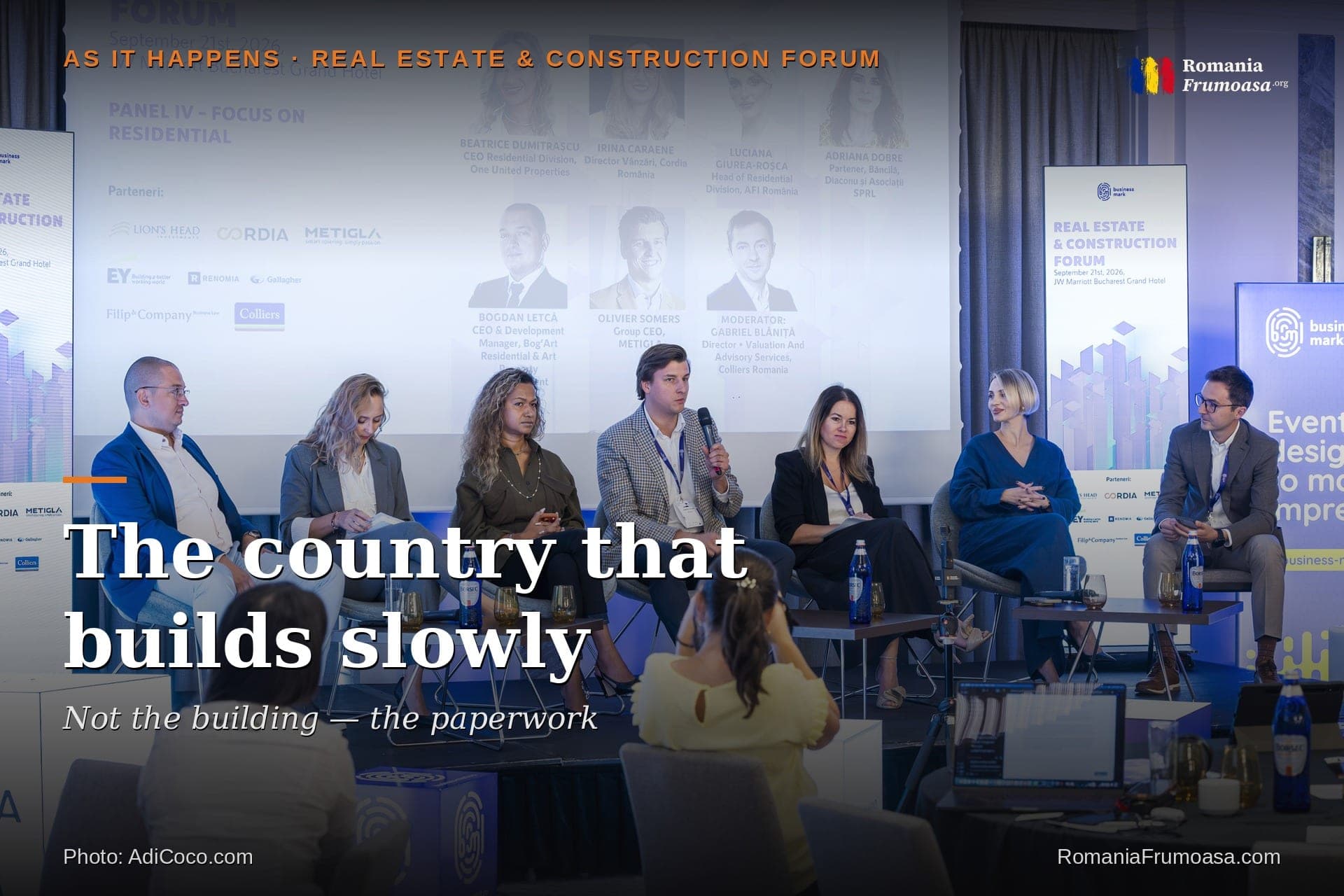
On the morning of 21 September, four or five conferences are running at once on the same floor of the JW Marriott in Bucharest. Each has its own check-in desk, each prints its own badges, and in the foyer the crowds mix: suits without ties, shirts over jeans, a phone in one hand and a cup in the other. The smell of fresh coffee holds the whole floor.
In the room where the Real Estate & Construction Forum is about to start there are a hundred, a hundred and twenty people at round tables. Nobody is waiting in silence. They talk, they make introductions, they exchange cards — for many of them this is the main reason they came: to sit at a table with people who do the same arithmetic.
One after another, the people who build, let and manage space in Romania take the stage: asset managers, leasing directors, the heads of retail, office and residential divisions. Among them a few from the margins — two lawyers, an insurance broker, a manufacturer of building materials. The advertised subject is the Romanian property market. From half past nine until nearly three, the room stays full, which at a conference that opens on retail and closes on housing does not happen often.
The subject that actually emerges, panel after panel, is a different one. Venera Munjev, group asset manager at CatInvest Eastern Europe, says it in the first session without sounding as though she is saying anything grave:
"This lack of predictability has become the normal state of things."
Over the next five hours the observation comes back in all four panels. An office developer with thirty-four permits for a single piece of work. A lawyer with a city plan written in six months. A Belgian who put the roof on Peleș Castle and cannot get a parcel delivered to his own house.
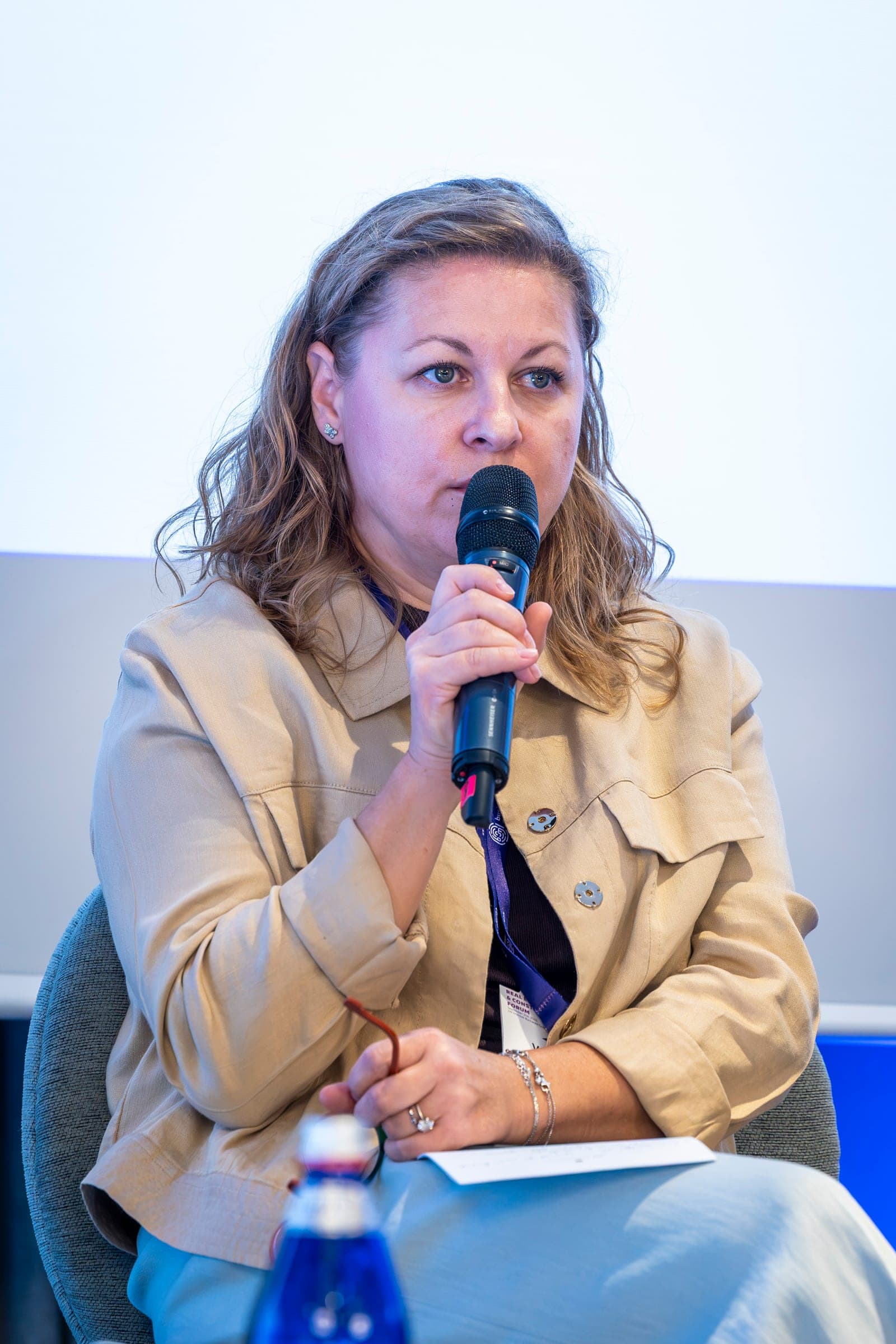
Footfall is no longer the measure
The first panel is about retail and opens with the balance sheet: higher construction costs, dearer financing, consumers turned cautious, projects postponed, targets missed.
Munjev, who runs ElectroPutere Parc in Craiova, Esplanada and Orhideea in Bucharest and TOM in Constanța, was not surprised. "We have been in this thing for about five years. Another year of challenges, and again something lands on us — a war, a tax, oil, petrol."
What has changed is the number by which a shopping centre is judged. "Footfall is no longer everything today," she says. "Generating footfall should be something where, fine, we generated footfall — but now how do you get people into your shop, keep them there longer, and bring them back?"

The same shift, measured. Cornelia Nicolae, retail operations director at FASHION HOUSE Outlet Centre, cites a study her company completed in August: 57 per cent of consumers buy fashion less often than they did a year ago. The brand has two outlets in Bucharest. Visitor numbers held steady at one, Militari, and fell slightly at the other, Pallady — yet sales rose at both. Fewer people, fewer purchases, but better considered ones.
Across the table sits the man opening more shops than anyone else in Romania. Vlad Mustață, leasing manager at LPP Romania Fashion — the Polish group behind Reserved, Cropp and House — announces that the group has passed 300 stores in the country and opened nearly 30 in the past six months alone. Then he says the thing a fast-growing retailer does not usually admit:
"There is cannibalisation between existing stores, we have seen it. And we have to factor that in when we look for a new location."
That is the moment the map changes. "An attractive city does not automatically make every site in that city attractive." And the priority moves: "It is not necessarily new openings that end up being our headline, it is also the refits." Across the existing estate, the best year-on-year performance belongs not to the fastest-expanding brand but to Reserved.
Adrian Bratu, investment manager at Global Vision, explains why companies like his keep building in small towns. Comparing the 2011 and 2021 censuses shows a marked rise in the population of peri-urban areas and secondary cities — people with money to spend and no shops left nearby. And no project starts on faith: it qualifies only with leases signed, financing secured and costs locked.
On e-commerce, which has reached roughly €8.5 billion in Romania this year against €8.1 billion last, Mustață gives the figure known mainly to the people who run the warehouses: of ten items ordered, eight come back. Repacking them, re-sorting them and returning them to stock has so far been paid for by the retailers. "It remains to be seen whether that will stay free in future."
Where Europe's warehouses are moving
Ionuț Oprea, moderating the logistics panel, opens with a line that sounds like a joke: "We did our best to have a government in place by the time we started, but the oaths have not been sworn yet."
It is not a joke. That morning, Romania had been four and a half months without a government with full powers: the Bolojan cabinet fell on 5 May in a no-confidence vote, two nominations failed in June, and the decree appointing the third prime minister-designate was being signed on the day of the conference.
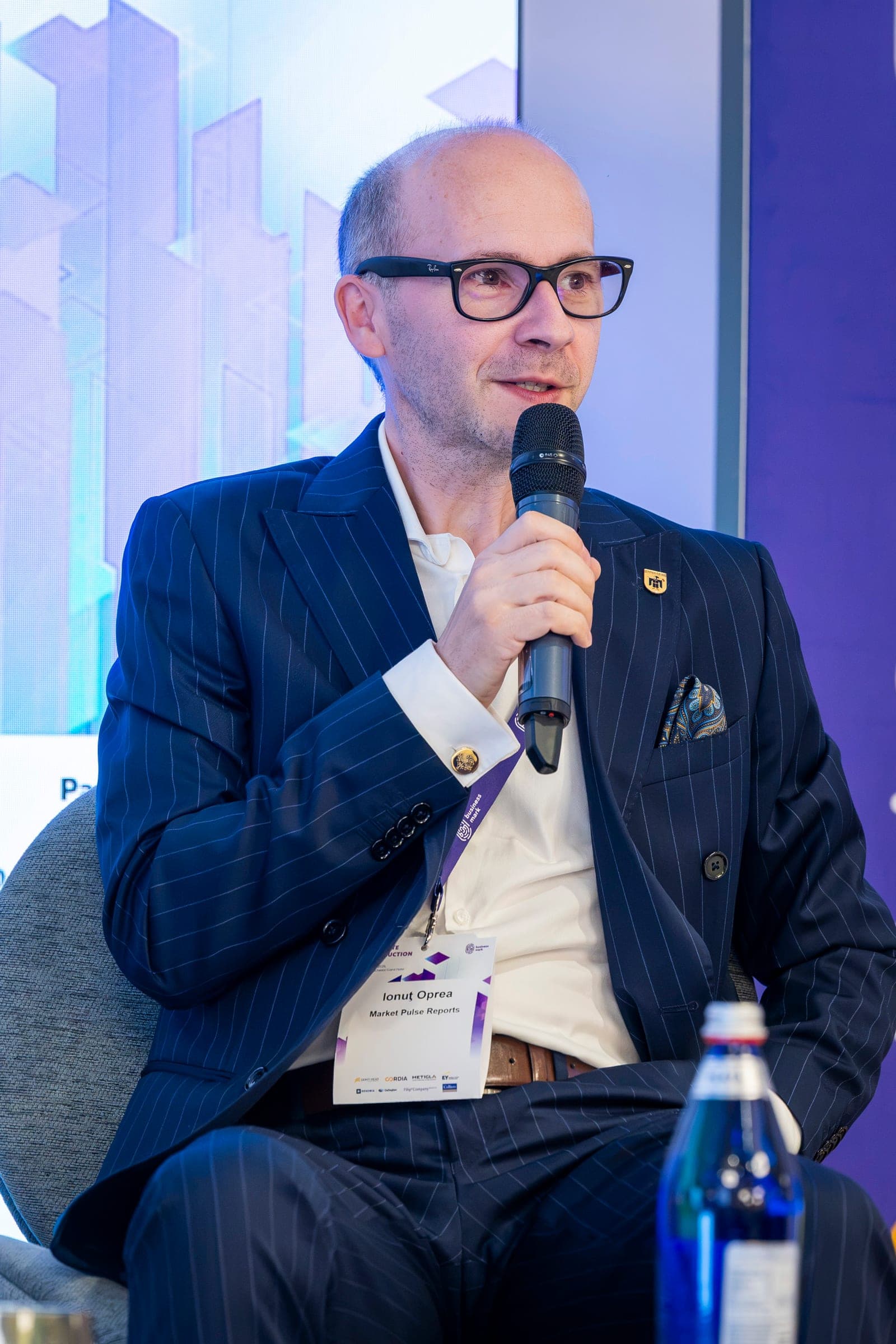
The panel begins with a film about the Arctic shipping route and ends in an argument about the Danube.
Between the two, Olga Melihov, chief country officer at MLP Group Romania, brings the war into the room. Since the strikes at the end of August, she says, enquiries have started arriving from Ukrainian retail and distribution companies looking towards Bucharest. It is not a move: "We are not talking about relocation, we are talking more about diversifying the risk."

The context she gives checks out. Of the roughly five million square metres of modern warehousing Ukraine had, more than two million have been lost. Two days before the conference, the Financial Times published the precise figure, obtained from a Ukrainian retail entrepreneur: 2.1 million square metres destroyed, 42 per cent of capacity, of which some 900,000 in recent months alone. Companies are breaking their stock into smaller, more numerous warehouses so that a single strike cannot take all of it. Some of them are now looking for square metres near Bucharest.
Lucian Opriș, of Colliers, completes the map. Odesa remains unusable, and Ukrainian grain leaves by rail through Moldova, comes down to the Port of Constanța and sails for the Mediterranean. "We are, at this moment, a node and a critical hub for the aid going to Ukraine."
He also puts the market in numbers. Romania's industrial and logistics stock stands at 8.3 million square metres and will reach 8.8 million by the end of the year. In the first half, 340,000 square metres were let, with 700,000 to 800,000 estimated for the full year, against more than a million last year. It will not be a record year, but the pace is sustainable. For scale: at the end of June, Poland's stock was 38 million square metres. Romania has a little over a fifth of that.

Ana Dumitrache, chief executive of Helios Phoenix and Olympian Parks, says where the gap comes from: "Romania was the Cinderella for many years, and it is still the Cinderella as far as foreign investors are concerned, compared with Poland." It is not demand that is missing, it is money — and money shows: "a site without money shows immediately, just as a site with money is visible to the naked eye."
The paradox is that lagging behind is exactly what keeps the market profitable. Asked from the floor what yields developers are targeting, Iulia Bîrla Istudora, commercial manager at VGP Romania, says she cannot give figures on the company's behalf. Ana Dumitrache gives them: the target is around 10 per cent, and when she started it was 16 or even 18. "In a market like Poland you can no longer have a 10 per cent yield, it is impossible."
Then, the film. The Arctic route would cut the journey for Chinese goods to Europe from about thirty days via Suez to twenty. Opriș refuses it:
"Personally I would not be glad if that route opened, because it means global warming is accelerating. We would get more goods from China into the northern ports, but the price we pay — look at what this summer was in Spain, in France — I am not sure we want to settle that bill."
And he brings it home, in two examples: volumes on the Danube reduced or halted altogether by low water, and the Cernavodă plant — Romania's only nuclear power station, which draws its cooling water from the river — shut down waiting for the level to rise. "I would rather this route stopped being a discussion at all, honestly."
From the film the moderator draws a conclusion that does not resemble the rest of the day. If the climate too is becoming unpredictable, Oprea says, then the industry is asking for the wrong thing: "these associations should no longer be asking for predictability and stability, I think it is quite clear we will not be getting any of that in this market — they should be asking for leaders and for competent policy and administration."
The rest of the panel is about where building is happening. In Brașov, the Carpathian city north of Bucharest that no motorway reaches — the Brașov–Făgăraș stretch is still on the drawing board — a shuttered factory has found a tenant, and Colliers is working on a 20,000-square-metre pilot that would bring heavy industry back to the city. What holds the investment there, Opriș says, is "the know-how, the city's history and the capacity of the people there."
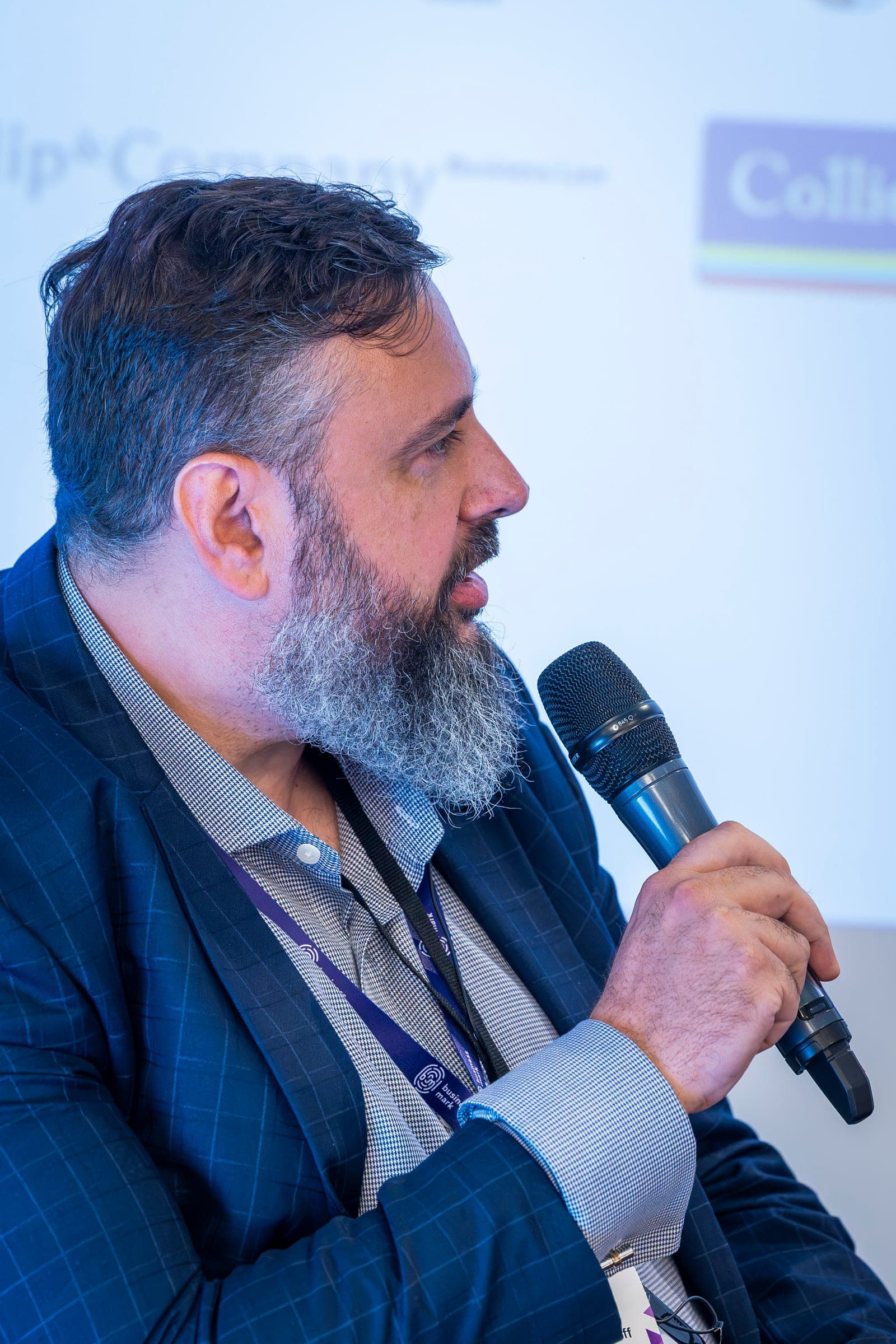
Vladimir Gurdjieff, who runs Lion's Head's logistics division, describes the north–south Via Carpathia corridor, from the Baltic to the Mediterranean, nearly finished in Poland, Hungary and the Baltic states, and lagging here: "Our countries are, I don't know, blessed or cursed to sit at a crossroads." Neither Romania nor Bulgaria, he adds, can build a strategy on cheap labour any more: "We are past that."
Asked by RomâniaFrumoasă whether any logistically good site had been given up for want of people, Melihov says no — the reason was something else. What has stopped land purchases is prices inflated by comparison with residential development and, increasingly, the cost or sheer unavailability of electrical capacity. As for people: there is a manufacturing enquiry on her desk right now that would mean a thousand staff per shift. "For any location, that number is a challenge."
Thirty-four permits
At half past eleven there is a break. The programme calls it a "business networking coffee break", and the name is exact.
On the office panel, Andrei Boca, leasing director at Globalworth, gives a number and then repeats it to make sure it lands:
"We are at 34 permits required for one project. 34. Not 3, not 4. 34."
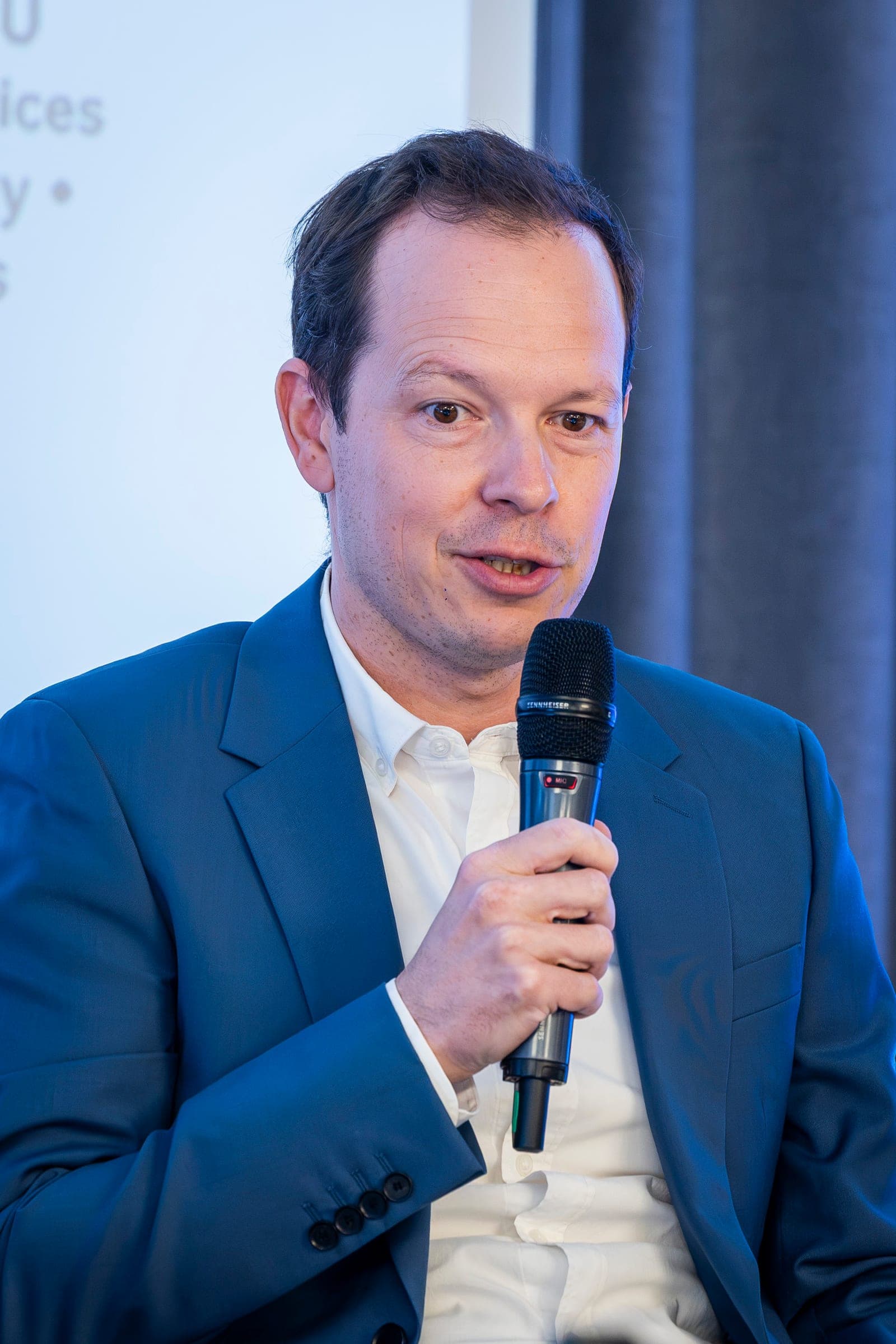
The project is not even an office building; it is an associated piece of work. And the consequence is measurable: the investment cycle, from identifying the land, has stretched to seven years. "Seven years is not a figure thrown out casually, it is an increasingly realistic cycle" — when what established Romania as an office destination in the first place was getting the money back in three.
In parallel, demand has changed shape. Maria Jianu, leasing director at SPEEDWELL Development, gives the proportion: a company that a few years ago would have taken 8,000 square metres takes 4,000 today, for the same number of people or more. The space has halved and the expectations have risen. Decisions have lengthened too — a leasing process that used to close in six months to a year now takes up to two years. "The modus vivendi is postponement."
Emma Toma, head of the office division at AFI România, brings the part that does not appear in the reports. There are companies moving their offices out of grade A buildings into grade B; in Timișoara, automotive firms have moved theirs into logistics areas. And her diagnosis is no longer about offices at all:
"I have noted with regret that Romania is a country that merely delivers, and the conditions can be anything at all for the employees."

It is the second time in the same day that someone says, in different words, that cheap labour has stopped being a strategy. It connects to what Boca says in the same panel: the companies that hired at entry level are contracting, and what is growing are competence centres. The market is becoming a skilled one. Only not every tenant has noticed.
On the new Urban Planning Code, in force since 25 August, Mihaela Ispas, counsel at Filip & Company, lays out the chronology. Three years of discussion. Tacit approval in the Senate, meaning no debate. Several thousand amendments in the Chamber of Deputies. Publication on 10 August. The reason for the haste: not to lose the money from the national recovery and resilience plan, Romania's share of the EU's post-pandemic fund. The result: inconsistencies, cross-references to articles that do not exist, implementing rules still missing. The single digital platform the code promises — a geoportal and a one-stop counter — has five years to become operational.
Ovidiu Trofin, of RENOMIA Gallagher, is asked which risk has grown most for an office building. Not fire, not earthquake. Cyber attack. His example is recent: in July, a ransomware attack kept e-Terra, the national cadastre agency's land registry system, down for twenty-eight days, during which no property sale in Romania could be notarised.

The city beneath the city
The last panel opens with a figure from the moderator, Gabriel Blăniță of Colliers: 59,000 new homes were delivered nationally last year, the lowest level since 2017.
Luciana Giurea-Roșca, head of the residential division at AFI România, describes what she found in the rental market: the first eighty flats in the company's Dimitrie Pompeiu scheme let in half of the hundred days budgeted, and the tenants are not the ones anyone expected. They are owners who have let out their own flat in order to move in. Rents between €800 and €3,000. Leases of up to five years, most of them over two, with a public undertaking that the price will not rise beyond indexation. And the reason is always the same word, the one from the first panel: predictability.
She also cites a study by the property portal Storia according to which 31 per cent of Romanians who own a flat regret buying it — because they looked at the price per square metre and not at how much time they would lose in traffic every day.
Then the discussion goes underneath the city. Beatrice Dumitrașcu, chief executive of the residential division at One United Properties, says the ageing housing stock is becoming a growing problem, that the seismic question has not been resolved, and that the private sector cannot resolve it. Bucharest sits on one of Europe's most earthquake-exposed urban sites: the 1977 Vrancea earthquake killed 1,578 people in Romania, 1,424 of them in this city, and hundreds of buildings in the centre still carry the red dot that marks a risk of collapse.
Bogdan Letcă, of Bog'Art Residential, proposes something concrete: transit housing to move people into, then demolition and rebuilding to standard. And on listed buildings: "One has been done in I don't know how many years. We are there, let us address them." The European model, he says, is that where the owner cannot act, the state steps in and forms a partnership.
Adriana Dobre, partner at Băncilă, Diaconu și Asociații, explains why a city of two million people is still being built according to a plan from 2000:
"It was done, like this Code, in a hurry. They had committed to a deadline, the deadline was coming up and nobody had moved, which is why in six months we collected all the approvals — some of them we did not even collect, they stopped mattering — and they went with it to the Ministry of Development without all the approvals, but we have a general urban plan."
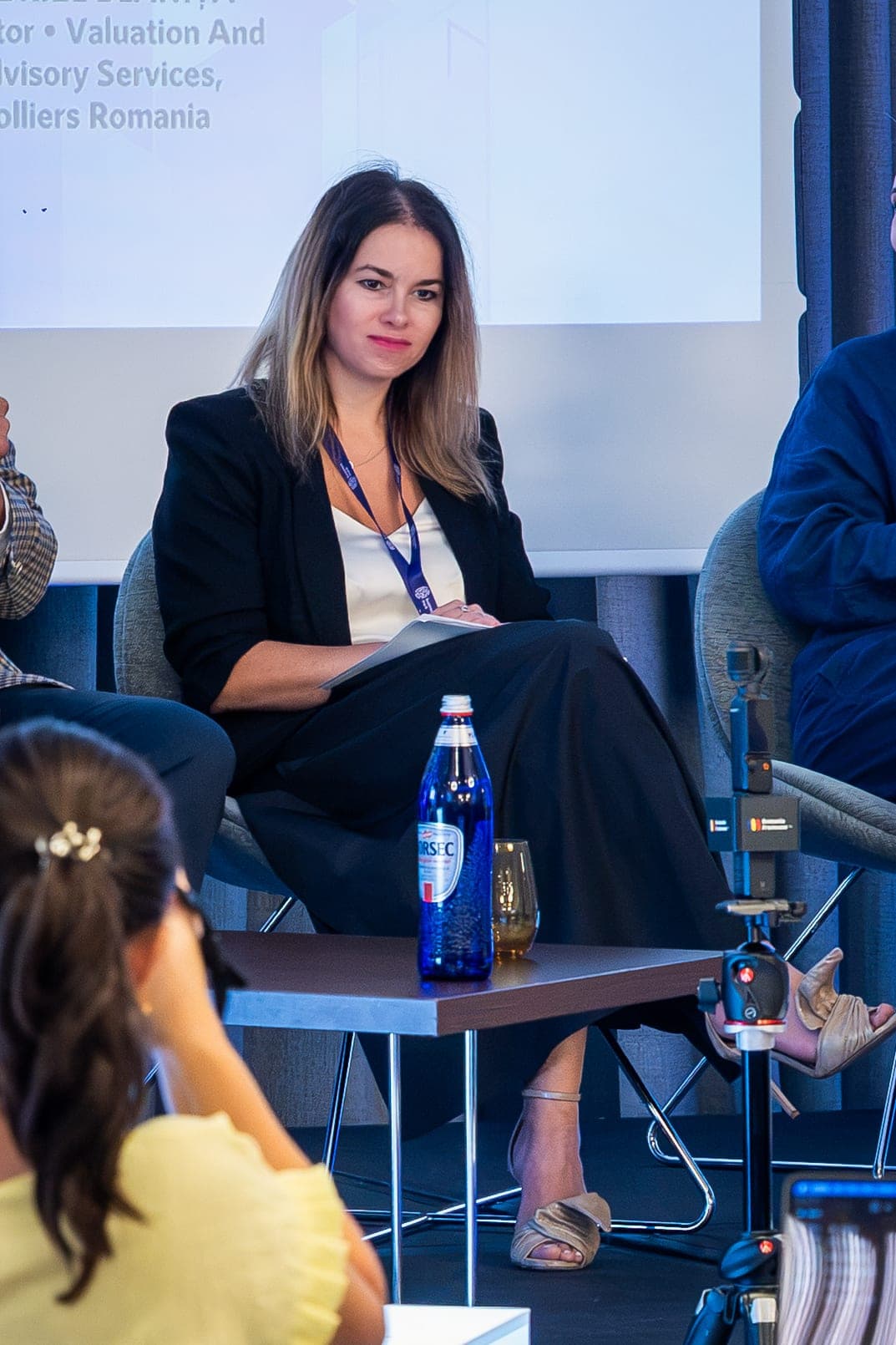
The general urban plan, known in Romania by its initials, PUG, is the master zoning document that determines what may be built where. The consequence of writing one at speed is still visible: the plan ignored the cadastral situation and the 1990s restitution laws, so a great deal of privately owned land is drawn on it as green space. "It is no use looking at the land register if the zoning plan says green space." The sector-level plans that partly corrected this — Bucharest is divided into six sectors, each with its own town hall — are in force only in two of them, sectors 2 and 4.
And from 1 November 2028, every building permit in Bucharest, from a new block to a garden fence, passes to City Hall, under a provision placed in the Code's final article. A new directorate is to be created for it, with a chief architect and seven deputies. The rules that will say how the transfer works — how the files, the staff and the assets move — are due in July 2027. Dobre does not believe it will happen on time: "Which I think will be postponed, if you ask me."
After listening to her, the moderator admits something: "Adriana has said a word I have not heard in a long time, and I confess I had not put it on the agenda either — the PUG. I think we have talked about the PUG at these conferences for days on end, panel after panel, and today it did not even cross my mind to put it on the list."
Meanwhile, people work with what is going to happen. Irina Caraene, sales director at Cordia România, gives an example: at a completed and sold scheme near Parcul 20, the fence was set from the outset on the new property line, following an expropriation that has not yet taken place. "Whatever is coming, I don't know when." On Calea Dudești it is the same.
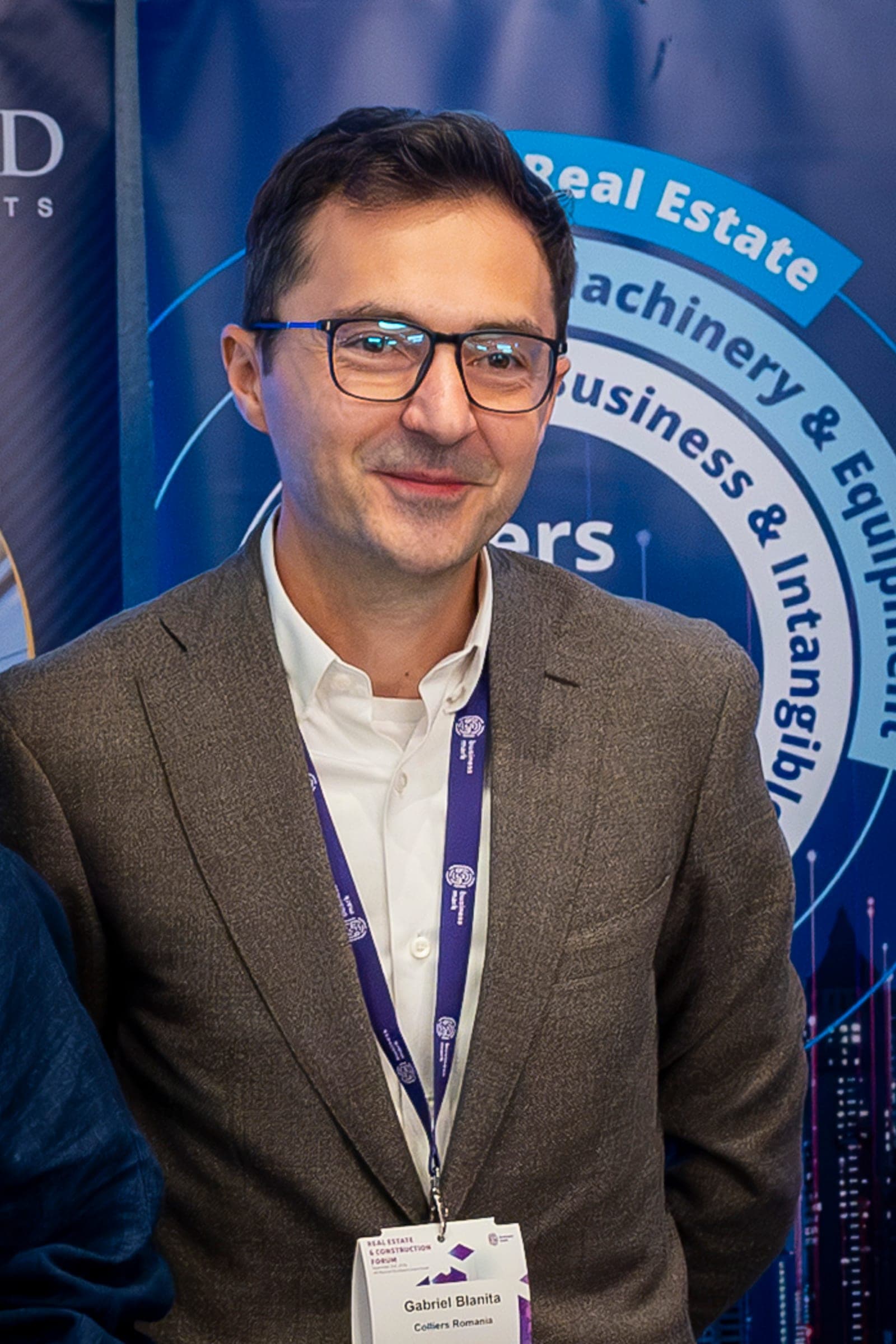
At the end, the moderator does the arithmetic himself. Blăniță values property for a living, so he measures in prices:
"And uncertainty has a cost, it has a price, and often it is harder to quantify, it does not show up immediately. But if a project takes three years instead of one to reach permit, that cost of blocked capital will show in the final price."
How many percentage points of the price of a new flat are in fact years of waiting, nobody knows: "I do not think anyone knows exactly how many, but we are certainly not talking about an insignificant cost here."
The roof
The last word from the room, before the applause, goes to the only person on the stage who does not sell space but the material it is made of.
Olivier Somers, group chief executive of METIGLA, has lived in Romania for twenty years and runs a factory at Ceptura, in Prahova County. He says he has seen a motorway built with European money closed in part for repairs after two years. That the difference in quality is not 20 per cent more money but five, seven, nine per cent — and attention. And that an investment in a historic building has to be thought of over thirty or fifty years, because heritage "is the country's calling card".

Asked how he sees the market in five years, he does not talk about square metres but about connections — infrastructure, public transport. Halfway through the answer he switches into English, and arrives at trains: he once took the train from Bucharest to Piatra Neamț in three hours, he says, and the same journey now takes about six.
He speaks from experience. His company roofed Peleș Castle, the royal summer palace in the Carpathians, and the nineteenth-century Știrbei Palace on Calea Victoriei in Bucharest. What he remembers is the severity:
"The legal side was very strict. They came to our factory, they came to see the quality of the material, they came to test it, in detail. I was rather proud of that. Otherwise we would never have won the project."
He also mentions, at one point, that he lives on Strada Jandarmeriei in Bucharest and cannot have his own materials delivered there — because the street is not registered as one, and no delivery address exists.
Field note: this article is based on attendance at, and the author's own recordings of, the Real Estate & Construction Forum, JW Marriott Bucharest Grand Hotel, 21 September 2026, transcribed and checked in two independent passes. Only statements confirmed in both transcriptions have been used. The figures on warehousing in Ukraine, Poland's industrial stock, the chronology of the Urban Planning Code, the duration of the cadastre outage and the chronology of the government crisis were verified separately in public sources. Quotations originally spoken in Romanian have been translated by the editors; the statements of Vladimir Gurdjieff and part of those of Olivier Somers were made in English and are reproduced as spoken. The question about workforce, on the logistics panel, was asked from the floor by RomâniaFrumoasă. Photographs taken on site.
Reportage by Adi Coco · RomâniaFrumoasă — A country, seen slowly · Bucharest, 21 September 2026.