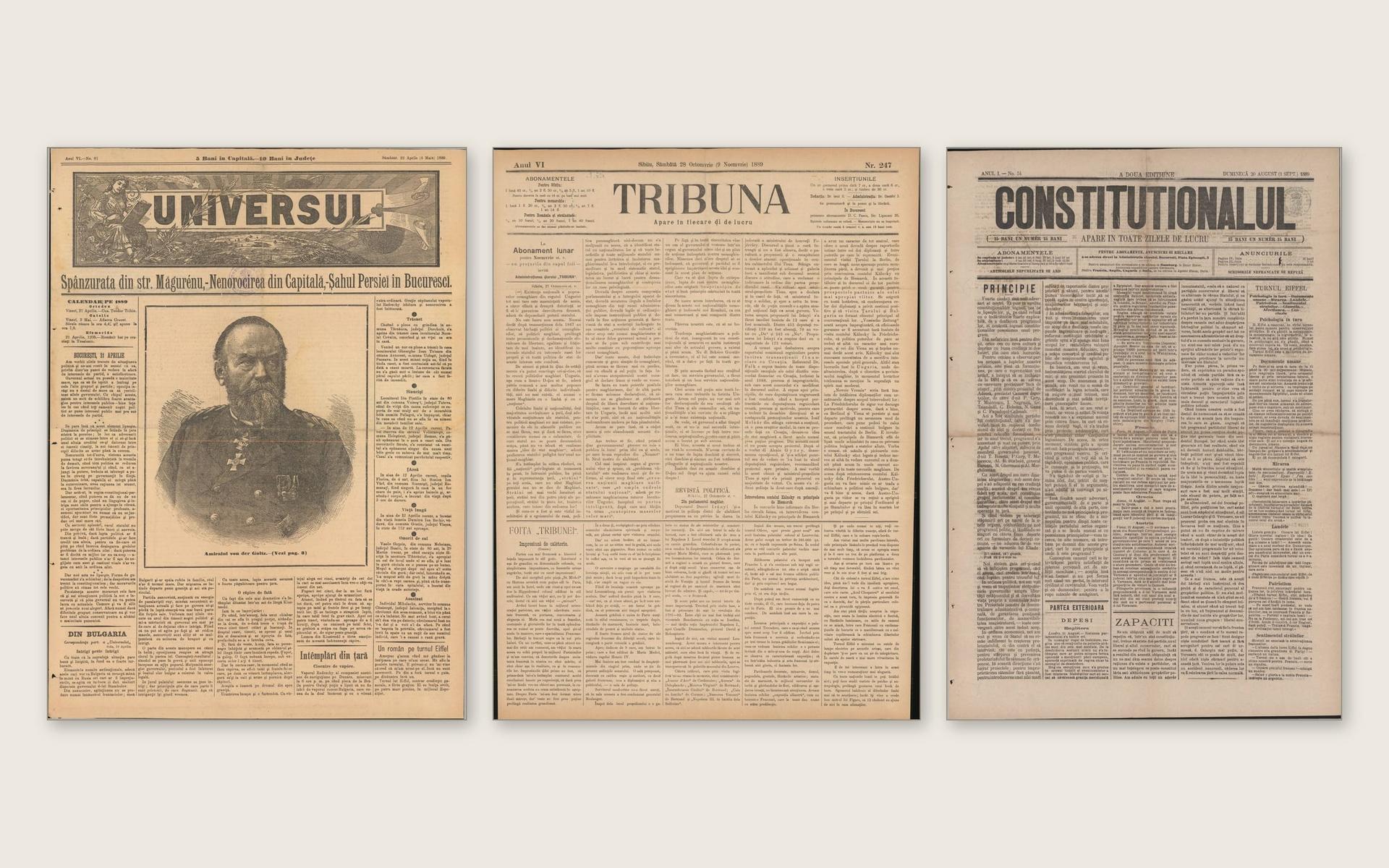
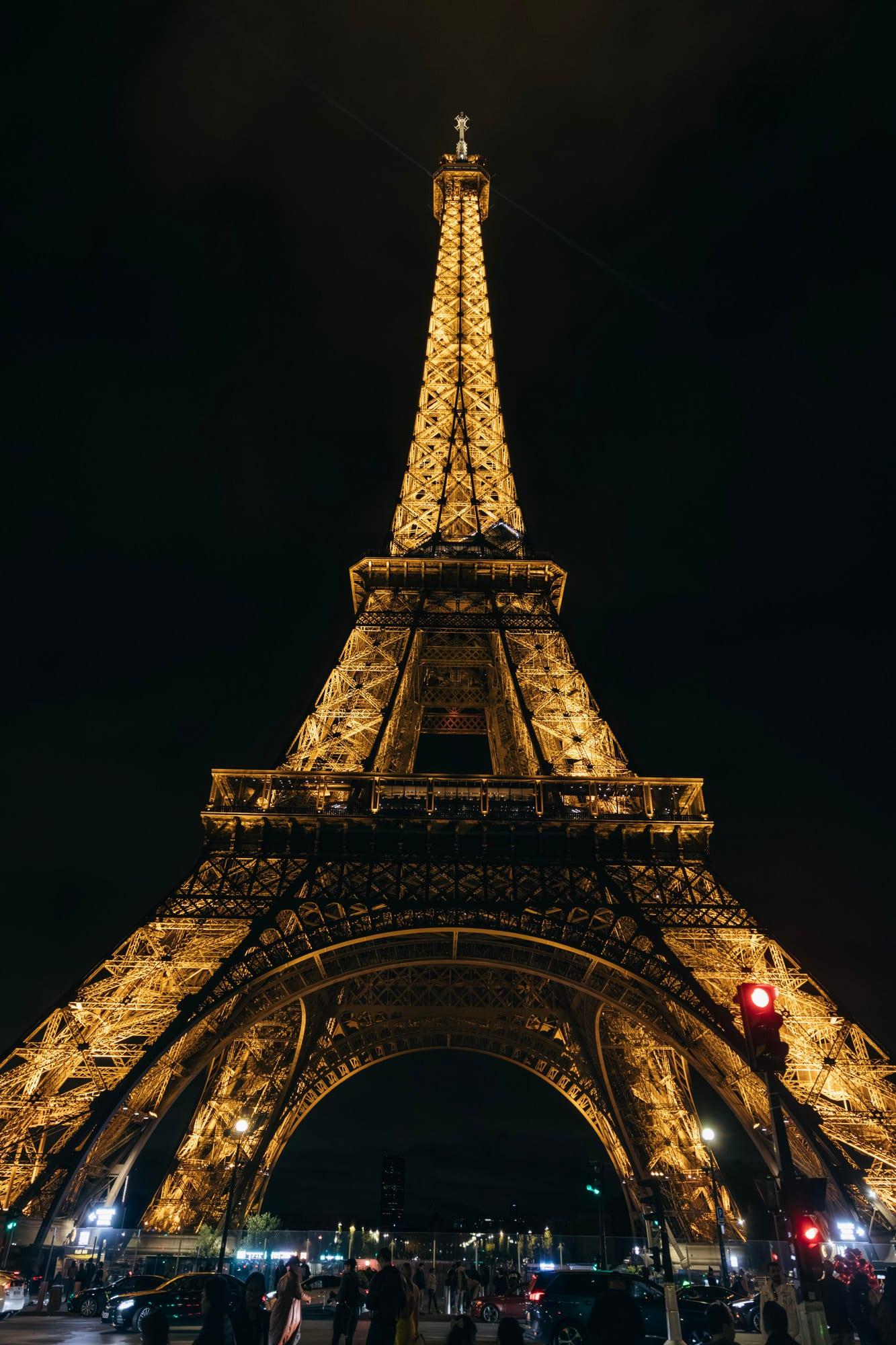
In 1889, a Romanian woman from Transylvania stood at the foot of the Eiffel Tower and wrote down its color: "bordeaux red." She did not go up. A cold wind was blowing, so she put off the climb for another day.
Her letters ran in Tribuna, in Sibiu. They are part of what Romanians printed about the tower while it was going up. The papers followed it for three years, from the first lawsuit to the closing of the exposition. They counted its bolts, worked out its price per kilogram and, once, invented 50 dead men for it.
One thing does not appear in these pages: Reșița. The legend that the tower's iron was made at the works in the Banat region still circulates today. A press that printed nearly everything there was to print about the tower, true or not, never mentions it.
These papers came out in two states: in Bucharest, in the Kingdom of Romania, and in Sibiu, Brașov and Oradea, in Austria-Hungary, under Hungarian administration.
First, there was a lawsuit
The first time the Eiffel Tower enters the Romanian press, it enters as litigation.
Dreptul, a law review in Bucharest, May 1887, under "Judicial Chronicle." On the Champ de Mars the foundations were barely being poured. The Champ de Mars is the esplanade between the Seine and the École Militaire: once the army's drill ground, named for the Roman god of war, then the site of the world's fairs of 1867 and 1878. Its neighbors had already sued the city of Paris, asking that the work already begun be torn down.
> "The Eiffel tower, which is to be built on the Champ de Mars for the exposition of 1889, has given rise to a curious lawsuit pending before the Tribunal of the Seine."
The review also lays out the deal: after the exposition, the builder gets the use of the tower for 20 years, and then it becomes the city's. The neighbors state their grievance with every courtesy:
> "…the Eiffel tower cannot constitute, in the dimensions it must have, a decorative edifice of the park."
The men on the scaffolding
In the summer of 1888, Universul, Bucharest's penny daily, apologized for coming back to the subject: "We have spoken so many times of the Eiffel tower, the marvel of the coming exposition in Paris, that we do not think it without use…" It was the end of July. The opening was nine months away.
In December, when the iron had reached 200 meters, the workers asked for 50 centimes more an hour. The paper notes dryly that "Eiffel will not make concessions."
Gazeta Transilvaniei, the Romanian paper published in Brașov since 1838, gave a detail from the site that same summer: boards had been nailed all around the platforms, "so that the workers can see nowhere but up." And in Bucharest, in August, the rumor: "It seems the engineer Eiffel has miscalculated…" The math was sound; the tower is still standing.
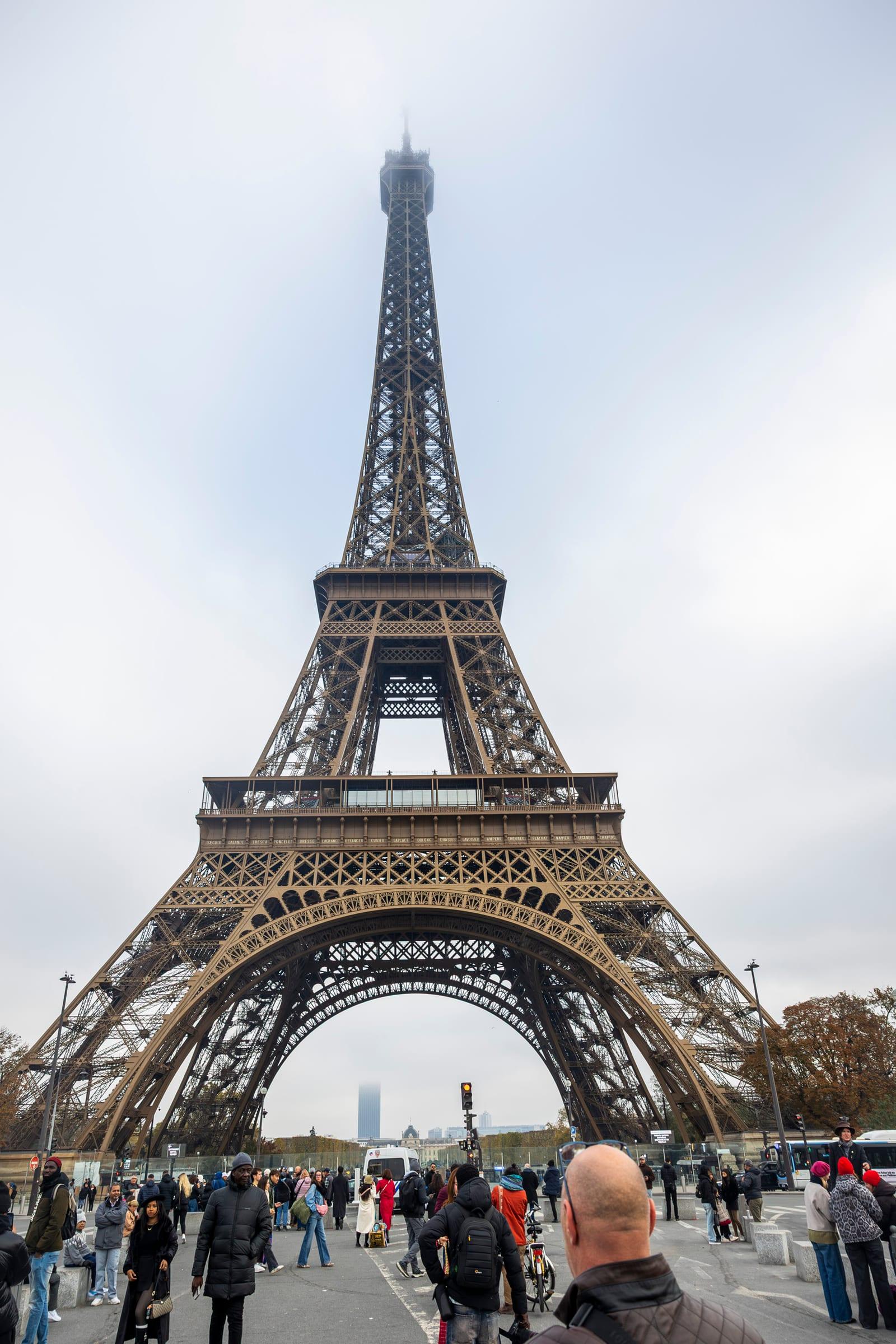
On Sept. 2, 1888, Românulu, the radical paper of the Rosetti family, ran a piece under its own headline, "The Eiffel Tower. The Colossus of the Universal Exposition in Paris." The paper was more than 30 years old at the time. The builder appears with the wrong initial, "Mr. H. Eiffel," and the text tells how hard it was for him to obtain not just the subsidy of a million and a half but "even […] the mere permission to build it." And then, with no change of tone:
> "…in the pits where the foundations were laid there also lie the corpses of men. More than fifty workers have perished so far, some by the caving-in of the earth, some by the collapse of the scaffolding, or by falling objects. The press has passed over these regrettable accidents in silence; the victims' families have been compensated as far as possible and with generosity."
It isn't true. The tower's present-day management records a single fatal accident, on May 24, 1889, after the opening: a worker, Angelo Scagliotti, during the installation of an elevator. The story of 50 men buried in the foundations has no known documentary support. It was a false report, printed in Bucharest as fact, complete with the reproach that the French press had kept quiet.
The man who went up
On April 22, 1889, Universul ran a two-page first-person account, picked up from L'Indépendance roumaine, Bucharest's French-language daily. The author is not named. The headline is "A Romanian on the Eiffel Tower."
The tower was finished on the outside, but the grounds were still closed and the elevators weren't running.
> "Nothing is ready yet on the Champ de Mars […] It is even dangerous to stroll in this place, where work goes on day and night with feverish activity. You could easily be crushed."
He climbed on foot, up the staircase in the leg facing the Trocadéro.
> "The staircase is made of small flights of fifteen steps each, joined by landings where you can catch your breath and rest. The steps are iron plates. The rails are at the height of the hand."
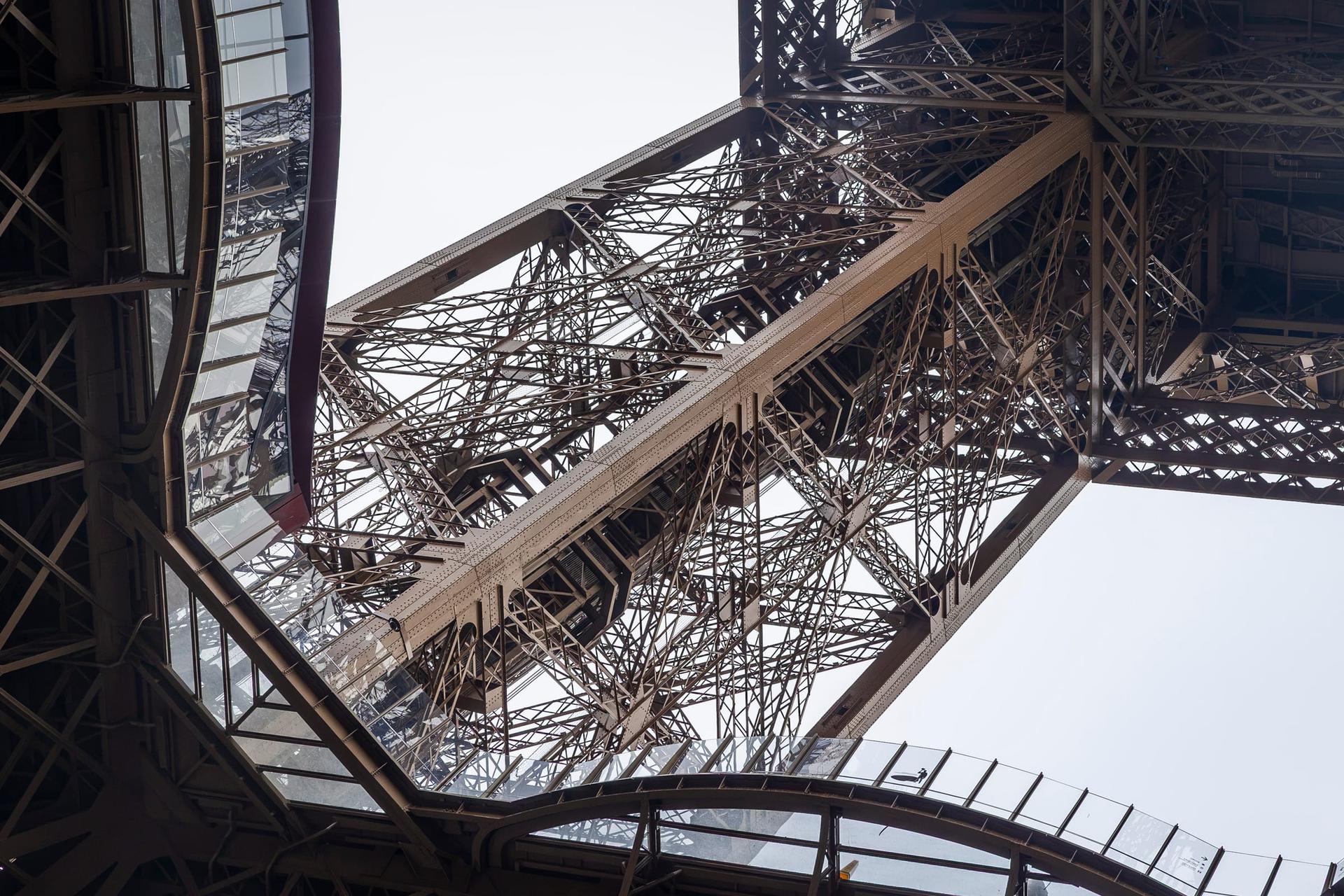
The platform takes him by surprise: "An immense salon suspended in the air. Eight restaurants will be installed on this platform. For the moment there is nothing yet." Workers hanging from the balustrade were fitting the lamps that would light the tower from top to bottom.
> "A light wind blows through the tower and makes a kind of music. It is rather cold. I no longer dare to look down. I am standing in space. The cold iron of the rail has frozen my hand."
> "I cast a glance toward the ground. Paris looks smaller to me."
The climb took him two and a half hours. The descent, two.
The woman who looked up
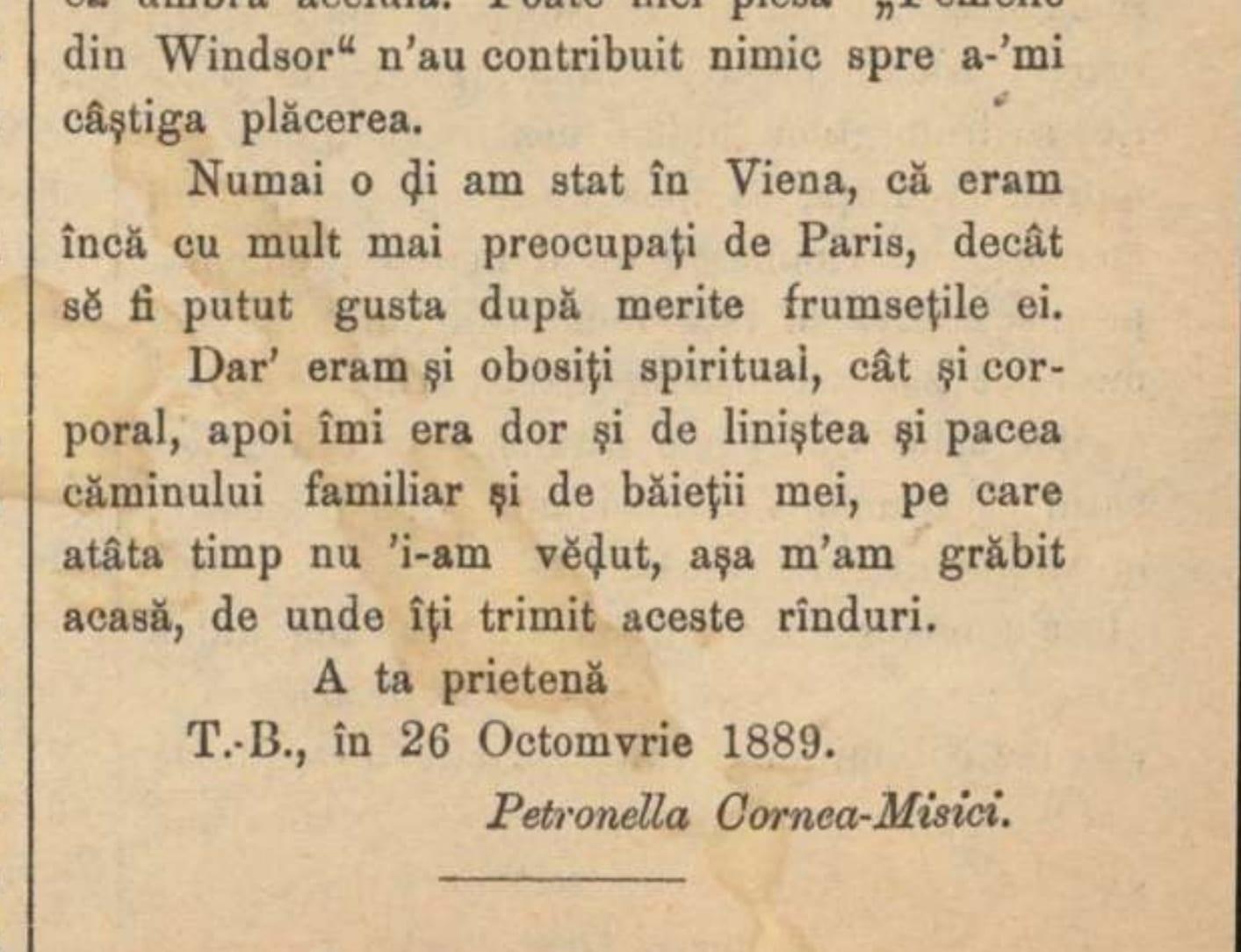
Six months later, in October 1889, Tribuna — the daily of the Transylvanian Romanians, launched in Sibiu five years earlier — began running a series of nine letters under the title "Travel Impressions." They open with "Dear friend!" and close with a signature: Petronella Cornea-Misici. She was writing to a woman friend, and her children were waiting at home — "my boys, whom I had not seen for so long."
She did not go up. She looked at the tower from below, and from there she saw something that can no longer be seen:
> "And wherever you look you see a bluish color in various shades, except for the Eiffel tower, which is in bordeaux red."
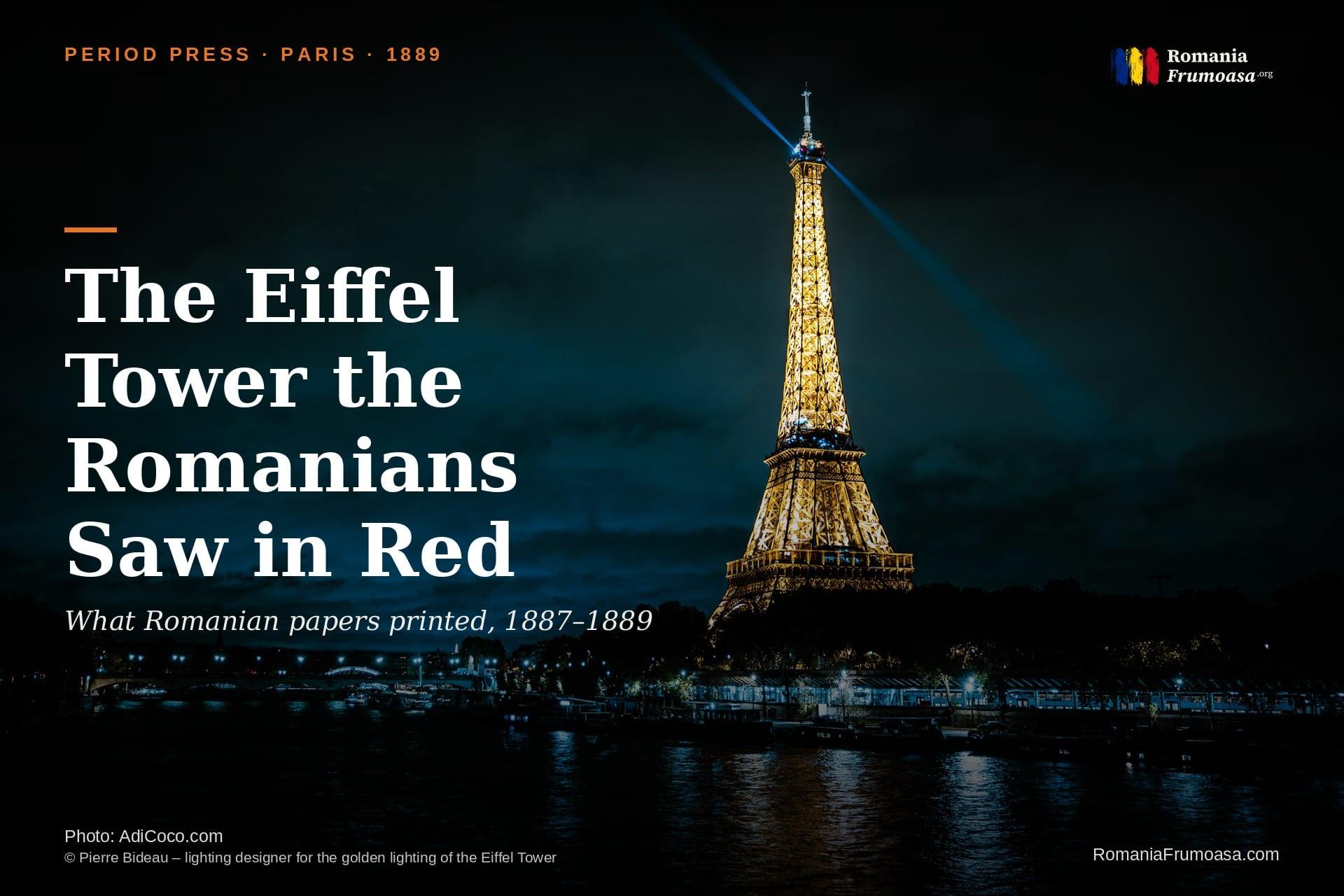
The color is not an impression. The tower's parts had been given a protective coat of Venetian red in the workshop, and in March 1889, before the opening, the whole tower received a thick coat of reddish brown. That is how it was inaugurated. In 1892 it turned ocher brown, and from 1907 yellow-brown, the shade Gustave Eiffel chose. It has been repainted 20 times in all. The red in her letter lasted three years.
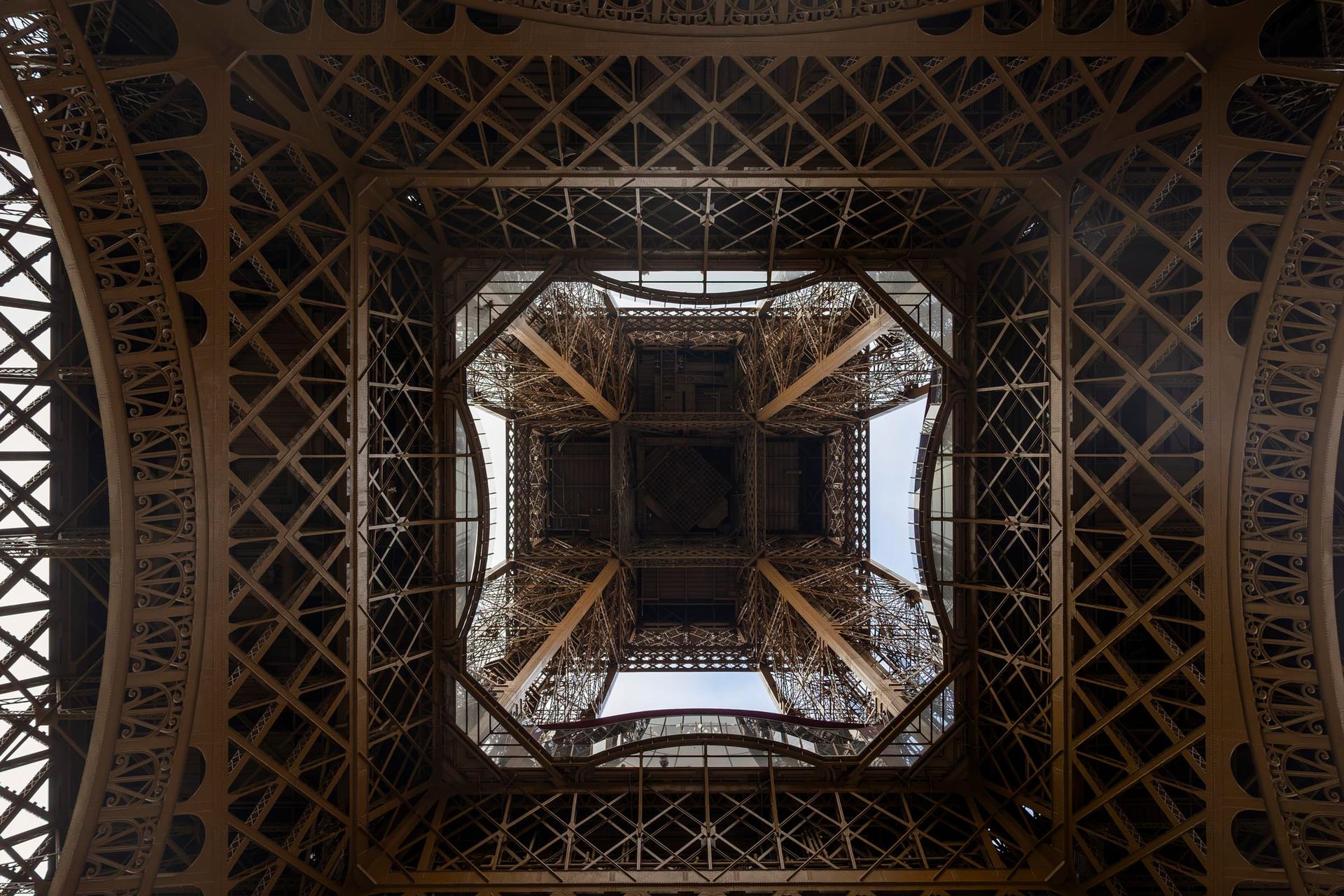
The description she leaves belongs beside anything written in Romanian about the tower in its first year:
> "This tower is the 'Cleopatra's Needle' of our century, in its general impression fine as lace, but in its particular parts colossal as an Egyptian pyramid."
In the evening, the lights: "…the hundreds of electric lamps on the giant arches, which from a distance look like a string of pearls." At six o'clock, a cannon on the second platform announced the closing of the pavilions.
Cornea-Misici also writes about the crowd at the exposition, and she doesn't spare it. The English, for whom the portion is always too small. The Americans, who are "dollar mines for the Parisians" and yet "objects of jokes and laughter before the French." Her visit closes with a sentence you could read today:
> "Paris has lost its true character; it has become the metropolis of foreigners."
On the way home she stopped for a day in Vienna: "everything seemed so small to me beside dazzling Paris."
Cornea was her married name, Mișici her maiden name. From 1898 she would publish as Neli Cornea-Mișici.
The state that didn't come
The man who climbed the stairs and the woman who looked up were there on their own. The Romanian state was not.
The exposition marked the centennial of the French Revolution — which, for a monarchy, meant the centennial of the overthrow of a monarchy. The Liberal government of Ion Brătianu declined France's invitation. How the country learned of it can be read in România Liberă, a conservative Bucharest paper, which on June 18, 1888, published an "Appeal to Romanians!" sent from Paris by the journalist Alexandru Ciurcu:
> "The Romanian government has refused to take part, officially, in the universal exposition to be held in Paris in the year 1889. In doing so, the Romanian government will surely have had its reasons, and it is not my business to judge it. It has done what most of the monarchical governments of Europe have done."
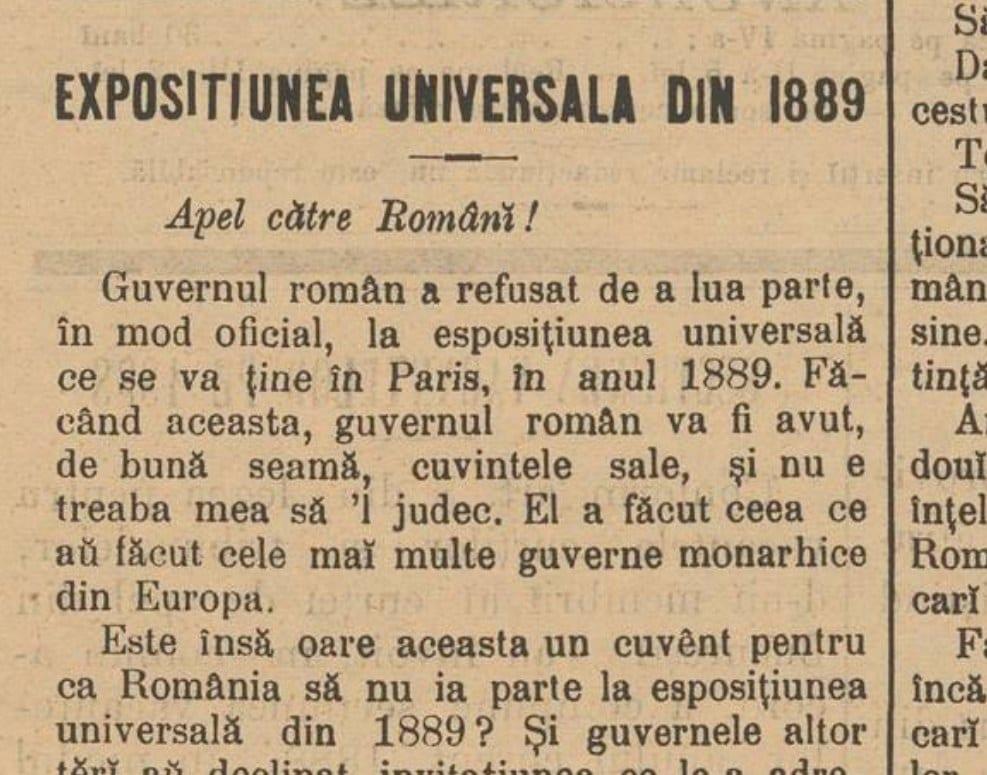
The registration deadline had passed. Ciurcu writes that he has nonetheless obtained, from the exposition's management, the promise of a space, and he calls for a national committee. Not to come, he adds, "would be to confess that we are afraid of the exam." Gazeta Transilvaniei reprinted the appeal the next day, in Brașov.
In a letter to the new prime minister, Teodor Rosetti, Ciurcu also gives the date of the refusal — "July 14 of last year" — and the reason offered: economy. The government had asked, however, whether a study commission would be well received in Paris, and for that Ciurcu has a comparison: It is as if a man invited to dinner answered that he would come, but first wanted to know whether he would be chased off "with the dogs."
The committee's presidency went to Prince Georges Bibescu. A quarrel followed. The Cooperators' Society, headed by Dimitrie Butculescu, answered with a "rejoinder" printed in three papers. The cooperators had been preparing since 1887, it said, and "the French government has granted us the space free of charge." Ciurcu met the claim with "the most formal denial." Voința Națională, the paper of the Liberals, by then in opposition, summed it up: "Great quarrel between Messrs. A. Ciurcu and D. Butculescu. Each claims for himself the paternity of the idea." It added that serious merchants would not accept the patronage of "a committee made up exclusively of Conservatives." Universul called for peace, so that the country might be represented "at the great revolutionary celebration."
In the end, Romania went by subscription. According to the historian Laurențiu Vlad, Parliament voted 200,000 francs for the committee in December 1888, and the rest of the money came from a lottery, from subscriptions and from the exhibitors. The Romanian stands came to 1,146 square meters, with two pavilions, a restaurant and a wine-tasting room.
That explains the kind of trace that remains: not commission reports, but newspapers. What we know about how Romanians saw the tower in its first year, we know because they went at their own expense and wrote home.
The tower by the kilogram
By the summer of 1889, the tower had stopped being news. It had become merchandise.
In Sibiu, Tribuna ran advertisements: "The Eiffel Tower as a stationery box, ready to assemble, 40 cm. tall," with 50 sheets of letter paper, envelopes and an inkwell in the upper gallery. The price: 2.20 florins. Next to it, "The Eiffel Tower as a building set," 70 pieces of wood and stiff leather, "with which any somewhat dexterous hand can put the tower together."
Gazeta Transilvaniei measured it another way:
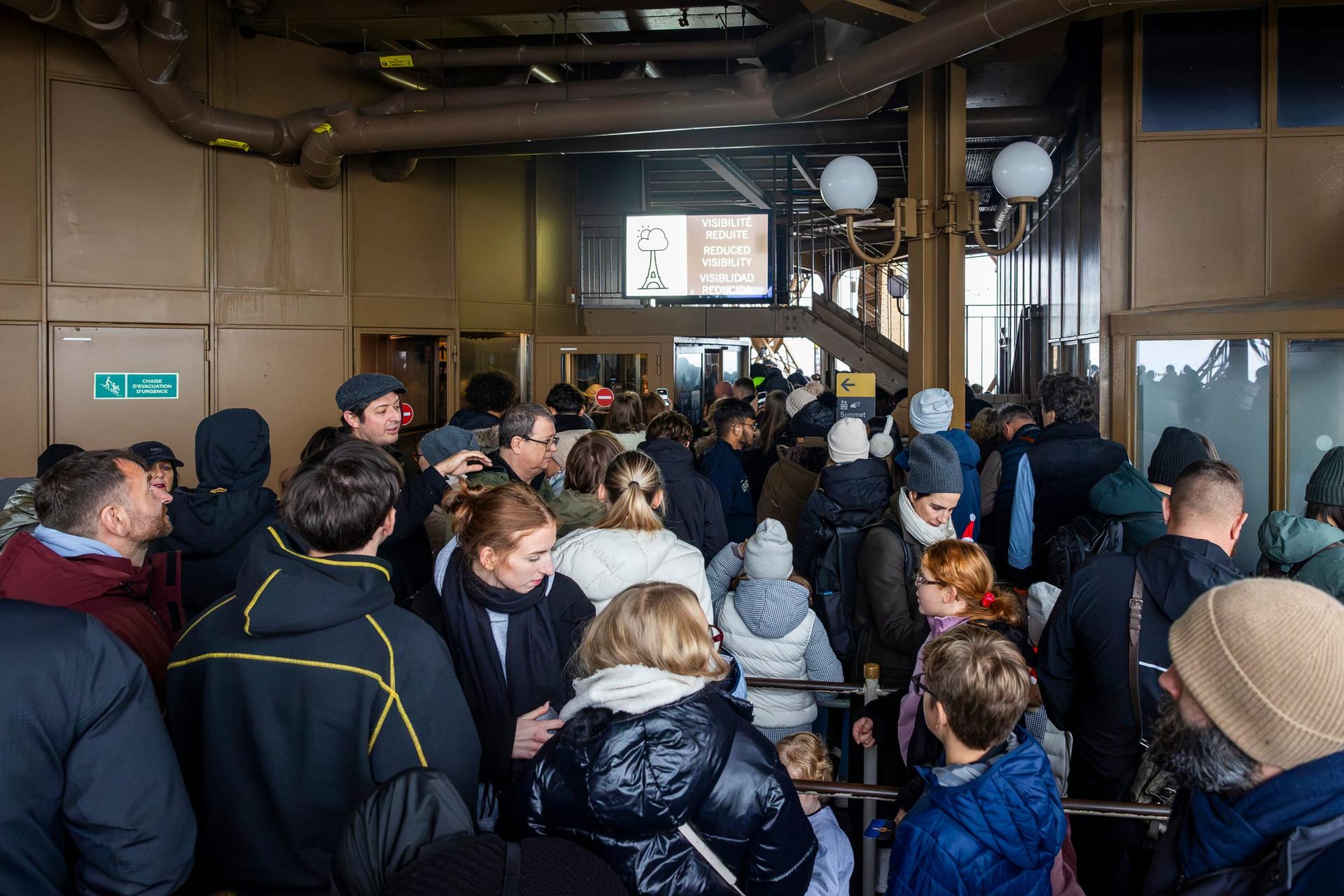
> "1 kilogram of Eiffel tower would cost 1 leu; if the exposition's management should somehow take it into its head to transport the tower across France on wheels […] it would need no fewer than 100 freight trains."
Out of the same curiosity, the paper writes, "the bolts have been counted too: 2 and a half million bolts passing through 7 million holes."
In August, Tribuna reported that on Aug. 19, at a quarter past nine in the evening, lightning had struck the tower. "The workers in the tower's lighthouse, busy at the projector, saw drops of molten metal running off the lightning rod." No one was hurt.
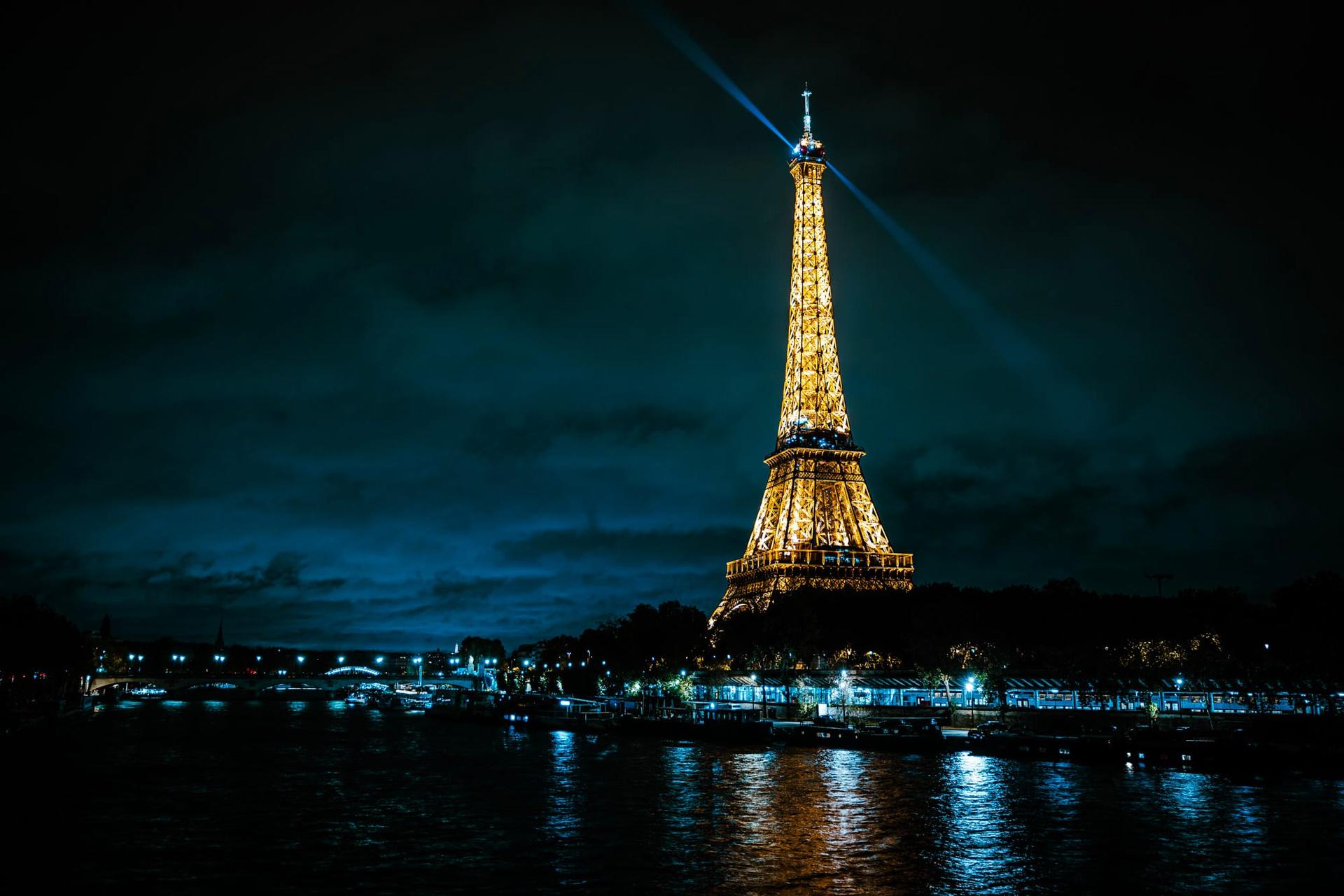
Also in August, Românulu had a headline: "Edison in the Eiffel Tower."
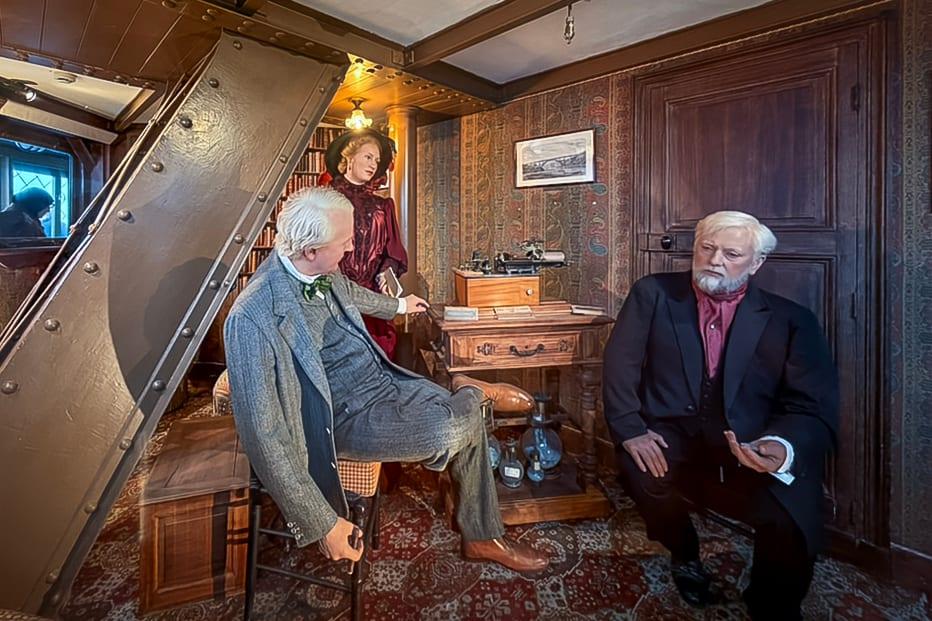
In Bucharest, Constituționalul printed jokes: "I promise my comrade Eiffel to name my firstborn daughter Eiffelina!"
And in October, in a Tribuna article that had nothing to do with Paris — it was about Romanian universities and the importing of modern institutions — the tower was already turning up as a figure of speech:
> "…the creators, the enthusiastic importers of novelties […] would have hastened to raise under the Romanian sky an Eiffel tower as well — tout simplement."
In the year it opened, the tower was no longer just an object. It was a comparison. And an object that has become a figure of speech comes loose from the facts easily.
What is missing
More than 150 newspaper pages, from 14 Romanian publications in the Kingdom and in Transylvania, between May 1887 and November 1889. A lawsuit, a strike, a false story with 50 dead, a man climbing the stairs, a woman looking up, a state that doesn't come, a 2-florin inkwell and a joke about Eiffelina.
In these pages, not even once, Reșița.
The legend that the tower's iron was made at the Reșița works still circulates, sometimes in the version that the parts are stamped "Made in Reșița, România." It was publicly taken apart in 2016, in the newspaper Adevărul, by the historian Mircea Rusnac and by Dan Perianu, the author of a history of the works. The tower's management says the structure is puddle iron, brought from the Pompey forges in Lorraine and then assembled in the company's workshops at Levallois-Perret. Two trade journals in Budapest, Épitő Ipar and Iparügyek, were writing about those same workshops as early as the summer of 1888.
But the simplest evidence is the silence. Romanian newspapers followed the tower from the lawsuit to the closing of the exposition. They counted its bolts, weighed it by the kilogram, sold its scale model and made it a punch line. They were capable of inventing 50 dead men for it. A Romanian ironworks they did not invent.
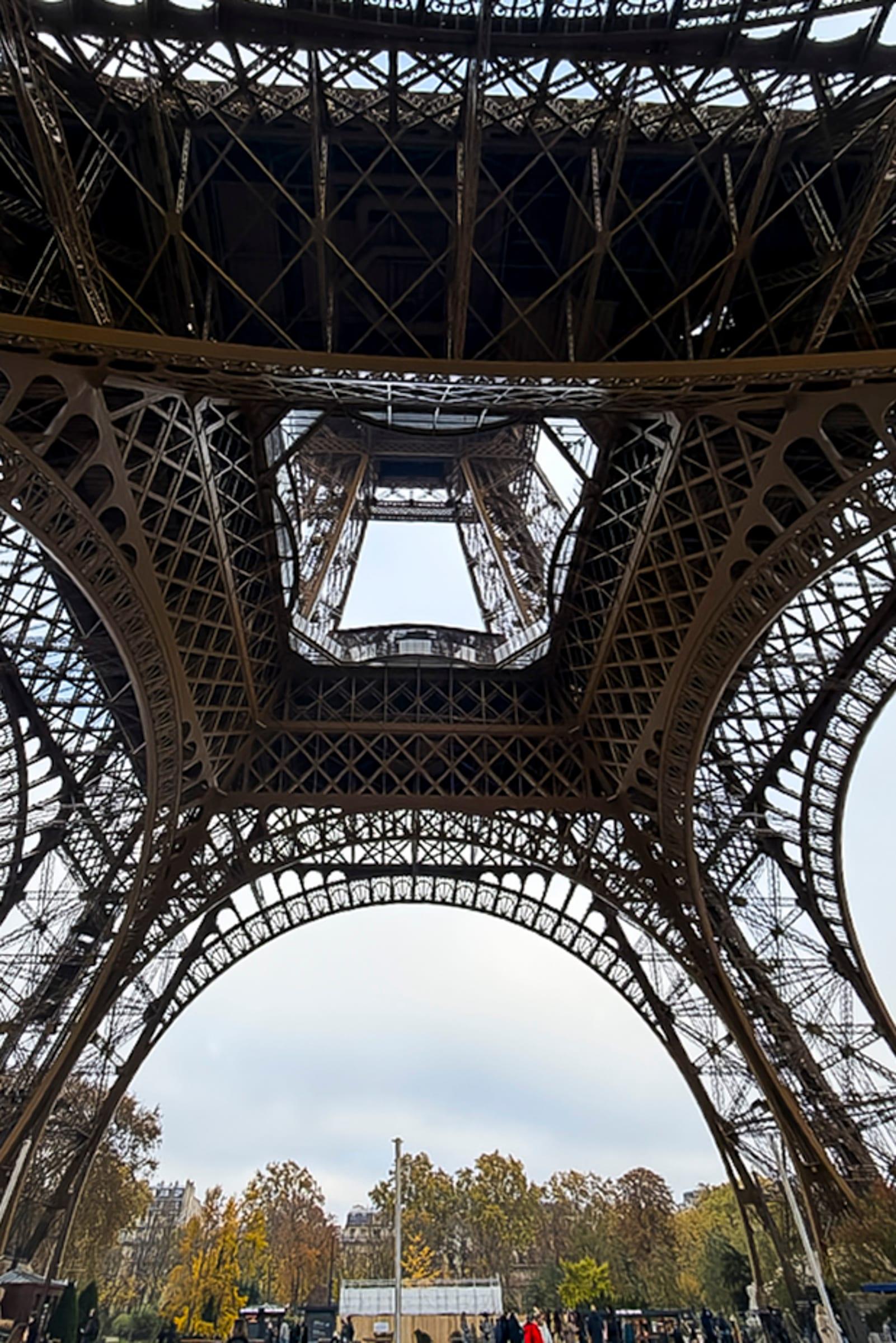
In the years when the tower was red, the legend does not appear in the newspapers.
The photographs were taken in Paris in November 2026; the two night views, in September 2025. The newspaper pages were consulted in the Arcanum Newspapers digital archive. The quotations were translated from the Romanian of the period, and the dates are those printed by each paper, generally Old Style, 12 days behind today's calendar. The absence of the word "Reșița" was checked by searching the automatically recognized text of the pages, a method that can miss unclearly printed words.
This English version is an automatic translation of the Romanian original.