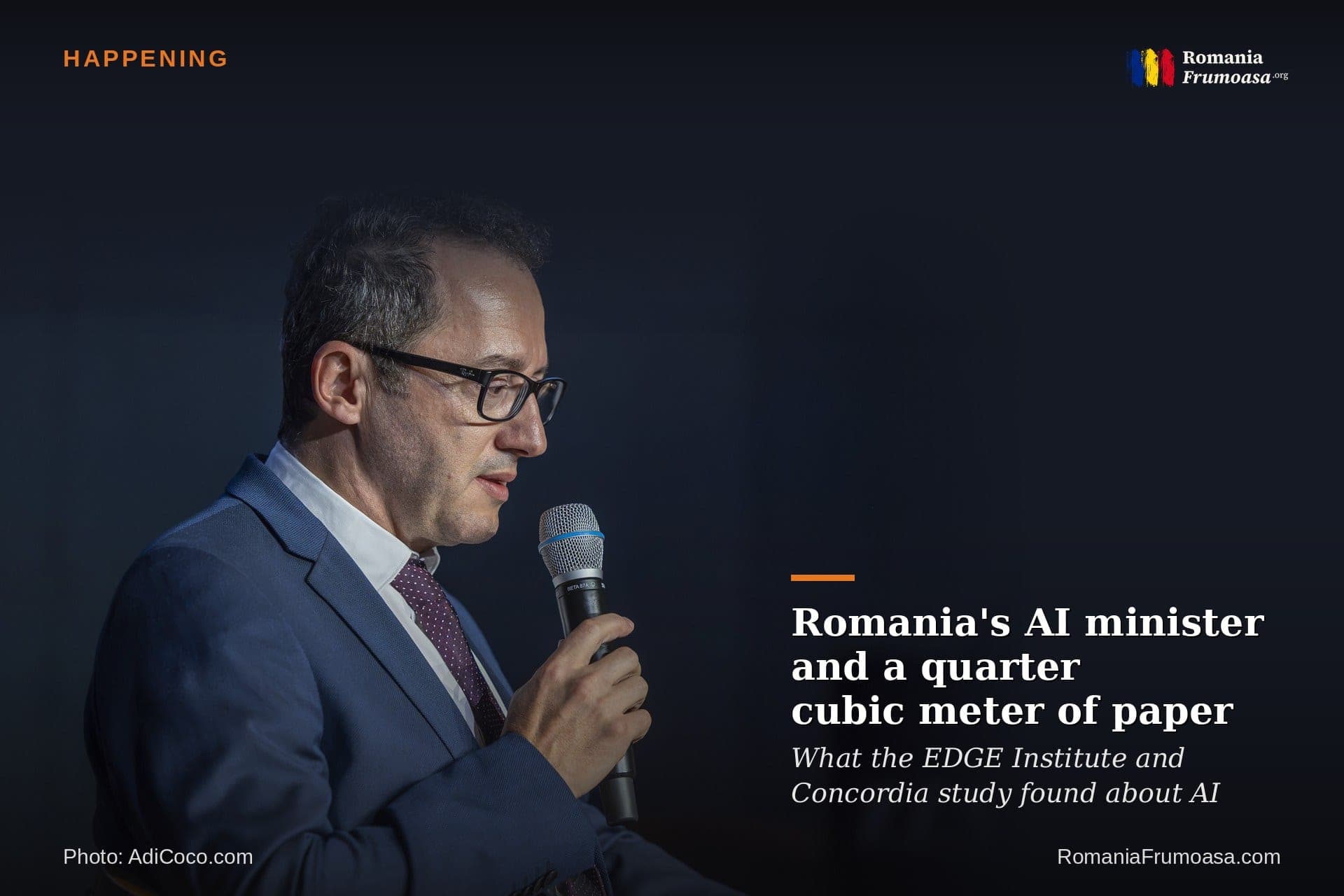

A quarter of a cubic meter of paper. That's how much Bogdan Dumitru had to read in his first week as a minister.
"I've never seen so much paper in my life," says the man who spent 30 years in the private sector, 23 of them as chief technology officer at Bitdefender, the Romanian cybersecurity company. So he has changed his goals, he admits: he now wants every printer in the ministry gone — "even with the minister delegate there."

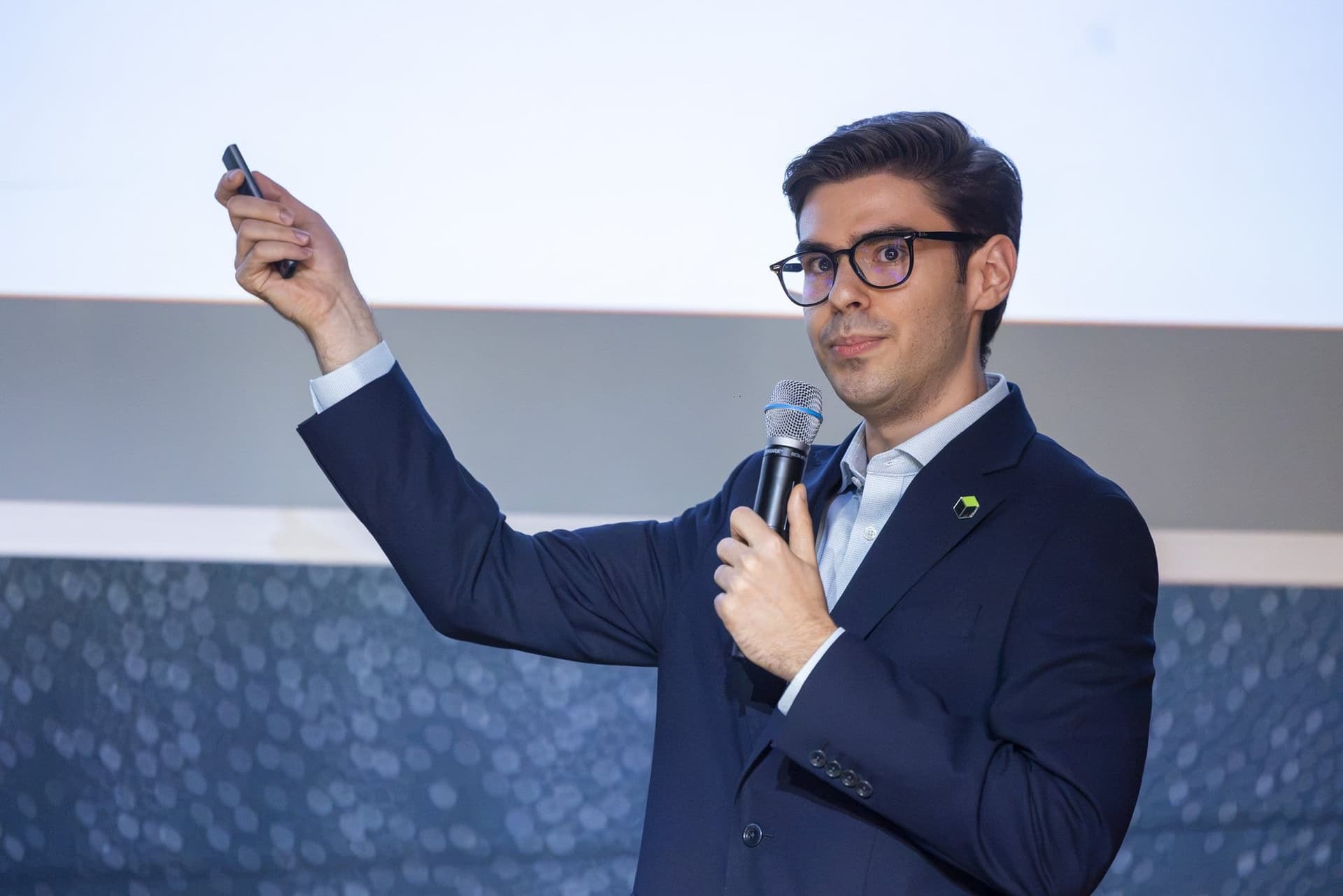
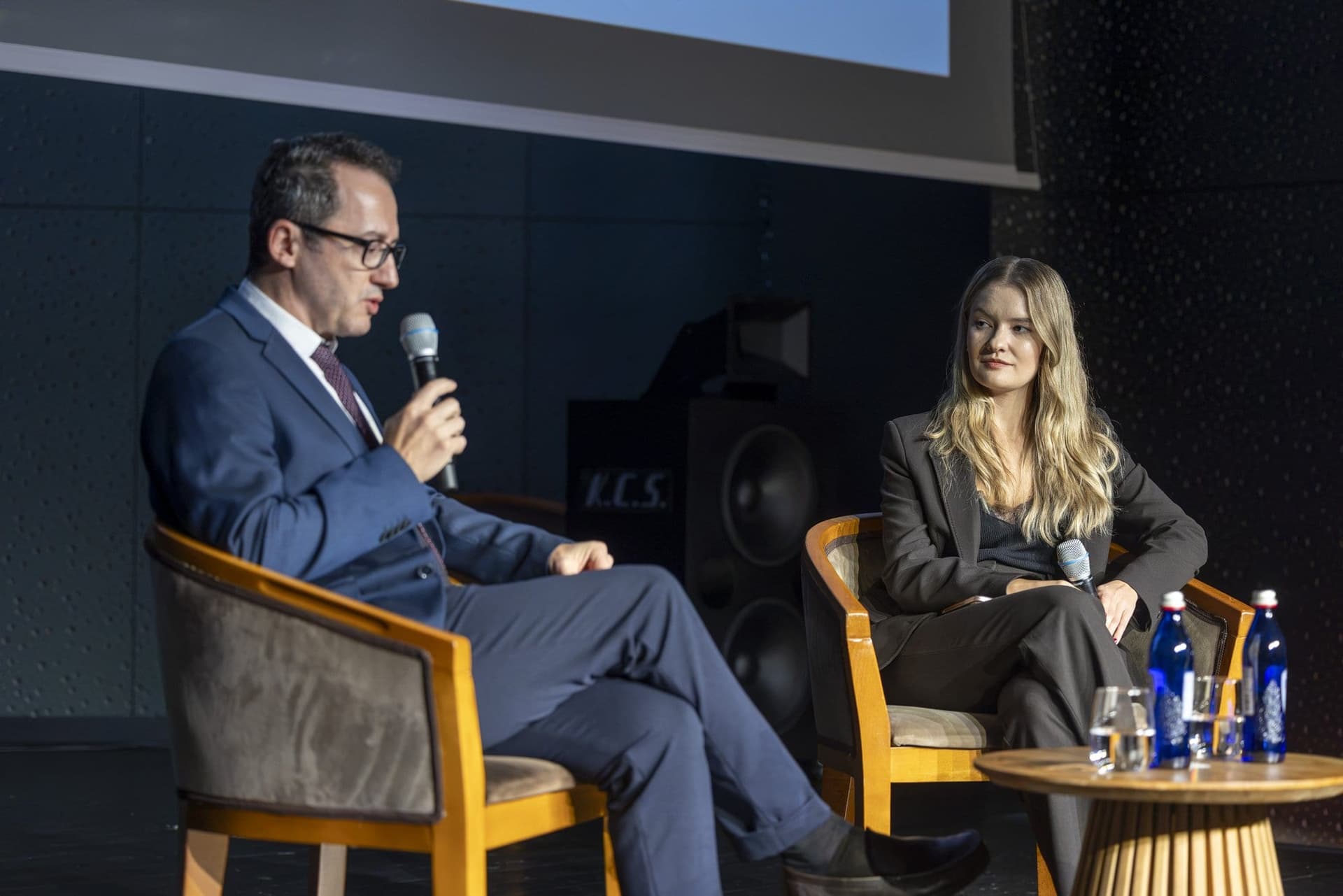
He told the story on Thursday evening, Oct. 29, at the launch of a study by EDGE Institute and the Concordia Employers' Confederation on artificial intelligence in Romanian companies. He had been in office for nine days. When Melany Pașca, EDGE Institute's director of public policy and legal affairs, thanked him for taking time away from the ministry, he made a point of noting: "It's still not quite clear to me what time the workday ends there."
The room laughed, but the joke wasn't far from the subject of the evening. Robert Berza of EDGE Institute, the moderator, had opened with a simple thesis: artificial intelligence is entering Romania through people, not institutions. The minister was a case in point — a man used to working with AI agents, now inside an institution that still prints. In companies, the study shows, the gap is the same.
Widespread, but shallow
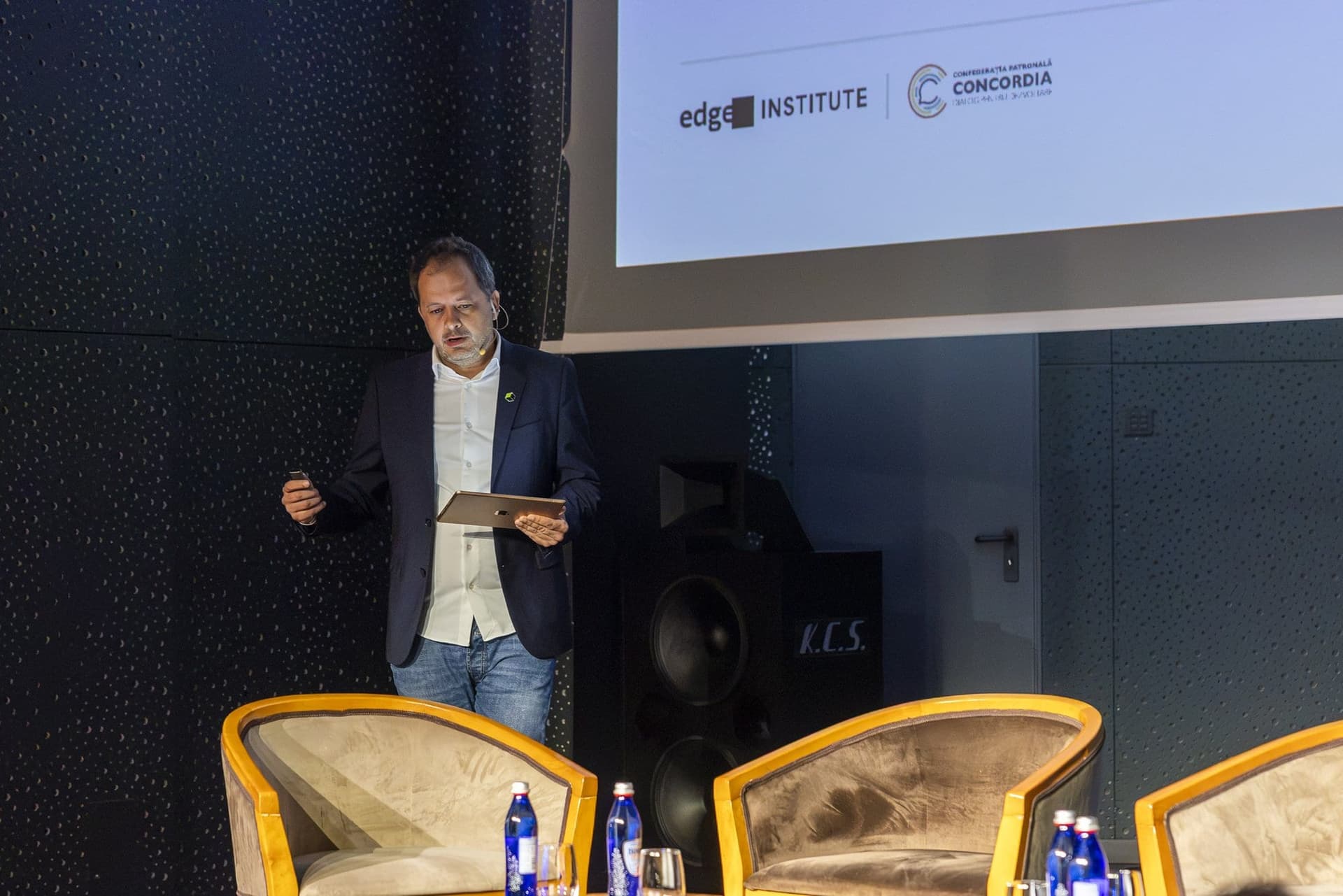
According to the research, 61.7% of Romanian companies with at least 10 employees use AI in some form. Only 13.5% use it regularly, and 3.3% have built it into their work processes. The study's title sums up the difference: "Widespread Use, Shallow Integration."
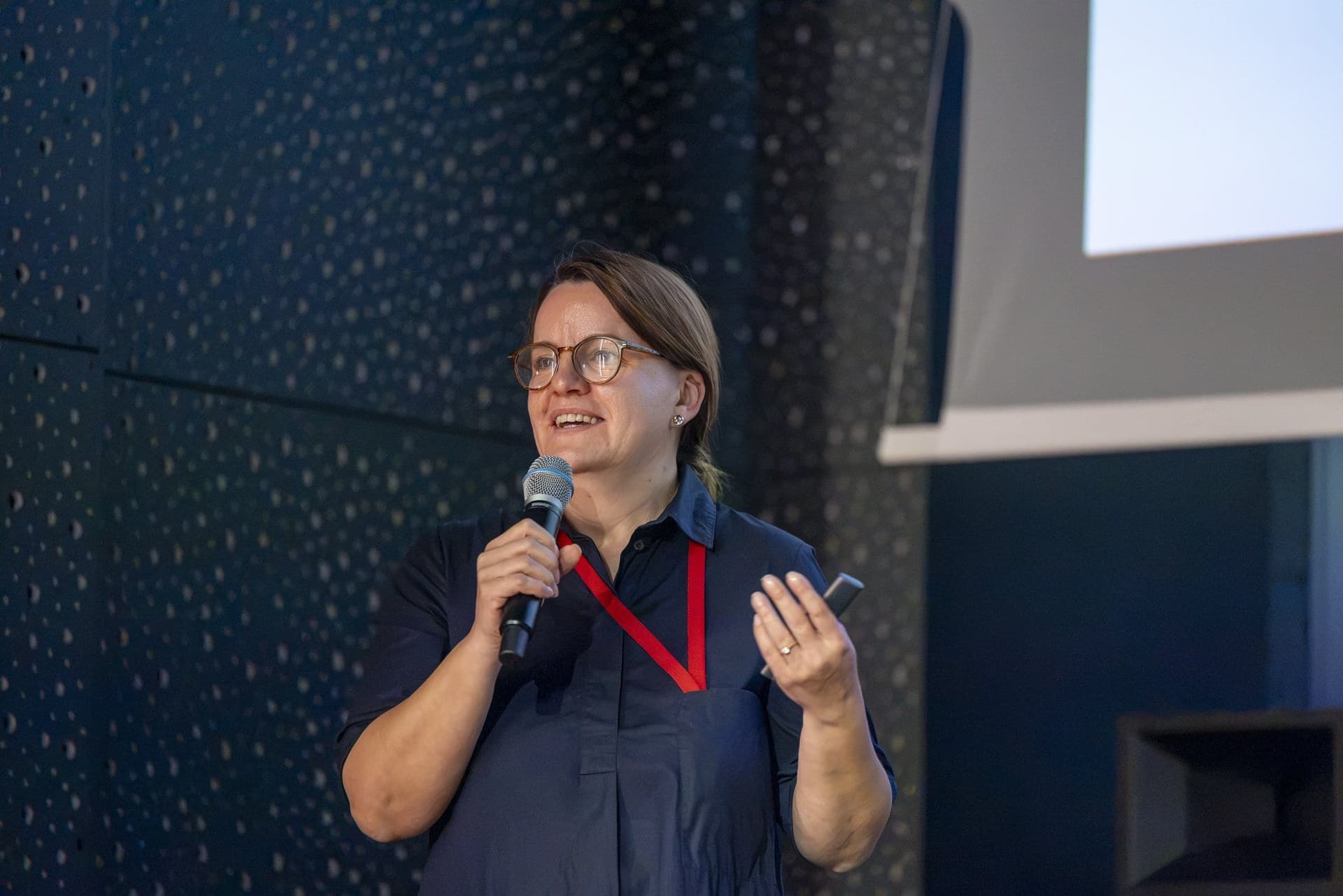
At first glance, that figure contradicts European statistics. For 2025, Eurostat ranks Romania last in the European Union, with 5.2% of companies using AI against a European average of 20%. Alexandru Dănescu, a co-author of the study, explained the gap: Eurostat counts a fixed list of technologies used at the institutional level, while the study also counted the employee who writes emails with a free chatbot account.
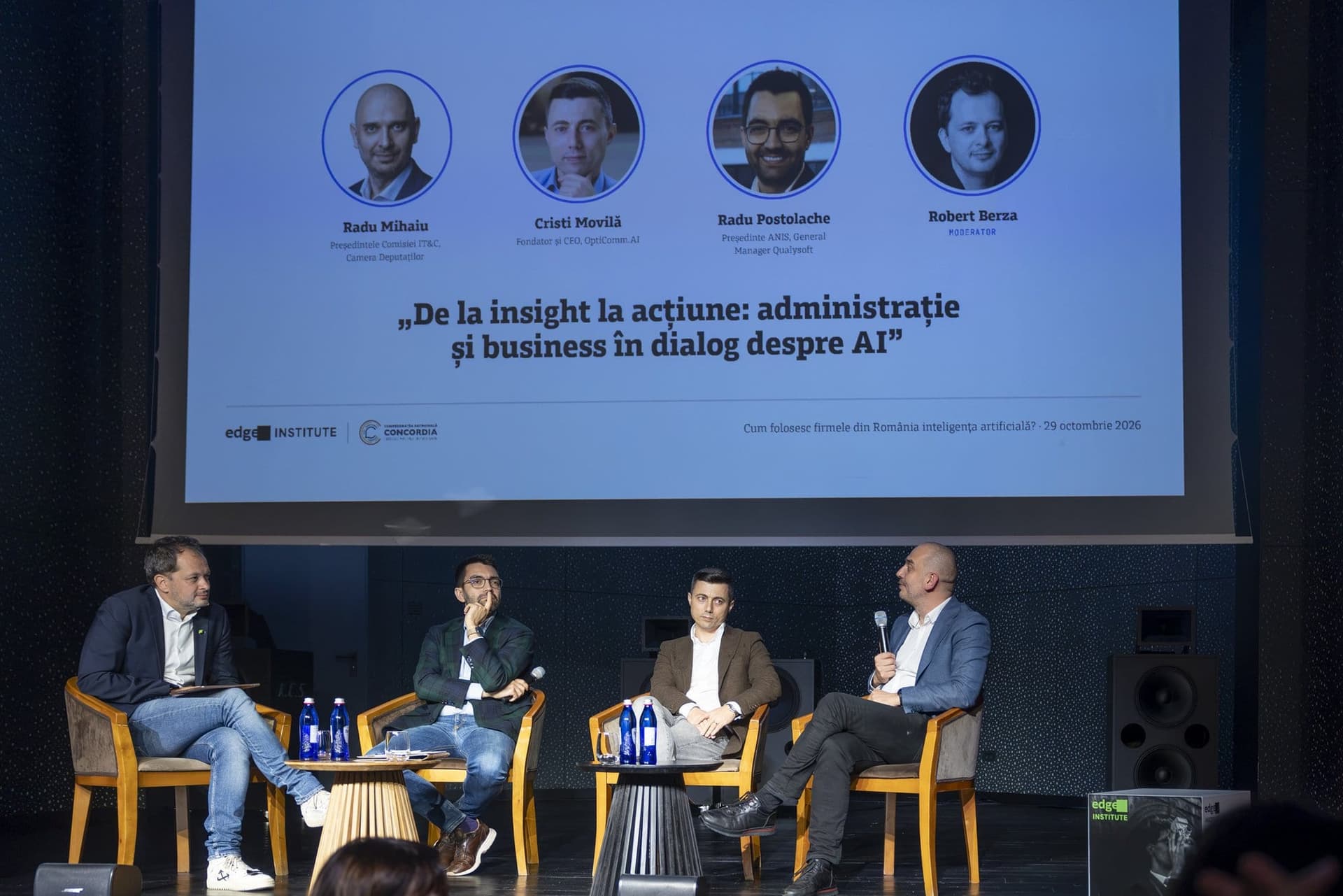
That is where the shallowness lies. In 56% of the companies that use AI, it reaches fewer than a quarter of employees. Radu Mihaiu, who chairs the IT&C committee in Romania's Chamber of Deputies, put the difference in one sentence: a company whose employees use AI is one thing, a company that uses AI is another — the second has it written into its strategy. Cristi Movilă, founder of OptiComm.AI, who works with large companies, was even more skeptical. Many companies that say they use AI actually just have a chatbot on their website, he said, and the real percentage should be "divided by 10."

The typical company in the sample has about 18 employees, doesn't export and is Romanian-owned. The survey was conducted by MIA in the summer of 2026 through 1,003 phone interviews, and most of the time the person answering was the owner — the one who makes the decisions. Almost half of the business leaders said they don't know what artificial intelligence is or don't know how it would apply to their company. For them, Movilă has a simple image: AI is an employee you give a computer, a goal and a job description. The world, he said, has moved from asking it questions to putting it to work.

The threshold is digitalization
The study has one central finding, which Dănescu repeated several times: it isn't a company's size that determines whether it uses AI, but how digitalized it is. The researchers measured eight digital tools, from customer and resource management software (CRM, ERP) to robots. Forty-six percent of companies use none of them — 55% of those with 10 to 25 employees and 3% of large ones.
The difference shows up immediately. Among companies with no digital tools, 33% use AI. Among those with three or more, 91% do. Large companies use more AI only because they digitalize more easily; once digitalization is taken into account, the gap between large and small companies nearly disappears. The exception is foreign-owned companies, something the authors have not yet been able to explain.
Radu Postolache, president of ANIS, Romania's software industry employers' association, and general manager of Qualysoft, reached the same conclusion from the industry side: without data and digital processes behind it, AI becomes "a glorified search engine." In other words, a chatbot.

Preparation has lagged behind use. Only 20% of companies have any kind of training measure, and 26% have any rule on how AI should be used. Thirty percent want to invest, but intent again tracks digitalization: 6% of companies with no digital tools, 75% of those using five or more. And 78% of those that want to invest need outside money.
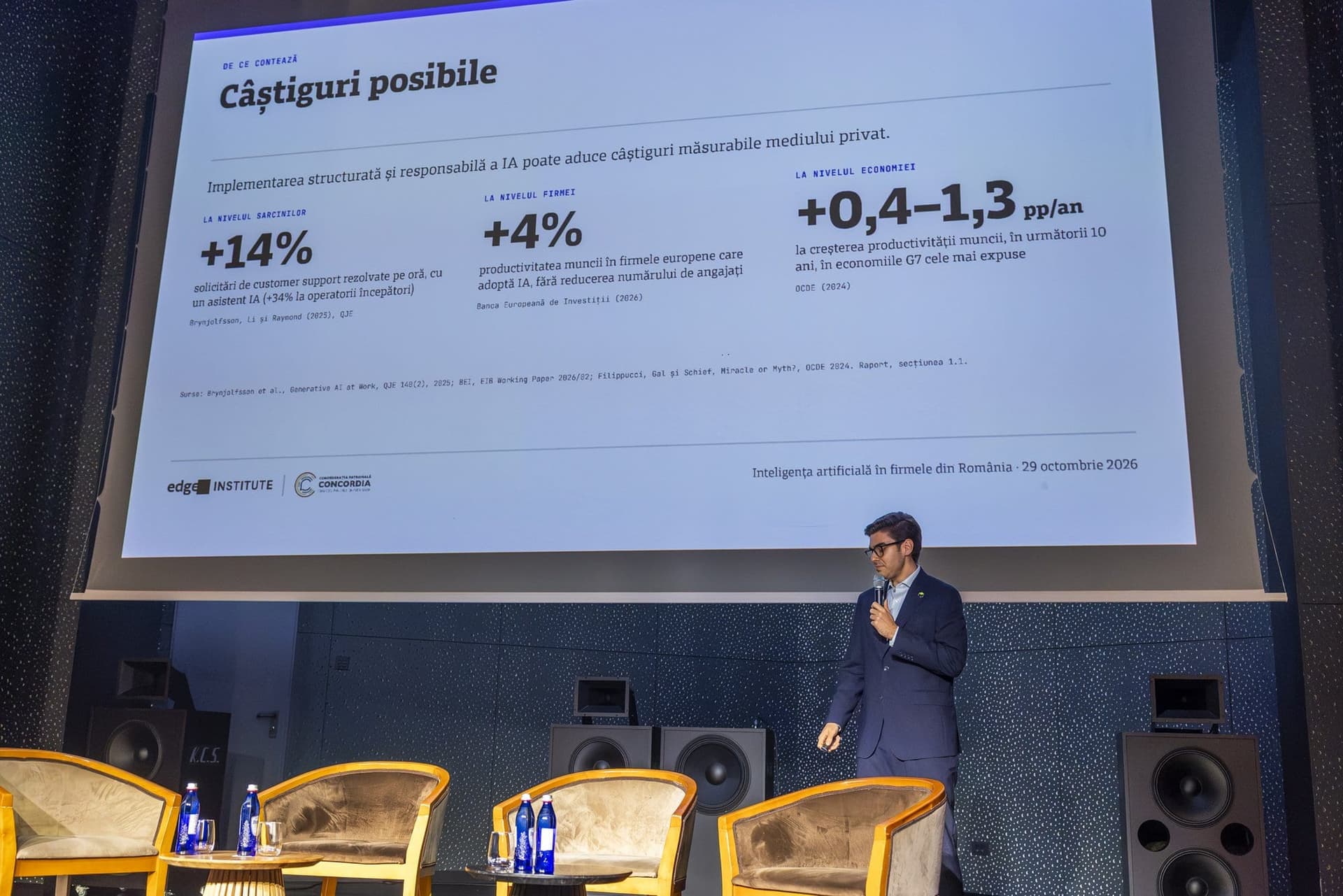
What is being lost? Starting from a 4% productivity gain estimated by the European Investment Bank, Dănescu calculated a rough opportunity cost of about 32 billion lei a year. For companies that are already digitalized but don't use AI, the figure would be about 5.4 billion lei.
What the state can do
Dumitru answered the question in two parts. The state should be a facilitator, "and if it can't do that for one reason or another, it shouldn't stand in the way too much."
The other guests added to the list. Postolache proposes simple vouchers for small and medium-sized businesses, administered through suppliers, with a free assessment that first establishes what each company needs: some need basic software (CRM, ERP, document management), others cloud, and only at the end AI. The model to follow, he said, is Spain, where such a program brought in 11,000 suppliers; the one to avoid is Britain, where a program built on a narrow catalog of products failed. Mihaiu wants the state to provide trusted data and infrastructure, not more rules. He also believes Europe started regulating before it knew what it was regulating. His example of what AI can do for someone working on their own was a blind colleague, a massage therapist with his own small business, who built his website and promotion himself.
Concordia's conclusions, which closed the evening, pointed in the same direction: support based on each company's level of digitalization, money for using technology and not just buying it, training aimed first at owners, and minimum rules delivered along with the tool. Asked what should be done in the next six months, the Concordia representative kept it short: "The first thing is to put the right people in the right place."
A ministry is a company, too
Asked how to reconcile speed with data security, the minister offered a comparison. A ministry, he said, can be seen as a company of a certain size, with different goals but the same processes. And the processes exist and work, if perhaps not as efficiently as they could.
From conversations with people in other ministries, he has learned that AI initiatives already exist. The problem is that they happen in isolation, each inside its own institution. His main goal is to connect the state's systems; he noticed that the term people use for this is to "poke" the ministries. If a common API can't be built quickly, he has a fallback: "At least let me put an agent here and one there, and let them work it out between themselves. And I'm not joking."
On the paper problem, he did some checking of his own. He set one of his agents to look at how others are doing. Neither the United States nor Europe is doing very well, "so it's not just Romania in this equation."
Seen through the study's lens, the ministry he described looks a lot like many of the companies surveyed: isolated initiatives, systems that don't talk to each other, paper. And the order of steps is the same. Connection first, artificial intelligence after. The minister acknowledged that the plan "doesn't look easy" and that the oath on the Constitution "makes you responsible in a much deeper way than I thought."

Until the agents learn to work it out between themselves, the quarter cubic meter of paper still gets read by a person.
Quotes were transcribed from our own recording of the Oct. 29, 2026, event and translated from Romanian; the study's figures are those published by EDGE Institute and the Concordia Employers' Confederation.
This English version is an automatic translation of the Romanian original.