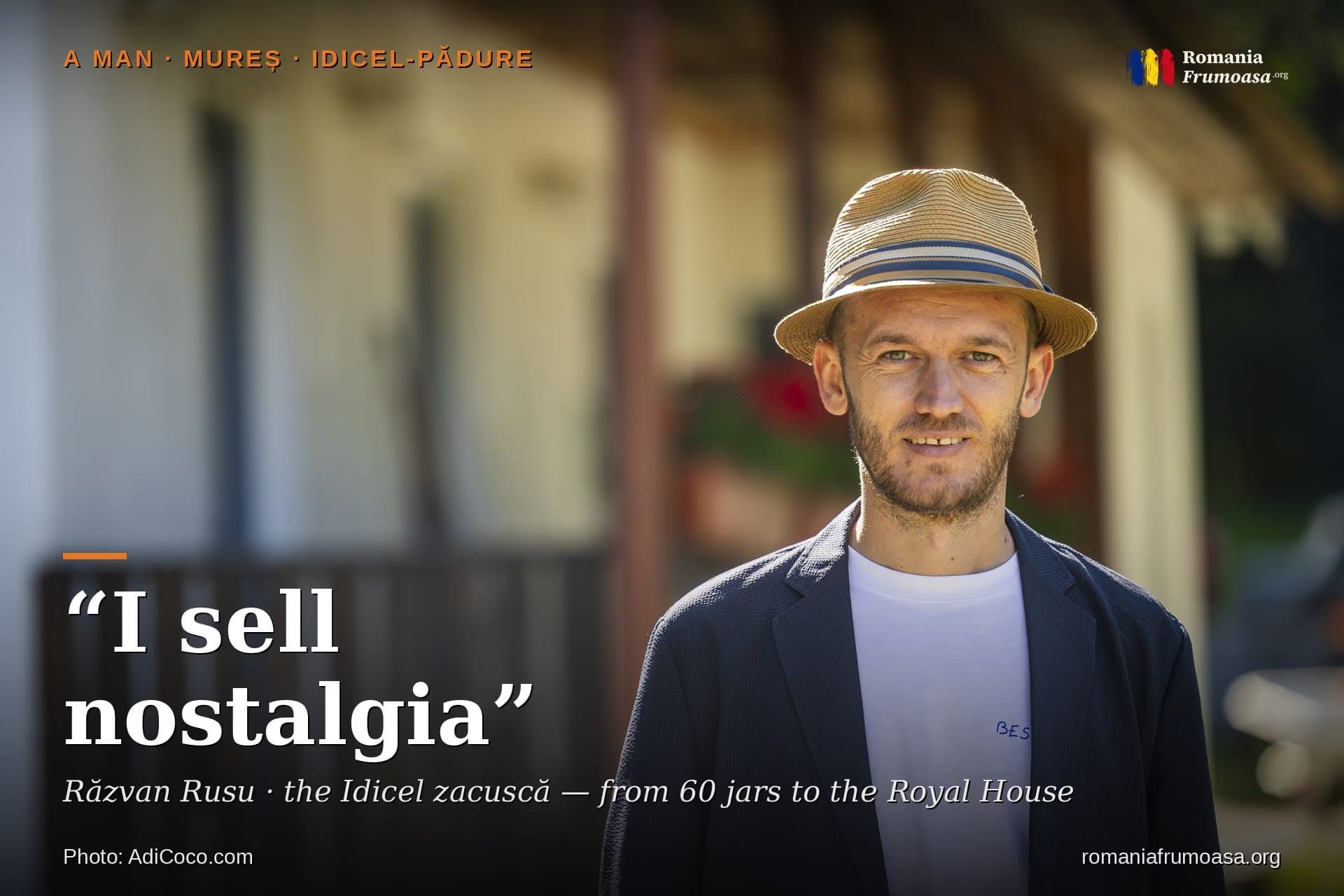
"I Sell Nostalgia"
A Man · Mureș · Idicel-Pădure
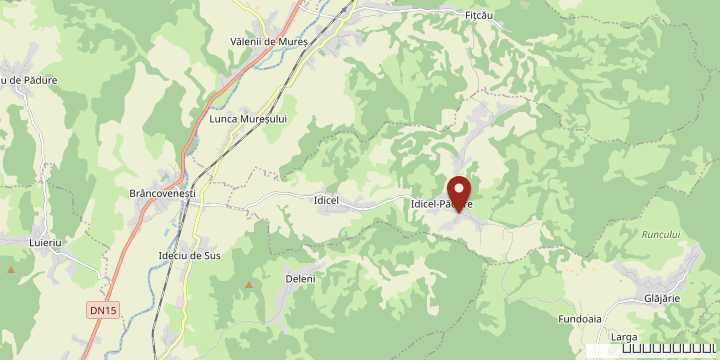
Răzvan Rusu was 23 and jobless when a university placement brought him to a village beneath the Gurghiu Mountains he had never set foot in. A local woman told him the hills were full of fruit that nobody picked. The next day he was making cherry jam in a cauldron in her yard. 14 years later, "Răzvan Idicel" sells hundreds of thousands of jars a year, is an official supplier to the Royal House of Romania, and his company has passed 2 million euros in turnover. All of it still cooked, in cauldrons, by the women of Idicel-Pădure.
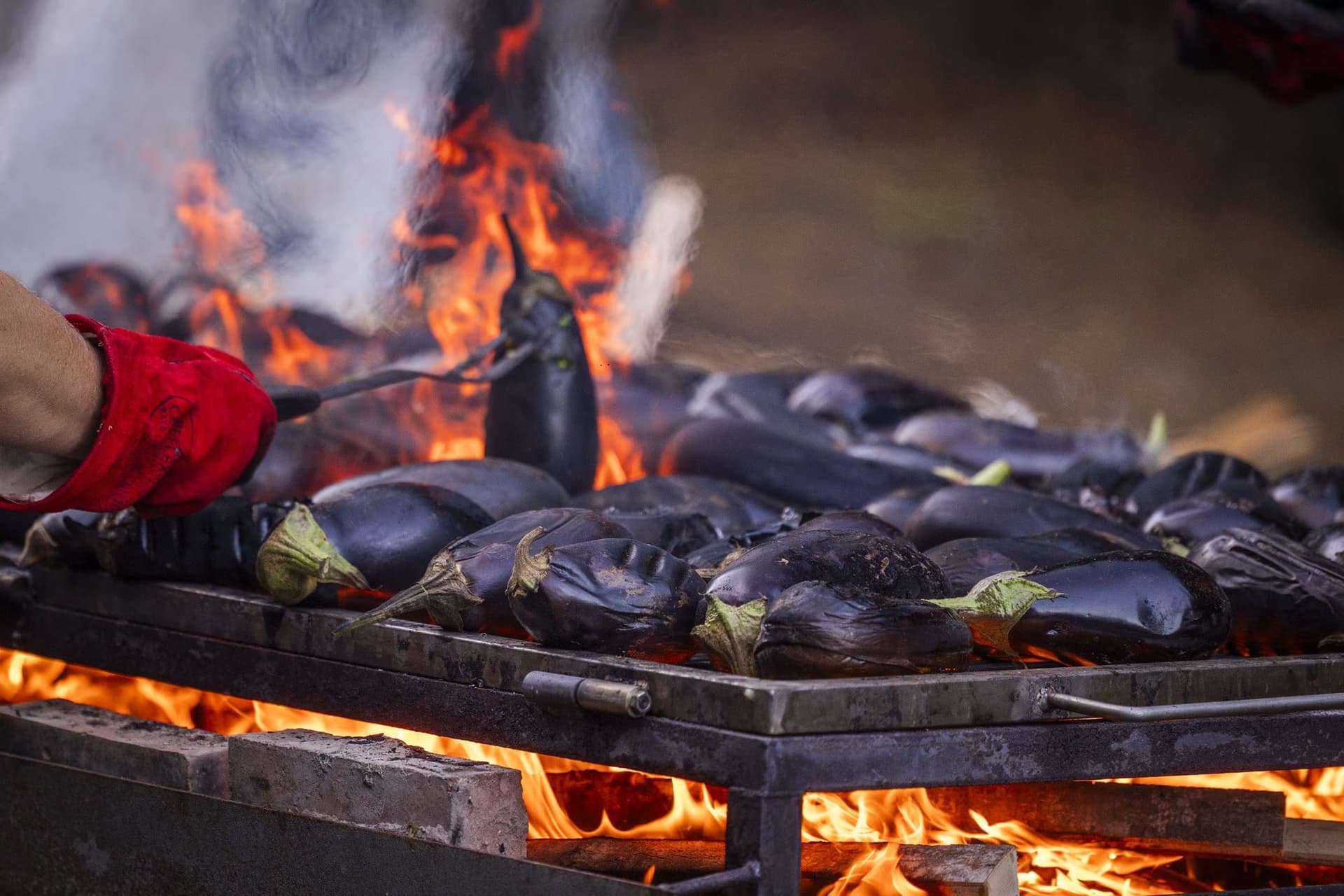
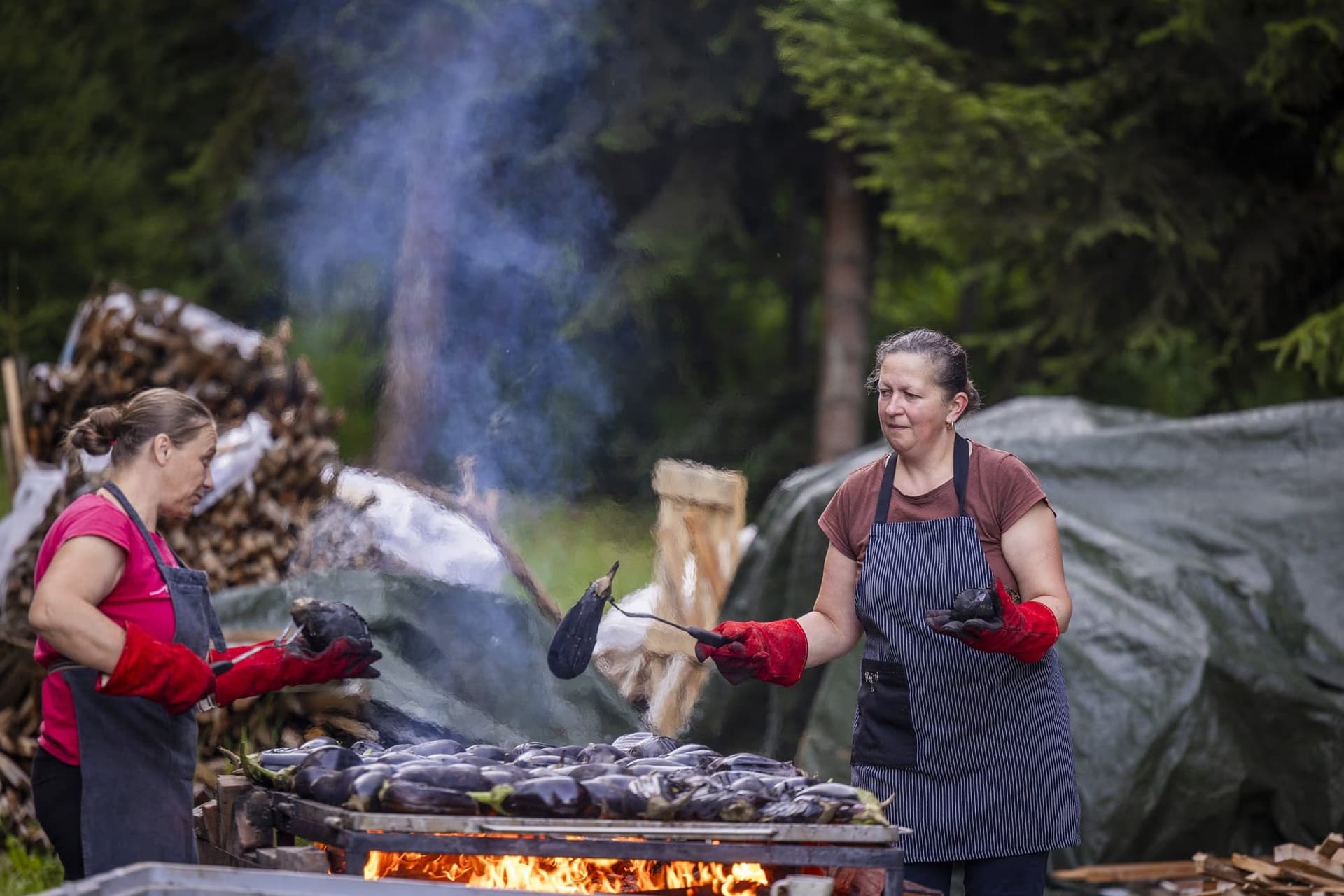
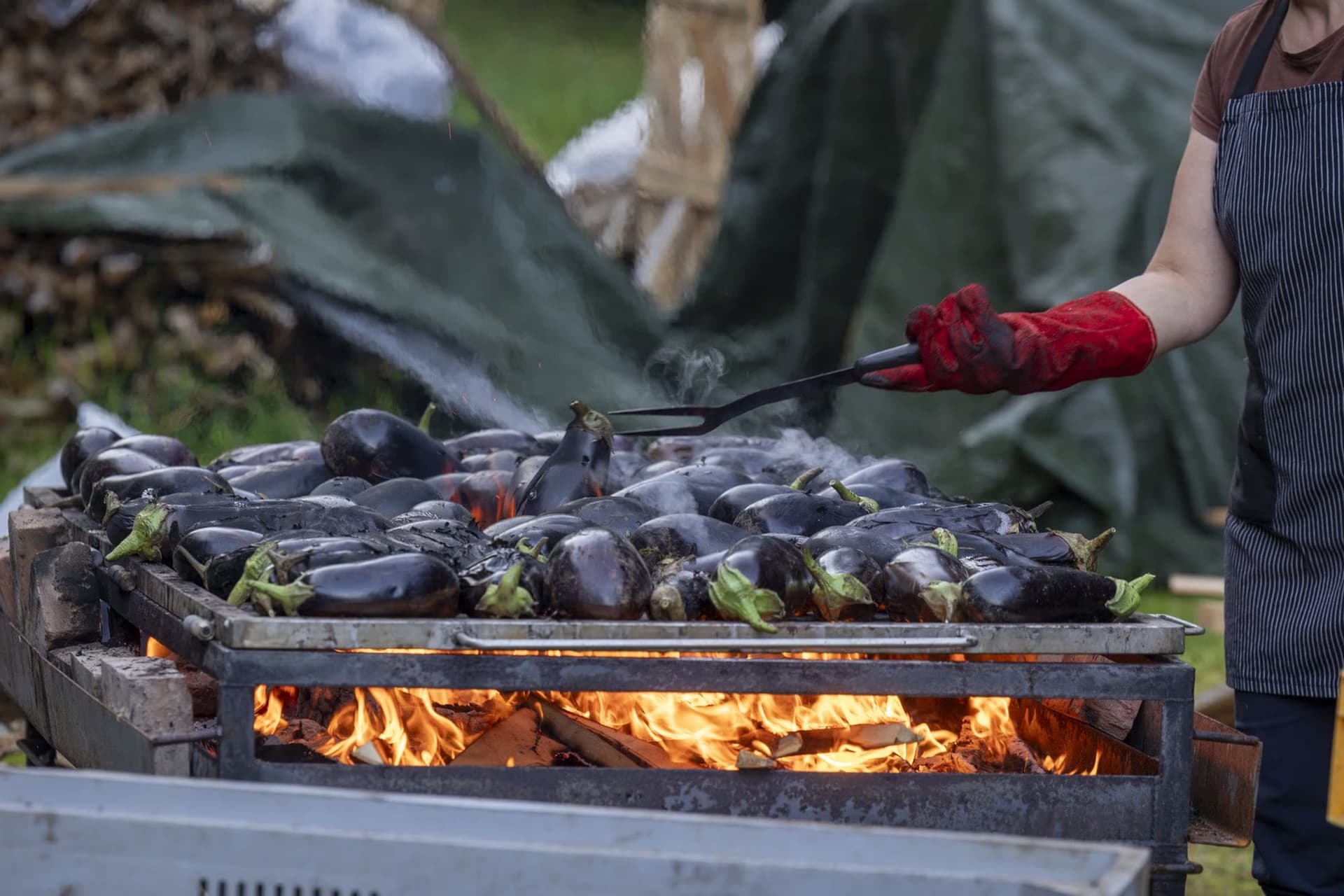
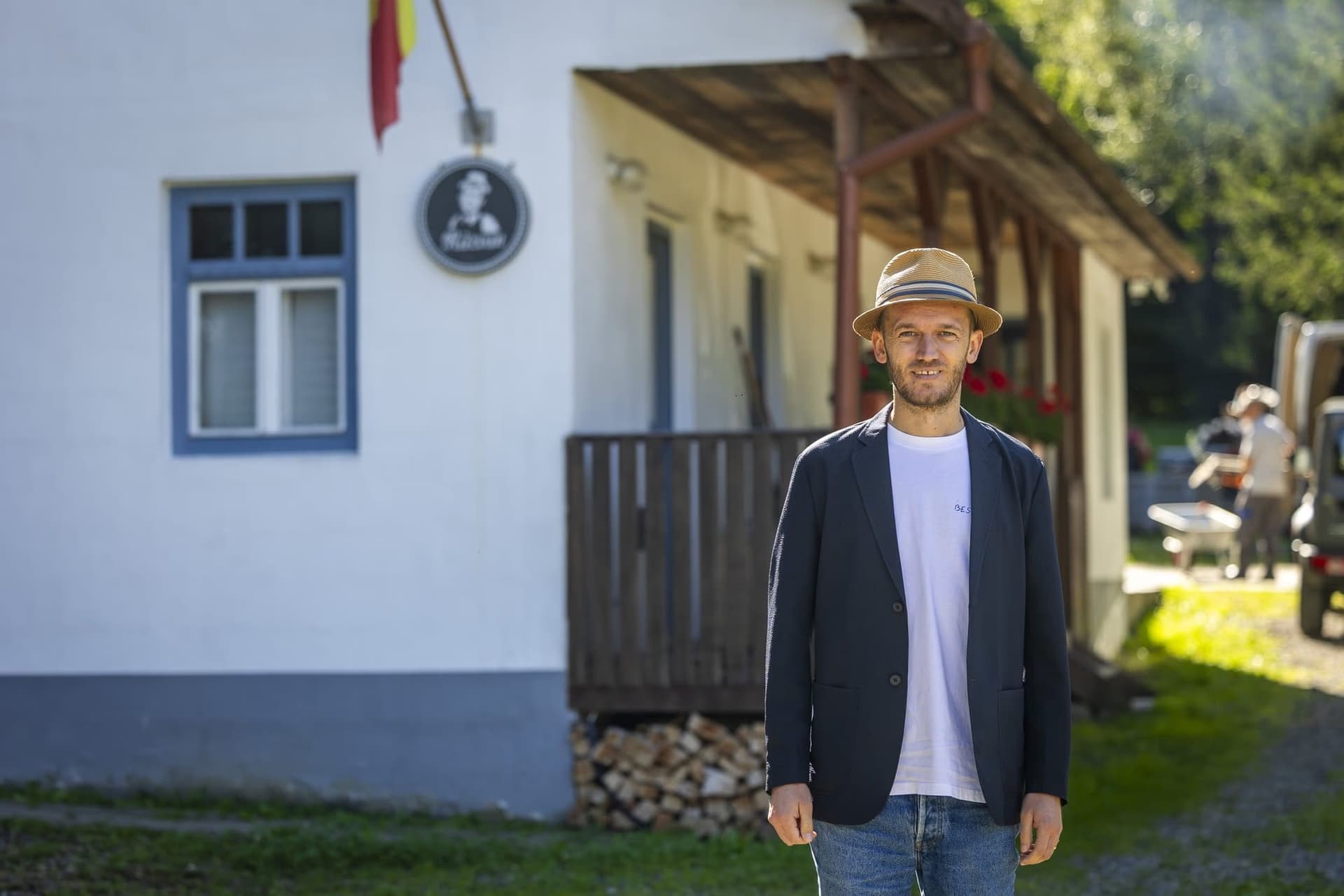
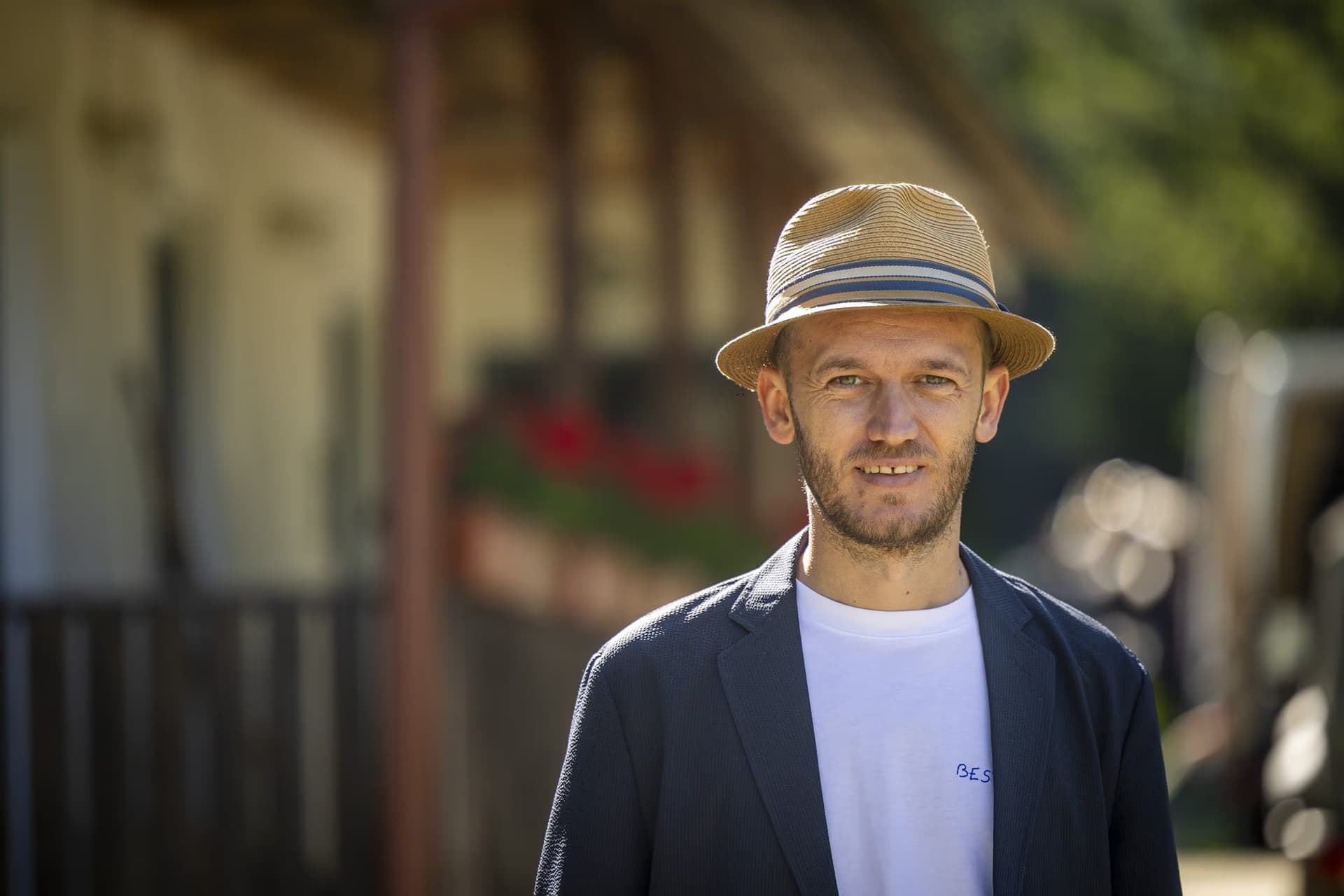
We talk in the yard of the little factory with its tricolour flag, on a July morning. A few metres away, the day's aubergines — 900 kilograms — are roasting on long grills, and now and then a cowbell sounds from the forest above. Răzvan Rusu wears a straw hat and keeps his phone in hand, between orders. The conversation ran twice as long as planned. We reproduce it almost in full.
"I'll come tomorrow and we'll make jam"
Răzvan, you're from Reghin, not from Idicel. In May 2012 you came to the village for a university placement. Cows by day, questionnaires by night. What was in those questionnaires?
Welcome to Idicel-Pădure, first of all. The questionnaires were questions about the households: what capacity the people here had to develop the village, to develop economically. Being a mountain area, everyone kept animals, dairy cows especially, and they all told me to do something with the milk. But I knew that was very, very hard — I would take the information, type it into the laptop, and there it stayed.
On those walks, though, I discovered the village. I saw how people settle, what they do, where they live, what lies around them — and that is how I discovered the cherries of Idicel-Pădure.
Veronica Gavrilaș told you the hills were full of fruit that nobody used, and you answered: "I'll come tomorrow and we'll make jam." Honestly: was it courage, recklessness, or did you simply have nothing better to do the next day?
Good one! I think I had nothing better to do. I was 23 and I gave myself a job, basically. At 23 you have nothing to lose: you have time, you have no money, you've found some cherries. I put out word in the village that I wanted to pick, I gathered — I don't remember how much, 100, 50, 200 kilograms, I genuinely don't remember the exact quantity, I never even wrote it down.
There was recklessness in it, but also the wish to make something, to develop a product entirely by accident. I have no experience as a cook, no great-chef credentials. I simply said: the fruit is here, Auntie Veronica wants to help me, nobody cooks in a cauldron any more — let's see what can happen. And here we are, 14 years on, still at Idicel-Pădure, in this universe of creation I enjoy day after day. I already live here.
"At 23 you have nothing to lose"
That was the first day of buying cherries. What thoughts did you take to bed that night?
(sighs) There was an incredibly great enthusiasm, because I was building something out of nothing. And a very great desire to succeed — that was my fuel: the desire to succeed, to prove I could, to validate myself. Romania was in economic crisis, nobody would hire you, you had no great experience — so I wanted to do something interesting, with life in the countryside, with the opportunities of the countryside.
Veronica and I would sit in the shade on a blanket, pitting cherries all day long; in the evening we boiled the jam. The first cauldron caught us in the dark — we didn't boil it long enough, because we had no light: we stood there by moonlight, peering into it. The second evening, Uncle Viorel rigged us up a bulb.
None of it was much prepared. But we made a jam, it turned out good, and that's that. The most important thing is to have the desire to make something, and to enjoy it. I never once felt I was suffering in those days of pitting cherries.
The first 60 jars, by moonlight
How many jars came out of that first batch?
If I remember rightly, somewhere between 60 and 70-odd. Thereabouts.
From 60-70 jars to a turnover of 2 million euros is quite a leap...
It is a leap, indeed, but it's a leap over 14 years. And 14 years are 14 years of your life that you have given to the business. My whole life is concentrated here. I have no hobbies other than staying close to the business, to the people, day after day.
Your greatest competition is with yourself, not with the market. You have to reinvent yourself, stay current, stay alert, so that you remain relevant. If I had stuck to making jam alone, we probably wouldn't be having this interview today. But I also made zacuscă — a smoky roast-vegetable spread — and hazelnut cream, and chocolate, and mustard, and tea — I'm always making something new, so the consumer has something to choose from. There are people who know me only for the hazelnut cream, others only for the zacuscă, others only for the jam. For each of them I have one very good product.
"I sell nostalgia"
I sense a certain nostalgia in your voice. Isn't it a little early, though? You're one of the youngest successful entrepreneurs...
The "young" part — that I'm genuinely beginning to realise: that I'm not so young any more. And I think it's the greatest competitive advantage you can have: being young. There is no other competitive advantage in the market. Being young, you're connected to the real world, you feel it, because you're of this generation — and you can also learn from those who have been through the world. Youth is the greatest asset you have as someone who wants to make something: you can not know, but be young and want it. That is my own example — I didn't know, but I wanted it and I persevered.
The nostalgia comes from somewhere else. There are many layers of hardship in these 14 years. When you start from the beginning and go through them again, you pass through filters that were not all good. They settle. And when you pass through them once more, they give you this feeling of nostalgia.
But, in practice, that is what I sell: nostalgia. Food cooked in a cauldron. Nobody makes it any more; everybody grew up with it. It has a special taste that cannot be replicated. We have over 6,000 positive reviews on the site and everyone says the same thing: food like grandma's, like the countryside, like mum's, like home, you can taste the smoke... That is what we make: nostalgia. That's why we're here, that's why we didn't move onto an industrial estate, that's why we stayed at Idicel — to deliver, constantly, nostalgia and this good taste of food cooked in a cauldron. And I'm very glad you're here today, where you'll see how the aubergines roast on the grill.
"I never worked in London"
One of the headlines about you in the Romanian press is "Răzvan, between the City and the Forest." But you never worked in London, did you?
I never worked in London. Very good, those journalists — see, the nostalgia is taking hold of me again. That is where I found my first money, though, because I had nothing to start with.
My parents couldn't afford it. And how do you hand a 23-year-old money to build a jam factory? It was utterly utopian — you can't, as a parent from Reghin. The family didn't have the resources for such an investment anyway. So I had to go looking for money, and I did indeed end up in London, where I found an angel investor who put up half the sum needed. The other half I built together with my father: this house, a house raised from nothing in the Idicel style. It went up between April and 25 August. On 25 August we mark 13 years since the factory opened.
But at the same time, the headline has a point: I stayed connected for a very long time to everything abroad. My inspiration — what a product should look like, how I should present myself — comes largely from companies in France, Britain, America and, more recently, Japan.
You built the factory in 2013 and you said you designed it so that it could be turned into a chalet. As a plan B.
Yes, that's how it was conceived. I find it incredible. They didn't believe — and I understand them now. Who could have imagined that at Idicel-Pădure, where there had never been anything, you'd make jam in a cauldron and in 14 years reach these results? This is Romania; it's hard to dream quite that high.
On the other hand, the factory really has served as a chalet: during the pandemic I retreated here with my wife and daughter. We have a small studio, an office and a bedroom. I believe strongly in the energy you put into a place, in the way you conceive it. I have some guests from France right now whom I'll be putting up here. So it has that role too — a house, but also a workshop for making zacuscă and cauldron jam.
Veronica's pension
Veronica worked her first year as a volunteer — at the time you couldn't afford to pay her a wage. What is she in the company today, and how much of the success is owed to her?
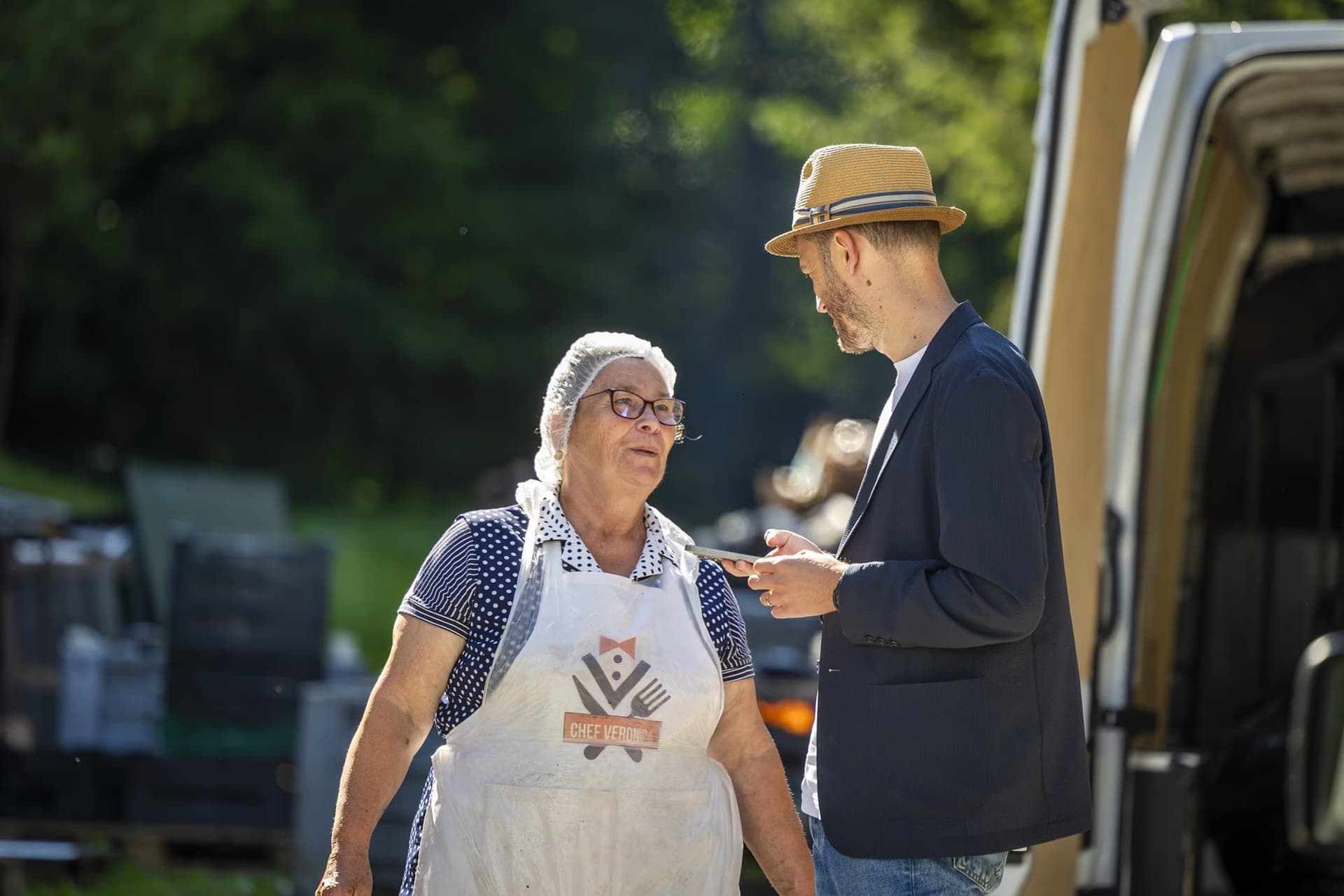
(sighs) Veronica has been the providential person in everything I've created, because she is the one who believed from the start. Even if perhaps it seemed strange to her, even if perhaps she didn't believe in all of it — she worked. She stood beside me and made jam.
And today Veronica has managed to retire from Tradiții din Natură — that's the company's name. It is a very important moment for her: a countrywoman who never had a job in her life, and at 52 someone appeared on a hill and said "let's make jam", and she said "fine, let's" — and after 14 years you receive your first pension. It's a great fulfilment, and I'm truly glad I had the chance to give her that.
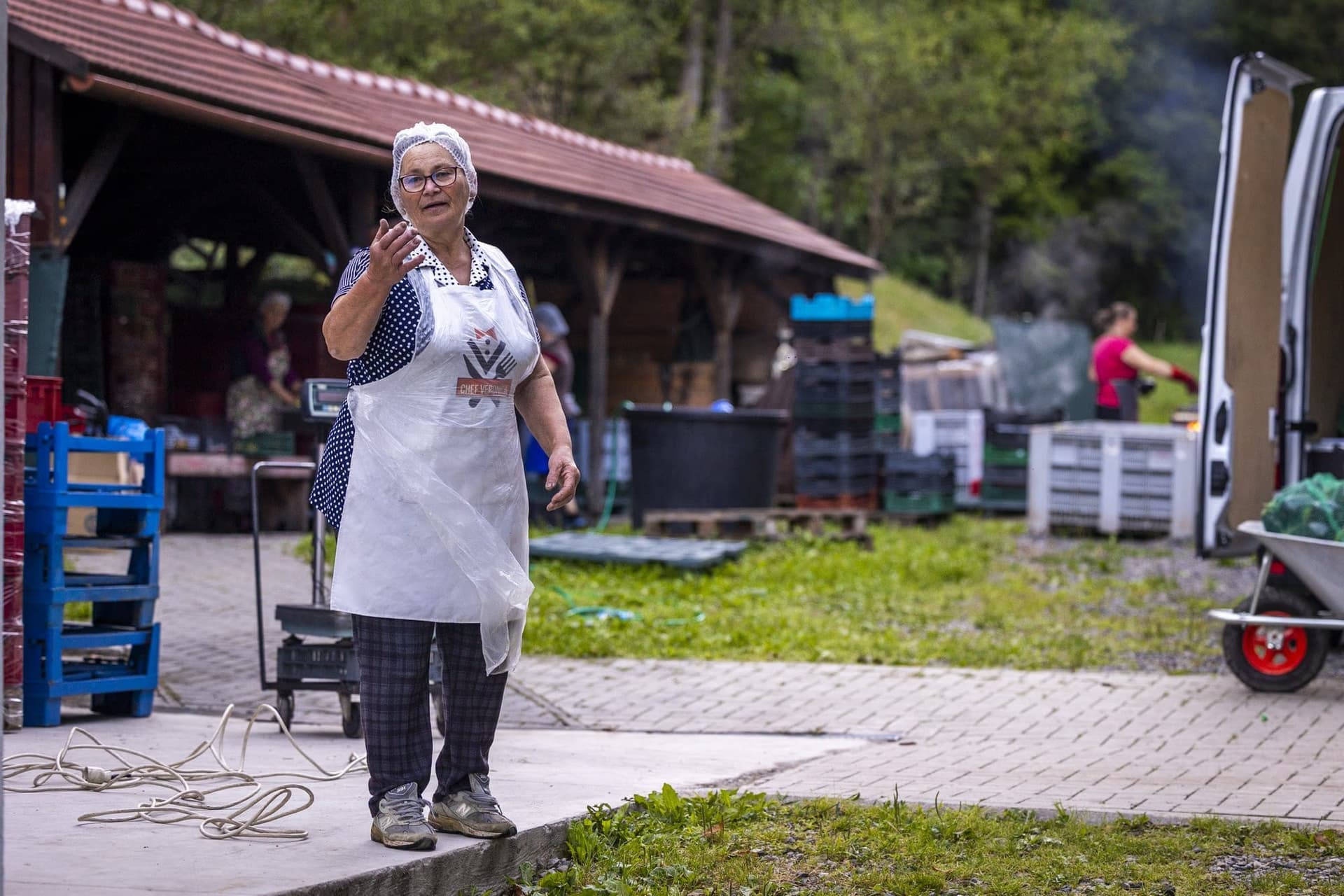
She had patience, she took care to keep things in order, and she formed here a community of women who help her. There are five of them now. The fact that Veronica is today in charge of production — head of production, if I may call her that — shows that age doesn't matter, if you have the desire to learn and to be constant. I repeat: until 52 she had never held a job. And today she is the vital link in the business I have. That's why I say providential: you don't just run into someone on a hill with whom you go on to build a 2-million-euro business. There is a destiny here.
Five women from the village actually work the cauldrons. What does this business mean to them, beyond the wage?
I recently discovered that it means a recognition — from me — of the work they put in day after day. They have the feeling that they contribute, that they are doing something good. Besides the household, where they care for their families, to come into a new environment and receive at the end of the month, on top of the wage, recognition and care — that is a very good thing.
I've never had problems. A small community, people mind how they're seen — you're in a village. I have no HR, nothing beyond what the law requires; otherwise — Veronica, me, we help each other out when there are big orders, when someone's away on holiday. There is a very great deal of understanding and communication.
At least the village women stirring the cauldrons don't have the sword of Damocles of AI hanging over their heads. Their jobs won't be taken by artificial intelligence.
AI hasn't reached them yet. It probably will, at some point — I really can't say. If two years ago I'd have said such a thing could never exist, now, seeing what's happening, I no longer know what to say.
But roasting aubergines over a wood fire, the fire in the stove that has to be tended — that, AI probably won't be able to do. It may learn to stir the cauldron, but fire management is hard for AI, at the grill and in the stove alike. The energy that goes into our food comes from this place and from the fact that human hands, not robots, do the work. And you can feel it in the jar: nothing arrives ready-made, nothing happens on a programme.
I think that being the alternative — remaining a custodian of traditions, where cauldron-cooked food is concerned — will be the most important thing I have in the AI future. I recently invested in a garden — I believe deeply in the soil, in making something with your own hands. We are the alternative to all the AI that will surround us.
Parting ways with the Englishman from Unilever
In 2021 an Englishman presented as a former Unilever CEO joined the company. Today you are sole shareholder again. What happened?
I had a very good opportunity to meet James and to see what vast experience in FMCG looks like, in food and in commerce. There were two or three years — I don't remember exactly — in which I learned quite a lot. But much of it didn't fit: our model of development differs greatly from the industrial model, from a corporation's. It starts from resources, from mindset, from what you want in life.
At some point I decided: I want to stay here, as I am, with the cauldrons. I don't feel I need to do more than grow organically, the way we have grown every year. That is how I feel my life is. So each of us went his own way.
It was an important stage, though, in which I got to see the other side, to understand how it all works. I took good things from it, a tenacity. It was, in effect, an MBA I had the chance to do — and I'm grateful to James for it. But my place is here, with the cauldron — you can hear the cowbell; I don't know if the microphone picks it up. There is a spirit here, a life I want to live, to put in a jar and send out into the world. What I do here is good.
"My competition is the mothers-in-law"
Zacuscă brings you 60% of your revenue. Why do Romanians pay for something they claim they make better at home? Everyone says they've never eaten zacuscă anywhere like the one made at home.
Because they no longer have time to make it. And if they have found, in retail or online, a zacuscă that resembles the one from home, they buy it. My competition, my rivals, are the housewives, the grandmothers, the mothers, the mothers-in-law.
We grew on the fact that very few people still roast aubergines. What we're doing on the grill today is done, perhaps, by two families who get together for fun. But to be able to pay for a product in which the aubergines are roasted on a grill and everything is made in a cauldron — it's a privilege to have that chance. That's why 60% of my revenue comes from zacuscă: because it is, quite simply, food. Zacuscă fills you up. Jam is for dessert, chocolate is for a gift, hazelnut cream is for breakfast, for pancakes — but zacuscă is a meal. And that feels different.
What is the first thing you allowed yourself that in 2012 you couldn't even imagine would be within reach?
(pause) The first thing was a radio. A very beautiful radio, some 400-500 dollars — a Revo. That was the object.
But before objects comes the fact that I have been able to travel, to go out into the world, to explore. That, I believe, is the most important thing I have: that I have travelled. As an object, though — that radio, the Revo.
1,000,000 jars, from the cauldron
You have declared a target of a million jars a year. Can a million jars still be cooked in cauldrons, over a wood fire?
Yes, they can. We want to build a small extension here — add five more cauldrons, to have 12 in all. If we make 300,000 a year in a single shift, on seven cauldrons, then in two shifts and with five more cauldrons a million is easily done. It all comes down to organisation and to the market you have.
I think that's also roughly where the limit lies — which is why I set myself this ambitious target: because I can see the flow can still be controlled. Three times what we do now, with better organisation, is possible. There are still some years of hard pulling before a million jars, but the idea is to be ready. I kept postponing; this year we'll probably start the extension here — although the original plan was in the centre of the village, where we have land for a bigger factory. Except it makes no sense. What I have here is perfect. Let others do big. We add one building at the front, one at the back — and that's it. That's the size of the business, here at Idicel-Pădure.
You have refused automation. What, concretely, is the red line you would not cross, whatever the revenue it might bring you?
I can't say I'm a zealot against automation, I'm really not. A year or two ago we introduced automatic stirring in the cauldron, because doing it by hand was an enormous effort. But that's about where we stop. (laughs)
At home, when you cook, you don't have many automatisms. You have a grinder — we have one too. We have a labelling machine, but we place the label on the belt by hand, so that it sits straight and takes the batch number. Things should be done simply, not needlessly complicated. I built myself a custom pasteuriser, because we didn't have enough electricity — I had to make it for the capacity we have here. Everything here is built to my needs; nothing is standard, bought off the shelf. I think that is what makes the business different: nobody comes to sell us production lines, fancy mixers — there are all sorts of those flying machines that aren't for us.
With chocolate, on the other hand, we have very capable lines — hazelnut cream, bean roasting, chocolate moulding. There, yes, technology helps enormously: control, everything. At the cauldron, though, you have to be a good housewife and know the fire. Fire management is the key, here at Idicel.
"My sabbatical is every day, here"
They say a well-built business is not necessarily the one with the biggest profit, but the one that survives even without its founder. Would "Răzvan Idicel" survive without Răzvan?
(sighs) Perhaps it's too early for it to survive, I can't tell. And I can't tell whether it should, either, because this business is the expression of my creativity and of my joy in what is beautiful, in every sense. It shouldn't be otherwise, because this is who I am. Răzvan Idicel is me, in the form of a commercial legal entity.
I meant the case where you might want to take a sabbatical year. Would you find the company in the same condition on your return?
A sabbatical year I wouldn't take. A month, perhaps. But I've never asked myself that question, because I don't see it as valid — at least not now; maybe in 10 years. I love what I do here. I wouldn't leave for anything. I go away for 10 days, a week, three days — but my sabbatical I live day by day, here. If I have created this universe, in which I take part every day through presence, through ideas, through conversations, then I live very well. I don't need to go anywhere.
How was the move to Bucharest — and the return?
I wanted to move to Bucharest. I was living in Cluj and I wanted a bigger experience; Cluj had become too small for me by then. I stayed about three years. I gave myself work there too — a shop on Calea Floreasca, Prăvălia Idicel — and I commuted. It was a hard period, with the road, the shop, all of it.
But it's part of my formation. I saw what goes on, I met very good people, I enjoyed it. Then the pandemic came, and this was the best place of refuge. Here I had no worry about the stress of the pandemic, about being shut indoors. My wife and I decided we weren't going back: we stay here and see what comes.
Since then we've renovated a house and we live over the hill. But for a year and a half we lived at the factory, with a fire in the stove. We have a beautiful stove, but not at all a practical one: I would set my alarm for 2:00 and 4:00 in the night to feed the fire. I said: I can't do another winter like this, it's too much of an ordeal — Eva was three.
Since I moved, the business has, I think, tripled. When you're younger, you believe happiness lies over the next hill — that if you go there and do that, something else will happen. There's always this expectation that beyond the hill lies a happy clearing. Having lived through all of it, you realise that, in fact, the best place on earth is Idicel-Pădure. A former partner once told me: "It's best here," and I answered: "You're mad — what do you mean, Idicel-Pădure?" — I was very young, I was 25, dreaming of Cluj, of Bucharest. Now I've realised he was right. The cowbell is ringing, aubergines are roasting on the grill. Few companies have the privilege of being as deep in nature as we are.
Supplier to the Royal House of Romania
Since 2024 you have been a supplier to the Royal House of Romania. What has changed in the business, apart from a fine label on the coat of arms?
There is a greater care over everything, a different responsibility. And, indeed, a great honour: a brand begun at Idicel-Pădure, not a very big brand, has managed to receive the recognition of the Royal House of Romania.
It's a moment for leaving a legacy. The title is renewed once every three years — three or four, I no longer recall exactly. I was doing the arithmetic in my head: at the third renewal, Eva will be able to go and collect the diploma. To see your child go to collect the diploma from the Royal House — that is a truly important moment. It's a symbol I wanted and one I enjoy every day, on the products and in itself.
Idicel-Pădure had 508 inhabitants in 2011. By the last census it had fallen to 429. How much is that actually felt in the village?
It isn't much felt, because the people here are extremely hard-working and they're all out on the hill, in the field — on the hill, rather, since at Idicel there isn't much field. I've never thought about it. I'm a man who loves quiet very much, I like being alone — the fewer people I see, the better for me. So for me it's an advantage that there are fewer of us. (laughs) There's nobody around.
You read the Financial Times and collect Monocle. In a village with no signal.
Yes, that is one of the pleasures I allow myself: to be connected with the wide world. Monocle I've been collecting for six or eight years — I have so many that I have to buy crates to stack them in, I've nowhere left to put them. And the Financial Times, though I'd have liked it on paper, is digital. You're plugged into the heart of things: Monocle is more about style, businesses, stories of culture; the Financial Times shows you the news and the direction the world is heading. It helps a great deal, when you go out into the world, to have a point of view and to know how the world is arranged. I was reading recently that in Japan there was no inflation, it was deflation the whole time, and only now are they beginning to have interest rates — 1%. Things you don't know, and it's good to be informed.
It's a great privilege: to be subscribed and connected to the world, even though I'm at Idicel-Pădure. Because although I like to be physically cut off from the world, in every other way I like to be very connected.
You said you imagine the moment Eva will collect the Royal House supplier's diploma. Would you want her to continue the business, or to take a path where things might be easier for her?
Eva is eight. It's hard for me to say what direction she will take, and I don't know that she must necessarily carry on what I've created here. What I want to leave her is the spirit I have developed — that is what I want: for her to carry the spirit forward. If she wants to carry the business forward too, that is entirely her wish.
I would like it, because I see what businesses passed from generation to generation mean: in France they're all in the second, third generation; in Japan, the fourth, sixth, seventh. I see how much it matters. But it depends on what culture she grows up in, how much she will value what we do here, what personal ambitions she will have. It's hard for me to project. What matters most is this spirit, which I hope to leave behind.
The bench in Paris
You went to France to study viticulture and winemaking. Why didn't you take the business toward wine?
It was more of a circumstantial opportunity: a friend knew a family who knew some wine producers. For me it was my first time out of the country.
I flew to Paris — the first time, I was 22-23. I arrived in the evening, the train was at noon the next day, and money to sleep in Paris I did not have. I said: I'll walk around anyway, it's Paris, it's the first time. I left my bag in a locker at the station and wandered with my rucksack on my back. I had a Canon of my own, like yours. I'll take photos and it will be fine.
Around 3:00 in the morning I couldn't go on. I was exhausted, I sat down on a bench and dozed off — 10 minutes, half an hour, I don't know. I woke with a start and got moving again, afraid something might happen. Day broke, the cafés opened, I drank a coffee, connected to some Wi-Fi, told myself I was fine. One café tried to shoo me away — what was I doing there in the morning... Anyway. At one point I got lost, I no longer knew where I was. I remember it to this day: a Frenchman came over, took me by the hand and led me, literally, to the metro. "Look, you get off here, you go this way, you stand here." I found it incredible. It was the era of paper maps; there was no Maps.
Last year I managed to place my products in a shop on a street parallel to the street where I slept on the bench. It was a very important moment for me: after 13 years, I came to sell on the street where I once slept on a bench. It was a milestone I got to live.
This very day, after the filming, I'm off to the airport to meet the children of the family I stayed with in France. They're coming to see what I have built in the past 13 years. Back then it was only the beginning of an idea — I had made the first jars and I took them with me. Now they have something to see.
So you effectively tested the first production run on them.
On them, yes. And when I visited them, after 10 years, together with my family, we stopped by the wine producer too. He told me: "I knew you would make it." I felt that was a very great mark of respect — and an inspirational moment, because they too are small, they have grown over time, they've built a new winery.
My experiences have been alongside people with small businesses. I wasn't surrounded by people with big factories, who see everything on another scale. I think that matters too: to find inspiration in the people around you and in their work.
How many jars will come out this year bearing the "Răzvan Idicel" emblem?
Probably about 10% more — somewhere around 330-350,000 jars. Although we've had 20% growth year on year, this year we will probably have less.
We are preparing for a new stage. The extension will give us the possibility of offering an experience at the factory too: to be able to come and see, to hold events more often, to show the world how cauldron food is made. I believe that in the age of AI, experience will count for a great deal in selling a product. Our future focus will be there — not how to reach a million jars, but how to improve people's experience of our product. Inevitably you reach a million at some point, but that will not be the focus. That's also why I made the garden: I want you to come into contact with the soil, with the fruit, with the vegetable — to have a whole picture of our production and of food in general.
What percentage of production do you sell outside the country — speaking of the shop in France?
Right now, in total, about 25% of turnover. And there, I think, we have great potential to grow. 12 years ago nothing sold at all — we would keep products in stock for a year at a time. It changed because people asked for it: those who finished their houses in Romania, or who settled over there, want a product that reminds them of home and that is good.
You mean the Romanians who left.
The Romanians who left, yes. They are the clearest consumers. Exports grow without my doing anything special — out of a person's wish to eat something different. They have tired of the same zacuscă; they want a change, even at double the price. Someone told me at one point that after eating our zacuscă they could not go back to another. That is how exports grow, little by little. For me it's a lovely thing to see that people abroad have the chance to taste the food we make at Idicel — and, why not, in the near future to come and visit us too.
I assume you've also had contact with foreigners eating zacuscă for the first time.
Yes. Look, at the shop in Paris they were all French — it was a French shop. Absolutely delighted; they bought jars, we made good sales.
But until someone comes to trust a product they don't know and don't have in their own culture, it's fairly complicated. That's why the first country on my map is Austria: there, the shops carry ajvar, which is essentially a Serbian zacuscă. Travelling to Croatia and around that whole region, they know the product — it's no longer something wholly new. In France or in Britain, zacuscă is something wholly new. And if there is no awareness around a product, the way there is around Korean or Japanese products, nobody takes something off the shelf without knowing how it is eaten. For a small business like ours, the readiest market remains the Romanians abroad.
Japan, the only country that understands us
You sell zacuscă where there are Romanians. But I assume you took a few jars with you to Japan as well. How did people from an entirely different culinary culture receive it?
I took cherry jam. Zacuscă is too big a leap, too hard to explain. Jam, on the other hand, is a breakfast product — they can understand it, they have a way in. We held tastings in two places: well received, "you can taste the smoke", very good feedback.
Japan is a very hard country to break into — it takes a long time, but it isn't impossible. We've established a few good contacts, which we hope will come to something in one form or another. It's very challenging, but it is the only country that truly prizes what we do at Idicel-Pădure. Manual work, craftsmanship — the roasting of aubergines, the cauldron, the wood fire — it's the only country for which these things genuinely matter. There's a feeling of singularity there, compared with a European country or with America, where everything is super-efficient, on another rhythm.
That's why I resonated so well with Japan: I recognised myself in their vision, in their patience, in their care. It is the country that has impressed me most as a philosophy of life and of work. I saw that one can live without sitting in Excel all day — not that I ever sat in it much. What matters is to enjoy life. And if I have managed to build this business that brings me joy, a life lived in harmony — with family, with nature, with people, with new things — poetic as it sounds, that is the reality. Why would I change? I have no reason to, other than to keep developing what I have created — but on my own model and in my own film, here at Idicel-Pădure, or elsewhere in the world if the opportunity arises.
You came to Idicel-Pădure as a student. Do you have students today who come to you on placements? Mentoring programmes?
You know, no. I really haven't been approached at all — good question. They came once, at the very beginning, and after that nobody. No mentoring either: you talk on the phone with one person or another, but no. Perhaps I'm to blame — I have a style that differs a great deal from people's expectations, so you'd be "wasting your time" here with me. I can understand that.
If you were to start again in another field — not necessarily one you have skills in — which would deserve your time?
Hospitality. It's a field I think I would love very much, because I can see how much gratitude there is in taking care of people: making them feel good, being courteous, oriented toward constant improvement. That is a field I would recognise myself in, and one that would come naturally to me.
"Life has shown me I am exactly where I should be"
Finally: is there any subject we haven't touched on that you'd like to tell us about?
I think what we lack is long-term vision — and accepting that what happens, happens for a reason.
The fact that I came to Idicel-Pădure entirely by chance, that I walked entirely by chance into Veronica's yard and made that first cauldron of jam — that is how it was meant to happen. I let things evolve naturally. I had partners, I explored, I experimented, then I remained alone in the company. I didn't fight the wave, the natural course of life, and I embraced every opportunity — far more good ones than bad. Even if I often lack patience, every single time life has shown me I am exactly where I should be. Absolutely every time.
When you come to realise that, a weight lifts from your heart, you draw a deep breath and you take joy in the people you have, in the jars you sell — without ambitions of rapid super-scalability. I've been in all sorts of situations where I wanted more; that's normal. But then you realise that what matters is to live here, with what you have, and to remain relevant. Not to believe that because you cook in a cauldron, over a wood fire, at Idicel, you're set for life. Not at all. You must always be in competition with yourself, so that you create, stay current and offer people something good.
That's about where I am, after 14 years. On 25 August we mark 13 years of the factory and 14 since I came to Idicel. I am well as I am: I don't need much more, and nothing less. And experience is what matters most: for a person to feel something in what you do, for it not to be merely a thing. And nature helps me with that.
Thank you.
And I thank you kindly.
Interview conducted on 30 July 2026, at Idicel-Pădure, Brâncovenești commune, Mureș county. The reporter's road to the village — an hour of wandering with no signal — is told in the reportage "The Village That Doesn't Want to Be Found", in "The Notebook" section. The full video interview — on the RomâniaFrumoasă YouTube channel.