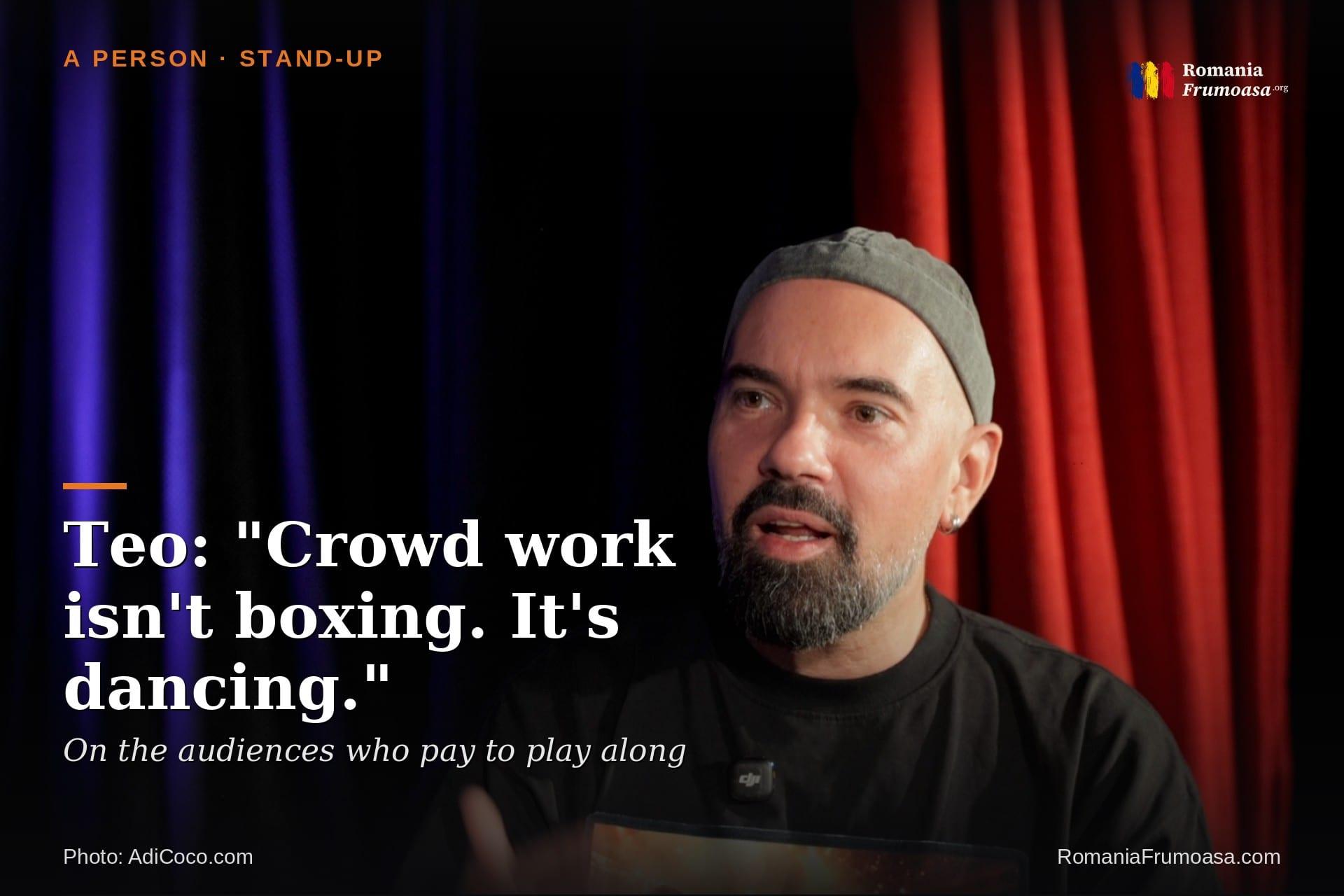
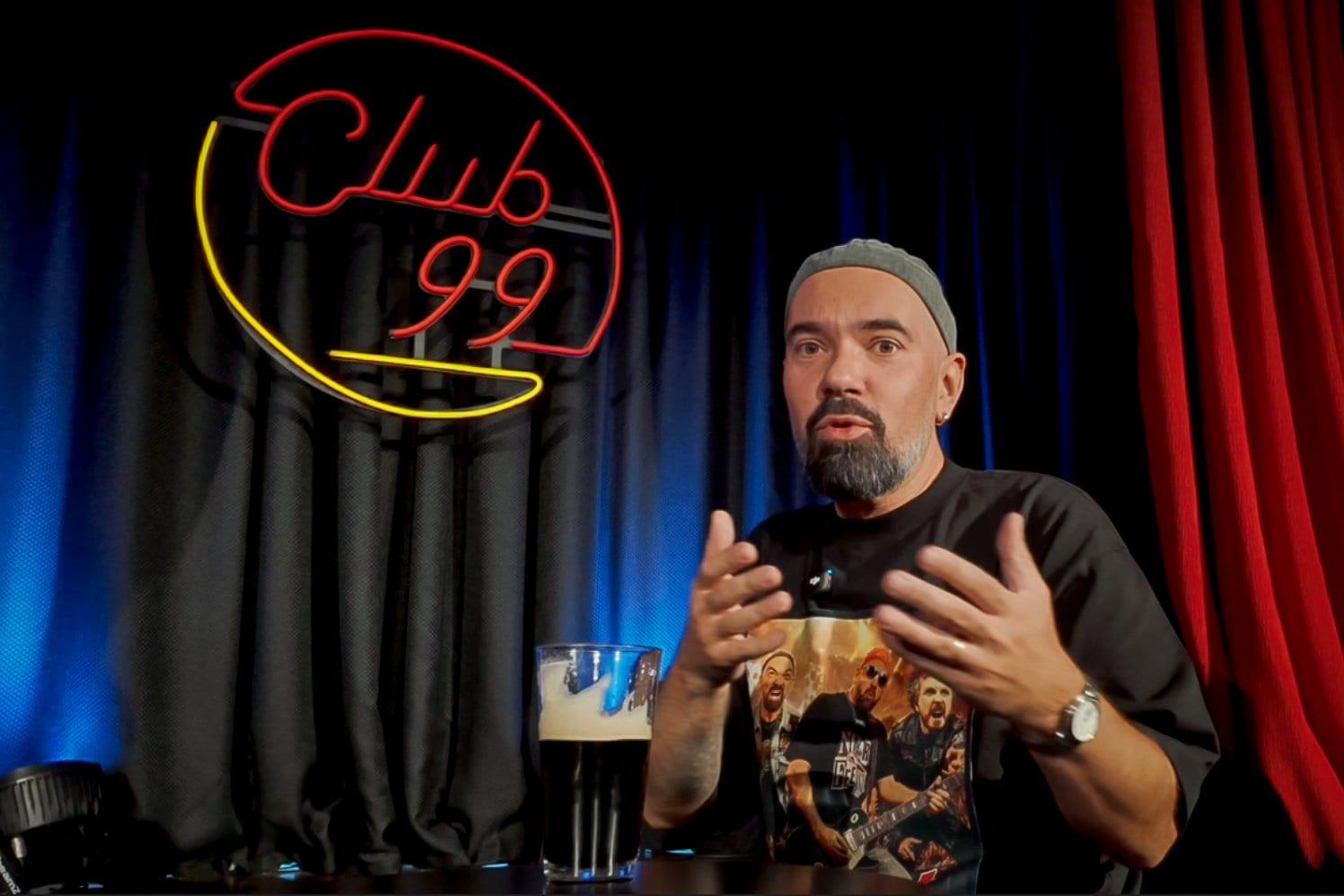
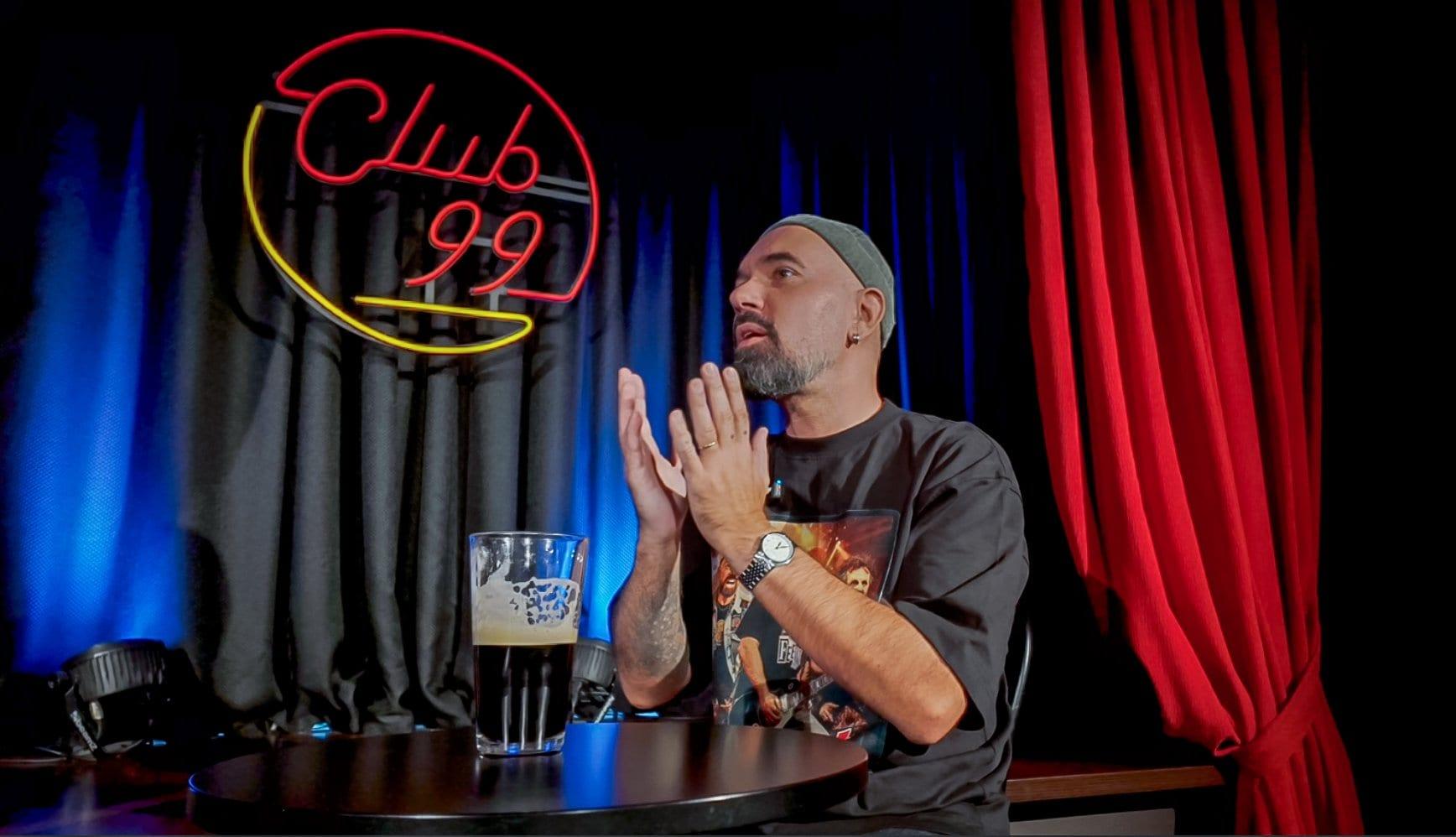
Crowd work is the part of stand-up where the comedian sets the material aside and talks to the people in the room. On social media it has become the most visible thing in the business: one-minute clips in which someone in the audience is asked what they do for a living and gets a punchline back. Claudiu Teohari, known to audiences as Teo, first went up on a stand-up stage in 2004. In 2009, with Costel (Costel Bojog) and Vio (Viorel Dragu), he opened a comedy club in Bucharest. Lately he has filmed several crowd work shows for Comedy Box, the streaming platform run by Romanian comedians.
We talked for an hour at Club 99. He started by challenging the very premise of my questions: people don't come to be made fun of. He finished by answering a question I hadn't asked.
Dancing, not boxing
How much preparation actually goes into crowd work? How much is improvised on the spot, and how much is ammunition gathered over the years?
There's no way to prepare for crowd work. Crowd work, if it's done honestly, means that moment. And you can't prepare a moment with people you've never met.
A lot of people don't know that improv shows have rehearsals. The improvisers get together and run the games from the show over and over. Some people find that hard to understand: how do you rehearse improvisation? You don't rehearse what's going to happen at the show. You get used to improvising. Crowd work is the same. The more you've done it, the better you know how to handle certain moments without knowing what the conversation will be about. You have no way of knowing what that person does or what they'll say, but your reflexes are in place. So a crowd work show is 100% on the spot, but there's the experience of feeling comfortable and knowing where to steer.
In stand-up you polish your material from one show to the next. In crowd work, aren't you tempted to reuse a joke that went well?
There's nothing to polish. If the person onstage builds the jokes on what the audience gives him, it's one and done.
Sometimes there's this idea: "Man, that went so well I'd do it at a regular show." As if we'd written a joke together and I wanted to tell it as if I'd written it at home. It's not about ethics. It just doesn't work anymore. It worked then, in that moment. It's the famous "you had to be there": you tell a story that's incredibly funny, nobody laughs, and you say, "You had to be there." It comes out however it comes out.
In 2010 you said you pick two or three anchors from the audience at the start of the show. How do you pick them?
I don't pick them by eye: "this one or that one." I talk to a lot of people, and some have more to offer. They have something interesting to say, and they say it in a way that helps the show.
Because nobody owes anybody anything. If you come to a crowd work show, you came to a show. You don't owe me a good night. Some people give too little, and you have to pull the words out of them with pliers. Others jump in too much, and those you have to ignore. The anchor is the person who has something interesting to say but stays within reasonable limits: ask a question and they answer, but they don't start rattling on nonstop. I can't look out at the room and say, "the blonde, that guy and the one in the blue shirt." I have no way of knowing what's going on with them before I talk to them.
Has an anchor ever collapsed on you?
All kinds of things happen, Adi. People get drunk while you're talking to them: they were fine, and half an hour later they've had too much. You hit a sore spot and have to back off, because the person says, "OK, I don't want to talk about that anymore." That's completely normal. They don't owe me their lives to do whatever I want with.
And now I'm going to answer a question you didn't ask me. I like interacting with the audience and I've been doing it for years, but the way I do it has changed a lot. Fifteen years ago I was, I don't know how to put it, young and stupid and arrogant. I'd go in with my boots on, as if you owed me: "No, say it! I asked you, say it!" I'm sure I ruined a lot of nights, and I'm sorry about that.
What changed, since you didn't ask what changed: I've become much more careful with people's evenings and with their energy. If I see I'm making you uncomfortable, I back off. There are plenty of fish in the sea; I don't need to stress you out. Fifteen years ago it was: "But I don't want to." "It's not that you don't want to — you're going to say it!" Now, if I see you're even a little uncomfortable, I say, "Love you, let's talk to that side of the room." That's why I say they don't owe me the evening. I owe them the evening.
You did competitive debate. Is crowd work more like a debate or a boxing match?
It's not a boxing match. A normal crowd work show is a friendly interaction that both sides have signed up for — consensual, to use the word that's fashionable now.
Interaction with the audience can also be hostile: someone can come after you. Fortunately, we haven't had hostile hecklers in years, but years ago you'd hear from the crowd, "You suck! Get off! Next!" If you engage with that person, it's a boxing match: he hit you, you have to hit back. Those are different rules of engagement.
But if I ask a couple how long they've been together, that's not a boxing match. It's a dance. That's the difference. A normal crowd work show should be a dance: I take a step, you take a step, I ask, you answer, and we build the move together.
What do you do when someone in the audience is funnier than you? Or thinks they are?
There's a huge difference between the two. If they're funnier than me, we're all happy. If they only think they are, chances are they're going to be disruptive. That ruins the night for everyone. It ruins it the least for me: I did my time, I got paid, I had a bad day at work. The others paid and were hoping to have a good time, and there's some guy or some girl who won't stop talking. On that front there's true gender equality, all the way.
But people in the audience have said things that made me cry laughing. I give you my word, no exaggeration: I was on my knees, I couldn't breathe. Why shouldn't I enjoy that? It's not boxing, it's not a contest, nobody declares you the winner at the end. If you say something from the audience and I laugh, and the whole room laughs, everybody wins.
It doesn't bruise your ego?
No, no. A few times a year someone says something that destroys me, and I laugh until there are tears running down my face. I'm glad when it happens.
Who pays to be made fun of
Why would anyone buy a ticket to be made fun of in front of a hundred, two hundred, three hundred strangers?
That "made fun of" is very debatable. No interaction with the audience should end with someone humiliated, unless the fight is started by someone in the crowd. If you yell at me, "You suck, get off!" — sure, my goal will be to make you look like crap. But if I start the interaction, if I come to you, I don't understand how I could at the same time be trying to make you feel bad.
Of course nobody pays money to be laughed at. But if you accept that not every interaction with the person onstage means you're making a fool of yourself, if you're confident enough to answer calmly, then you're not making a fool of yourself. You're stepping into a dance. I understand why it's seen that way: I've often seen performers mock people who had paid for tickets. As far as I'm concerned, that's wrong and it's mean. At the last crowd work shows I did, I felt that people came in open, knowing what they were coming to. And I hope I didn't make anyone feel they'd been made fun of.
When you look out at the room, can you tell who wants to play along and who's pulling back?
At crowd work shows I try not to have too much light in the room, because light is intimidating. There's a bit more light on the audience, but not all the way. With the house lights fully up, people would clam up; nobody would talk. So I can't see them very well. You can tell from how much they jump in. I don't need to read their faces.
Sometimes I have prejudices; I judge people by their faces or their attitude. I can't say I have an amazing success rate. Plenty of times, people who looked shy turned out to be much pushier, and some who looked like they'd come in all guns blazing said, "Nah, I'll pass." So the answer is no.
Does the person who wants attention pull back once they're in the game?
That doesn't really happen. Whoever jumps in pretty much wants attention, and that's a problem, because it's a tightrope walk. At a show billed as crowd work, people say, "Well, isn't this crowd work? So I started talking." It's hard to explain the rules: yes, but no. The fact that it's crowd work doesn't mean I say "good evening" and you start in with "Hey, let me tell you a story!" Hold on, maybe I want to go in a certain direction. Maybe I want to ask what cheese you like and do something with telemea versus gorgonzola. And at a regular stand-up show, someone who wants attention is an enormous problem.
At least once or twice a year we run into the famous extremely loud, weird laugh. We've all come up against it: someone with a strange laugh that stands out and is never quiet. It's one of the hardest situations to handle.
A forced laugh, or a natural one?
That's the first question. Often we conclude they're doing it on purpose, to get attention: the proof is that for minutes on end you don't hear it, and then it comes out of nowhere. The second part is how you handle the moment. In theory, that person is doing exactly what everyone came to do: laugh. How do you ask someone not to do the thing everyone came there for? You have to keep the room's attention and at the same time stop someone from laughing. Very hard.
Have you ever had to throw people out?
Yes, it happens fairly often. For years we had no backup at all, and for the past few years we've had security. We're lucky to have a very attentive guy who knows when to step in and when not to. I've talked with him a lot: if someone jumps in and is being disruptive, they don't need to be thrown out right away. That's part of the risks of the job; it's part of the show. That person needs to go when it becomes clear the show can't continue if he does, consistently and deliberately. You can't throw someone out for laughing. In more than three-quarters of cases it's alcohol: people so drunk their mouth runs without them and you can't even understand what they're saying. What comeback do you have for that?
Who's more dangerous at a crowd work show: the shy person, or the one who comes to be funnier than the comedian?
That's impossible to answer. Between the two extremes, I'd take the person who stays quiet. You can knit something out of that silence: if you don't give me much, I fill in, I bring my own stuff. If it's someone who's disruptive and you can't talk over him, there's nowhere left to take it. It turns into survival.
The heckler and the room
Has the room ever put a heckler in his place before you did?
Not before me. The room waits for the answer from the stage: that guy wasn't talking to the room, he was talking to me. But when it gets to be too much, you'll sometimes hear someone in the crowd: "Shut the hell up, enough!"
What's interesting is that in this boxing scenario, with a hostile heckler, it's a very good idea to let him talk. I learned that the hard way, and then I found out a lot of people had reached the same conclusion. Your first reflex is to cut him off, to shut him up. You have to do the exact opposite: let him make an ass of himself as much as he possibly can. There's that expression in English: give him enough rope to hang himself. Not a little — all the rope.
These situations come up when you don't expect them. It's not like a crowd work show, where you come in set up to talk to people. You've got a Friday-night show in Lugoj, you've got material. And suddenly some guy insists on telling you things. You let him talk for a while because several things happen. One: you find out where he's coming from and what his problem is. Two: it gives you time to think; you don't have to answer in five seconds. Three, the most important: you let the whole room get fed up with him.
In a boxing match with a heckler, your biggest weapon is the rest of the room. Not whatever comes out of your mouth. The room has to be the club you hit him with. You have to isolate him from the audience, so the audience no longer feels he's one of theirs. If the audience feels you're going after one of their own, they defend him instinctively. They have to get to the point of saying: "OK, he's not one of us anymore. Go fucking get him!" To get there, you have to let people get annoyed, and for them to get annoyed, you have to let him talk. "Well, but you said that…" "Yeah? But why?" "Well, when I was with my mother-in-law…" After a couple of minutes the room starts in: "Shut the hell up, man!" — and they're inviting you to go after him.
The hardest one is the guy up front who comments quietly. The people in the back can't even hear what he's saying, so they don't get annoyed. He's destroying you, wrecking your rhythm, but the room isn't bothered. And if you jump on him without the room knowing why — at some point, "Hey, shut the hell up!" — you'll see the whole room freeze. It's like an organism that's been attacked and doesn't know why: it feels that one of its own has been attacked. If everyone had heard him, they'd have said, "Good for you!" But if they don't know why, you feel the temperature in the room drop. And then you've got a much bigger problem than the guy who was talking.
And what do you do when the room turns against you?
You keep going. My honest opinion is there's nothing you can do. You accept it, swallow the lump in your throat and carry on, hoping the material coming up is good enough to thaw them out little by little. You've already lost; there's no point digging yourself in deeper. I hope that in the next few minutes they forget and forgive me, that I've got jokes so good they start laughing almost against their will: "Come on, you made me mad, but that one was good."
Is there no moment when you say, "That's it"?
Until people stand up, start cursing at you or come up onstage to beat you up, the show goes on. The room got cold, you made a gaffe — it happens. There are so many mines you can step on without knowing they're there. The more shows you do, the more random the stuff that happens to you, as young people say. You might have a joke about someone who drowned, and the day before, in that town, a child drowned. You feel the room getting cold and you wonder what happened, and they're all like: "That little girl drowned yesterday and this guy comes in with jokes like that." Until someone comes to cut your mic or punch you in the mouth, the show goes on. And sometimes it goes on after that, too.
It happens the other way around, too. The room laughs way too hard, because something happened that you don't know about and they think you're alluding to it. "You haven't heard about the guy who fell out of a tree last week?" No. All of Bârlad laughed about it, and you don't know.
"Go after that guy"
A study on audience psychology shows that people who like being the butt of jokes also like seeing others laughed at. Have you noticed that?
What I've noticed is a very clear mechanism: when you go after someone (an expression that kind of annoys me), a lot of people laugh out of psychological relief that you didn't go after them. "Glad I got off the hook! He's not talking about me, he's talking about that guy."
About that study, honestly, I don't have an opinion. What I can tell you is that some people want someone else to be the victim. I've never accepted that. Do you know how many times someone has come up to me before a show and said, "Go after that guy"?
Pointing you to a target?
Yes! "Hey, listen, I've got a buddy at my table, let me tell you some stuff, go after him." And I'm like, "Man, what do you think I am? Why do you think I'm here?" Maybe my ego's too big, but that kind of thing gets to me. What do you think I am, your hammer to whack your buddy over the head with? "Come on, tell me, what did he do?" "His wife cheated on him." "Done — what's his name? Marius? Watch what I do to Marius!" In what world would that be the job of a person who gets up onstage? To start mocking Marius out of nowhere because I know some stuff from you? Man, how sick are you?
It's happened much more often than you'd think, and every time it's left me speechless. It's not just that I don't accept it. I don't even understand what's going on in your head that you can ask for something like that.
Has someone who was an anchor one night ever looked you up afterward?
No. Look, that's the only question where the answer is no. Fairly often I run into someone by chance who tells me, years later: "Remember that bit? That was me! I was the guy with the boat a penguin jumped onto!" But nothing beyond that. People own it at crowd work shows. I'm glad about that. At the shows I've filmed recently for Comedy Box, four or five of them, the audiences were great: friendly, open, not over-talkative. Really wonderful.
You've said Romanians want frothy humor with a clear target. Is crowd work just teasing raised to the level of a show?
That's very debatable. I've started not to like crowd work anymore. I don't even think I'll do it again. I don't know; I might. It's lost a bit of its charm, because it's very easy to do it at that level, as mockery. I sincerely wish it weren't so, but unfortunately it is. People got used to the idea of crowd work by comparing it to what they know best, which is making fun of people. And often they like it because it's not them: it's the laugh of relief, "he went after someone else." People like that. And I don't like that they like it.
Roasts, television and the red line
Are roasts and crowd work from the same family?
No. A roast is very clearly a boxing match: aggression is in its DNA. Done out of love and friendship, in theory, which here is almost completely missing. A roast should happen between people who know and appreciate each other. And you can feel it very easily when that's not the case: when it's done with malice, or with people you don't know and don't care about, which, unfortunately, is the case most of the time. A roast means hitting someone. And I don't think that's what crowd work is.
Yes, it takes two; yes, we touch; yes, we both move — but one is boxing and the other is dancing. Crowd work should be something pleasant for everyone, not an activity where someone loses and someone wins.
Can crowd work be done on a TV show?
It's almost impossible, because the situation is far too observed. It's like quantum physics, where the mere act of measuring something changes the result. When we do crowd work shows for Comedy Box, people know they're being filmed, but I hope I manage to create an atmosphere where we forget about the cameras. I don't think anyone forgets completely, but you get a kind of energy in the interaction that goes beyond "we're at a taping." On a TV set, the taping is everything. You can fake crowd work, better or worse, but I don't think anything real and spontaneous can happen in such a hostile environment. A set is a very bad environment for comedy. For anything except taping.
What's the red line you'd never cross with someone in the audience, even if the room were dying of laughter?
There are a lot of red lines. There's a red circle around me. I keep telling you: I don't want to make someone feel insulted or attacked for no reason, when they haven't set it up themselves, when they haven't started the aggression. I really don't want to make anyone feel like crap.
Have you ever felt that you stopped, but the room wanted more?
Oh, yes, that happens. The room is fine with going after someone because, I'll say it again, it's not them. It depends a lot on what kind of people they are. I'm actually proud that my audience is a bit more refined and I don't get many of those thugs who yell, "Tell him, man, screw him! Go on, f*** it, why the hell won't you say it?" But in general, the room is up for more than I am.
Sometimes it happens the other way around: the person and I find what's happening funny, and someone in the room doesn't. Many years ago, here, at the end of a show, Costel and I both got up onstage to do a bit. We didn't know exactly what we were doing either. There was a young woman at a table up front who was making some very strange jokes at us, and we didn't understand why. Then she showed us her burned hands: she had survived the Colectiv nightclub fire. We brought her up onstage, talked with her, made some little jokes, and so did she, a lot of them pretty off-color. She had a great time. Afterward we stayed and talked with her, and she told us a lot. It was interesting and moving; it was a fairly heavy night.
While we were talking with her, a woman from the audience who was on her way out came over to scold us: how dare we, how rude and cruel could we be to make fun of that poor woman. With her right there! And she looked at that woman and said: "What are you talking about? That's not what happened!"
There's this tendency to defend people who don't want to be seen as victims. That woman was attacking us for making her feel bad, while she was right there saying: "But I didn't feel bad! Why are you making me out to be a victim? I had fun, I like these guys, I like what happened!" If the discussion had happened online, after the show, there would have been different perspectives on the same event and you could think everyone had a point. But it was strange to see it live, right then, with the people who had been there.
So it can happen that the room says, "Come on, tell him!" and I say, "No, that's not OK," and it can happen that something amuses me and someone in the room says, "That's not right." I don't want to pass myself off as a knight in shining armor.
Microwaved and slow-cooked
Crowd work has become so popular that in some cases it's beating the stand-up show itself. What's your take, as a comedian with a long track record?
Finally, an opinion! From everything I've picked up, in the States the peak has pretty much passed. It was so popular that the backlash came fairly quickly. I think the fad will be gone in a few years — not many.
Crowd work blew up in the States thanks to social media, or because of it; everyone can pick. A written joke has little chance of fitting into a minute or so. Bits are usually longer than what goes viral. And if you've thought up a joke, tried it out and put it online, that's it, it's gone, you can't tell it anymore. You've burned it.
Crowd work was a very good content generator. It fed the social media beast. You could have two quick exchanges that fit into a minute, and it didn't hurt to put them online, because in three days you'd film another one. It was cheap to produce. People realized it's a very easy way to promote yourself: you say to some guy, "You're Hispanic? Well, you don't look like you're carrying knives. What's up, Jose?" and bam, a million views out of nothing. You didn't think, you didn't work, you didn't burn anything. Tomorrow you set up the camera again and tell someone else, "You're kind of Black, she's kind of white," and so on.
It reached saturation. Both audiences and comedians realized: it's fun, but it's too much.
I honestly like a different kind of crowd work. One that builds more slowly and isn't really suited to going viral. I'd like to keep doing slow-cooked crowd work, not microwaved.
Like Jimmy Carr?
No, Jimmy Carr is the opposite. He's the "Why are you wearing that tie?" kind, with the quick comeback, very vulgar, very violent; the whole room laughs and the clip goes viral. When I say slow-cooked, I mean crowd work where we find things out and build. You tell me, "I do this for a living, I have these kids," we find out what your kids would like to do, we talk about how you learned. A story gets built. It goes on for 10 or 15 minutes, we set it aside, we come back to it. It can be a story built over an hour that gets to a punchline the whole room laughs at because it ties together two or three things said in the last half hour.
That can only be lived in the room. It can't go viral in a short clip, and often it doesn't even make it through the screen if you put it online. It lives only among the people in the room. And I think the line between crowd work and improvised stand-up is very thin. I like to take something you tell me, get an idea and do a short improvised bit starting from it, without necessarily talking to you anymore. That doesn't go viral either. It's not what people want to watch in 40 seconds, hit like and move on.
Does the audience have patience for this slow crowd work?
Well, of course, they're sitting right there! The audience is patient because that's what they came for, to watch the show. It's not like they're saying, "OK, three minutes have gone by and this guy hasn't said anything."
The difference between being in the room at a stand-up show and watching from home is enormous. I'm glad a lot of people have started to feel it. The ones who don't are generally the ones who comment. When you watch a video, you're detached, and that makes you much more critical. That doesn't mean you lose your critical sense in the room, but you're living a moment, with joy, socializing, with people around you.
We're very tribal, very social monkeys. We're not made to live alone, without contact with the people around us. When you're in a place with a hundred people, you feel it in your flesh and in your brain. Your reaction to a joke is very different when you're alone at home at 11 at night, in front of a screen, than when you're with a hundred other monkeys in a cave at 11 at night. Crowd work is a moment we create and live at the same time, here, in this cave. Whoever watches from home a month later, at the moment when that hundred monkeys had a great time, has a very hard time connecting.
Who pays for stand-up
In 2025, Comedy Box still wasn't profitable.
It isn't now, either.
What does Romanian stand-up live on? Tickets, clips or corporate gigs?
Tickets. And that's very healthy, because it's the most honest way to make a living: someone wants to pay to consume what you do. If you live off tickets, you can't lose touch with reality. If you live off money from a TV network, you very easily can: you don't know exactly who's watching or why, and they pay you because they have interests of their own. The showbiz machine that has nothing to do with live shows can go off the rails in lots of ways.
For us, live shows are 90% of what we do: being in a place with people who paid to be there. That keeps you engaged and honest. You can lie to anyone, but not to someone who bought a ticket and got off their butt to come all the way to you. You can fool them, but you can't lie to them.
Corporate gigs — or, more accurately, private shows — mean a lot more money for the same time. I'm sure there are people who make a lot of money from them. I haven't done them in a while; maybe I will again. But tickets are still the foundation. The internet isn't, either: in Romania we don't have comedians who are really big streamers. There's some money from YouTube, but it's not money you can live on.
How are tickets selling now compared with 2019, the last year before the pandemic?
From what I know and what I see around me and at our place, 2026 is worse than 2019. 2019 was a wonderful year. 2020 was the pandemic year, and we can't count it. But 2026 seems worse to me than 2021, too, when there were still restrictions. Yes, 2026 has been pretty much the worst year so far.
Because of the economic situation. It's kept going down since the start of the year. People don't have … what's the word in Romanian, because I don't want to dirty my mouth with English … disposable income. They don't have money to blow on silly stuff. For us, 2026 felt pretty much the way the 2008 crisis felt. At no point did I sense a change in attitude toward what we do. Just: "It's great, but it's expensive, there's no money."
The collective character
Your father roasted you on "iUmor." Did you know ahead of time?
I really didn't. On "iUmor" they truly kept those moments secret, because they cared about the person's genuine reaction. Setting aside that there's a lot of lying on TV and everything is staged.
What was it like to be on the other side?
If I had to go out on a limb, I'd say it was the opposite of a roast. It was a kind of "Dad loves you and he's proud of you." That wasn't a roast. I was very happy to see him. I picked up a lot of cadence from him. Sometimes I hear myself talking and I hear him. I owe him a lot of what I do. That moment was wonderful.
How do you react when you're the target?
It depends on who's doing it and how, same as with anybody. If a stranger stops you on the street and says, "What glasses — you look like a stove," you're like, "Buddy, who are you?" If it's your childhood friend, it's something else, though even with him you can feel whether he's doing it out of affection or out of malice, out of envy. If a friend who knows you tears you apart with love, it's wonderful, you laugh too. But there's no way you'd say: "How great, some guy came up to me on the street and told me I look like crap, we had such a laugh! I don't know who he was, I thought I'd dressed nicely that day, but the man made fun of me." That doesn't exist.
Has anyone in the audience ever said something that stuck with you?
It really bothers me that I don't remember moments. There were things that made me cry laughing and that I told people about afterward, but I don't remember them anymore. I don't even remember my material from six years ago. I do remember that once I was asking people what strange pets they had. Someone told me they had shrimp. Keeping shrimp as pets, at home. Though it's actually great: if you get hungry, you've got a pan of garlic-and-lemon shrimp in no time. You can't really do that with cats and hamsters.
After 20 years of working with people …
Twenty-two and a half. Vio and I were talking, and we realized something mathematically overwhelming: next year we'll have been doing stand-up for more than half our lives. Right now we have 22 years of stand-up and 44 years of life. Next year, 23 and 45. It messes with your head a bit.
So after 22 years of working with audiences and for audiences, can you read people?
No. I can read a room, not people. I'm very attentive to feelings; I realize very quickly when someone is bothered. But I don't look at you and say, "You're that type." I don't have that at all. What I can do is read a group of people who are at a show.
I know it sounds like bragging, but I've gotten to where I can tell the general character of an audience by its laugh. By the letter they laugh on. A laugh shouldn't sound like anything in particular; it should be a general noise. If you hear a room going "o-ho-ho-ho!", if that's the general sound, that's already a problem. You shouldn't hear letters in a laugh.
When the lights go down and the show starts, the people in the audience lose a bit of their individuality. Every little piece they lose goes to a new person who appears: the audience. Nobody knows who the audience is, nobody wants to be the audience, nobody influences it much. It's this thing that lives in the dark in front of the stage, and it has a personality. Every night it's a different audience: sometimes lazy, sometimes hyperactive, sometimes very sensitive, sometimes very cruel. It's more than the sum of its parts. That one I can read very well. Each person in it, not so much.
And now let's go back to the question I didn't ask you.
I already answered it! I was so proactive that I already answered the question you didn't ask me: what has changed over the years in the way I treat the audience. At first I was pushier, more careless and crueler. Over time I realized that's not OK and became more empathetic: if someone doesn't want to interact, I accept that they don't and I go somewhere else.
That's the question you didn't ask me. And I answered it.
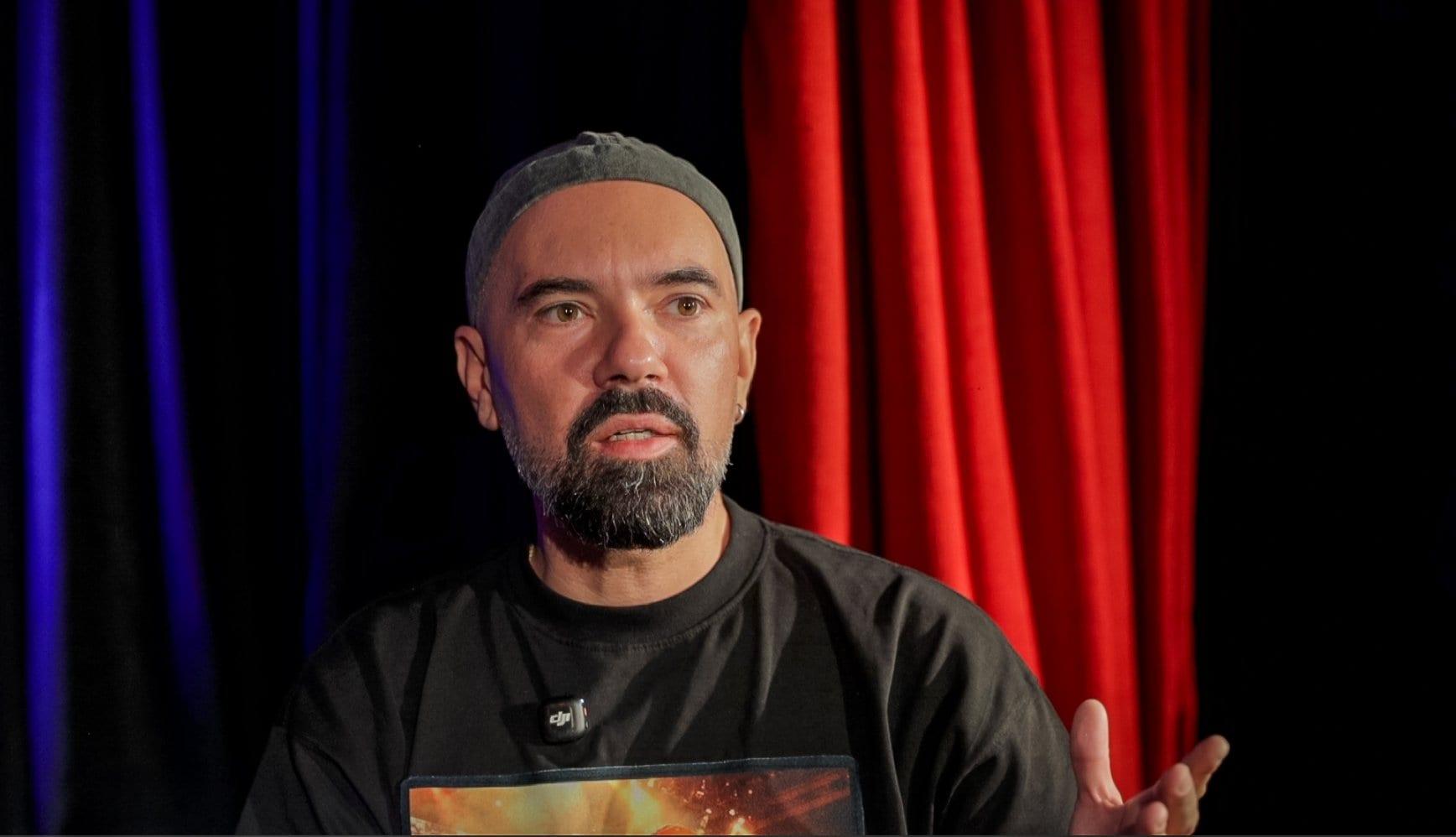
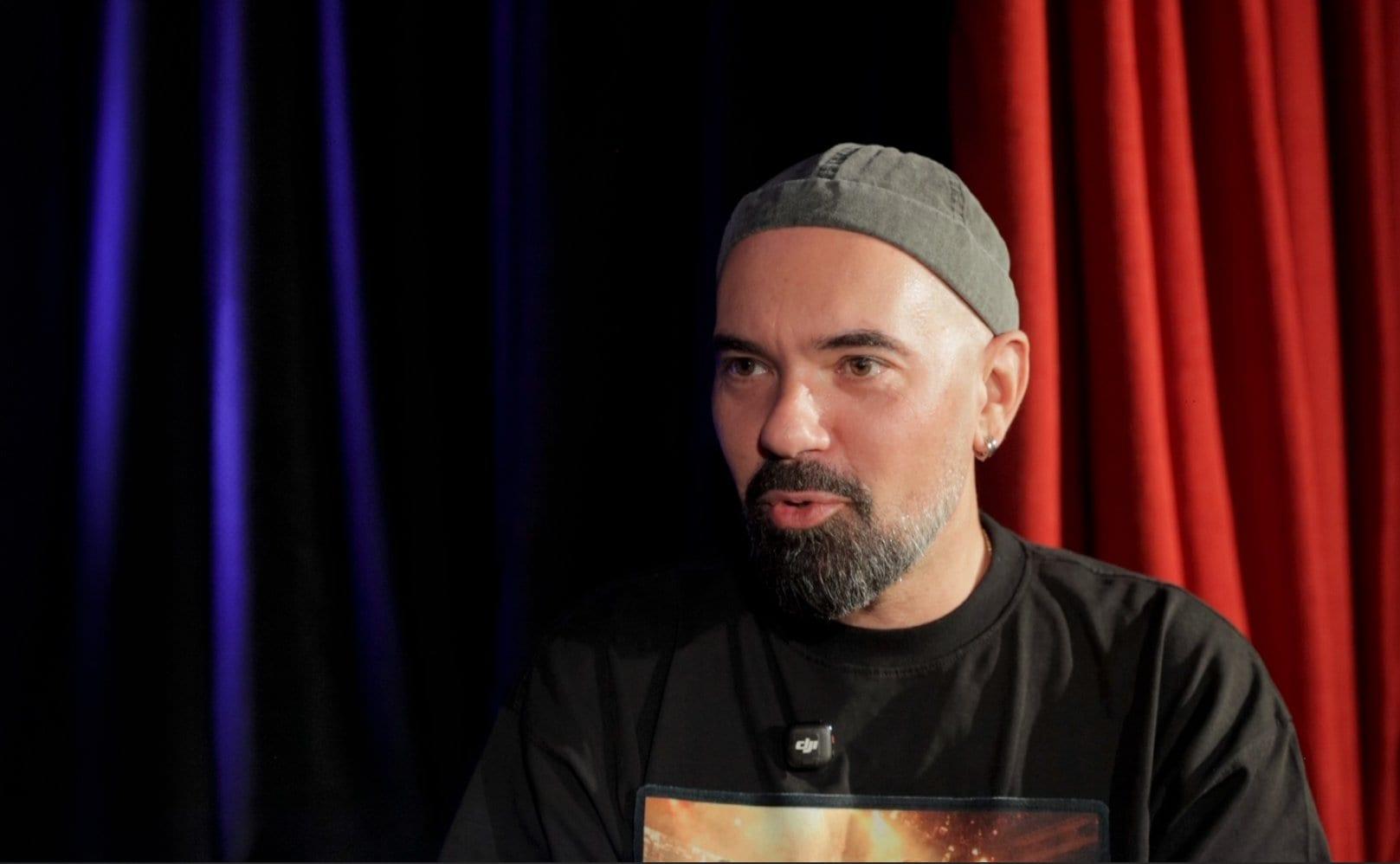
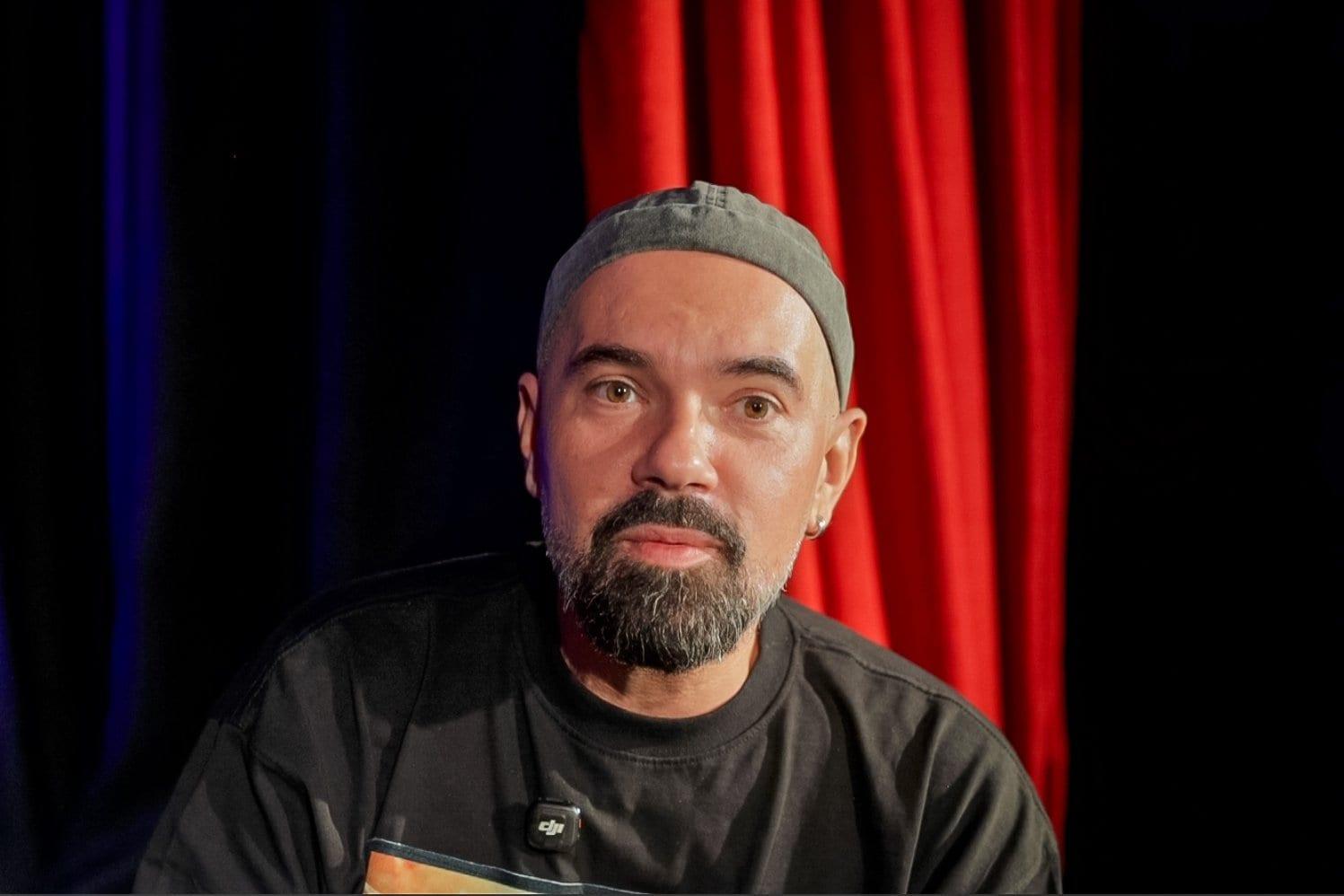
The interview was conducted at Club 99 in Bucharest in October 2026, within a one-hour limit. This text is an edited and condensed version of the conversation, which was in Romanian; the full video interview is on the RomâniaFrumoasă YouTube channel. The photos are stills from the interview video.
This English version is an automatic translation of the Romanian original.