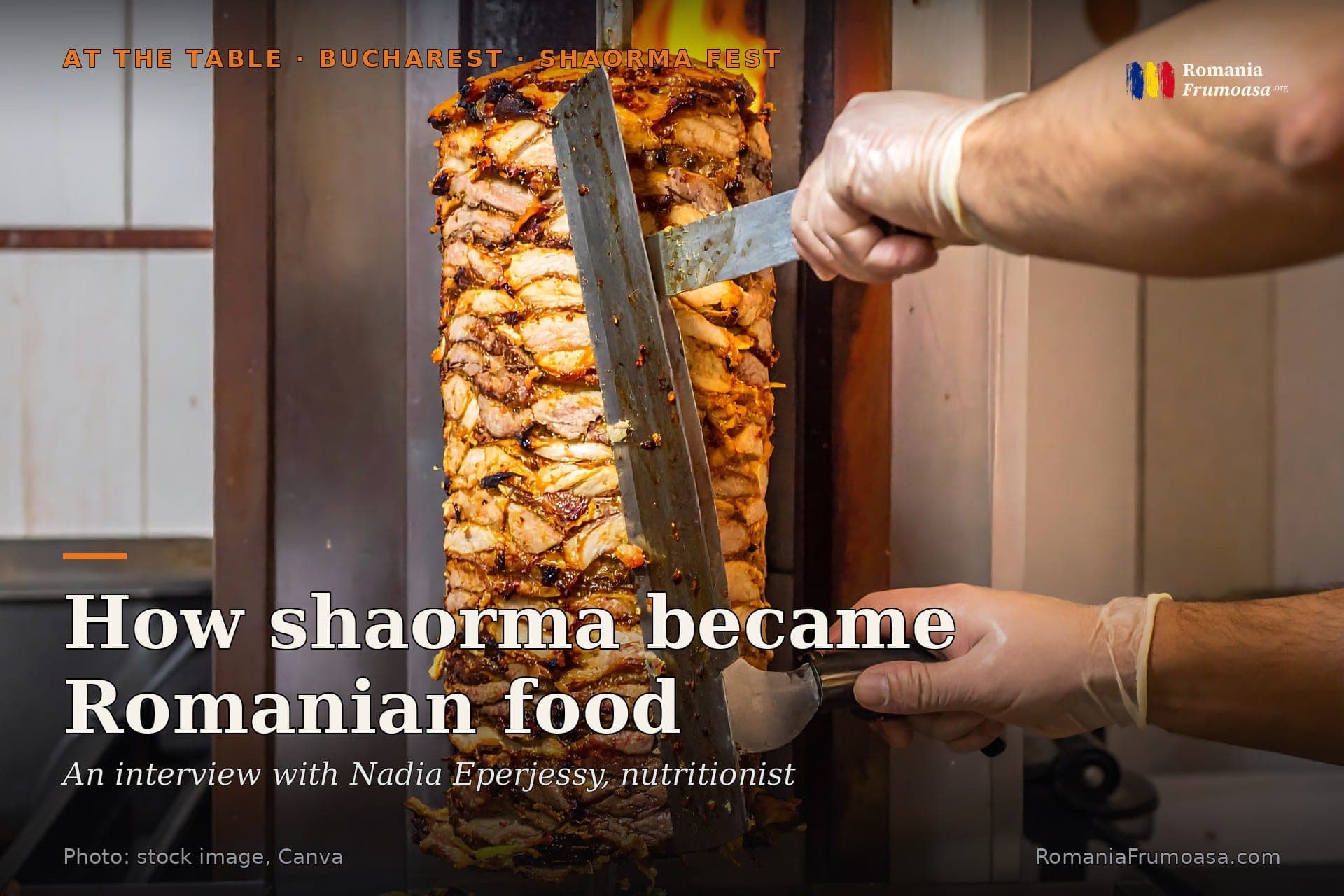
At the table · Bucharest · Shaorma Fest
Nadia Eperjessy ate her first shaorma on her way out of a club in Constanța, some twenty years ago. Today she is a nutritionist, and part of the team organising Shaorma Fest, billed as the first Romanian festival dedicated to the dish. What changed in between is not the recipe, but who owns it.
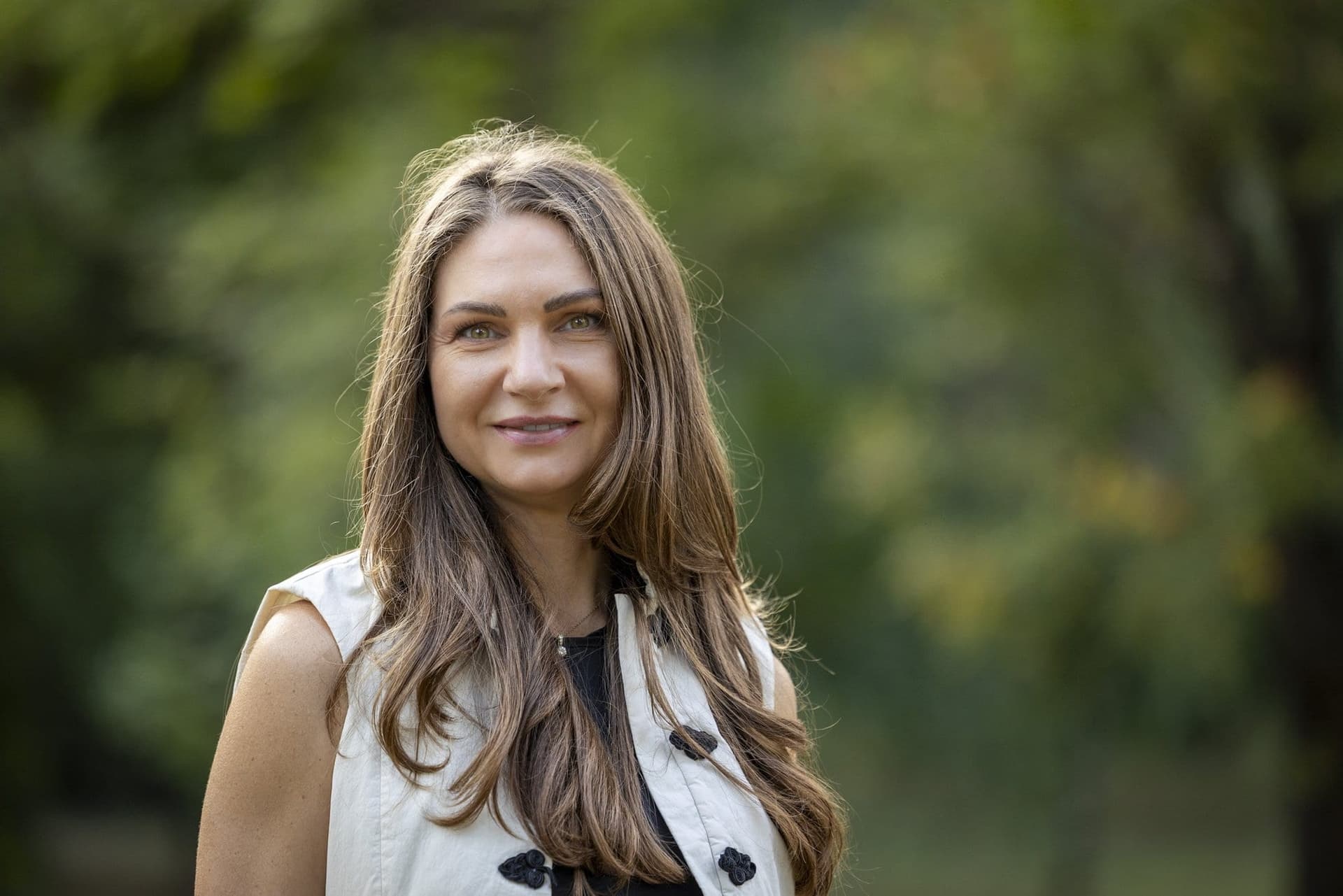
„It was the poison of choice," says Nadia Eperjessy about the shaorma she used to eat in Constanța, at dawn, walking out of a club. „After a whole night out, I don't think anyone stopped to do the nutritional analysis. It was part of the ritual: you left the club and you went for shaorma."
Shaorma is what Romanians call shawarma — and, as it turns out, it is also what Romanians have made of it. Since that morning in Constanța, Nadia Eperjessy has become a nutritionist, and the dish has become something else: not a different product, but ours.
Asked directly whether shaorma is Romanian food, she does not hesitate. „Obviously not. Not by origin." Shaorma belongs, she says, to a culinary family rooted in the Near East and in the Ottoman tradition of meat cooked on a vertical spit. „But food travels, and it adapts."
In this case, the adaptation went all the way. „I wouldn't say we invented shaorma, but we adapted it so well that we started making it to our own taste. And that happens to a great many dishes which, after a few generations, end up being part of a country's food culture."
The interesting question, then, is not where it came from. It is what we did to it once it got here.
The gap it found
Before shaorma, street food in Romania was a short and familiar list: covrig, the boiled-then-baked pretzel sold from kiosks; merdenea, a hot cheese pastry; pâté sandwiches; savoury pies; hot dogs; and mici, the grilled minced-meat rolls that remain the national barbecue staple. „They were quick, cheap foods you could eat while walking," she says.
Shaorma joined that list and changed the rules, because it brought something else: not a snack, but a meal. Flatbread, meat, sauces and — in the version that took hold here — potatoes. „It was no longer just something to fool your hunger with until you got home. It could genuinely stand in for lunch or dinner."
It did not make any product disappear, she says. What it did was win a substantial share of the fast-food market, where it competes with pizza by the slice, with burgers, hot dogs, pretzels and pastries.
What we did to it
The list of changes is short and instantly recognisable: garlic in quantity, layered sauces, generous portions and, above all, french fries tucked inside the flatbread.
The fry in the flatbread is the local signature. It is both the thing that surprises a foreigner most and the thing a Romanian no longer notices, because it has become part of the product. Here you don't order the fries — you decline them. The version with potatoes is the default; the other one has to be asked for.
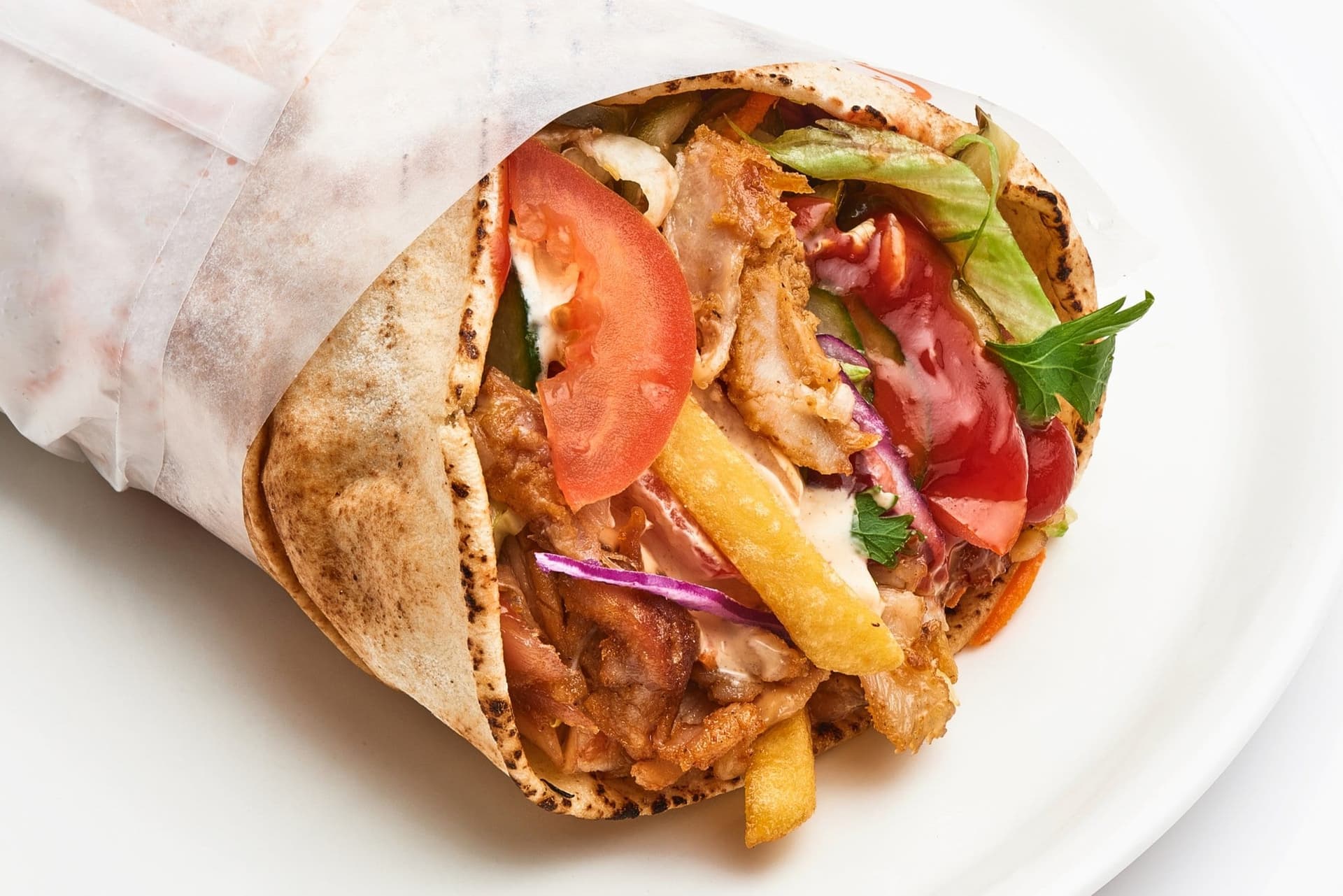
The second thing it picked up here is the complete flexibility of the order. „It is highly customisable. You decide what meat you want, how much sauce, which vegetables, whether or not you add potatoes, how spicy it should be. In practice everyone builds their own shaorma." Two decades before menus filled up with configurable bowls, the shaorma stand on the corner was already doing exactly that.
A dish becomes a place's own when the people there stop ordering it and start composing it.
The price of adapting
The adaptation also went in a less happy direction. „One of the most obvious changes is the size itself," says Nadia Eperjessy. „Shaorma entered a very simple commercial logic: more means you get more for your money."
That is how the large versions appeared — XXL, with more meat, more potatoes, more sauce. And here, she says, is the paradox: taken separately, the ingredients of a shaorma are nothing dramatic. The problem is built by addition.
„A large flatbread, plenty of meat, french fries, two or three mayonnaise-based sauces and, often, a sugary drink. Each one adds something, and by the end you can have an extremely energy-dense meal."
Asked what the real problem with shaorma is, she answers without hedging: the portion. And, right after it, the combination of mayonnaise-based sauces, when a yoghurt-based option exists.
„The problem is not that you're eating meat with vegetables in a flatbread," she says. „Most of the time the problem is that you're eating two meals in one flatbread."
Which means that the most Romanian thing about today's shaorma — the generosity of the portion — is also what does it the most harm.
A nutritionist at a shaorma festival
Nadia Eperjessy is not only a nutritionist. She is also on the team organising Shaorma Fest, the first festival dedicated exclusively to shaorma, according to its organisers. The contradiction is obvious, and she was asked about it directly.
Her answer does not dodge, but it does not concede anything either: „Nutrition should not be a list of permitted and forbidden foods. If my profession meant telling people «you're allowed this, you're not allowed that», I'd probably be a fairly poor nutritionist." The role of a nutritionist at such a festival, she says, is not „to show up wagging a finger and ruin people's appetite", but to explain what is being eaten.
Asked what she has turned down in the organising so far, she says there has been no need to refuse anything on quality grounds, because the partners are long-standing and known. There is, however, a clear limit: „I would categorically refuse a product I had reason to believe was of doubtful quality. The fact that we are organising a festival dedicated to shaorma does not mean the standards should be lowered."
And on how a festival with a 25-lei ticket sustains itself, she says it does not run on ticket sales: the price is there to keep the event accessible, and the rest comes from commercial partnerships.
The full interview, on video: How shaorma became Romanian food — an interview with Nadia Eperjessy
The anatomy of a good shaorma
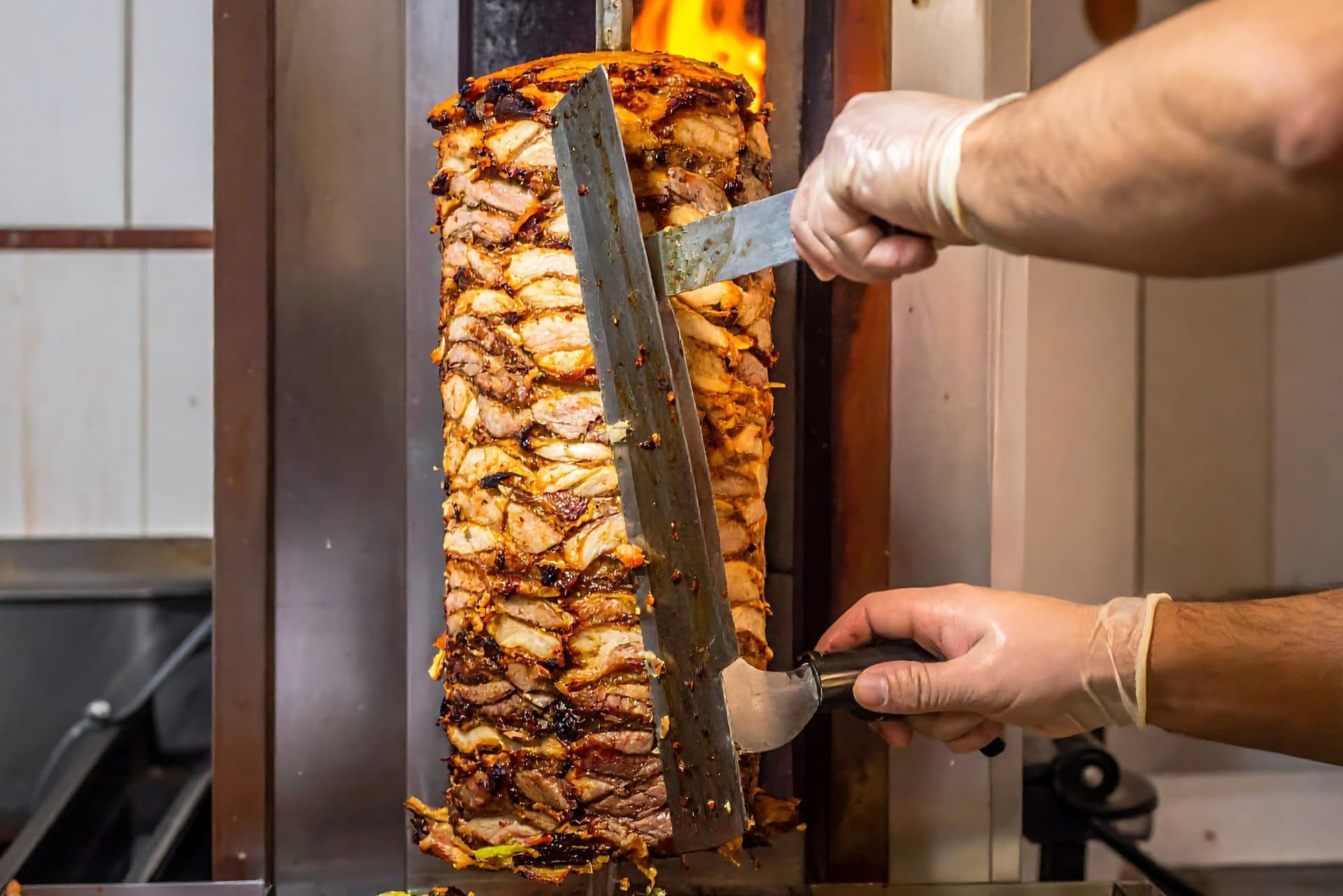
For Nadia Eperjessy, the order of importance starts with the meat. „It should be the main character. Well cooked, browned on the outside, juicy inside, and I want to taste the meat and the spices, not just the salt."
The flatbread: fresh, pliable, lightly warmed. „If it tears after two bites, the experience is more or less over."
The vegetables have to deliver the opposite of the meat — freshness, texture, a little acidity. The cabbage crisp, not drowned in sauce. The sauce has exactly one job: „to bind the ingredients, not to cover them. If after the first bite all you taste is mayonnaise and garlic, you're no longer eating a shaorma, you're eating sauce with some ingredients in it."
And temperature, which matters enormously: the meat hot, the vegetables fresh, the flatbread warm without turning damp.
Her final test is simple and can be applied at any street stand: after the first bite you should be able to identify the ingredients separately, but like them together.
„Shaorma doesn't need to become diet food," says Nadia Eperjessy. „Sometimes it just needs to stop trying to feed two people at once."
Walking out of that club in Constanța, none of these criteria mattered. What mattered was that it was hot, that there was a lot of it, and that the place was open. What has changed since is not the shaorma — it is that we have learned to judge it, which may be the final proof that we have adopted it.
If you go
Shaorma Fest takes place on 26 and 27 September 2026 at Divertiland Water Park, at kilometre 13 of the A1 motorway, in the Militari area west of Bucharest. Entry costs 25 lei. The programme lists twelve participating food outlets, a competition for the best shaorma judged by a jury and a public vote, music and stand-up comedy. Organiser: Venus Social Concept.
Interview conducted on 13 September 2026. Published in commercial partnership with the organisers of Shaorma Fest; the questions were formulated independently by the editorial team, and the answers are reproduced without changes of substance. The statements about the origin of shaorma are the interviewee's; those about the festival being a first belong to its organisers. Both are reported as such, not as claims by this publication. Details about the event come from the organiser's official communication, verified on 16 September 2026. The portrait of the interviewee is our own photograph; the food images are licensed stock images, credited as such. The video interview is in Romanian.