On the AI bubble — and why photographers lived through a version of it twenty years ago, when automatic cameras arrived. What survives after a bubble bursts, and who actually knows how to use what's left.
This whole business with AI reminds me a great deal of the dot-com bubble.
In the late 1990s, companies appeared overnight with „.com" in their names, raised money and promised to change the world. On 10 March 2000, the Nasdaq peaked at 5,048 points. Two and a half years later it stood at 1,114 — a fall of almost 78%. More than five trillion dollars evaporated. The index would not recover its peak until 2015, fifteen years on.
Many of those companies vanished. The internet did not vanish with them. Quite the opposite.
What remained changed the world. Amazon fell from around 106 dollars a share in December 1999 to under 6 dollars by the end of 2001 — a loss of more than 90%. It did not disappear. Neither did eBay. And a great many services we now use without a second thought were born out of exactly that wave.
I think we'll see something similar with AI. A pile of products built in a hurry, plenty of them „vibe-coded", probably won't survive. That doesn't make the technology hype without a future. The ones that actually solve a problem, and solve it better or cheaper, can change entire industries.
I've seen this film before, only from the inside
What I find interesting is that photographers went through a version of this story earlier than almost anyone else.
In the 2000s, automatic digital cameras came within reach of everybody. Suddenly anyone could press a button and get an image correctly exposed and correctly focused, without knowing anything about anything. And that created a very widespread illusion: that you could take photographs like a professional, because you got the same result on the screen.
Sure, there was a chance that out of a thousand frames shot at random, two or three would come out well. And two or three good frames, lifted out of context and placed side by side, give you the impression that you know what you're doing.
Except that the professional isn't the one who occasionally lands the good frame. He's the one who can repeat it. Who knows, before raising the camera, what he wants and how to get there. Who can do it at a wedding where time doesn't run backwards, at a portrait sitting where the person in front of him has five minutes, and on ground he didn't choose.
That doesn't mean none of those who started out with an automatic camera went on to shoot professionally. Some did. But they got there after hundreds of hours of study and thousands of hours of practice — that is, along precisely the road they had first tried to short-circuit.
And there's one more detail, which strikes me as the best possible footnote to any conversation about bubbles. That wave of automatic cameras had a peak of its own: 121 million cameras shipped worldwide in 2010. Then came the phone. By 2023 the figure had fallen by 94%.
The compact-camera bubble burst too. Photography didn't disappear.
AI doesn't erase your skills. It makes them dearer
This is the part I find most important in the whole discussion, and the part least talked about.
When I generate an image, I don't just tell it „make me a beautiful photograph". I can tell it what focal length I want, from what angle, at what aperture, how the light should fall, what depth of field, how the composition should sit. Obviously I stand a far better chance of arriving at something credible than someone who doesn't know these things. Not because I'm cleverer, but because I know what to ask for.
And experience helps me in the other direction too, which matters just as much: seeing when something is off. Impossible light. A perspective that doesn't add up. Optics that don't match the image. Reflections with nowhere to come from. The kind of anomalies AI still produces, but which you don't notice unless you've spent years looking at how light actually behaves.
An example, so this doesn't stay at the level of talk
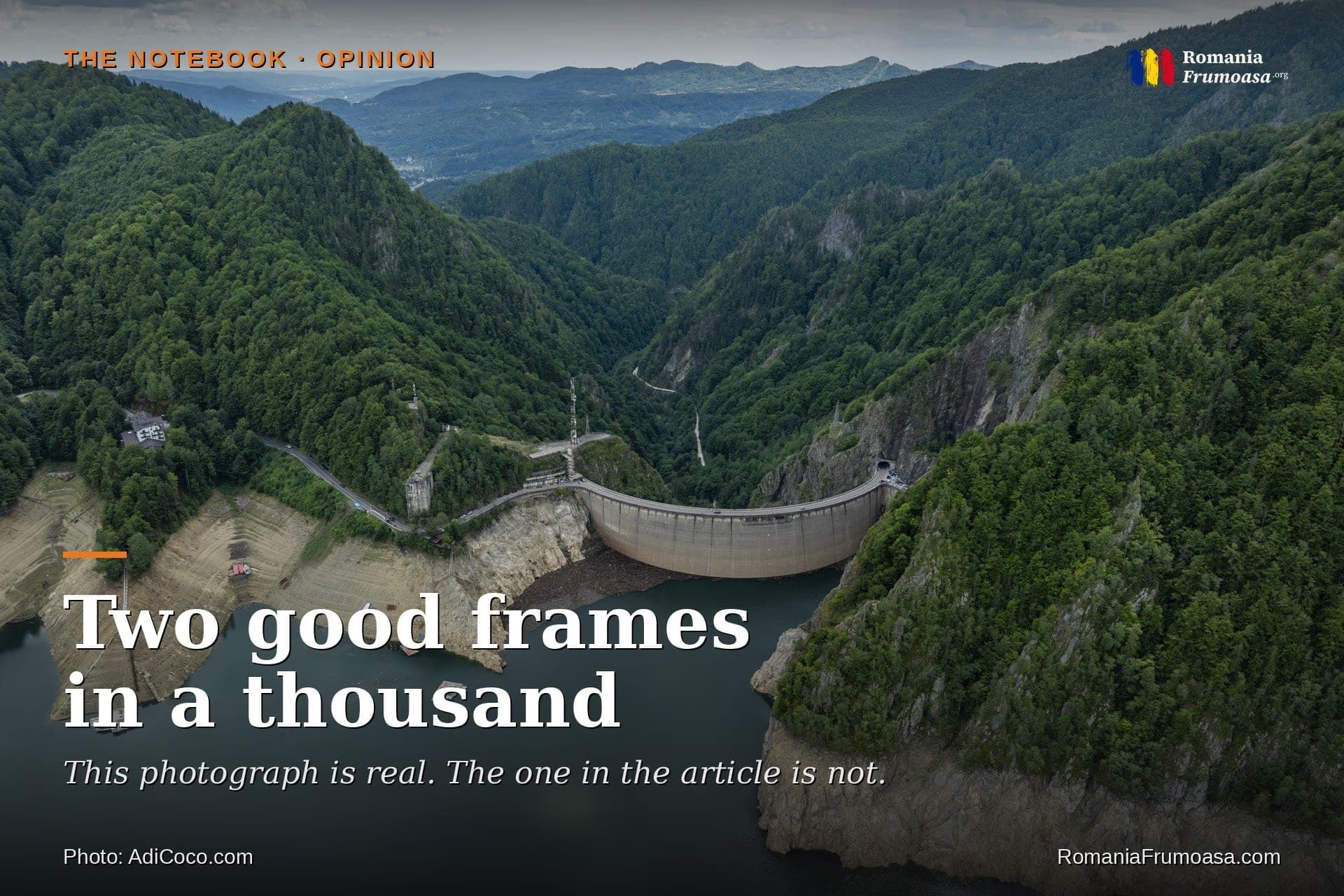
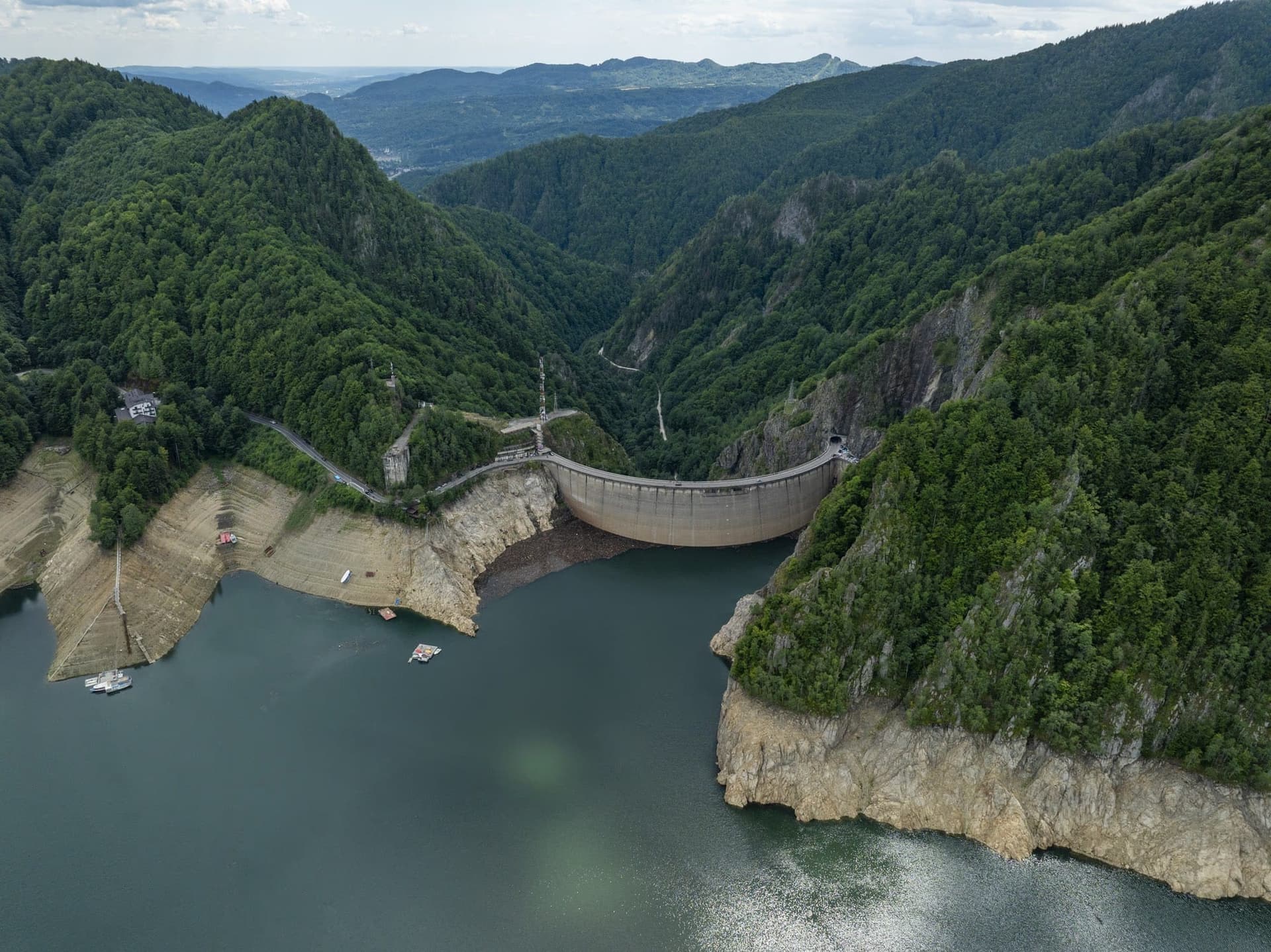
The photograph at the top of this article is mine, shot with a drone at the Vidraru dam in July 2026, while the reservoir was refilling.
The image below was generated with AI, on the same subject.

AI-generated image. Not a photograph. The numbers mark four places where the structure doesn't hold together.
It has to be said up front that it isn't bad. Scrolling past, it passes. Still, I've put four circles on it:
1. There are two dams. Behind the main crest, a second curved concrete wall appears, with a parapet of its own — and behind that one there's no water, but a dry basin. A dam behind a dam, with nothing in between.
2. The outlet works discharge nothing. It's a cluster of concrete forms with no gates, no conduits, no chute, no stilling basin. And no river leaves the foot of the dam — only a puddle.
3. The walkway across the middle of the face starts on the left and ends in mid-air.
4. Mature birches growing hard against the wall, at a scale that contradicts the height of the structure.

Detail: the main crest (1) and, behind it, the second (2), with a dry basin instead of water. AI-generated image.
And there's something the circles can't show: the light. An evenly overcast sky, with not a single cast shadow anywhere. That's the generator's safe choice — it gets nothing wrong because it risks nothing. Shadows are hard to get right, so it doesn't attempt them at all.
None of this jumps out at a glance. All of it jumps out if you've spent years looking at how a dam is built and how light falls on concrete.
It's probably much the same in programming, in medicine, in design, in marketing, in any other field. AI makes execution far more accessible. But it doesn't pour twenty years of experience into your head. It hands you an instrument that quickly executes whatever you know to ask for — and just as quickly executes nonsense, if you don't.
The difference between those two outcomes isn't made by the instrument. It's made by the person in front of it.
„Yes, but AI keeps improving on its own"
That's the one serious counter-argument to everything above, and it's correct.
The automatic camera had a ceiling. It solved exposure and focus, and that was about it. However much it improved, it never climbed higher than that. AI has no such ceiling — or at any rate none we can see from here. So the gap between those who know and those who don't may not merely narrow. It may close.
I think that's actually the likeliest outcome. And it still doesn't change my conclusion.
Because the automatic camera solved exposure completely. Today there is no one left who ruins a photograph by getting the shutter speed wrong. That problem is dead. And yet photography didn't die with it — the value simply moved higher up, from „I got a correct image" to „I got the image I wanted".
Those are two very different things. The automatic camera gave anyone a correct photograph. It gave nobody the intended one.
My hunch is that the same thing will happen now. If execution becomes free, then the question is no longer who can make the image, but who knows which image is worth making, for whom and why. And who can tell, looking at the result, that something is wrong.
And that judgment — the part of you that says „no, that doesn't look right" before it can explain why — is still built the long way round. I don't know of any shortcut to it yet.
I may be wrong. It may be that this part gets automated in its turn. I only note that, so far, every technology that promised to move the line did move it — but didn't erase it.
So
Perhaps the question isn't whether there's an AI bubble. There probably is, and plenty of hype around it.
The more interesting question is what remains once it bursts — and who actually knows how to use what remains.
In my experience, the answer to the second part has never changed, whatever the technology: the ones who did their homework first.
Adi Coco is a photographer and the editor of SeeingRomania.
EDITORIAL NOTES — remove before publishing
Hero: hero-bula-ai-EN.jpg, in the folder root. Not included in the body of the article — uploaded separately to the CMS. Its subtitle, „This photograph is real. The one in the article is not.", is written for the social card, where the image travels without a caption.
Localised images. The warning band is burned into the pixels, so the English article uses -EN versions of both the marked image and the detail. Do not use the Romanian files here — the band would read in Romanian.
The figures. All verified. Nasdaq: Goldman Sachs · EBSCO Research. Amazon: CNBC — sources differ on the exact low (5.51 to 8.37 dollars depending on the date taken), which is why the text says „under 6" and „more than 90%". Cameras: CIPA data, via PetaPixel.
Translation choices worth flagging:
- The Romanian title, „Din o mie de cadre, două bune", is literally „out of a thousand frames, two good ones". English wants the shorter, punchier order, hence „Two good frames in a thousand" — which also fits the hero on two balanced lines.
- „Ți le scumpește" has no clean English equivalent. „Makes them dearer" keeps the double sense of expensive and more valued, which is exactly what the Romanian does.
- „Nu îți toarnă douăzeci de ani de experiență în cap" — kept the physical verb (*pour*), because the absurdity of the image is the point.
- „Se adunase lumea ca la urs"-type idioms don't appear here, but the register does: the Romanian is conversational-precise, not essayistic. English kept short sentences and avoided abstraction.
- The domain in the English text is RomaniaFrumoasa.com; internal links point to /en/articles/....