Reportage · Wildlife · Argeș–Sibiu
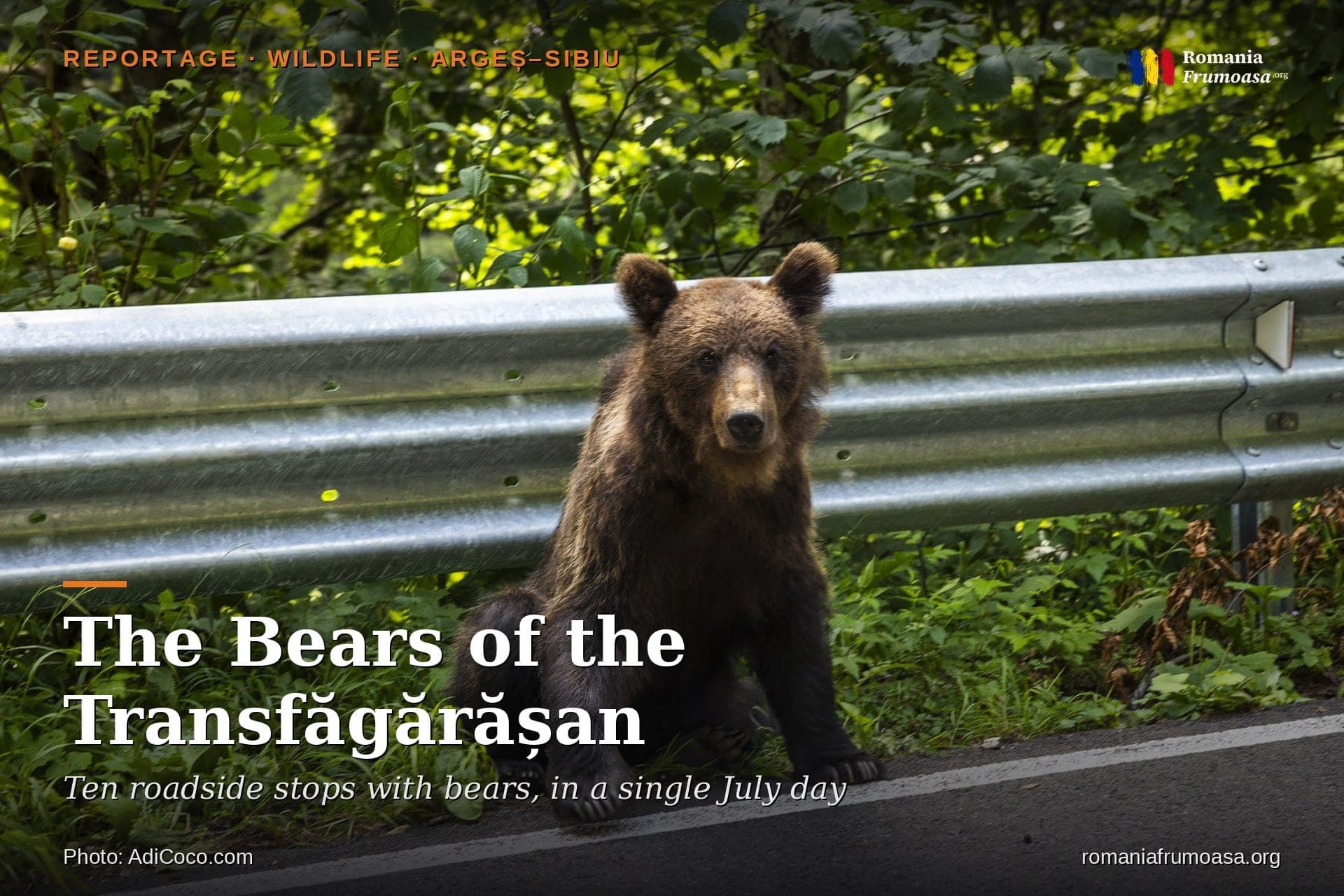
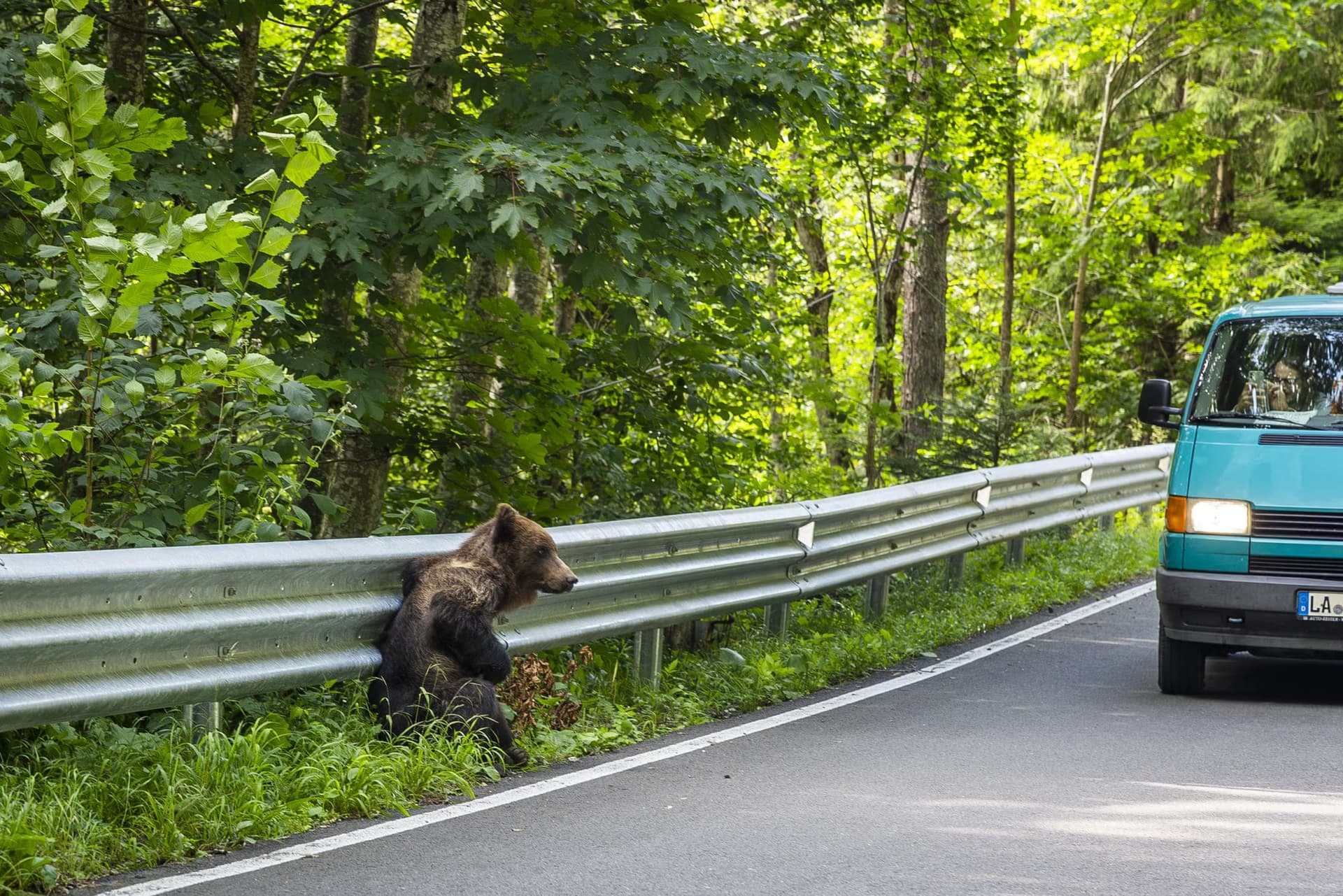
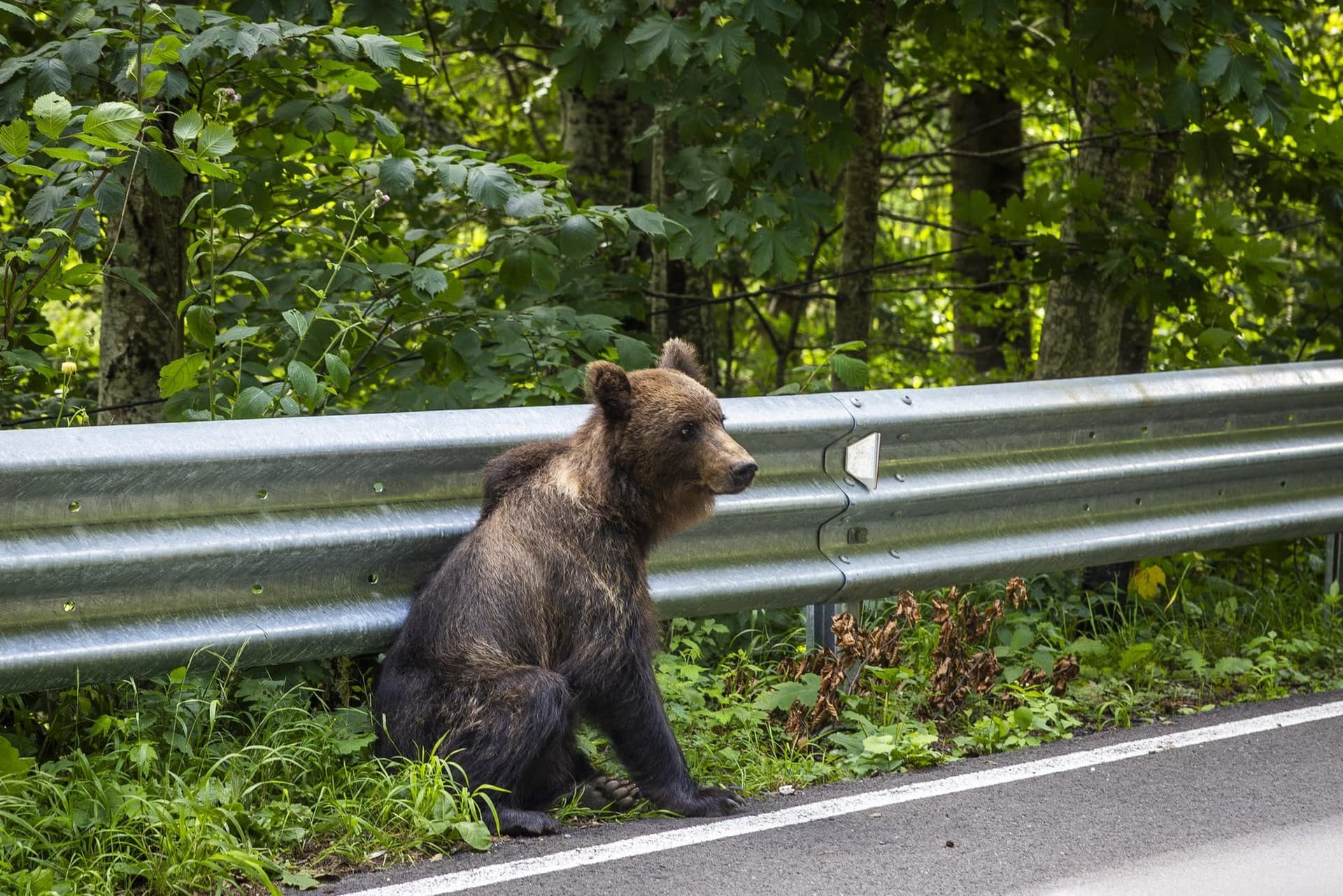
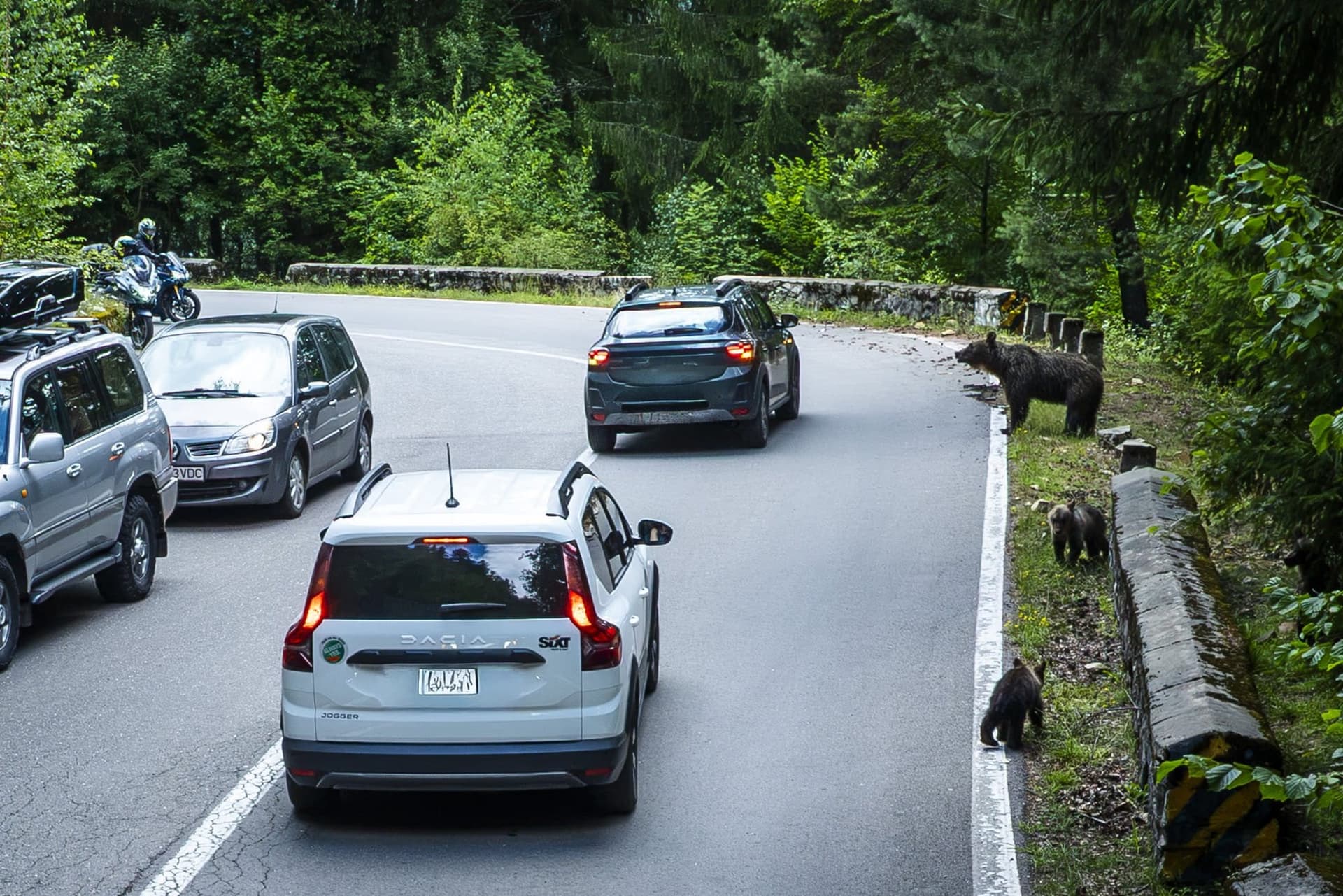
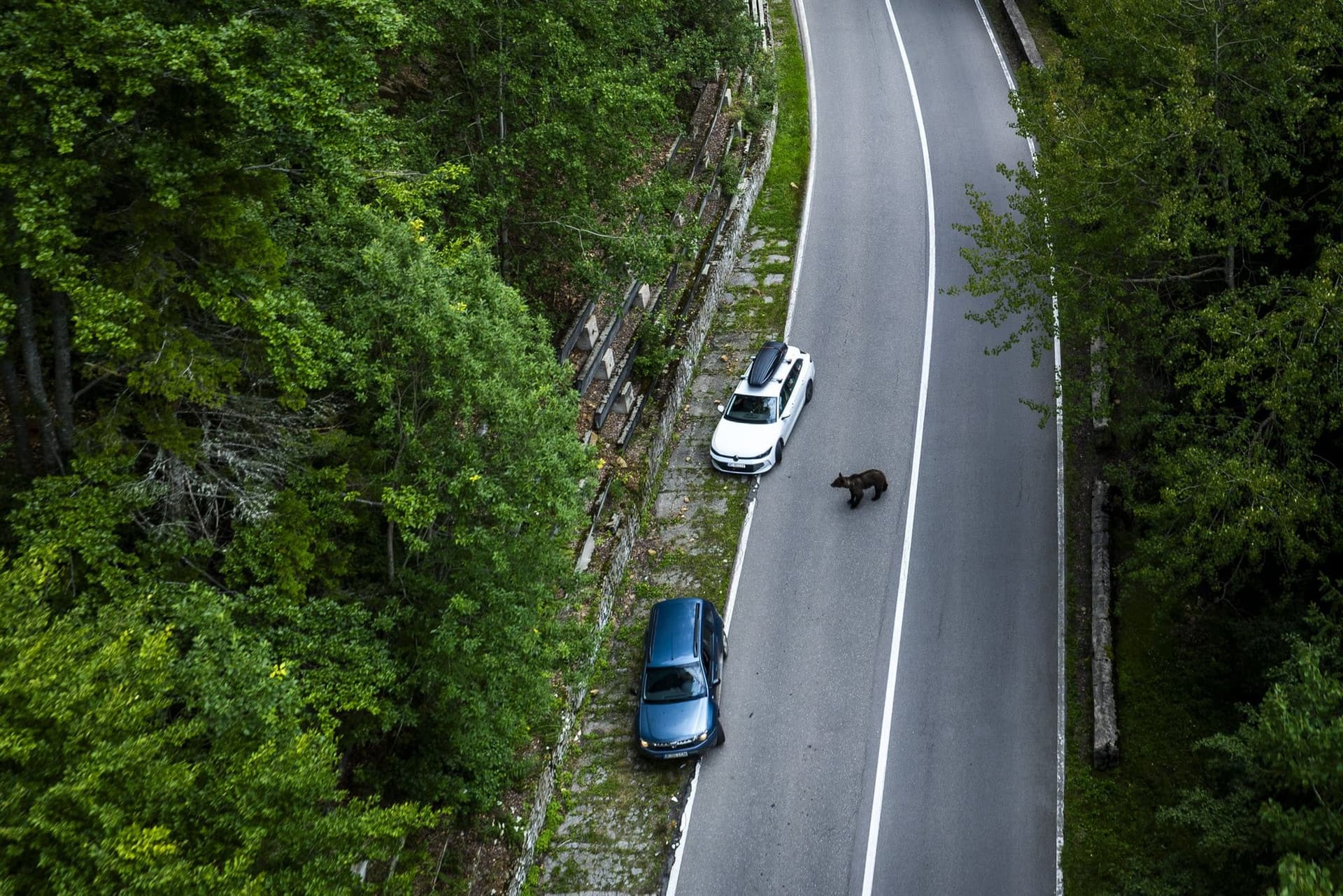
They sit at the edge of the road, thirty centimetres from the asphalt, and watch the cars go past. They do not run, they do not hide, they have no reason to. In a single day in July I counted ten roadside spots with bears on DN7C. How many there actually are, how they came to be there and what happens to them next — nobody can answer any of these questions in full.

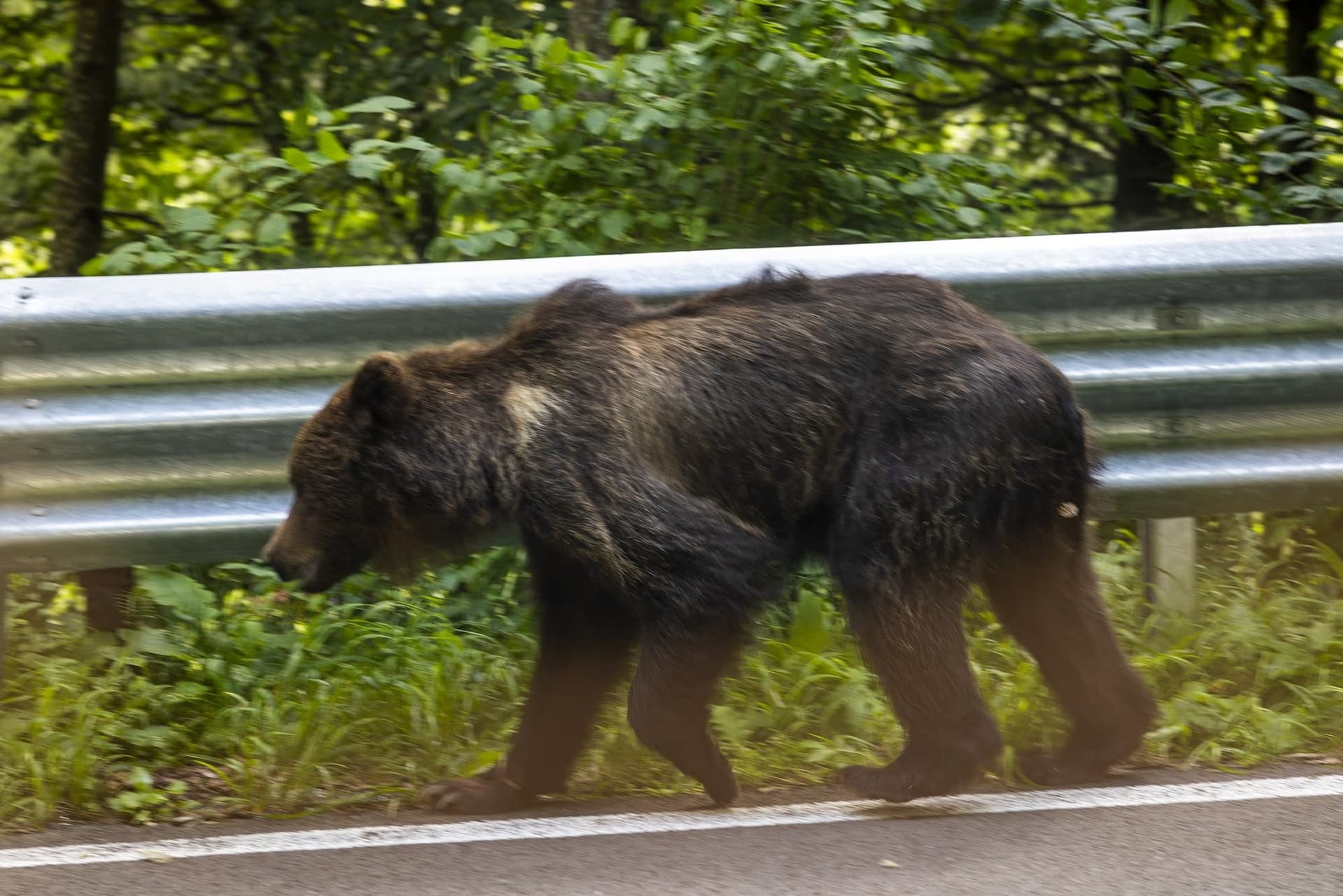
The bear is sitting on the strip of grass between the crash barrier and the forest, in a posture with nothing wild about it: seated, its back against the metal, its front paws dangling. It is watching the cars. When one slows down, it lifts its head slightly. When the car drives on, it lowers it again. This is a routine, and the routine is, technically speaking, an occupational disease of the animal: it is called habituation, and when food received from humans is added to it, food conditioning.
I drove up the Transfăgărășan — Romania's most famous mountain road — on a Thursday at the end of July 2026, on my way to something else, not to see bears. I counted ten places where they were sitting at the roadside.
Ten places, not ten bears. The distinction sounds like pedantry, but it is the very heart of the story.
Nobody knows how many there are
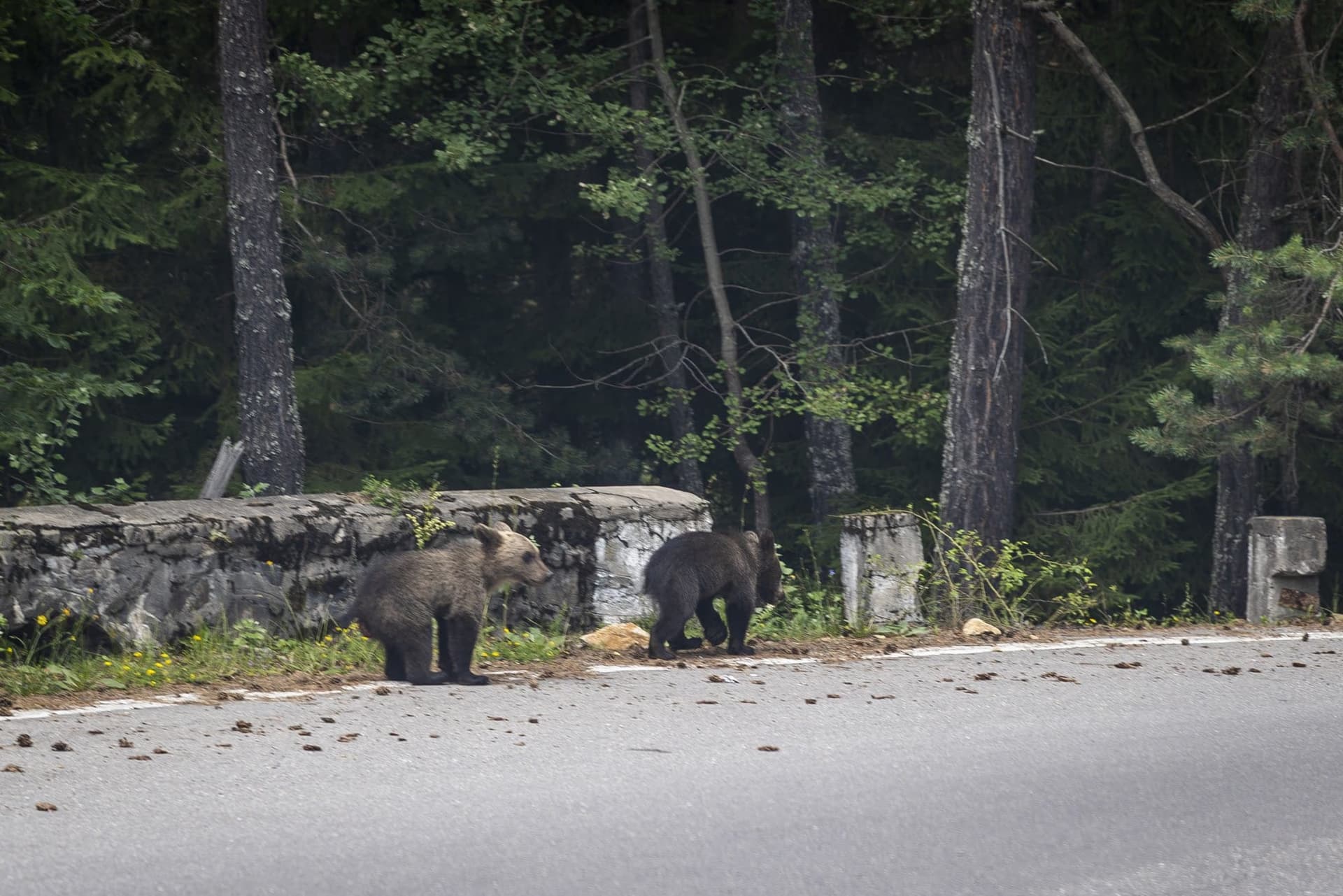
The brown bear is, in general, impossible to identify individually from a photograph. It has neither the unique markings of the lynx nor the nose print of other species. To know how many distinct bears frequent a stretch of road, you need GPS collars, ear tags or genetic profiles.
Not one bear on the Transfăgărășan has any of these.
The official figures that have circulated in recent years are three, they come from three different sources, and none of them arrives with a published methodology: fifteen habituated animals in 2022, twenty-six in 2024, twenty-three in 2026. They are not monotonic, they are not comparable with one another, and it is not known how they were obtained. One animal seen in three places produces three observations and a single bear; in accounts of the phenomenon, the three observations often become three bears.
The consequence is graver than it looks. The Romanian state relocates and shoots animals on a road whose bears have no count. And the derogation from the strict protection laid down in European law — the basis on which these interventions are carried out — assumes, by definition, that they are selective: that you know which individual animal is the problem. Without individual identification, the "problem bear" remains a label, not a category.
Fifteen kilometres, not the whole road
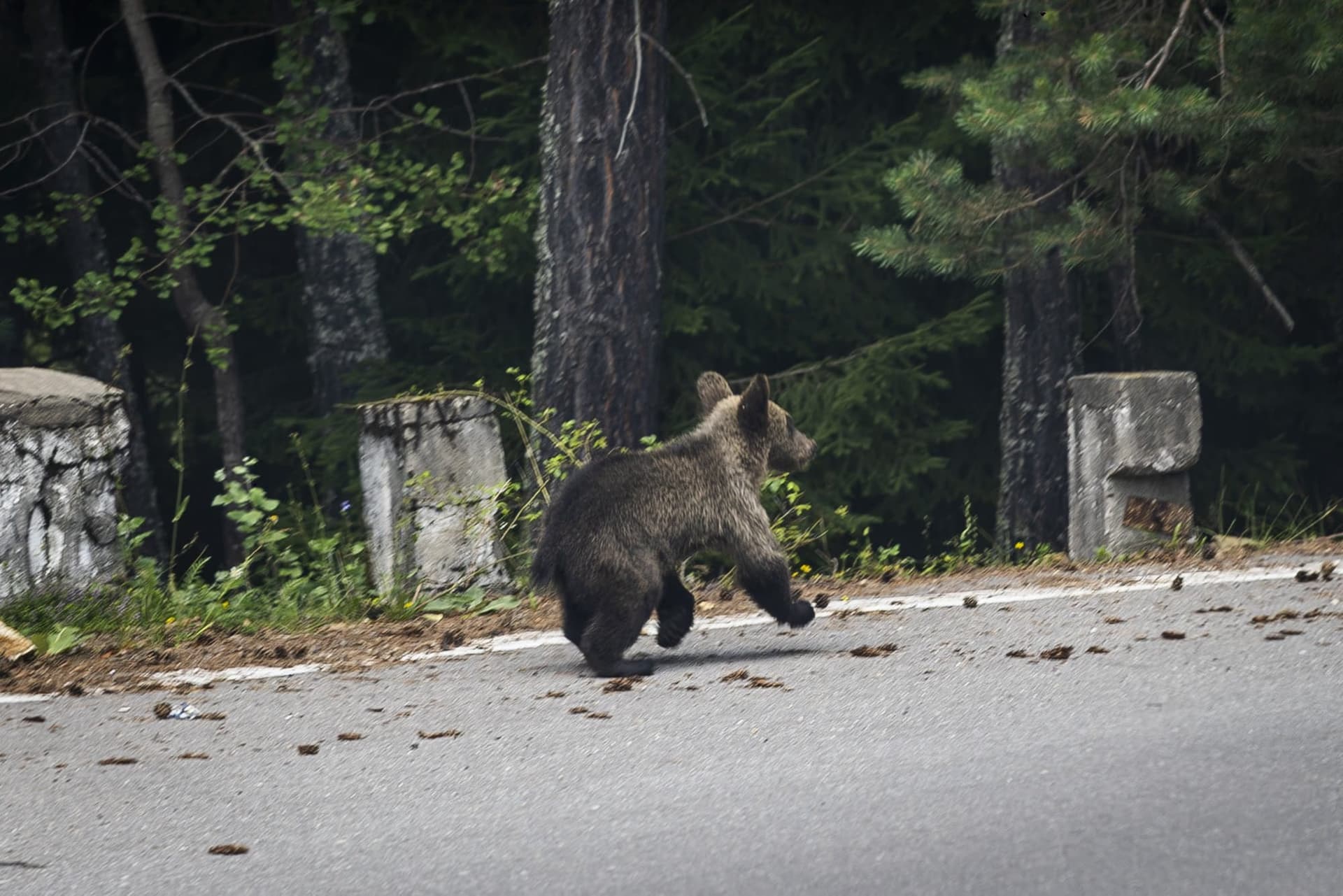
The second confusion is geographical. The "bears of the Transfăgărășan" are not up in the alpine zone, beside Lake Bâlea. They are down on the Argeș side, at 800 to 900 metres, on the stretch between Căpățâneni — the village below Poenari Castle — and the Vidraru dam.
The figure that settles the matter is this one: twelve of the fifteen incidents resulting in injury that could be documented occurred on this 10-to-15-kilometre strip of asphalt. On the alpine paths of the Făgăraș, the highest massif of the Romanian Carpathians — Podragu, Negoiu, the Bâlea–Capra route, precisely the places anyone would expect to be dangerous — not a single attack causing injury could be confirmed.
This is therefore a road phenomenon, not a mountain one. It does not happen in the wild: it happens next to cars.
The area even has an official delimitation. In September 2024 the National Environmental Protection Agency asked the Interior Ministry for joint patrols on a precise sector: between the access road to Valea lui Stan and Valea cu Pești — roughly fifteen kilometres. The reasoning given by the agency's president at the time: scaring the animals off and relocating them "no longer produce results, the animals returning every time to the places where they have grown used to receiving food".
The detail carries a practical consequence that few people draw: the alpine section of the road is open for about four and a half months a year — and only between seven in the morning and nine at night. The stretch with habituated bears, south of the dam, is accessible all year round. The phenomenon does not close down when the road does.
In the Arefu hunting ground, the game management unit crossed by exactly this strip, Romsilva — the state forestry administration — reported in July 2025 a population of 112 bears, against an "estimated optimum" of 25: four and a half times above the threshold. What it did not report was the area of the hunting ground. Without that, the figure cannot be converted into a density and cannot be compared with anything.
Why they stay there
The answer is as simple as it is hard to change: because it works. A bear that is given food at the roadside learns, within a few weeks, that the effort of foraging in the forest is pointless when a car will throw you a pretzel out of the window.
The behaviour is not new, but its history is surprisingly badly documented.
The oldest directly verifiable evidence dates from 25–26 June 2019: video footage of tourists — among them a child — who had got out of their cars and were feeding the bears at the edge of DN7C, picked up that same week by two independent newsrooms. It is worth noting what this means: the first piece of evidence for a phenomenon that would lead, six years later, to a man's death was a Facebook post, not a finding by any authority.
Further back, the ground becomes unreliable. The magazine Flacăra wrote in 1980 about "beggar bears" on the Transfăgărășan "around the seventies" — animals that would come towards people "with their paws held out". Accounts from the period when the road was built, 1970–1974, describe feeding troughs deliberately set up next to the military camp at Bâlea Cascadă, filled with canteen leftovers, in order to draw the animals away from the construction site's livestock pens.
The most unsettling item, however, is another. In 1977, the president of the county tourism and mountaineering commission, Aristide Stavros, reported that gamekeepers in the mountains around Brașov had been tasked with catching bear cubs, raising them on the bottle and then releasing them in the Făgăraș for restocking — animals which he himself wrote ended up displaying "behavioural aberrations". If the account is confirmed, the habituation of the bears on this road is not merely the result of careless tourists after 1990: it has, at least in part, its origins in state policy. It must be said, however, that this claim has no other confirmation.
All three of these sources circulate exclusively through second-hand quotation. None of them could be consulted in the original — nor confirmed factually. They are, at least for now, archival leads, not established facts.
And between 1990 and 2014 there is no accessible documentary trace at all: no press coverage, no public photograph, no recording. A quarter of a century of silence — but this silence belongs to the archives, not necessarily to the road.
I can give personal testimony for part of that interval: between 2006 and 2008, driving down from Sibiu towards Argeș, I encountered bears at the edge of the same road, on the same stretch that is written about today. I did not photograph them, nobody reported them, they entered no statistics. That is a testimony, not a piece of evidence anyone else can verify — and that is precisely the problem with those twenty-five years: the phenomenon was, very probably, continuous, but it left no traces that anyone on the outside can check.
What can be stated with certainty, on the basis of documents, is only this: the phenomenon becomes publicly documentable from 2019, is institutionalised locally in 2020, receives its first official figures in 2022 and produces its first fatality in 2025.
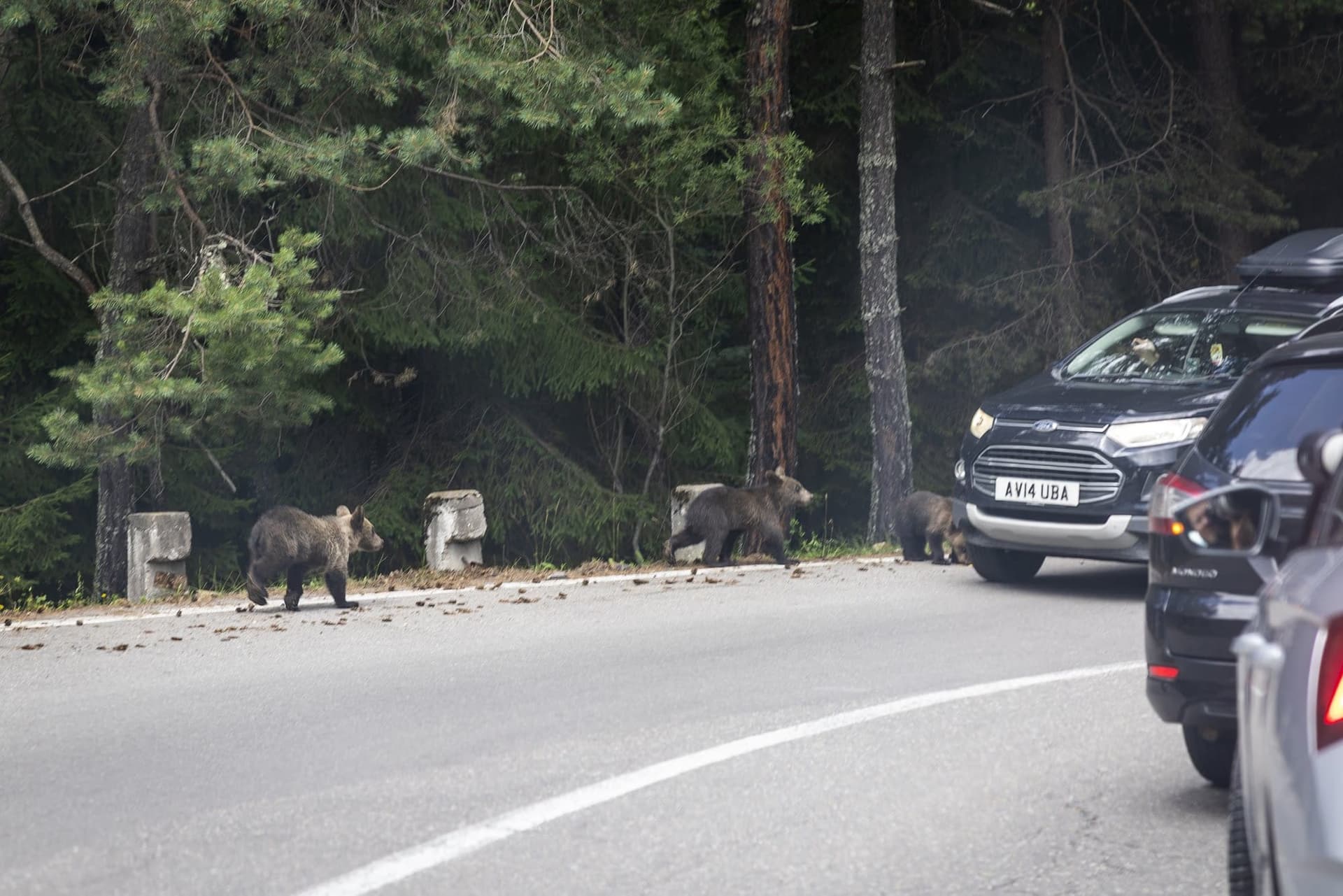
What has certainly changed is something else: the interaction is no longer only about food. It is about the image. Official warnings have evolved, in seven years, from "do not feed the bears" to "do not try to photograph them" — the authorities have themselves come to identify photography as a vector of risk.
What happened on 3 July 2025
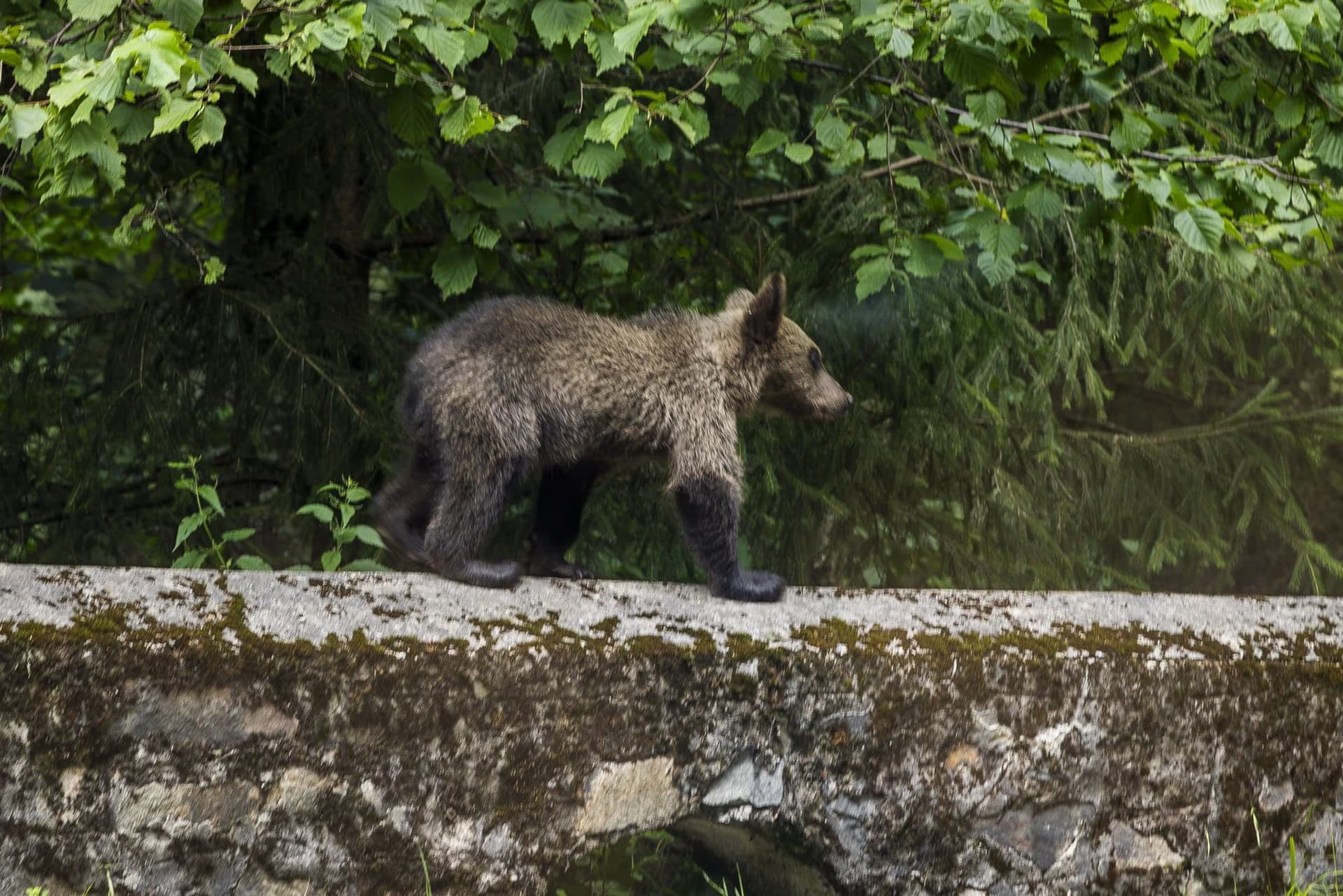
On the morning of 3 July 2025, in the area of the Vidraru dam, a 48-year-old Italian motorcyclist was killed by a female bear. He is the only documented fatality on this road. He had stopped to feed the animal and to photograph it; his phone contained consecutive photographs and a video of the bear approaching, frame after frame. The body was dragged sixty to eighty metres downhill, towards the lake. The bear had three cubs. She was shot. Of the cubs, one was found and taken to the sanctuary at Zărnești; there is no public confirmation of what became of the other two.
The case fits exactly the pattern described in the scientific literature, and that pattern contradicts the popular image of the beast that hunts humans. In a study published in Scientific Reports on brown bear attacks worldwide, only five per cent are predatory; ninety-five per cent are defensive, and the dominant scenario — almost half of all cases — is the female with cubs. What happened at Vidraru was not an animal hunting, but one taught to approach humans, which one day defended itself.
Romania does indeed account for almost half of the brown bear attacks recorded in Europe between 2000 and 2015. But the historical profile of the Romanian victim is not the tourist: in half of the cases documented in detail, those attacked were shepherds, farmers or livestock keepers — people who work in the mountains. What is happening on the Transfăgărășan is a different phenomenon, newer and concentrated along fifteen kilometres of asphalt.
There is also a bitter irony here that management cannot resolve: Scandinavian research shows that females with cubs are pushed towards areas frequented by humans precisely because there they escape dominant males, which would kill their cubs. The zone that is dangerous for us is the safe zone for them.
What the bears risk
For a long time, feeding bears was not prohibited in Romania by any explicit rule. The first ban along the route came not from the state but from the commune of Arefu: local decision number 21 of 2020 penalised feeding wildlife and photographing it from less than twenty metres away. The first fines, in August of the same year: five hundred lei.
The state got there five years later. Emergency Ordinance 60/2025, published in the Official Gazette on 7 November 2025 and in force from 17 November, explicitly bans feeding bears, with a fine of between 10,000 and 30,000 lei (roughly €2,000–6,000).
How much did the rule count for until then? An investigation based on official responses from the gendarmerie inspectorates of twenty-one counties found, for 2015–2024, eighteen fines in the entire country, totalling 6,900 lei. In the two counties crossed by the Transfăgărășan: seven fines, one thousand three hundred lei — roughly two hundred and sixty euros for a decade. In 2026, in six weeks and in Argeș county alone: nine fines, 106,500 lei. It is not only the amount that has changed; on 27 May 2026 the prefect of Argeș signed the order setting up permanent joint enforcement teams on DN7C. The rule had existed for years. The people to enforce it had not.
But there is another part of this, which is discussed less. The same ordinance of November 2025 introduces into Romanian law the category of "habituated bear" — and makes it an autonomous ground for removing the animal, while at the same time eliminating the requirement for graduated intervention. The penalty for the person who feeds and the definition that condemns the animal fed came into force on the same day, through the same act.
"A fed bear is a dead bear" — the formula, borrowed from the North American literature, was uttered publicly by the environment minister in the summer of 2024. Since 17 November 2025 it is no longer a campaign metaphor but a causal chain written into law.
And the other solutions do not work. The best available dataset on the relocation of brown bears — 110 events in Alberta, Canada, over forty years — shows a failure rate of seventy per cent; the animals come back, and "home" only begins to disappear as a concept beyond a hundred kilometres, that is, beyond the Făgăraș massif. In March 2025 the environment minister publicly acknowledged: "The relocation method does not produce results, the method of scaring them off does not produce results."
That leaves shooting. And here comes the figure that changes the way the entire official vocabulary reads: of the 381 bears removed under the so-called "prevention quota" in roughly ten months, between 2024 and 2025, more than 70% were trophy animals — animals with high scores, assessed under the international hunting grading system, not problem bears identified as such. And the law that established this regime contains a price scale per skull, calculated according to the trophy score.
Prevention and trophy hunting, in other words, use the same quota. The existence of a price scale in a prevention law is, in itself, a fact worth reading twice.
The quota for the coming season — almost a thousand animals, four and a half times more than in 2023 — was not, as of mid-August 2026, in force. The Constitutional Court had rejected the president's challenge on 24 June, but on 7 August he asked Parliament to re-examine the law, with six requests; three of them restate, almost word for word, the methodological objections raised by WWF Romania against the genetic study of December 2025.
The missing numbers
As for the national population, the picture is just as unstable. The same institutions of the same state have, over the past decade, reported anywhere between 4,650 bears (the figure submitted to the European Commission for 2013–2018) and 12,787 (the upper bound of the genetic study presented in December 2025) — a factor of almost three.
The genetic study, which cost 57.3 million lei and analysed more than 24,000 samples, produced a range of 10,657–12,787 individuals, with a mean of 11,651. It did not, however, settle the dispute; it displaced it. WWF Romania challenged the methodology on six points, among them the fact that the samples were collected over the course of three years, which violates the "closed population" assumption on which this type of model rests. The objection is not theoretical: data from the Conservation Carpathia Foundation in the Făgăraș show that, of 504 bears identified cumulatively between 2017 and 2022, only 20% of those detected in 2017 were still being found in 2022. Individuals accumulated over several years are not the same thing as the population existing at any given moment.
Nor, for that matter, is there even a public record of human victims. The Romanian state does not publish an annual series of people injured or killed by bears. The figures invoked politically — "26 dead and 274 injured in twenty years", a formula used by the environment minister in 2024 — are not broken down by year, have no clinical definition of "injured" and cannot be audited by anyone outside. And the series in circulation contradict one another arithmetically: 4,400 calls to the emergency number 112 in a single year, according to one report, against 6,400 in five years, according to another.
One correction is worth making, because it circulates often: the formula "Romania has half of Europe's bears" is misleading. The 2024 EU Council document attributes "approximately half of the European population" to the Carpathian population as a whole — Romania, Slovakia and Poland. Romania itself wrote, in its 2018 national plan, that it holds 35–40% of the European population excluding Russia.
And one more, topical: unlike the wolf, whose protection status was effectively lowered by a European directive that entered into force in July 2025, the brown bear remains, in August 2026, a strictly protected and priority species under Union law. There is no formal proposal from the European Commission to the contrary — only a political request submitted jointly by Romania and Slovakia in June 2026.
The last bear
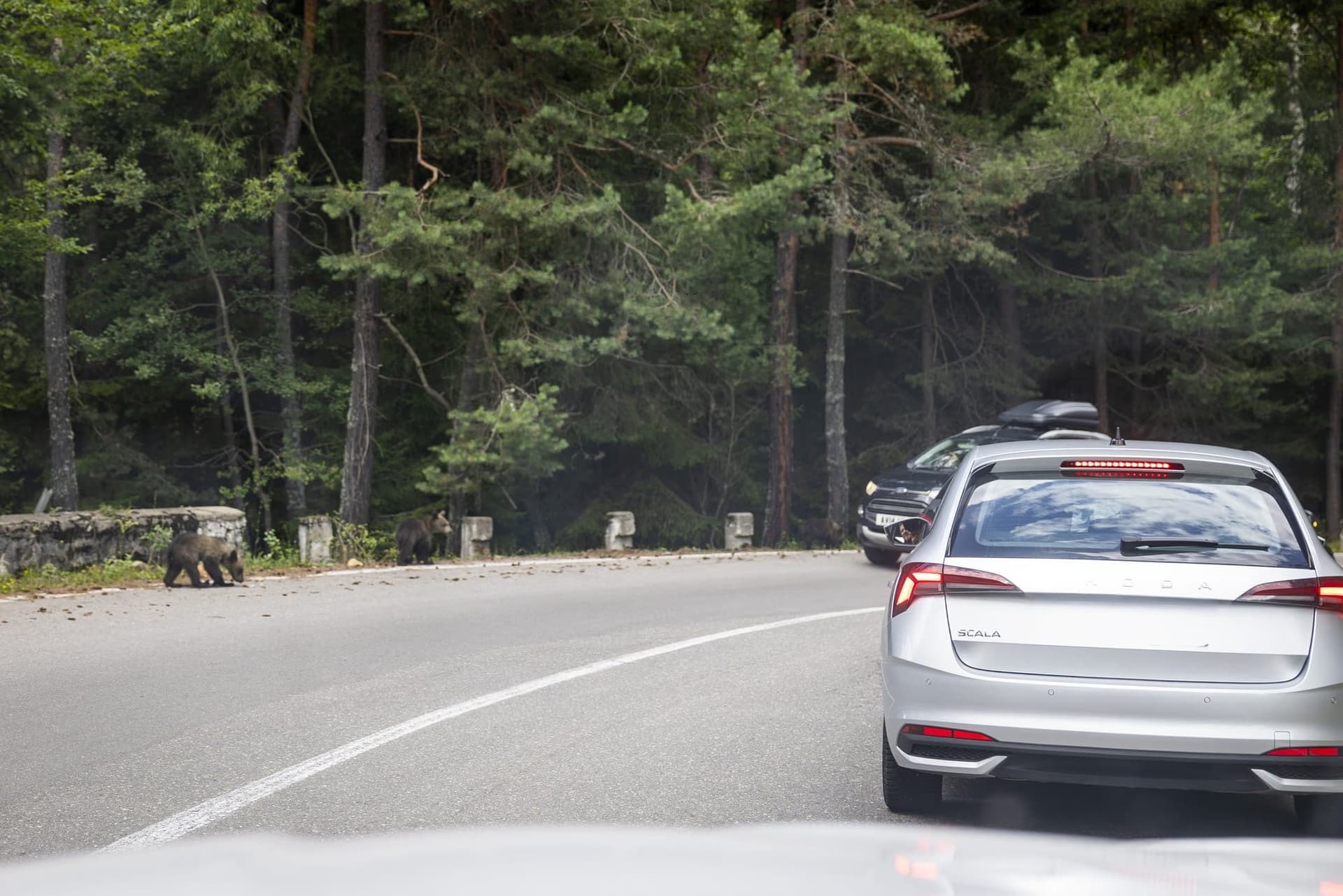
On the southern slope, at the first stops, there was a queue. People had gathered as if for a bear — the old Romanian expression, here meant literally. The number of those actually feeding the animals was small, but they existed, and along the whole route, more and more frequent, the signs: NU HRĂNIȚI URȘII, with the English translation underneath. In September 2024 there were ten of them along the entire road; a year later, more than twenty.
On the descent towards Sibiu, by contrast, the enthusiasm had thinned. At the last few spots, barely a car still stopped. A bear at the edge of the road was no longer an event but an obstacle: you slowed down, you looked for two seconds, you drove on.
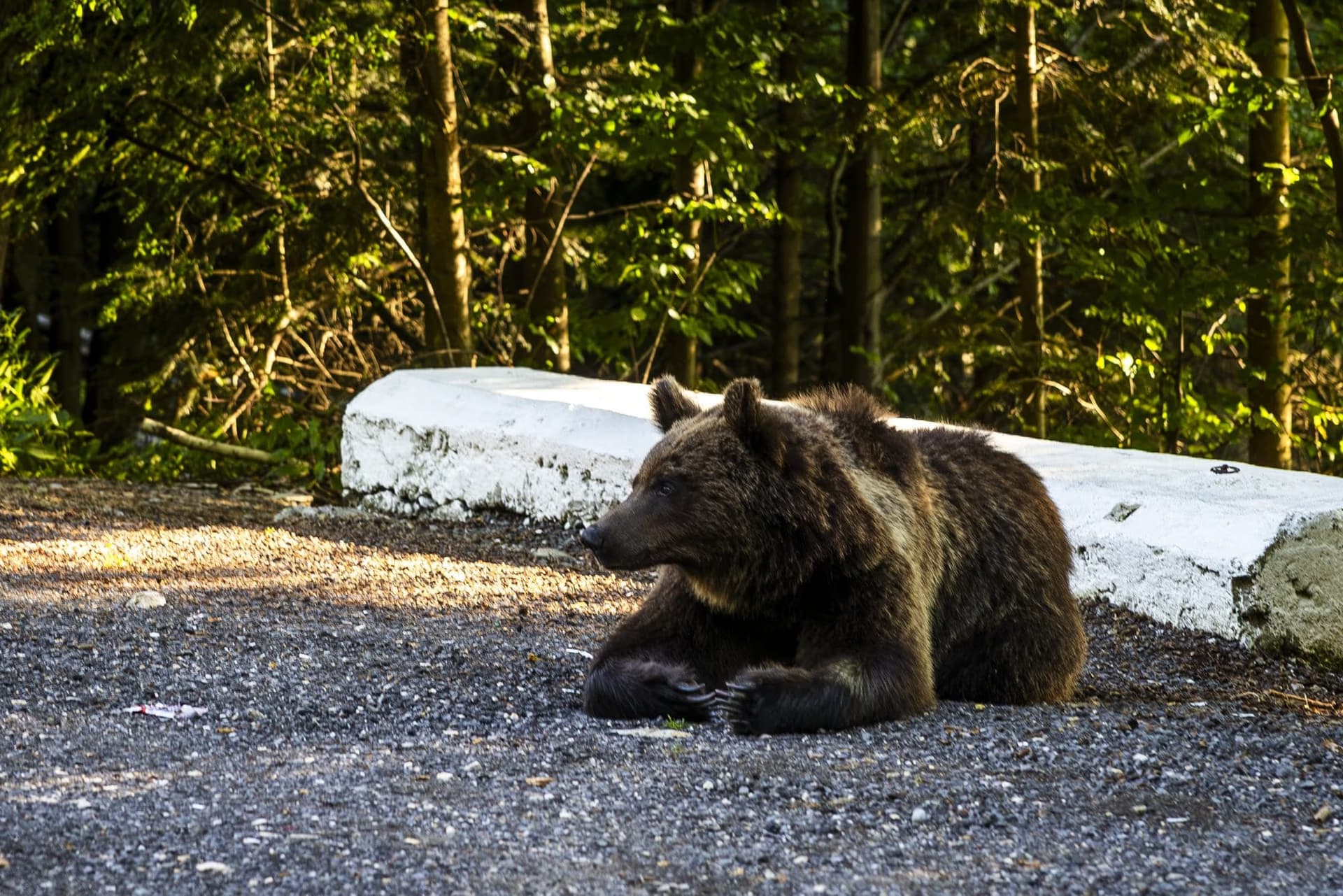
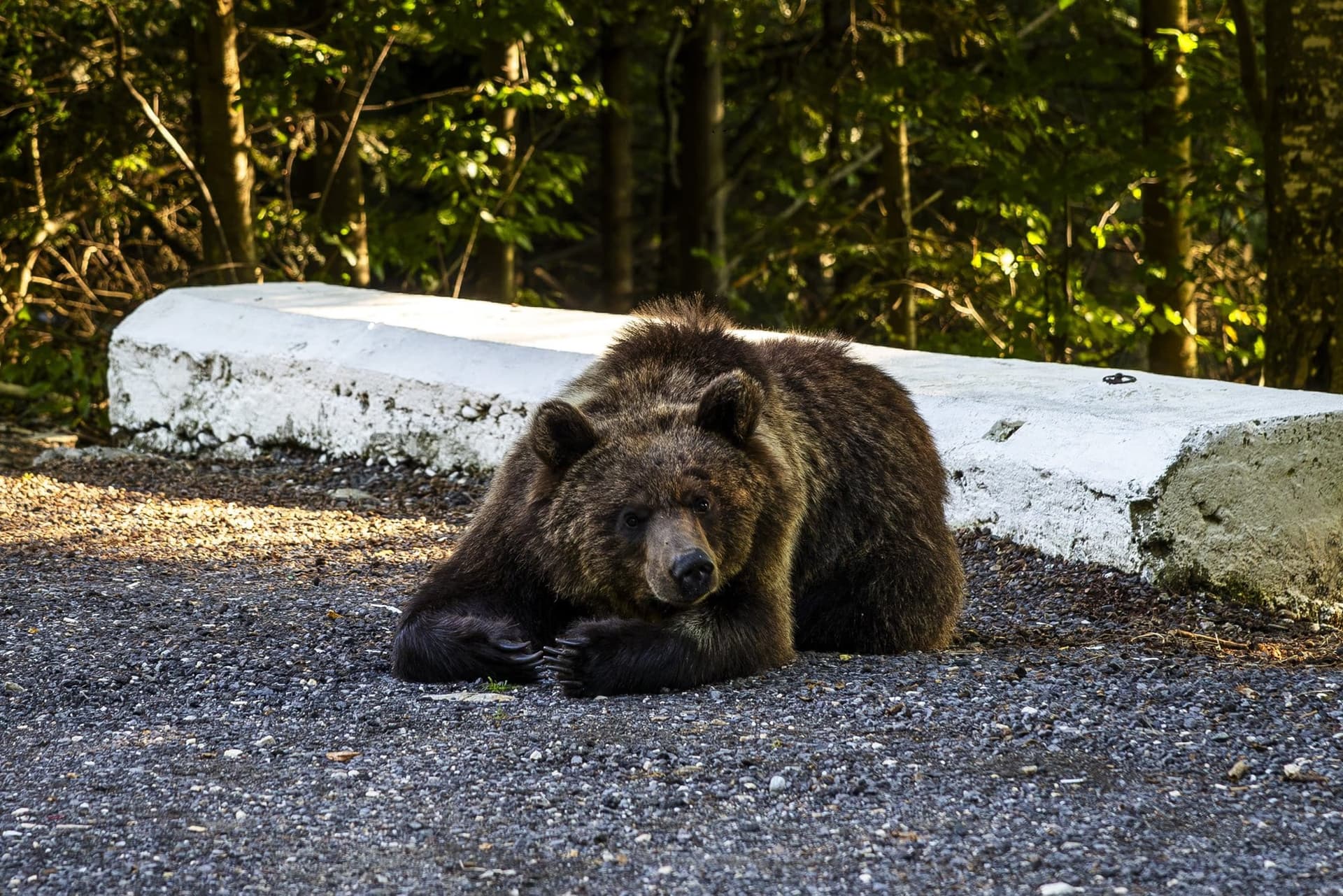
The last one I saw, at seven in the evening, below Bâlea Cascadă, was not begging and was not approaching anyone. It was asleep in a car park, pressed against a concrete kerb, its muzzle on its paws. Not one car had stopped.
In a few weeks' time the alpine road will close for the winter. But the bear is not going anywhere.
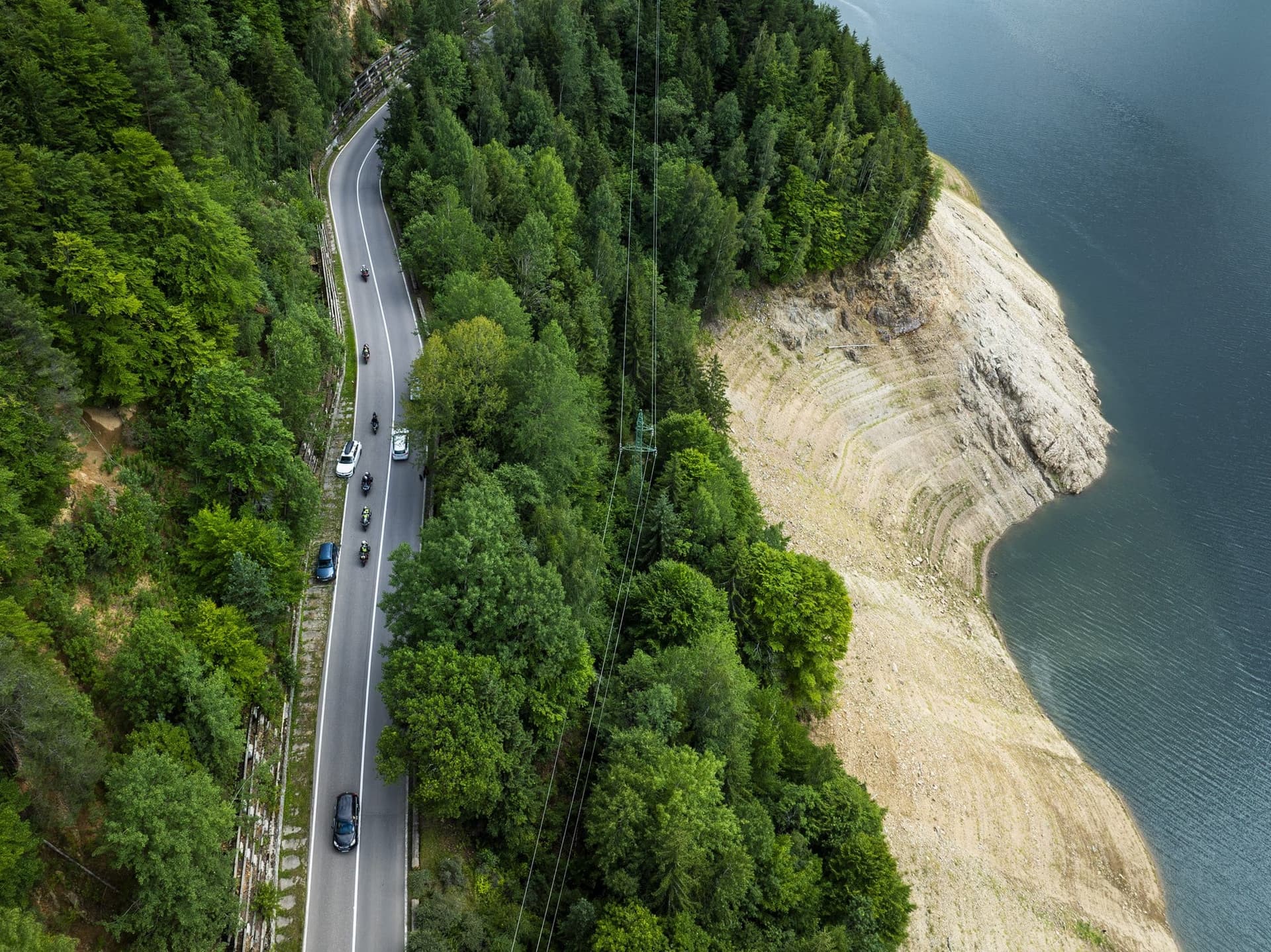
Reportage by Adi Coco · RomâniaFrumoasă — A country, seen slowly · Photographs taken on Thursday, 23 July 2026, on national road DN7C, between Argeș and Sibiu counties.
Sources:
Agerpres — Romsilva: the Arefu hunting ground has 112 bears against an optimum of 25 (3 July 2025)
Snoop.ro — "Romania versus the bear: we do not know how many there are, we count them by eye"
Digi24 — the first video evidence of bears being fed on the Transfăgărășan (25 June 2019)
Mediafax — ten warning signs installed on the Transfăgărășan (19 September 2024)
Mediafax — the first fines under the Arefu local decision (24 August 2020)
HotNews — Romsilva's figures in the case of the motorcyclist killed by a bear
Conservation Carpathia — the first genetic census of Romania's bears
WWF Romania — the results of the genetic study: on the need for transparency and scientific rigour
Council of the EU — Directive (EU) 2025/1237 on the protection status of the wolf
European Commission — Habitats Directive, large carnivores
Note on method. The ten places with bears are my own count, made during a single crossing, on Thursday 23 July 2026: they are observations, not distinct animals. The figures for the number of habituated bears on DN7C (15 in 2022, 26 in 2024, 23 in 2026) come from different institutional sources and have no published methodology. The inventory of incidents involving injury (twelve out of fifteen on the Argeș sector) is the result of my own research in public sources, not of any official record — no such record exists. The accounts of "beggar bears" in the 1970s, the article in Flacăra (1980) and the report by Aristide Stavros (1977) circulate exclusively through second-hand quotation; the original sources could not be consulted and are treated here as archival leads, not as established facts. The exact values of the price scale per skull in the quota law could not be confirmed in the Official Gazette and are therefore not reproduced. The account of encounters with bears on the same sector between 2006 and 2008 is the author's direct testimony, unsupported by photographs or by any report from the time; it does not cancel the documentary gap of that period but explains it. The brown bear remains, in August 2026, a strictly protected species under European Union law — the change of status in 2025 concerned the wolf, not the bear.