Between 2015 — when the Romanian Air Force's combat fleet was still exclusively Soviet — and 2030 — when the first F-35 is due to arrive — Romania is making a three-generation leap, unprecedented in the history of the Romanian Air Force. Figures, decisions, seven pilots lost, two modernisation programmes (one failed, one successful), and a sky that remains sovereign at a moment when the country's northern neighbour is at war. Timeline verified with the Ministry of National Defence.
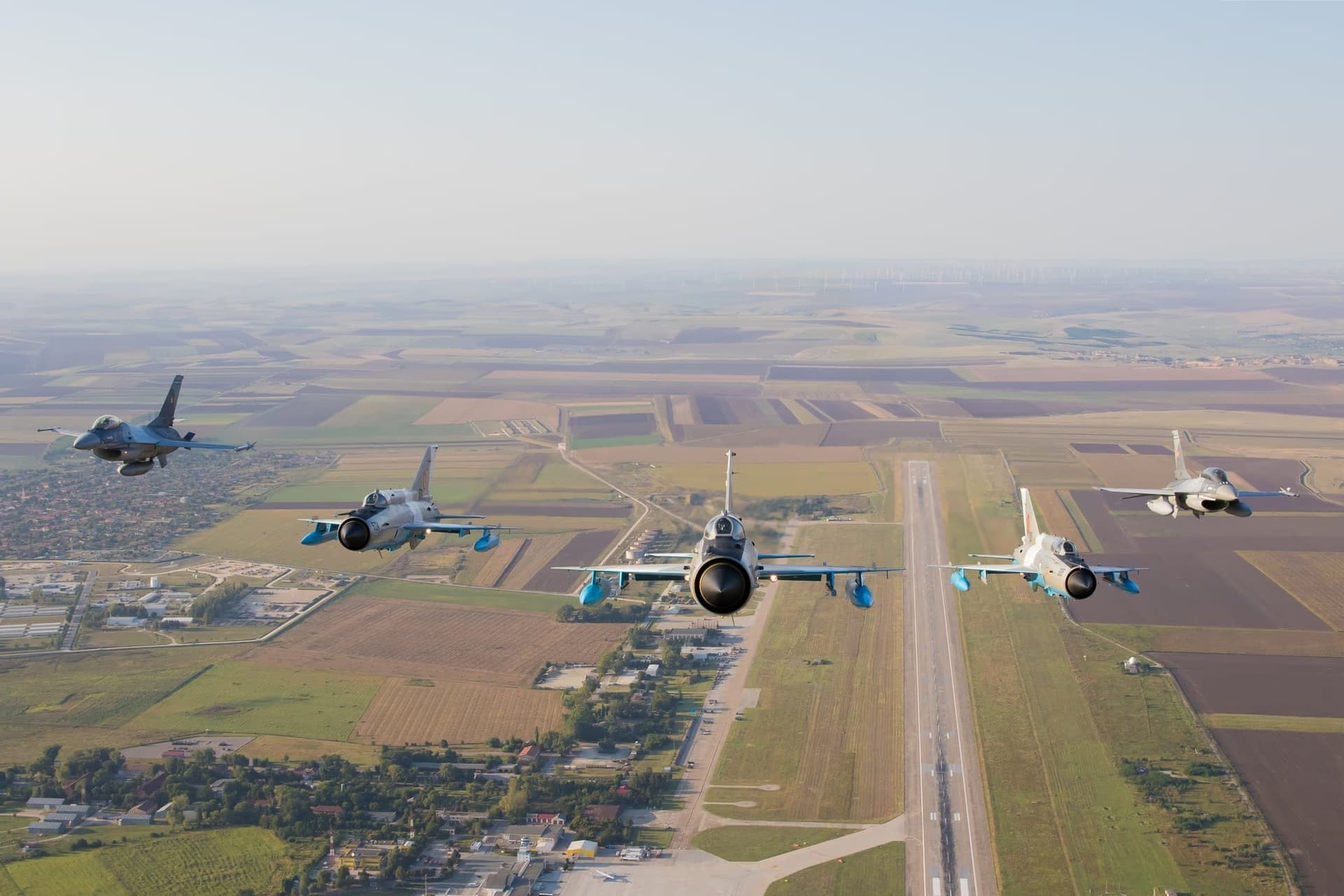
In fifteen years, the Romanian Air Force has moved from an exclusively Soviet fleet to 58 F-16 Fighting Falcons delivered (out of 67 contracted, from three successive transactions with Portugal, Norway and the Netherlands) and has contracted 32 F-35A Lightning IIs from Lockheed Martin, worth 6.5 billion US dollars. It has lost, along the way, seven pilots. It has built, in the same period, the first European F-16 training centre for both Romanian pilots and NATO allies. At BSDA 2026 — Romania's biggest defence exhibition — the United Kingdom set up its first national pavilion in Bucharest, a signal that this market, in the middle of a complete refresh, has become a direct sales channel for the European defence industry.
The end of the old order
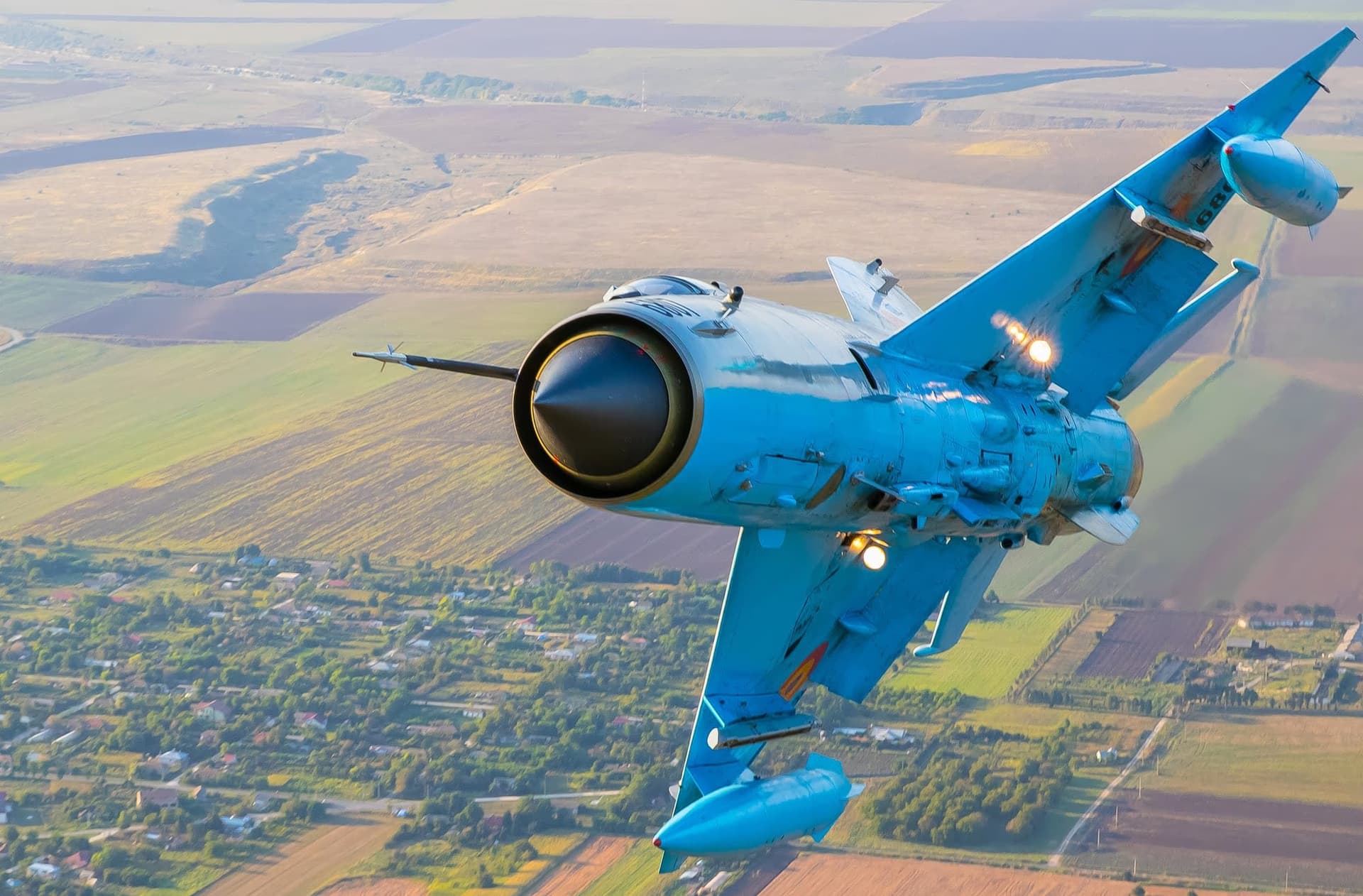
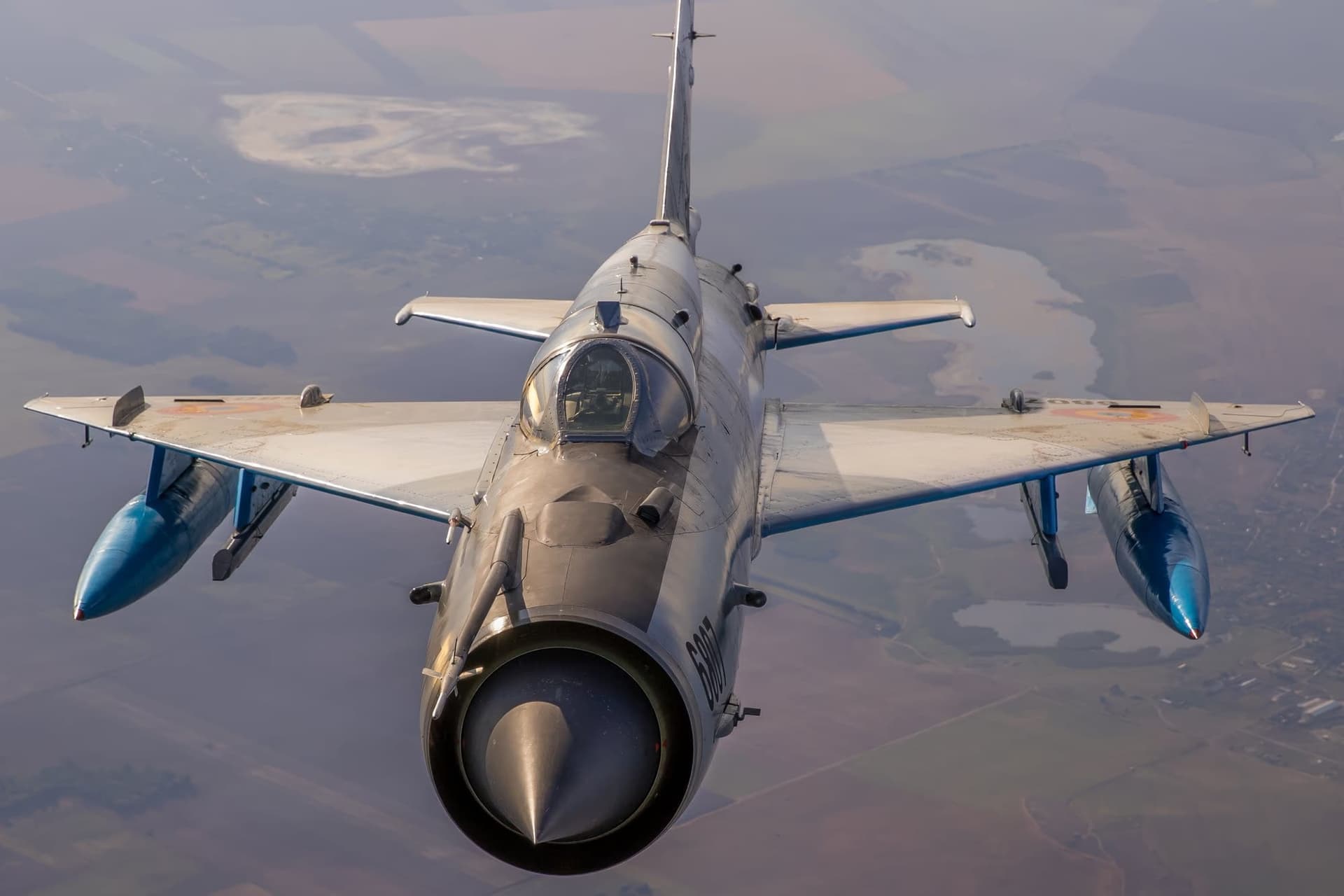
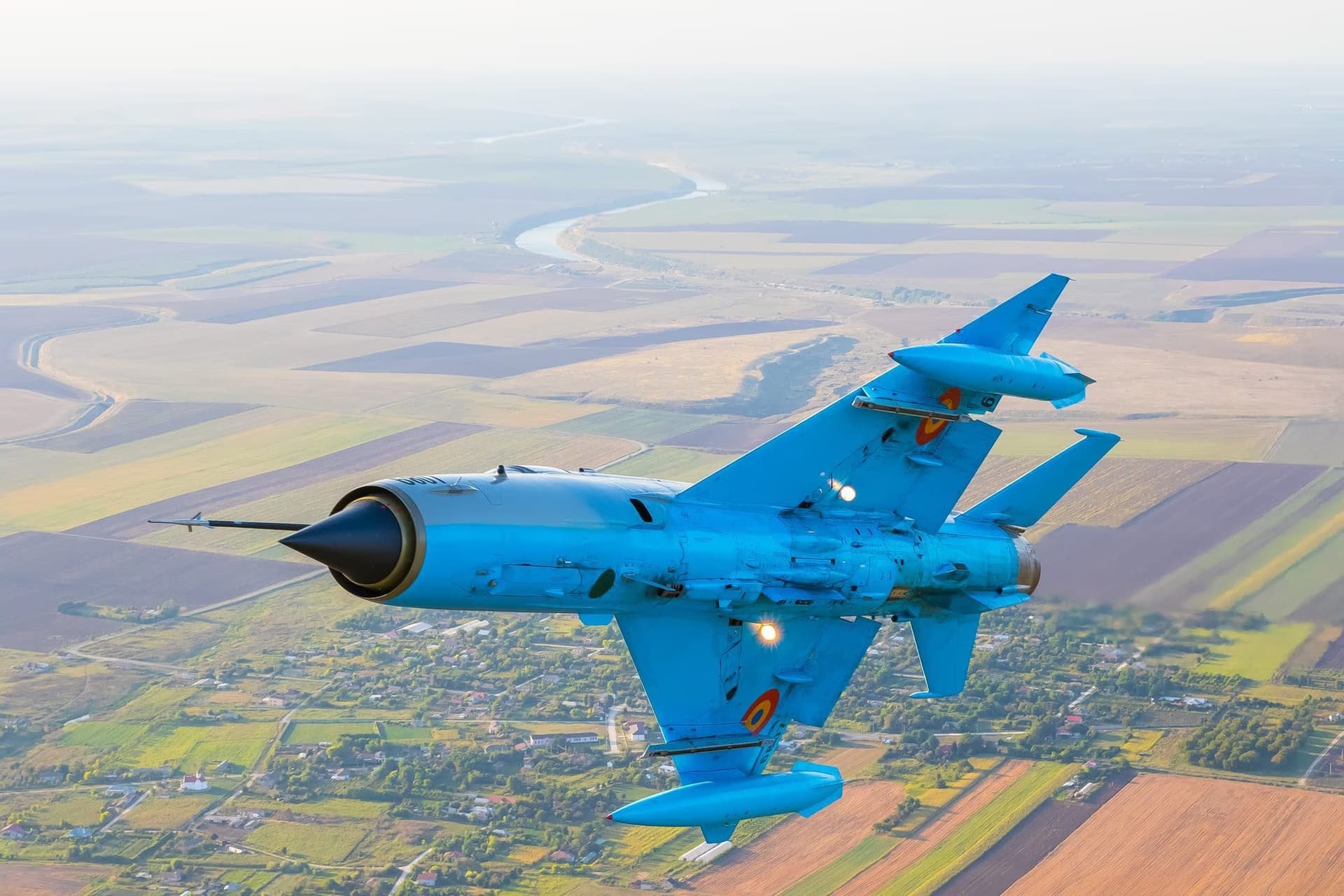
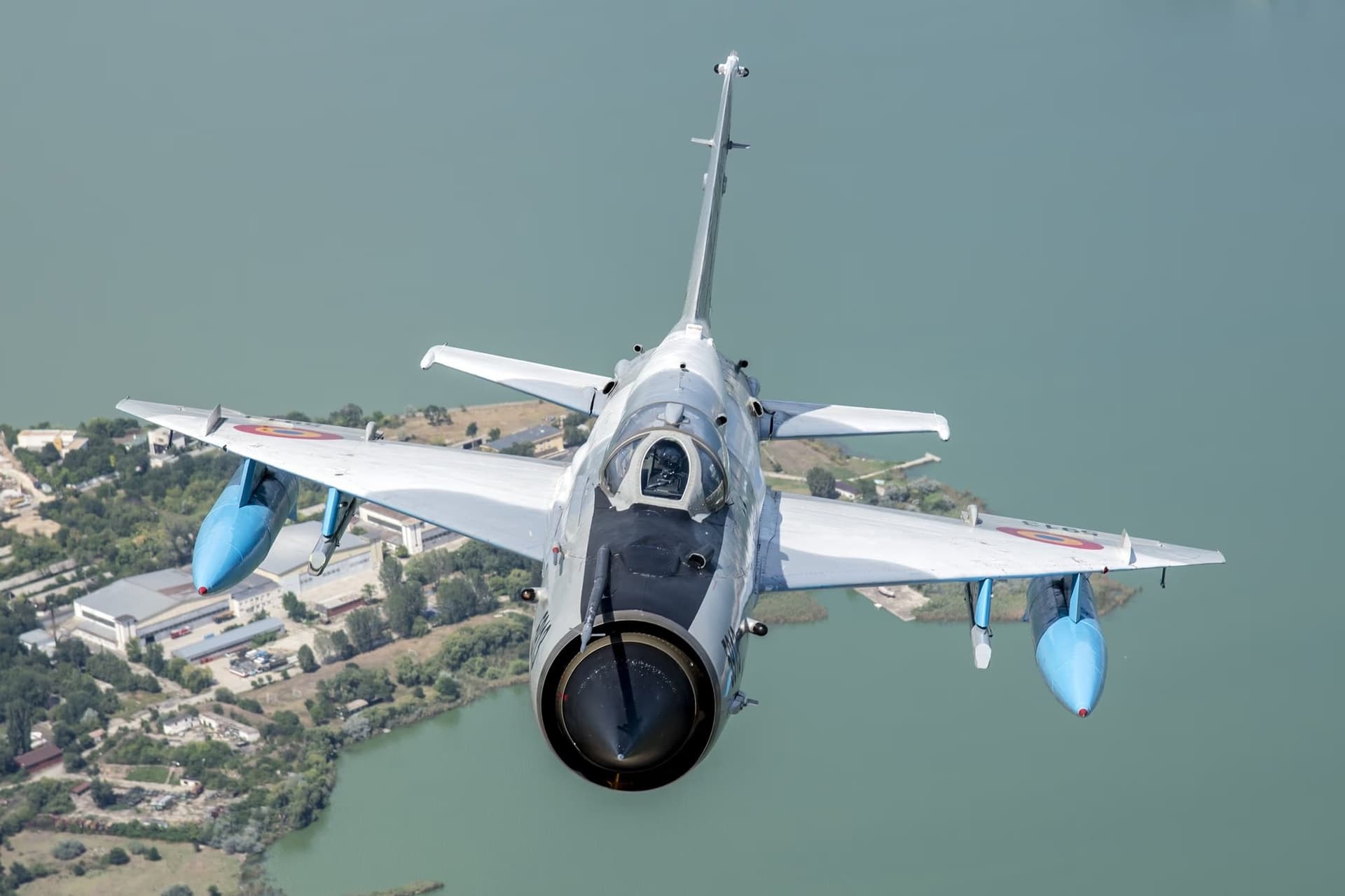
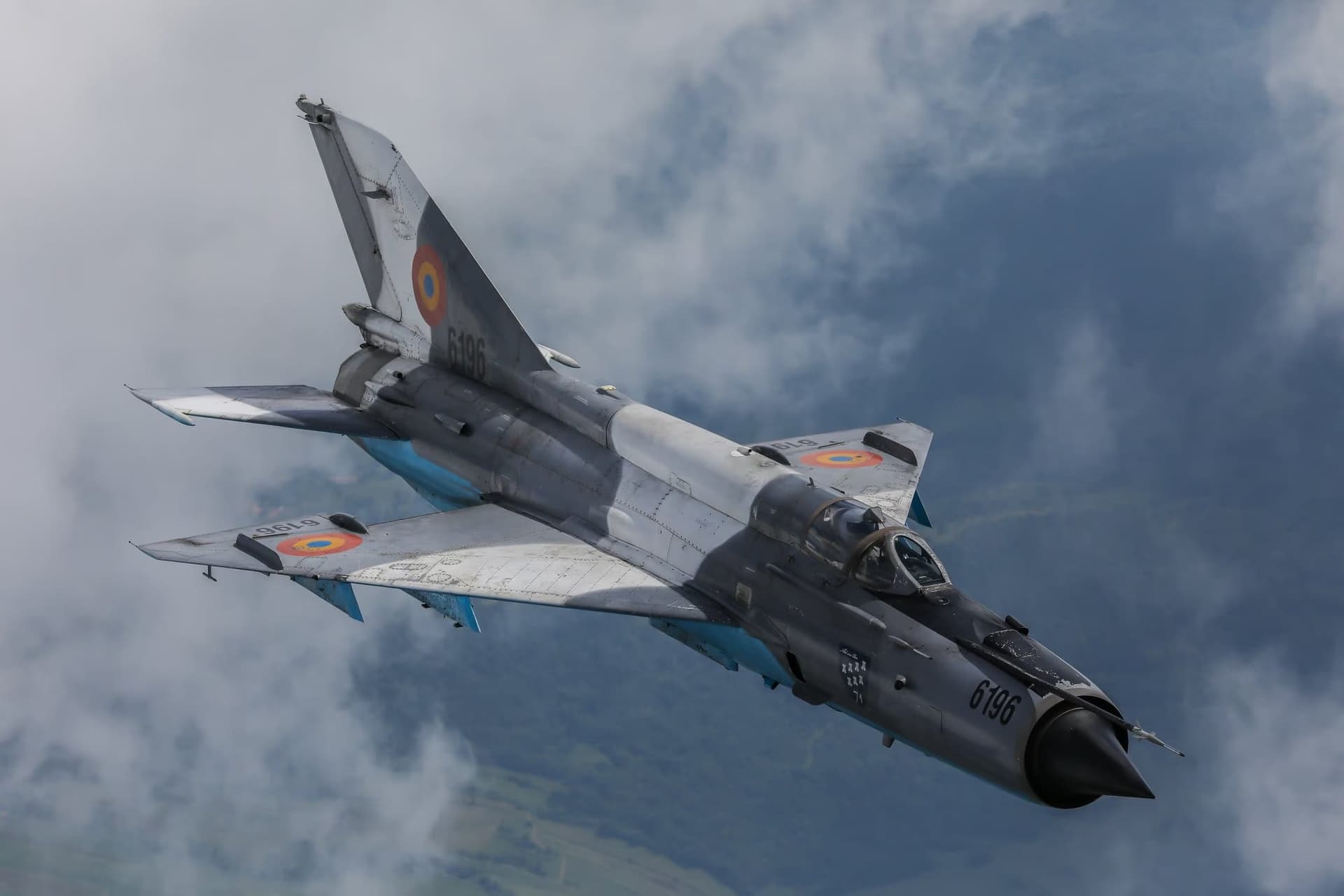
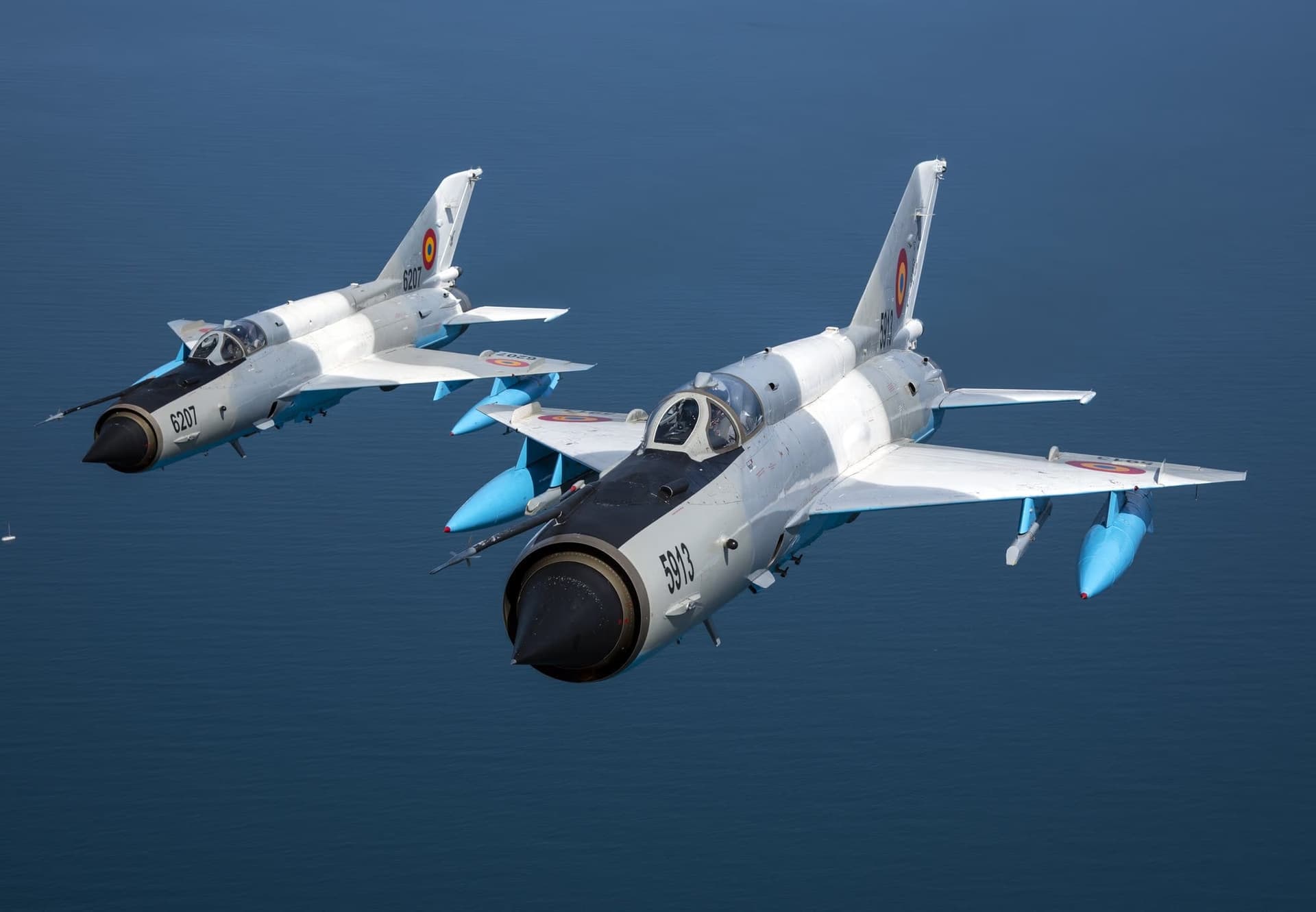
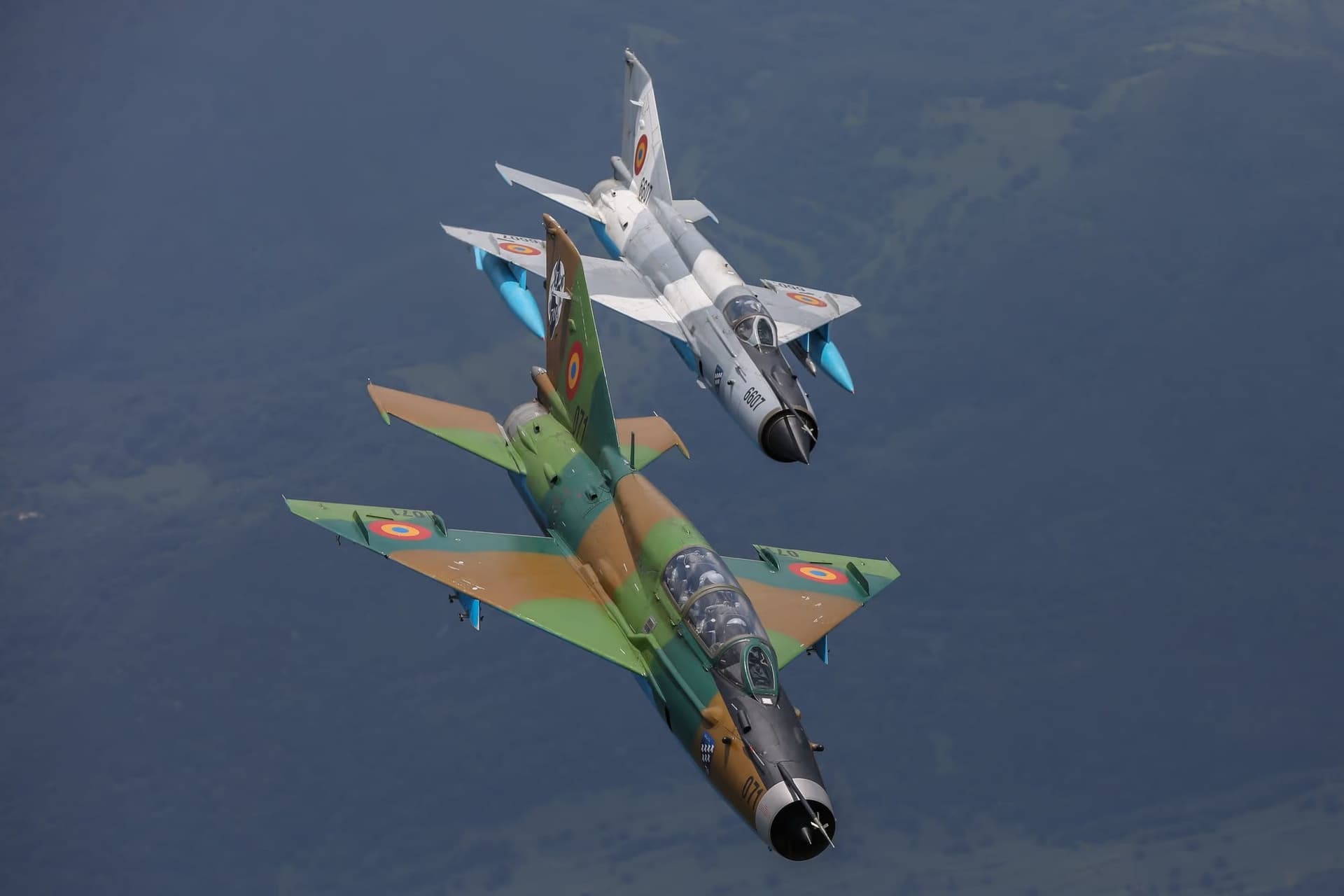
On 15 May 2023, the last MiG-21 LanceR landed at Borcea for the last time. With that flight, an era of six decades came to an end. The MiG-21 entered Romanian Air Force service in 1962 and, until withdrawal, Romania acquired more than 300 MiG-21 aircraft, in various variants (official MApN figures, June 2026).
In the early 1990s, Russia cut off spare-parts supply. Bucharest's response came in 1993, in the form of a contract with Aerostar Bacău and the Israeli firms IAI and Elbit: a portion of the MiGs were to be modernised to a standard called LanceR, with new avionics, NATO-compatible systems and the capacity to launch Western armament. Between 1995 and 2002, 110 aircraft were modernised to the LanceR standard, in variants A (ground attack), B (training) and C (interception).
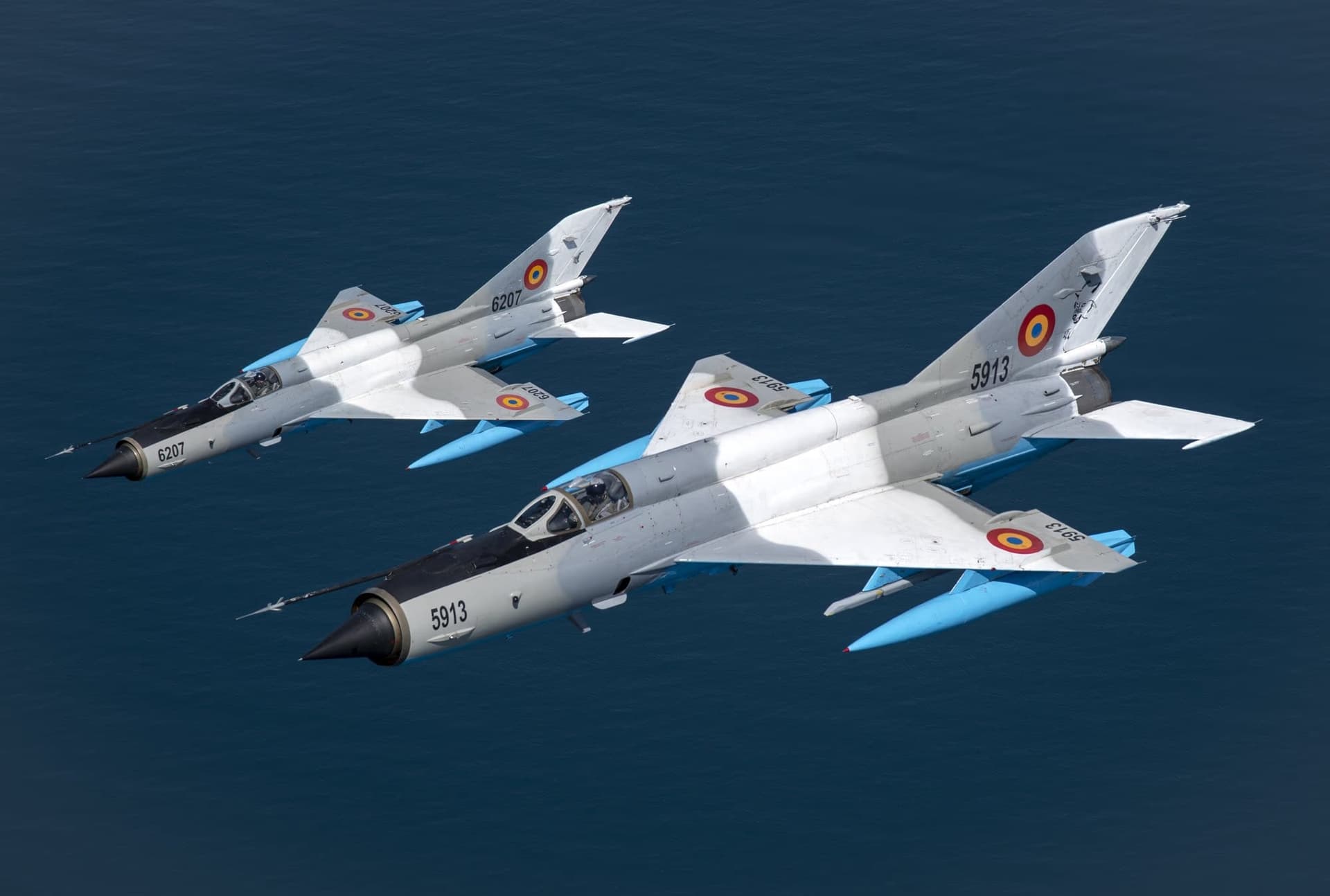
For a time, Romania had the most modern MiG-21 fleet in the world. It also had one of the most dangerous. The accident rate remained consistently high throughout the operating period, but — as the MoD has noted — „without a dedicated archival study and a unitary statistical base, we cannot draw a valid comparison between the operating periods." Complete data for the pre-1989 period are not publicly consolidated in a form comparable with later ones.
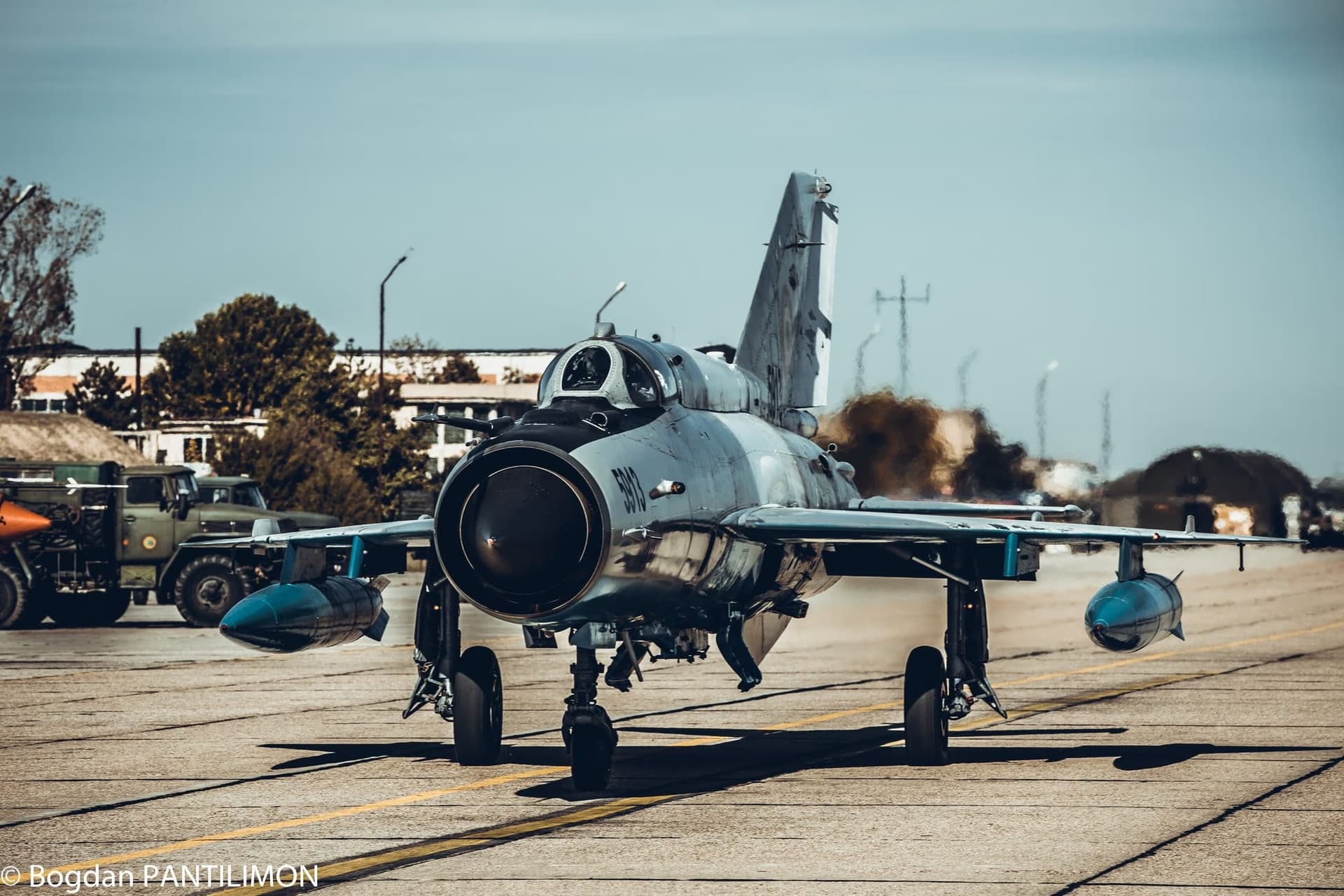
The decision to withdraw came on a night in March 2022, when a LanceR on patrol over the Dobrogea region disappeared from radar. The pilot, Captain Iosif-Costel Niță, 31, died. The IAR-330 Puma helicopter sent to look for him also crashed at sea in bad weather. All seven people on board died, including two Naval Forces rescuers. Eight dead in a single evening. It was the worst military aviation accident in Romania's recent history. The MiG-21 flew for another year under the pressure of the war in Ukraine, then was withdrawn for good.
In the twenty years of LanceR operations (2002-2022), the Army Media Agency officially commemorated — with names and dates — seven pilots killed in major accidents, in the article [„Farewell, MiG-21 LanceR!"](https://presamil.ro/ramas-bun-mig-21-lancer/):
- Lieutenant Commander Adrian Manuel Săvulescu — 21 February 2002
- Captain Commander Horea Sorin Popa — 25 September 2003
- Commander (posthumous) Dan Andrei Ghica-Cucerca — 22 November 2006
- Captain Commander Laurențiu Chiriță — 1 November 2010
- Captain Commander Sorin Avram — 1 November 2010
- Lieutenant Commander Florin Rotaru — 7 July 2018
- Captain Iosif-Costel Niță — 2 March 2022
When asked about this list, the MoD confirmed „the general framework" without compiling a fresh nominal record, noting that the validated public information remains that published through the institution's own records and those of the National Office for the Cult of Heroes. Losses of lives and equipment existed before 1989 too, but for that period the complete data are not publicly consolidated in a unitary form.
Chiriță and Avram died together, in a two-seat LanceR on a weather-reconnaissance mission near Câmpia Turzii. They could not eject. Both were 40, and each had a child at home. Rotaru died at an airshow in Borcea, in front of the public.
The modernisation that didn't happen
The question the Romanian press doesn't ask directly is: why did Florin Rotaru die in an aircraft designed in 1955, when Romania still had, somewhere, a fleet of MiG-29s — an aircraft three decades more modern?
The answer lies in a political decision from the early 2000s. The Air Force had received, between 1989 and 1990, 21 MiG-29 „Fulcrums", out of an original order of 45. These were the most advanced combat aircraft Romania has ever had. Aerostar Bacău tried a modernisation programme called Sniper, with Germany's DASA and Israel's Elbit. A single aircraft — tail number 67 — was converted; it first flew in May 2000. Then the programme was halted. The money was gone, the Russian parts were gone, and Moscow pressed against modernisation with Western technology.
According to publicly communicated MoD data, the MiG-29 aircraft were withdrawn from service by a Supreme Defence Council (CSAT) decision in 2004, entering the legal procedures applicable to decommissioned assets. The status of each surviving aircraft has since been managed through the patrimonial records of the competent structures; where possible, some have been used as exhibits or teaching material. The choice to give up the MiG-29 and bet on the modernised MiG-21 was economically short-sighted and had long-term consequences that were paid, in part, in pilots' lives.
The transition: Portugal, Norway, the Netherlands
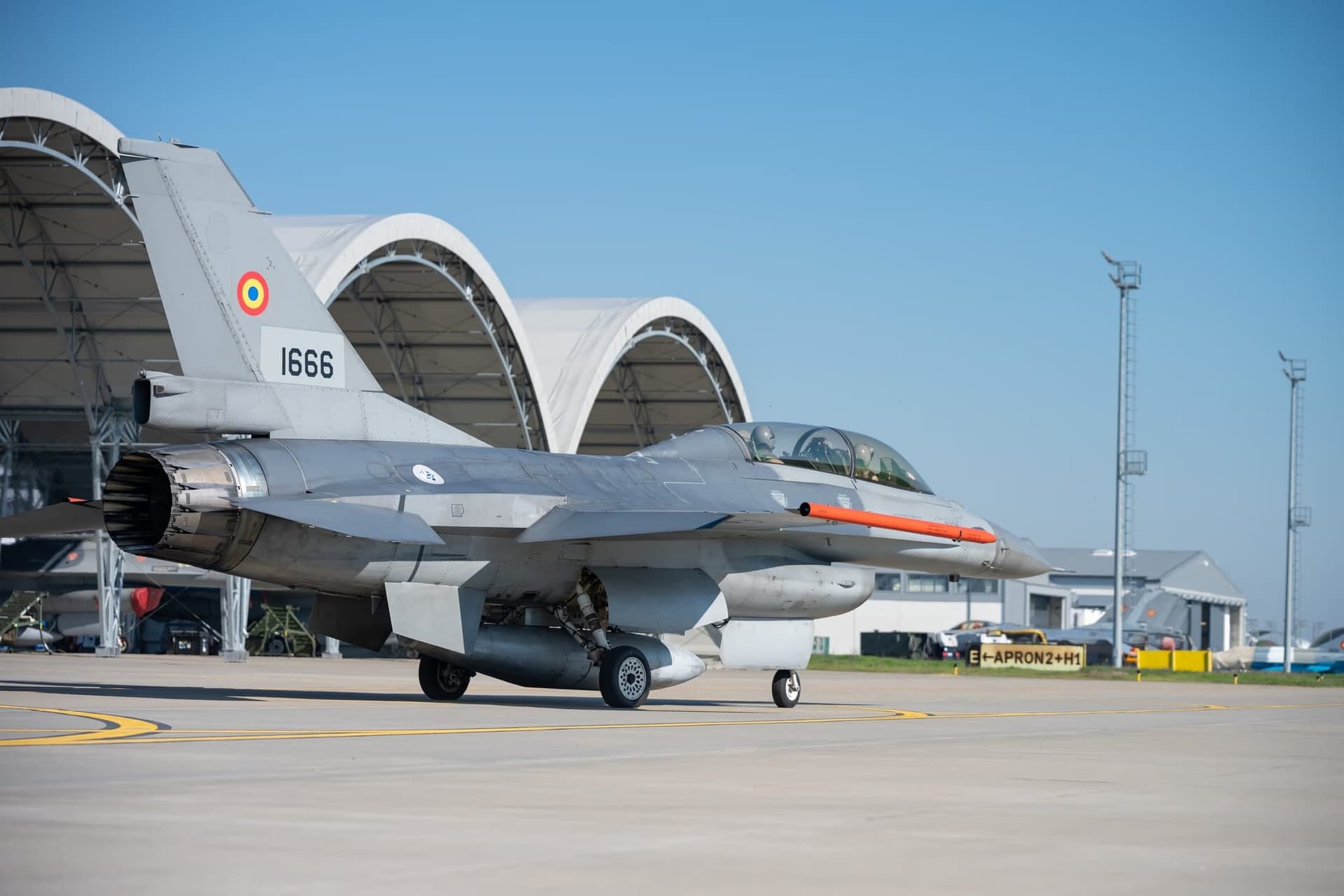
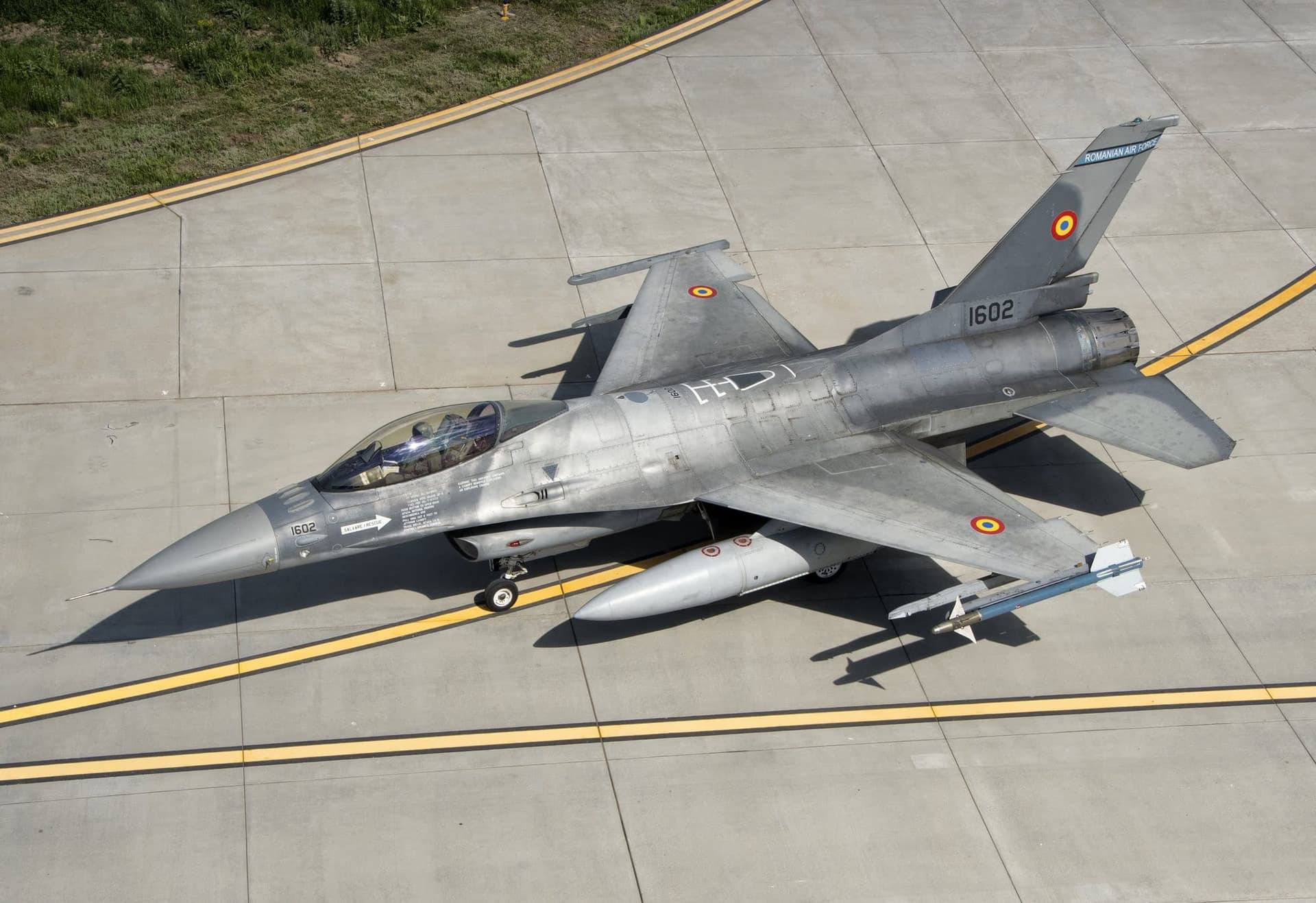
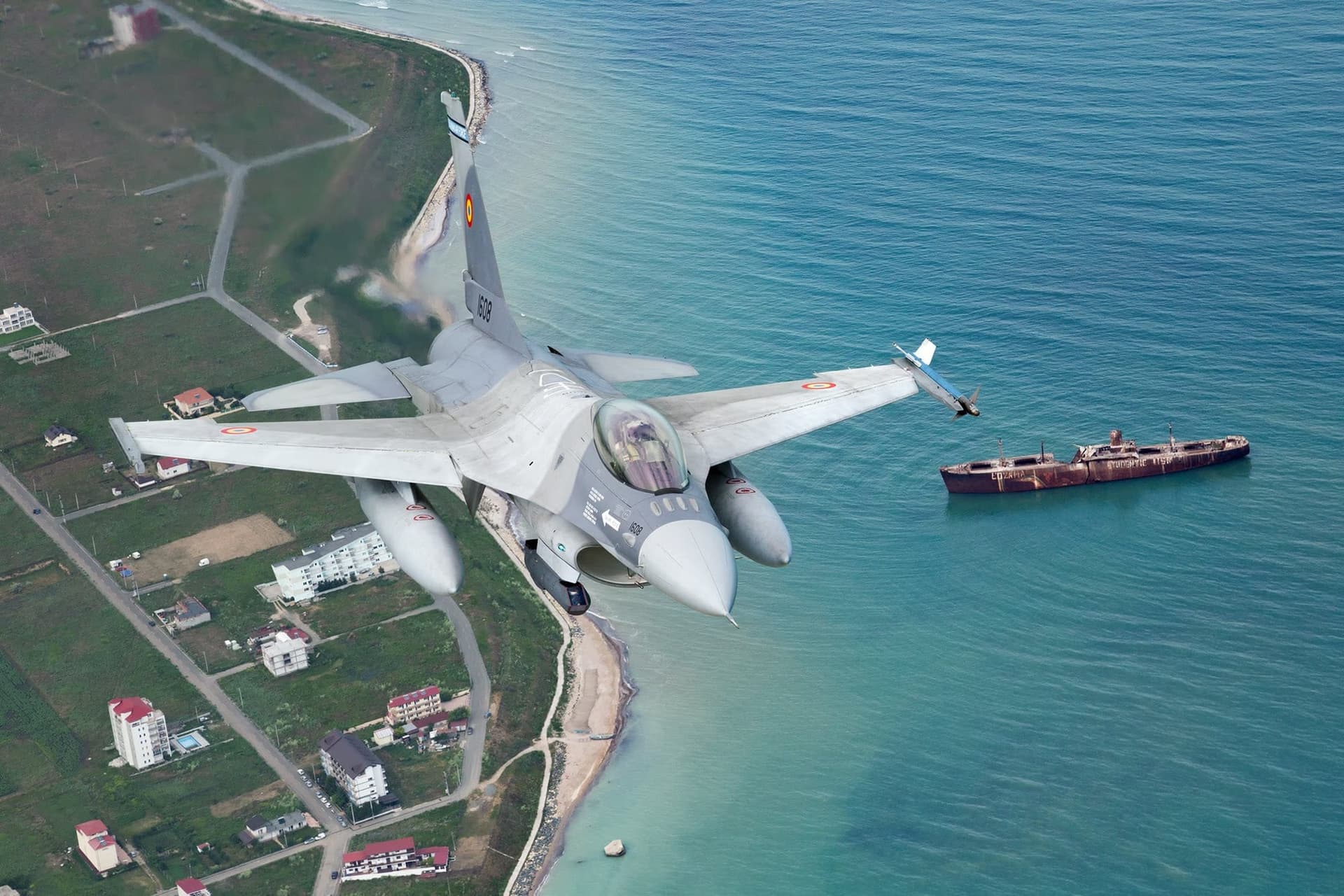
The place of the MiG-21 had, however, been prepared by an older and wiser decision. In 2016, Romania signed a contract with Portugal for 17 F-16AM/BM Block 15 MLUs — second-hand aircraft, but already through a deep modernisation. The total package cost, with armament, training and logistics support, came to nearly 600 million euros. The first six arrived at Fetești in September 2016. The last, in 2021. The transition took five years.
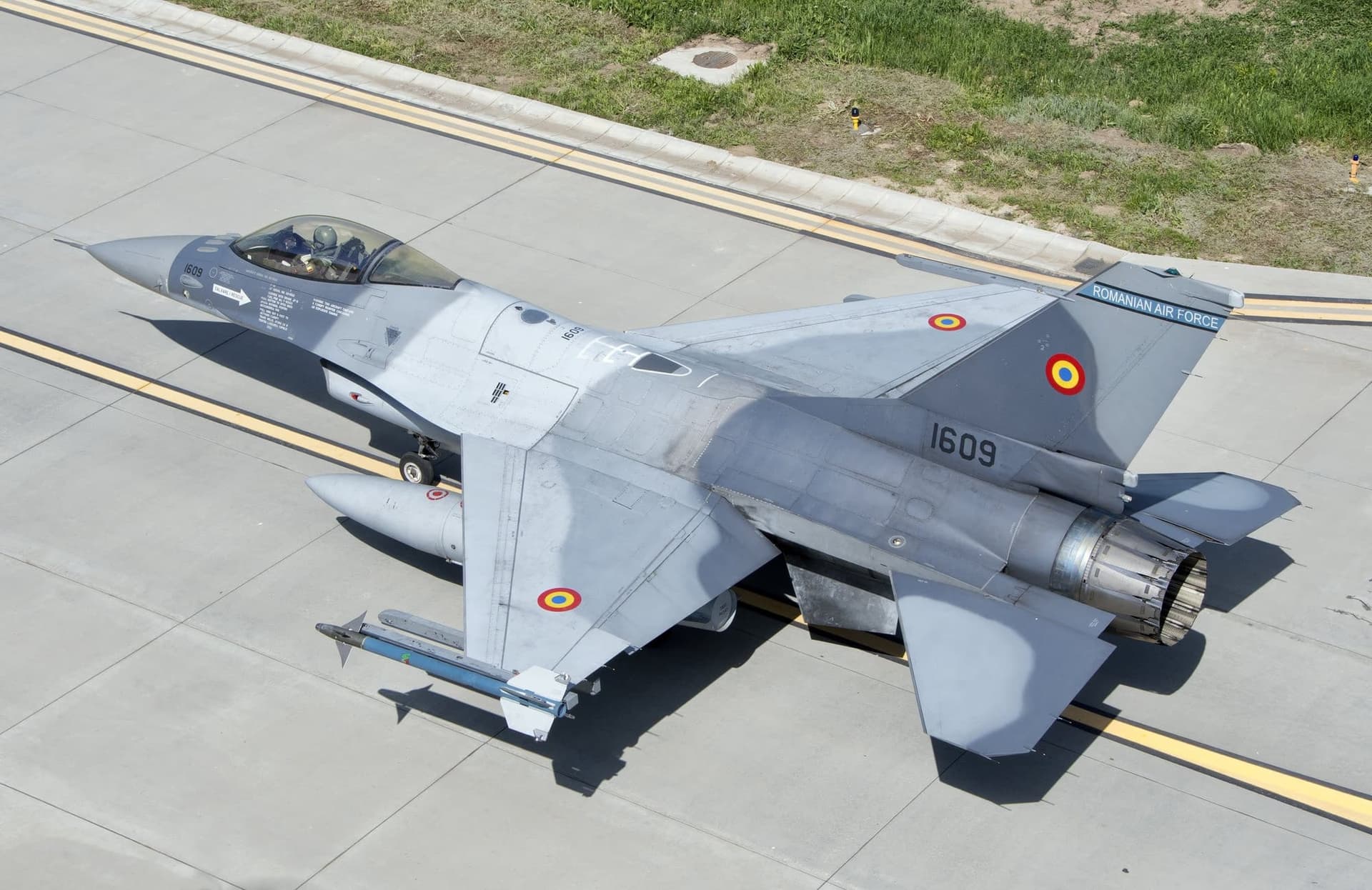
The war in Ukraine accelerated everything that followed. In June 2022, four months after the Russian invasion, the government approved a second purchase: 32 F-16s from Norway. The contract was signed on 4 November 2022, at an initial value of 388 million euros, rising with subsequent upgrades to about 454 million. They are also F-16AM/BM Block 15 MLUs, like the Portuguese ones, but in a superior configuration (M6.5.2) that allows the launch of JDAM smart bombs and AMRAAM-120D air-to-air missiles.
Delivery status as of June 2026, per official MoD data:
- Portugal: 17 aircraft delivered (contract complete)
- Norway: 23 of the 32 contracted aircraft delivered (deliveries continue per schedule)
- Netherlands: 18 aircraft delivered (used at the European F-16 Training Centre at Fetești)
The third transaction, with the Netherlands, closed on 3 November 2025. At the Ministry of Defence, Brigadier General Ion-Cornel Pleșa and Linda Ruseler, representing the Netherlands, signed an intergovernmental contract by which 18 Dutch F-16s were transferred to Romanian ownership for the symbolic price of one euro. Romania paid 21 million euros in VAT on the declared value. These aircraft had already been at Fetești since 2023, operating as Dutch property on loan to the training centre. Now they belong to the Romanian state.
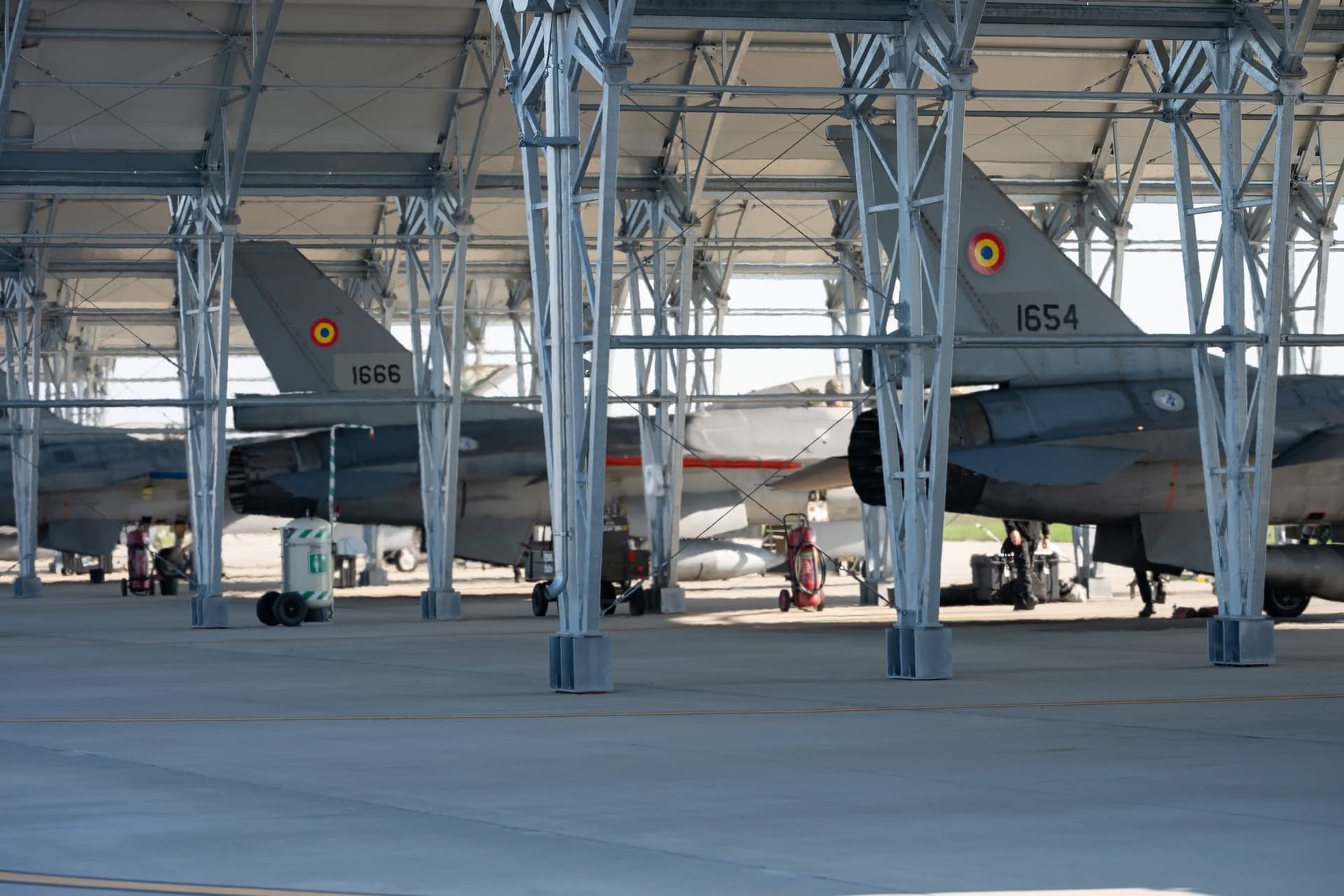
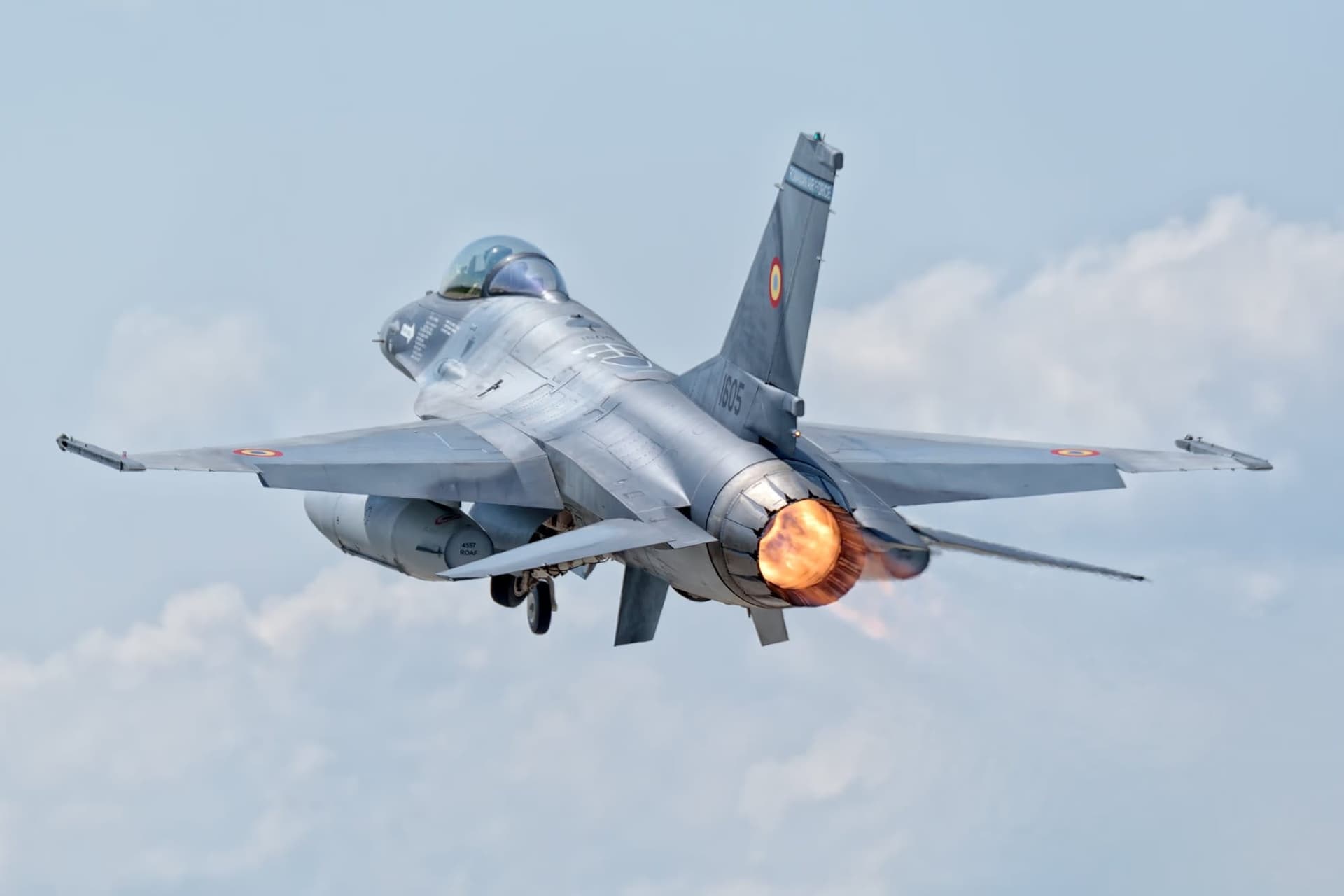
Total: 58 F-16s delivered by the end of June 2026; 67 will be in the country once the Norwegian deliveries are completed, distributed across three squadrons at Câmpia Turzii, Fetești and — currently being made operational — Mihail Kogălniceanu. For a country that, in 2015, flew exclusively on the MiG-21, the scale of this transformation is more visible from the outside than from within.
Fetești: when the pupil becomes the teacher
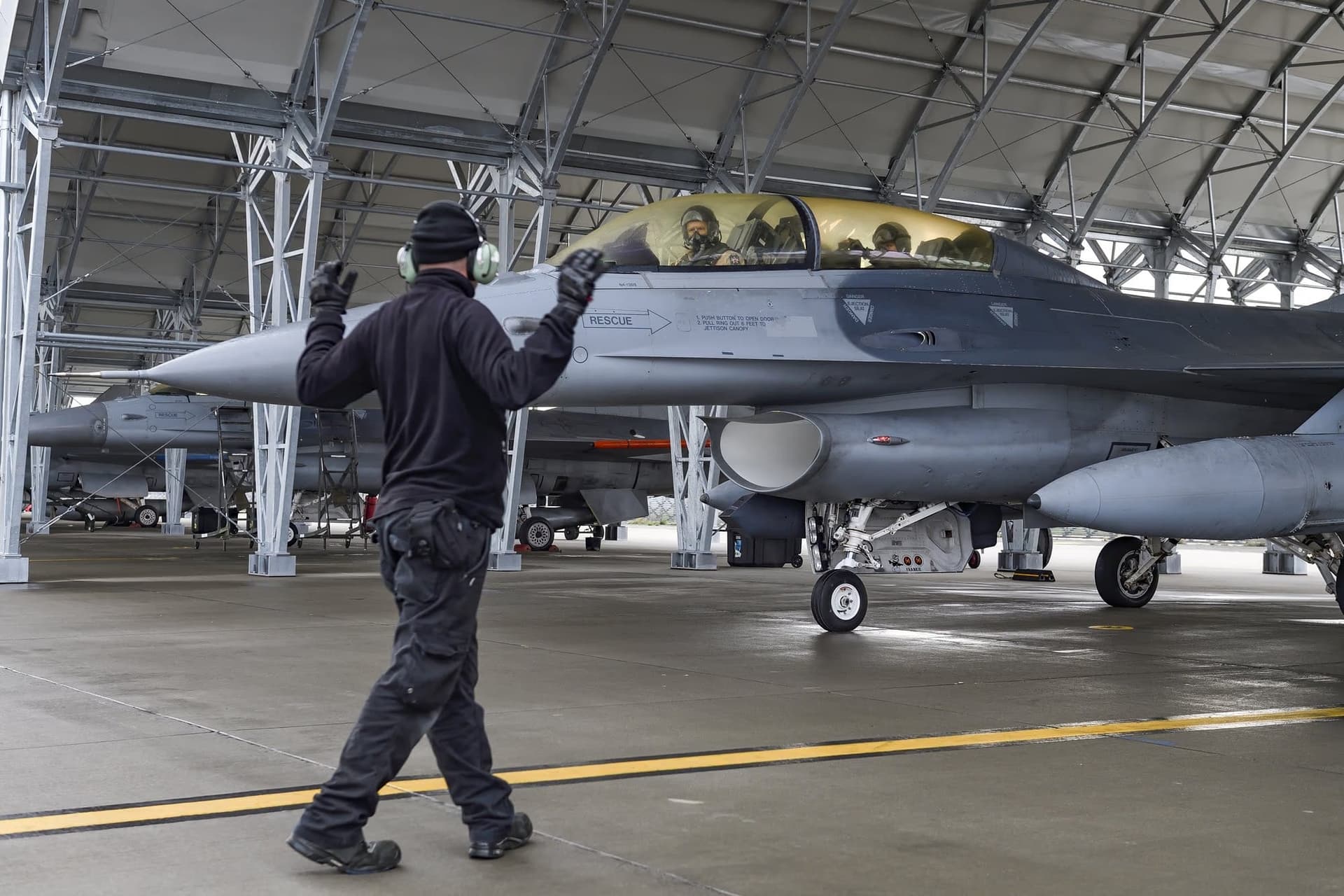
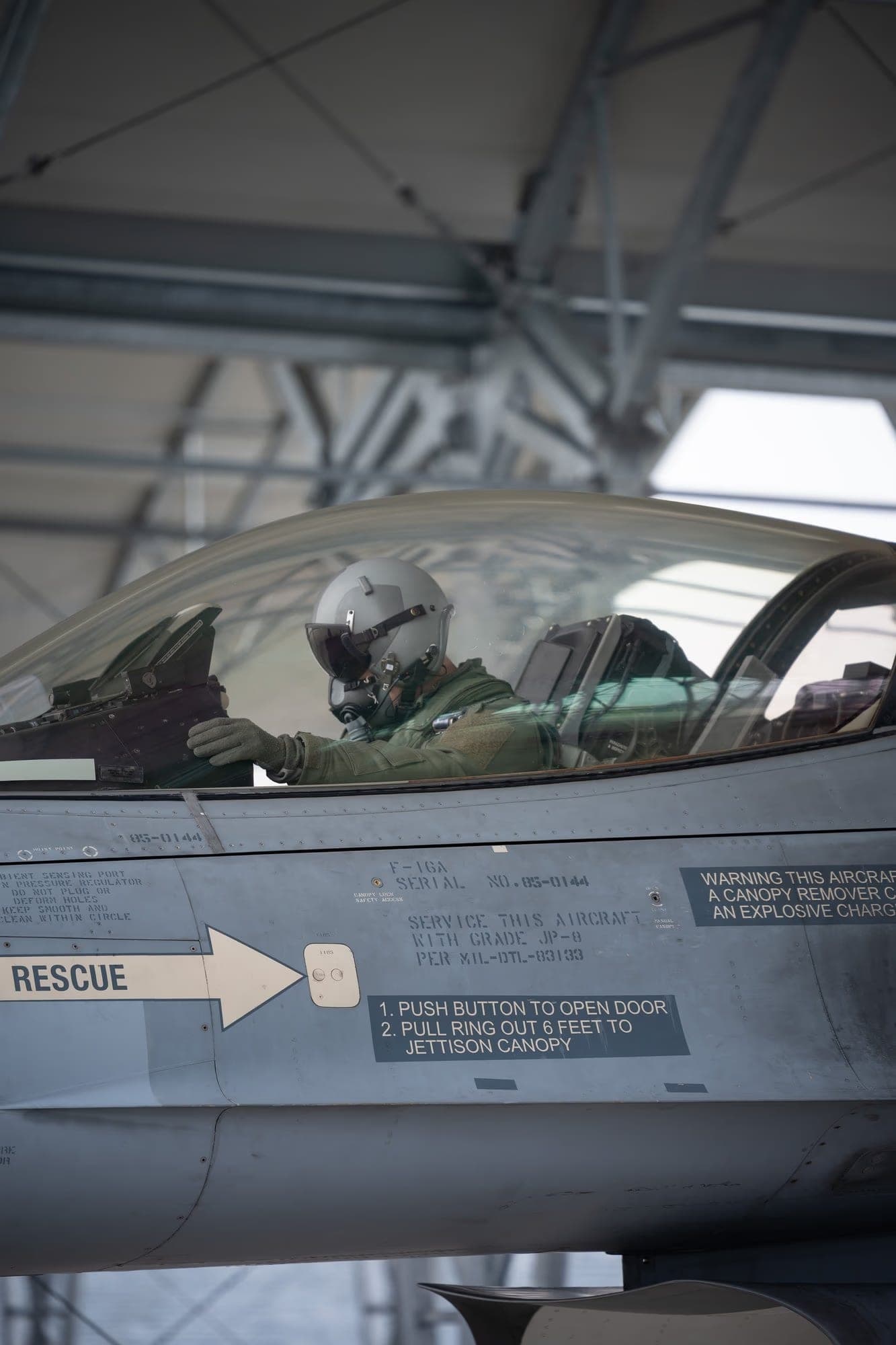
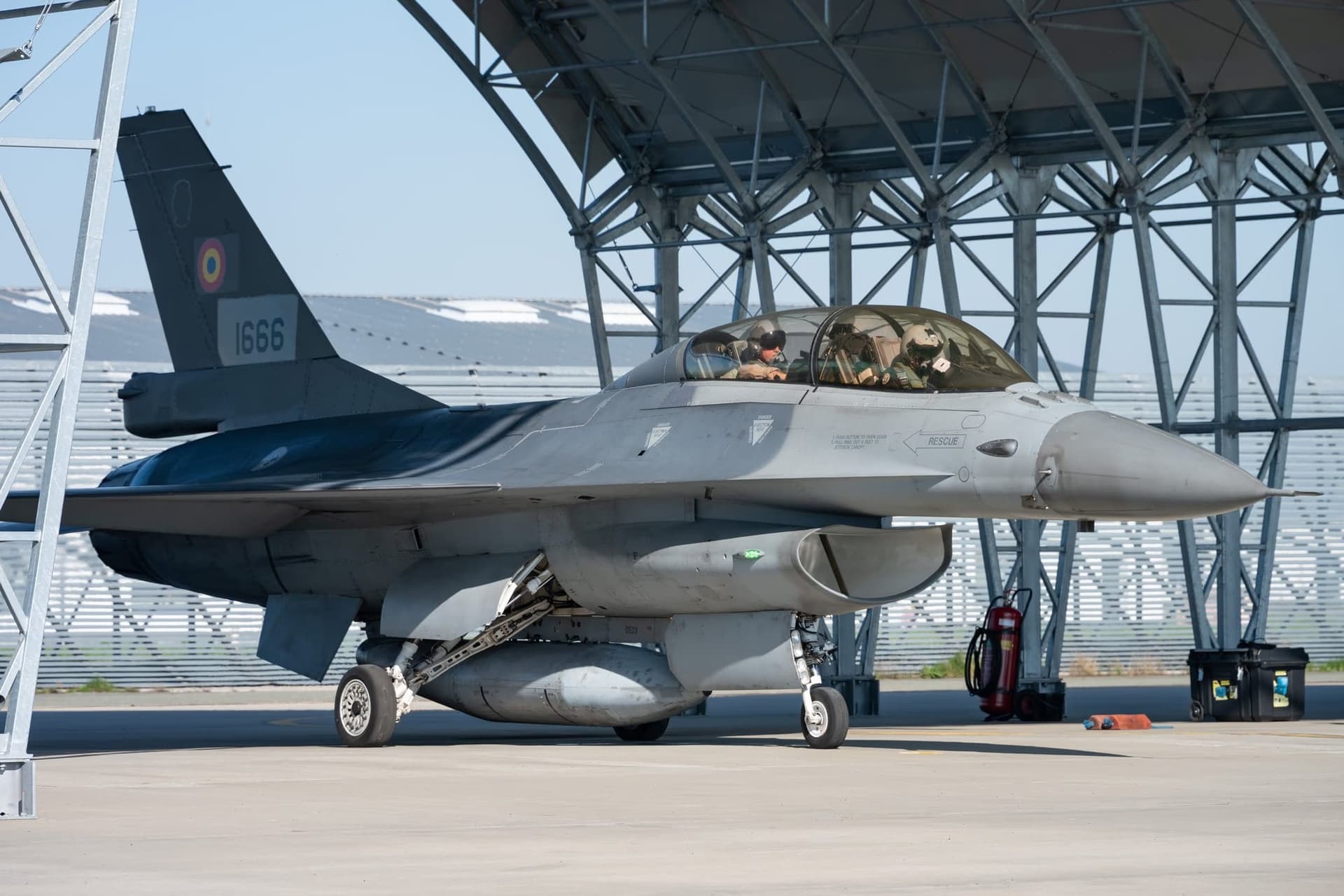
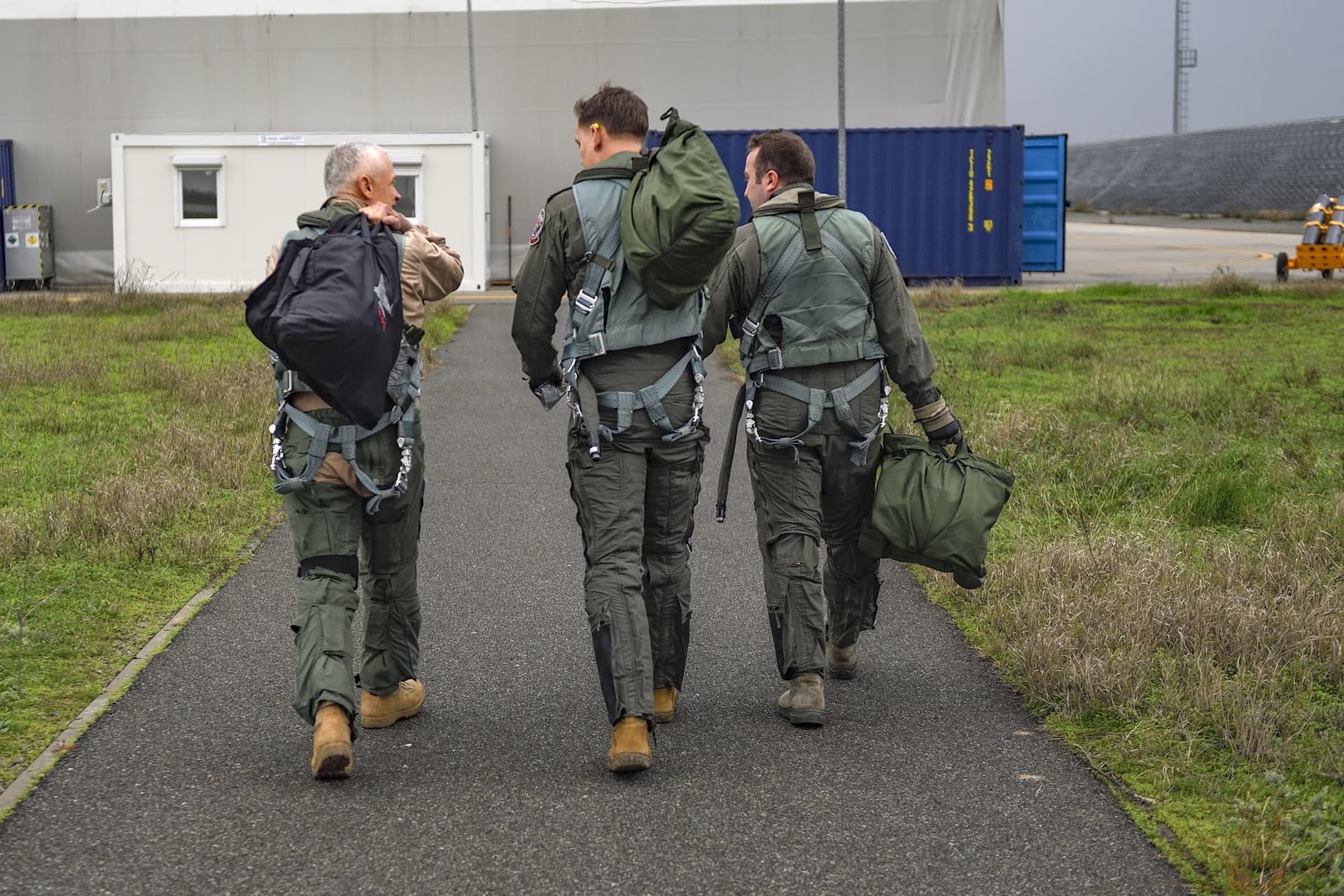
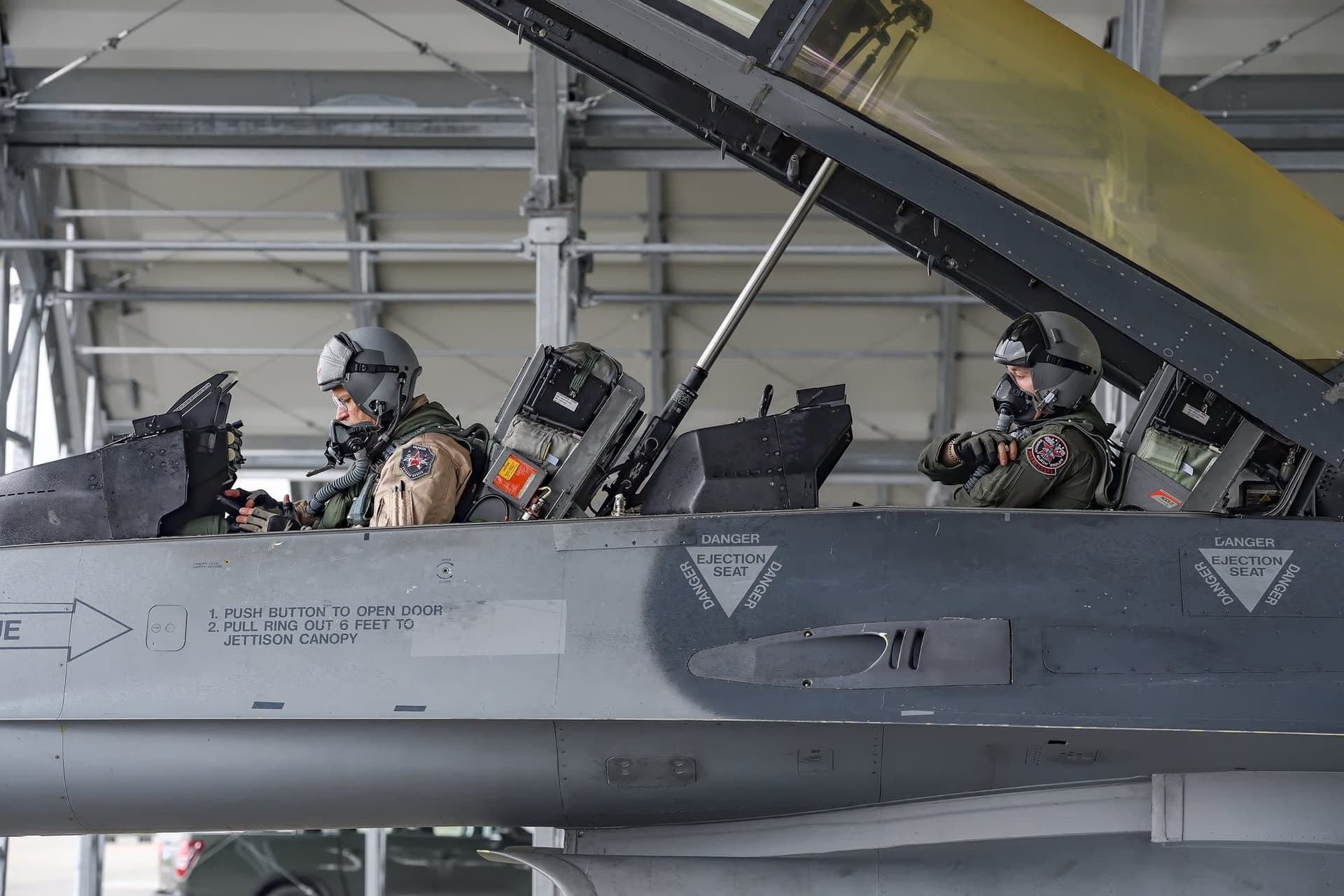
There is a moment when a cultural transfer ends and something else begins. For Romania, that moment came on 13 November 2023, at the 86th Air Base „Lt. Aviator Gheorghe Mociorniță" at Fetești. The defence ministers of Romania and the Netherlands inaugurated then the European F-16 Training Centre (EFTC), the first of its kind in Europe. The Netherlands provided aircraft. Romania provided the base. Lockheed Martin brought the instructors and maintenance, through subcontractors such as Draken International and Daedalus Aviation Group. Denmark and the United States supported it financially and politically.
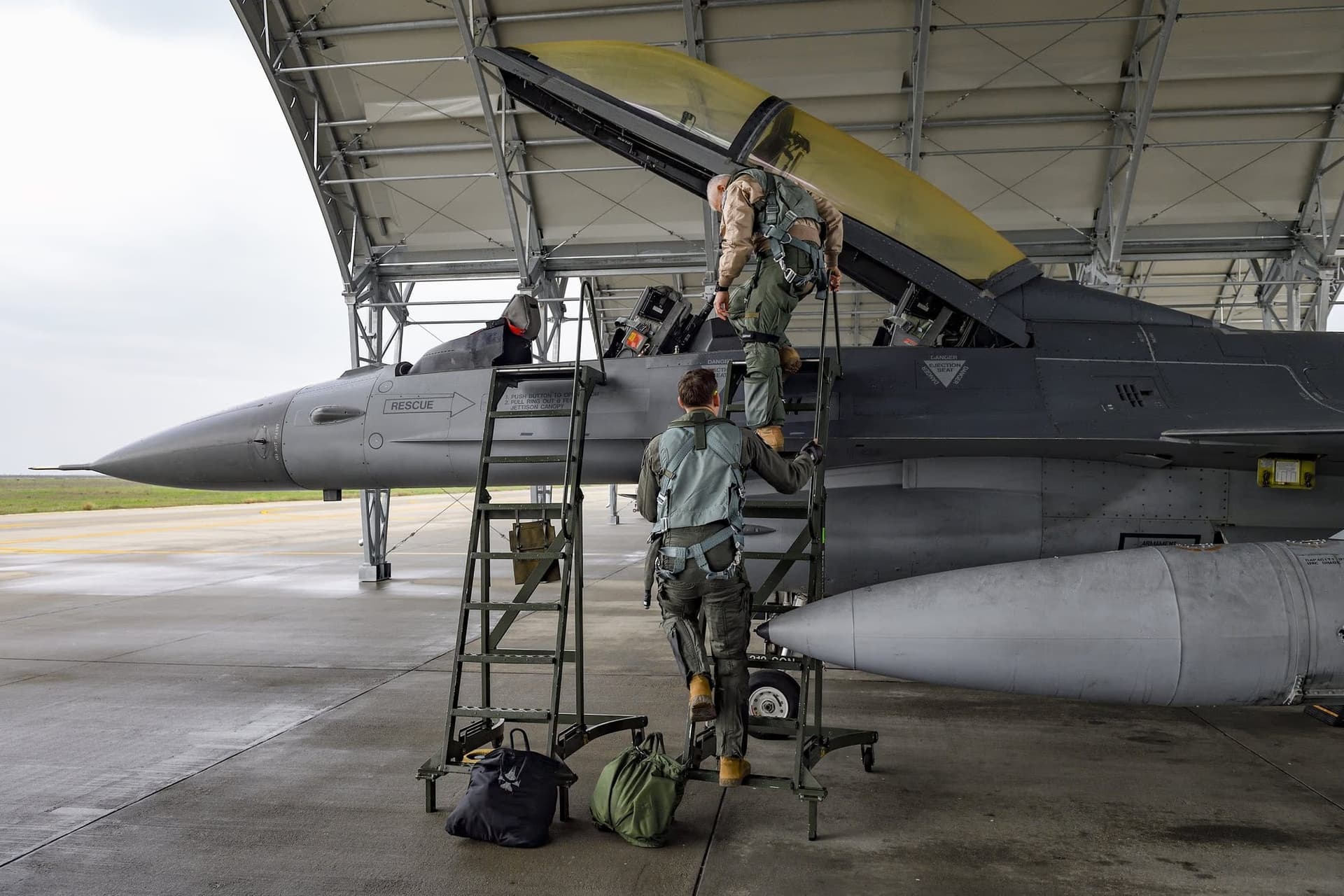
„From its inauguration on 13 November 2023 to the present, the European F-16 Training Centre at Fetești has supported the training of Romanian pilots and of pilots from partner states, in training activities carried out on F-16 aircraft", the MoD states. On 15 January 2024, a Romanian pilot made the first training flight at the centre, with a Lockheed Martin instructor in a Dutch F-16.
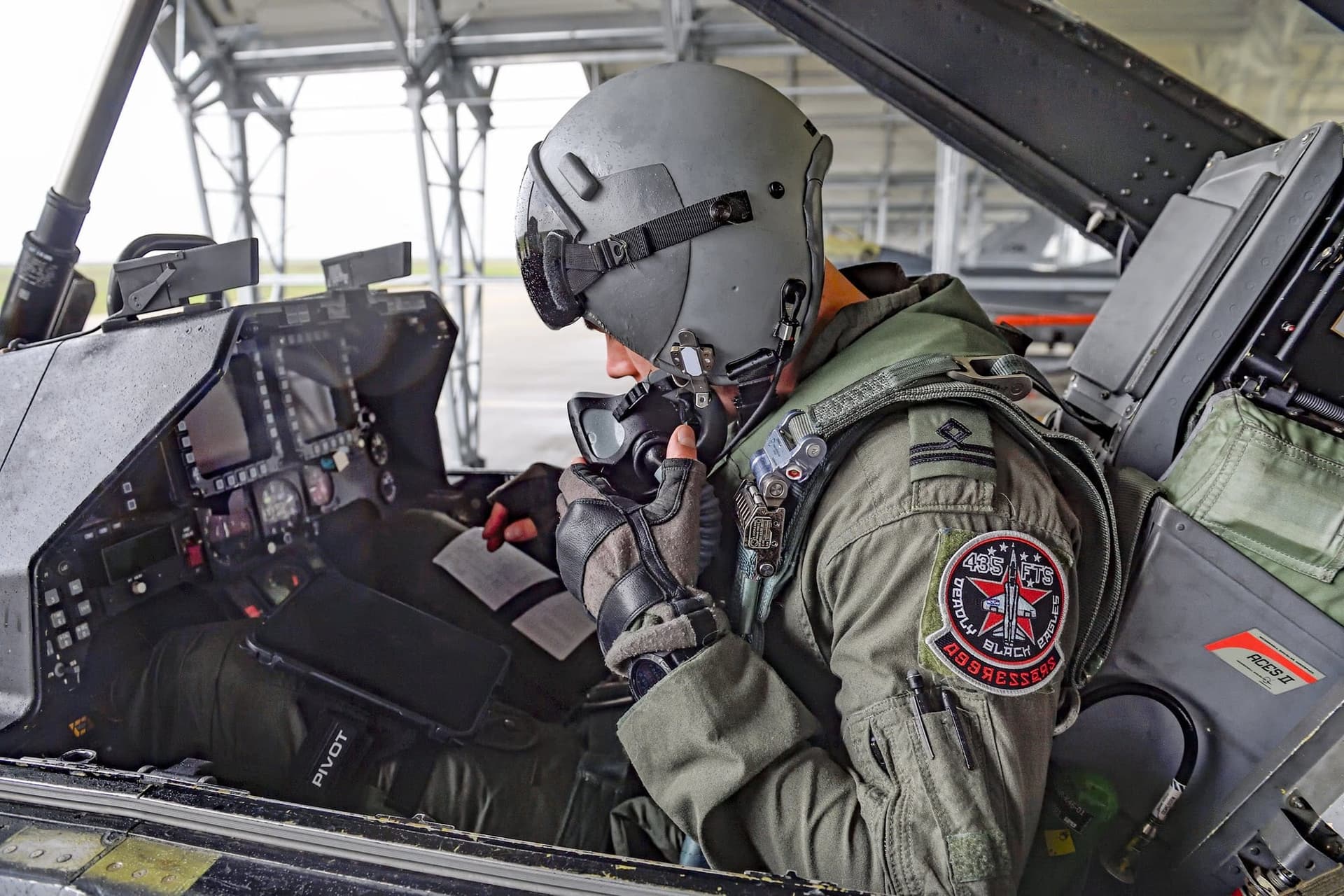
The question that follows — and which will become decisive towards the end of the decade — is whether the same centre will be converted for the F-35. Bill Thomas, EFTC operations lead, explained in [an interview for RomâniaFrumoasă.org](https://romaniafrumoasa.org/articole/apropierea-de-razboi-te-face-sa-fii-mai-atent-lectiile-pregatirii-f-16-in-romania) that the answer is not yet official: „That is going to be decided by the Romanian government and the U.S. government. All I know is that our contract is currently for five years, and the Romanian Air Force has discussed a considerable extension, so as to cover the F-35 period — even the phase when F-16 and F-35 will fly simultaneously."
The difference between the two periods is not formal. The F-35 is a fifth-generation aircraft, with completely different maintenance, simulation and training requirements. A conversion of Fetești would turn Romania into the regional node for training the aircraft on which, in the next decade, a large part of NATO airpower will fly.
The F-35 and the chain of inheritance
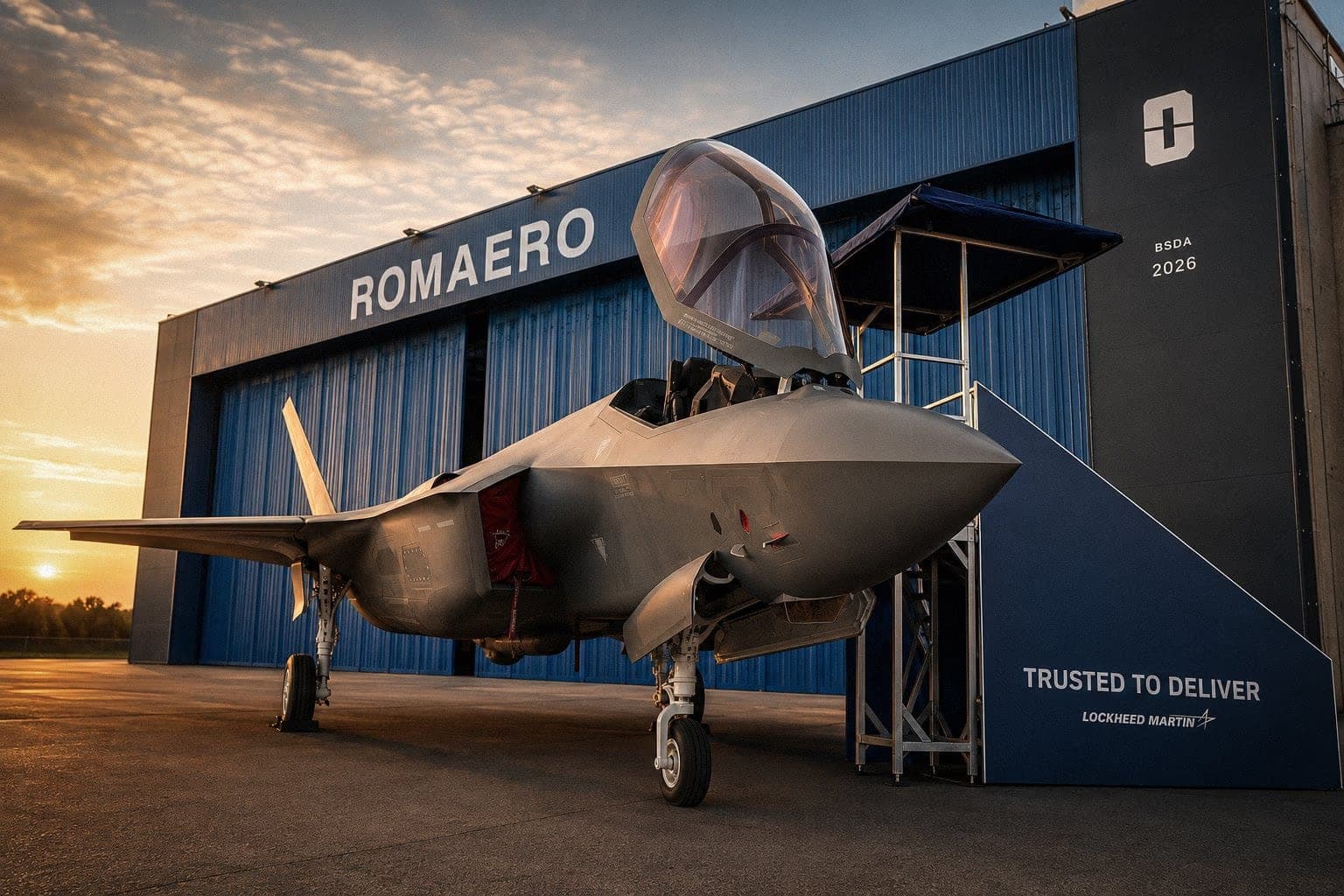
The last gate in this transition opened on 21 November 2024, when Romania signed the Letter of Offer and Acceptance for 32 F-35A Lightning IIs, worth 6.5 billion US dollars, according to MoD data. The country became the 20th international operator of the F-35 programme.
The acquisition takes place under Law 284/2024 for delivering the operational air defence capability foreseen in the Concept of operational air defence capability with fifth-generation multirole combat aircraft, within the procurement programme „Fifth-generation multirole aircraft, F-35", Phase I. The package includes spare engines, logistical support, equipment and services for the training of flight and technical-engineering personnel, plus access to the F-35's global support stream.
Per the agreed schedule, delivery of the first F-35 aircraft is planned around 2030.
At the British stand at BSDA 2026, Air Vice-Marshal (r) Nigel Maddox — a former RAF pilot, now senior adviser for British defence exports — emphasised a technical distinction that often goes unnoticed at first glance: „The Romanian Air Force is getting the A model, which is different." There are three F-35 variants: A, conventional take-off, for land bases — the cheapest version, and the one most air forces buy; B, short take-off and vertical landing, for small carriers, which the British operate; and C, for large American carriers. The British have substantial F-35 experience, but a part of it does not transfer to Romania.
The Romanian Ministry of Defence has described the F-16 purchase as „an intermediate stage towards the introduction of a fifth-generation aircraft." That means that the same 67 Portuguese, Norwegian and Dutch F-16s replacing the MiG-21 today will themselves be replaced by F-35s after 2030. What will happen to them then?
The precedent already exists: Norway, the Netherlands, Belgium and Denmark have together donated 87 F-16s to Ukraine as they transitioned to F-35. Specialist outlets — The War Zone, The Aviationist — have speculated that, after 2030, part of the Romanian fleet could follow the same path. Officially, no one has confirmed it. The aircraft on which a Ukrainian pilot trained today at Fetești will fly tomorrow may, in a few years' time, be exactly one of those flying today over Romania.
SAFE, BSDA, and the money of the next decade
On 13 May 2026, at the opening of BSDA, the United Kingdom set up its first national pavilion in Bucharest. Eight British companies under one logo; another thirty firms scattered across the rest of the exhibition halls. The stand was imposing. The absence behind it was greater.
The British came to Bucharest because the European door has closed three-quarters of the way. In November 2025, negotiations for the UK to join SAFE — the European Defence Programme worth 150 billion euros — collapsed. Brussels asked for an entry fee of close to six billion. Canada had paid ten million for the same access. London refused.
„The Commission's financial proposal was unrealistic," the British Ambassador, Giles Portman, told us at the stand. The outcome: British companies can still participate in SAFE contracts, but cannot supply more than 35% of a project's value. The rest stays with industries inside the Union. Romania is one of the markets where that money will be spent in the coming decade.
Maddox did not come to Bucharest to sell the F-35. The Americans sell it directly, through Foreign Military Sales, and the contract is already signed. The British came for something else: simulators, communication systems, advanced training, predictive maintenance, mission-planning software, accompanying drones. And for the Eurofighter, which they are trying to sell to European partners who have not yet made up their minds.
Maddox dropped, in passing, an idea modest in form but substantial in substance: „Cross-servicing, as we used to do in NATO, is something that is really, really important." He's describing a scenario in which Romanian engineers could service Eurofighters from Germany, Spain, Italy or the UK, making a short stopover on a Romanian runway. The alliance as a series of small technical gestures that keep aircraft in the air and defence economies integrated.
And Portman, beyond the notes about SAFE, repeated the same idea in another formulation: the British defence industry is, he said, „very, very integrated" with European industries. It's the most honest statement of the interview. Brexit did not disintegrate British defence from Europe. It only complicated access to certain financial schemes. The industry itself was there before and stays there. The BSDA pavilion is, in this light, a friendly reminder of that fact — addressed to a partner who, in the next decade, will spend a great deal of money buying exactly the things the British know how to do.
Sky
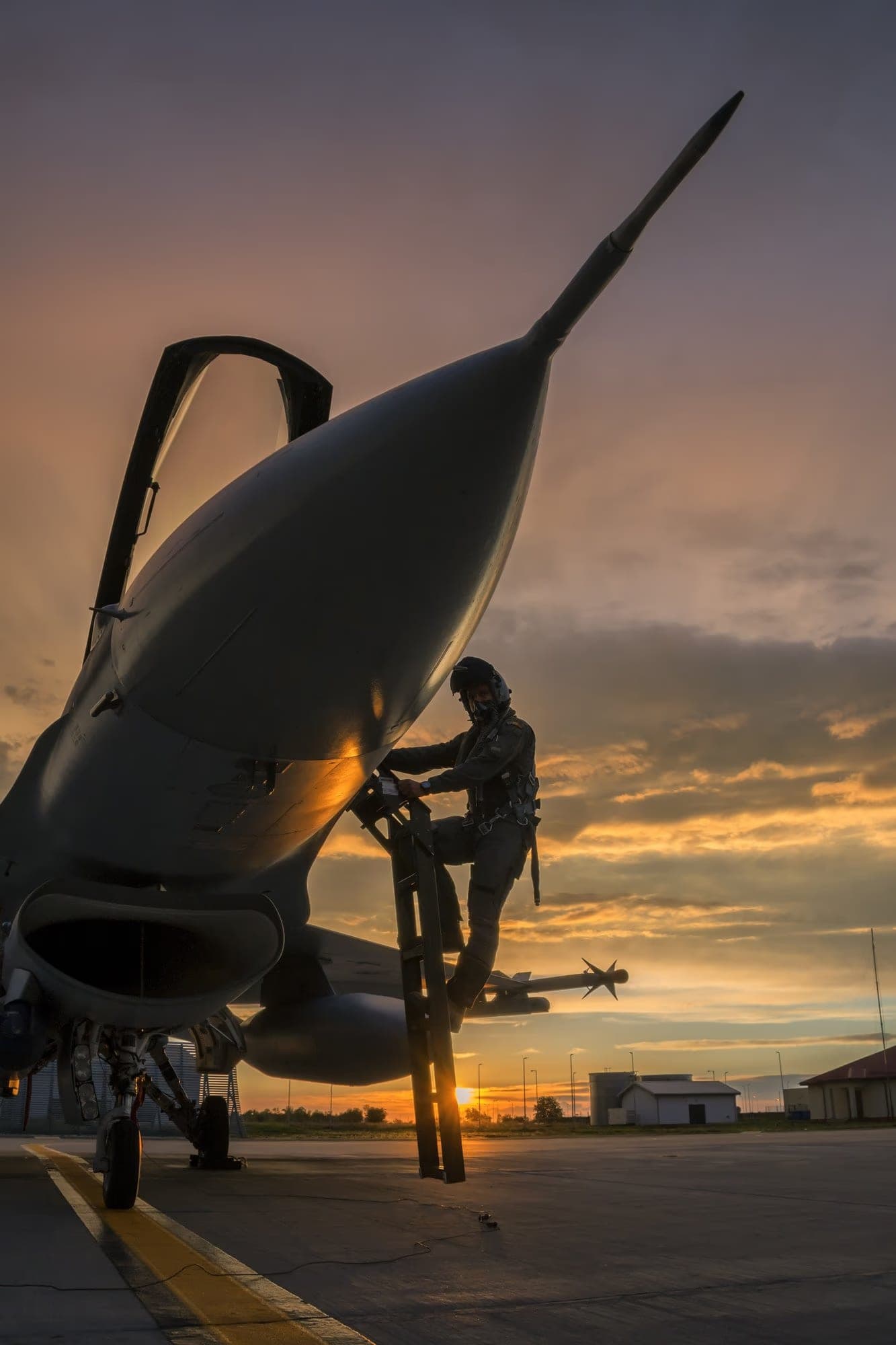
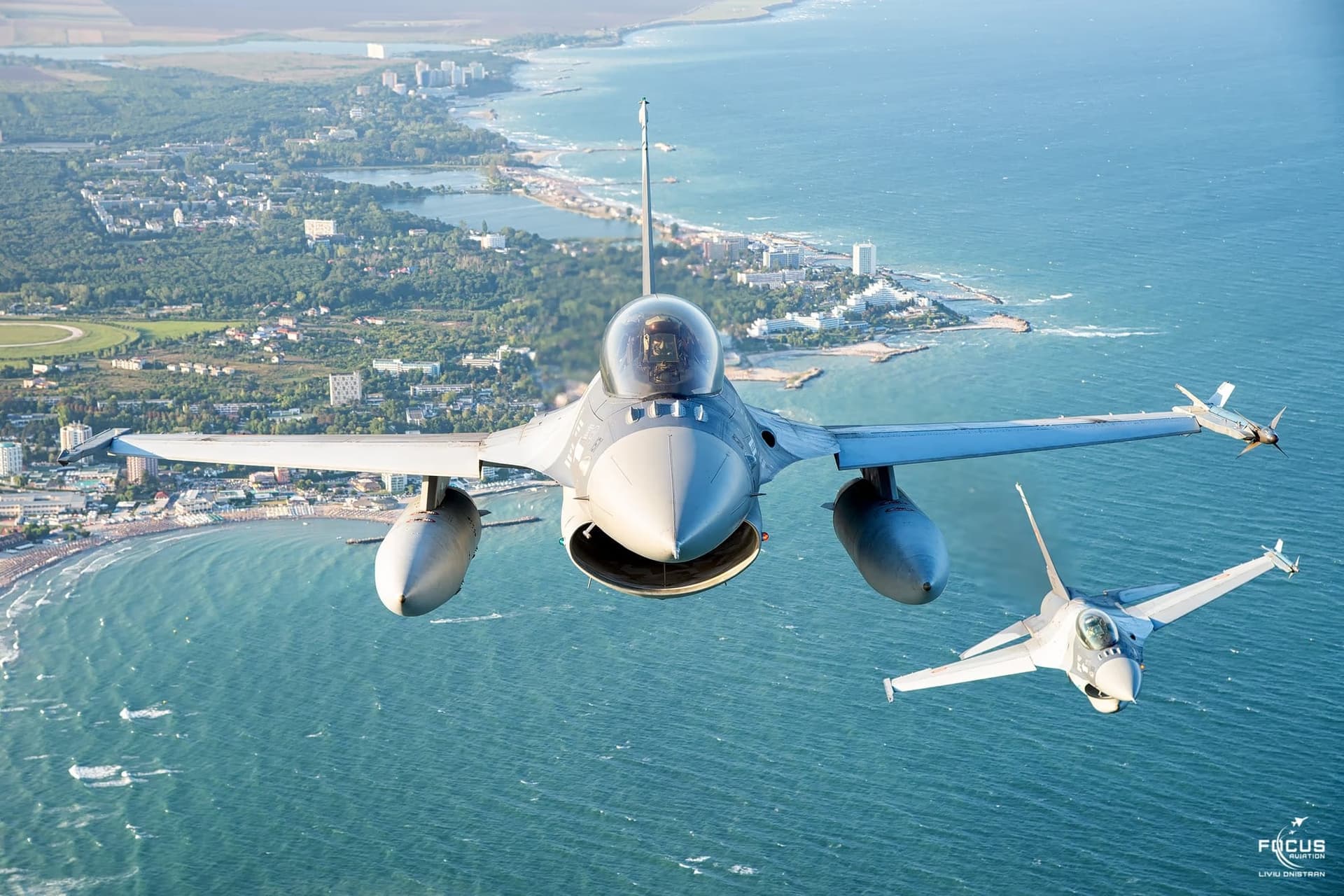
Today, in June 2026, Romania has 58 F-16s delivered (out of 67 contracted). It has between four and five years left until the first F-35. It already has, at Fetești, a training centre through which Romanian pilots and pilots from partner states pass. It has a transition experience few NATO countries can match: how to move, without serious gaps, from Soviet to American aircraft while keeping a sovereign sky over the Black Sea at a moment when the country's northern neighbour is at war.
Fifteen years. More than three hundred MiG-21s sent for scrap. MiG-29s withdrawn in 2004. Seven pilots dead in the LanceR era. One failed modernisation programme and one successful. A historic purchase from Lockheed Martin which, only towards 2030, will start to bear fruit.
The British pavilion lasted three days. The sky remains.
Photo gallery
Epilogue — two incidents, between drafting and publication
This article was drafted in early May 2026. Publication was delayed pending the Romanian Ministry of National Defence's official reply to the freedom-of-information request registered as nr. 369/2026, received in June 2026 and used to update the figures and context. In the meantime, two events directly related to the article's subject took place.
19 May 2026 — The „Carpathian Vipers" detachment shoots down a drone over Estonia
A Romanian Air Force F-16, on Enhanced NATO Air Policing duty, shot down on 19 May 2026 a drone that had penetrated about 80 kilometres into Estonian airspace, at 12:14 local time. The aircraft, part of the „Carpathian Vipers" detachment — around 100 personnel and six F-16s based at Šiauliai (Lithuania) between April and July 2026 — used an air-to-air missile, not the gun. The pilot, Commander Costel-Alexandru Pavelescu, was later decorated with the „Emissary of Peace" emblem, first class, proposed for the distinction by Defence Minister Radu Miruță.
Per the publicly available analysis, the drone was of Ukrainian origin: it had passed through Russian Federation territory, was subsequently jammed by Russian electronic-warfare systems, lost its planned course and ended up in Estonian airspace, where it was intercepted. NATO confirmed the operation as the Romanian detachment's first shootdown.
28-29 May 2026 — Russian Geran-2 drone crashes into a residential building in Galați
In the early hours of Friday 29 May 2026, around 02:00 local time, a Russian Geran-2 drone with a full explosive payload crashed onto the roof of a ten-storey residential building in Galați. The entire payload detonated on impact, igniting a fire on the top floor.
**The official tally:** four people injured — including a woman and a 14-year-old child taken to hospital with burns, with two others treated at the scene. About 70 residents evacuated from the building.
The Russian origin of the aircraft was confirmed officially by the spokesperson for the Supreme Headquarters Allied Powers Europe (SHAPE). The European Union called it „a serious incident"; NATO condemned „Russia's recklessness." Bucharest responded by declaring the Russian consul in Constanța persona non grata and closing the Russian consulate. As the international press reiterated, the event was described as „the first time Russia directly caused damage to a NATO member state" — distinct from the earlier Polish incident, where the cause had been a Ukrainian air-defence missile.
What these two days change for the article above
The transition from buying the aircraft to using them operationally in NATO took place, for Romania, in parallel with the drafting of this article. On 19 May, the Estonia interception was the first real-world validation of the F-16 investment, far from home. Ten days later, at Galați, the event showed that the defensive dimension of Romanian airspace is no longer an abstract problem — but one with casualties inside a ten-storey building, on its own soil.
The 58 F-16s already delivered, the 67 total once the Norwegian contract is completed, and the 32 F-35s contracted for 2030, are no longer — after 28-29 May 2026 — a matter of strategic planning. They are the answer to something taking place now.
Epilogue sources:
- [Defense România — drone shootdown over Estonia (19 May 2026)](https://www.defenseromania.ro/drona-rusa-a-fost-angajata-de-f-ul-romanesc-cu-o-racheta-aer-aer-nu-cu-tunul-de-bord-cine-e-pilotul-roman-de-f-16-care-a-doborat-uav-ul_644706.html)
- [HotNews — the „Carpathian Vipers" detachment](https://hotnews.ro/ce-este-detasamentul-carpathian-vipers-din-care-face-parte-avionul-romanesc-care-a-doborat-o-drona-in-estonia-si-de-ce-trimite-romania-avioane-de-vanatoare-f-16-in-tarile-baltice-2250118)
- [Mediafax — Ukrainian drone, Russian sabotage](https://www.mediafax.ro/breaking-news/avioanele-ridicate-din-nou-in-letonia-si-estonia-dupa-noi-alerte-un-avion-f-16-romanesc-a-doborat-azi-o-drona-ucraineana-intrata-in-spatiul-aerian-al-nato-ucraina-acuza-un-sabotaj-rusesc-23739650)
- [Digi24 — Russian drone hits a residential building in Galați](https://www.digi24.ro/stiri/o-drona-s-a-prabusit-pe-un-bloc-din-galati-doua-persoane-au-fost-ranite-usor-precizarile-mapn-3790645)
- [HotNews — drone crash at Galați, initial casualties and subsequent measures](https://hotnews.ro/drona-prabusita-pe-un-bloc-in-galati-urmata-de-o-explozie-si-de-un-incendiu-doi-oameni-raniti-usor-intervine-inclusiv-sri-2258156)
- [Știrile ProTV — Geran-2 with explosive payload, 70 evacuated](https://stirileprotv.ro/stiri/actualitate/o-drona-cu-incarcatura-exploziva-s-a-prabusit-pe-un-bloc-din-galati-70-de-persoane-au-fost-evacuate.html)
- [Euronews — four injured, prosecutor's office takes over investigation](https://www.euronews.ro/articole/o-drona-a-lovit-un-bloc-din-galati-patru-raniti-in-urma-incendiului-de-la-etajul)
- [AGERPRES — NATO and the EU condemn „Russia's recklessness"](https://agerpres.ro/romania-in-lume/2026/05/29/drona-cazuta-la-galati-nato-condamna-nesabuinta-rusiei-si-spune-ca-va-continua-sa-si-intareasca-apar--1561105)
Reportage by Adi Coco · Seeing Romania · 27 June 2026.
Official sources: Romanian Ministry of National Defence (MApN) — reply via the Directorate for Information and Public Relations, registered as nr. 369/2026 (June 2026); Bill Thomas interview for RomâniaFrumoasă.org (May 2026); Army Media Agency (presamil.ro) — „Farewell, MiG-21 LanceR!", 17 May 2023; Law 284/2024; Norwegian Defence Materiel Agency; Lockheed Martin. Press sources: The War Zone; The Aviationist; Defence Industry Europe; Romania Insider.
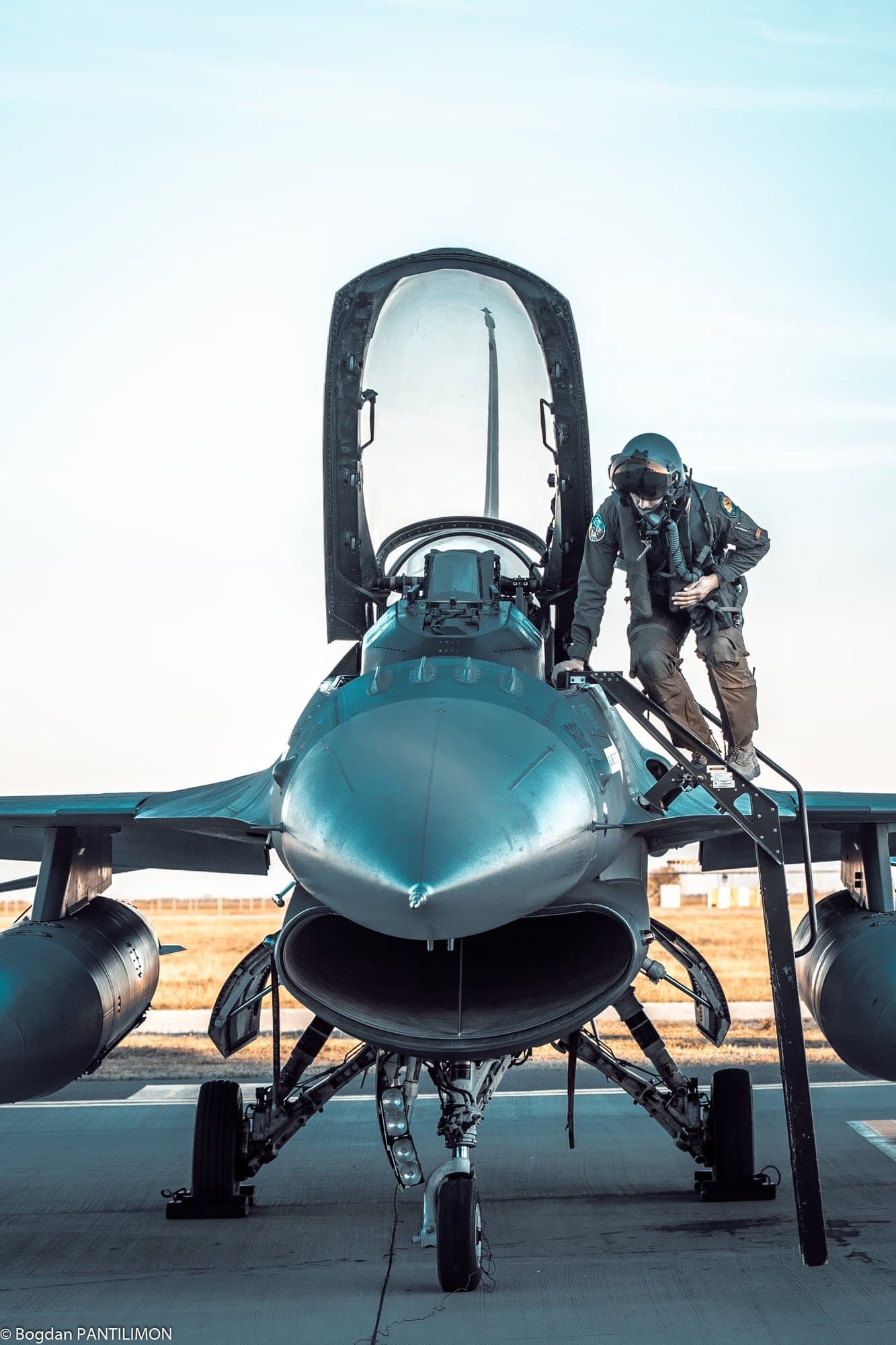
Image credits: Lockheed Martin (frames labelled „EFTC Fetești" / European F-16 Training Centre); Romanian Ministry of National Defence (MApN) — including frames by photographer Bogdan Pantilimon; Adi Coco / AdiCoco.com for the F-35A image at BSDA 2026.