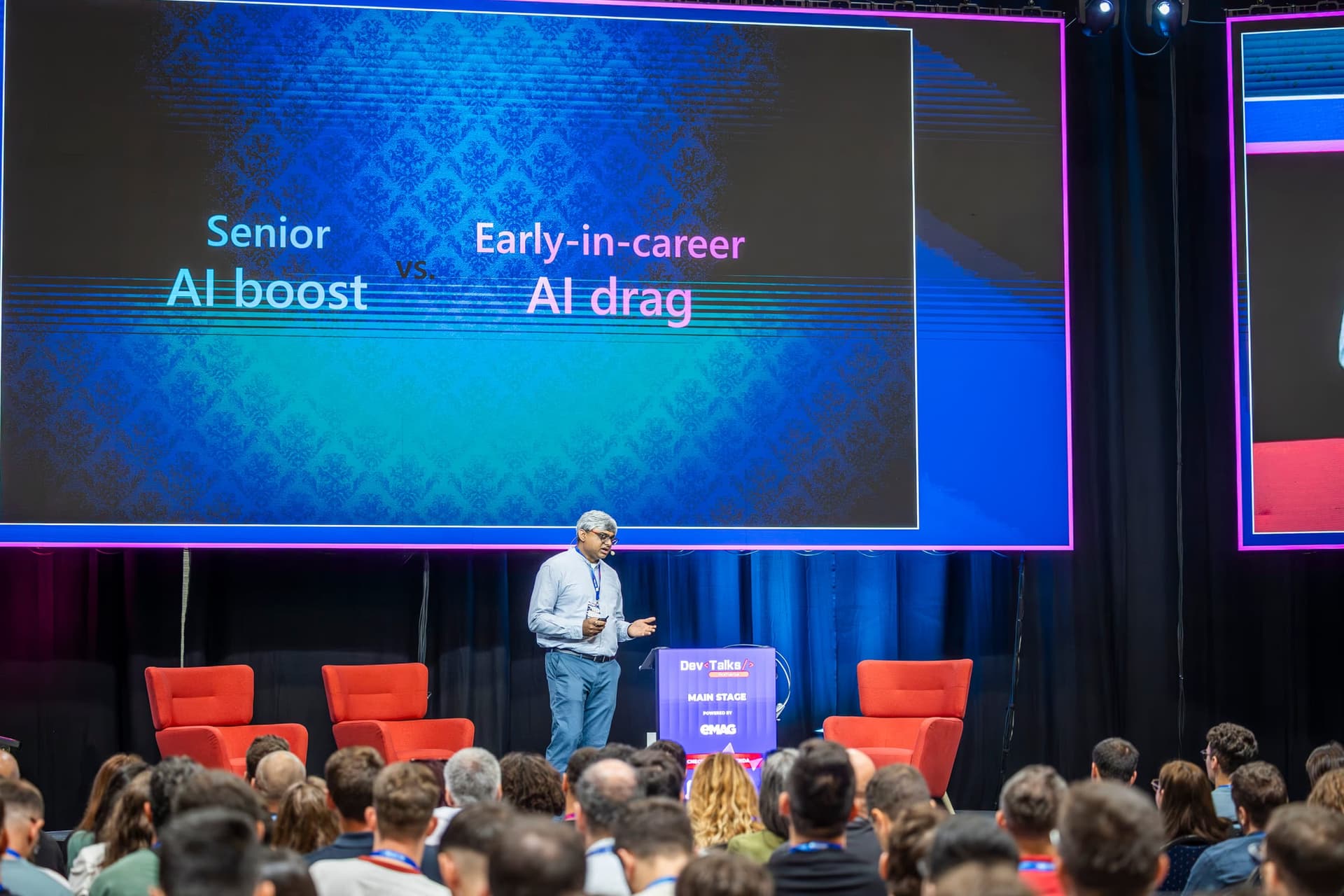
Cars that aren't going anywhere
You check in and walk into Pavilion B at Romexpo at nine-thirty in the morning. The first breath of air you take doesn't smell like technology. It smells like new. Carpet, panels, and… cars.
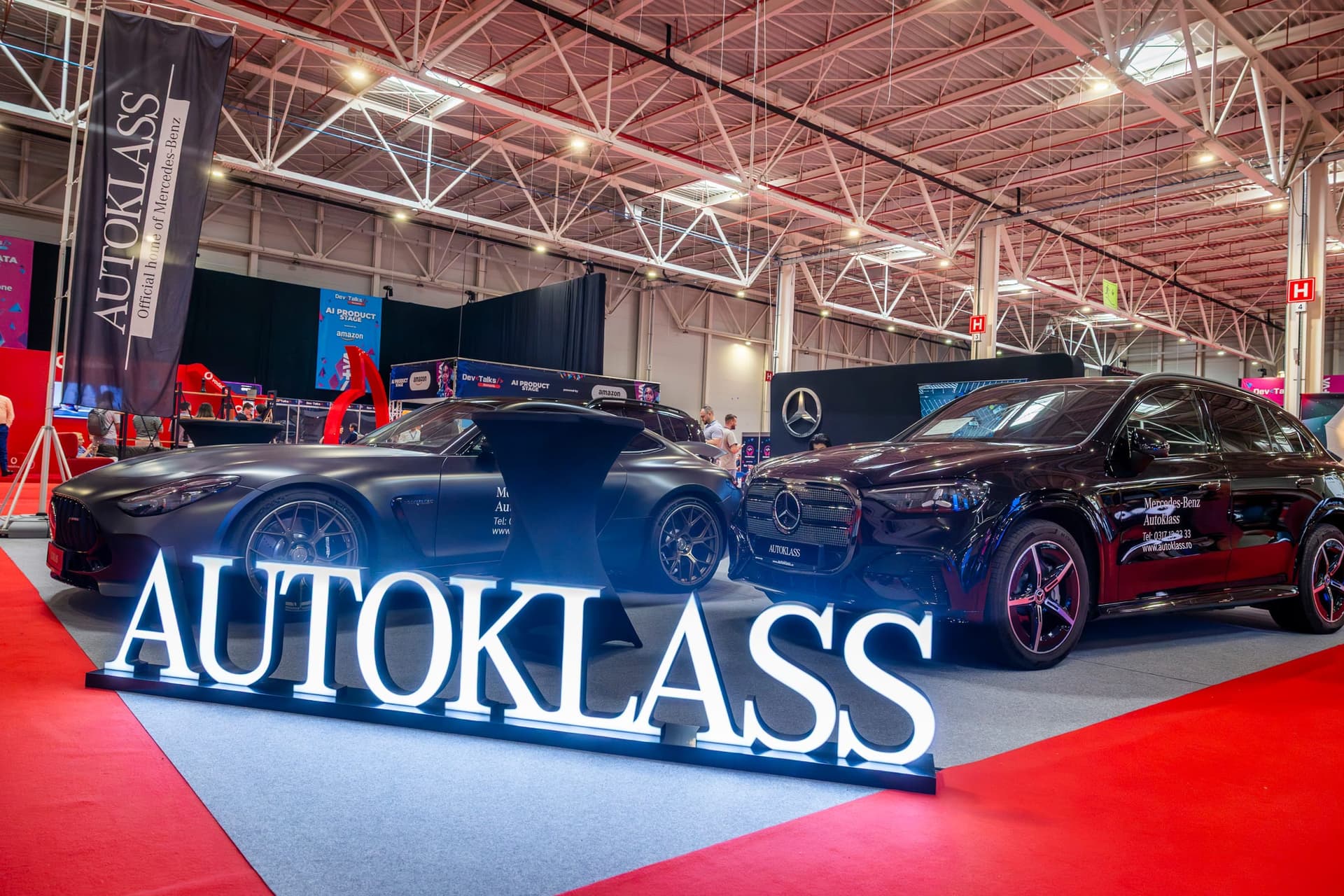
Two Mercedes — a black coupé and an anthracite SUV — wait beneath a sign lit with light-bulb letters. Romexpo has hosted many motor shows since the late '90s. Now it's a tech conference, but can anything be more tech than the latest generation of cars?
The pavilion has its industrial steel-truss ceiling, its suspended lamps, its PVC floors reflecting the yellow light in a faint shimmer. Today it's full of banners about code and artificial intelligence. But at nine-thirty, when the conference hasn't started yet and the lights are only half on, the pavilion commands your attention. You stop for a few seconds beside the AMG coupé. It's remarkable how quiet an engine designed to be "nervous" can be.
In the background, in the distance, the first footsteps can already be heard. A male voice tests a microphone.Test. Test, two — ten. Someone, somewhere, tastes their coffee and sets it back on the table. The day begins.
Children who build
Walk five minutes along the red carpet, past two stages that no one has stepped onto yet, past a coffee vending machine, and suddenly the electric blue of software brands disappears.
In its place: fuchsia pink. And building blocks.
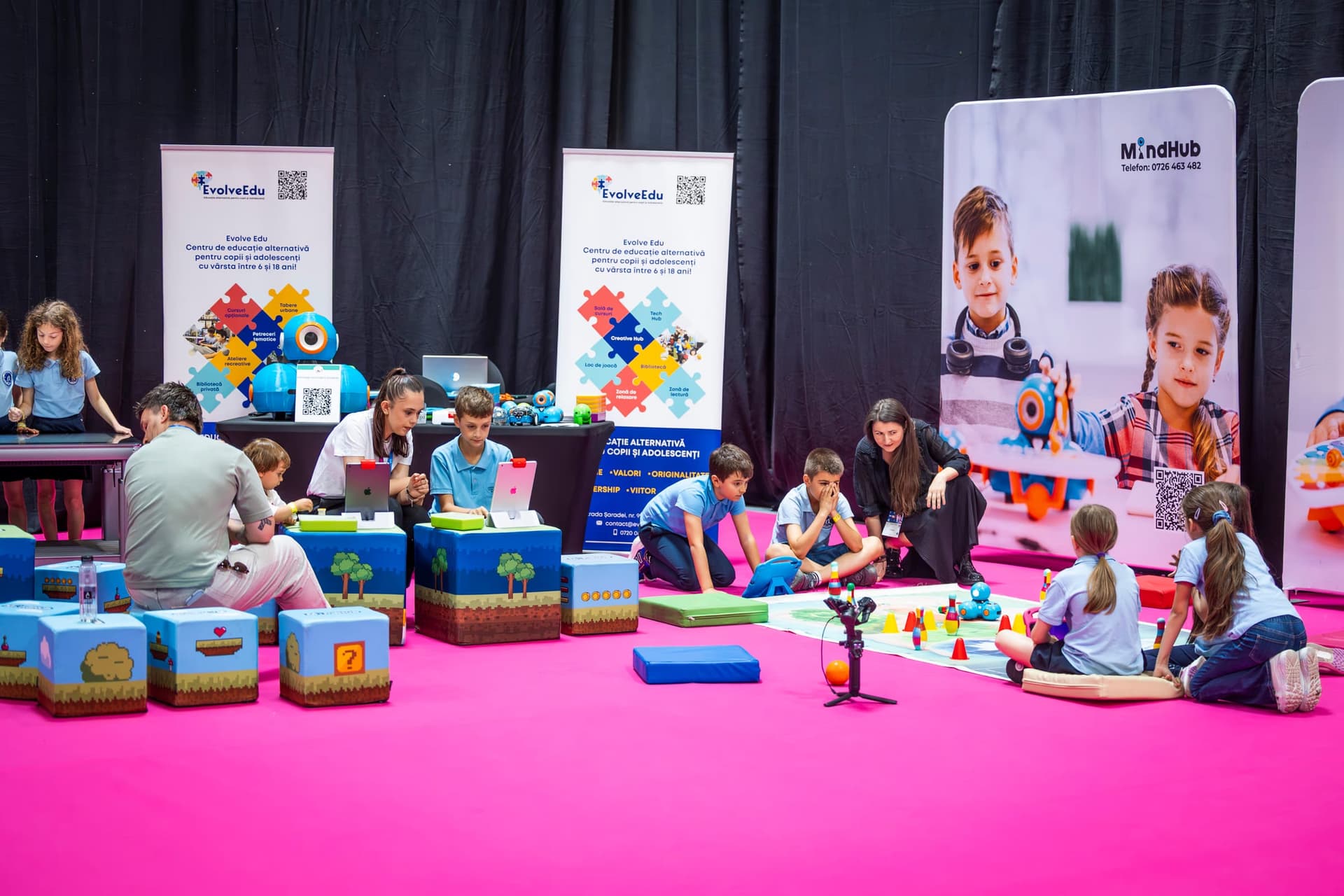
Seven children, none older than ten, sit on brightly colored cubes straight out of a Minecraft world brought to life. They hold laptops. Two adults — instructors by the look of them — lean over and point something out on the screens. One child, blond-haired, with a gaze that seems not to have blinked in five minutes, types something. Then looks up. On the panel behind them, two enormous photographs: a boy and a girl who seem to be watching over the room.
There is a strange quiet here, at odds with the bustling pavilion outside. Not the quiet of a classroom where discipline is imposed. The quiet a child makes when they have gone deep into something and forgotten that adults exist.
You stand there for a minute, two minutes, without moving. You watch a child's hand hesitate over the keyboard and then commit. An instructor who doesn't correct — explains. Another child who has turned to a classmate and is showing something on their own screen, without asking anyone's permission.
Later, when you try to recall the day, this will be the scene that comes first. Not the speakers. Not the statistics. The seven children on Minecraft cubes, learning to code, at a conference for adults who build software for banks.
You leave almost on tiptoe.
The woman who failed an exam
At quarter past twelve, the DevLead Stage is packed. You stand behind the third row in a crowd of kids barely past twenty. This is a conference where the median age does not belong to my generation.
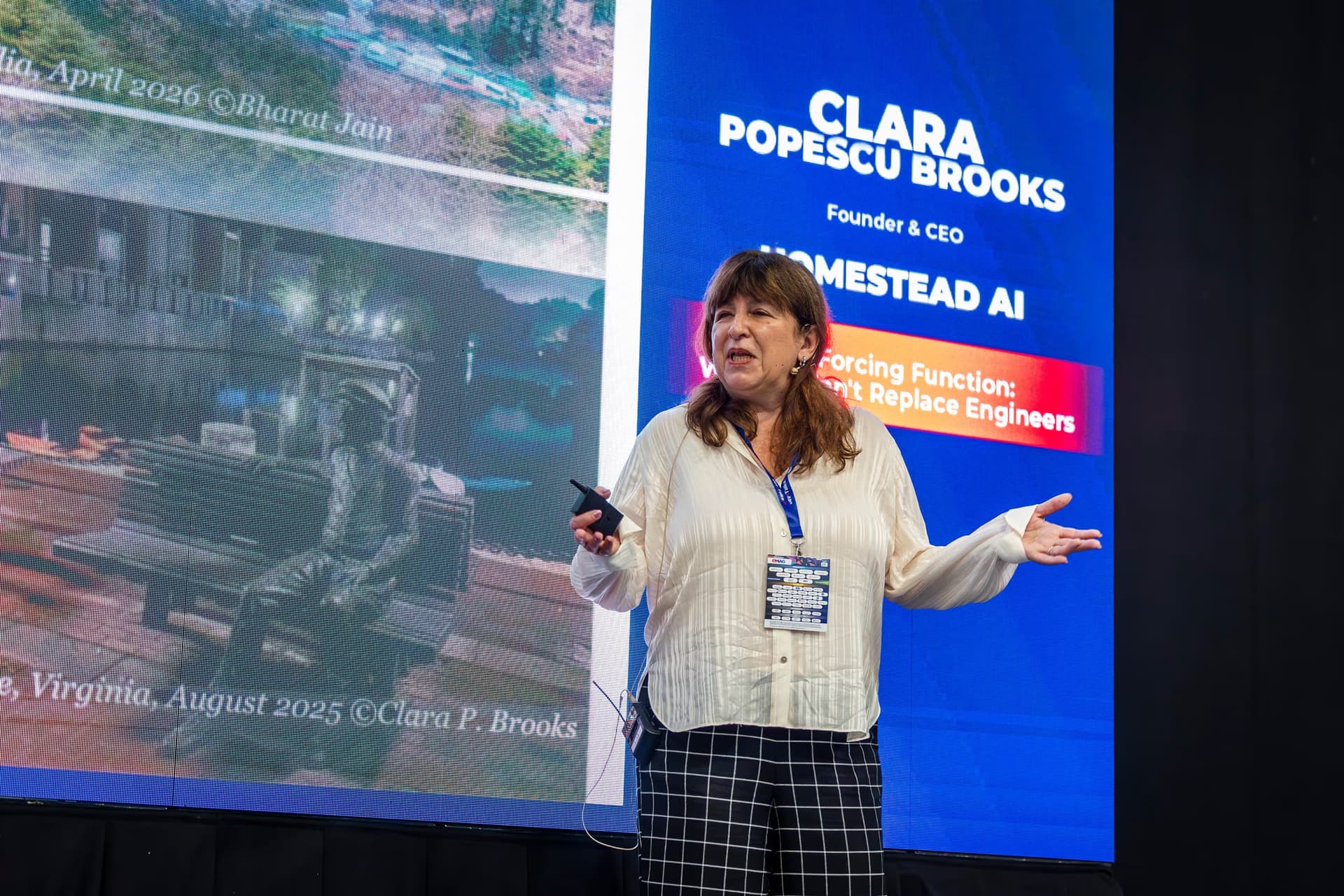
Clara Popescu Brooks — founder of Homestead AI, who left Romania nearly three decades ago — speaks calmly, about a single phrase.Forcing function.The function that forces you. That moment when options close off and decisions you had been avoiding become possible, because they are the only ones left.
Before getting there, though, she opens with a gallery of photographs. Personal, simple images. A Black Sea sunrise sent by her brother the day before. A colleague she worked with for five years — first at a smaller company, then at Google — on a trip in the Himalayas. A friend's wife, photographed in Portugal. A corner of a restaurant in Virginia, with a bronze statue in the background named Simon. "We are more connected," she says, "than we have ever been. This is a moment when things are changing fast."
On the DevLead stage she builds a single idea — that AI doesn't replace the engineer, it raises their ceiling. Today's engineer doesn't just do backend. They have ideas about product. About UI. About trends. "We are an orchestra," she says. One person can be, at the same time, project manager, designer, architect, and director.
She then talks about the product she is building. ECOU — a private app where families preserve, organize, and pass on their own stories. "We use AI," she says. "But we don't let the model invent your childhood." Her team is made up of engineers, but not only. Some are artists. Some play in bands. Some write poetry on weekends. The point, she repeats, is that engineers are creative — it's just that no one has ever asked them, until now, to beand that during work hours.
She mentions in passing one of Anthropic's co-founders — a woman with a background in English literature, not engineering, who said recently that in the AI era creative skills have become more important than technical ones. Brooks nods with a dry smile. And thinks, at this point, about an exam.
"I wanted to be an architect," she says. "My path changed." That's all. Three sentences. The audience laughs, lightly — it's the laughter of a recognition no one puts into words.
During the Q&A, someone asks about a society growing more polarized in the AI era. She answers calmly but seriously. AI, she says, is gradually becoming a utility — water, electricity, the internet, intelligence. Three of those are distributed evenly. The fourth, for now, is not. "There are entire villages without running water. They won't have running intelligence either. That frightens me."
Another person asks about the "AI engineer rush" — people adding the title to their LinkedIn profiles without ever having written a line of training code. Brooks describes an AI instruction course she took: three weeks, twenty-two sessions. The instructor — a twenty-two-year-old woman — was not an engineer. "It works," she says. "But if you remove the engineer from the equation, you have an architecture that won't stand." She pauses for a second. Then names the thing directly: it's a gold rush. And as in any gold rush, there are real miners and there are imposters.
Toward the end, she tells a story about an evening. The night before, after the conference networking, she went to a concert at the Ateneul Român — the building on Calea Victoriei completed in 1888. "I used to come to concerts here as a teenager, in the eighties," she says. "My stepfather and older brother had season tickets. I'd go and get bored — without really listening." Last night, though, something was different. During one of the closing pieces — a film scoreGame of Thrones, with a full choir and fifteen shadows projected on stage — the lighting was handled by her younger brother. "He's never done music," she says. "He does lights." Engineering, then. But in service of art.
In the hall, people fell silent.
The applause at the end is not polite. It is the applause of an audience that recognized itself in someone who speaks for them. Five or six people stand up and form a short queue. Brooks responds to each one, in turn. You leave before she does.
Outside the hall, walking down the corridor through the blue glow of a Microsoft banner, you think about the exam that didn't go her way. About how many of her generation were pushed off course without choosing it — and where they ended up.
Consultant Cristi
Later, on a main stage backed against a sponsored corner, it's a different story.
Cristi Popesco — for those who didn't quite catch the name, "Consultant Cristi" — he walks on, microphone in one hand, pointer in the other, and launches in as if he's just stepped out of a weekly meeting with his camera off. The audience recognizes him within seconds. A few people start laughing before he finishes his first sentence. It's a laugh of "I know where this is going" — the recognition of a life everyone has lived, a life everyone is living right now.
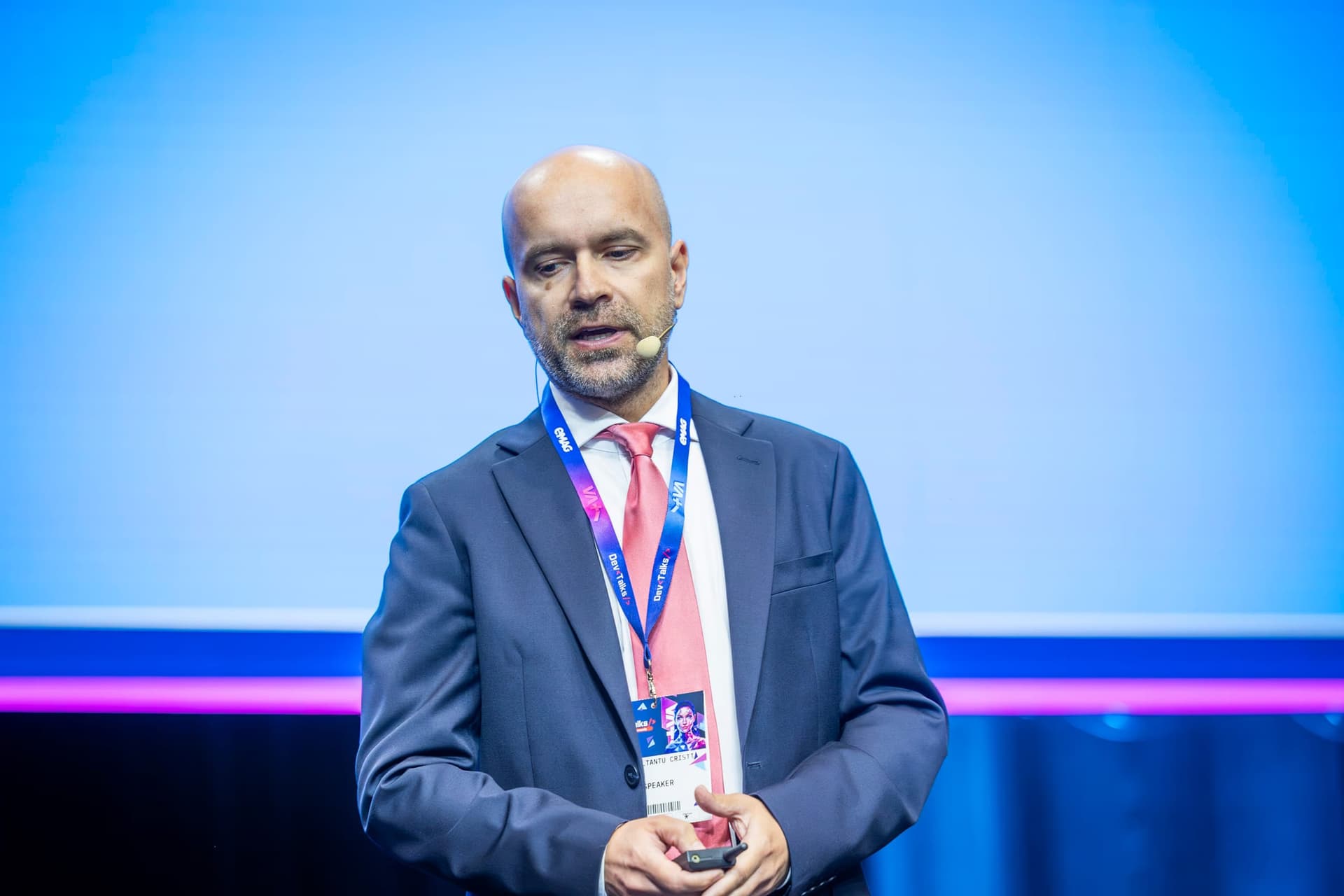
He talks about multinationals. About PowerPoints demanded by managers. About meeting rooms where ten people with their cameras off say"let me jump in real quick", and then nobody jumps anywhere. About KPIs and OKRs and "leveraging synergies". About scrolling through the LinkedIn posts of people who'd rather be on OnlyFans.
The room laughs. Laughs a lot. Laughs in a particular way — laughs because everyone has recognized themselves in at least one of those poses. The men in shirts with blue lanyards. The women in the third row with coffee cups in hand. The few in suits who came over from the Java Stage. All of them. And the laughter lasts longer than you'd expect.
It's a different silence from the one in the Minecraft kids' zone. This is the silence that follows laughter — the brief moment when everyone looks inward and confirms, wordlessly, that yes, it's true. Brooks had spoken, two sessions earlier, about the window that closes and forces decisions. Cristi speaks, without saying it outright, about the window that was left open too long — and about all the races we've lost by missing the moments when we should have jumped through it.
At the end, no queue forms for questions. Because there's nothing to ask. People simply leave with wider smiles than when they walked in.
A man alone
The conference rolls on — speakers on stages, a steady stream of people flowing in and out of the makeshift halls. But somewhere between two pavilions, in a work area, there's someone who looks like he's racing a deadline. He's focused on his keyboard and the screen in front of him. He seems to be approaching 40. Older than the apparent average. White T-shirt. Thin-framed glasses.
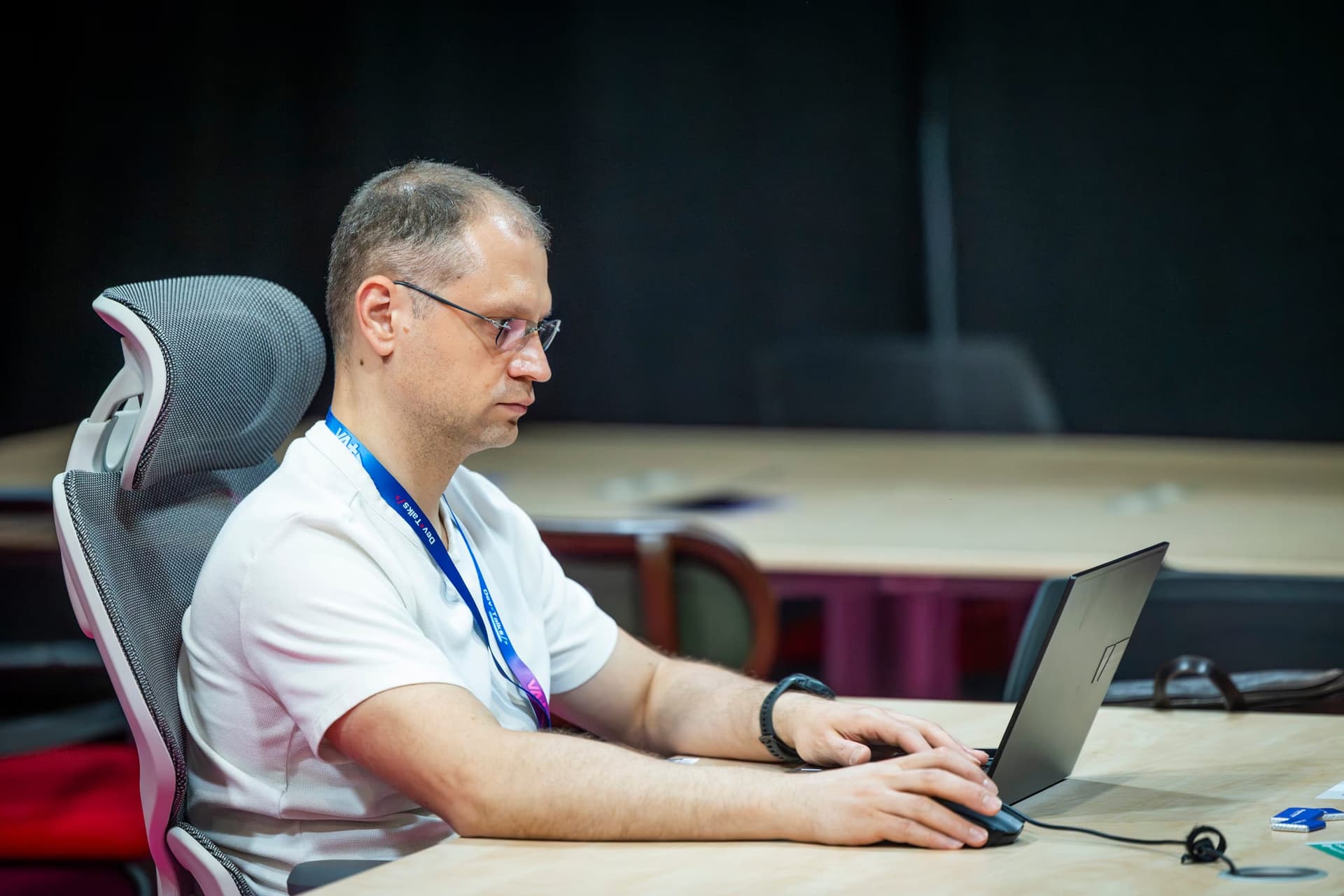
All around him the pavilion hums. On one wall alone, three speakers can be heard simultaneously — two from stages, one from a live-recorded podcast. Twenty metres away, the kids are still on their cubes. Thirty metres away, Brooks is shaking someone's hand. And he — this man, who appears on no agenda, whom no magazine pull-quote will ever cite — is working.
You stop. You look at him for a second longer than necessary. You wonder if he has a deadline. Or a proposal he sent this morning and hasn't heard back on. Or a presentation he was supposed to give tomorrow. Or, more likely, he just has work to do.
The conference — its speakers, the kids on Minecraft, Brooks at DevLead, the Mercedes cars at the entrance, the Hugging Face emoji smiling from the Web Stage screen — exists in parallel with him. Or, more honestly: he exists in parallel with it. It's hard to say which is the backdrop for which.
Today, inside Romexpo, there are a few hundred people like him — in halls, along corridors, under sponsor tents, in workstation zones. All of them came to a conference about how AI is rewriting the way code is written. Many, however, while listening to the speakers, opened their laptops and kept working.
It's a way of attending that no agenda records.
 1 / 35
After 4 or 5 o'clock the conference begins to wind down. The speakers head to the after-party. The kids are rounded up from the Minecraft cubes. The two Mercedes cars remain. Tomorrow — Day 2 — a young Romanian woman who works at OpenAI will open the Main Stage with a keynote about how AI is rewriting the way software is built. But that's another day.
Today, DevTalks 2026 was much more than its name suggests. It was an exhibition of technologies under the hood. It was a school. It was a theatre featuring a woman talking about a failed exam. It was a stand-up comedy break. It was a waiting room where one man worked quietly.
All of it under the same industrial roof at Romexpo.
Photo essay by Adi Coco · RomâniaFrumoasă · June 3, 2026.