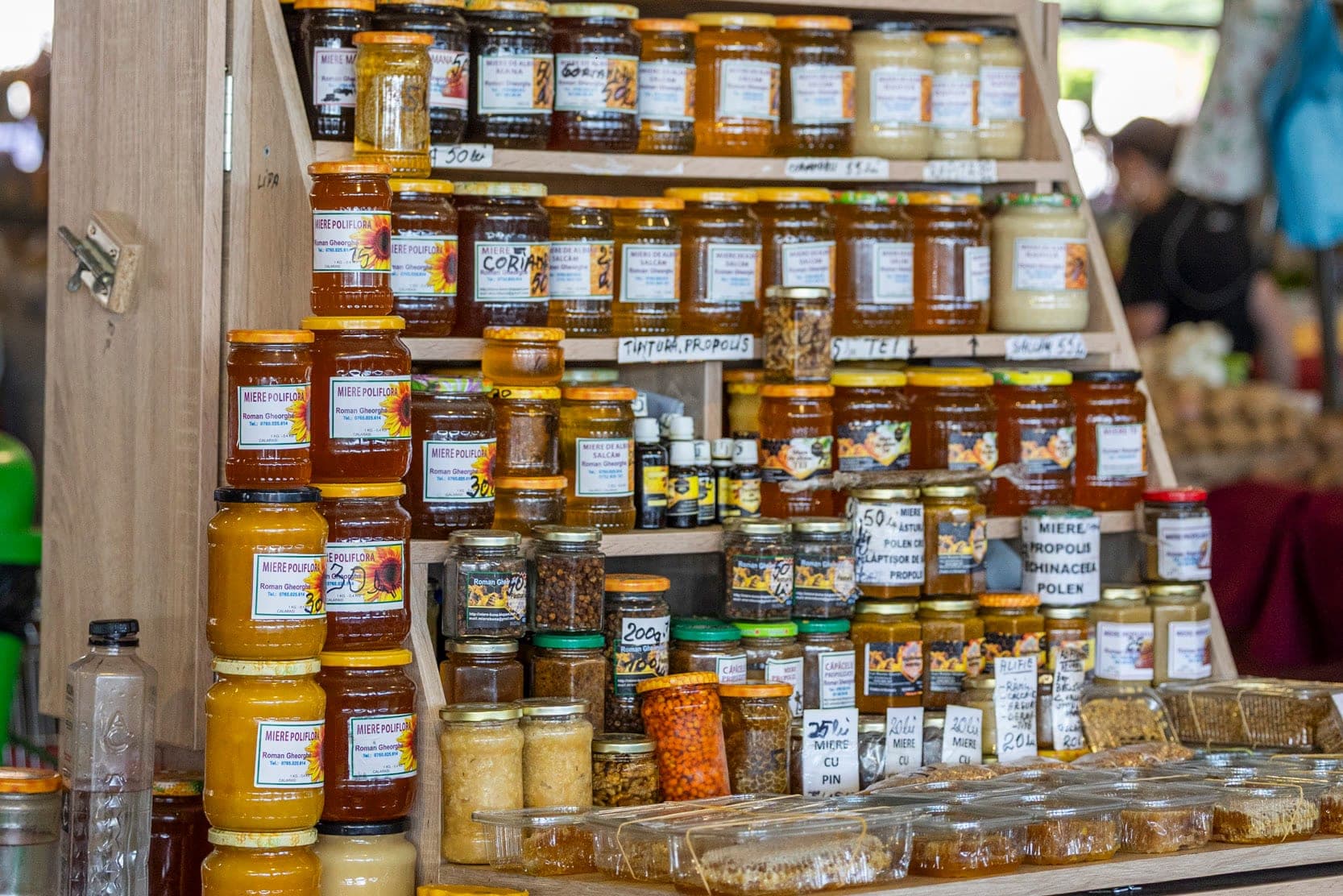
A radish bought at Hala Obor arrived by van from Adunații Copăceni before five in the morning. It was made here — that much is clear. A few meters away, the honey shelf — forty small jars, hand-labeled with pollen, propolis, bee bread — made here. Two steps further, the crates of tomatoes carry yellow stickers with a single word written in ballpoint pen: Colibași. Same place.
But if you look up, below the ceiling of the hall renovated in 2010, hundreds of fluorescent lights flicker on — made nobody knows where.
"Made here" is a phrase that, in 2026, is becoming harder and harder to define.
The Label
For Brussels, "here" translates into European quality schemes. At the start of 2026, Romania had 16 officially recognized products: 12 with Protected Geographical Indication (PGI), 2 Traditional Specialities Guaranteed (TSG) and a single Protected Designation of Origin (PDO) — Telemeaua de Ibănești, registered in 2016 using natural brine from the springs of Orșova (Mureș County). Others — pike roe salad from Tulcea, Dobrogean flatbread (plăcintă dobrogeană) — are under evaluation.
All of them are "here" geographically. Legally, they have the right to carry the word "here" on their label.
Everything else — the several million products that pass through this country every day — carries that word without entitlement, carries it falsely, or doesn't carry it at all.
The Water Beneath Our Feet
Romania has hundreds of mineral water springs and exports brands every Romanian knows — Borsec, Dorna, Bucovina, Aqua Carpatica, Perla Harghitei. Industry representatives have repeated, for years, a figure that has become almost a national brand: over sixty percent of Europe's reserves. No official statistics confirm it, however; it is an estimate, not a fact.
The true figure for reserves is not precisely known. The figure we see every day is a different one: in Bucharest supermarkets, the price of Romanian mineral water per liter has been approaching, for several years now, the price of mineral water from Luxembourg.
"Made here" does not necessarily mean it stays here. And it does not necessarily mean it is cheap here.
The Code You Can't See
There is another industry made here that goes unseen: software. In 2023–2024, between 190,000 and 215,000 IT specialists were working in the country. ICT service exports exceeded eleven billion dollars in 2024 — one of the largest categories of services the country sells abroad.
Behind every banking app used by Germans, every delivery app used by the French, every telecom interface used by the British, are a few thousand lines of code written in an office in Cluj, in Iași, in Timișoara. Not one of them carries the label "Made in Romania".
It is made here. But it is not seen here. We know where we stand with digitalization…
Honey, Sunflowers, the Hive
In 2015, Romania had approximately 1.4 million honeybee colonies and produced between 28,000 and 35,000 tonnes of honey in a good year — one of the largest producers in the European Union. In organic honey, it ranked third in Europe, behind Bulgaria and Italy, with over one hundred and seventy thousand certified hives. By hive count, it ranked second in the EU until not long ago. Since then, Italy has moved ahead.
That was then. In 2025, the harvest was well below normal: pesticides, climate change, erratic winters. The country's roughly forty thousand beekeepers say there will be fewer of them in 2025 than in 2024. They won't last much longer if something doesn't change.
Also made here is more sunflower than anywhere else in the European Union. The oil used for frying across half of Europe grew, statistically speaking, somewhere between Brăila and Călărași.
And there is no label there either.
The Wood That Sings
In the Gurghiu Mountains, near Lăpușna, there is a nature reserve officially called "The Resonance Spruce Forest of Lăpușna". Its timber, felled by the old rules — a certain number of rings per centimeter, a certain absence of knots, a certain tone when you tap it with your finger — travels to Hora Reghin — the factory founded in 1951 that produces around seventy thousand musical instruments a year, of which over eighty percent go to export, into the hands of teachers, children, and soloists who have never heard of Lăpușna.
There is a legend, often repeated, that Stradivari's emissaries once bought timber from the Gurghiu Valley. It is only an oral tradition, without documentary confirmation, yet everyone in the area tells it the same way. That, perhaps, is one definition of "made here": a place that does something so well that the legend grows around it like bark.
The Unlabeled
Romania produces something else for the outside world that it never labels: adult web services. According to the most widely cited estimates, the world's second-largest producer of erotic content after the United States, and the first in Europe, with over one hundred thousand people working in the sector and an estimated turnover of more than three hundred million dollars a year. These are estimates, not official statistics — the sector does not appear as such in the ANAF tax classification.
It may be the largest "made here" category you will never see on any shelf. It is a fact. Nothing more.
Here
I, who photograph this country slowly, have arrived at a conclusion: "made here" is not a label — it is a question.
It is the question you ask when you see a road entering a village — who built it, when, by whom? It is the question you ask when you open a jar of honey — whose bees, which flowers, which summer? It is the question you ask when you see a bridge over the Siret, the Olt, the Danube — who, when, for what need?
The answers are almost never a label.
In most cases, "made here" means: made by a woman in rubber gloves before five in the morning; made by an engineer from Saligny's school; made by 40,000 beekeepers who have never met each other; made, in fact, by the generation before us, under the conditions we inherited.
Most Romanians have never bought a telemea with a PDO label. They have, however, bought telemea from a woman who told them where it came from. The label was her voice.
At Nine in the Morning
At Hala Obor, the woman in rubber gloves sprays her radishes for the third time. Her radishes have, legally, no label of any kind. No PDO, no PGI, no "Made in Romania". What they do have is an exact route — Adunații Copăceni, Giurgiu, 30 kilometers south, DN5, a van, an hour, a market stall, a plastic bottle with a punctured cap.
That is the label I am looking for.