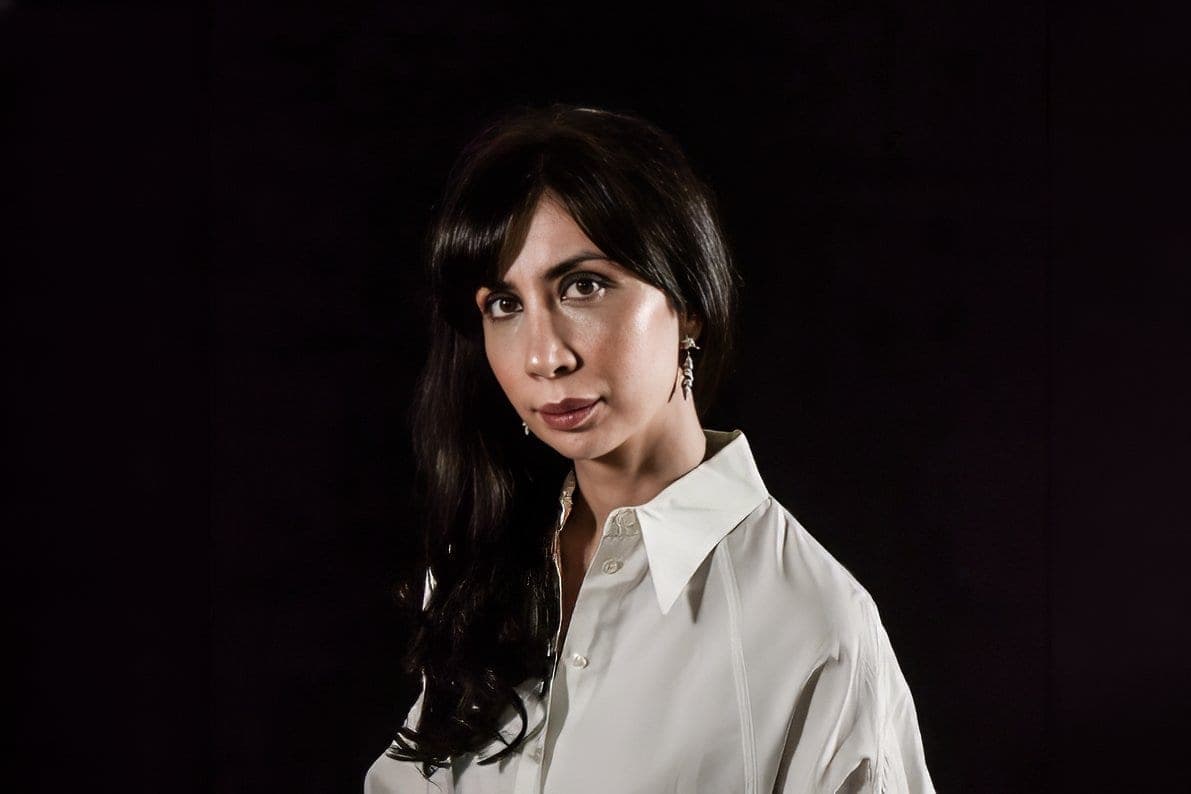
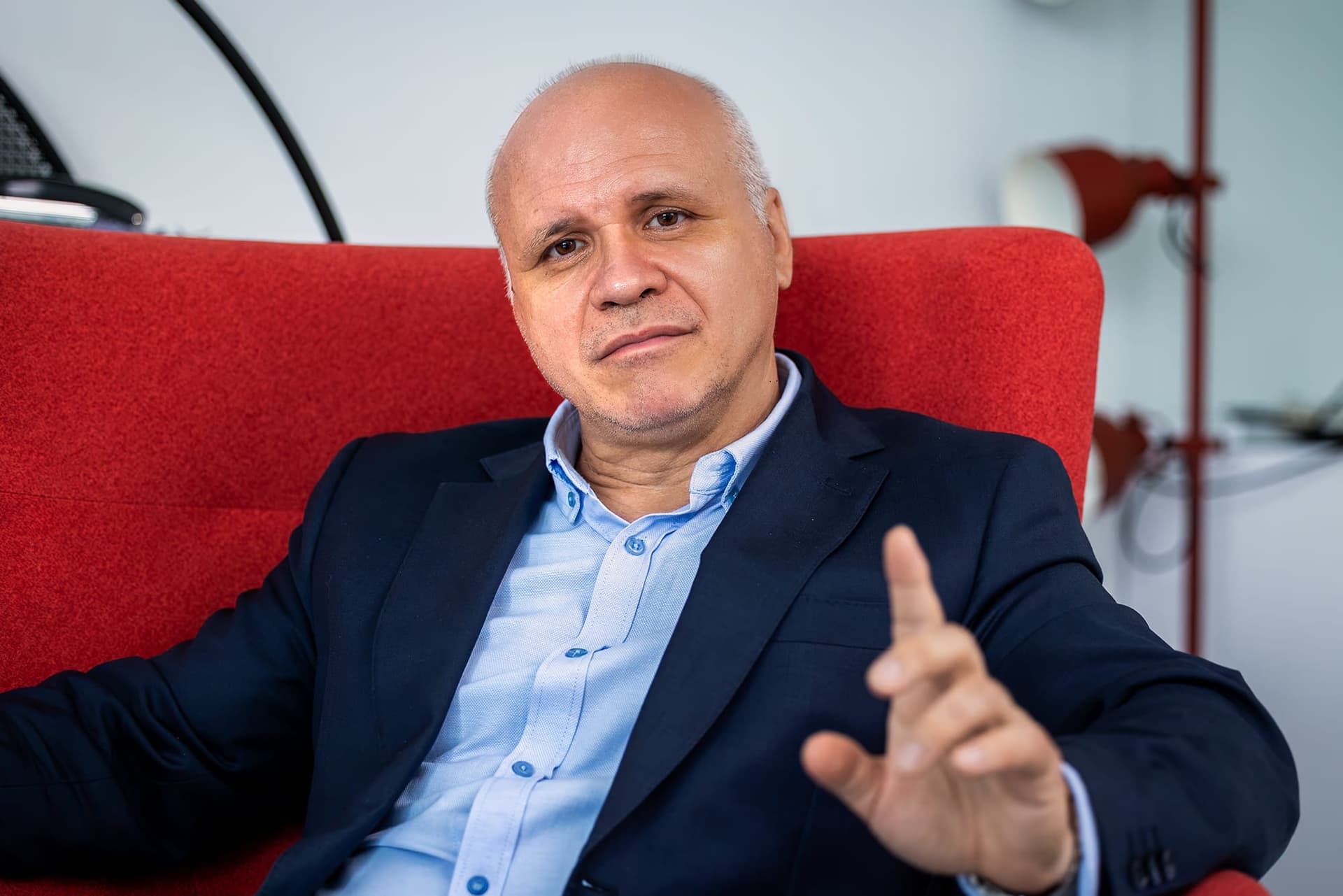
Few people can talk about fear from so many angles at once. Sorin Faur is, before anything else, a psychologist — with a degree in psychology and sociology, a master's in organizational psychology from the University of Bucharest, and postgraduate training in psychodiagnosis and psychotherapy. But he has spent his career in the world of work: more than twenty years in human resources, ten of them as head of HR for fourteen countries across Eastern Europe and the Balkans in the BDO network. Today he runs the HR Academy, is the author of Employee Motivation and Retention, and teaches, among other things, a course on managing stress and burnout. A man who has seen fear both in the consulting room and in the board meeting. Good afternoon!
Sorin Faur: Hello — welcome!
Adi Coco: Good to be here. What is fear, actually?
The Nature and Evolution of Fear
Sorin Faur: It is a state, an emotion from the negative register, one that comes from insecurity, from not knowing, from the inability to control the present and the future. It is a profoundly human feeling — and one we have been wrestling with for millennia. Fear first appeared in primitive man in relation to animals, to the risk of surviving or not in difficult circumstances. The capacity to survive is the first great fear we have: survival itself.
But then this fear evolved into much subtler forms. If at the beginning it was fear of an animal — of a lion, of a real physical danger, perhaps of thunder, of rain, of other natural phenomena, of an eclipse — history is full of such fears of the natural world.
Then it evolved, as I say, into subtler forms, personal and social. In today's society we no longer live with fear of a physical threat as such — except, perhaps, in relation to war and to conflict zones. On the personal level, there is no direct menace left in the modern world. Nothing attacks us anymore; we are the dominant species, the ones who control the planet — what could threaten us? Almost nothing. Perhaps, again, natural phenomena on a very large scale. Perhaps disease, as the pandemic was.
In essence, fear has migrated into the personal sphere: social fear, fear connected to self-affirmation, to identity — tied not to physical survival but to prosperity, to success and failure. The fear of failure. Today we are terribly afraid of failing, of social humiliation — the internet included — of public appearances that show us in an unflattering light, of damaging our image. There are people who live largely off their image. For many, to seem is to be. They are hostages of an image.
Because they are on social media, because they are influencers, politicians, economists, people in the public eye — their image matters enormously. What are these people's fears? Or the fears of businesspeople? Being eaten by a lion? Obviously not. Failing. Not succeeding, not fulfilling their potential, not making their numbers, missing the target, not selling — or slipping into oblivion. There are people who are afraid of being forgotten, of not being remembered, of being ignored.
So fear has evolved into these subtle forms — and they are everywhere. Fear is ubiquitous. We live in a society genuinely governed by fear, dominated by it in multiple forms. In the past the enemy was very clear; the aggressive element was well defined, well isolated. It generally had a material, visible, direct component. It was a concrete threat you could put your hand on. You knew exactly what you were fighting.
Today, not necessarily. It is a diffuse fear; sometimes you don't know where it is coming from. It is a general state fed by a perpetual sense of menace — insecurity, uncertainty, indecision about tomorrow. It may come from the war at the border; from the fact that a drone can fall on your apartment block, or land in a port — you don't know. From a terrorist attack: you walk down the street and, as we have seen in countless parts of the world, you are no longer sure whether to leave the house at all. From the economy: you are no longer sure whether your salary will arrive at the end of the month, whether you can put bread on the table for your children or pay the mortgage. You are no longer sure you will survive fiscally, whether you will have the money to pay your debts and your taxes.
These are the elements that generate today's forms of fear — social, as I say, rather than strictly personal survival fears, but just as aggressive and just as painful. They create a permanent stress that society lives with, and it affects the collective mind. So yes, we can say that at the social level, right now, the predominant feeling is fear. More than well-being, more than ease or relaxation — that state we aspire to, in which the world is beautiful and life is good. No: the predominant state is fear.
The Difference Between Fear and Anxiety
Adi Coco: Many people conflate fear with anxiety. What is the difference between them?
Sorin Faur: True — the boundary there is a subtle one. Anxiety has no particular object; it is a diffuse state, without an easily identifiable cause. Fear is a more intense form of that same emotion, and it has a better-defined object — a physical aggression, say, or a direct threat.
Even so, there is a transition zone between the two. Anxiety turns into fear very quickly once the threat becomes more concrete and the feeling reaches a certain intensity. At the level of society we can speak of both. The difference, then, is one of intensity rather than of nature — and of how concrete and immediate the threat is.
If you can put your hand on the threat, if you can clearly identify the aggressor or the danger, and it belongs to the here and now, we are talking about fear. If it is more diffuse, harder to pin down, coming from several directions at once, with no clear object, yet producing that state of discomfort and uncertainty — then we are obviously talking about anxiety. But anxiety, too, can end in panic attacks. Accumulated over time, at chronic levels, over months, perhaps years, you can no longer even tell them apart; it tips into panic attacks. And there are many people who wake up screaming in the night, if they have reached that point.
Can Fear Be "Unlearned"?
Adi Coco: Can fear be unlearned? Can someone actually get rid of it? Does it disappear, or is it merely covered over, in danger of resurfacing?
Sorin Faur: Absolutely, you can. Look at a famous science-fiction novel, Frank Herbert's Dune: the hero battles fear constantly, and he has his litany against fear. So yes, it can absolutely be unlearned. That is what happens in the consulting room; it happens in countless places — the School of Courage, for instance. There is a methodology. Broadly, we are talking about approaches that are not necessarily psychotherapeutic — some belong to psychotherapy, some to personal development — but which tackle exactly this subject.
Fear is not a state to live in. It damages health in the long run, drives stress up to enormous levels, and over time that means illness, inefficiency, exhaustion, fatigue and much else. It is clearly not a desirable state, and not one that defines normality. It should be something punctual — a response to a direct threat.
Look at nature: the zebra, the deer — the lion comes, it runs, it escapes, and afterwards it does not remain in a state of fear. In us the fear lingers, because we are permanently exposed to other triggers — subtler ones, harder to name, on the border between fear and anxiety. Added together, though, the overall state is a bad one.
Yes, it can be unlearned. We should be talking about this in school. From this point of view there is a gap in the education system — and not only ours: we have forgotten to educate the human being. We invest enormously in education about nature, about everything outside us, and that is very good. We need to know the world: mathematics, physics, history, geography — these give us authority, mastery, the capacity for control, economic and personal effectiveness. I am not against that kind of knowledge; on the contrary, it must be done. I am only saying it is not enough. Necessary, but not sufficient.
That education about the world, about the universe, about everything around us — about our exterior, in short — should be completed with an education about our interior: how to manage fear, emotions, feelings, the big negative states. Why don't we have that school? We have perhaps one hour of psychology a week in the tenth grade, and even there the syllabus is not really about managing emotions and self-command. We should have a school of self-control, of emotions, of self-mastery, where we learn to work with these emotions from middle school, if not earlier. Because these feelings are everywhere around us, and a great many people do not know how to master them.
So yes, fear can be unlearned. It starts with self-knowledge. When you have a good relationship with yourself — when you know yourself, when you have discovered your talents, your values, your capacities — you know you are not alone in the struggle, that you have native, personal resources that depend on no one, resources inside you that you can activate. A map of your inner resources helps you diminish fear, perhaps shed it altogether. Why? Because you have the tools with which to face the threat.
That feeling of fear or generalized anxiety also comes from living with the sense that there is nothing you can do. Fear triggers the classic response: fight or flight. If you can fight — if you trust yourself to cope with the threat — you will fight. If not, you will run. It all comes down to resources: if you have them and can activate them, the opposite feeling is born — courage, the determination to fight. If not, you flee. And it becomes a permanent flight.
If you ask me what the predominant reaction is right now to these more or less identifiable threats, I would say flight rather than fight. Both exist, of course: the fight response means you have activated your inner resources and you engage the threat in order to defeat it — you do something. But when you judge that you lack those resources — and that is, in general, the judgment people arrive at — the answer is flight. A continuous, permanent flight.
So the first mechanism against fear is to know yourself and to activate your inner resources, so that you shift into fight mode rather than flight mode. Then come ownership, courage, self-confidence: I have the resources, I know I can use them, so the mental equation comes out positive — I will win, I engage. That element of commitment, of inner determination: fight. And you enter the fray.
There are certainly clear solutions. Psychotherapy, personal development, positive psychology have all proposed mechanisms over the years for attacking fear and anxiety. In general, though, they are not widely known; they are practiced in the consulting room, agreed. Sometimes you need a specialist — when it goes beyond a certain level and you cannot help yourself, you need help, just as when you break your leg: you cannot set it yourself, so you go to a doctor who helps you with a cast, an external structure — but the bone gets set.
It would be better still to work on prevention — not to reach the point of needing a therapist at all, and to teach these things in primary and secondary school, so that we learn to work with ourselves and our emotions. Either way, the message is: it can be done. We have the tools, we have the mechanisms. We just have to learn them.
The Fear of Change
Adi Coco: One of the most current fears in society is the fear of change. Which raises the question: why do we stay where it hurts? Sixty to seventy percent of people admit they would like to make a change, yet very many settle into the same situation. Half of all employees say they would leave; most stay. The same rupture shows up in couples — and even in the voting booth.
Sorin Faur: That's right. That's right. The fear of change is in fact the fear of the unknown. I said earlier that one source of fear is the inability to control a situation — and what situation is harder to control than the unknown? A situation you simply do not know. So many people choose to stay in their current situation: it is bad, but at least we know it, we control it, we have grown used to it, we know which end to grab it by; we have our little mechanisms.
The unknown, especially in the imagination, can take on unsuspected shapes. Faced with a situation you do not know, your mind usually goes to the worst. We see it with medical tests, with prognoses of every kind — why do you go straight to the worst? Partly for a logical reason: it is best to be prepared for the worst-case scenarios, so that if the news turns out better, or you are not in those scenarios, you were ready anyway.
On the other hand, imagination amplifies these scenarios all the way to the blackest ones. And what do you live through in your mind as you go there? The worst version, of course. Emotionally, imagination magnifies the negative. And so what ought sometimes to be a simple change becomes a threat, because you do not know what lies on the other side.
We tend to look at the negative rather than the positive when we construct scenarios because it is a survival mechanism — a defense left over from time immemorial: better to be prepared for the worst than to be caught off guard. The survival instinct tells you to brace for the worst.
But emotionally, as I say, that also means living the anticipated situation at maximum intensity. Which is not good. The fear of change is a fear of the unknown, and very often people inflate that unknown and the dangers it holds — which is why they prefer to remain in the present they know, even when it is bad.
In fact we ought to train the imagination equally — as a kind of brainstorming exercise — to find solutions, mechanisms, positive elements, not only negative ones. We have been conditioned, or have conditioned ourselves over time, to see the dark side of the picture and of our options rather than the bright side. Naturally you end up living with a great deal of fear, and resistance to change appears.
For balance, then, we should think about the positive side of the situation too: yes, change carries these risks, but don't I also stand to gain a great deal? Do at least an honest analysis, and then, yes, make a rational decision. On one side there is risk management — the capacity to analyze a situation and its outcome, and note: in risk management there is no emotion, only calculation and analysis, which is fine. In the fear of change, by contrast, there is more emotion than risk management: you live the fear emotionally, while rationally you are selective, dwelling mostly on the negative outcome. That is neither fair nor accurate.
Sudden Changes
Adi Coco: And yet the opposite also happens: people change abruptly, overnight, from one moment to the next. What is the mechanism that triggers it? What makes someone say, "That's it, I've had enough, I'm gone"?
Sorin Faur: Well, you have given part of the answer yourself — and that is where I wanted to pick up. "That's it, I've had enough." In fact it is an inner preparation that began long before. What we see is only the moment the decision surfaces. You may have been thinking about it for ages; it may have taken subtle forms; perhaps in your subconscious you had long been preparing that very change — but the decision had not yet been taken at the conscious level.
When it happens, it does look like a sudden, overnight decision. In reality, most of the time it is something that was prepared and thought through in the subconscious or semi-conscious layers of the mind. We thought about it, we forgot, we came back to it — and in general, when we were ready and felt that inner accumulation of energy and resolve, we took the decision and said: "Okay, this is it. From tomorrow I change. From tomorrow I quit smoking, from tomorrow I get out on the track and run, from tomorrow I make an important change in my life, from tomorrow I go looking for a new job, a new destiny, a new future." So it is really the ripening of a decision you have long been contemplating — it has been proofing in the mind like dough — and that is simply the moment it matures and you feel the surge of determination. But in fact it was thought out long, long before.
How Effective Is Therapy?
Adi Coco: To get concrete: out of ten people who end up sitting down with a psychotherapist to voice their fears, how many genuinely manage to break free?
Sorin Faur: If what should happen in the consulting room happens, all of them should. It depends, of course, on the time allocated and on personal energy — as with anything else. You commit time, energy, involvement; you take it seriously. Take sports training: you could just as well ask me how many of the athletes who go to practice become — let's not say champions, but performers in their sport. In theory, all of them, if they follow the practice, the training regime, the exercises and the discipline the coach prescribes. Because the method works. Every sport has developed a training method which, if you respect it, clearly takes you far above where you started — perhaps all the way to real performance, and why not a title.
What is the difference between one athlete and another? Discipline, level of commitment, determination, the inner decision you take — the ownership of the change and the willingness to keep working in the same direction. It is the same in therapy and in personal development. I work mostly in personal development and positive psychology.
The same applies in these fields: the level of commitment. The methodology behind it works. Psychology is a very powerful science; it has advanced enormously in recent years and long before that. It is one of humanity's most important sciences — still underappreciated, perhaps, and unfortunately, though it is growing spectacularly. Perhaps the encounter with AI will make us realize once more how important the human being, and psychology, really are.
But to return: psychology long ago developed these methodologies and mechanisms — for personal development, self-control, mastering one's fears, self-confidence, attitude, a winner's mindset. These things are established, and I practice them every day in the consulting room.
Part of the result, obviously — that is why we speak of a consulting room — lies with the client. The level of personal commitment is fundamental. But if someone takes on the mechanisms, the solutions recommended by the counselor, the therapist or the psychologist, the results are there. Always. Almost guaranteed. So we could say 100 percent — but it depends on the personal level of commitment.
Violence in Relationships and Control Through Fear
Adi Coco: In 2025 the World Health Organization reported that one in three women worldwide has experienced violence from a partner. The figure has barely moved in 25 years. When we talk about fear in a relationship, the first thing that comes to mind is physical violence. But you have presumably also seen forms without a single blow. What does control through fear alone look like in a relationship?
Sorin Faur: Yes — here we are unfortunately talking about situations in which, within couples and within society, aggression is directed generally and overwhelmingly against the woman, who ends up in these situations of domestic violence — whether direct physical violence or psychological violence, and violence within the relationship broadly.
Sadly, it is a situation the global statistics capture, and it has remained unchanged. That means we have not made sufficient progress, unfortunately — in education, in personal rights, in human dignity and in the recognition of human worth. That is where we are. Behind it stand some very old models that, again, should be changed through education.
And yet we live in a world that has become far more self-aware, far more conscious of itself and of personal worth. We must keep fighting this scourge, because every human being is talented. That is the premise in psychology — and not only in psychology; in law as well, and beyond. I speak as a psychologist: every human being is a talent, a unique, special being, justified absolutely. You need no justification whatsoever to exist and to have your dignity and personal worth recognized.
Violence is a form of aggression, obviously — a lack of respect for the other — and it should be excluded completely. Beyond physical violence there is psychological violence, which works through intimidation and threat; these forms, too, we meet very often.
What causes them? Lack of education; stress, certainly. These are also mechanisms through which such people discharge themselves — in an absolutely negative way, as I say. What you should see in the other person, though, is a partner. A partner, a person with whom one plus one makes three, if not eleven — a synergy. And the inability to see a partner in the other means you see something else: a subordinate, an instrument meant to serve you rather than you them. There is no real communication there.
We fall into these traps in couples because the world has grown more aggressive and people have grown lonelier. Social media has apparently opened all sorts of doors to direct communication, but it has isolated us from one another — worse, it has estranged us from ourselves. We sometimes spend hours on end online and at the end cannot say why we were there.
So: loneliness. It leads to the absence of dialogue, it leads to distance, and it is obviously easier to be aggressive toward someone you do not love, with whom you have no real, authentic communication. We need to increase communication within the couple, to increase authentic communication between us — sometimes to put away the devices and the screens and simply meet for a coffee, meet on a terrace, meet ourselves on a park bench — and to address the real problems we have through simple dialogue: Who are you? How are you? What do you want from this life? What are your goals? What are you feeling, thinking, going through? What contents you? How can I help? What do you need? What gives you pleasure, what brings you joy?
There — a series of questions, rattled off quickly, from the territory of coaching and personal discovery, that partners in a couple should be asking each other in order to step out of the zone of violence. Where there is violence, there is almost certainly no love, no understanding, no positive emotion. There is discharge. And again — coming back to self-control and to what I said at the start about the psychological education we ought to have, at a higher level and at scale in society, beyond what happens in the consulting room — the lack of self-control, of maturity and of psychological preparation translates directly into violence. A person who commands himself, who is able to govern his own emotions, does not end up discharging them violently onto another human being — husband, wife or children, for children too are caught, predominantly so, in this zone of aggression and domestic violence.
So we are clearly talking about missing psychological competencies and capacities that later translate into these reactions. Before we ever get to love, coupledom, understanding, affection, partnership, we are talking about a crass deficit of self-command, of psychological education, of psychological maturity. Which, as I say, shows the level of our society — it is a global social phenomenon, not confined to one country or one place. You quoted global, worldwide statistics, unchanged for 25 years. Exactly. Why? We have not managed to evolve enough, psychologically, at the level of the masses. Meanwhile humanity has grown — we are at 8.5 billion people or thereabouts, so the mass and the complexity have grown too; the world is not what it was 25 years ago. You might call those objective causes, but they are not excuses. Because over the same period society has advanced, technology has advanced, access to knowledge and information has advanced — today information is practically free, one click away. We ought to educate ourselves emotionally. That would be a measure that would answer, and massively reduce, violence in the family and in the couple.
Gaslighting and the Relationship with the Self
Adi Coco: One of the new words in heavy rotation is gaslighting, which...
Sorin Faur: A welder working by gaslight! (He laughs.)
Adi Coco: ...has become very fashionable on social media. By now it means almost anything. As a psychologist, where do you draw the line between a lie, an innocent quarrel and true gaslighting?
Sorin Faur: A lie... A lie is, after all, a form of protection — it shows either that you do not trust the other person or, on the contrary, that you are angling for some advantage for yourself: dishonesty. From my point of view, again, I think we should work much, much harder on our psychological condition.
What happens in the consulting room is already treatment — think of preventive medicine. We have too little preventive psychology, just as we have too little preventive medicine. In my view it is never too much, and never too early, to start building this culture of self-knowledge.
What do I want, first of all, from this life? Because if you know what you want, you are faithful to your own purpose and objectives; you make an action plan that steers you toward your goal; you are a purposeful person, effective in your own actions, who generally achieves what he sets out to do. Self-command, control of the emotions, as a form of psychological maturity. Discipline and will, so that your plans and actions can be carried into reality and achieved. Integrity, values. What are my values? If you look at mine — truth, personal development, evolution, self-mastery, fairness, ethics — you realize you no longer end up in gaslighting, or in lying, or in fear, or in manipulation, or in aggression, or in any of these forms of insecurity.
They are all measures of the level we are at. Which, unfortunately, is not where it should be. We are not where we should be. We have evolved tremendously in technology — we can travel anywhere on the planet very fast, we can travel off the planet, we have ultra-advanced technologies; lately we speak of artificial intelligence, of autonomous robots, of autonomous cars. But in the realm of self-command and psychological condition we are still behind.
Everything you listed is a form of that lag; in terms of developmental psychology we have stayed at a much lower level. So: the lie is a form of defense; fear, as I said, is a reaction to the unknown and to aggression. We are far too dominated by fear, by lies, by self-doubt. I see so many people who do not believe in themselves. Where does the lack of self-confidence come from? It has many causes, of course, and we cannot list them all now — but we can say that lack of self-belief is one of the things that amplifies fear, and the feeling of insecurity, and lying, and all the rest.
So why don't we trust ourselves? We do not know ourselves; we spend far too much time outside ourselves. Ask someone today to sit in an armchair for a quarter of an hour, twenty minutes — for most people it is very hard. They feel the need to pick up a phone, to look at something. Why can't you sit with yourself a little longer and talk with yourself? Why don't you feel at home in your own company? I am not being absurd — I am not saying we should all become hermits or full-time meditators, no. I am talking about a minimal act of relating to the self, and it is missing. A good part of the people I have seen over the years cannot bear to sit with themselves for more than twenty minutes; they need to grab something — a phone, a tablet — to call someone, to scroll social media. That inner restlessness shows that you are a stranger in your own mind, a stranger to yourself. And all the other forms are manifestations of that self-estrangement.
We should work with ourselves more. We should take a break — a simple ten-minute pause in which we talk to ourselves, actually look up at the sky, calm down a little, stop being so agitated. And in that moment we will discover an inner world that may be infinitely richer than the outer one. Or at least as rich. All the great values of the world came out of the inner world: works of art, culture, novels, technology — absolutely everything. You do not compose the Ninth Symphony, if you are Beethoven, amid the din of a bar. You compose it in your soul; you compose it while dreaming of great and mighty things — it is the anthem of Europe, after all. (He laughs.) You compose it in solitude; you compose it from within. That is where these things are created; there is an enormous space in there, and that is where all these values come from. Perhaps we should spend more time there and bring more things out.
So let us not be afraid to go inside ourselves. On the contrary — it is a fascinating, enormous universe, and one of psychology's roles is to turn your gaze inward. Toward who you really are. And from there, from the talents you have — and the talents in the biblical sense too, if I may reach toward spirituality: talent and talanton — to display them to others, to produce light, positivity, energy, positive creation; to contribute to the good of the world, not its harm. Not to spread more fear, violence, aggression, uncertainty, self-doubt, lies and gaslighting — but as much light, creation and beauty as possible. Where do these things come from? From within us, of course.
Once you discover that relationship with the self and see how much richness is there, you realize you clearly need to spend more time with yourself. I have been doing it for a long time, and I help my clients do the same — to truly discover themselves. Because there, once again, lies an astonishing universe.
Solitude and Mental Hygiene
Adi Coco: So the need for a screen before bed comes, in effect, from the fear of sitting alone with yourself?
Sorin Faur: It is clearly one form of it. And before sleep, mind you, it is even worse. It agitates you. It assaults the mind with a whole stream of ideas, offers, suggestions, temptations — precisely when you should be preparing for sleep, settling down. Sleep is a form of descent into the self. In dreams we communicate with the subconscious. And those dreams carry messages for us — messages from the subconscious that we ought to access more often.
We should be quieting down — not turning outward one more time in the last five minutes before bed, one more look and then another, as if we hadn't been doing exactly that all day, every day. Instead of looking inward. To the very last moment we run from ourselves. It is a form of flight from the self.
But that is what we have grown used to. That is what we have grown used to — which is why I said that in the absence of a psychological culture of self-discovery... The Greeks — and not only the Greeks, the ancients in general — had that dictum inscribed on their temples, part of their philosophy of life: Know thyself. And I am not speaking only in philosophical terms; that was psychology, the relationship with one's own self.
The recommendation before sleep is clear: at least half an hour — an hour would be better, but let's be realistic and in tune with the times — at least half an hour with the phone set aside. Put on some calming music; turn the light off or down a little; step onto the balcony and look at the stars or the sky; take a gentle walk; or simply lie in bed with a book — read, absolutely, and hold on to that to build an inner story. Or meditate; review the day. A very good technique is the review of the day: what happened today; replay and re-edit a few of the day's events; draw some conclusions; think about who you are, what you want, how the day went — was it a good day for you, a day won? Would you change anything, if you could live the day again, from that perspective? And gently you can turn to tomorrow, to what you are going to do; allow yourself a little dreaming, imagine how things ought to be, and take pleasure in your own thoughts. Perhaps arrive at a few inner conclusions.
Here is one recommendation I make, if you like, as a psychologist: put a meeting with yourself in your calendar. At least once a week. We have meetings with a crowd of people, professionally and personally, with friends: "Let's grab a beer, a coffee, a terrace, a film, a match." Very well. We have meetings with a client, meetings with business partners. And we honor those meetings. If it is at two o'clock, we may arrive at 2:05 — traffic, something came up — but we respect the meeting; we are there. Because there is a partner involved, and we honor our commitment to the other person. So let us book a meeting with ourselves, then — and honor the meeting with ourselves.
I would put it — say, every Friday, at the end of the week, since Monday is crowded, Tuesday is crowded, you charge into the week with energy, the week sweeps you up and there is no time for such things, I understand. Or Saturday. But I would put a meeting with myself in the diary every week — half an hour per meeting at first, later an hour — a meeting with me. As if you were meeting a client. The same respect, the same determination and effort you devote to an important client — the meeting you would never dream of missing, because it means money, resources, your professional reputation, your business or your job. You would never miss it, and you prepare for it: you think about the presentation, the emails, the communication, what you will say — you allocate time. Not just the meeting itself, but the preparation for the meeting.
Well then — let us have a meeting with ourselves. More often. Once a week would be no great sacrifice. Friday, Saturday, at 2 pm, at 4 pm: "meeting with myself," entered in the calendar. Formally entered — in Google Calendar or whatever calendar you use on your phone. And I honor that meeting. And what do I do in the meeting with myself? Self-coaching. Inner dialogue. The "know thyself" of the Greeks, where we started — a philosophy of life, a way of living: to know yourself. And that means thoughts: what are you thinking? Know your thoughts; audit them if you like, map them. And, obviously, the emotions.
What emotions have visited me this week? Do a mental review. Mostly positive or mostly negative? Which quadrant did I occupy this past week — the plus quadrant or the minus quadrant? Emotionally speaking. And if in the week gone by you dwelt mostly in the quadrant of fears, negative feelings, insecurity, uncertainty and so on — hate, aggression, all of that sits on the minus side — that is not good! It means that is your life. You spent a week of your life in the negative, in the minus. And then you wonder why you get ulcers, why your head aches, why you feel tired all the time, why life isn't beautiful and why you feel like hitting someone. I wonder why!
Think of an orange. You squeeze it — the symbol, let's say, of life's pressure. What will flow out of the orange? Whatever is inside it — namely, orange juice. And if you take a lemon and squeeze it — the same everyday pressure — what will flow out? Lemon juice. So: what is inside us spills out of us. Into everything we do. Tell me who you are and I will tell you what you do — and what you will do. I can predict behavior from your identity, and from your behavior I can read your identity — reverse engineering. I can invert the dictum: tell me what you do and I will tell you who you are. Because, obviously, a person is known by their deeds as a tree is known by its fruit.
So we are reflected — here is another answer — in our actions. A violent man who abuses his partner, his children, his wife; or a toxic boss who abuses his employees: where does he get all that? From inside himself! That is what is in that person; it is nothing else. You bring out of yourself what is in yourself. What is inside you shows outside you. If that is what came out, it is because that is what was in there: malice, aggression, fear, insecurity. Only secondarily could we say that these people are victims of their own lack of development, of self-concern, of psychological maturity. Not that it excuses them — but again: what is in you shows outside you.
Well — if we spent more time with ourselves, if we knew those two great fundamentals, our thoughts and our feelings: what do I think, what are my principles of life... For example: it is good to do good. If that is one of your life-thoughts, one of your principles, that is what you will do; it mobilizes your mind, it organizes your life. If, on the contrary, you think the world is an evil place to be guarded against, a place that attacks you, you will react defensively, you will hide, you will answer in kind — evil for evil, negative for negative.
So, coming back to this meeting with the self: it has enormous therapeutic value, and self-knowledge value too. Just two things, that is all: the thoughts and the emotions. Think about the thoughts you had last week; think about where your mind spent most of its time last week — and if the balance comes out negative... Here is a quick rule of thumb, to close the answer: if it is more than 50 percent, it is obviously bad — most of your time, more than half, spent in negative thoughts, negative emotions, insecurities, fears: "Oh God, what's going to happen, oh God..."
But if you ask me what the real figure is — 50 percent is beyond obvious already; the true threshold is much lower. The real ratio is 80/20, or 20/80. Which means that if you spent more than 20 percent of your time in the negative, you already need to act; you must not wait to reach 50. That is Pareto's rule — a rule of personal efficiency among other things, with applications in many fields. It should be 80 percent in positive territory and 20 percent tolerated — because we cannot eliminate every negative element from the world and from our lives. But then you have the energy from the other 80 percent to face the bad in your life.
The Danger of Isolation?
Adi Coco: If you spend too much time with yourself, don't you risk becoming introverted, antisocial? Where is the line?
Sorin Faur: "Too much"... That is quite a word — it depends what that "too much" means. (He laughs.) Honestly, given the pace of life and the challenges we face, I think the world is far from being in danger of spending too much time with itself; the risk of reaching that "too much" is a distant one.
So, beyond that caveat — it is unlikely you will end up spending far too much time only with yourself, though it can happen, of course — no: introversion and extraversion have nothing to do with the time you spend with yourself. That is not what determines them; it does not turn you into an introvert. Not remotely. These are fundamental traits of the person — introversion and extraversion were theorized by Jung. They are fundamental traits; they concern a person's basic orientation in the world and in general. They do not arise from spending time with yourself; that is not the cause; it does not turn you into a coward or a recluse or an introvert. Far from it.
In short: first, I would not worry much about it. But of course there are people who do end up in that situation — through loneliness and so on; they may indeed spend too much time with themselves, and there the solution, the recommendation, is the opposite: go out into the world, meet people, burst that bubble of negativity. Which is why psychology, like medicine, is personalized. The disease is one thing, the patient another, you know? Not everything suits everyone under the same conditions. A treatment that works well for one person should in theory be good for all — we already know it is not; medicine and psychology alike are genuinely personalized. You do not treat a cohort of people; you treat each patient in turn. So too in the consulting room: each patient, each client has their own time and their own dialogue with the therapist, the counselor, the specialist, the psychologist.
So I would say: case by case. But those who end up spending too much time with themselves — why do they? If they are in the benign zone, the zone of positivity and creation — no, not remotely a problem! On the contrary: they will bring out wonders. If they spend too much time alone because they have been afraid of the world, of social contact, and because they are introverted, withdrawn — then yes, indeed; but the one did not cause the other. For them, the solution truly is to go out into the world more, to discover interests, passions, new friends. The answer is personalized. But no: if you are on the positive side and you spend time with yourself out of a need for inner exploration and creation — far from it. You will bring out wonders.
Fear in the Workplace and Leadership
Adi Coco: Let's take up another very current fear: fear on the job — the boss who leads through fear. A classic study found something counterintuitive: the good teams reported more mistakes. They didn't make more mistakes; they had the courage to speak up more. You have said that many bosses use fear as an instrument of authority. In practice, what is the difference between a leader a team follows out of respect and one it follows out of fear?
Sorin Faur: Yes. In the school of management and leadership there really are people who learn to run teams through fear, because fear puts you in a defensive position: in fear you mostly react, you are reactive, you respond to a threat. So what does such a boss do? First of all, he creates a threat. That you will be thrown out, fired, penalized one way or another, assigned all sorts of chores, docked pay, given the hardest and most unpleasant work; that I will shout at you, harass you in every way — there are many forms this generic threat from the boss can take, all designed to put the other person on the defensive, to make him protect himself. And how do you react to that? It is a threat. It puts you on the defensive. The immediate reaction is defensive.
Well, yes, this style of management and leadership is practiced. The people who do it have their own wishes — perhaps their own problems too: they want to be seen as the god-manager, as the authority; they often carry their own unfulfilled ambitions and translate them into these behaviors. And what do they get in return? They get obedience. They don't get respect.
And they lose enormously on creation and on good ideas. Because — take a good idea. You cannot put it in a job description, in any company, as a mandatory task: "you must produce three ideas of genius from which we, the company, will make billions." You cannot do that. Good ideas are a gift. Say an employee notices something that could be improved. Well — if I am living under a regime of fear, under a toxic, aggressive boss of that kind who leads through fear, I am not sure I would think of offering that idea. And I don't see why anyone would. And that is exactly what happens! People who are led through fear do not bring their best ideas. Why? Perhaps they have noticed a piece of equipment that could be improved; perhaps there is a recurring defect somewhere on the process line and the engineer — that person — has spotted it. In a culture of fear, they will not say a word.
All good ideas are gifts you make to the company; they are an act of generosity. Of course, you may expect a reward — a share in a patent, say, if a patent or an innovation is filed, or a promotion, a partnership, a commission of some kind. But even so, it is a good idea, and you offer it. In submission, in fear — not a chance.
Leading through fear is an act that does get you an immediate reaction — it is a mode of management that produces an instant response — but you do not get the best out of a person. In fear, you never get the best out of a person. Fear does the opposite: it inhibits, shrinks, constricts, diminishes; it triggers the classic response — fight or flight! It is not a response of the type: create, innovate, contribute something positive, build, lift! No such response.
So in settings like these you get not the best of a person but the worst. People are afraid — but that does not necessarily mean they have respect. They respect the threat, not you; and they certainly do not love you. Meanwhile you lose the collective, you lose brainstorming, you lose ideas, innovation, openness to the future. What you gain is: "Yes, sir! Whatever you say, sir!" Instead of synergies — one plus one equals three — instead of a thousand brains thinking alongside you, you have a single brain thinking, a single mind and hand giving orders, and everyone else executing because that is what the boss wants.
And unfortunately, in Romania, I have come across a great many organizations in which the entrepreneurs, the top managers, the directors never learned to lead through collaboration; they themselves are afraid, first and foremost — of losing their place, of being pushed aside — and so they lead through fear. But the effects they get are exactly the opposite. They would have achieved far more — and this is scientifically demonstrated: the psychological condition of creation is a positive condition, while the psychological condition of fear is a negative one. At the level of fundamentals, without wading into any deep psychology, it is plain that this paradigm cannot build what is best over the medium and long term.
Such situations are very common indeed, but they must be worn down through education and through the understanding that the true leader is a brave one: he leads by example, adopts an attitude that grows the people beneath him — and in turn he is lifted like a wave by all the rest. To be a leader is to potentiate the team. Not merely to command it. To potentiate it, to grow it, to amplify tenfold the result you would have got from the mere sum of the parts. There is a factor of logarithmic, exponential amplification in there.
Fear as a Productivity Tool?
Adi Coco: There's a belief that a little fear keeps people alert and makes them more productive. What's the reality?
Sorin Faur: You could say, sure — a threat hanging there makes you more vigilant. But we are talking proportions: "a little" fear, you know? I think we should not be discussing fear as a productivity mechanism at all. Not at all. We should be talking instead about the opposite. Look — many research projects have appeared lately, in psychology, in sociology, in productivity studies, on high-performing teams. High-performing meaning the sales team, the research team, the marketing team — you name it, it doesn't matter.
What makes a team high-performing? How do you get those people — if we are talking about management again — to perform? In none of the studies I have seen did fear appear, not even a little of it, as you put it, in small doses, as an amplifier or catalyst of that high productivity. It was always about attitude, courage, respect, communication — a great deal of communication among team members, top-down and bottom-up, from above and from below. It was about trust; about the capacity to create an environment in which you can make yourself vulnerable. Where you can open up with ideas that might, on the face of it, be judged — "What a stupid idea!" — but that would feed a better one. Because if you are not afraid that the reaction will be "What a stupid idea!" and so on, you share it with full confidence. Very often you have a bold idea — borderline, even — but that is the strength of the group: to take it up and improve it! Whereas if your inner state is "Oh no, what will the boss say..." — you don't say it. And yet that idea might have stimulated another mind in the group, in your team, to adjust it! Fine, it wasn't perfect. And what is the expectation — that you arrive with a perfect idea on the first try? How, exactly? It's a process! Mobile phones, everything, is incremental. The iPhone 17 did not appear on the first attempt! These evolved generations emerged through a process of growth — the Samsungs, the Microsofts, all the software we use. All incremental. A process of natural evolution! Nobody arrived with the best solution on the first try and simply stopped there. Where would evolution be then?
Trust and Vulnerability in Teams
Sorin Faur: So clearly — clearly — you can always improve on what came before. Creating a climate in which I can show up in a vulnerable posture and share both my best ideas and my less good ones — the ones that stimulate the act of creation and group brainstorming — is one of the defining traits of high-performing teams. And not only high-performing work teams: the same goes for the family, for the couple, for friendships.
A true friend, a true partner — spouse or business partner — a true colleague, a teammate at work or in sport, wherever, in professional life or personal life, is someone who accepts you as you are, who understands that you do not have to be perfect, that you do not have to be God in person. You have your better moments and your worse ones — as a human being you move along a sine wave — but they take both your peaks and your troughs and treat them in the same key: as opportunities to climb higher and to work through. And that is how you get from version 2.0 to 3.0, from 3.0 to 4.0, from 4.0 to 5.0, from 5.0 to 6.0 and so on — you evolve.
In short: we can see a grain of truth in the claim that fear keeps you more vigilant and creates a certain alertness. But in essence, in highly productive, creative, high-performing environments, it is never about fear — not even a little. It is about the desire to evolve, the capacity to express yourself as you are, in your better phases and your less good ones. It is about the courage to say who you are, to dare to think things that are borderline, to put on the table what you thought in that moment.
So I would not lean on that idea. Besides, as I said, the studies do not support it beyond a superficial first impression — highly productive teams have no component of fear in them at all.
Management by Fear and the Danger of Dysfunction
Adi Coco: And yet there are heads of institutions who lead through fear and post good financial results. Do you think they can still change — or has fear become a very comfortable instrument, one their results have validated?
Sorin Faur: Well... Again: something simply works, doesn't it? And that something finds a state of equilibrium — even when the environment in question is run or coordinated through fear. And at the level where it has found its equilibrium, it produces results. Clearly, it is not completely broken.
But are we talking about the fact that it produces results — it does — or about what results it could have achieved without that paradigm? That is what I want to say and to defend: something is happening there, clearly, even in an environment dominated by fear. Look at totalitarian societies; look at oppressive regimes. Those societies function, after all! We in Romania lived under communism, an authoritarian, oppressive regime. Look around the world now: there is a string of countries — no need to name them, we know them already — with such regimes active today, ruling through fear on a grand social scale, over millions, tens of millions of people.
And those countries still function: they produce, they have economies of their own. What would the alternative be — that nobody lives there at all? People get on with their lives; they try to do their best even in environments ruled by fear. But again: true performance is not found in such environments.
And if you get used to something, you function in that regime — those in the execution ranks and those in command alike. You know nothing else; you no longer even dare to function differently. It takes a revolution, doesn't it? That is usually how those societies change. Because the society enters a state that can no longer be changed from within. It grows used to itself; the evil becomes the given, becomes natural; and the society runs in that regime until any other mode of functioning — political, economic, social — becomes simply impossible to imagine.
Over the medium and long term, though, these regimes have clearly proved their unreliability; they have collapsed under their own weight throughout history — we know this very well, we are one such example — under the pressure of history, and they functioned only for limited spans of time. They are profoundly dysfunctional. At the fundamental level, everything built on fear is profoundly dysfunctional.
It can hold for a year, two, seven, ten, twenty, fifty — absolutely. At the social level we are talking about very great forces. But at the level of history, these models have shown their fragility and have not endured. And in personal life too, as I said, fear is not a mechanism that holds — least of all when it is made permanent or stretched over long periods. It destroys; it does not create.
So those people would have to change from within — but it is probably very hard for them, as you yourself said very well. They no longer have the capacity; having functioned that way, they stay in that mode of functioning — and short of a revolution, nothing will change them.
Fear in Politics
Adi Coco: Which brings us to the third arena: fear in politics. Totalitarian powers work on the principle that whoever frightens, rules. In Romania, one study shows that 68 percent of Romanians no longer trust the political parties. How does a discourse built on fear work, psychologically? What buttons does it actually press? What makes you... is it like the relationship you can't leave — the circle that tightens around you?
Sorin Faur: Fear always works through a threat that it creates — a credible threat that it creates. That is the essence: something is about to happen, something bad. And either I am the source of that bad thing — if you do not obey me, I will bring it down on you — or I am the one who can protect you from it. And again, the general mechanism is to create dependence on the person who either holds that power in his hands or can stop that something — that threat, which may come from some other source, it doesn't matter — but you are the one who can stop it. Everything always runs through you. That is the mechanism.
But in essence, the real way to function must be built on courage, trust, positivity. As I said, over the medium and long term, any mechanism that appeals to fear exhausts itself sooner or later. Because fear exhausts you — it consumes you, wrings the energy out of you, wears you down. It keeps you in a permanent state of alert — the threat is always there — until you reach a point where you can no longer recover, can no longer come back to yourself. You have no time to recover, because it never stops. Sleep is no longer sleep; you stop sleeping well, you stop resting.
You can no longer come up with ideas, no longer create — which means evolution happens far more slowly, or not at all. You stay trapped with whatever you had. Fear does not create. You cannot create, cannot produce brilliant ideas, because you cannot project a good future. You remain locked inside that horizon of threat — it will be bad, it will get worse — stuck in that defensive zone.
All the positive energies of creation come from a space of calm. You cannot paint the Mona Lisa in a state of fear. It does not exist. You cannot compose a symphony — you simply cannot; you do not have the inner state required to create such a thing. Music, art, painting, ideas, research. Today's world runs to a great degree on research. You could just as well say: whoever discovers, innovates and advances in this respect controls the world and evolves. Absolutely right! If I were choosing a principle of social philosophy and social growth, I would build it on innovation, on growth as a principle. Because truly, whoever innovates, whoever discovers new things — progress has always been a form of power.
And those who possessed it, who managed to invest more in research and innovation — those countries pulled ahead of the others, visibly, to this day, to the very highest levels. Because the new confers an advantage — strategic, economic, technological, in every sense. And it is, at the very least, an act of progress.
Fear, by contrast, is a mechanism of inhibition, of constriction, of threat — and again the two fundamental reactions: fight or flight. Neither belongs to the good zone. Fighting at least has something to it: you activate an inner force and, as I said, you deal with the threat. Flight, never. Both scenarios — fight or flight — are negative; but in the flight half it is total, while in the fight half you may at least resolve something.
On the whole, though — one hundred percent — the reaction is clearly more negative than positive. Whereas in a construction of the type — innovate, create, evolve, what is the next level, where can we climb higher from here? — I see only positivity.
Clearly, at the level of history, such methods have shown their limits over time, even where they worked in the short term — and we ourselves, as I said, have been through our share of such episodes over our history. The best way to lead a country, a company or an institution is through innovation, through openness, through positivity.
From Fear to Anger
Adi Coco: As you were saying, fear paralyzes societies. What truly mobilizes societies is anger. How does fear turn into fury against a common enemy?
Sorin Faur: Injustice. When you meet an act of profound injustice — one that wounds something fundamental — you do arrive at fury. You cross from one regime into the other; both are negative, but anger belongs clearly to the fight zone, whereas fear carries the flight component: hide, duck, make yourself small, disappear, stay defensive.
From that point of view, anger usually appears when very, very powerful principles are violated, or when a terrible injustice occurs — an innocent being is harmed, a particular social group is harmed — and then you truly feel fury. You step out of the fear zone; fear no longer matters; you move into anger because the injustice seems to cry out to heaven and you feel the need to react at any cost.
So when fundamental ethical or moral principles, or the justice owed to a person or a group, are violated in a brutally aggressive way, then society — and each of us, for it happens at the individual level first and then accumulates at the collective level, a sum of reactions — feels fury. A form that moves toward: "Wait a moment — I can react, I can strike back!" Anger is already an attack on the other; it is a reaction in which you are no longer passive. You feel the need to act — you take up the pitchfork, you take up something; you are already furious; it is another attitude entirely. You leave the purely defensive zone and go on the offensive.
That is what usually triggers fury: an enormous injustice you feel compelled to correct, one you can no longer tolerate at any price — whatever happens, you accept the consequences; you want that absolute wrong put right. The assault on truth, the assault on justice, on innocence — these are what provoke fury. An attack on everything that is right and, as I said, beautiful and pure generates fury indeed.
Passing Fears On: Inheritance vs. Upbringing
Adi Coco: How many of our fears do we actually inherit? How many come through DNA, and how many through upbringing?
Sorin Faur: More through upbringing, yes — clearly more through upbringing than through DNA. In the DNA we find at most a few atavistic fears, leftovers from the past — those utterly primitive threats which we scarcely encounter in modern society anymore, and which have transmuted into social and personal fears: of reputation, of brand, of economic survival, rather than the physical survival of being attacked by a lion or some animal.
So, mostly through upbringing, indeed. And that is a very important point. A great many fears really are inherited and taught from within the family. For example, when parents tell a child: "Careful — you never know what might happen out there..." And again, not that they mean any harm — but it shouldn't stop there. And yes, we take all of these... yes, it is a more violent, more dangerous world than it used to be.
But if we constantly hammer on these things — the risks all around us — then the idea the child is finally left with, this is my point, is that the world is a dangerous place. That someone will attack you; watch out for pickpockets in the crowd; that's a rougher area, don't walk through that part of town, there are people there who... All these subtle warnings project a model in the mind of the child, of the young man or woman — a model of a world that is out to swallow you, to assault you, to strike you, to do you some kind of harm.
These things stay, and they shape your model of the world in general — as a place you must shield yourself from. You would not necessarily have formed that vision of the world on your own; it was instilled in you through upbringing and repetition. And once more: the dangers in question may be real — absolutely; it does not mean they should go unmentioned. But do we communicate the world's positive prospects just as much? That is my point: do we educate the spirit, the mind, to face these challenges, and not merely to hide from them? Not nearly as much. Do we build on the side of opportunity? Not as much. We stick to: watch out, don't do this, don't do that — prohibition, which creates yet another defensive mechanism.
So a great many fears are indeed inherited, at an age when the mind of the child or the young person is too raw to have defense and protection mechanisms of its own. And so the model you build, once again, is a negative one — predominantly negative — about the world. That anything can happen; that you won't cope; that you won't know; that you'll fail the exam; that money is hard to come by; that at any moment something could fall on your head, and so on.
And again, these situations may reflect a punctual, circumstantial reality, but through generalization they come to poison the way you relate to the world in general — negatively and dysfunctionally.
Parents are very important, and in primary school so are the teachers. We should be teaching a school of courage, of self-confidence — yes, there are dangers out there, of course there are; the point is not to pretend there are none, or to ignore them, or to play the ostrich and bury our heads in the sand. No! But in equal measure we should teach courage, attitude, self-belief; teach the desire to act; teach positive action rather than negative reaction, so that people cope better.
From that point of view, the earliest years are critical. Later we become far more self-aware, we develop the capacity to reflect on our own condition, and we may change — but for some it may be too late. If they were pushed too far past the point of self-repair, they can no longer come back on their own; they need a therapist, a counselor, a psychologist, because they have passed beyond the zone in which they can recover by themselves.
So yes: fears are very largely inherited — instilled, pumped, injected into our minds, sometimes with good intentions, sometimes in bad faith, above all in the earliest years — and they stay there, and monsters ferment in them. Whereas in equal measure we ought to be taught to trust ourselves, to know ourselves, to set goals and objectives, to activate our inner resources, to lean on friends, to be honest and true, to have a circle of deep trust with whom we can talk about anything — a circle that is also a support group, and a source of strength — to discover our inner power.
Inner power is an important subject: the capacity of every human being to be someone, to affirm themselves with a capital letter — to assert themselves as a Somebody, a Personality with a capital P. Not only risks, but opportunities too.
Psychological Inertia and the Securitate
Adi Coco: Studies show that where societies were authoritarian and totalitarian, with an armed enforcement arm — as we had with the Securitate, the communist secret police — mistrust of other people took hold and lingered a full generation later. Have you seen this in your practice, in Romanian society?
Sorin Faur: Clearly, as I said, these fears do not dissolve overnight; they remain, residually, in the values of that generation, which — contaminated by them — passes them on, inevitably, to the next. Not because it wants to; simply through the way it functions. Very often the children, the young, do not even need to be told anything; they copy what they see. The power of example!
And if what you observed, back then, was: "Let's not talk about certain things — someone is listening; let's not talk..." It was constant, everywhere; the Securitate was everywhere. "Let's not talk..." I caught communism; I lived it on my own skin, in person. I caught communism and I lived in it. I stood in queues ten hours a day — you left your shopping bag in the line and came back the next day; sometimes you waited three days for chicken, for meat to arrive, or for bananas and fruit like that, which were almost impossible to find. We had a ration card: every day you went to the bread center and they stamped it — half a loaf per person per day. If you didn't collect your bread that day, you couldn't claim the previous day's the day after, and so on. And that is only the everyday business of getting by. Beyond it, yes, there were those menacing structures — we know this very well; a whole line of people suffered, some to the point of giving their lives, under appalling oppression. It was real. It actually happened.
How did that translate into social behavior? You didn't know who you were talking to; you trusted almost no one with almost anything; you had to watch yourself at all times. A very tight circle of friends, acquaintances, family — and even there you could not be sure that the person you were talking to would not inform on you somewhere. That coiled reflex became... Look at 1984 — Orwell's tremendous novel, describing such a society taken to its absurd conclusion. Doublethink, doublespeak — mechanisms of internalized duplicity. You remodeled your very way of functioning in order to survive. You internalized those behaviors because otherwise you could not control them; at any moment you were in danger of letting something slip, so you had to build them in. Yes — there was a double speech, a double thought at work.
Well, I lived those things, and truly, when it reaches that level — I was a child, of course, and came out of communism at a very tender age — the generations that spent longer living under communism developed those reflexes. Inevitably: they became behaviors of their own. They were no longer merely defensive behaviors; they became habit. And habit becomes second nature.
Then came the Revolution — and did people shed it all in the very next second? There was, to be sure, a feeling of enormous liberation, of personal and social affirmation. But you see, there is also a psychological inertia, exactly as there is physical inertia. You cannot stop a train weighing hundreds of tons instantaneously. You would need a colossal force — and even if you had such a force, you would risk crushing the train, flattening it, because of forces that are fundamental physics. It is the same in psychology: we have these psychological inertias.
Even if freedom came literally the next day — and in theory no one was chasing you down the street anymore, or informing on you, or hauling you off to the Securitate — that coiled tension, like inertia, could not be stopped instantly. It stayed in behaviors; it diluted more and more, certainly, but it persisted for a good while. And because it was transmitted through the power of example, through attitude, through those internalized psychological reflexes and fears that could not be scrubbed clean overnight... Even a garment, if you want it clean, you machine-wash it; you scrub a stain a long time before it comes out. Nothing is instantaneous. Nothing in psychology is instantaneous either — it is no accident that some therapies can last years in certain cases; there is much to repair in the traumas of the past that scarred that mind, that psyche.
So no — it is not easy to wash these things out of the mind and the psyche, especially not at the social level, where they are systematically reinforced and re-reinforced: a continuous process of contamination, ever weaker, of course, but you keep re-encountering it in others. Even if you have escaped, you can be re-contaminated by your circle — in an ever fainter form, but it is a process. It can easily take a generation, even two, to be rid of these reflexes.
They were very visible in those years; much less so now, because the new generations were born entirely in freedom — digital natives, the internet everywhere, access to information, the democratization of thought — so without question we have not seen it for a long time. In the 1990s and just after, up to the 2000s, say, it was felt very strongly indeed. From the 2000s to the present, we have clearly moved past that generation of fear — a generation raised, after all, in a regime of fear, some of whom lived under it to the age of 50, depending on when they were born; some spent their entire lives under communism, others only stretches of it. But clearly, since 2000 I have seen no remnants of that kind. We have other fears today, tied to other factors.
The Common Antidote: Self-Knowledge and the Psychological Revolution
Adi Coco: One thread ties together everything we've discussed — job, relationship, politics, inheritance. Is there a common antidote, or does each fear have its own way out?
Sorin Faur: Yes, there is a common antidote. Of course — the disease is one thing, the patient another, you know? In the end you always arrive at a personal solution, and you must, because we are not a collective being like a swarm of bees; we have no hive mind. We are individual beings.
But yes, there is always a common factor: it lies in psychological education, in self-knowledge. We must work harder; we must have the confidence to go to the consulting room, to go and talk to psychologists, to have the confidence to talk to ourselves. Psychology is a science of self-knowledge; it is a positive science, a science that repairs but, above all, builds. It does not have only a therapeutic wing — repairing, sustaining. No! It has, in equal measure, a wing of positive construction, whose fundamental mission is the development, the raising, the growth of the human being — not merely the repair of past traumas or the recovery from negative situations, which would be its reactive or reparative component.
No! We also have positive, constructive psychology, performance psychology, self-knowledge, personal development, coaching — disciplines oriented entirely toward growth. So the common thread, if you like, is self-knowledge, liberation from fear of every kind, the cultivation of self-confidence, of values, of healthy, honest principles, of the desire to evolve.
To evolve — continuous growth should be a principle instilled in us as part of our fundamental education. Constant evolution. We should ask ourselves every day: What did I learn today? In what way am I better today than yesterday? Did I grow today? Did I evolve — by a fraction, no matter how small — or did I stay at the same level? We should be in a process of constant evolution — professional, personal, emotional, of any kind, but evolution. To be able to say: "Well, today was a day with pluses and minuses — they added up, but the balance came out positive. I learned something; I grew in one way or another. I am better than yesterday; I am better off than yesterday." You see?
And that is a common thread in personal life, in social life, in political life, in life of every kind. The idea of improvement, of constant growth, of permanent evolution through knowledge, self-knowledge, questioning, introspection, revelation — inner revolution. And the courage to own our identity.
From that point of view, I believe that we — humanity in general — must reach a higher level of self-awareness: to know ourselves, to set out to evolve not only technologically but psychologically and spiritually, in order, among other things, to meet the challenges of AI. Because that too is a very important subject. AI, today, forces us once again to return to ourselves. What is the value and relevance of the human being in this context? How can we still create value when an AI understands — or seems to understand — as well as we do, and can spin out of a few quick prompts an entire story that used to take you three days of work?
We must redefine and rediscover ourselves as human beings in this context of AI — and psychology is the perfect science for doing it. So: I would pick up a psychology book; I would read more in this field; I would ask myself more about myself and who I am; I would book more meetings with myself; I would draw a map of my personal fears on a flipchart, on a sheet of paper, in a Word document: "Here are the things I fear in my life — being poor, having no money, falling ill, losing my job..." All these fears should be written down, because through writing and externalizing them, through awareness, you are already far more able to control and eliminate them.
If they stay there in the dark — lurking in the dark, prowling the border between conscious and subconscious, where you cannot quite name them — they control you far better, they master you far better. You don't know where to take hold of them; you don't know where to aim your arrow at the enemy, how to react. Whom are you fighting? There is no one to fight — it comes from all sides. But through awareness — you write them down in a notebook; you sit down one afternoon, one evening, one Sunday, with a sheet of paper or a simple table, and you have already taken the first step. Then you take them one by one: What is this fear about? Why do I have it? How concrete is it, really? On a scale of 1 to 10, if I had to grade it, what mark would I give it? A 7 out of 10. Hm — okay, and how can I fight it? What can I do so that it stops affecting me, so that its intensity drops?
Because in the end, is that what you want — to live in fear your whole life? Not a good idea! Or to carry a whole assortment of fears, one for every domain — personal, professional... It is not good! There are too many, from too many directions.
So the common thread is education, the return to the self, self-knowledge — because otherwise we will become beings highly evolved technologically and badly regressed psychologically. Underdeveloped psychologically, if you prefer. Which would not be good at all, especially set against AI — which is, yes, a very powerful intelligence. In fact we are already heading toward superintelligence; we no longer speak merely of artificial intelligence but of artificial superintelligence. The engines, the models of the coming years will be logarithmically, exponentially more intelligent and more capable than today's.
But — are there emotions in there? Are there souls in there? There are not. It is only intelligence. Intelligence, the capacity to process information logically, intelligently, coherently — that we already have artificially. But artificial emotion, soul, meaning — we do not. We remain the masters of meaning, the creators of meaning; these solutions are technological, but they need to be aimed with sense, with purpose.
And how are you going to give purpose, meaning, a calling to a tool, when you don't even know what to do with your own tomorrow, when you have not defined a meaning for your own life? A mission, a destiny? Where do you want to get to in this life? What are your goals — what is the purpose of your life, what do you live for? That is a fundamental question every human being must ask! The knowing-of-oneself the Greeks made their dictum begins, among other things, with the question: Who am I, and where do I want to arrive in my life? Who do I want to become? And I don't mean strictly engineer, doctor, lawyer — that is part of the answer, of course. But why do you want to become a doctor, an engineer, a lawyer? For what? The quick answer: for money, for survival? Again — part of the answer, but is it the whole answer? Only a part.
That is the undertaking which, once begun, matures you, grows you, restores you to yourself — and in the end makes of you what we, people, each of us, ought to be: full, mature beings, able to stand upright and dignified in our own lives.
And then AI — because this is one of the contemporary fears; opportunities too, yes, but also fears — the fear of AI: What if it takes my job? People really do lose their jobs over this! If it takes my job, what will I live on, what is left for me to do? The AI already does everything I know how to do, and for now I cannot beat it. Add a few servers, a few more chips behind it, and it acquires new competencies — easy. Whereas you, as a human being, must invest time and energy. So we carry this fear too at the moment, above all in the labor market.
How do we meet this technological evolution and revolution? Through a psychological revolution, clearly — and a personal one! It really is time to ask ourselves in earnest who we are and what we want, so that we can master the technologies we have created.
What do you set against a technological revolution? A psychological revolution. A revolution of personal growth and evolution, of self-discovery, of amplifying what the human being is. And look — to close the answer — we talk constantly about our enormous cognitive potential, and not only cognitive. Somewhere out there is that figure, accurate or not: we use 10 to 15 percent of our cognitive, cerebral potential. Whether it is 10, 15 or 20 percent — we can argue about the numbers. What is unanimously accepted is the message: we are not at our true potential; we are far below it. I have quoted publicly familiar figures; maybe they are smaller or larger — irrelevant now. The basic idea is that each of us feels, recognizes and understands that we are far below that potential. Well then — shouldn't we busy ourselves with activating it? And since we are here — with AI upon us, as I said — there is a worthy preoccupation: to reactivate that potential, to activate the latent potential, to become the beings we ought to be and are not, for we are only a fraction of what we could be! There is a preoccupation for you.
So the narrative thread, the red thread that binds all these elements together right now, is that we must evolve constantly — outgrow our fears, our limits, our limiting beliefs: that we can't, that we are not enough, that we are not there yet, that tomorrow will not be better, that it will be worse, that who knows what will hit us next. These beliefs, these permanent fears — taught, inherited, re-edited in their turn, reinvigorated in their turn (for that too is a version of them), wave upon wave of historical carry-over, and on it goes... Well: let us overcome them all and fight to become truly ourselves — courageous, whole, authentic, beautiful, happy, fulfilled and dignified as human beings.
Closing
Adi Coco: One last question, a personal one: what are you afraid of?
Sorin Faur: Well — I have reached a register of experience and of life in which I have worked all my life with my clients' fears and with my own, in a process of personal evolution. Of course some worries always remain. About the children, about the family, you know? Generally about the people around me, more than about myself. But those worries are always there, because you do not control everything, you know? You do not control everything like an absolute master; you cannot foresee and control every factor in the world.
But it is not an active fear — not the kind of dread that inhibits you, that... no. I have taught my clients to master their fears, to work with them. These are the models I have more or less touched on here in our interview, and I have followed them over the years. They are subjects I write about regularly, subjects I work on regularly; I practice them every day in the consulting room, and I practice them on myself. So I no longer carry an active, permanent, sharply defined fear. What remains is more for the people around me — for the future, for my family, for my children, for what they will face, for the future they will get — because there are indeed many threats.
And as I said: the School of Courage, the School of Self-Confidence, self-discovery, self-knowledge — these are always the mechanisms by which we heal our fears. So no, I am not dominated by any particular fear; on the contrary, I have tried to project courage and to encourage people to be brave — by personal example, and through the things I have taught, the things I have written and still write on my blogs and vlogs, and in my family too, and so on.
But there always remains this: yes, you do not control everything, and anything can happen. That has been true forever, you know? Anything can happen tomorrow, and in that sense we do not control the future absolutely — someone might say not at all. True: we do not control it. I am at that stage of life and experience now where I have outgrown my fears and anxieties. You must be strong, you must be brave, you must trust yourself — and I believe very much that it comes down to personal evolution.
From my point of view: no, you cannot control the future totally, absolutely — but that does not mean we must live in fear of it. If you trust yourself, you also trust that you will cope with whatever challenges come. These are things that can be learned, and as I said, I learned them long ago; I have that resilience, that inner resistance to the potential threats which — once again — exist. Humanity has carried them for thousands of years; we have always lived with them. Who has ever controlled the future? No one, ever. The threats are different now, of course — some more diffuse, some more concrete. But on the personal level, you must outgrow your fears.
It is not something that dominates me; I do not live each day with some dread or other. On the contrary: you must be serene, at peace with what will be and with what is, and know that if something happens, then you fight — you activate your inner resources, you fight rather than flee, and you find the allies and the resources to cope. It is not easy, but after years of practice and personal evolution I have arrived, as I said, at this level, and I recommend the journey to everyone, because it can be learned. It is a skill, an ability.
Self-confidence can be learned; self-assurance can be learned; overcoming your fears can be learned. There is a school of courage and self-belief that I discovered first of all in myself, that I cultivated across 25 years of career, and that I now teach to others — that is exactly what I teach in the consulting room, helping people become the best version of themselves: brave, strong and self-confident. And I hope the things I say help make the world a little better, a little brighter.
These, too, are eras we live through — darker ones. There was the dark Middle Ages, after all — those were genuinely terrible times. We complain about our own, but those were horrific! Every era, obviously, is lived at full intensity, in its own key, by the people inside it, so comparisons only go so far — but there have clearly been worse times than these. Always, though, with the hope that tomorrow is a better day — absolutely! That must be the attitude, you know? Nothing but: we prevail, we win, I am strong, I succeed, I can cope. That is the mindset to hold on to — and the one we must cultivate in every one of us.
Adi Coco: Thank you!
Sorin Faur: Thank you too!