On 17 February 1993, the general assembly of the Romanian Academy had a single letter on its agenda.
The Academy's president at the time, Mihai Drăgănescu, was proposing a return to the letter „â" inside words, and to the forms „sunt, suntem, sunteți" — the present tense of the verb to be — which had been abandoned four decades earlier in favour of „sînt". Romanian has two letters, â and î, for one and the same vowel sound; which of them you write is purely a matter of rule. The main argument was that spelling the sound as â makes the Latin origin of the language visible.
The argument had a problem, and the linguists in the hall knew it: many of the words in which Romanians write „â" today do not come from Latin at all. Târg (market) is from Old Slavonic, cântar (steelyard) from Turkish, a mântui (to save, to redeem) from Hungarian. In their case, the letter shows no origin whatsoever.
The two linguists present did not vote in favour. According to the later account of the academician Radu Voinea, Ion Coteanu read out the negative opinion of the Academy's own linguistics institutes and voted against, while Emanuel Vasiliu abstained.
Voinea himself refused to vote. He said that philology is a science, and that scientific truths are not put to a vote.
They were voted on anyway. The decision appeared in the Monitorul Oficial, Romania's official gazette, on 8 March, and the implementing rules two weeks later. Newspapers were to switch to the new spelling from 1 May 1993, magazines from 1 January the following year, and schools gradually, starting with the first grade. The decision never went through Parliament and has no force of law in itself. Its power comes indirectly, through two later statutes: one that gives the Academy the right to establish binding spelling rules, another that requires texts of public interest to observe the academic norms in force.
That is how Romanian is written today, from the second-grade textbook to the official gazette.
This moment is not an exception. It is a pattern that recurs. Several times, when the Romanian language took a large step, the step was decided — by an order, a government decision, a vote in a hall, a court ruling, a decree. Somewhere in the seventeenth century, Romanian stops being something that is found and becomes something that is made; from then on, almost everything that happens to it is the result of a decision taken by a few people, for many.
And behind every one of those decisions lies the same thing: we know far less about this language than we imagine, and the gap has been filled, every time, by someone who decided.
The latest decision of this kind is six months old. It was signed in Bucharest, and today it is visible in Chernivtsi.
The beginning no one could decide
Romanian schools teach a clear chronology: Trajan conquers Dacia in 106, Romanisation lasts a century and a half, Aurelian withdraws the administration in 271, the population stays behind, Latin turns into Romanian.
Of that whole sequence, the year of the withdrawal comes from no ancient source at all.
The Aurelian withdrawal is recounted by three Latin authors — Eutropius, the anonymous biographer in the Historia Augusta, and Festus. Their texts resemble one another to the point of dependence, sentence by sentence. None of them gives a year. And Festus attributes the loss of Dacia to a different emperor altogether, to Gallienus. The years 271 and 275, which circulate in textbooks, are modern reconstructions; in a standard edition of the Historia Augusta, the editor writes, in so many words, „probably in 271". Nor are the three independent witnesses: classical philology links them to a lost history of the empire, used by all three. Anyone counting three ancient sources is, very probably, counting fewer than they think.
Nor does the Latin of Dacia say what we would like it to say. A doctoral study devoted entirely to the language of the inscriptions from the province — some 4,500 stones, tablets and fragments — concluded that the departures from literary Latin are the same ones found across the rest of the empire. Nothing that would allow the secure identification of a local speech, a precursor of Romanian. The written stone cannot be summoned as a witness for either side.
That leaves the substratum — the words inherited from the population that lived there before the Romans. Among those proposed: brad (fir), buză (lip), baltă (marsh), balaur (dragon), baci (head shepherd), mal (bank), viezure (badger). The method of identification works by elimination: you remove what is Latin, Ancient Greek and Old Slavonic, and for what remains you look for a relative in Albanian. Not a borrowing — a relative, from a common stock. How many there are is unknown: Ion I. Russu spoke of some 160 to 170 native words, other linguists work with lists of eighty or ninety. And the academician Marius Sala adds the qualification that cuts through all of them: not one native element of Romanian is certainly Thraco-Dacian, for the simple reason that the Thraco-Dacian language is unknown to us.
The oldest passage ever invoked as evidence of Romance speech in the Balkans is a line shouted on a mountain road, in 587, when a mule's pack-saddle slipped. The chronicler closest to the event does not give the words; he reports them. The second quotes them — „torna, torna, fratre" — but writes more than two centuries later. And the form that sounds most Romanian appears, according to Elisabeta Negrău's analysis, in only two manuscripts copied five centuries afterwards. Ever since Gheorghe Șincai, linguists have argued over whether it was the speech of the place or a piece of army barracks command. The argument is open to this day.
No one was able to decide anything about this period. It is the only one in the whole history of the Romanian language of which that can be said.
A merchant who did not date his letter
The first Romanian sentence we can read with our own eyes is a commercial warning about troop movements.
A merchant from Câmpulung, in Wallachia, named Neacșu, writes to the mayor of Brașov, across the mountains in Transylvania, that the sultan has left Sofia and that this is worth knowing. The letter opens in Church Slavonic, with the courtesy formula of the age — „to the wise and noble and honoured" — and continues in Romanian. It bears no date. The year 1521 and the two likely days at the end of June were deduced from what it describes: the Ottoman campaign towards Belgrade, the departure from Sofia, the order of events. An archivist in Brașov, Friedrich Wilhelm Stenner, found it in 1894, in the old town hall's archive. Nicolae Iorga published it. The two things are constantly confused.
It is commonly called the oldest text in the Romanian language. The correct formulation is longer and more interesting: it is the oldest Romanian text we can date. There are manuscripts that could be older — the psalters and codices known as rhotacising, after their habit of saying lumiră instead of lumină (light) and bire instead of bine (well). They are held at the Library of the Romanian Academy. They carry no year, and philologists have been arguing over their dating for a century, with arguments drawn from the watermarks in the paper. Even the Academy Library's own pages contradict one another — because one speaks of the age of the translation, the other of the age of the surviving copy. These are two different questions, and both answers are correct.
Four decades after Neacșu's letter, in Brașov, a deacon who had come from Târgoviște begins to print in Romanian. Over some twenty-five years, Coresi turns out a whole shelf: gospel books, psalters, an apostolos, a book of canon law, books of instruction. Not all of them in Romanian — of the thirty-six books attributed to him by the Academy Library, two thirds are in Church Slavonic.
He wrote down his reason himself, in the psalter of 1570. It is the most direct sentence in the whole Romanian sixteenth century:
> „Cu mila lui Dumnezeu, eu diaconul Coresi, deaca văzuiu că mai toate limbile au cuvântulu lu Dumnezeu în limba lor, numai noi Rumânii n-avămu."
Translation: „By the mercy of God, I, the deacon Coresi, seeing that almost all peoples have the word of God in their own tongue, and only we Romanians do not."
He was not even the first. The catalogue records, in Sibiu, in 1544, a catechism printed in Romanian, of which no known copy survives.
The oldest book in the Romanian language is a book no one can read any more.
„Words should be like coins"
Up to this point, the language is written however it happens to come out. Every printer, every copyist, every chancery has its own habits. Words are written in Cyrillic letters, some forty of them, and what is done in Wallachia does not always resemble what is done in Moldavia.
In 1648, in Alba Iulia, the metropolitan Simion Ștefan prints the New Testament and puts in the preface the most memorable Romanian statement of the problem:
> „Rumânii nu grăiescu în toate țările într-un chip, încă neci într-o țară toți într-un chip. […] Bine știm că cuvintele trebuie să fie ca banii, că banii aceia sunt buni carii îmblă în toate țărâle, așia și cuvintele acealea sunt bune carele le înțeleg toți."
Translation: „Romanians do not speak the same way in all lands, nor even within one land do they all speak alike. […] We know well that words should be like coins, for those coins are good which circulate in all lands, and likewise those words are good which everyone understands."
It is the first time anyone writes, in Romanian, that the language is a problem to be solved.
The change also shows in everyday paperwork. In the chancery of Matei Basarab, between 1632 and 1654, Slavonic and Romanian coexist; 1,728 documents have been counted, and the proportion tips slowly, from half and half to three quarters in Romanian.
But it does not tip evenly. Of more than fifty scribes who worked there over two decades, five senior clerks produced about three quarters of everything that still came out in Slavonic. Five men kept alive, for twenty years, the chancery language of a country that had already moved on to another.
It is the only measurement in the entire history of the Romanian language that shows what a change of language actually looks like at close range. A country's language changed, among other things, because some people went on writing as before, and others did not.
The century in which the language was manufactured
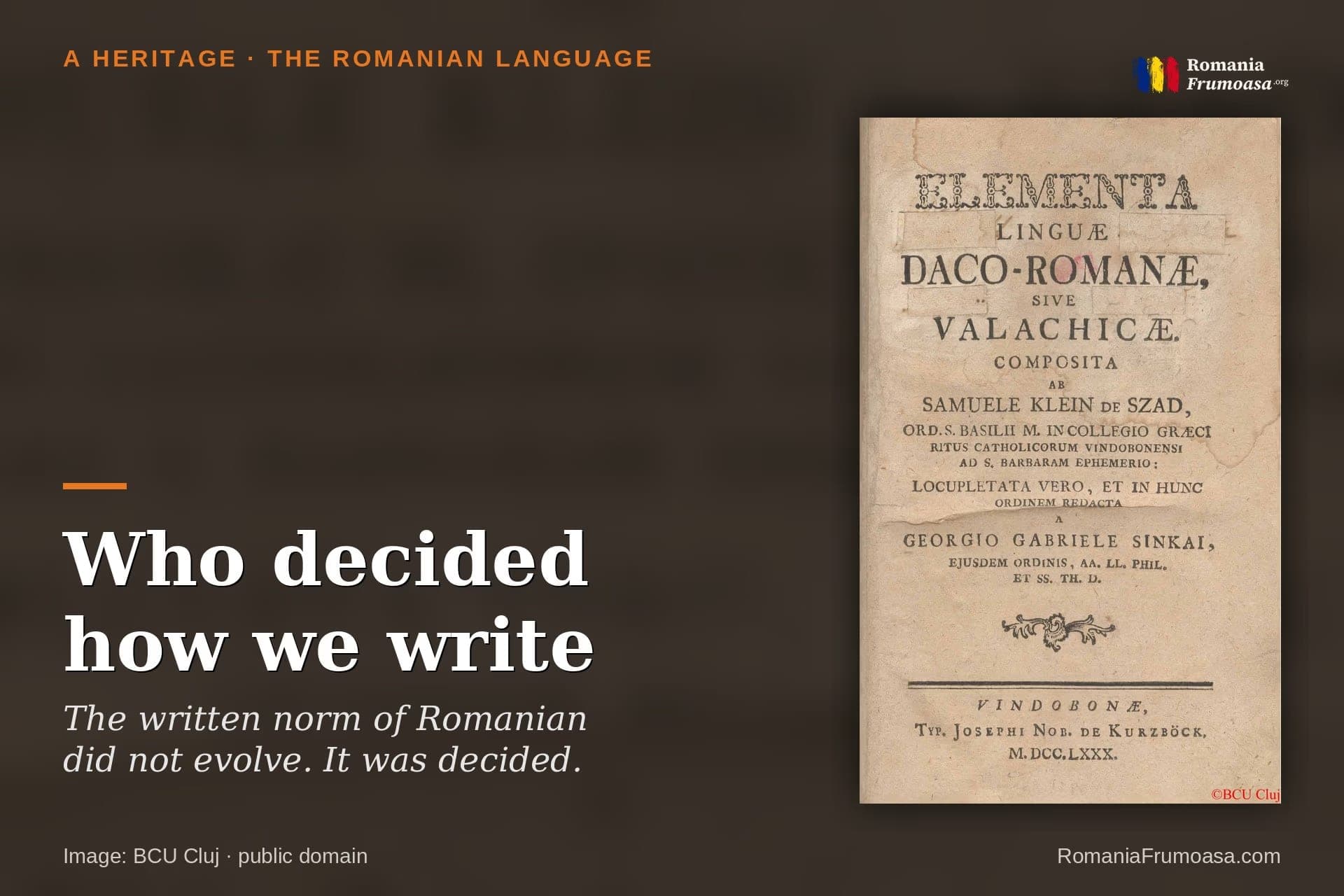
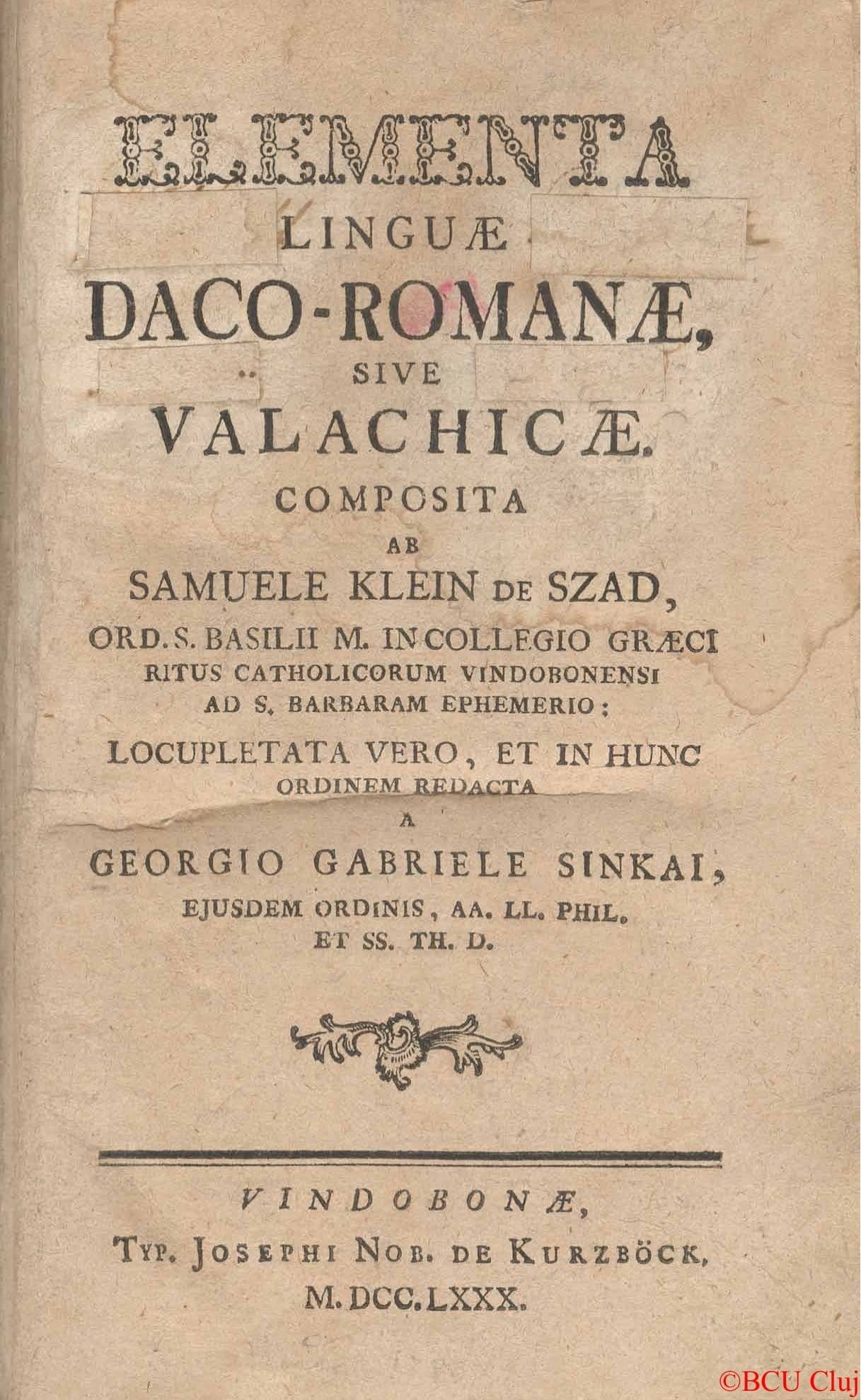
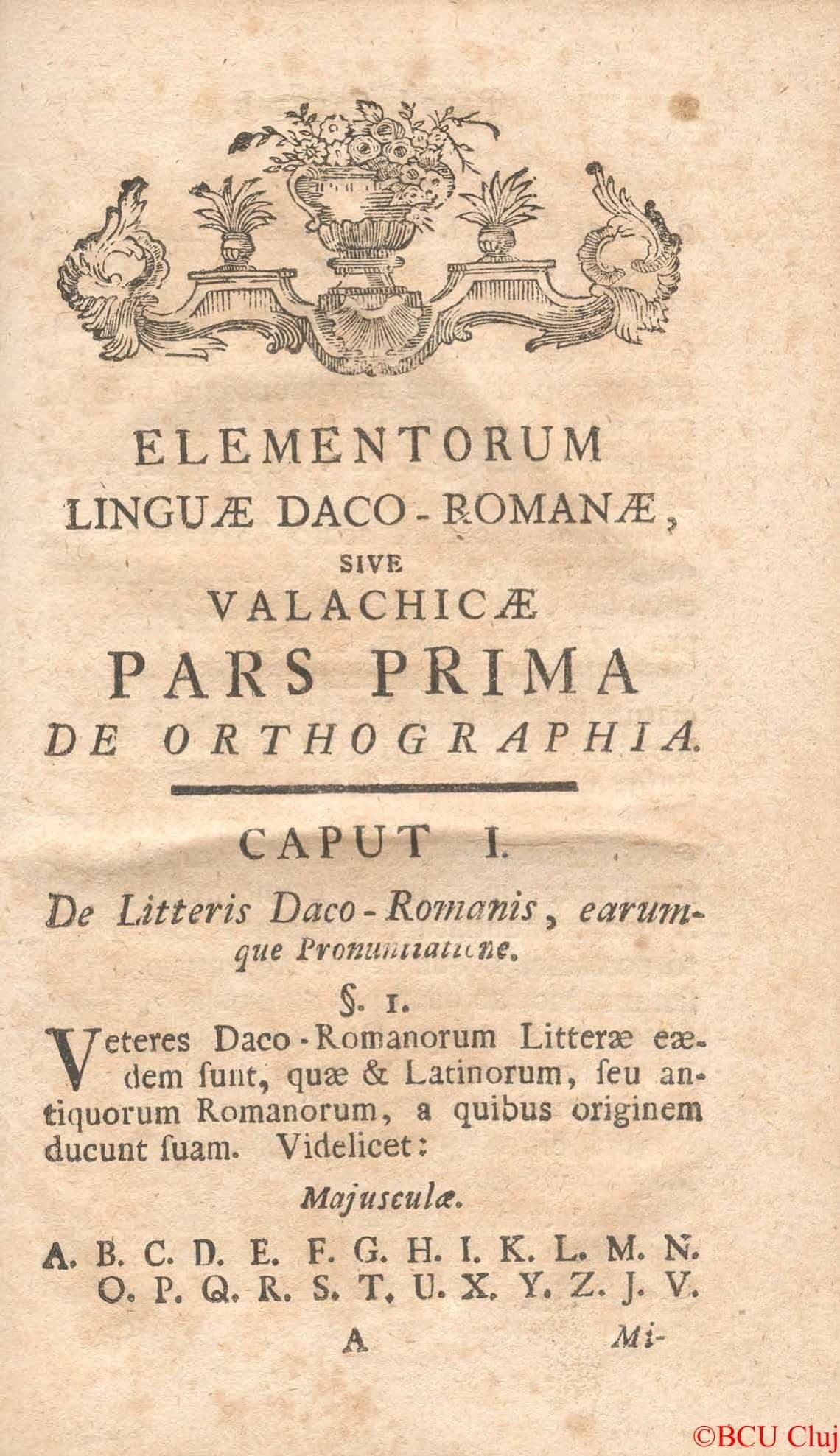
The argument from Latinity becomes a political instrument in 1780, when Samuil Micu and Gheorghe Șincai print in Vienna the first printed grammar of the Romanian language — a hundred pages, written in Latin, with a spelling built expressly to bring the origin of each word into view.
The first grammar written in Romanian was already twenty-three years old and had no printer. Dimitrie Eustatievici had finished it in 1757, in Brașov, and found no one to put it under the press. It was published in 1969, two hundred and twelve years after it was written.
Out of the same Latinist impulse comes the most spectacular failure in Romanian philology. The first Academy commissions a dictionary. August Treboniu Laurian and Ioan Massim produce it in two volumes, between 1871 and 1876, by doing something simple: they write words as they ought to have looked had Romanian remained Latin, and move whatever strikes them as un-Latin into a separate volume, a kind of lexical quarantine called the Glosar. On the title page it says, with the caution of someone who senses what is coming, „drawn up as a project". It never became the norm. The Academy passed the task on to someone else, and then to someone else again.
What remains from that century is a figure that says more than it seems to. In a comparative study of a representative vocabulary of the Romance languages, coordinated by Marius Sala, Romanian has 782 words inherited directly from Latin and only 38 that entered by the learned route — that is, taken straight from Latin by scholars. Italian, in the same corpus, has nearly twenty times as many learned words.
The language in which Latinity was discussed most, and most emotionally, has one of the thinnest layers of learned Latin in the whole Romance world. The explanation: its re-Latinisation was carried out largely through French and Italian. The words arrived by a detour.
The institution that counts them exists by decision too. The Academy was founded in April 1866 as the Romanian Literary Society, and its founding act states plainly what for: „chiefly for the compilation of a dictionary and a glossary of the Romanian language". That dictionary, actually begun in 1906 and entrusted to Sextil Pușcariu, was finished in 2010. More than a century of work, with an interruption between 1952 and 1958 which the institute records today, drily, as „for ideological reasons".
Three hundred years over one letter
The Latin alphabet did not arrive by decree, on a given day. It crept in, through mixed Cyrillic-Latin alphabets used for some thirty years in newspapers and books. It is the only large step in the history of Romanian writing that nobody decided: it happened on its own, and the ruling came afterwards, to acknowledge it.
The Romanian Academy dates the official adoption to between 1860 and 1862. The acts themselves sit in a collection of the official gazette that has never been digitised.
The first official and binding orthography is adopted by the Academy in 1881, with Titu Maiorescu playing an important part. Then comes the 1904 reform, which removes three accented letters from the alphabet and leaves standing two signs for the same sound, â and î. With a rule of distribution, and with one exception: the word „Român" — Romanian. That exception will return twice more, a century apart, and each time it will mean the same thing. Then come the philologists' congresses of the 1920s, and the reform of 1932.
Then comes 1953. The new rules are drawn up by the Academy of the Romanian People's Republic, but approved by a decision of the Council of Ministers, signed by Gheorghe Gheorghiu-Dej. There are sixteen points. The letter â disappears completely, replaced everywhere by î; for a decade the country's own name is spelled „Romînia".
But many of the other conventions established then survived into later norms and are still in use today, without anyone knowing where they come from: the hyphen in place of the apostrophe, the loss of a final unpronounced „-u", „z" instead of „s" in zbor (flight) and zgomot (noise), lower-case initials for the names of peoples, months and days, the letter „b" in septembrie and noiembrie. The 1953 decision was repealed long ago. The most contested reform in the history of the Romanian language has largely remained in Romanian spelling.
In 1965, â comes back — but only in „România" and its derivatives. The 1904 exception, for the second time.
The third time is the hall on Calea Victoriei, in February 1993, where an assembly in which most of those present were not linguists decided to return the letter to its place inside words.
What happened afterwards shows how far a decision can be from a language. The argument did not end with the vote: it went on for years, between those who adopted the Academy's recommendation and those who carried on writing in the old orthography. The clearest evidence is visible in some of the texts written about that vote. The article in which the linguist Laura Carmen Cuțitaru explains why the etymological argument does not hold is itself written, throughout, in the pre-1993 spelling. „On 17 February 1993, the Romanian Academy decided to replace the letter î with â", she writes — spelling hotărît, with î.
The norm in force today is called DOOM, the orthographic, orthoepic and morphological dictionary of Romanian. Its third edition, printed in 2021 by Univers Enciclopedic and put online by the „Iorgu Iordan – Al. Rosetti" Institute of Linguistics — the same institute whose opinion was read out in the hall in 1993, and the same one that had stopped work between 1952 and 1958 for ideological reasons. It has over 65,000 entries. It decides, at this moment, how the word you have just read is correctly spelled.
What it is called
The latest series of major decisions about the Romanian language is not about how it is written, but about what it is called. And unlike all the others, it was not taken in Romania.
The Constitution of the Republic of Moldova, adopted in 1994, stated that the state language was „the Moldovan language". The Academy of Sciences in Chișinău twice asked for something else in those years, stating that the correct name of the official language is „the Romanian language". In 1995 the Constitutional Court gave a favourable opinion on a presidential initiative to change the article. Parliament did not act on it.
In December 2013, the same Court solved the problem by a detour. The operative part of its ruling does not contain the phrase „the Romanian language". It contains something else: that the 1991 Declaration of Independence forms a single body with the Constitution, that it is primary constitutional text, and that in case of divergence it prevails. And the Declaration of Independence says „the Romanian language". The Court did not rename the language. It established which text carries more weight.
The law that actually made the change throughout the legislation came in March 2023. A year later, the Constitutional Court struck down a single article of it — the one by which the legislature had assumed the right to declare that a phrase in the Constitution had fallen out of use. As for the rest, including the article replacing „the Moldovan language" with „the Romanian language", the challenge was declared inadmissible: it was not examined on the merits. That article remained standing.
A year after the law came into force, in April 2024, the Republic of Moldova counted its people. The census questionnaire offered both options under mother tongue. The final results, published in October last year, read as follows: 48.1 per cent of inhabitants wrote „Moldovan". 31.8 per cent wrote „Romanian".
What the figures say, in the comparison drawn by the National Bureau of Statistics itself with the census of ten years earlier, is that „Moldovan" lost 7.4 percentage points and „Romanian" gained 9.2. What they also say is that the state unified the name in law, and people went on answering with whatever each of them knew.
Then came Ukraine's turn — and it came quickly.
On 3 December 2025, the Verkhovna Rada adopted law 4699-IX, amending the list of languages protected under the European Charter for Regional or Minority Languages. Romanian goes onto the list. „The Moldovan language", a term left over from Soviet nomenclature, comes off it. The law was signed into force on 12 June 2026 and took effect the following day.
Three months before it was promulgated, on 12 March 2026, Volodymyr Zelensky had signed decree 235/2026 and announced it in Bucharest, at a joint press conference with President Nicușor Dan: Ukraine establishes a Day of the Romanian Language, to be marked annually on 31 August.
The date is not arbitrary. 31 August is the day on which the Republic of Moldova has celebrated its language since 1990, and Romania has marked it officially since 2013, when law 53/2013 was passed. Even the celebration was established by legal act, in all three countries. Today is the first day on which it is held simultaneously.
Ukraine has not counted its people since 2001. At that census, „Romanian" and „Moldovan" were two separate boxes, and the result, read region by region, says on its own how little the name of a language has to do with a piece of legislation. In the Chernivtsi region, 114,555 people declared themselves Romanians and 67,225 Moldovans. Two hundred kilometres away, in the Odesa region, the same language was declared by 123,751 Moldovans and by 724 Romanians.
There are four ways of deciding what we speak: a vote in a hall, a decree signed at a press conference, an article of law, and a line filled in on a form, hundreds of thousands of times, by people who never consulted one another.
In Chernivtsi, the celebration lasted three days and ended today, at the National Palace of the Romanians. The writer Maria Toacă-Andrieș, who has been writing in Romanian in northern Bukovina for several decades, told G4Media two things, one after the other. First: „We have been celebrating it for 37 years." Then, about the decree and the officials who had come to honour it: „Perhaps it gives Romanians a gram of pride, nothing more."
And, looking around the hall: „You saw that a great many came. But did they come simply out of love, for us… or out of duty?"
Research carried out in August 2026, largely on primary and official sources — Romanian, Moldovan and Ukrainian legal acts, library catalogues, census data and digitised editions of the old texts — supplemented by academic literature, cited in the list below. The information on the switch to the Latin alphabet, in 1860–1862, rests on the chronology published by the Romanian Academy; the acts themselves are held in the Monitorul Oficial collection of the National Library of Romania, for which no digitised edition was found. The account of the session of 17 February 1993 is based on the published testimony of the academician Radu Voinea; the named minutes of the session are not public, and some later accounts reverse the votes of the two linguists or mention only one linguist present. The statements from Chernivtsi are taken from the G4Media report published on 31 August 2026, the only source for them.