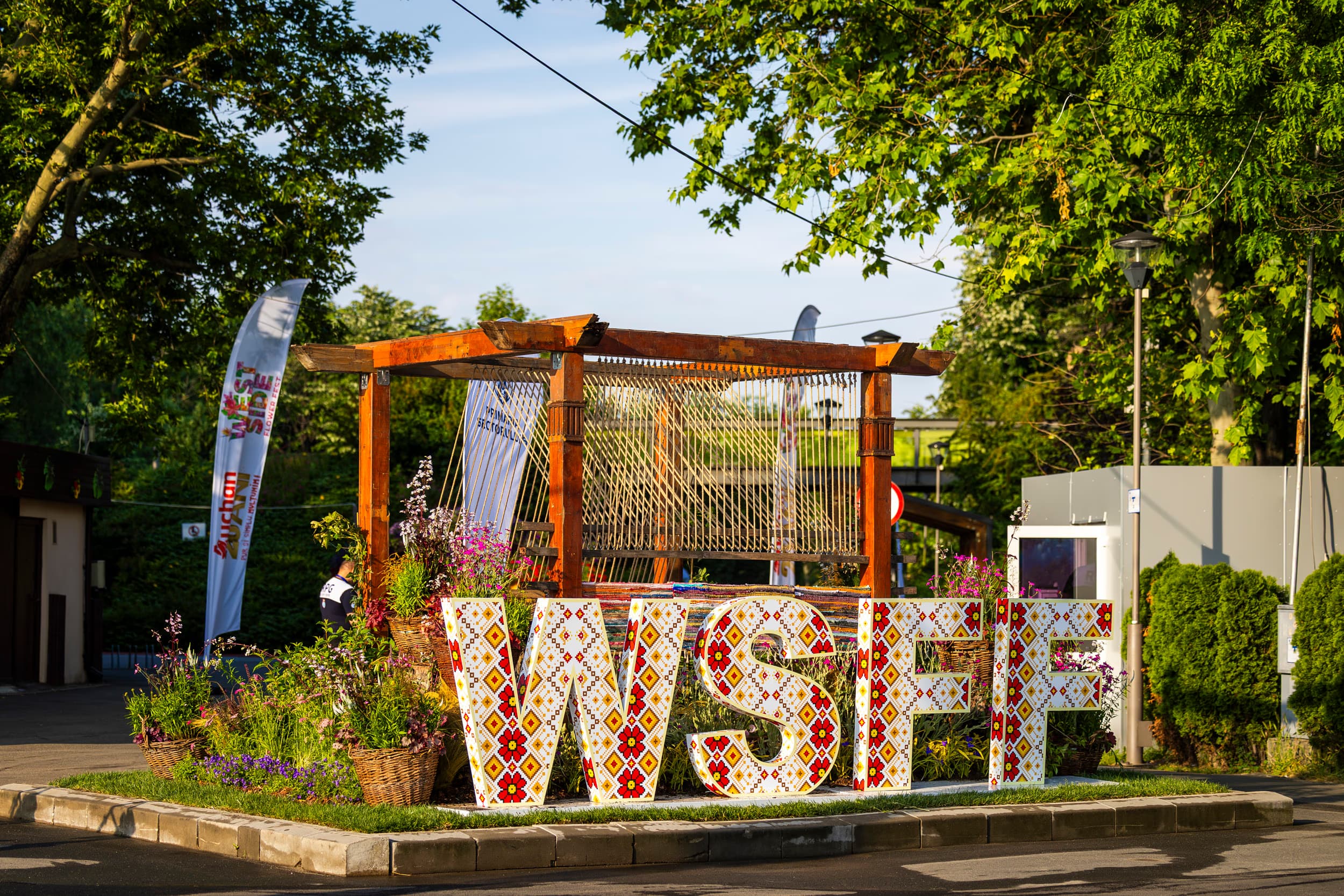
Drumul Taberei, at seven in the morning
The fourth edition of the Flower Festival transforms, for a few days, the park between the ten-story apartment blocks into a different kind of neighborhood. I arrived at the crack of dawn, when even the park had not yet woken up.
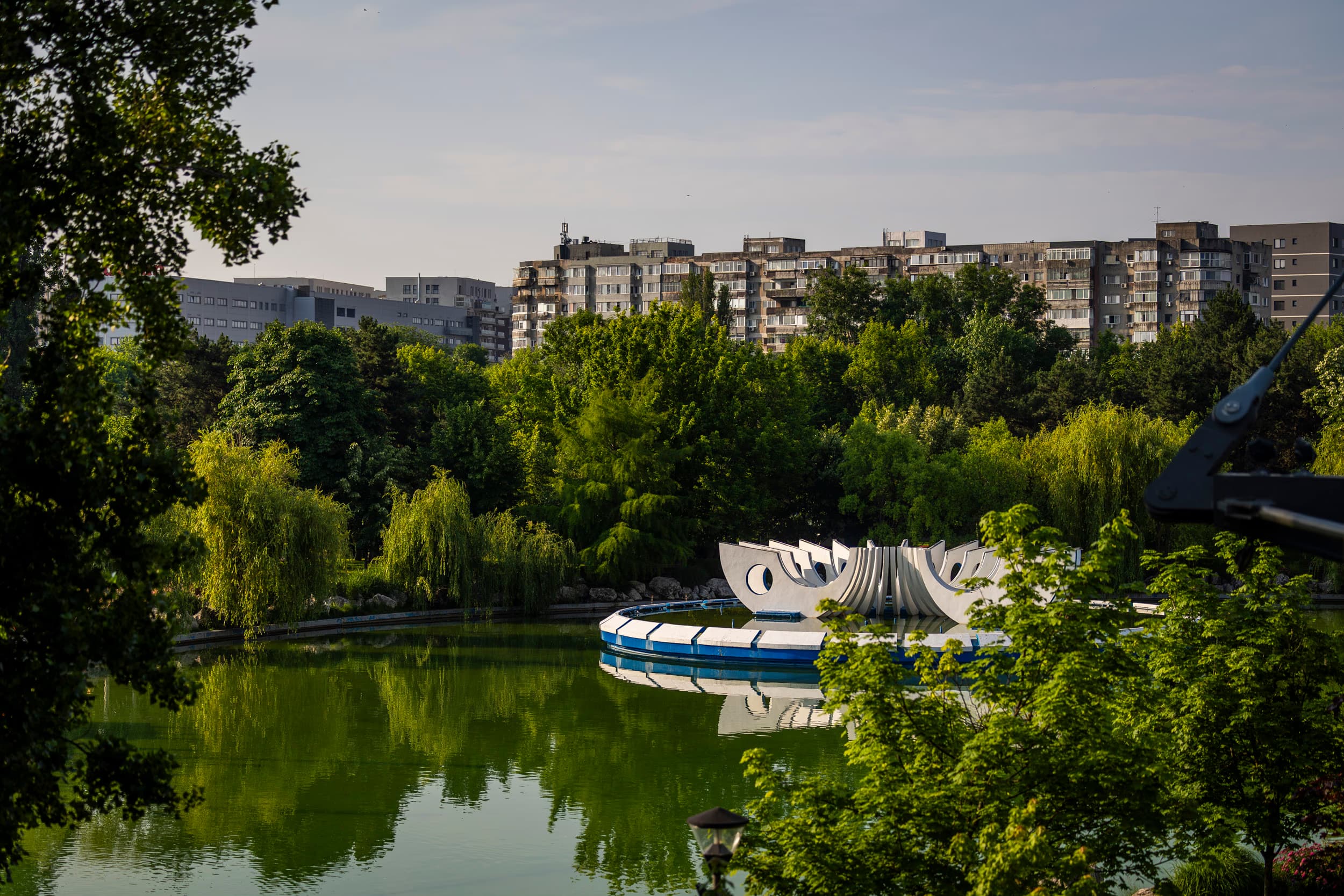
The park, the lake, and the apartment blocks. The festival takes place among them.
I arrived at a quarter to seven. The air was cool, though it was shaping up to be a very warm day — that gentle June heat that doesn't bear down on you but simply keeps you company. At seven, though, it wasn't there yet. Only the light. The low-angled morning light of June that, in the first fifteen minutes, turns any neighborhood into a place that seems to belong somewhere else entirely.
At the entrance to the park, flowers in the shape of S6. For Sector 6. It's a kind of local pride that, if you're an outsider like me, makes you smile. Behind the letters, the ten-story apartment blocks have been standing for fifty years. White. Yellow. Anthracite. A mix of colors left over from different eras. Their flat facades, with balconies barely wide enough to stand on, looked just as they had in winter. Only now, beneath them, flowers were growing.
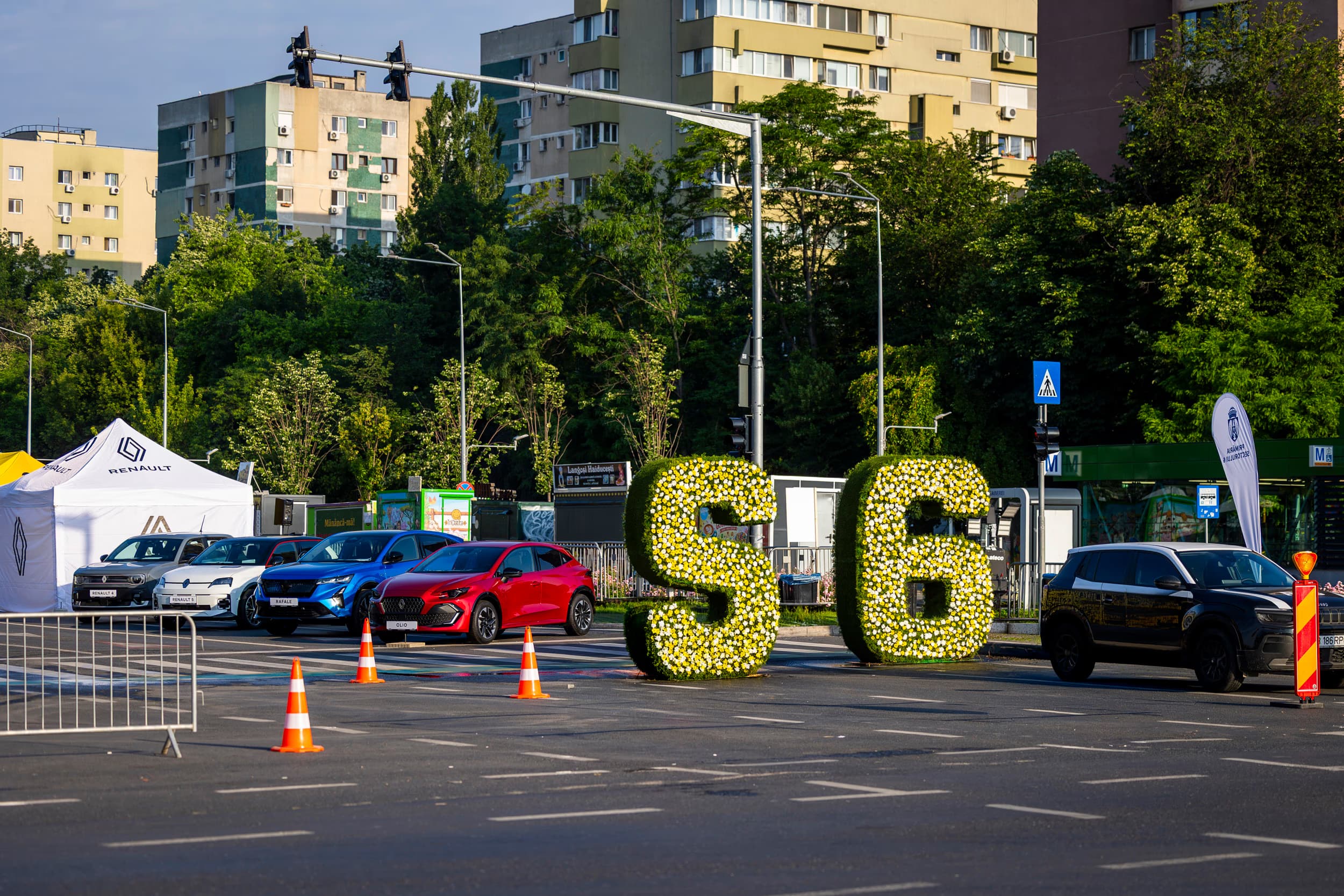
It's a district event, but one that draws crowds from across Bucharest. By evening you can barely move. Unfortunately, most people come by car rather than public transport, even though the park is reasonably well connected — both by tram and by metro.
The park, in brief
The park was laid out in the 1960s, together with the neighbourhood. At the time it served a population of sixty thousand people — a figure that seems unrealistic today, but was accurate. It was named Alexandru Moghioroș, after a Communist deputy prime minister in Chivu Stoica's government.
In '76 they dug a lido with three pools, which locals nicknamedTrei Ligheane — the Three Washbasins.Officially, two thousand five hundred people cooled off here. Unofficially, far more. The excavated earth became an artificial hill in the southern part of the park. After '89, the name was changed. It became Parcul Drumul Taberei.
In 2013 it underwent renovation. The work lasted two years, cost nearly 75 million lei, and was covered in the press at the time more for its controversies than its results. In 2018, another twelve million came in for further repairs. In October 2019, the seven greenhouse pavilions housing tropical plants were completed — one thousand three hundred and fifty square metres divided into seven themed rooms.
Today, around seven in the morning on a June day, Parcul Drumul Taberei is — without any exaggeration — one of the most beautiful parks in Bucharest.
That is what I came to see.
"The Bride and Groom Who Never Existed"
In a corner of the park, beneath a bridal arch made of Spanish moss and white roses, stood four mannequins.
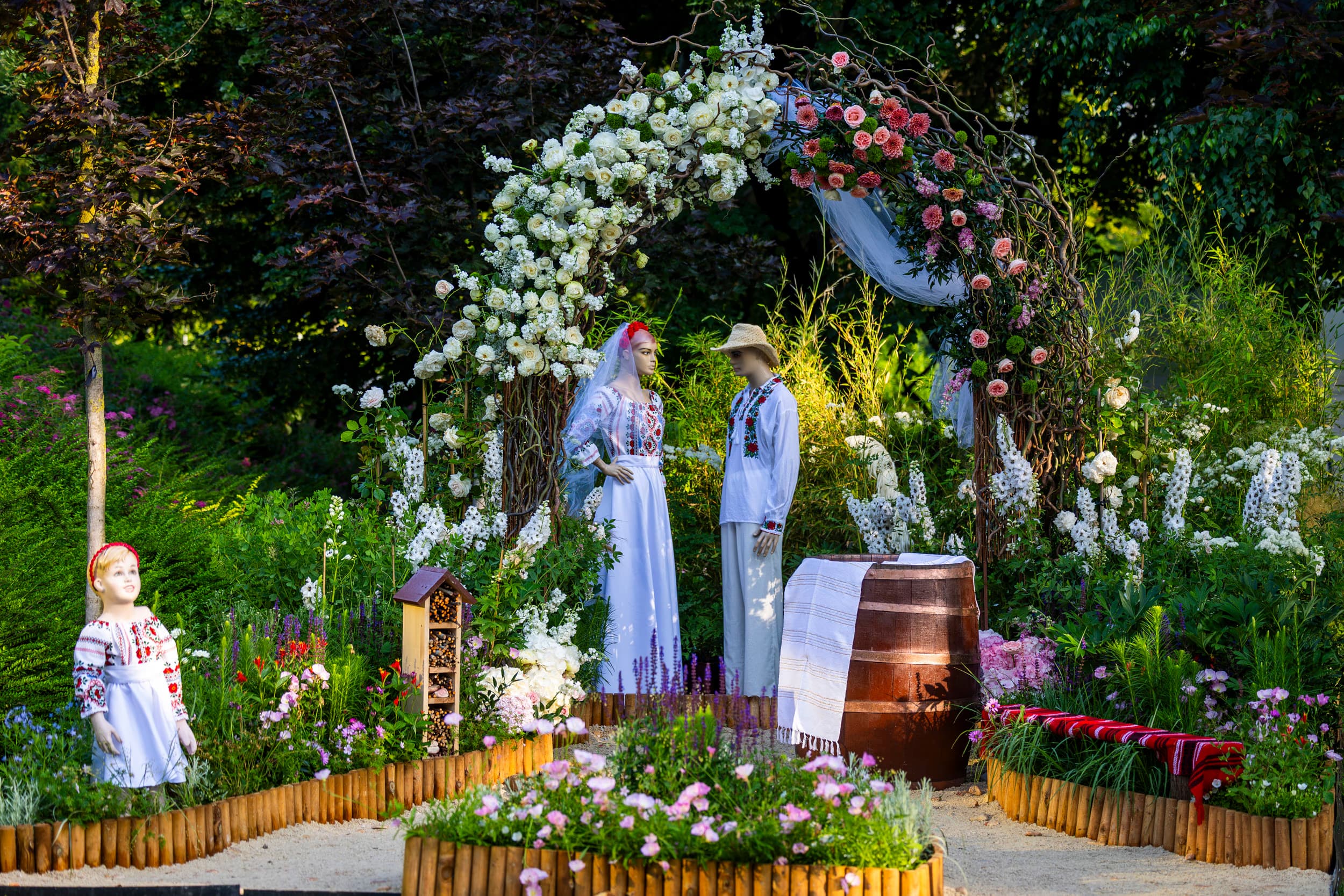
A man and a woman in folk costume — two plastic newlyweds who never married. He wore a straw hat. She had flowers in her hair. Their gazes were locked on each other, slightly melancholic, without touching. At their feet, a copper barrel. Lavender. White tulips that were out of season and yet here, perfect.
I stared at it a few seconds longer than I meant to.
The feeling it triggered wasn't nostalgia — I've never been to a wedding in folk costume. It was something else. It was the idea that someone, probably an entire team, had spent hours arranging every flower in its place for a ceremony that would never take place.
They had reconstructed a presumed ritual.
Beside me, a city worker in a high-visibility vest was watering a lavender border behind the installation. He didn't notice me. Only the flowers he was watering looked back.
I looked at the groom. I looked at the bride. I left.
The Little Ewes (Miorițele)
I had walked a hundred meters and was in another world.
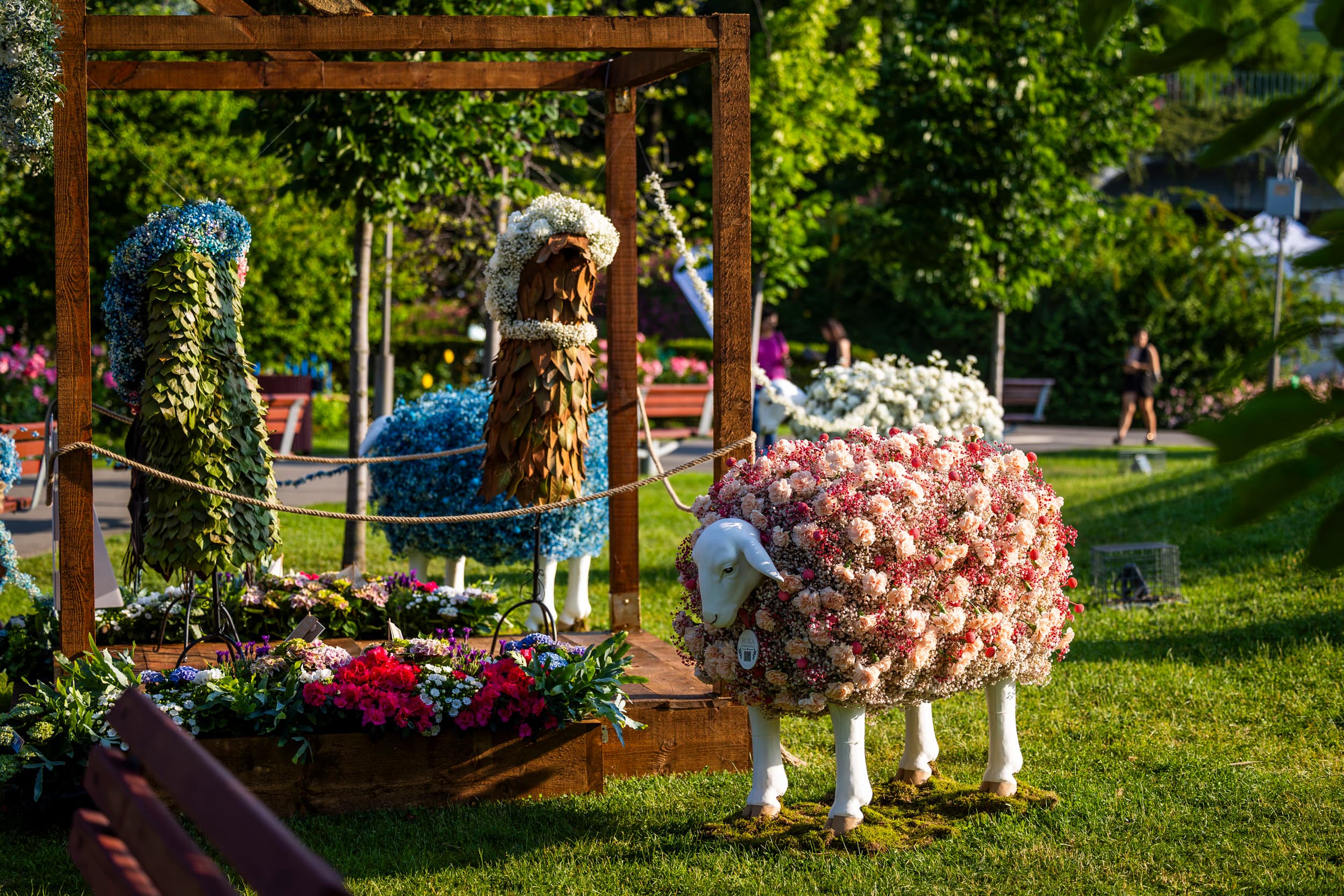
A few sheep made of flowers. Two were made of wheat stalks. One, of pink and white roses. They stood in the grass, side by side, like a real flock that had stopped to graze. They were absurd. And yet, when I drew closer, I had the strange feeling they were about to wag their tails.
Further on, a peacock made of blue mosaic — a metal sculpture — perched on a trunk of ivy that rose from the ground like a long, sinuous, vegetal wave out of a Brothers Grimm story.
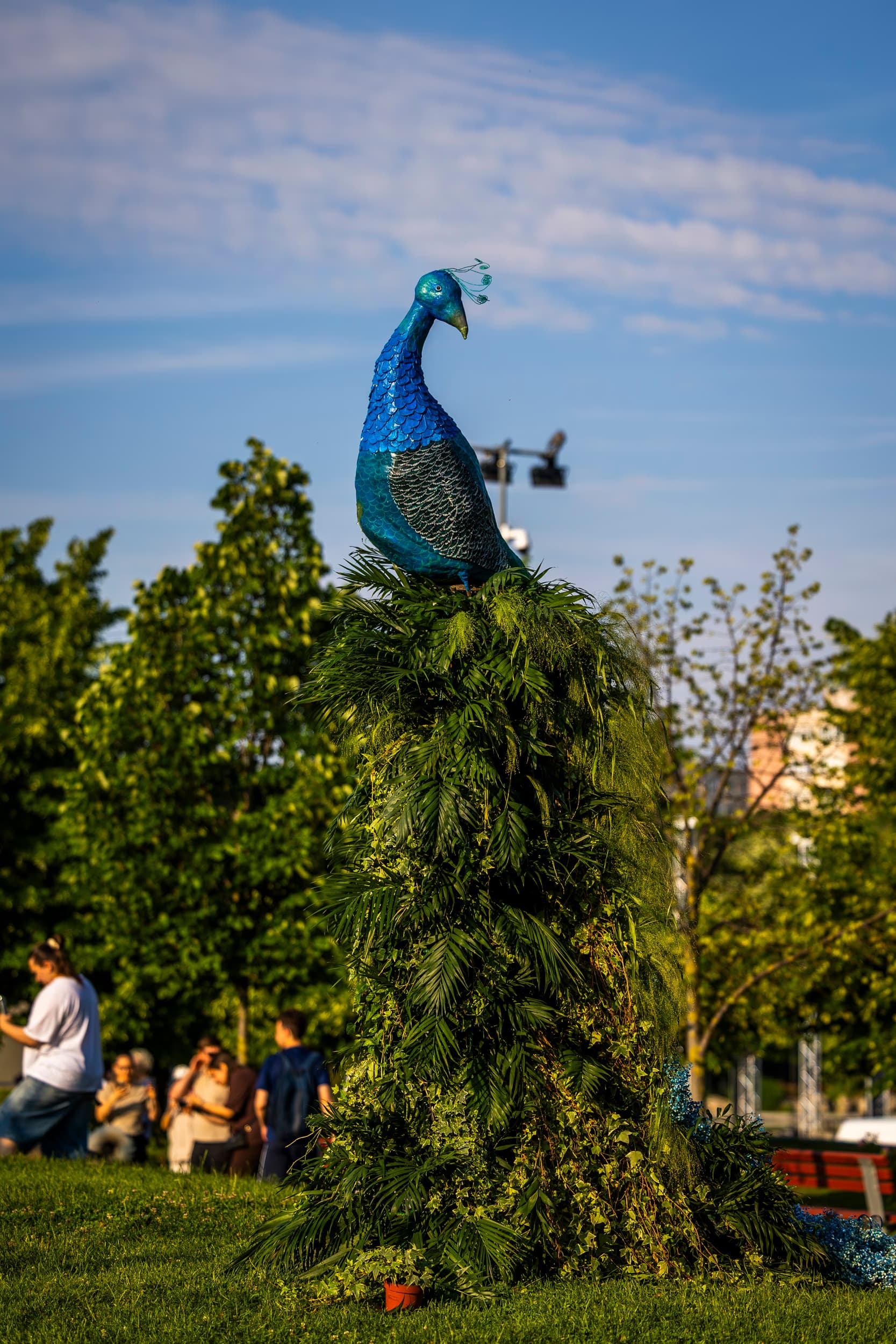
Around it, a few people who had also come out that morning were taking photos. A woman alone, in a tracksuit, paused her run to look at the sculpture for five seconds before heading on her way.
That is the festival's currency, in the morning — a woman who runs, stops, looks, and moves on. She didn't take a photo. She didn't take out her phone. She just stood five seconds beside the peacock, then continued.
It is strange the way a park surrounded by ten-story apartment blocks, with worn playground equipment and broken benches, can become — for three days — a place where a person running at seven in the morning stops to rest their eyes on a peacock sculpture.
That kind of silence is not something you often hear in Drumul Taberei.
The ribbon pole
And then there was the circle.
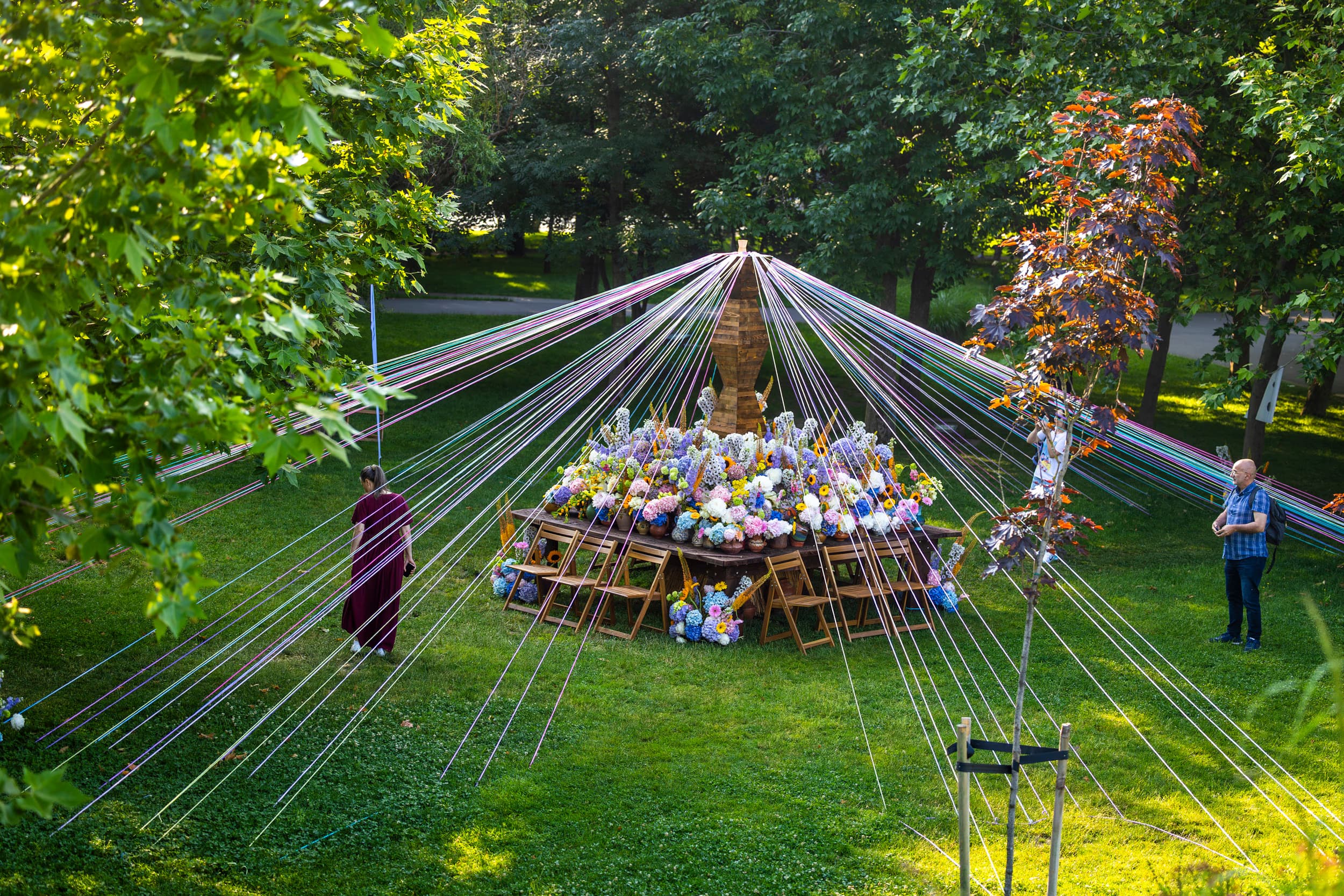
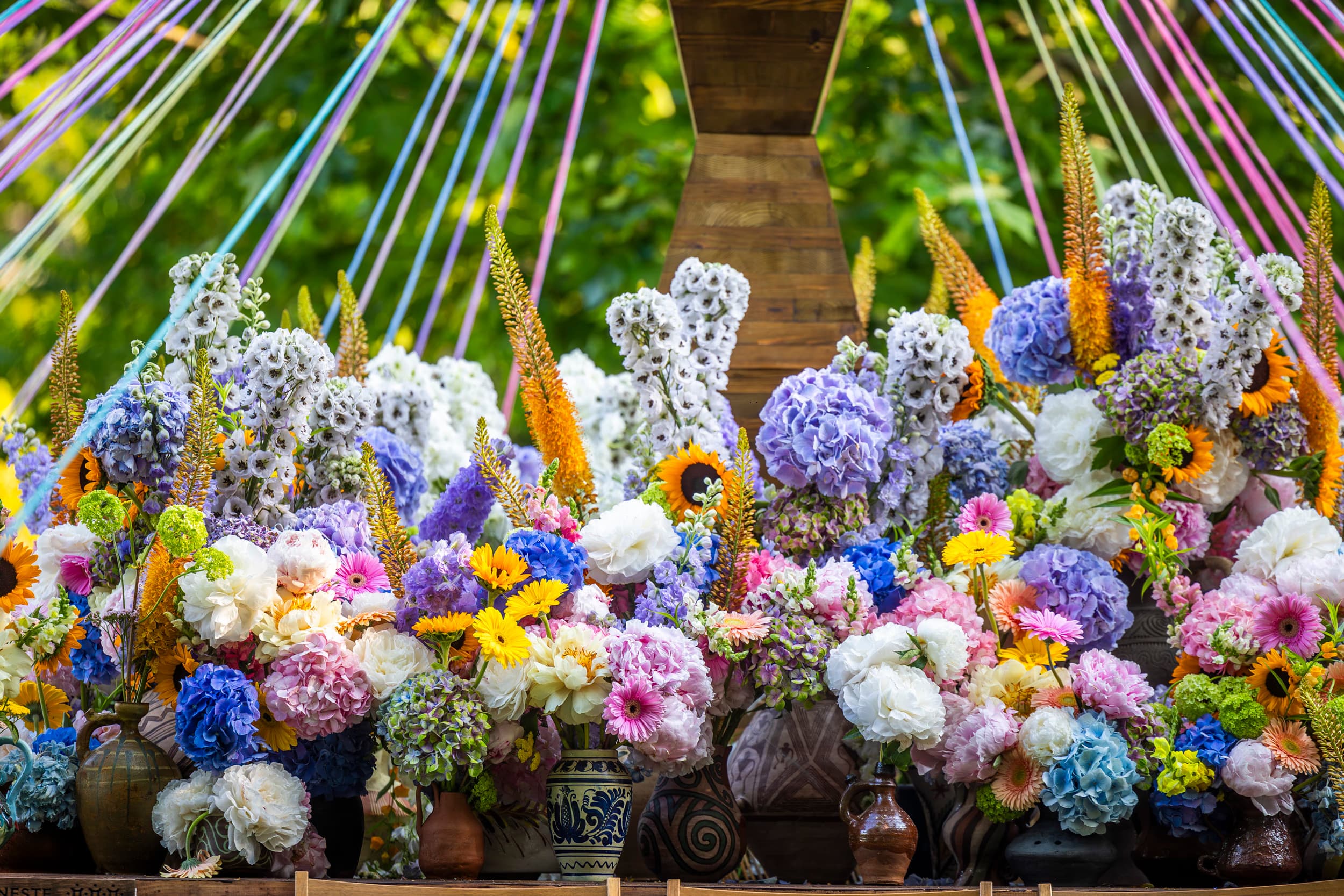
In the middle of the lawn, a pole like a section of the Column of Infinity— with dozens of colored ribbons spiraling down and anchored, at ground level, in a vast mass of flowers. Hydrangeas. Gerbera. Thistles. Lavender. Roses. All mixed together, without order — and yet with a logic you don't see right away.
It was a May pole. A maypole. A ritual from pre-Christian Europe that, this year, in 2026, in the middle of the concrete blocks of Sector 6, stood there almost alone. At seven in the morning, only a handful of people had come to look at it. A light wind moved the ribbons against each other, making them touch, briefly, without a sound.
I stopped.
I looked at the ribbons. I looked at the flowers at the base — so many, so close together, that I was tempted to lean down and take one. I didn't. I thought that if every person who passed by here today took one, within an hour there would be nothing left.
That is what holds everything together. The unspoken understanding that it belongs to all of us, without belonging to any one of us.
The Bridge
Around eight or so, the sun had climbed just enough to warm the air, but the light was still soft rather than harsh. I had finished my short loop and was making my way back toward the main entrance. I approached the glass bridge — the new cable-suspended bridge connecting the two banks of the lake.
On it, a single woman. She walked slowly, her back to me. She carried a small backpack. Her gaze was fixed somewhere in the distance, toward the far bank, where the long apartment block of the neighborhood came into view.
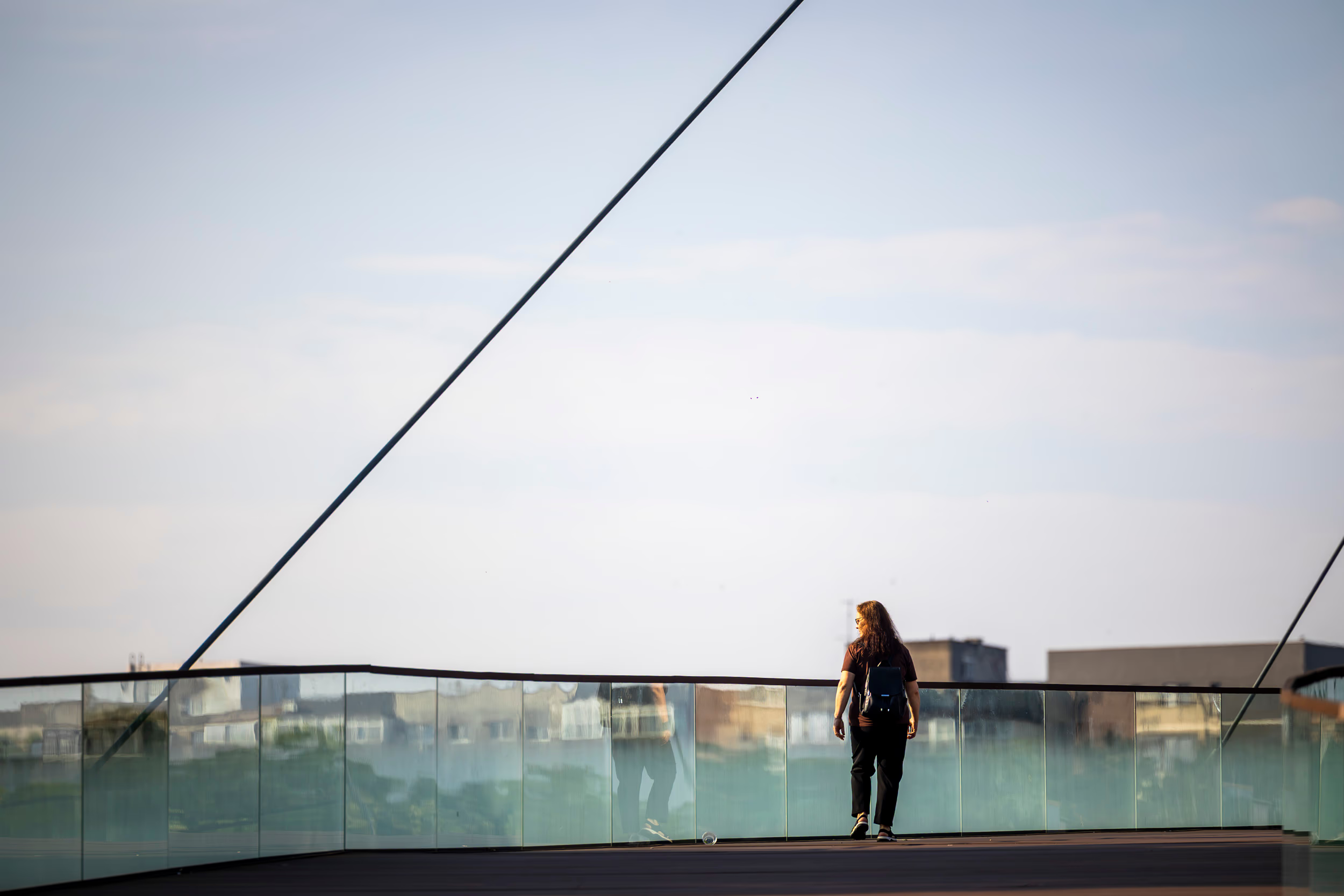
I didn't know her. I never will. But for two minutes, her path was mine as well. And I understood — without asking myself anything complicated — that this was the thing. Not the bride and groom. Not the sheep. Not the peacock. Not the ribbon-wrapped pillar.
It was the way in which, for three days, the sixth district paused the daily rhythm of Bucharest and its people for an hour — and offered someone a June morning in which to walk slowly, alone, across a lake, with the cool early light on their face.
This is the Flower Festival (Festivalul Florilor).
Behind me, somewhere between the sheep and the peacock, I heard hurried footsteps — another staff member coming with a wheelbarrow of soil, while a woman was taking photos of herself dancing on the flower bridge. Day two was beginning. Within a few hours, the park would be full again — with people, children, dogs, and phones taking pictures.
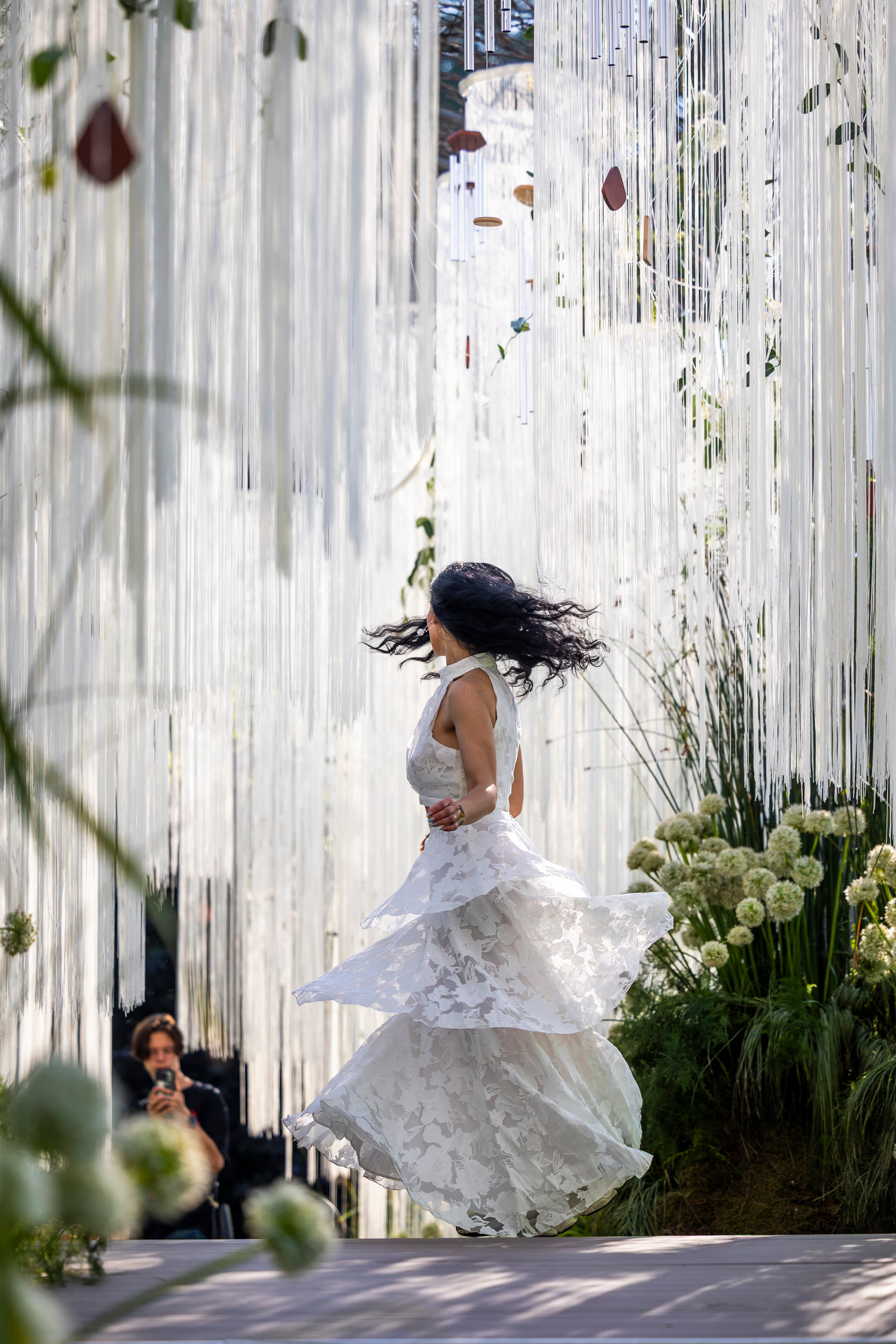
At seven in the morning, the park belonged to me and a handful of other early risers.
And, by extension, to every person who would come later and remember — from now until next June — that for one week in 2026, someone sat and arranged flowers on an artificial hill dug in 1976, just to make their neighborhood a little more beautiful.
Reportage by Adi Coco · RomâniaFrumoasă · The Flower Festival, Drumul Taberei, București, 6 June 2026.
 1 / 26