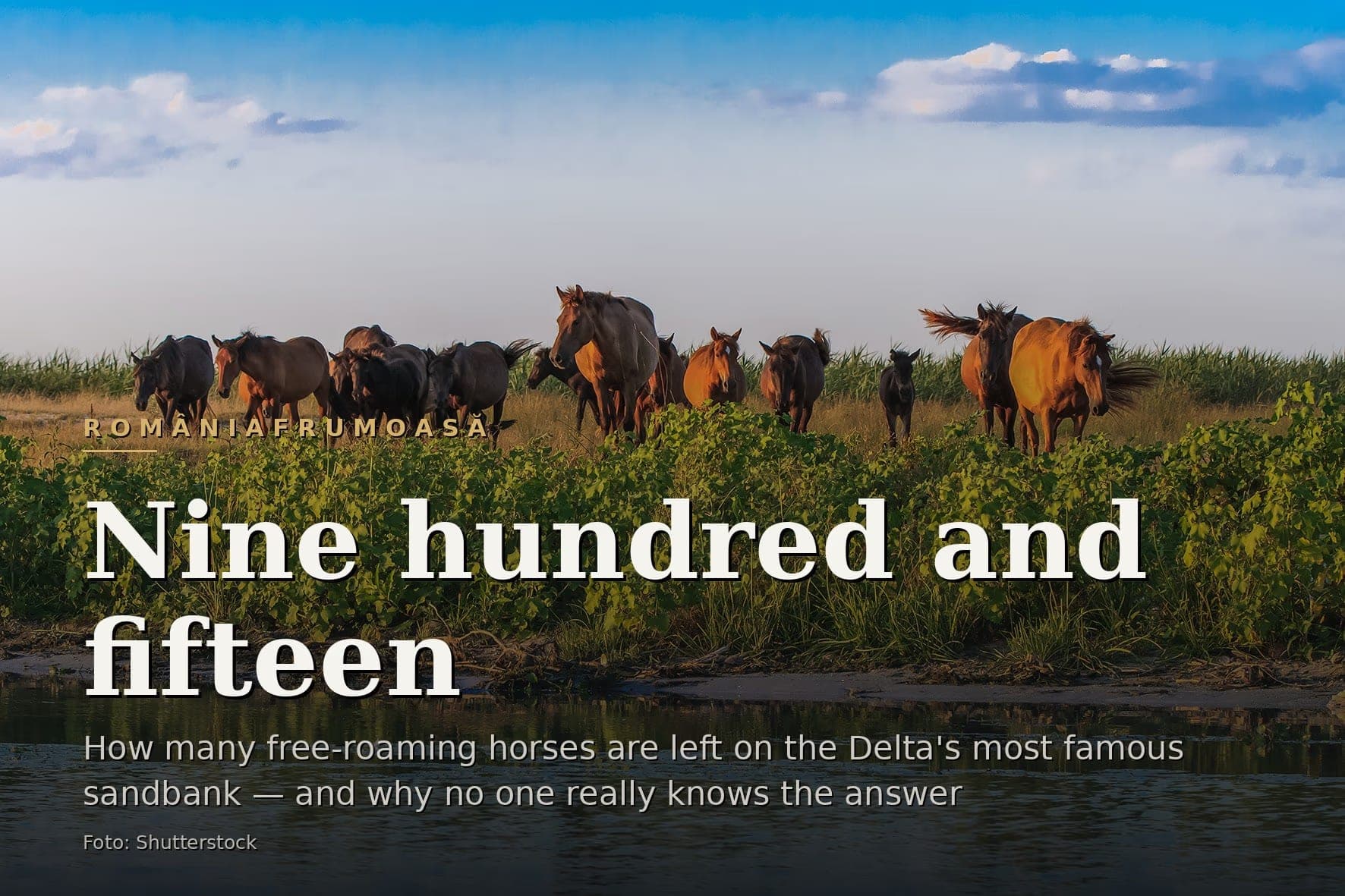
The first time you see the Letea horses, you realise you've been using the wrong word. You'd called them "wild" for years, like everyone else, but the animal that lifts its head out of the reeds and holds your gaze has none of the fear of creatures that keep out of human sight. It sizes you up. It is sturdy, short — a metre and a half at the withers — with a black or chestnut coat and the calm eye of an animal that remembers, somewhere deep in the bone, that its ancestors pulled a harness. It is not a wild horse. It is a horse that once belonged to someone and has forgotten.
That is the first correction the subject demands, and the most important. The second is a number.
The number that didn't exist
Until February 2023, no one knew how many horses lived free in the Danube Delta. Numbers were quoted — two thousand, three thousand, four thousand — with the confidence people reserve for things no one can check. The veterinarian Ovidiu Roșu, who ran the population-management programme for years, summed up the era bluntly: the total was "a matter of speculation, somewhere between 2,000 and 4,000."
Then the Danube Delta Biosphere Reserve Administration chartered a helicopter. Over six and a half hours, across 839 kilometres and sixteen survey zones, a team counted the Delta's horses one by one. The result demolished the mythology: 1,926 horses in the whole reserve. Not four thousand. Not even two. And on Letea sandbank, the most populous area — 915 animals.
That number, 915, is the anchor of any serious discussion of Letea. Not because it is final — the census dates from 2023, and since 2019, when the flyover had found 444 horses on the same sandbank, the population had doubled. But because it is the first number that was measured, not assumed. Everything said before it — including the famous 2010 estimate from The Guardian, "four thousand in the Delta, two thousand at Letea" — was, in effect, a guess.
Here comes the third trap, the one most articles fall into. "At Letea" means three different things. There is Letea Forest proper, the strictly protected reserve since 1938 — the second protected area in Romania, after Retezat — a perimeter of roughly 2,800 hectares ringed by a double fence. There is Letea sandbank, the much larger stretch of sand and dunes around it, where the 915 live. And there is the whole Delta, with nearly 2,000. When someone tells you "two thousand horses at Letea," they are, in fact, mistaking the map for the territory.
Where they come from
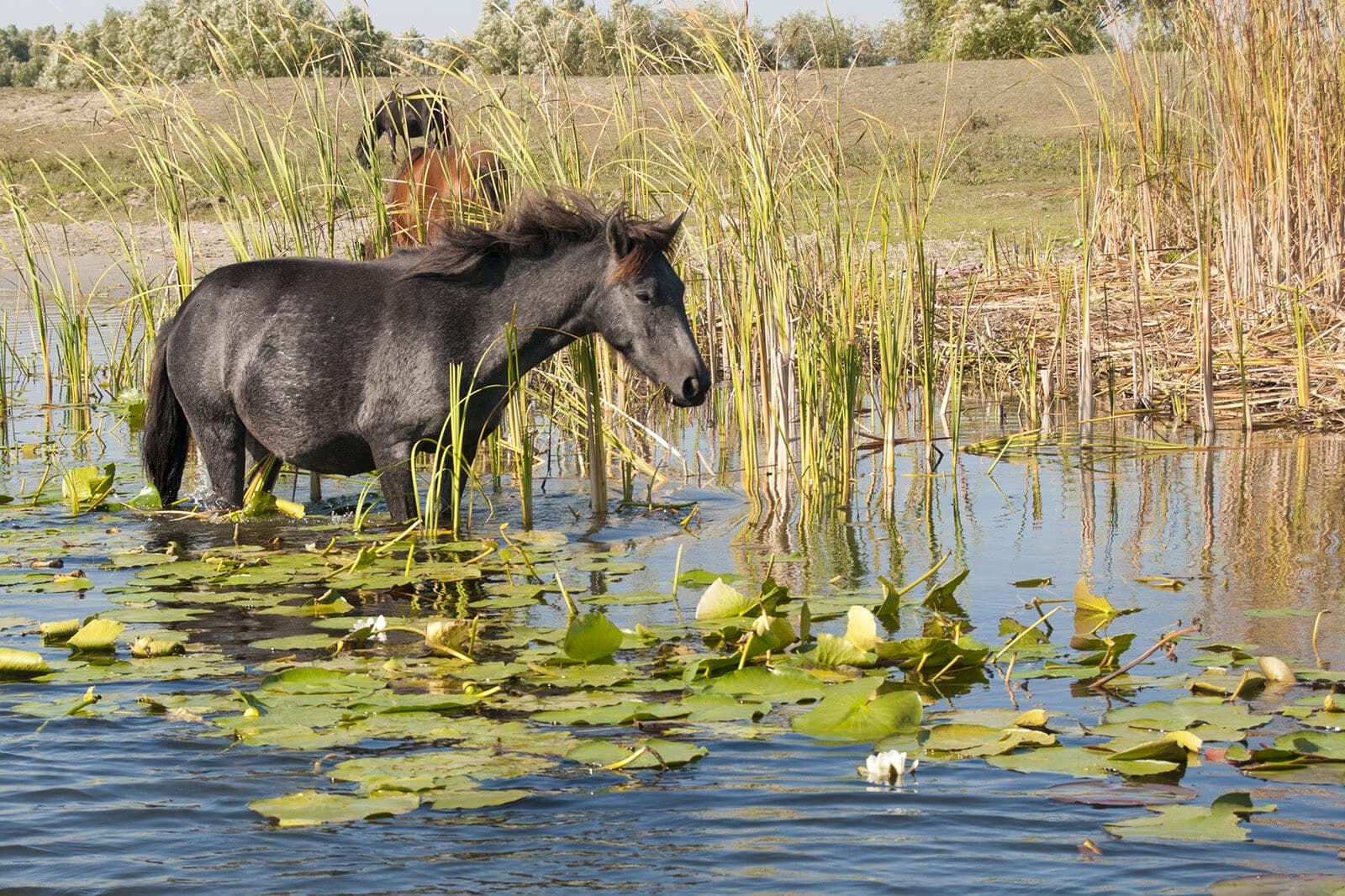
The story of their origin is usually told in two ways: a beautiful one and a true one. Both are in circulation, and the difference between them is worth keeping.
The beautiful one is the Tatar legend — the horses supposedly descend from war stallions left in Budjak seven or eight hundred years ago. It is a seductive narrative, repeated in tourist leaflets and even in the communications of some animal-protection organisations, but it has neither a document nor a study behind it. It is marketing.
The true one is less romantic and more interesting. Today's horses are the product of two overlaid layers. One is old: a population of free horses has existed in the steppe north of the Delta for centuries — Dimitrie Cantemir himself mentioned wild horses in the Budjak region in his Description of Moldavia, around 1716. The other is recent and decisive: after 1989–1990, when the agricultural collectives and state farms were dissolved, thousands of workhorses were suddenly left without owners. People could no longer keep them and set them loose. The phenomenon was compounded by equine infectious anaemia, an endemic and incurable disease that, once diagnosed, blocked the animals from being removed out of quarantine — so many horses simply stayed where they were.
It is worth stating plainly, because it is so often written wrong: there is no documented stud farm or specific farm as the "source" of the horses. Serious sources speak generically of collective and state farms. The detail about a farm at Sfântu Gheorghe struck by foot-and-mouth disease in the 1980s appears only in travel blogs, not in rigorous journalism. And to this day there is no genetic origin study establishing the "breed" of these horses. What is known is simple morphology: they resemble the draught horses of central and eastern Europe, not any old wild breed. They are, in technical terms, feral — domestic animals returned to the wild. They are not Przewalski's horses. They are new.
May 2011, the road to the abattoir
All of today's international affection for the Delta's horses was born of a single ugly week.
In May 2011, under pressure from the mayor's office of C.A. Rosetti commune, the forestry directorate and the reserve administration, locals paid around a hundred lei a head rounded up more than seventy horses into a pen. A commune official, Aurel Cârlan, would utter a line that went around the world: "They're very beautiful, but… what we wanted, with these actions, was to send them to meat."
On 20 May, a lorry left C.A. Rosetti for an abattoir in Sfântu Gheorghe, Covasna county — the meat, it was said at the time, destined for export. On board, 49 horses; nineteen of them had tested positive for infectious anaemia and were, by law, to be compulsorily slaughtered. The next day the transport was stopped at Ianca, in Brăila, by the Austrian organisation Four Paws (Vier Pfoten) and the traffic police. Two horses had already died on the way. More than forty were saved, taken to a farm at Urleasca, cared for for half a year and returned to the Delta.
Here honesty is needed in both directions. The disease was real — not an invented pretext. But the May 2011 operation was not a sanitary campaign; it was a commercial round-up onto which the testing was conveniently grafted. The anaemia functioned, in equal measure, as legal justification and, at other moments, as the barrier that blocked the horses from being removed. The truth is prosaic: a real disease, used for an action with a commercial motive.
One last clarification, because the figures get mixed up: the numbers of "two hundred," "two hundred and fifty" horses that are sometimes attached to 2011 refer, in fact, to a separate incident, in 2022. In 2011, there were 49 on the lorry.
The vaccine that wasn't enough
Out of that crisis came the most civilised idea in the whole story. In November 2013, after more than two years of negotiations with the authorities, Four Paws and the ARCA association launched a contraception-by-immunisation programme — a vaccine called pZP, fired with a veterinary dart gun into the mares, which prevents them from breeding for about a year. It was the first programme of its kind applied to free-living animals in Europe. Pilot phase: fifteen mares. Target: one hundred, by the following spring.
The programme ran for years, with hundreds of cumulative immunisations. And yet, look at the figures: 444 horses on Letea sandbank in 2019, 915 in 2023. Contraception did not stop the growth. A free population, without predators — the wolf vanished from the area long ago — and with a single hard winter every few years proves harder to regulate than it seemed. In 2025, after more than a decade, Four Paws handed the programme over to the Romanian authorities. What comes next under the state's administration remains, for now, uncertain.
An animal that is "up in the air"
The question that blocks everything is not ecological. It is legal. Whose is the horse?
The official answer, repeated by the Delta administration, is that these horses are not protected wildlife but abandoned domestic animals. The reserve's governor, Bogdan Bulete, put it plainly: "There are no wild horses. They are horses that have owners or had owners and were abandoned by them." The consequence is brutal in its simplicity: the ordinance that protects wild species in natural areas — forbidding their capture or killing — does not apply to them, because a domestic horse does not figure in those annexes. And the animal-protection law shields them only from cruelty and from killing without cause.
The result is a vacuum. The ARCA representative, Kuki Bărbuceanu, put it memorably: the horses "are considered neither wild animals nor domestic ones. So they are up in the air." For foals born free to abandoned parents, there is neither owner nor management regime nor clear responsibility. The reserve administration is responsible for the habitat, but does not own the horses. The town halls answer for the pastures and for the locals' animals. The forestry directorate, for the forest. The veterinary authorities, for microchipping and disease. And for the horse, as such — no one.
That vacuum produced, in 2023, the most unsettling scene of the story. When the veterinary authorities proposed microchipping the nearly two thousand horses, the idea seemed a simple administrative formality. But a trader, Nicolae Godea, had already "bought," by notarial contract, 368 wild horses "and all their descendants." In a world where the horses are marked and reclaimable, such a deed could turn into a mass death sentence at the abattoir. That is why the organisations opposed microchipping with a vehemence that, from the outside, looks disproportionate. From the inside, it is the logic of survival.
The forest versus the horses
And yet the ecologists are not wrong. This is the uncomfortable part of the story, the one that horse-lovers skip over quickly.
Letea Forest is a continental rarity — dunes, centuries-old oaks with twisted branches, lianas climbing to the top, an almost subtropical corner caught at the mouth of the Danube. It has been strictly protected since 1938. And the horses, especially in winter, when the grass runs out, gnaw the bark of the old trees and trample the saplings, keeping the forest from regenerating. The authorities' argument is not "horses, yes or no." It is how many. The official line invokes a threshold somewhere below 400–500 animals for the sensitive zone.
Here two exaggerations that circulate even in environmental materials must also be dismantled. There is no published official figure for the habitat's "carrying capacity" expressed in horses per hectare — whoever quotes one is inventing it. And the erosion of the dunes, often laid at the horses' door, is in fact attributed to ATV tourism. The real facts are grave enough without embellishment: the winter of 2010 killed, according to locals, half the horses; in August 2022 the two watering points inside the fenced perimeter ran dry, and the horses were saved at the last minute by people with buckets.
Since 2024, a law forbidding grazing in protected forests has given the authorities grounds to act. They began removing the horses from the forest's strict core: out of a population of some 254, nearly a hundred were relocated by 2025, leaving fewer than 150. The headlines announced "the Letea horses, fewer and fewer" — correct, but only inside the fenced forest. On the sandbank around it, where the nearly one thousand live, nothing has thinned out.
The village with more horses than people
At the end of all these figures is a village that is dying out.
C.A. Rosetti commune — of which Letea village is part — had 1,179 inhabitants in 2002. At the 2021 census, 636. A drop of thirty per cent in a single decade, which places it 2,822nd out of Romania's 2,861 communes. Letea village proper has fallen to some 270 souls. Hence the phrase that has stuck to it like a label: the village where more horses than people live.
It is a place without running water and without a sewer system, with drinking water carried in canisters, with Ukrainian houses whitewashed in blue and white and roofed with reed, reachable only by boat and along a sand track. Here the free horse has become, by turns, problem and salvation. A problem, because it gets into the maize and the gardens — a complaint that goes back to 2006. A salvation, because the tourist comes for it.
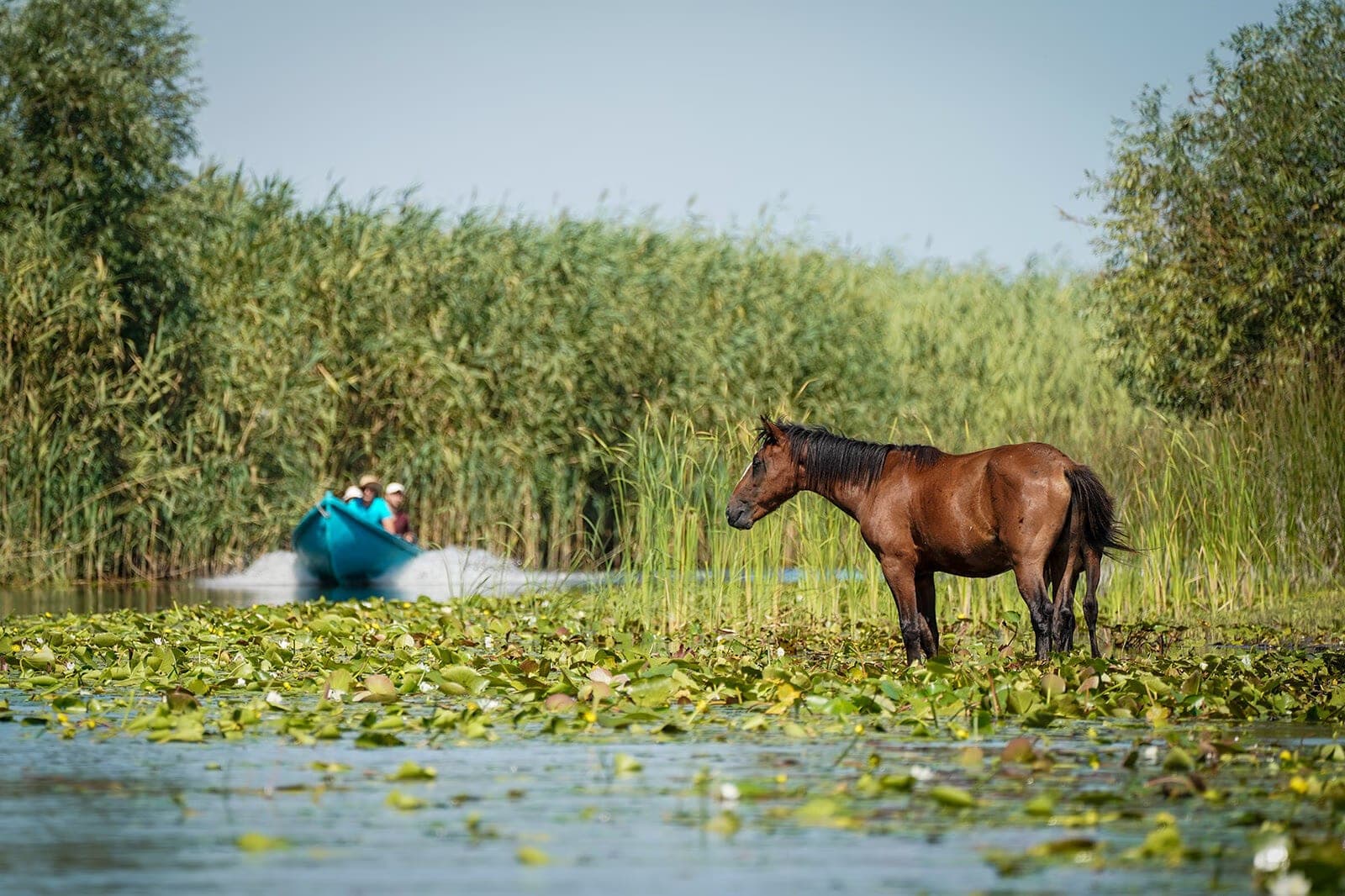
The tourist comes mostly in summer. From Tulcea, by boat to the village; then, along the seven kilometres of sand between village and forest, a "safari" by off-road vehicle or by cart — access with one's own vehicle is forbidden. Operators such as Safca Delta Tours, a family business with nearly two decades of trips, or Discover Danube Delta take the groups to the horses at prices starting at 275 lei a person for a day and reaching some 80 euros for the full package with a guide. One vehicle carries ten to twelve people at a time. There are no public flow statistics — but there is, every summer, a coming and going of laden carts through a forest that is, officially, strictly protected. The contradiction is the business model itself.
Dranov is not Letea
One final clarification, because it is fresh and because it will be confused. In February 2026, the press reported dozens of horses found dead in the Delta, killed by a frost of minus twenty degrees and by frozen water. It happened on Dranov sandbank, in the south of the Delta — not at Letea. Some forty carcasses out of a herd of about three hundred and fifty. At Letea, in the same winter, the ARCA association and the veterinarian Ovidiu Roșu said the animals looked even better than in other years. Whoever tells the story of the 2026 crisis must place the dead correctly on the map — otherwise they shift one sandbank's grief onto another's shoulders.
At the end remains the same figure we started from and the same question it does not close. Nine hundred and fifteen horses on a bank of sand, in a country that does not know whether they are its own or no one's, whether they are heritage or problem, whether they should be counted with tenderness or with concern. Perhaps the right answer is that they are, at once, all of these — a domestic animal turned free again, in a forest too rare to carry it and too beautiful to drive it away. For now, the only thing we have learned for certain about the Letea horses is how little we know about them.
Photo: Shutterstock · romaniafrumoasa.org