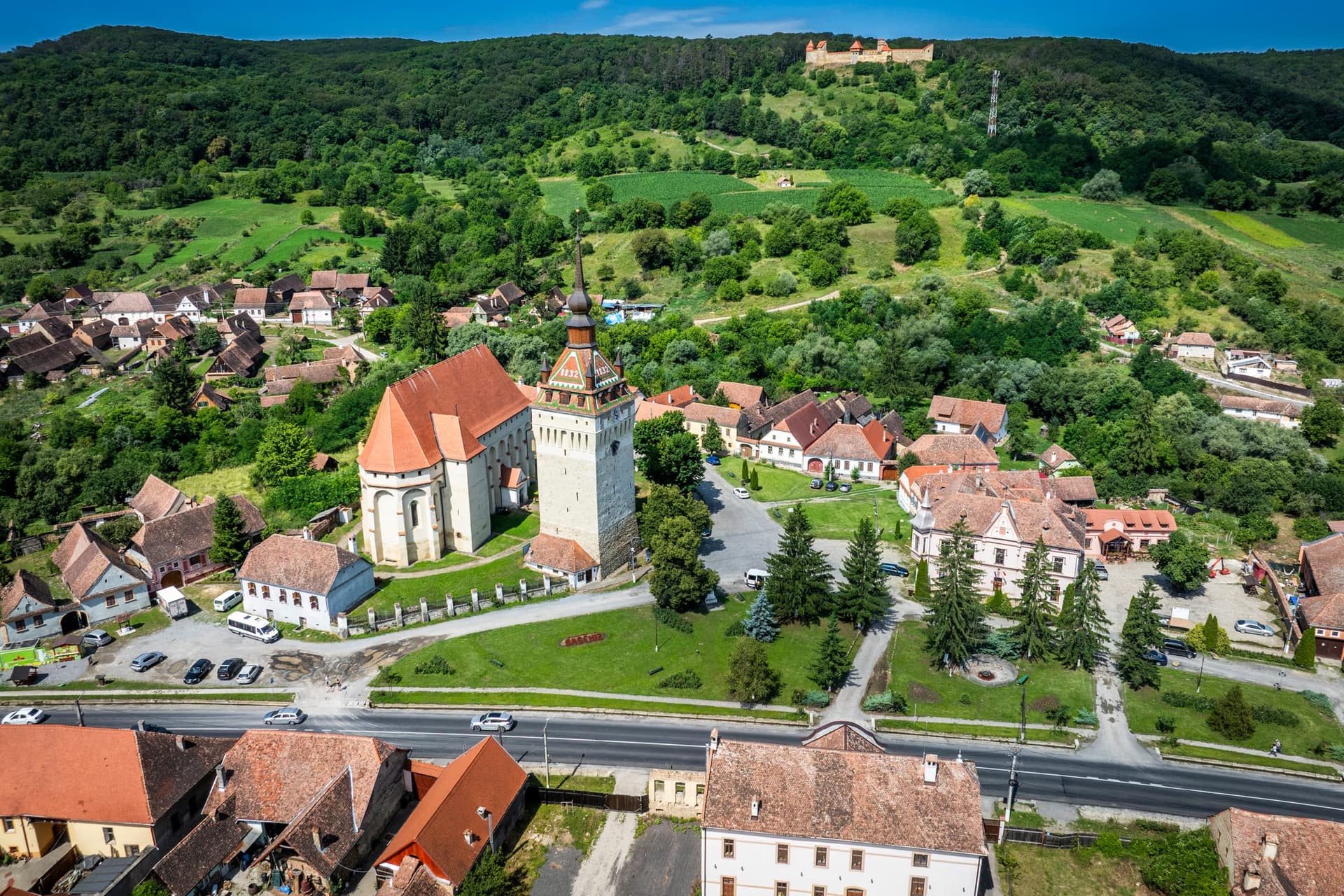
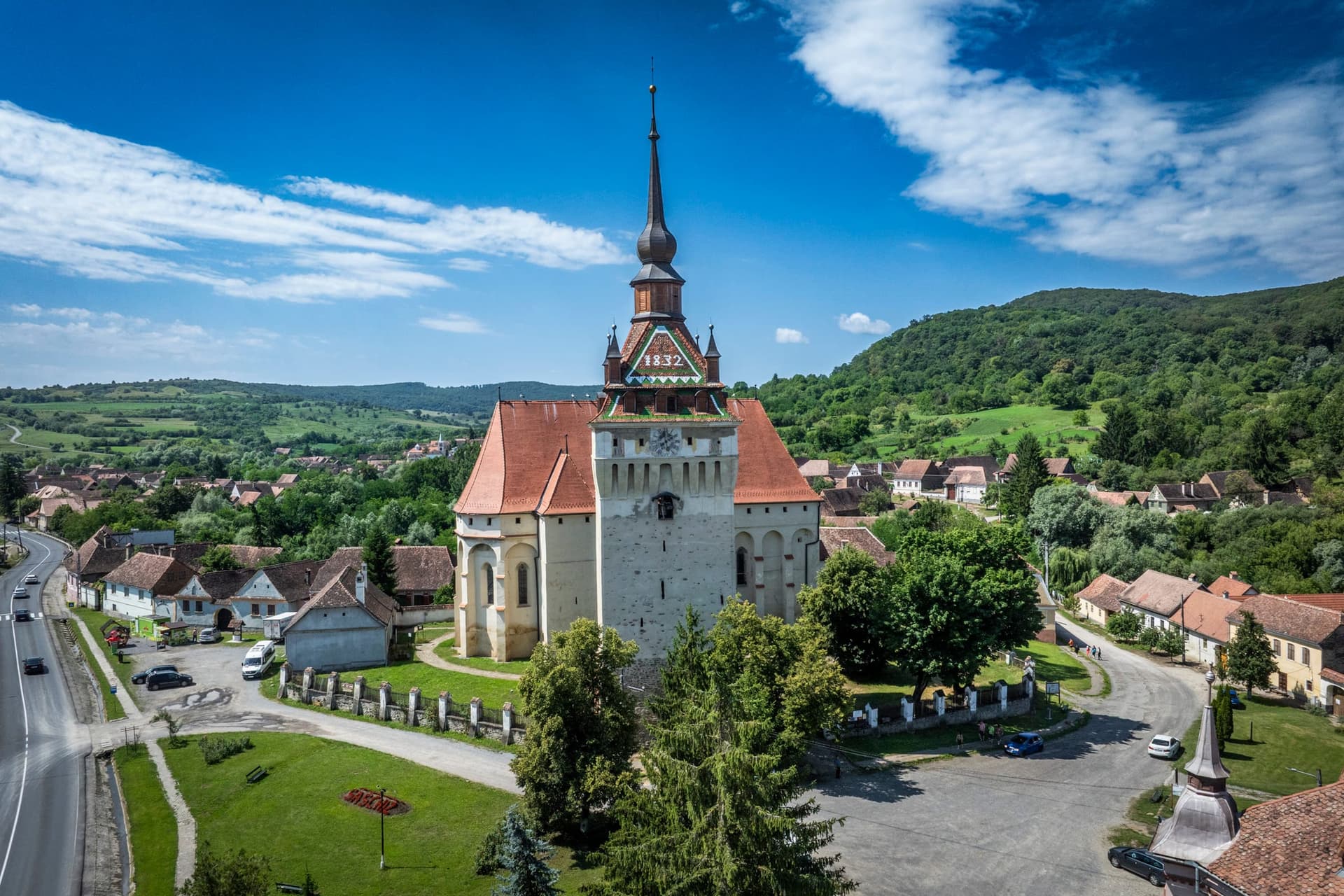
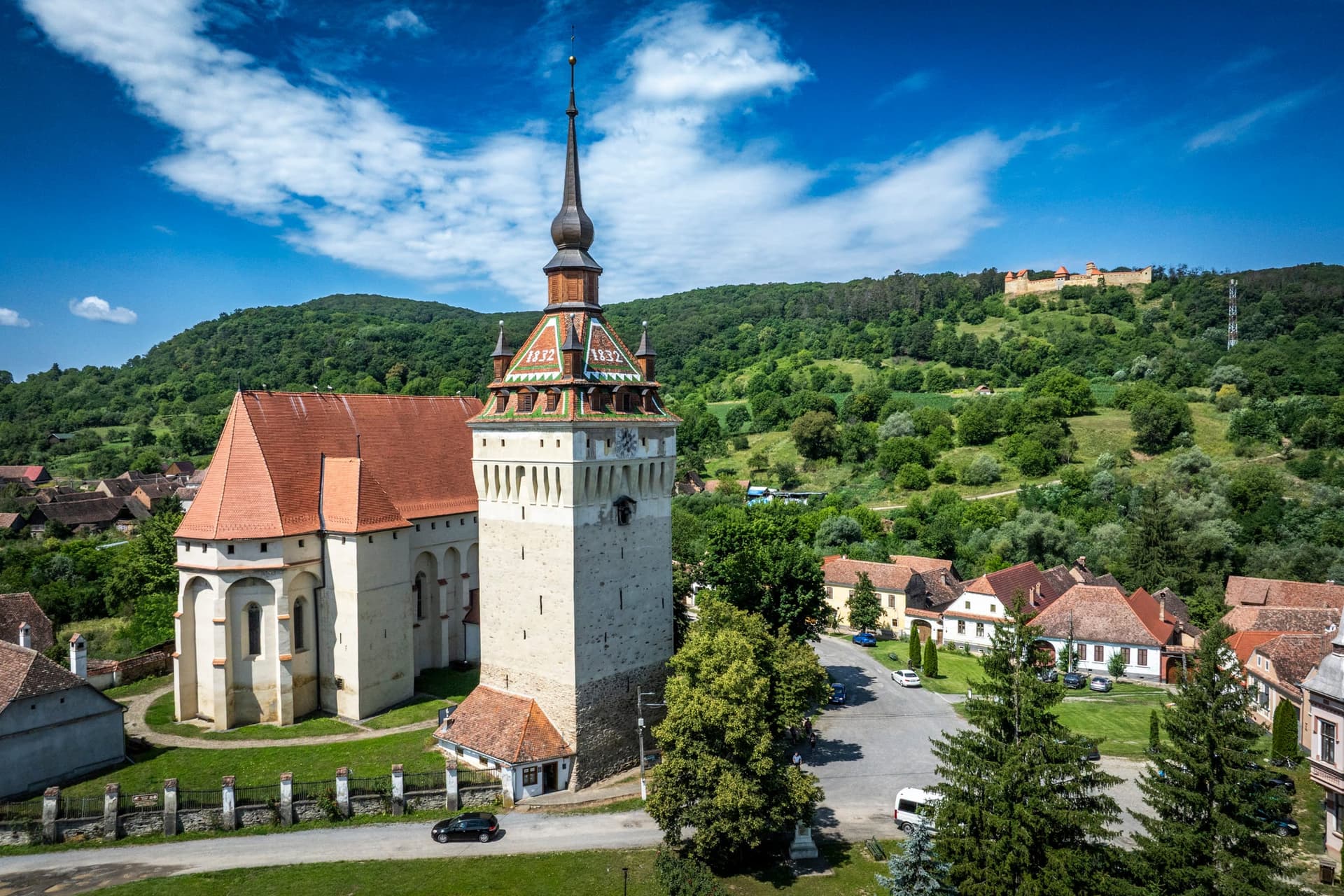
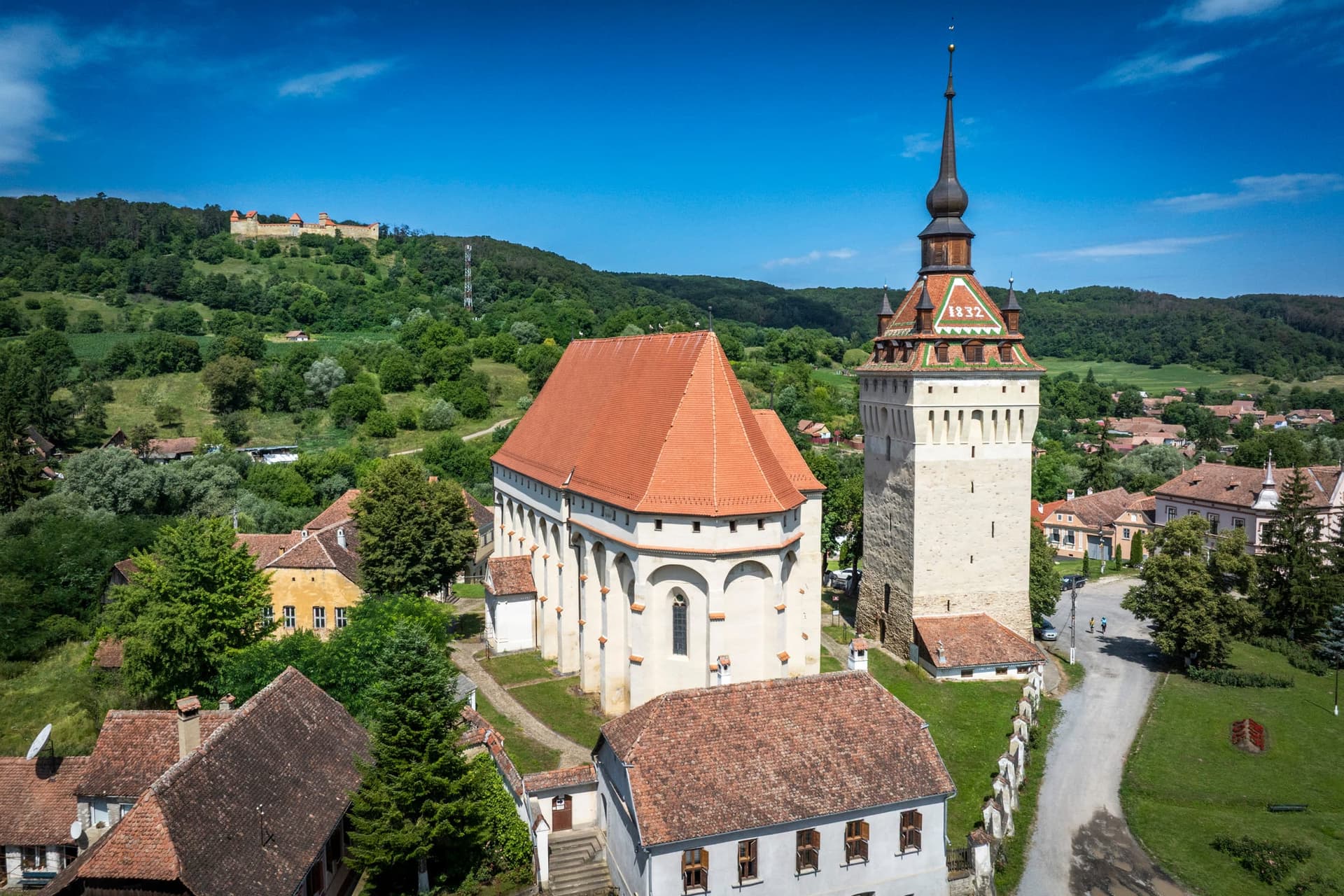
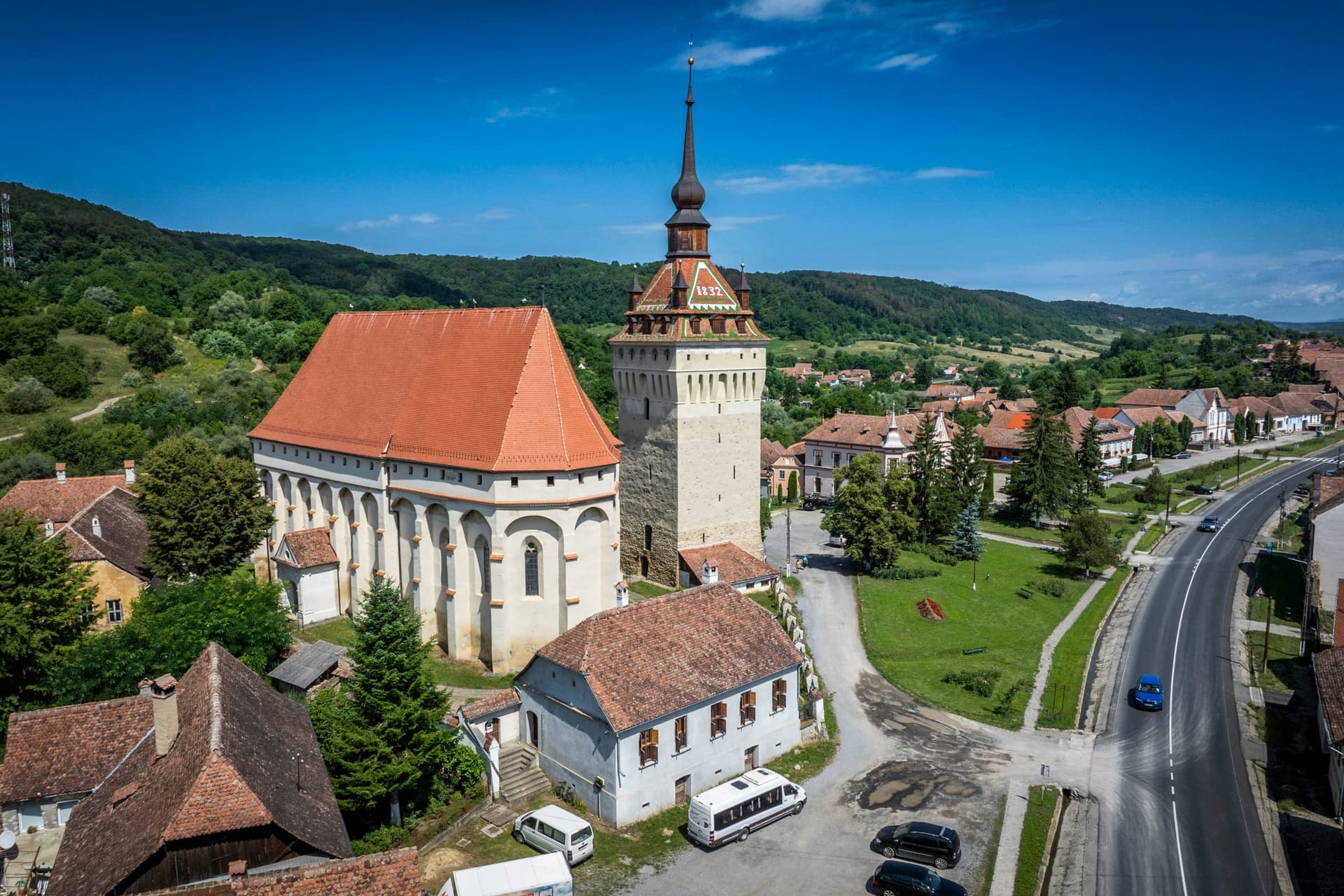
About 17 km west of Sighișoara on DN13, Saschiz has held, for centuries, two landmarks visible in a single frame: the Gothic fortified church completed in 1525, inscribed in the UNESCO World Heritage list since 1999, and the peasant citadel built in the 14th century on Citadel Hill (Dealul Cetății), reopened to the public in May 2025 after restoration with European funds. A guide for a full day — how to get there, what to see, where to stay, what to eat.
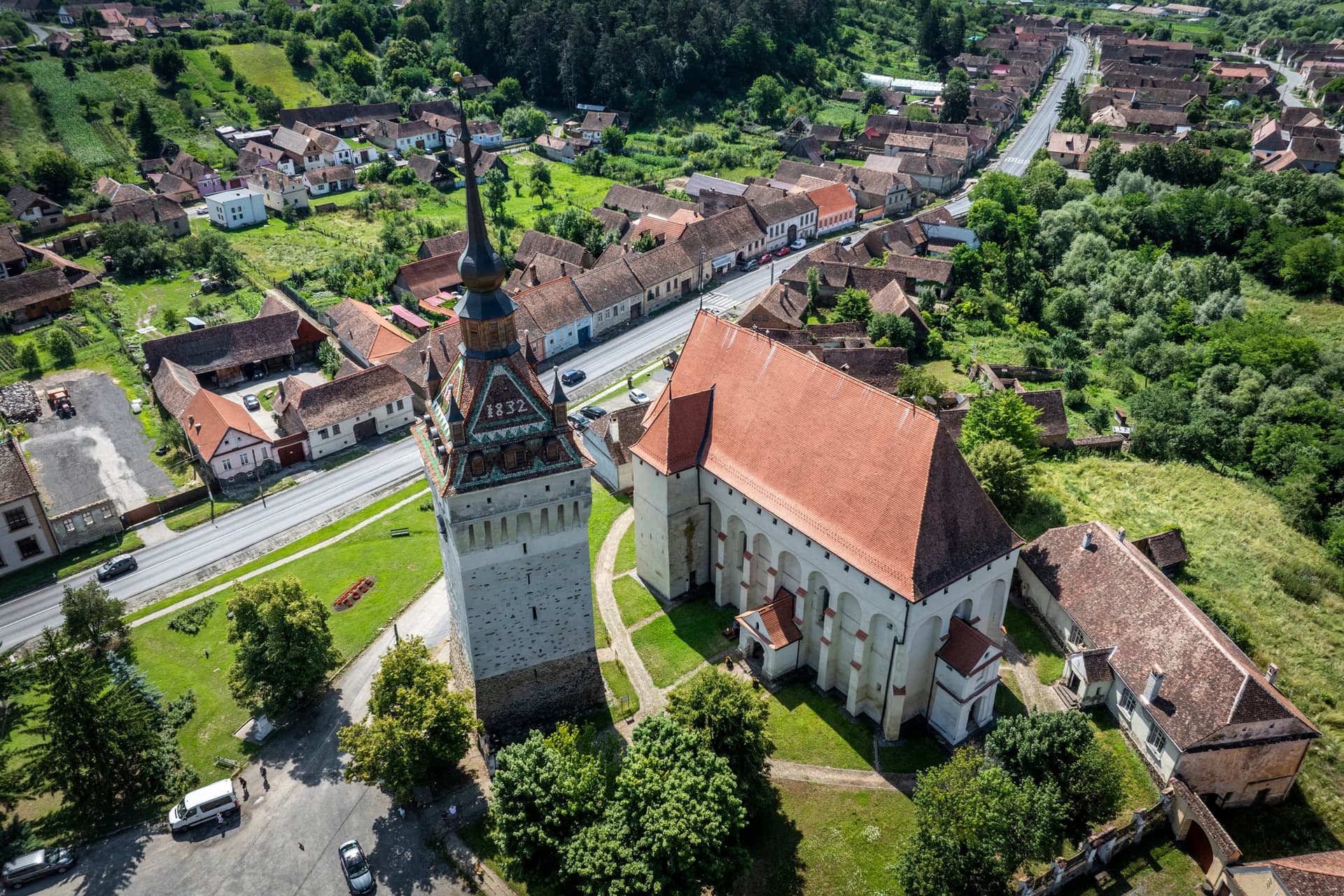
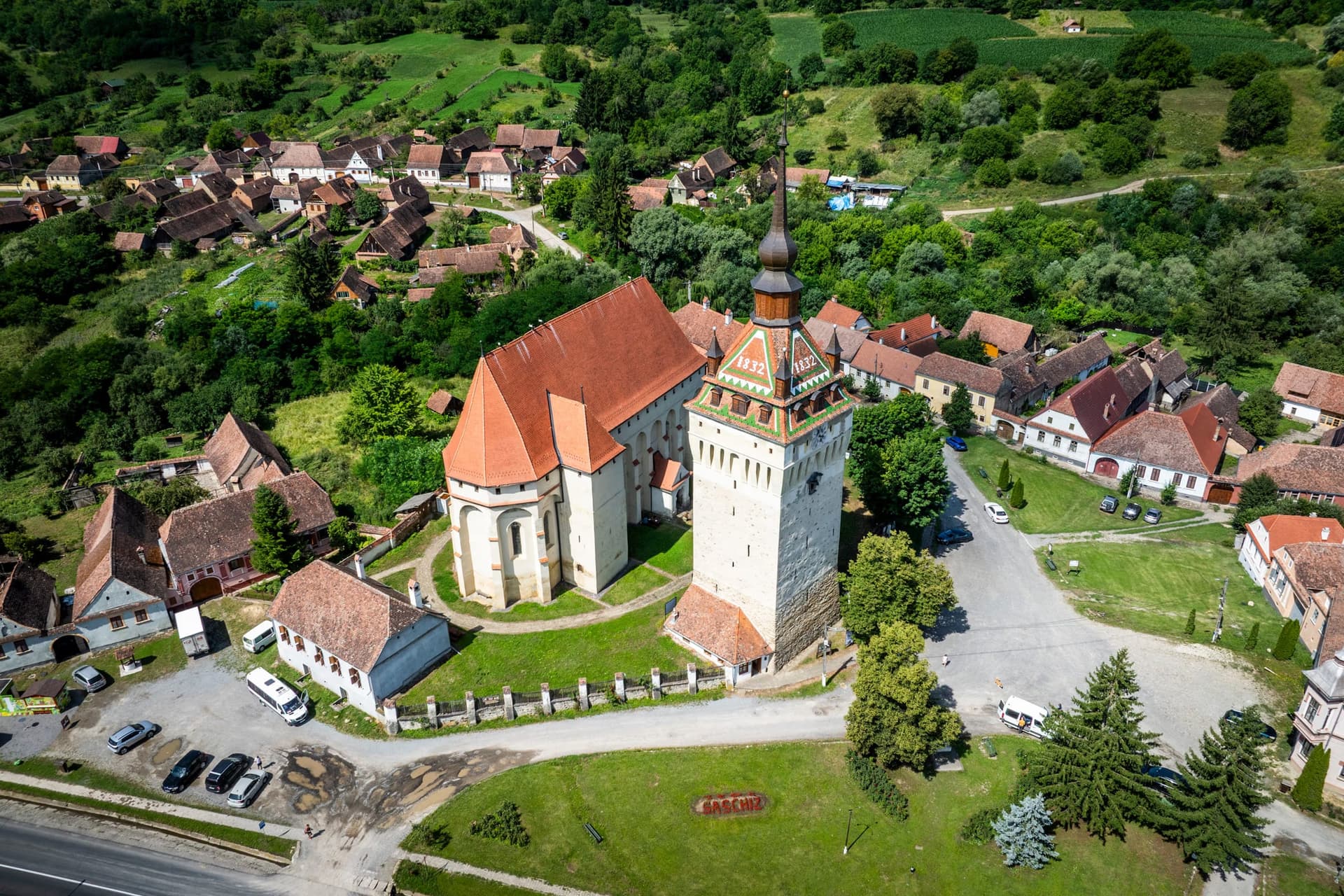
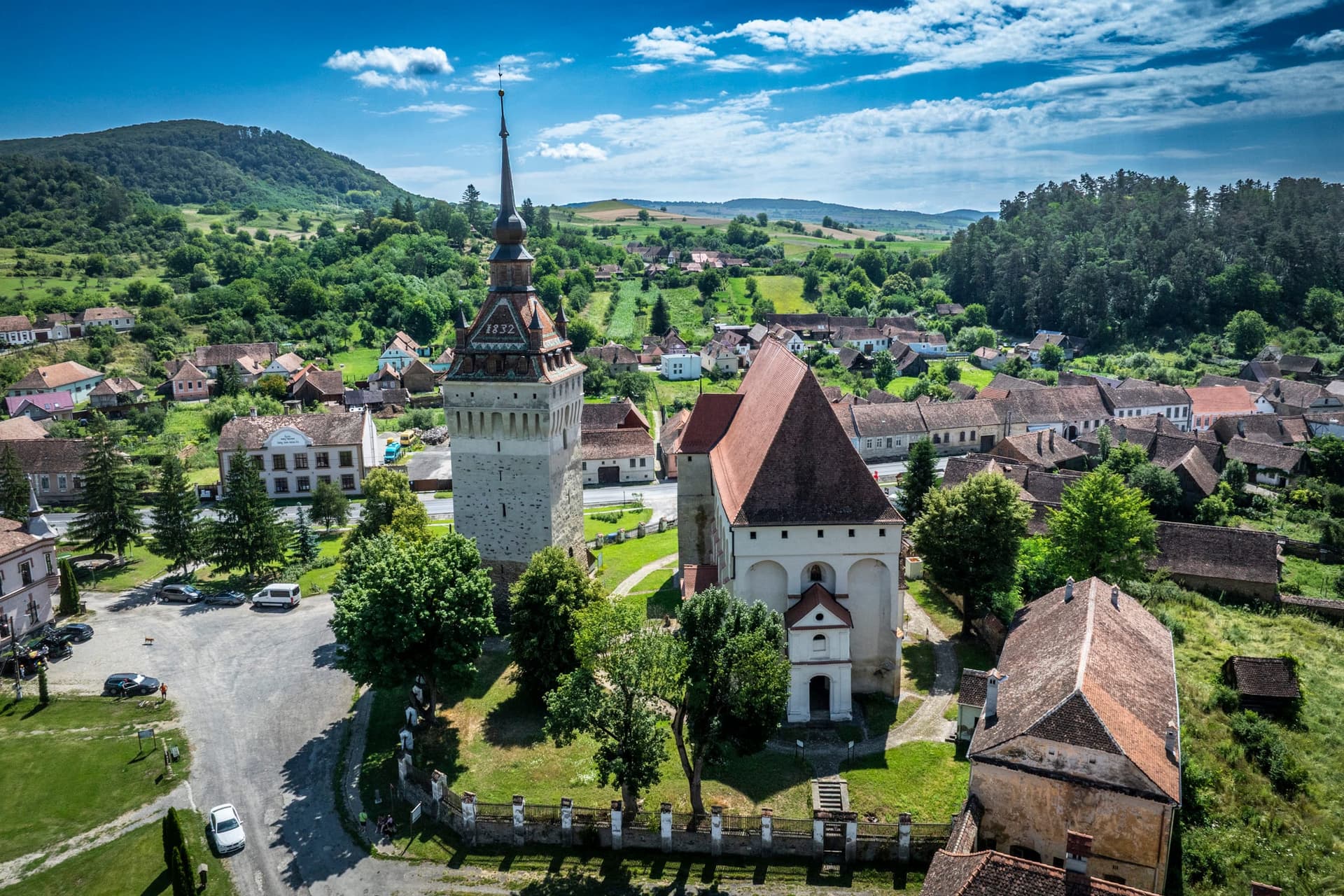
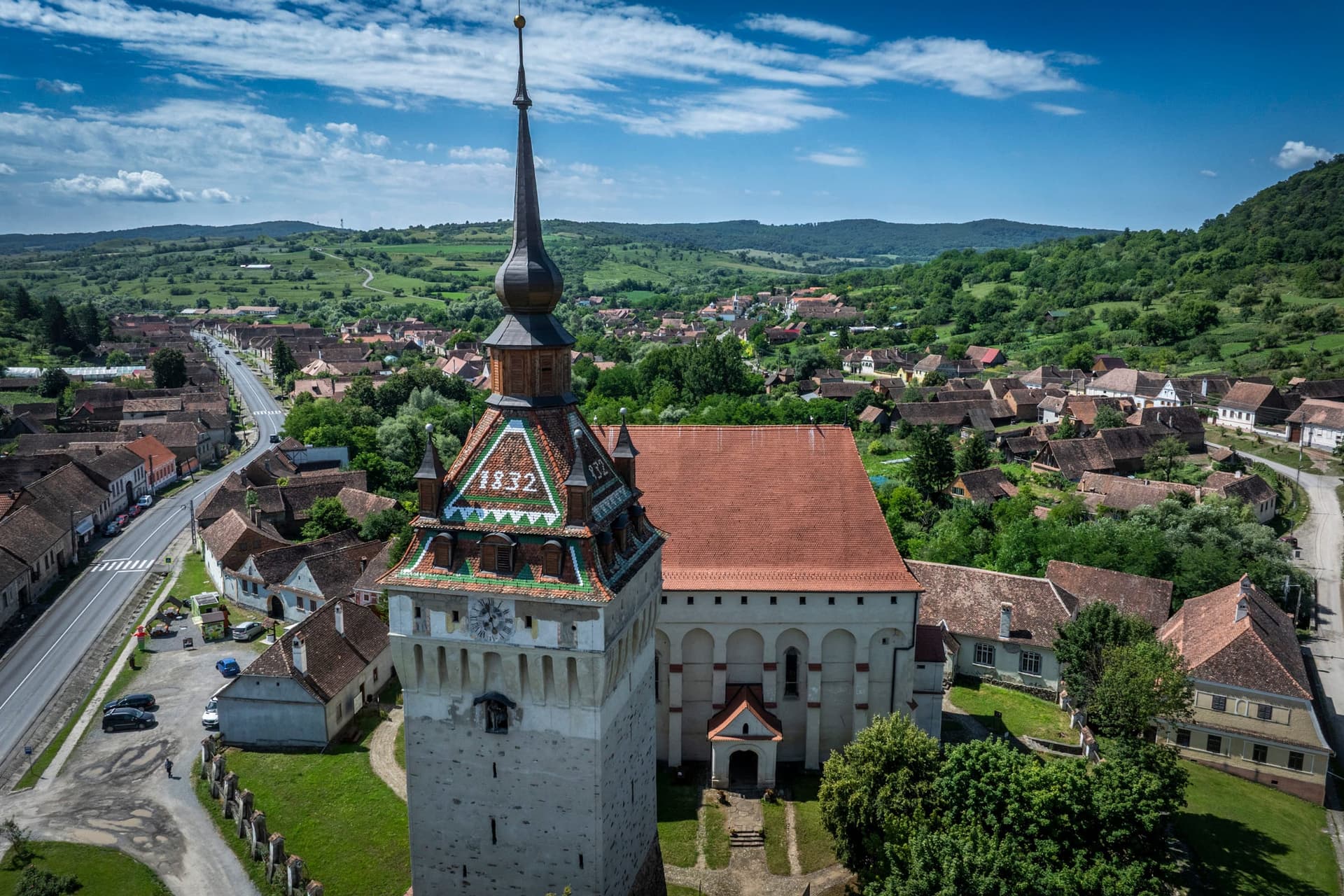
You arrive from Sighișoara along DN13, the E60 European road. Twenty minutes by car, just after the curve that brings the road into Saschiz, you start to see the top of the bell-tower — somewhere over forty metres, crowned with a collar of battlements and a sharp spire. On its face, in relief, the year 1832 marks the rebuilding of the clock mechanism. On the wooded hill behind the village, about five hundred metres off to one side, the silhouette of the citadel's walls comes into view.
Two structures raised in different centuries — one in the valley floor, one on the ridge — which, together, define Saschiz. And which, if you have a little time in Saxon Transylvania, justify a full day's stop here.
History in five dates
12th–13th centuries. A community of „hospites" (Saxon colonists) is settled in this part of the Târnave Plateau, under privileges granted by the Hungarian king. Before the Saxons, the area was inhabited by Székelys. The demographic transition unfolds across a few generations; the village's identity becomes Saxon.
1308–1310. First documented mention. Saschiz appears in written sources as a chapter centre (centre of an ecclesiastical capitulum) for the Saxons of the region. The name appears in several forms: Keisd / Kaisd in German and the Saxon dialect, Szászkézd in Hungarian, Saschizd in older Romanian. The Saxons also used the name Hünenburg — „the giants' castle" — for the citadel on the hill.
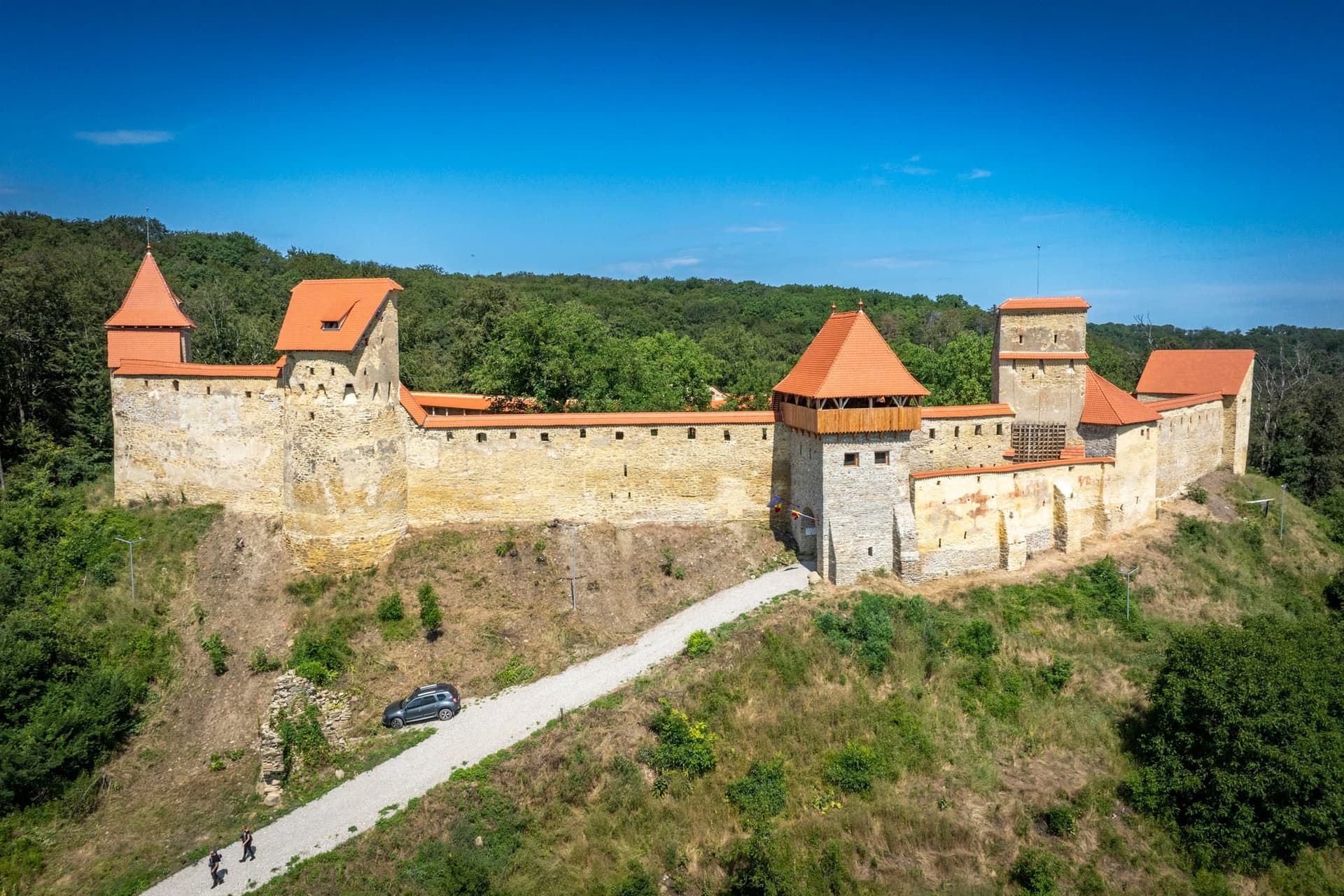
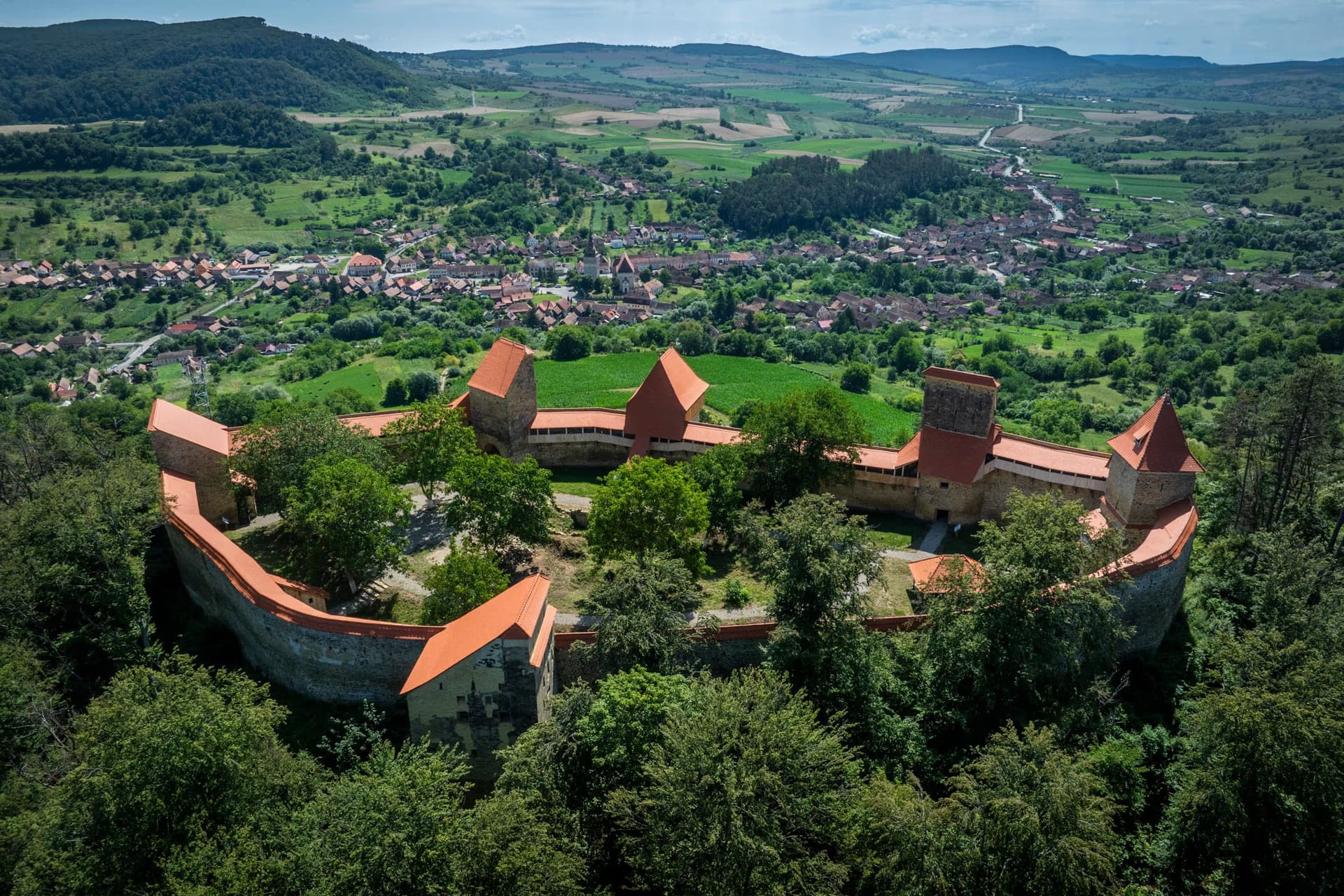
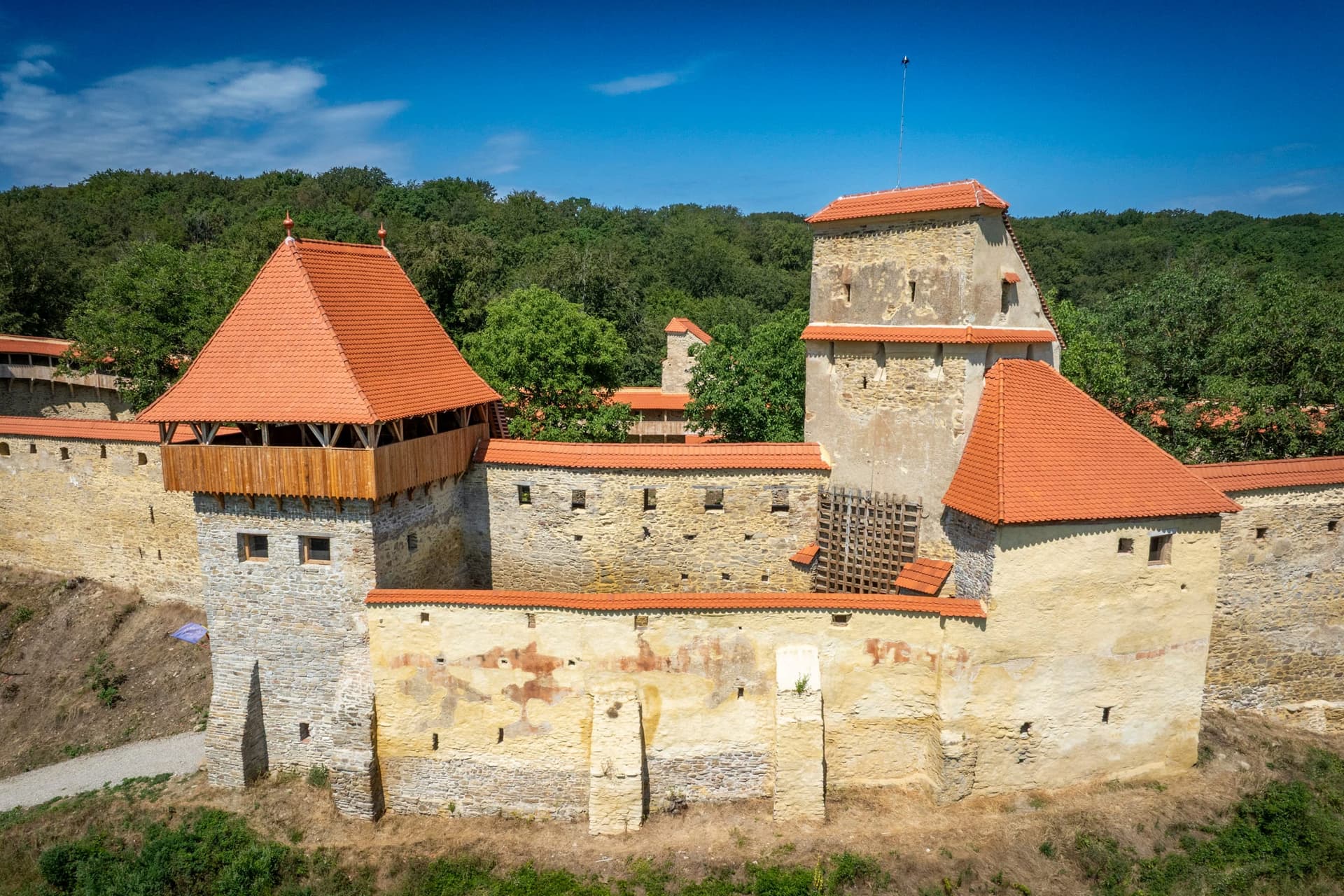
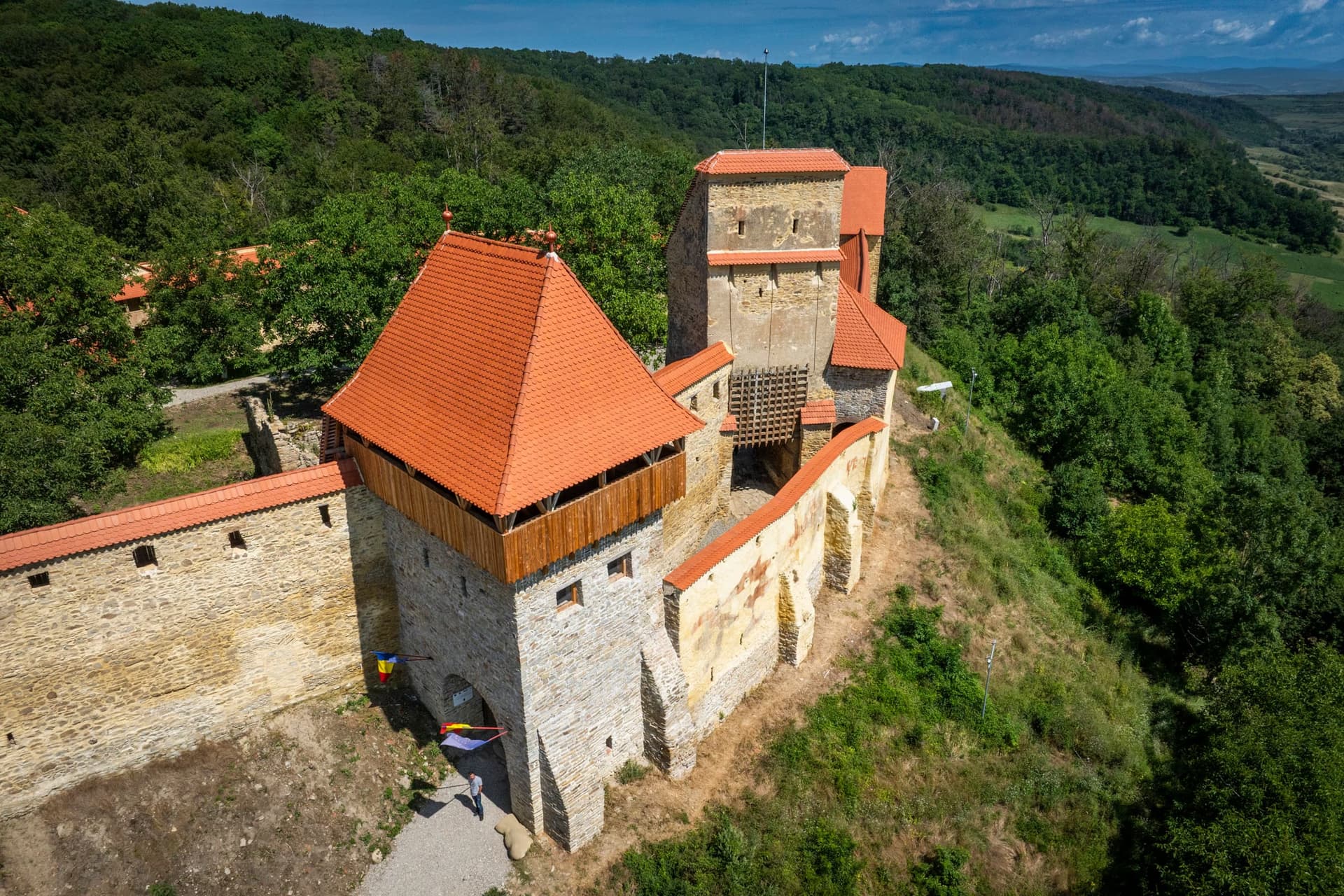
14th century. On Citadel Hill, a few hundred metres to one side of the future main street, the Saxons raise the Peasant Citadel — a refuge fortification built as a delayed response to the great Tatar–Mongol invasion of 1241 (a century later, once the traumatic memory had settled). The citadel has four corner towers and two gate towers — six in total, depending on historical interpretation — connected by a defensive wall about ten metres high. It is not a noble residence. It is a collective refuge, where in case of danger the villagers could climb to shelter together with their cattle and supplies.
1493–1525. In the centre of the village, the Saxon community begins construction of the fortified Lutheran church that still stands today. Built of quarry stone, in late Gothic style, reinforced with twenty-two buttresses. The choir is completed in 1496. The walls of the fortified enclosure raised around the church reach nine metres in places. The whole ensemble is completed in 1525. At that time, Saschiz was an important Saxon centre of the region, comparable in some respects to Sighișoara — the capital of the Saxons in this part of Transylvania — both economically and ecclesiastically.
1999. The fortified church of Saschiz is inscribed in the UNESCO World Heritage List, as part of the site „Villages with Fortified Churches in Transylvania" — an ensemble that includes six Saxon parishes (Biertan, Câlnic, Prejmer, Saschiz, Valea Viilor, Viscri) and one Székely (Dârjiu). The inscription was made on the criterion of preserving a „vivid image of the cultural landscape of southern Transylvania."
How to get there
By car. Saschiz lies on DN13 (E60), between Sighișoara (17 km east) and Rupea (29 km west). From Bucharest: ~310 km, ~4h45 (via A1 + DN1 + DN13). From Cluj-Napoca: ~157 km, ~2h45 (via E60 through Târnăveni–Sighișoara). From Brașov: ~140 km, ~2h15. From Sibiu: ~115 km, ~2h.
By train. The nearest major station is Sighișoara, with direct IRC/IR connections from all major Romanian cities. From the station to Saschiz, options include a taxi (~80 RON), local minibus (inconsistent schedules — check Autogări.ro in advance), or car rental from Sighișoara. Recommended: combine a one–two day stay in Sighișoara with a day in Saschiz.
By bicycle. Saschiz is part of the „Transylvanian Highlands" (Colinele Transilvaniei) ecotourism network — with physical waymarks, maps, rest points. A pleasant route: Sighișoara → Saschiz → Mălâncrav → Viscri, with possible overnight stays at Mihai Eminescu Trust guesthouses along the way.
What you see: the fortified church in the village centre
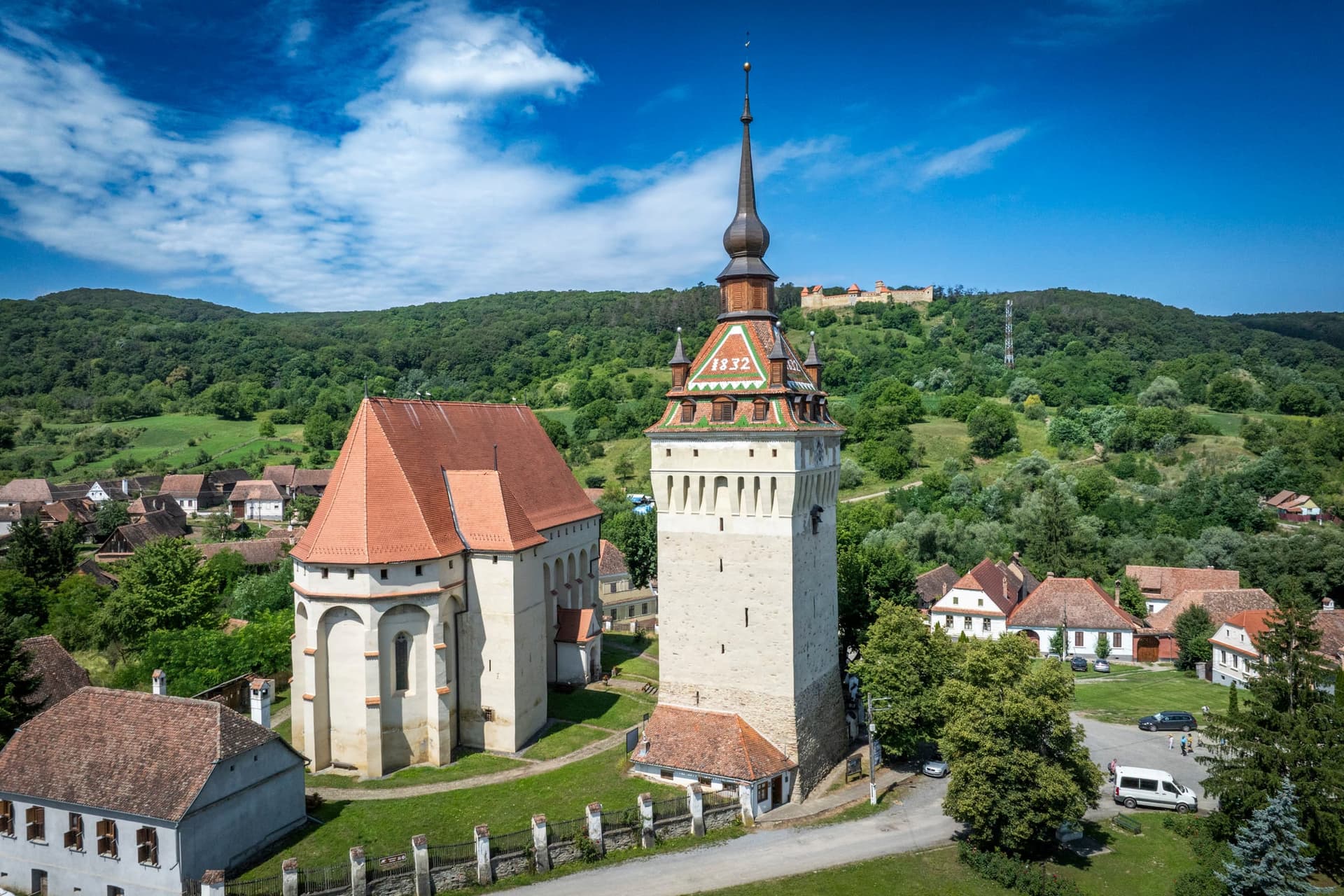
The church sits centrally, on the southern side of DN13. Entry is through the enclosure courtyard, open in season (usually April–October, ~10:00–18:00; verify on arrival at the Tourist Information Centre on the main street, or by phone with the town hall).
What to look for on site:
- Late Gothic style in quarry stone. Unlike the late-Baroque churches you see in Transylvanian towns, the church at Saschiz is comparatively sober, emphasising verticality and fortification.
- The 22 buttresses along the central nave, best seen from the courtyard.
- The detached bell-tower — with the date 1832 in relief on its face, marking the rebuilding of the clock mechanism. The tower has an observation platform, reachable by an internal staircase.
- The enclosure walls — a defensive perimeter around the church, average height 9 m, with a partial sentry walk visible on the northern side.
- The interior — original Saxon pews, painted wooden pulpit, organ, and traces of Gothic murals uncovered in recent restorations.
Admission — generally 10–15 RON adult, 5 RON student/pupil. Variable by season. Proceeds go to the Lutheran parish administration, which maintains the church.
What you see: the peasant citadel on Citadel Hill
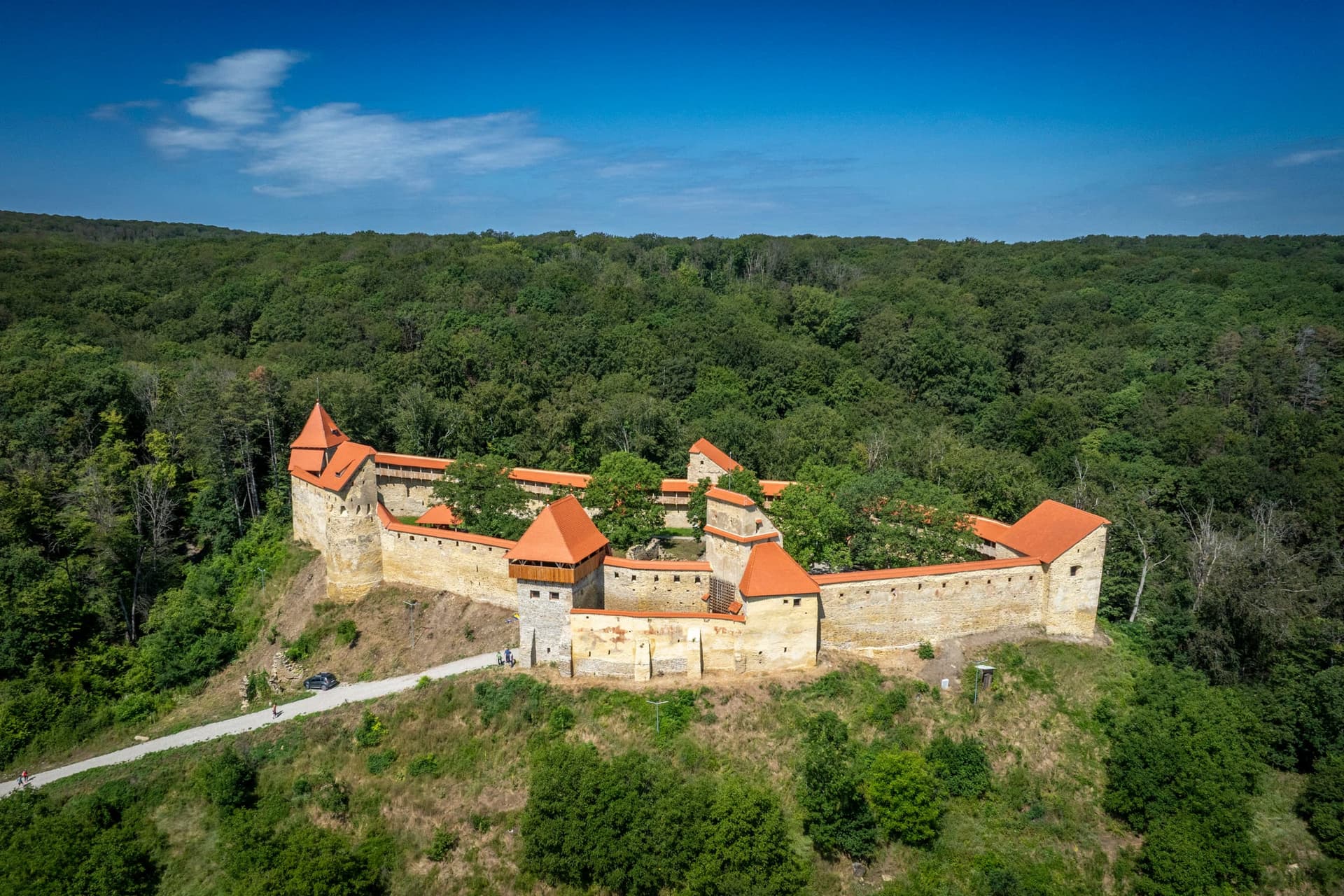
The citadel sits on the wooded hill behind the village. Access: the cobbled path begins at the northern edge of the village, just off DN13. The climb takes ~20–25 minutes on foot, manageable for most able-bodied visitors. Elevation gain: ~120 m.
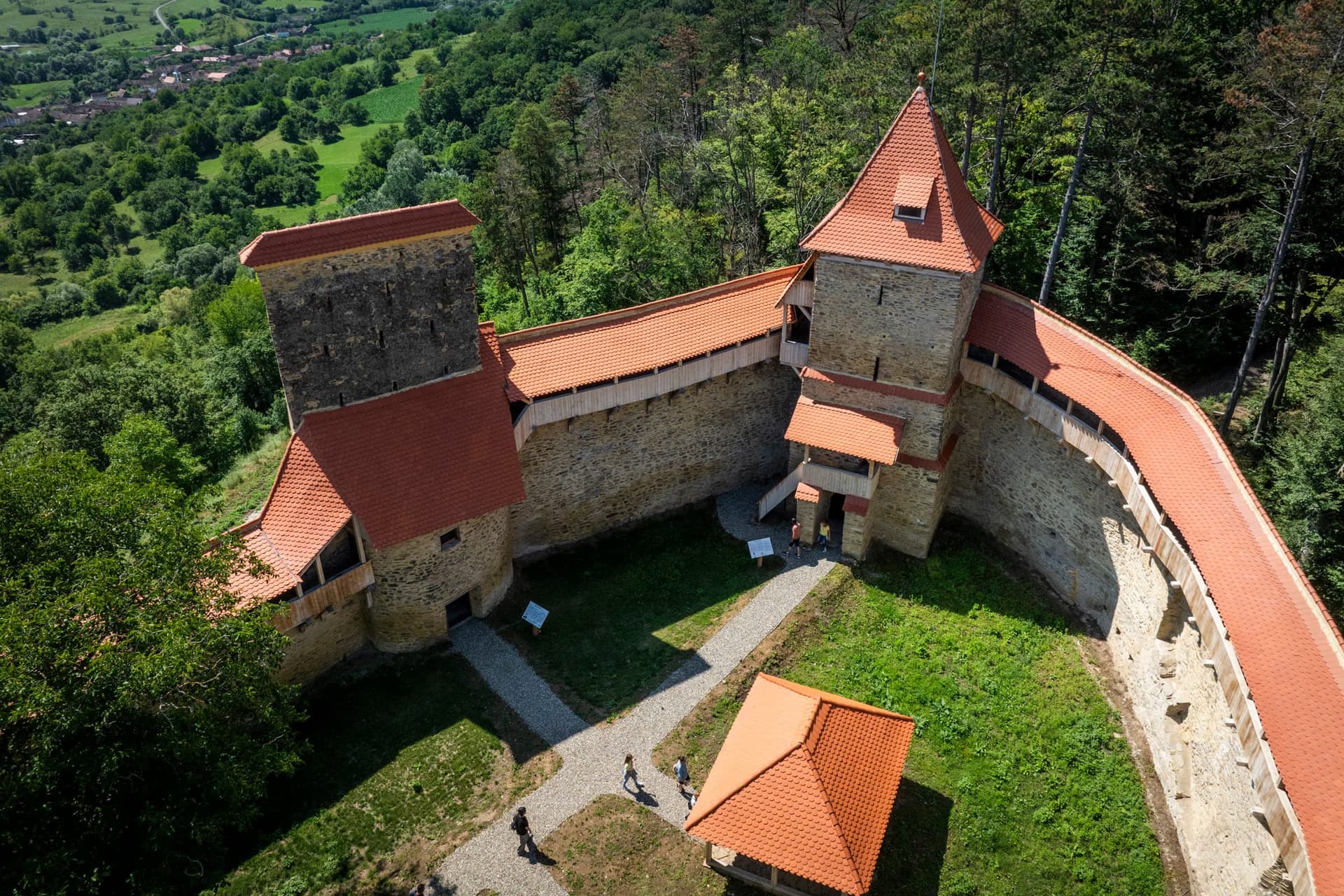
The citadel was reopened to the public in May 2025, after several years of works and a total investment of about 8.49 million RON (~€1.8 million) in European funds, managed through the Saschiz town hall. Works included structural consolidation, reconstruction of the enclosure walls, access paths, and the installation of observation points and interpretation panels. The tower roofs — now with new red tiles — were rebuilt to their original dimensions.
What to look for on site:
- The four corner towers and two gate towers — each tower had a specific defensive function; some also served as family shelters.
- The defensive wall — about 10 m high, visible around the whole perimeter.
- The sentry walk, partly accessible, offering a panorama over the village below.
- The interpretation panels — installed at reopening, explaining in Romanian and English how the citadel functioned as a collective refuge.
Admission — verify on arrival at the Tourist Information Centre (the official schedule was set after reopening; proceeds support ongoing maintenance).
What you see: the main street and the Saxon houses

Saschiz has a typically Saxon urban structure, preserved almost entirely: „wagon" houses with their gable end to the street, parallel lanes, arched gates of heavy timber (many from the 18th–19th centuries), pitched red-tile roofs, gables painted in pale yellow, wall-white, brick-green.
Walk the main street from east to west — duration: ~30–45 minutes at a relaxed pace, with stops every five or six houses for photographs.
Things to watch for along the way:
- The painted gables — note the difference between older colours (matt yellow, brick-green) and recently restored ones (pure white).
- The arched gates — many bear inscriptions of construction dates and owners' initials, in German or Latin.
- Outbuildings — barns, sheds, courtyard wells. Some still functional; some restored as guesthouses.
- The Tourist Information Centre — your essential starting point for a physical map, local guides, and the citadel's schedule.
Where to stay
Saschiz has seen its accommodation offer grow considerably in the last fifteen years — largely through the restoration of Saxon houses into guesthouses, partly funded by the Mihai Eminescu Trust (a British foundation set up in 1987 in London, which has run the „Whole Village Project" under the patronage of the Prince of Wales, now King Charles III).
Reference guesthouses (check prices and availability before travelling):
- Casa Săsească Saschiz — a guesthouse restored in a traditional house, central location. Recommended for authenticity.
- Conacul Grofului — more sophisticated, boutique atmosphere, restaurant with a local menu.
- Dominic Boutique — premium segment, oriented towards the European tourist.
- Pensiunea Cartref — modest comfort, reasonable prices.
- Pensiunea Keisd — the name preserves the Saxon name of the village; locally run.
- Pensiunea Violeta and Pensiunea Elena și Maria — family-run options, more accessible.
- Hanul Cetății and Motel Tranzit — functional, on the main road.
- Camping Zori — for visitors arriving with caravans or tents.
For a three-day, two-night experience, recommendation: stay in a restored guesthouse (Casa Săsească, Conacul Grofului, or Dominic Boutique).
What to eat
In Saschiz you buy by the jar: the products from Pivnița Bunicii (rhubarb jam, quince jam, elderflower jam) are the village's signature. The rhubarb jam, in particular, is listed in the Slow Food „Ark of Taste" catalogue. The community is working towards obtaining a protected geographical indication at European level. Rhubarb is specific to Saxon cuisine — a plant with thick, slightly astringent stems, where sugar is used sparingly. The result: a flavour you won't find in industrial productions.
Distribution reached the British market as well, starting in the late 2000s, through the ADEPT Foundation (founded in 2002 in Saschiz, with Swiss and British support).
Restaurants — options depend on the guesthouse where you stay (Conacul Grofului has a restaurant, as does Dominic Boutique). In the centre there are also two inns along the main road, with traditional daily menus.
How to plan one day (8–10 hours)
| Time | Activity | Duration |
|---|---|---|
| 09:00 | Arrival, parking in the village centre, stop at the Tourist Information Centre for maps and schedule updates | 30 min |
| 09:30 | Fortified church + bell-tower (ascent) + enclosure | 1h |
| 10:30 | Coffee on the main street, photographing Saxon houses | 30 min |
| 11:00 | Climb to Citadel Hill and the Peasant Citadel | 25 min ascent |
| 11:25 | Visit the citadel, photograph the panorama, read the interpretation panels | 1h |
| 12:30 | Descent, lunch at a guesthouse with a restaurant (Conacul Grofului or similar) | 1h30 |
| 14:00 | Walk along the main street, shopping at Pivnița Bunicii (rhubarb, quince, elderflower jam) | 1h |
| 15:00 | Short hike in the surroundings or departure toward Mălâncrav / Viscri | — |
For two days: sleep in a restored guesthouse; dedicate the second day to villages in the „Transylvanian Highlands" network — Mălâncrav (~25 km), Viscri (~40 km via Mălâncrav), Cloașterf (a village of Saschiz commune, 6 km).
Photo gallery
Saschiz commune in numbers (2021 census — INSSE)
- Population: approximately 2,080 inhabitants (slight increase compared with 2011)
- Ethnic composition (official INSSE data): mostly Romanians, with minorities of Roma, Germans, and Hungarians
- Dominant religion: Orthodox; the historical Lutheran (Augsburg Confession) is now a minority
- Component villages: Saschiz, Cloașterf, Mihai Viteazu
- Mayor (2024-2028 mandate): Ovidiu Șoaită
Saschiz is a commune in Mureș county, on DN13 between Sighișoara (17 km east) and Rupea (29 km west). The fortified church is inscribed in the UNESCO World Heritage List since 1999. The Peasant Citadel was reopened to the public in May 2025, after restoration funded with European money worth about 8.49 million RON (~€1.8 million). The rhubarb jam produced here is listed in the Slow Food „Ark of Taste"; the community is working towards a protected geographical indication.
Fact-check sources
- [Peasant Citadel of Saschiz — May 2025 reopening (Historia)](https://historia.ro/sectiune/actualitate/cetatea-taraneasca-din-saschiz-redeschisa-pentru-2527683.html)
- [Restoration project — official history](https://cetateasaschiz.ro/scurt-istoric/)
- [Rhubarb jam puts Saschiz on the European map (România Liberă)](https://romanialibera.ro/special/reportaje/gemul-de-rubarba-scoate-saschizul-in-europa-103108)
- [Mihai Eminescu Trust — history](https://www.mihaieminescutrust.ro/)
- [Saschiz Tourist Information Centre](https://turism.saschiz.ro/)
- [Saschiz Town Hall — official information](https://saschiz.ro/)
- [Pivnița Bunicii — Saschiz traditional products](https://www.pivnitabunicii.com/)