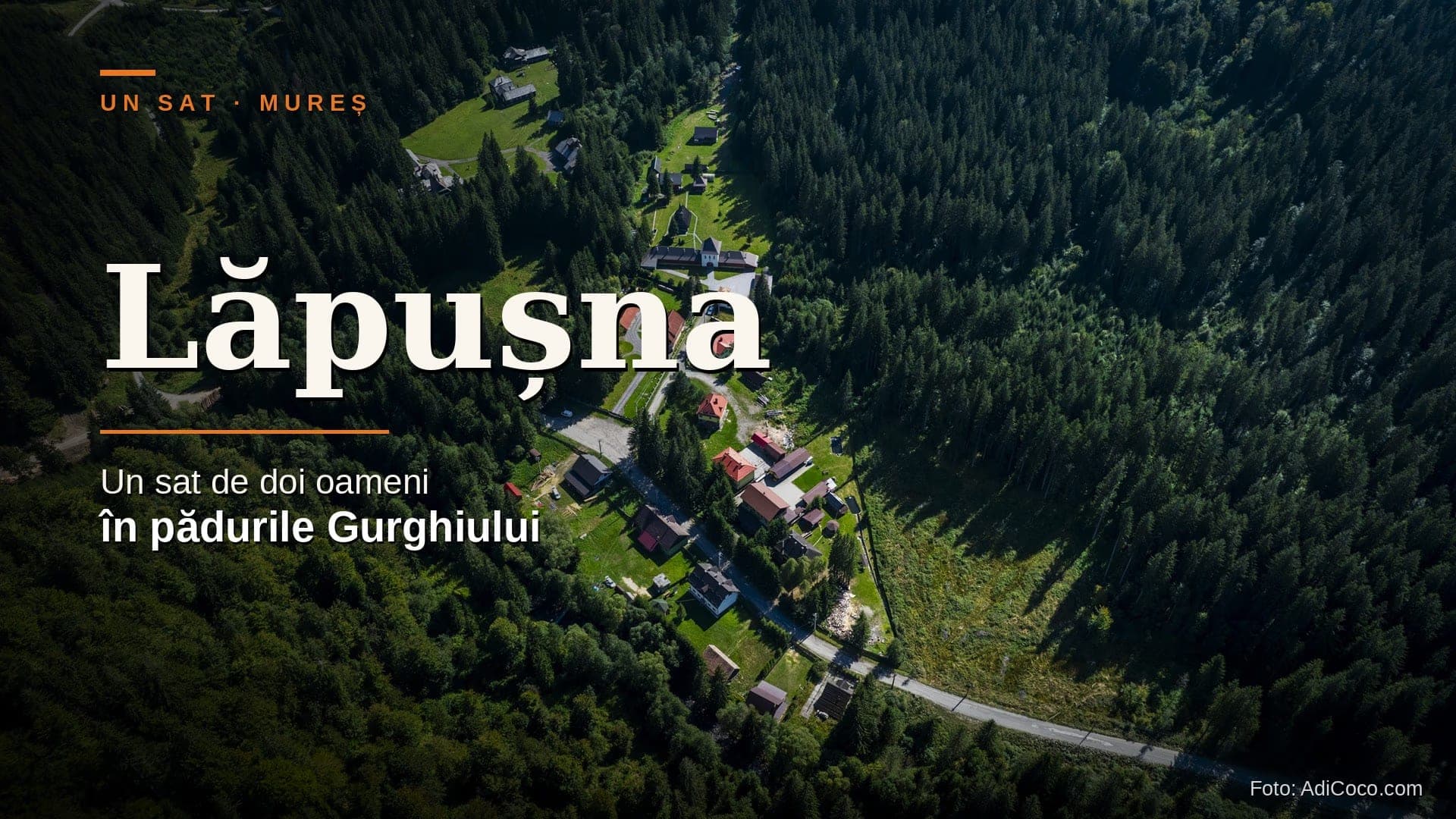
A VILLAGE · MUREȘ
Two residents, at roughly 815 meters above sea level, deep in the forests of Gurghiu. Everything else is here: a royal castle, a monastery, a former pioneer camp, a state-run trout farm, and a nature reserve of spruce trees whose wood becomes the world's finest violins.
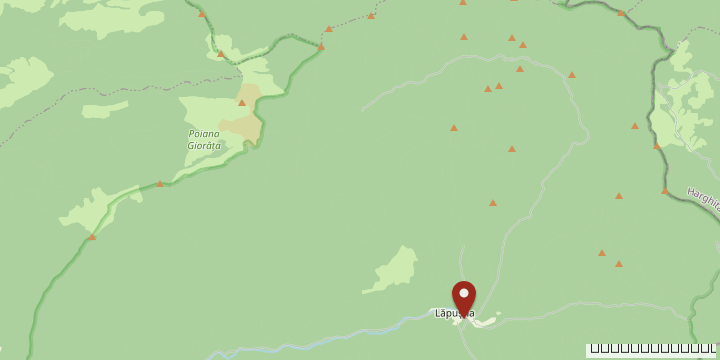
The road to Lăpușna doesn't rush you. You set out from Reghin, climb along DJ153C through the villages of the Ibănești area, and drive almost as far as Brădețelu — where the asphalt ends. From there, the forest takes over, along with a forestry track of roughly 11 km that, after rain, turns into a course only ATVs and motorbikes can manage. At the end of it, at roughly 815 meters altitude— the same elevation as the castle — and about 70 kilometersfrom Târgu Mureș, you find the village: a handful of scattered houses, a wooden church, a castle hidden among the firs, and a silence that stops you from speaking above a whisper.
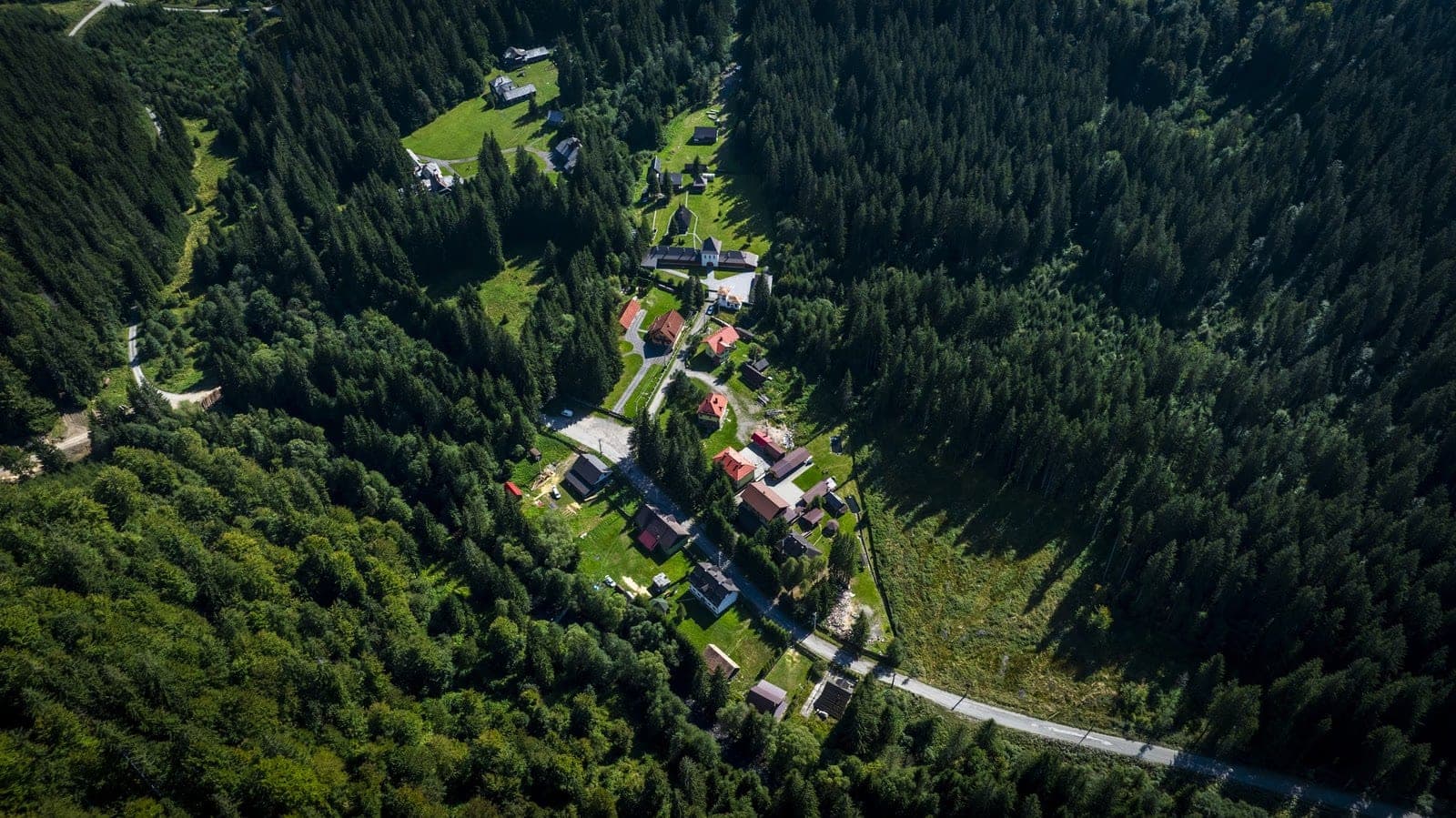
The numbers of a village without people
The 2021 census recorded just 2 permanent residents in the village of Lăpușna. Two. In practice, however, the number of people passing through daily or working here seasonally — foresters, monks, trout farmers, hotel-castle staff, camp administrators, protected-area guides — is far greater. The built-up area covers roughly13 hectares. Lăpușna is one of the ten villages that have made up Ibănești commune since 1968.
It also appears in Austro-Hungarian historical documents under the name Erdőlibánfalva (Hungarian, "the village of Liban in the forest") and Laposchna (German) — names that speak to Transylvania's three linguistic heritages.
It is a paradox of a village: nearly empty of people, yet full of reasons to stop.
The Forest That Sings
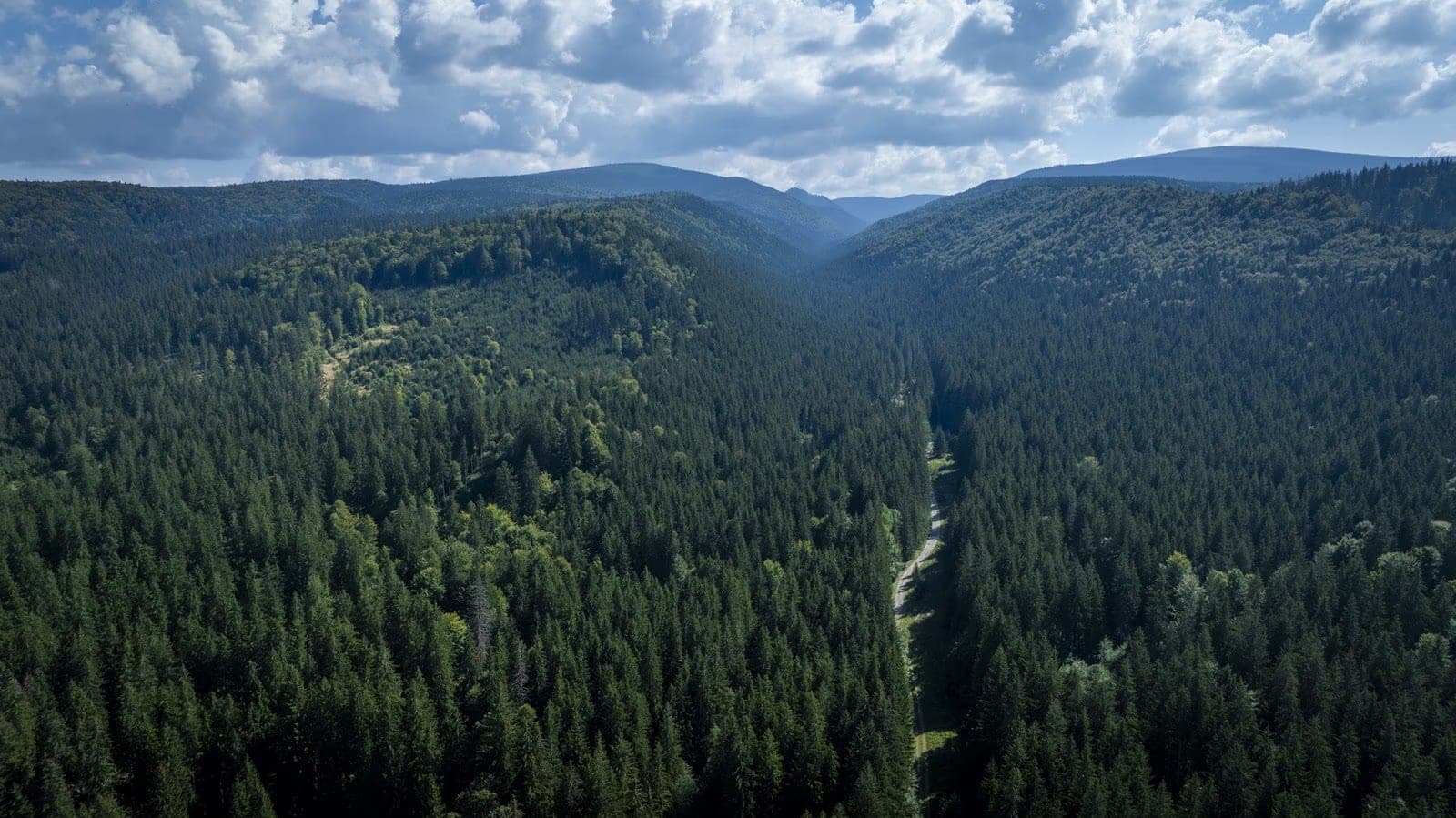
The most precious thing about Lăpușna cannot be seen from the road. It lies in the forest above, on the eastern slopes of the Gurghiu Mountains — The Lăpușna Forest Resonance Spruce Nature Reservea protected area of 77.8 hectares, IUCN Category IV, with more than 90% Norway spruce and trees aged 170–180 years. It forms part of the Natura 2000 site Călimani–Gurghiu.
That is where the resonance sprucegrows — a rare variety of Norway spruce (Picea abies) with exceptionally uniform and very narrow annual rings, which give the wood outstanding acoustic properties. It is used to make the soundboards of violins, cellos, and pianos — essentially every stringed instrument in the world. It is not felled by just anyone, nor in just any manner. A chosen log is tested by striking it — a luthier listens to the wood, as if to a chord, before accepting it.
This connection ties Lăpușna directly to an entire industry. Just 45 kilometresto the west, in Reghin, the factory Hora S.A. produced, in 2023, around 70,000 musical instruments a year — 8,000 bowed(violins, violas, cellos, double basses) and around 60,000 plucked (guitars and others), more than 80% exported. Industrial production began in 1951; the reputation of Gurghiu timber, however, goes back much further.
There is a local legend— repeated in many sources, but without any primary historical evidence — that Stradivari and Guarnerihad sent emissaries to the Gurghiu Valley to search for wood for their violins. Hence a second nickname for the valley, "The Italian's Valley". A fine piece of oral tradition; historically, unconfirmed.
The Camp — from Pioneers to Children from across the Country
Also in Lăpușna there is a school camp with a longer history than it might seem. Before 1989 it was one of the pioneer campsof the county — intended for children from schools across the R.S.R. The 1990s left the buildings standing, but not the discipline. Anyone who spent time there in the summer of 2000 still carries traces of the atmosphere, the forms, the rituals of the Pioneer movement — an institutional legacy that outlasted the name change by many years.
It went through a long period of dormancy in the 2000s and was officially reopened in 2014: 3 dormitory buildings with 9 beds each, and plans to expand with new timber cabins. It operates in summer, serving pupils from several counties (Mureș, Sibiu, Brașov, Cluj). It also hosts cultural camps run by the Mureș County Centre for the Preservation and Promotion of Traditional Culture: workshops in folk dance, painting, and woodcarving. Prices are nominal. For many children, it is their first real encounter with the forest.The Trout FarmOne of the oldest forestry facilities in the valley. Lăpușna Trout Farmat
795 m altitude, falls under the Mureș Forestry Directorate – Romsilva (Gurghiu Forest District). Romsilva data show an annual output of 25–27 tonnes of table trout and over 120,000 native trout fry for restocking mountain rivers. The ponds are gravity-fed from the Secuieu stream — a small alpine operation that, beyond what it sells, keeps the local river system alive.Wildlife and Flora
Lăpușna sits in the northern Gurghiu Mountains, within the Natura 2000 Site Călimani–Gurghiu— one of the most important large carnivore zones in the Carpathians. Across the entire site (not just the village), the Gheorgheni Forestry Office recordsover 400 brown bears, 100–200 wolves, and 70–80 lynx, alongside red deer, wild boar, foxes, and squirrels. Among birds,
the capercaillie(an endangered species), the hazel grouse, wagtails, and the crested lark; along the waterways, the white-throated dipper and the kingfisher. The streams yield trout, grayling, and barbel.The forests are of beech, sessile oak, fir, and spruce — old-growth, partly centuries old. In spring, the valley erupts into bloom: wild snowdrops, wild hyacinths, gentian.
The castle and the church — landmarks, not protagonists
Lăpușna also has aroyal hunting lodge, built between 1925–1926 and fully furnished by 1933 for King Ferdinand I. It passed by will to Prince Nicolae, was seized in 1939 by King Carol II,
nationalized in 1949
following King Mihai's abdication (December 1947) and subsequently used as a hunting residence by the communist leadership (Nicolae Ceaușescu among others). After 1989, through Government Decision 1041/1990 and Order 154/1991, passed into the ownership of SC Grand SA Târgu Mureș and operates today as a private hotel — with no public visiting hours; you can only enter if you book a room.
A few steps away,
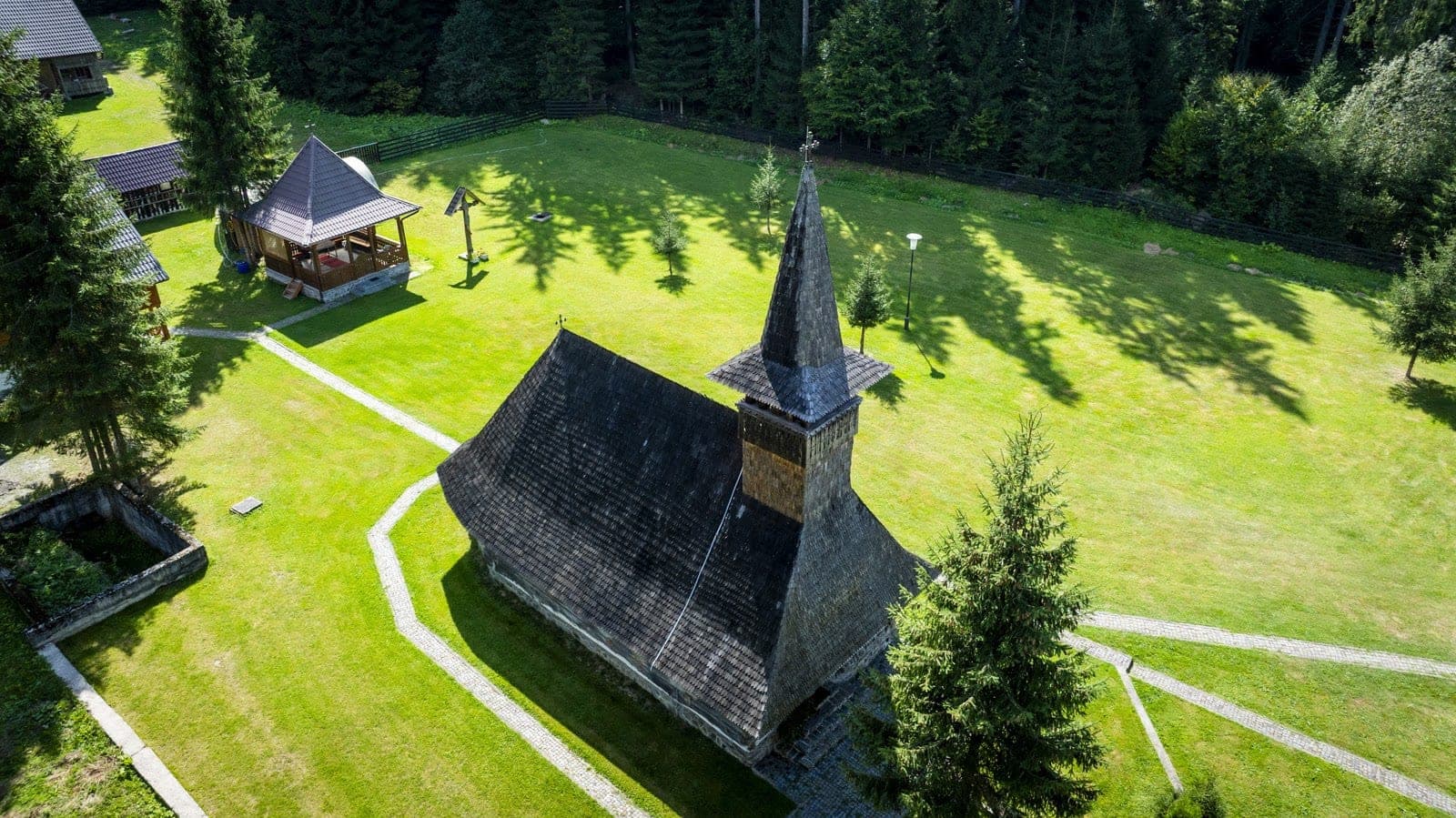
the wooden church of Saint Nicolae ("Sfântul Nicolae")
, built in 1779 in the village of Comori (Gurghiu commune) and dismantled and re-erected at Lăpușna in 1939(some sources say 1937), at the request of King Carol II. It is the only wooden church in Mureș County with a fully restored interior. In1997a monastery was founded beside it —the "Saint Nicolae" Monastery— whose monks tend the church to this day.CuriositiesTwo residents. That's it. And yet the village has a registered address, a SIRUTA code, a road, a forestry district, a monastery, a castle-hotel, and a summer camp.Two nicknames for the Gurghiu valley. "The Valley of Kings" — in memory of those for whom the valley served as a hunting ground: the princes Rákóczi, Prince Rudolf of Austria
(son of Emperor Franz Joseph) and, later, King Carol II. And "The Italian's Valley" — for the legend of violin wood.The village's historical names: Erdőlibánfalva (Hungarian), Laposchna (German).A difficult road:paved road on DJ153C most of the way, then about 11 km of forest track. After heavy rain, the final stretch can effectively be impassable for passenger cars.Lăpușna without people, full of institutions — a village that functions more as a management hub for a forest and a heritage site than as a lived-in community.Two people registered as residents in Lăpușna. Everything else — spruce trees destined for violin-makers, trout ending up on dinner plates, children arriving for summer camps, monks holding services, tourists paying for a room in a royal castle. A village at 815 metres that, if you stop for five minutes, tells you more stories than most cities.Lăpușna — the village with two residents