

An illustrative model: the same small plumbing firm brings in €120,000 from clients over the course of a year, VAT included. How much remains after taxes — and how many billable hours are needed to earn that money — reveals two major divides between Eastern and Western Europe: taxation and the local cost of labor.
Picture a plumber running his own firm. He is, at once, entrepreneur, manager, the person doing the work, and the one who picks up the phone when a pipe bursts on a Saturday night. By year's end, his clients have paid his firm a total of €120,000, VAT included. The same sum, whether the firm is based in Sofia, Warsaw, București, Madrid, Lyon, or München.
A necessary caveat from the outset: that €120,000 is not the firm's money. VAT collected must be remitted to the state, so the first step is to remove it from the equation. Because the standard VAT rate varies by country, so does the actual base — revenue net of VAT: in Poland, at 23% VAT, roughly €97,600 remains; in Romania and Spain, at 21%, around €99,200; in Bulgaria and France, at 20%, exactly €100,000; in Germany, at 19%, approximately €100,800.
That is the starting point for the comparison. The firm pays operating expenses, the entrepreneur's salary, the associated social contributions, corporate income tax, and finally dividend tax. The outcome depends on the legal structure, social contributions, location, and deductible expenses — which is why the figures below should be read as a model with explicit assumptions, not as a simulation automatically applicable to any plumber. Key assumptions: a corporate income-tax-paying entity; one person, paid a local plumber's salary, with the remainder taken as dividends; modest operating costs (vehicle, fuel, accountant, insurance, phone: ~€4,500–8,000/year), excluding materials — we assume labor is billed separately and the client purchases materials.
What's left after taxes
With these assumptions, here is what the entrepreneur takes home — and, more interestingly, what that income is made of: net salary plus net dividends.
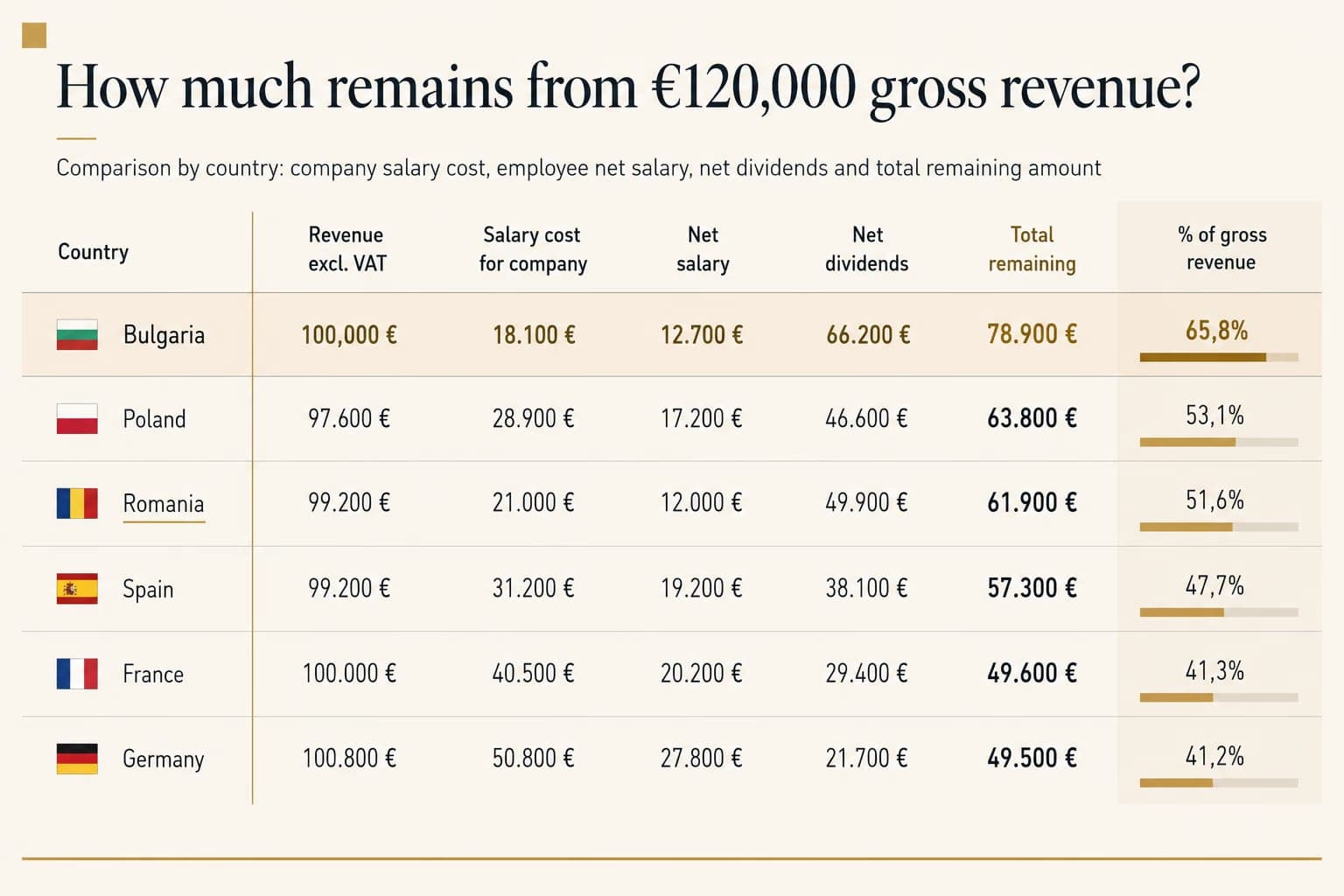
In this simplified scenario, the map is not simply 'East good, West bad' — it is a gradient. At one end, Bulgaria, with its flat rates (10% corporate tax, 5% dividend tax), leaves the entrepreneur nearly two-thirds of revenues. At the other, France and Germany are virtually tied at around 41%. In between, Poland ranks surprisingly high — thanks to a 9% corporate tax rate for small firms — followed closely by Romania, then Spain, caught midway between the lighter fiscal burden of the East and the heavier social contributions of the West. The gap between first and last place, from exactly the same revenue, is nearly €30,000 a year.
The explanation lies in two places. The first is the taxation of profit and dividends: 10% plus 5% in Bulgaria, or 9% plus 19% in Poland, versus a corporate tax rate of around 30% in Germany (including the Gewerbesteuer, the local business activity tax) plus 26.4% on dividends, or France's flat tax (flat tax) of 31.4% on dividends from 2026.
The second is the cost of labor — and here one point deserves clarification. How that cost is split between 'employer contributions' and 'employee contributions' is, for the final outcome, irrelevant: it all comes out of the same firm revenue. What matters is how much is lost in total on the way from the firm to the individual's pocket: around 30% in Bulgaria, ~38% in Spain, ~40% in Poland, ~43% in Romania, ~45% in Germany, and ~50% in France. (A counterintuitive detail for Romania: although the employer's formal share is negligible — a consequence of the 2018 reform — the total burden on wages remains high, because it was shifted almost entirely onto the employee.)
And here a second pattern emerges, visible in the composition of that income. In the East — Bulgaria, Poland, Romania — where local plumbers' wages are lower and dividends are taxed more lightly, almost all of what remains comes from dividends; the salary is a thin slice. Moving toward the West, salary becomes the dominant component: in Germany, net salary (~€27,800) actually exceeds net dividends (~€21,700). In short, the Eastern European entrepreneur lives mainly off company profit; his Western European counterpart, primarily off his own wage.
The other side of the coin
The comparison could stop here, with a tidy conclusion about the friendlier tax regimes of Eastern Europe. That would be the less interesting half of the story.
Because those 120,000 euros don't appear out of thin air. They accumulate hour by hour, job by job, at whatever rate the local market accepts for an hour of labour — and that is where the ratio reverses. The hourly rate billed to the client (VAT included) is, according to published price lists and market sources, around ~€75 in Germany and ~€55 in France, ~€40 in Spain, versus ~€30–32 in Poland and Romania and ~€22 in Bulgaria. A one-to-three difference — a mirror image of the tax gap.
Translated into working time, the same target looks completely different. Starting from billed hours, then adding non-billable time — a lunch break and an average half-hour of travel between jobs per day, meaning billable time amounts to roughly 84% of time actually spent working — and dividing by 48 working weeks:
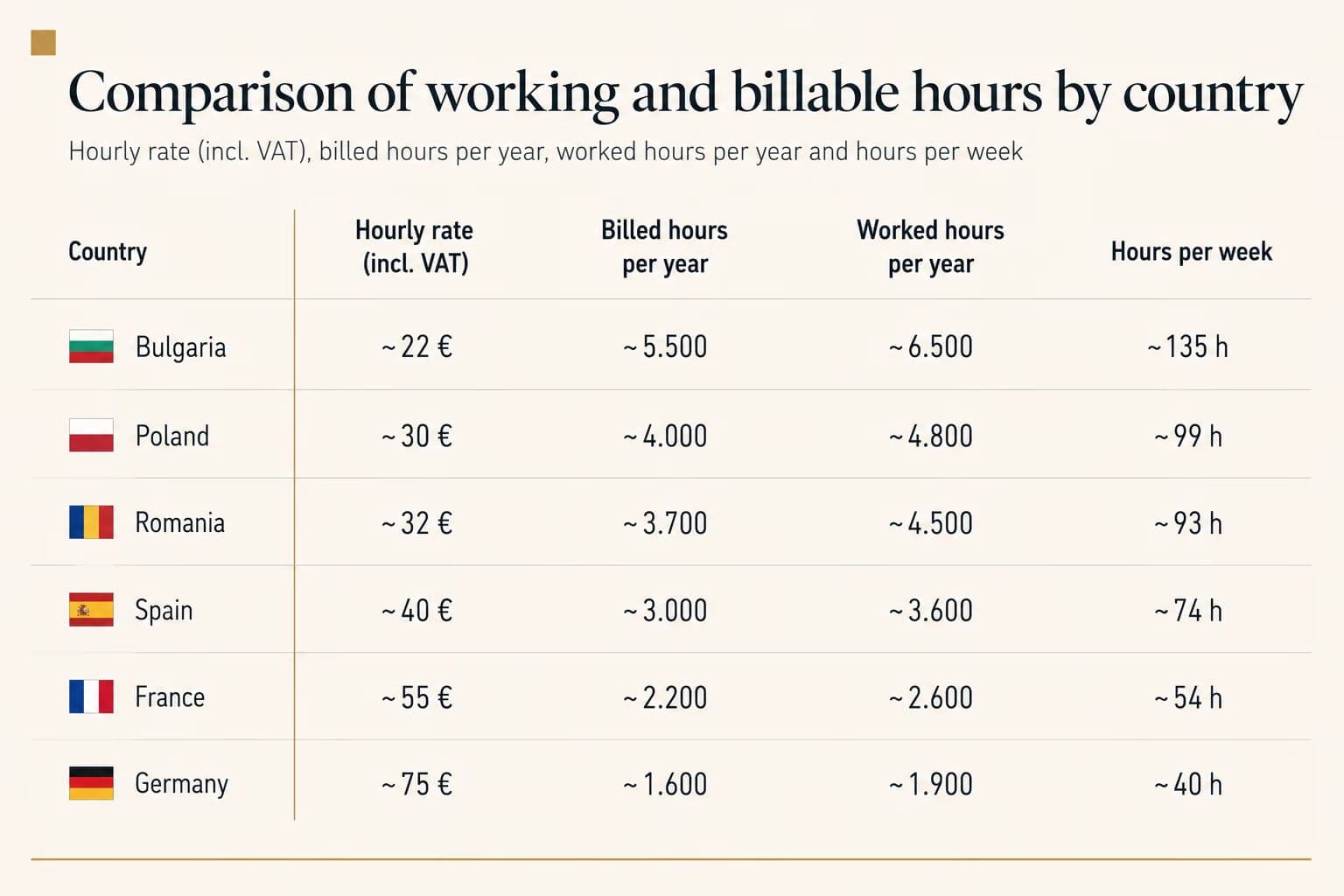
Under this rate model, in Germany those 120,000 euros can be earned on a schedule close to a standard annual workload — around 40 hours per week. In France, it requires more effort, but is still achievable for a single very busy professional. Spain is already at the limit: ~74 hours per week means someone who barely has a weekend. In Poland, Romania, and Bulgaria, the same figure becomes unrealistic for a single person working at the assumed average rates — somewhere between ~93 and ~135 hours per week. In practice, such a figure would be reached differently: through higher rates, jobs billed as packages rather than by the hour, subcontracting, or simply a team of two or three people.
This second half of the analysis is also the most fragile, and it is worth saying plainly: the entire conclusion about hours depends on the assumed hourly rates, which vary widely by region, urgency, and type of job; the figures for Bulgaria and Poland are estimates, public data being thin. This is a scenario, not an economic law.
Money that appears on no receipt
Place the two tables side by side and an interesting pattern emerges: in this model, the countries that leave the entrepreneur a larger share of the money are also the ones that demand more work to earn it. Bulgaria leads on 'how much stays' and leads equally on 'how much must be worked'. Germany, the stingiest with the entrepreneur, demands the least work. And between them, the gradient is almost perfectly symmetrical: the further east you go, the more you keep — and the more you work.
This nuances the cliché of 'high taxes versus low taxes'. In the West, a larger share of gross revenue goes to VAT, social contributions, and income tax — but every hour of work is well compensated. In the East, the tax burden is lighter, yet the lower local rate forces the entrepreneur to bill far more hours for the same sum. Beyond taxation, there is an invisible economic cost that appears on no receipt and in no public budget: the lower price of one's own labour.
From this, a more useful conclusion: a '120,000-euro business' does not mean the same thing everywhere. In Germany, it can represent the annual output of a single well-paid tradesperson who hands a large slice to the state. In Bulgaria or Poland, the same figure looks more like the turnover of a small team — or of an entrepreneur billing complex projects rather than simple labour hours — who keeps, in return, more of every euro.
If you want to truly measure the distance between the six Europes, don't just look at the tax rate. Look at the cost of one hour of work.
Appendix: calculation chain (auditable)
All figures in euros/year. Assumed local gross salary: BG 15,800, RO 20,600, PL 24,000, ES 24,000, FR 27,000, DE 42,000.
🇧🇬 Bulgaria — revenue excl. VAT 100,000 − expenses 4,500 − payroll cost 18,100 = profit 77,400 − corporate tax 10% (7,740) = 69,700 − dividend tax 5% (3,480) = 66,200 net dividends + 12,700 net salary = 78,900.
🇵🇱 Poland — revenue excl. VAT 97,600 − expenses 5,500 − payroll cost 28,900 = profit 63,200 − corporate tax 9% (5,680) = 57,500 − dividend tax 19% (10,920) = 46,600 net dividends + 17,200 net salary = 63,800.
🇷🇴 Romania — revenue excl. VAT 99,200 − expenses 4,800 − payroll cost 21,000 = profit 73,300 − corporate tax 16% (11,730) = 61,600 − dividend tax 16% (9,860) − capped health insurance contribution (1,850) = 49,900 net dividends + 12,000 net salary = 61,900.
🇪🇸 Spain — revenue excl. VAT 99,200 − expenses 7,000 − payroll cost 31,200 = profit 61,000 − corporate tax 21%/22% (12,900) = 48,100 − dividend tax 19%/21% (9,970) = 38,100 net dividends + 19,200 net salary = 57,300.
🇫🇷 France — revenue excl. VAT 100,000 − expenses 8,000 − payroll cost 40,500 = profit 51,500 − IS 15%/25% (8,625) = 42,900 − PFU 31.4% (13,460) = 29,400 net dividends + 20,200 net salary = 49,600.
🇩🇪 Germany — revenue excl. VAT 100,800 − expenses 8,000 − payroll cost 50,800 = profit 42,000 − tax ~30% (12,600) = 29,400 − dividend tax 26.375% (7,760) = 21,700 net dividends + 27,800 net salary = 49,500.
Methodological note and limitations
Illustrative model only, not tax advice. 2025/2026 rates:
- Romania: VAT 21% (from 1 Aug. 2025), corporate tax 16%, dividends 16% (from 2026) plus capped CASS health contribution.
- Bulgaria: VAT 20%, corporate tax 10%, dividends 5% — the proposed increase to 10% was withdrawn in Dec. 2025 following protests, and the country joined the eurozone on 1 Jan. 2026, leaving the 2026 budget unsettled.
- Poland: VAT 23%, corporate income tax 9% for small taxpayers (turnover under €2 million; otherwise 19%), dividends 19%; ZUS social contributions plus 9% health contribution and PIT. Note: in a single-member limited liability company (sp. z o.o.), the sole shareholder is treated by ZUS as self-employed — we modelled a standard salary, which is a simplification.
- Spain: VAT (IVA) 21%, corporate tax 21% on the first €50,000 of profit and 22% above that (micro-enterprise regime for turnover under €1 million), dividends taxed as savings income (19% up to €6,000, 21% above); high social contributions. Note: the director of an SL is generally subject to the self-employed workers' scheme (autónomo/RETA), which carries a lower contribution rate than the general regime used here — under that regime, Spain would rank higher.
- Germany: effective corporate tax ~30% (variable locally via Gewerbesteuer), dividends 26.375%.
- France: corporate tax (IS) 15% on the first €42,500 of profit and 25% above, flat tax (PFU) 31.4% on dividends from 2026. Modelled with the entrepreneur treated as an employee-equivalent (the most expensive scenario); under the self-employed regime, France would rank higher.
Operating costs and local salaries are estimates; hourly rates are market averages with significant regional variation (Bulgaria and Poland — poorly documented estimates). Non-billable time assumed: 1 hour lunch + 30 min commute per day (~84% billable time), 48 working weeks per year.
Main sources
EY — Romanian tax changes; Euronews and Novinite — Bulgaria withdraws 2026 budget (dividends remain 5%); PwC Tax Summaries — Poland, Spain, Germany (corporate tax, contributions); ProSpainConsulting — Spain micro-enterprise rates 2025/2026; LégiFiscal — France flat tax 31.4% 2026; ERI/SalaryExpert — average plumber salaries.