Fourteen
A number · Romanian football in Europe · May 2026
Fourteen Romanian footballers have lifted the trophy above their heads on the night of a winning final, across the entire history of European club football's top competition — the European Champion Clubs' Cup and its successor, the UEFA Champions League— throughout the competition's history.
Thirteen of them did it on a single night.
Seville, 7 May 1986
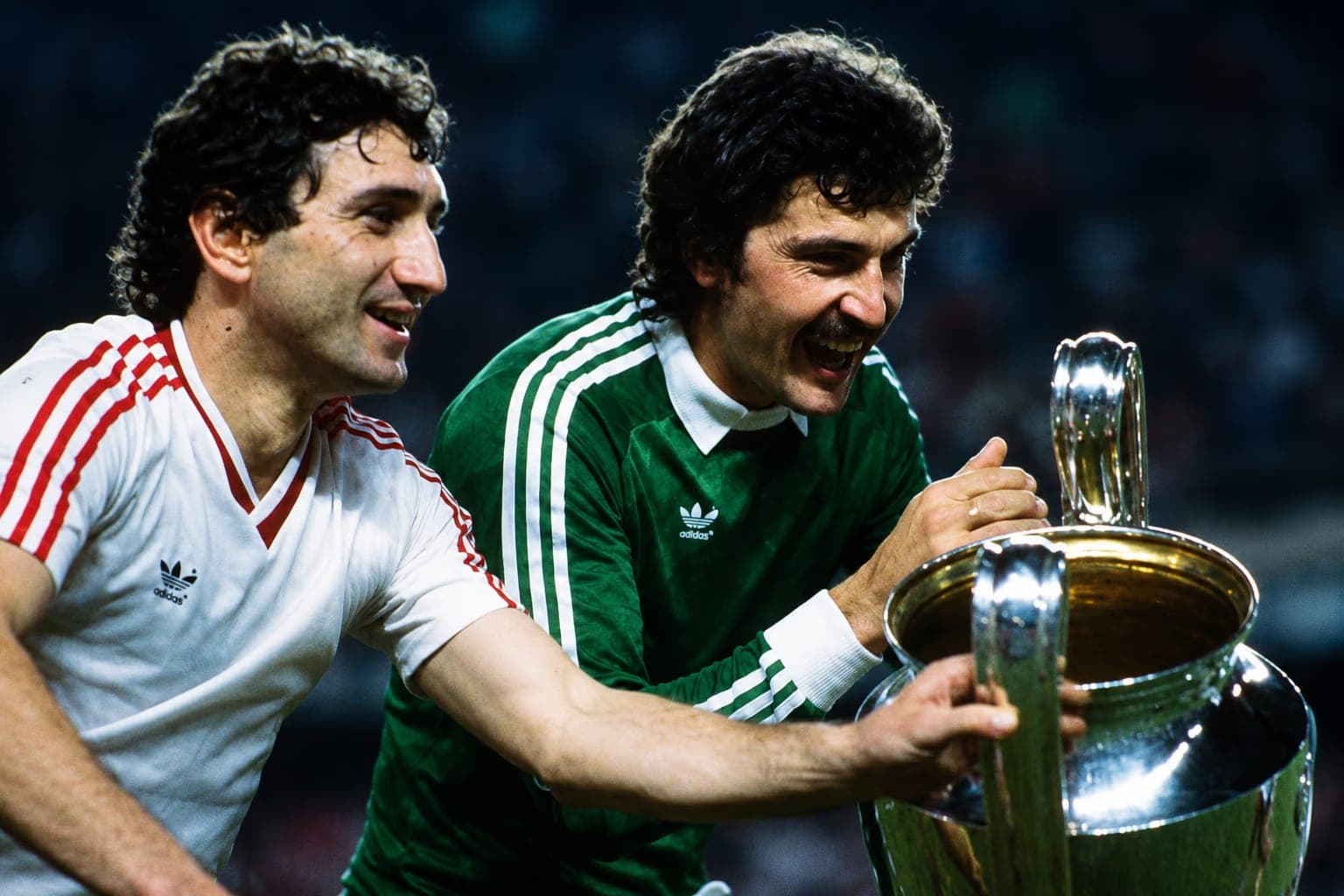
At the Ramón Sánchez Pizjuán stadium, Steaua București contest the European Cup final against Barcelona. Full time: 0–0. On penalties, 2–0 — because a moustachioed goalkeeper, Helmuth Duckadam, saves four consecutive kicks, a feat still unmatched in a European final. Playing for Steaua that evening, in order of appearance:
Starting XI:
- Helmuth Duckadam (goalkeeper)
- Ștefan Iovan (captain, replacing the suspended Stoica)
- Adrian Bumbescu
- Miodrag Belodedici
- Ilie Bărbulescu
- László Bölöni
- Lucian Bălan
- Mihail Majearu
- Marius Lăcătuș
- Victor Pițurcă
- Gavril Balint
Substitutes introduced during the match:
Anghel Iordănescu (73rd minute, for Bălan)
- Marin Radu II (112th minute, for Pițurcă)
Thirteen Romanians walk past the trophy at the end of extra time and the penalty shootout and lift it above their heads — the first from an entire nation to do so. Two more Romanians would go on to lift the trophy, in different decades and with other clubs. In fact, just one more…
The team's captain, Tudorel Stoica, is absent from the final — suspended after accumulating yellow cards on the European run. Stoica nonetheless receives a medal as a member of the winning squad. According to lists published by the Romanian sports press (ProSport, Fanatik, Tikitaka), the medal-winning Steaua squad of 1986 numbers seventeen Romanians: the thirteen on the pitch, plus Tudorel Stoica, reserve goalkeeper Vasile Stângaciu, Marin Pistol and Anton Weissenbacher (who played in the semi-final against Anderlecht but did not appear in the final).
Belgrade, 1991. And then again.
Five years later, on 29 May 1991, the European Cup final is played in Bari, between Red Star Belgrade and Olympique Marseille. After 0–0 and 120 minutes, Red Star win on penalties, 5–3.
At the heart of the Serbian defence plays the same player who, five years earlier, stood at the heart of Steaua București's defence. Miodrag Belodedici — a fugitive from Ceaușescu's Romania since 1988, sentenced in absentia to ten years for treason in his country of birth — becomes the first footballer in history to win the European Cup with two different clubs.
He remains the only Romanian with two European Cups on his shelf.
Madrid, 2010
On 22 May 2010, at the Santiago Bernabéu, the UEFA Champions League final between Inter Milan and Bayern München. José Mourinho lines up a Romanian defender who shadows Arjen Robben for long stretches:
Cristian Chivu, number 26.
Inter win 2–0, with a Diego Milito brace. Chivu is substituted in the 68th minute. At the final whistle, he lifts the second Champions Cup won by a Romanian with a foreign club.
He remains the only Romanian to have won a Champions League in the modern format (post-1992).
The thirteen nobody remembers
On another evening, 24 May 1989, Camp Nou, Barcelona, Steaua contested another final — this time against AC Milan of Sacchi, Van Basten, Gullit, Maldini, Baresi. Steaua lose 0–4.
Steaua line up from the first minute under manager Anghel Iordănescu:
- Silviu Lung (goalkeeper)
- Dan Petrescu
- Adrian Bumbescu
- Ștefan Iovan
- Dorin Ungureanu
- Daniel Minea
- Tudorel Stoica (captain — now available)
- Gheorghe Hagi
- Iosif Rotariu (replaced at half-time by Gavril Balint)
- Marius Lăcătuș
- Victor Pițurcă
Five of them had won the 1986 final — in the squad or on the pitch: Bumbescu, Iovan, Lăcătuș, Pițurcă, Balint (all on the pitch in Seville) and Stoica (suspended in 1986, but a medal recipient).
They remain the Romanians who have both won and lost a European Cup final.
Losing for the first time were Hagi, Petrescu, Lung, Ungureanu, Minea, Rotariu — plus the substitutes brought on during the game (Balint, and two or three others).
Gheorghe Hagi played in the 1989 final and lost it 0–4. He had not featured in 1986 (he joined Steaua only in the summer or autumn of that year). The greatest name in Romanian football does not appear among the fourteen. The most famous Romanian footballer neverlifted the Champions Cup above his head.
Adding the thirteen on the pitch in 1986 to the new names who lined up in the 1989 final, plus Chivu in 2010, we reach at least twenty Romanians who set foot, at least once, on the pitch in a European Cup / Champions League final. Counting the substitutes used in 1989, the exact figure depends on how you read the squad lists — somewhere between 20 and 25.
Fourteen won.
An honest note
Several Romanian sports media outlets count Florin Răducioiu as the third 'Romanian winner of the Champions League.' In the 1993–94 season he was a player at AC Milan when Milan won the final 4–0 against Barcelona in Athens.
The reality is more nuanced, however. Capello, the Milan manager, was compelled to leave Răducioiu — alongside Jean-Pierre Papin and Brian Laudrup — out of the match-day squad for the final: the UEFA rule at the time limited the number of eligible foreign players to three. Răducioiu did not play a single minute of that final. According to several sports sources (Tikitaka.ro, World Football), he received a medal as a member of the league-winning squad.