On the night of 23 June, in the centre of Borșa, on a street closed to traffic, a pyre rises — built not of firewood but of torches of split fir. Around it: hundreds of people, three generations of dancers in Maramureș costume, fiddlers and a drummer. And before the fire: opera arias and ballet beneath the Rodna Mountains, at the "Symphony of Love" concert. A custom documented by ethnographers in the Vișeu Valley — Borșa included — celebrated today as a festival of the whole town.
The skeleton of the pyre is already standing in the middle of the street as the sun goes down. It is made of pale, freshly split wood, almost delicate — the kind of object you walk past without seeing. The evening has other priorities for now: on the stage in the centre of this mountain town there is opera and ballet, the food trucks are turning out churros and lemonade, the terraces are full, children tug at balloons, phones film everything.
Before the fire: the "Symphony of Love"
Few concert halls anywhere have such a backdrop. Behind the stage, above the fir trees in the foreground, rise the slopes of the Rodna Mountains, the ridge of Pietrosul still patched with cloud. The "Symphony of Love" concert — part of the "Nights of Sânziene" festival — brought to Borșa famous opera arias, Italian canzonettas, waltzes, tangos and film music, with conductor-violinist Bogdan Costache, the Italian tenor Paolo Spagnuolo of Teatro alla Scala in Milan, the young classical guitarist Gabriel Popescu, and the Orchestra di Teatro d'Opera Italiana together with the Opera Vox orchestra, ballet and choir.
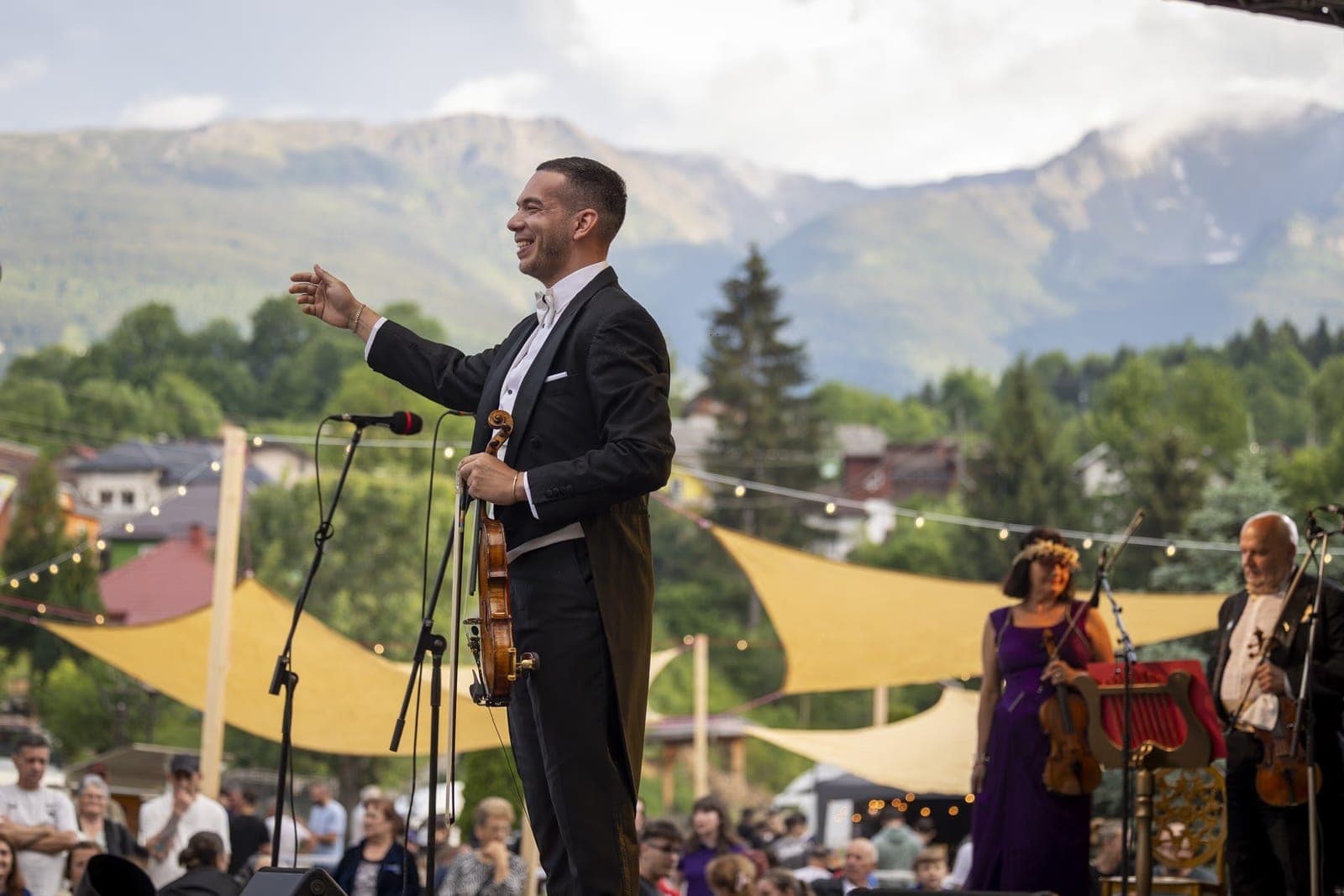
The opening, as befits Sânziene, belongs to the locals: the town's folk dance groups take the stage first, its LED wall running with Maramureș cross-stitch patterns — red and black stitches, the same as on the embroidered waistcoats in the audience. Then the world changes. The women of the orchestra wear not the regulation black of the pit but long dresses the colour of summer — bright green, blue, powder pink — and flower crowns in their hair, in keeping with the holiday. The choir likewise: pastel gowns and wreaths of sânziene flowers, as if the fairies of the night had been handed sheet music.
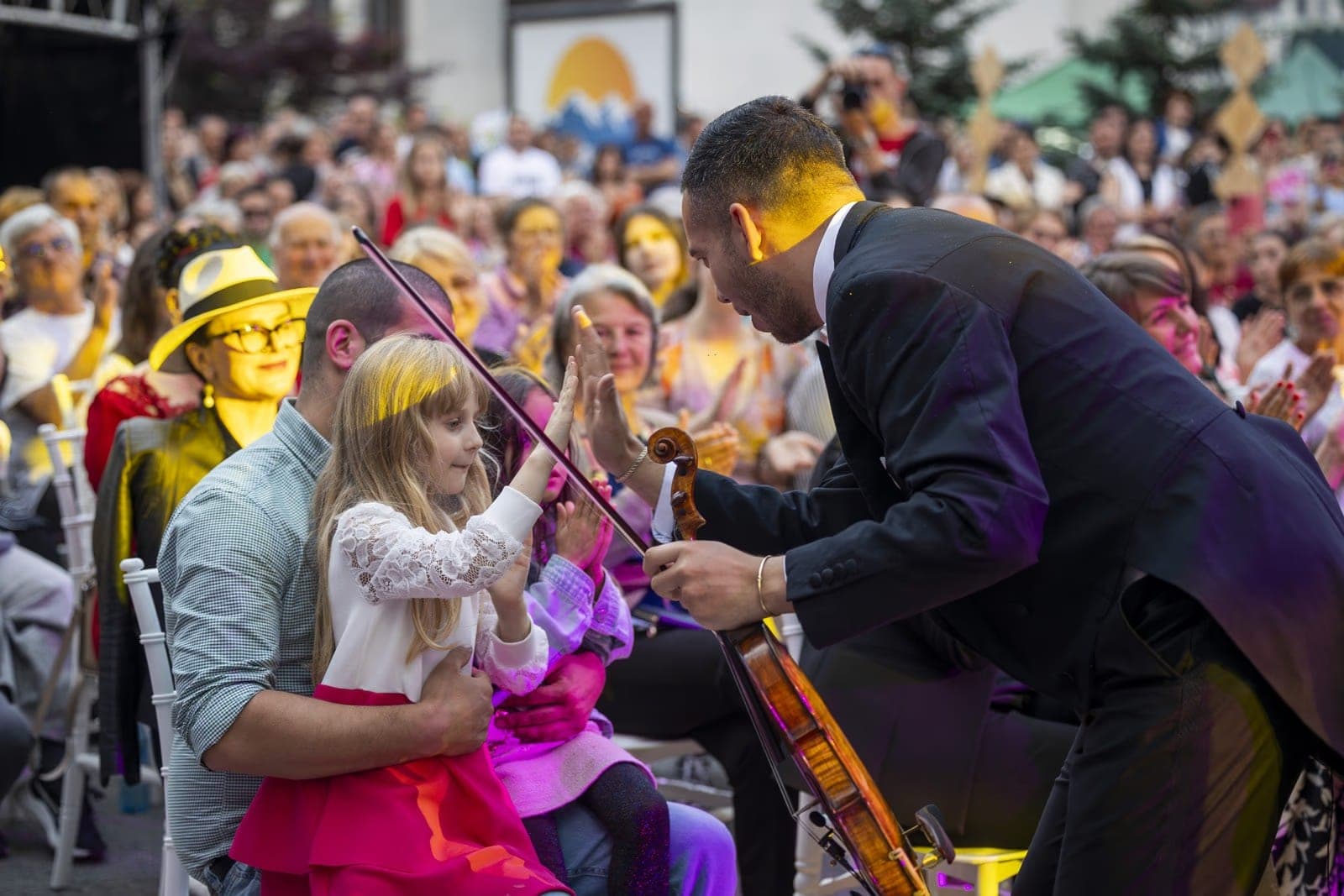
The moment that stays: Bogdan Costache steps off the stage, violin and all, and walks down the rows of chairs playing. A little girl in a white dress, perched on her father's knee, reaches out and touches the moving bow — one second in which classical music has no pit, no stalls, no protocol left.
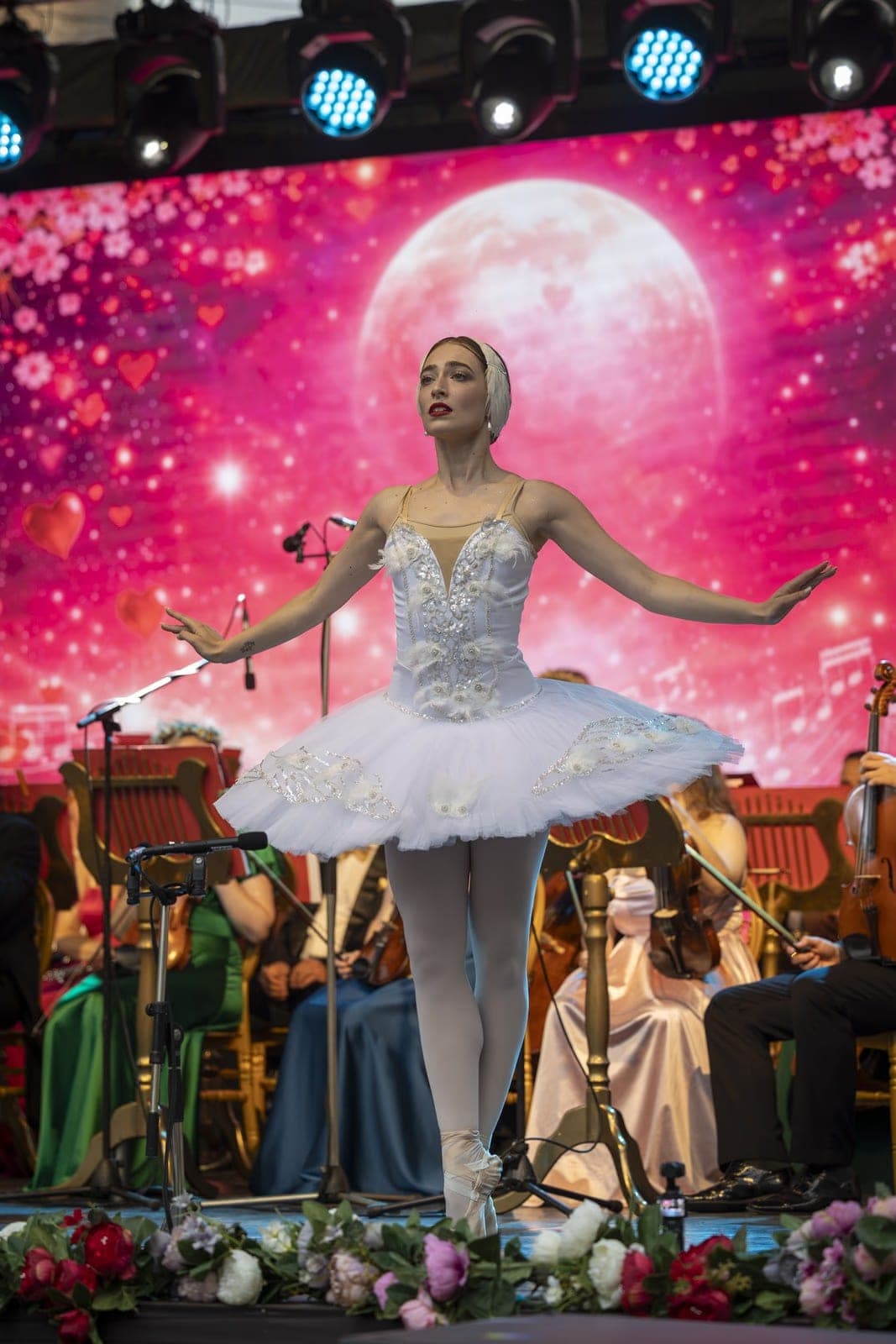
The ballerina dances her first solo from Swan Lake, in a white tutu, to the orchestra playing live; later she returns with her stage partner for a tango at the very edge of the stage, one step from the front row. Among the evening's numbers: "Caruso", Lucio Dalla's homage to the great tenor, and the theme from Pirates of the Caribbean — proof that the "film music" on the programme was not a figure of speech. And when the choir raises its glasses in a toast — the brindisi from La Traviata, the moment when opera itself clinks glasses with its audience — the champagne flutes catch the pink of the stage lights.
The finale comes with confetti: the whole company, shoulder to shoulder — tailcoat next to flower crown, ballet dancers next to violinists — bowing in the coloured rain. Above the stage hangs the full moon of the LED wall; another, projected, drifts across the façade of the town hall. Between the two moons, the town rises from its chairs. Because the real encore of the evening is not on stage.
 1 / 49
The fire is lit
The dance groups gather around the pyramid, someone touches a flame to it — and within seconds the street has only one centre of attention left. The town settles into a circle by itself, the way people have settled around fires for as long as fires have existed.
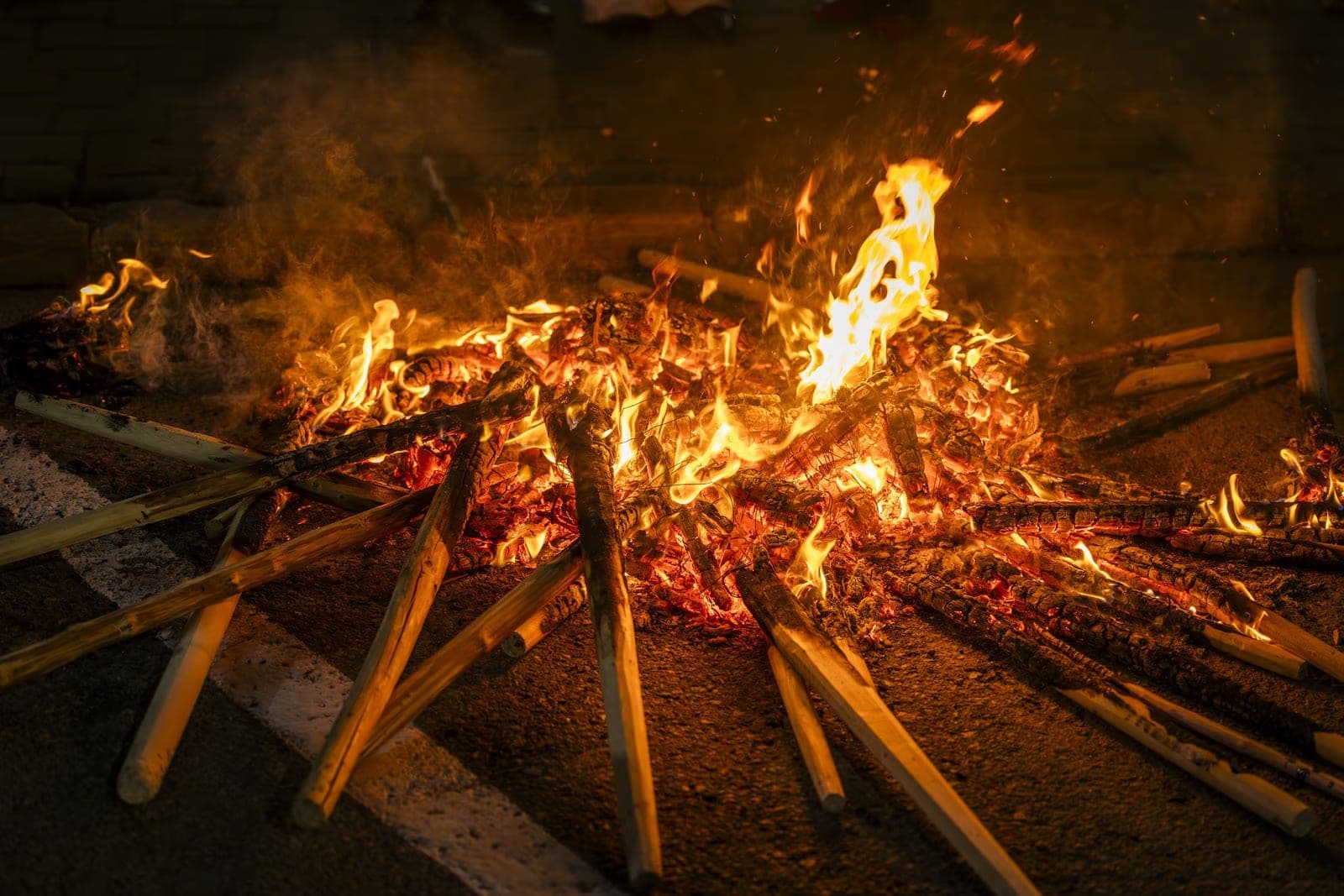
It is worth getting close, as close as the heat allows. The pyre is not built of firewood. It is built of objects: bundles of finely split fir laths, tied with string and wire, stuffed with tow, stacked one upon another. Some are shaped like narrow ladders, with notched rungs, smeared with black resin. These are torches — the objects that, in the villages of the Vișeu Valley, were swung blazing overhead on Sânziene eve, year after year, generation after generation. Here, in the centre of town, they make up the very body of the fire. Not props: the custom itself, laid on the pyre.
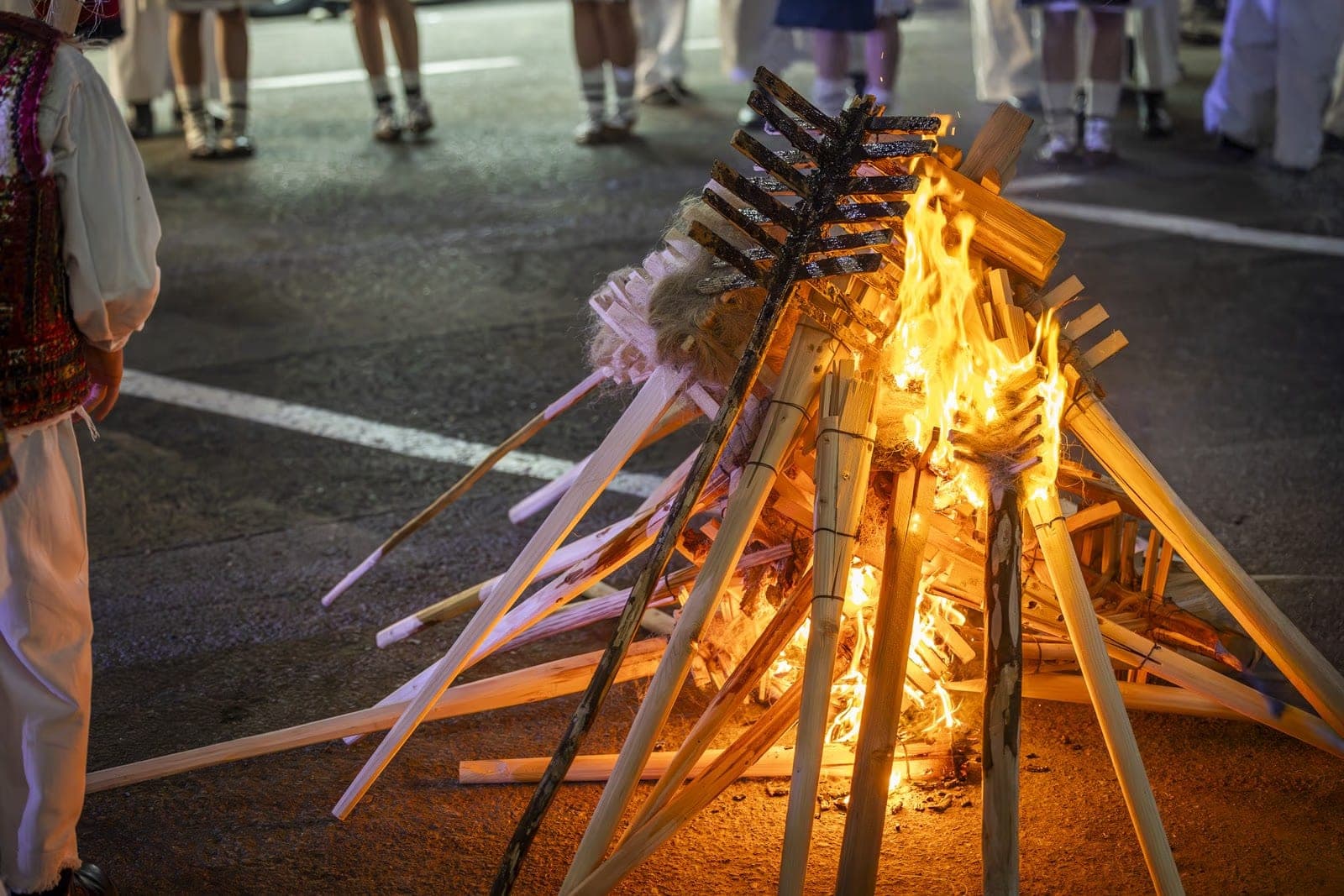
The flames climb several metres. Sparks rise high, smoke settles over the apartment blocks and the hospital building in the background. The heat pushes the circle of onlookers back a step, then another. And into the orange light, one by one, come the dancers.
Three generations around one fire
The smallest of them barely clears a metre. He stands very straight, black hat pulled down over his eyes, and seeks out his partner with the seriousness of someone who knows this is not a game. The girl facing him wears a crown of white flowers, tightly plaited; halfway through the dance it begins to slip down her forehead and she pushes it back without missing a step. Two paces away, the blaze.
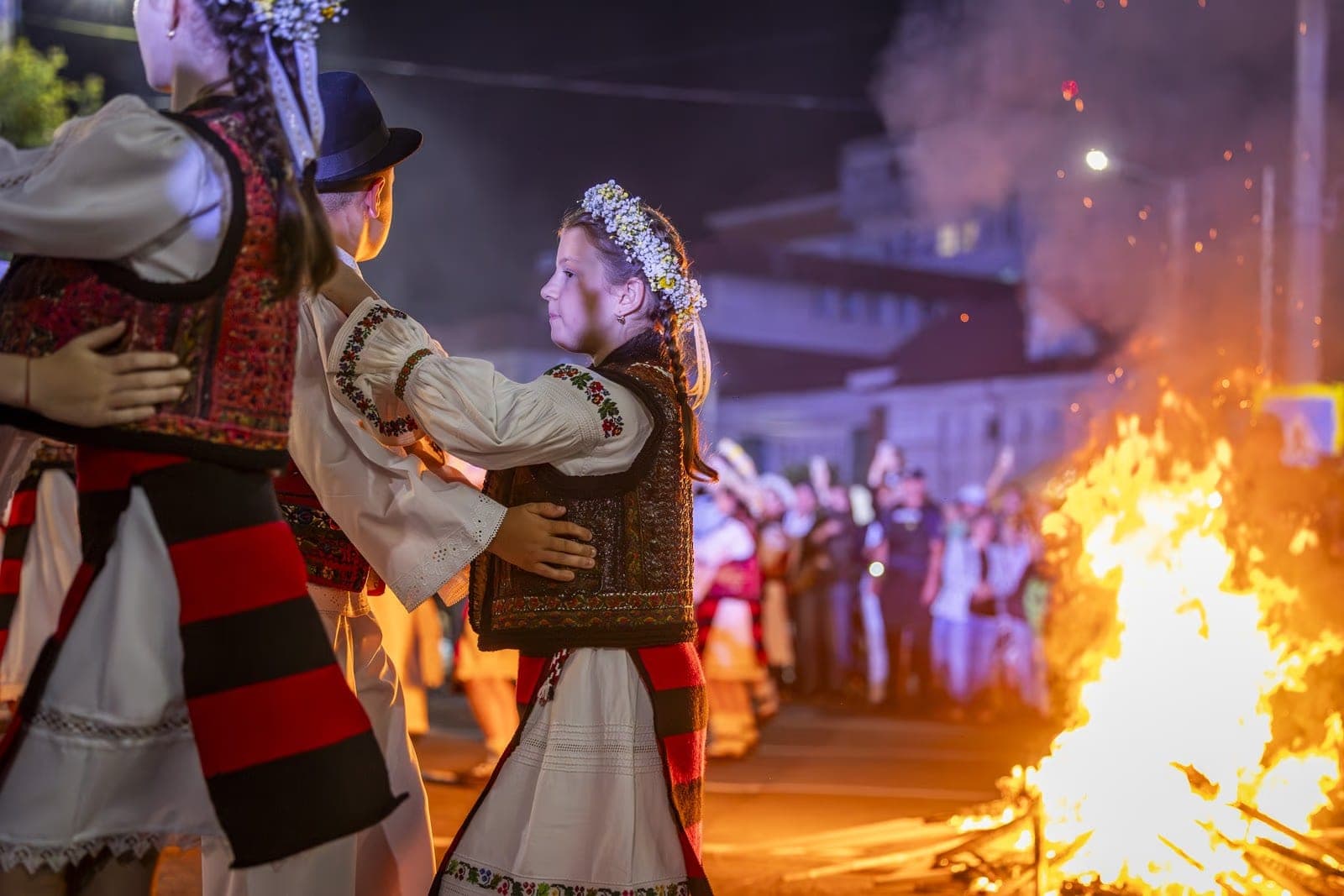
The ensembles come in waves, by age: the children, then the girls and the young men, then men in their prime. All wear the dress of the valley — white embroidered shirts, densely stitched floral waistcoats, aprons in broad red-and-black stripes, narrow-brimmed hats, leather opinci laced over white woollen socks. On the girls' heads, crowns of white and yellow flowers: the sânziene — lady's bedstraw — that gives the night its name.
The music is made on the spot, with no stage and no playback. Fiddles, saxophone, accordion, drum — the musicians stand between fire and crowd, faces shining with the heat, keeping time for as long as the dancers last. The young men dance in a circle, with claps and shouted verses that cut through the noise of the crowd. At one point they all drop to one knee at once — one knee, one movement — and one of them snatches off his hat and sweeps it towards the fire, like a salute. The girls join the round dance, hands on the shoulders in front of them. In one long line, the dancers hold their open palms out towards the flames, the way you would hold out your hands to warm them — or to offer something.
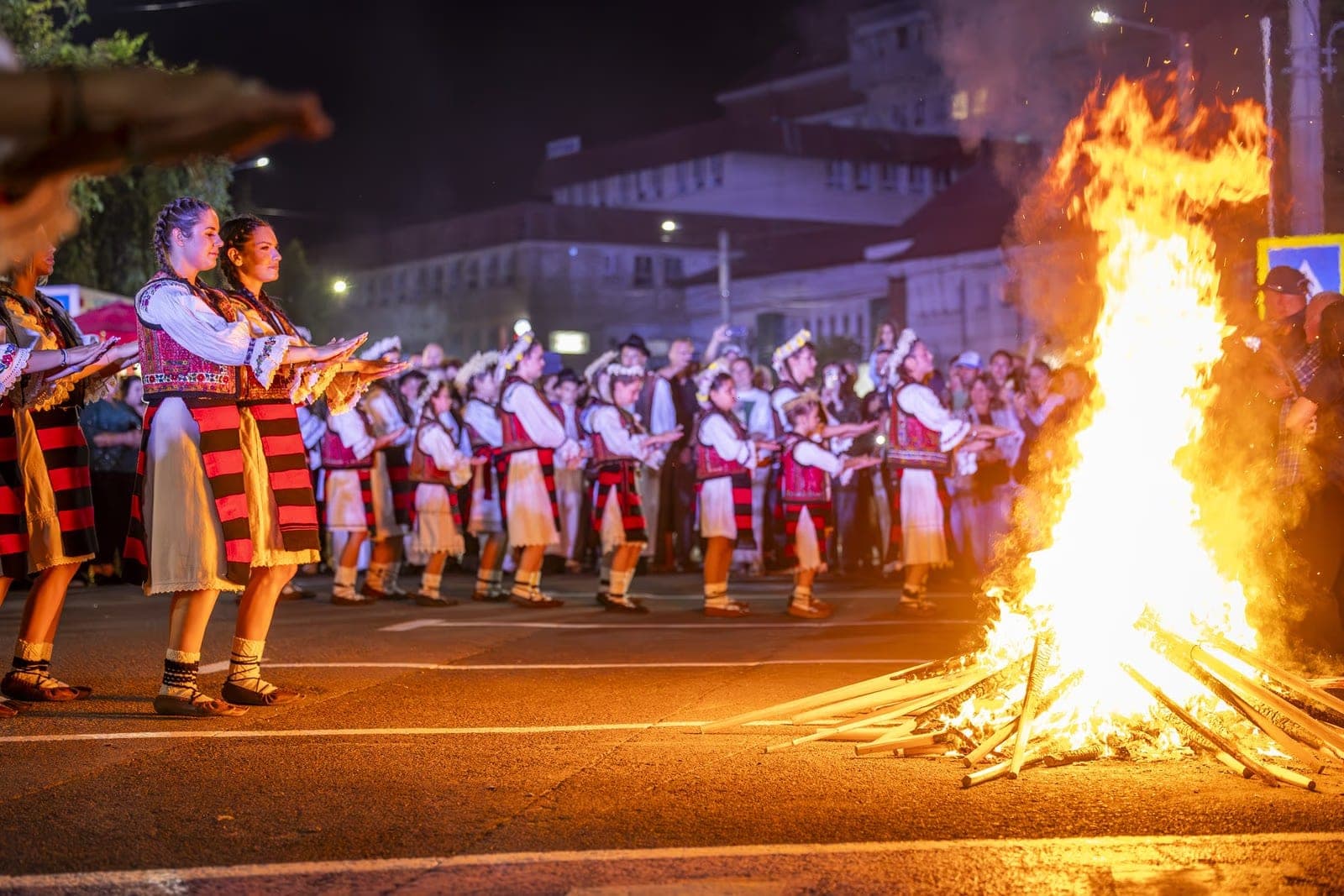
All around, the whole town. Grandmothers at the edge with coats over their shoulders, June or not — mountain evenings are cold, even at midsummer. Parents with children asleep on their shoulders. Gendarmes and local police guarding the perimeter, backs to the fire, faces to the crowd, as the job requires. Dozens of phones held high. And among costumes cut to nineteenth-century patterns, a black Rolling Stones T-shirt — Borșa in 2026, a contrast without a contradiction.
The phones tire first. Their lights go out one by one, and then you can hear what was there all along: the crack of the wood, the fiddles, and a good kind of silence — of people looking into a fire and feeling no need to say anything.
Toward the end of the night, the pyre collapses into embers. Left on the asphalt are the pale handles of the torches, their heads charred, and the wire that held them together — the same construction detail Maramureș ethnographers have been recording for decades. A whole custom, summed up in a piece of blackened wire.
The event is organised by Borșa's town hall and house of culture, with the local ensembles — a celebration the institutions have made their own. But the custom they stage is no festival invention. It is one of the very few Romanian Midsummer fire customs attested in the documentary record — and it is here, in the Vișeu Valley, that it is at home.
 1 / 40
The documented history: what we know for certain about the Sânziene fires
Here it is worth slowing down, because a thick modern mythology has been spun around Sânziene. What can be proven from documents is less spectacular than the legends — and all the more precious for it.
The first written trace is 160 years old and belongs to a meticulous Transylvanian Saxon. In 1866, in Sibiu, the historian Wilhelm Schmidt published a book on the folk calendar of Transylvania's Romanians — Das Jahr und seine Tage in Meinung und Brauch der Romänen Siebenbürgens — in which he noted, under the feast called "symzelene": "Abends erglühen Johannisfeuer auf den Höhen" — "in the evening, St John's fires glow on the heights". Their flames, Schmidt wrote, were meant "to drive the spell of the wicked away from man, cattle and field". He was writing of the Cluj area "and elsewhere". It is the earliest verifiable attestation of Sânziene fires among Romanians.
Just as telling is what the documents do not say. The great compendium of summer festivals — Tudor Pamfile's Sărbătorile de vară la români (The Summer Feasts of the Romanians, 1910), covering mainly Moldavia and Wallachia — describes Sânziene across dozens of pages: wreaths thrown onto rooftops, healing herbs, Drăgaica fairs. It mentions no fire at all. Nor does Dimitrie Cantemir in the oldest description of the feast (*Descriptio Moldaviae*, c. 1714–1716, on the Drăgaica). And in Oltenia, the questionnaires of the Romanian Ethnographic Atlas and recent scholarship found no Sânziene fires whatsoever. The documentary conclusion is plain: the custom was never general among all Romanians. The Sânziene fire is a northern custom — of northern Transylvania and, above all, of Maramureș.
And in the Vișeu Valley it is the best documented in the country. The ethnographic journal Memoria Ethnologica published Ștefan Andreica's study of Sânziene in Vișeu de Sus: "The best-known custom practised on Sânziene eve, after sunset, is the swinging of the torches. It is a means of appeasing the Sânziene fairies and of driving away evil fairies, unclean spirits, strigoi... The fire of the torches draws luck in marriage." Fieldwork also preserved the shouted rhyme, in dialect, love-promise included: "Hai, Marie, la faclie, / C-a zâňi șî Vasalie... / Să ťe dai pisťe faclie." — Come to the torch, Marie — for Vasile is coming too.
The ethnologist Anamaria Iuga, head of Ethnological Studies at the National Museum of the Romanian Peasant in Bucharest, confirmed in a 2017 interview that the custom is still alive "in the Vișeu area" — Vișeu de Jos, Vișeu de Mijloc, Vișeu de Sus, Moisei and Borșa: fires lit after sundown, torches "made of small pieces of fir" swung "following the circular motion of the sun", burning wheels of hay rolled down the hillside, and the cry "Ia făclia, măi!" — "Take up the torch, hey!" She also recorded the changes, without needless nostalgia: for fear of setting haystacks alight, the custom came down from the hills to the river valleys, and its main keepers today are children.
How is a torch made? The Baia Mare ethnographer Pamfil Bilțiu describes it: a stake of dry fir, sharpened at one end for a handle, split at the other and packed with resin and shavings, "then bound with wire so the fire does not fly apart as it burns". Precisely the objects that burned this night on Borșa's asphalt — down to the detail of the wire, visible in the embers.
The ethnologist Ion Ghinoiu, coordinator of the Romanian Ethnographic Atlas, fixed the custom in his dictionaries under the name "Făclia de Sânziene" — the Sânziene torch: the young men would gather in the evening "on a height beyond the village", form a circle, swing their burning torches "from east to west" while shouting in chorus "Făclia, măăă!", then come down into the village and plant the torches in the middle of the orchards — the fire carried home, among the trees about to bear fruit. Ghinoiu adds, honestly, that the custom exists only "in certain ethnographic zones". Not across the whole country.
There is only one other place in Romania where the communal Sânziene fire is as well documented: Maieru, in the valley of the Someșul Mare in Bistrița-Năsăud county — across the mountains, south of Borșa — where the local museum cites an attestation from 1768, and where the fire is jumped three times, "so that one is kept safe from evil spirits and illness".
What cannot be documented — the "Dacian custom"
Online, the Sânziene fires are almost invariably described as a "Dacian ritual", a "pre-Christian solar cult", a "heritage thousands of years old". The documentary truth is more modest, and deserves to be told as such.
There is no ancient attestation of the custom. The first written trace among Romanians dates from 1866. What came before — centuries or millennia — is possible, but unprovable. The "solar" interpretation (the swinging of the torches as an imitation of the solstice sun) belongs to the scholars, beginning with Schmidt himself in 1866 and continuing with Ghinoiu. The people who practised the custom spoke, in the field records, of other things, closer to life: evil spirits to be driven off, luck in marriage, orchards to be protected. And one detail undoes any astronomical rigour: in the Vișeu Valley, if it rains on 23 June, the torches are calmly postponed to the eve of Saints Peter and Paul, five days later. The sun can wait; people will not have their holiday spoiled.
Nor does European scholarship still hold to the solar-cult theory. James Frazer, its father, abandoned it himself in favour of the purifying explanation — fire that burns away evil — and the British historian Ronald Hutton (*The Stations of the Sun*, Oxford, 1996) showed that the explanations given by participants across the centuries were always protective, never astronomical.
What can be said with certainty is something else, and it is not little: Borșa and the Vișeu Valley keep one of the very few authentically documented Sânziene fire customs in Romania — with published ethnographic descriptions, with rhymes collected in dialect, with a torch-making technique handed down to this day. The form has changed, as everything alive changes: from the hills to the town centre, from the band of village lads to organised ensembles, from the dark of the valley to the light of phones. The wire that binds the laths has stayed the same.
A European night
The fire in the centre of Borșa has kin across the whole continent. The eve of the Nativity of St John the Baptist — the feast falls on 24 June, three days after the solstice — is the night of fires all over Europe, and has been, on record, for nine centuries: the first account of it as a folk custom was set down by the Parisian theologian Jean Beleth around 1150. In Transylvania, the "Szent Iván" fire, complete with fire-jumping, is attested among Hungarians as early as 1570, in Cluj. The Spanish have San Juan, the French Saint-Jean — in Paris, until 1648, the king himself lit the fire — the Latvians have Jāņi, the East Slavs Ivan Kupala. And in the Pyrenees, the descent from the mountains with burning torches on solstice night has been UNESCO intangible heritage since 2015 — Andorra, Spain and France filed the dossier together.
Romania does not appear in the great European surveys of summer fires — Frazer did not even include the Romanians in his chapter on "The Midsummer Fires". Perhaps because the Romanian form is different: not the huge bonfire of the town square, but the individual torch — swung overhead, carried through the orchard, planted in the ground. A custom of the hand, not of the crowd. Smaller, more intimate — and for that very reason easier to lose, unless someone keeps it burning.
In Borșa they keep it burning. With gendarmes around the perimeter, churros ten metres away and the Rolling Stones on a T-shirt — but they keep it burning.
Worth remembering
* The "Nights of Sânziene" festival featured, on the same evening of 23 June, the "Symphony of Love" concert on the central stage — with Bogdan Costache, Paolo Spagnuolo, Gabriel Popescu, the two orchestras and the Opera Vox ballet and choir, as announced by the organisers — and, after dark, the lighting of the Sânziene fire on the main street.
* The torches in the pyre are made the traditional way: split fir laths, bundled with string and wire, packed with tow and resin — the technique described by the ethnographer Pamfil Bilțiu.
* The costume is that of the Vișeu Valley: richly embroidered waistcoats, aprons in red-and-black stripes, opinci sandals, narrow-brimmed hats; the girls wear crowns of sânziene (lady's bedstraw, Galium verum) and field flowers.
* The Vișeu–Borșa area (with Moisei and Vișeu de Sus, de Mijloc and de Jos) is one of only two zones in Romania where Sânziene fires are solidly documented ethnographically; the other is Maieru, in Bistrița-Năsăud.
* The feast's name comes from the sânziana plant; the day overlays the Christian feast of the Nativity of St John the Baptist (24 June) and the nearness of the solstice — hence the German name for the fires, "Johannisfeuer", applied to the Romanian ones as early as 1866.
* What we did not see this year: torch-swinging on the hills and fire-jumping — in Borșa's town centre the fire belongs to the whole community, and the ritual centred on the pyre, with dance and music. Torches are not swung in town: in a crowd, it is simply too dangerous.
When the embers settle, people do not leave. They linger, without reason and without hurry, faces orange — children dozing on their fathers' shoulders, the musicians easing their strings, the gendarmes finally looking into the fire themselves. One night a year, an entire town looks at the same point — as the villagers Wilhelm Schmidt described watched the fires on the hills 160 years ago. The rest of the year, the torches wait in a shed: split, bound with wire, ready.