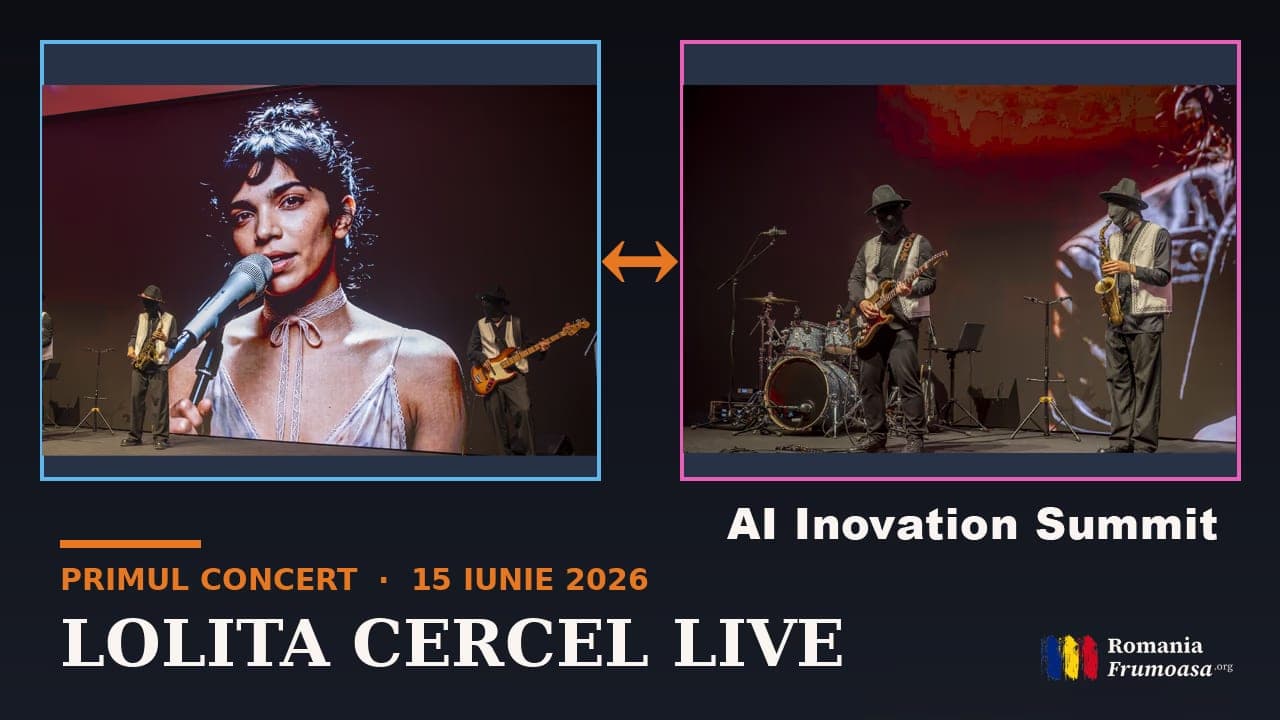
At Bucharest Tech Week 2026, Romania's first successful AI-generated singer performs live alongside real musicians — for the first time. Fifteen minutes that test how far the experiment can be pushed.
At 2:45 PM, on the stage of the Innovation Summit — part of Bucharest Tech Week 2026 — Lolita Cercel, Romania's first commercially successful singer created with artificial intelligence, does something she has never done before: she sings live, alongside a human band.
Fifteen minutes. That is how long the combined art-and-technology experiment lasted, listed in the official programme under the laconic title: „Lolita Cercel in a Live Band Performance." Sponsor: Universum Events. Venue: a corporate hall, the audience composed mostly of marketing directors, technology consultants and AI investors.
For those who have not come across the name: Lolita Cercel is a project launched in late 2025 by a designer from Bacău known publicly only as „Tom." The seven tracks he has released gathered, in their first month, millions of views. The musical style is described as a fusion between Balkan nostalgia and synthetic aesthetics — drawing centrally from the Romanian lăutărească tradition, a folk-music form with deep Roma roots.
Here is where things get complicated.
In January 2026, Roma activist Alexandra Fin criticised the project as „an exploitation and instrumentalisation of Roma culture." Independent Romanian artists joined the criticism from a different angle: AI-generated music gathers millions of views at launch, while working musicians spend years for the same exposure. They asked Spotify, YouTube and the streaming platforms to explicitly label AI-generated content. The request has not been heard — yet.
Today's concert is, then, the first time this contested project presents itself in a hybrid format — the synthesised voice meets the acoustic instruments of real musicians. The composition of the band remains unknown; its members chose to stay anonymous as well. The performance was warmly received in the hall, drawing open applause.
The editorial question worth asking: what is actually at stake?
For Bucharest Tech Week, the format confirms the event's broader thesis — AI enters mainstream cultural life, and the industry celebrates it as a new chapter. For the Lolita Cercel project, this is the first stage validation: the audience reacts positively, and the project's authority can grow. For the artists and activists who criticised it, this is institutional consecration — precisely the kind of gesture that confirms their concerns.
For the musicians in the band — the question is more delicate: how do you collaborate, as a living instrumentalist, with a (lead) voice that does not exist?
Fifteen minutes to see the result.
Reportage by Adi Coco · Seeing Romania · 15 June 2026.