
At the end of a forest road in the Retezat Mountains, where the Râul Mare narrows into a tight valley, stands a wall of rock and earth 168 metres high. It is Romania's tallest dam — a rockfill dam with a clay core, which is to say not a concrete structure but an artificial mountain, raised layer upon layer. A fifty-five-storey apartment block would reach its crest.
It is called Gura Apelor. It was built between 1975 and 1986. And it has a peculiarity few people know about: for thirty-five years it could not be filled to its design level. Excess seepage on the left abutment kept the reservoir below the level it had been designed for, and the downstream plant, Râul Mare-Retezat, ran for decades on roughly 200 of its 335 installed megawatts. Full impoundment, at elevation 1,072.5, was achieved only on 16 August 2021. In May 2026, Hidroelectrica announced the start of the plant's refurbishment.
Romania's tallest dam spent what amounts to a human lifetime with the water below the line it had been built for. And all that while, on the country's mountain roads, the coaches were going somewhere else.
There is no "largest dam in Romania"
First rule, because this is where most of the confusion starts: a superlative means nothing without a criterion. Romania has four different structures which, depending on what you measure, compete for the title.
The tallest is Gura Apelor, at 168 metres, followed less than a metre and a half behind by Vidraru — 166.6 metres, according to Hidroelectrica's technical sheet.
The largest stored volume is at Iron Gates I: 2.1 billion cubic metres, in a reservoir roughly 130 kilometres long — about the distance from Bucharest to Comarnic.
The largest power station is also Iron Gates I: 1,166 megawatts on the Romanian side alone, with a design output of more than 5.2 terawatt-hours a year — roughly a tenth of all the electricity the country produces.
The largest volume held back for flood attenuation — that is, to stop a flood before it reaches people — is at Stânca-Costești on the Prut, a scheme Romania operates jointly with the Republic of Moldova: more than half a billion cubic metres kept empty precisely so that high water has somewhere to go.
And if the question is which is the largest artificial lake on the country's inland rivers, the answer is Izvorul Muntelui, at Bicaz: 1.25 billion cubic metres and some 32.6 square kilometres of open water — about four and a half thousand football pitches.
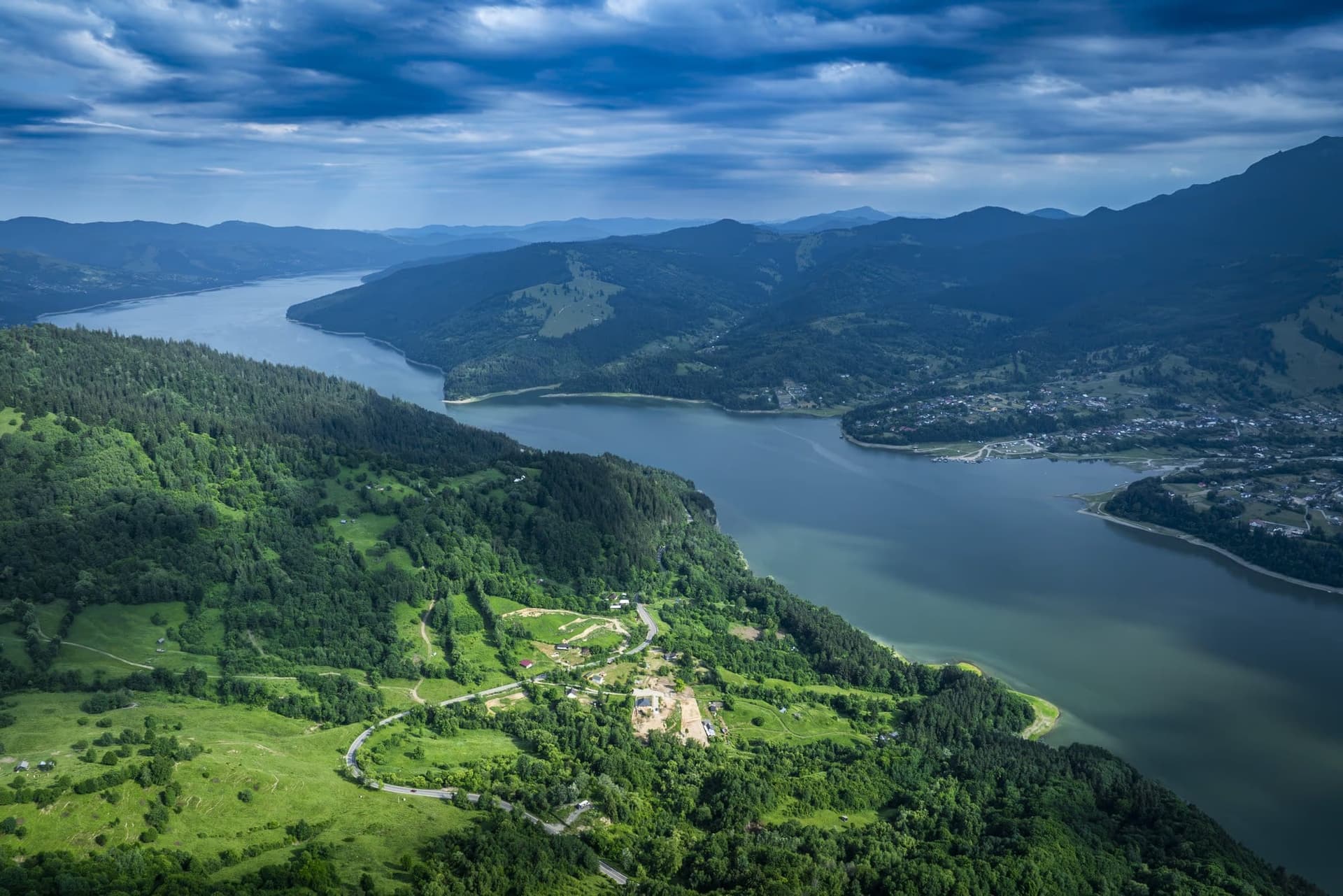
Four structures, four superlatives, no single title.
How many are there, in fact
Here too the numbers behave the same way: it depends what you count. According to a December 2025 briefing by the National Administration "Apele Române", the institution manages 82 major dams and 329 of lesser importance; Hidroelectrica holds 99 major dams; and more than 1,500 small dams — fish ponds, amenity reservoirs, local works — belong to municipalities, companies or private individuals. Added up, they pass two thousand four hundred structures, of which only about two hundred fall into the exceptional and high-importance categories.
Of all these, the ones that count in international statistics — "large" dams, over 15 metres high, by the definition of the International Commission on Large Dams — number around 246. That is the figure with which Romania appears in world rankings, somewhere ninth in Europe. Not in the top three; nowhere near last, either.
So the line "Romania has thousands of dams" is technically true — and completely useless, because it puts a two-hectare pond in the Bărăgan and a 168-metre wall in the Retezat in the same basket.
The gallery of the big ones
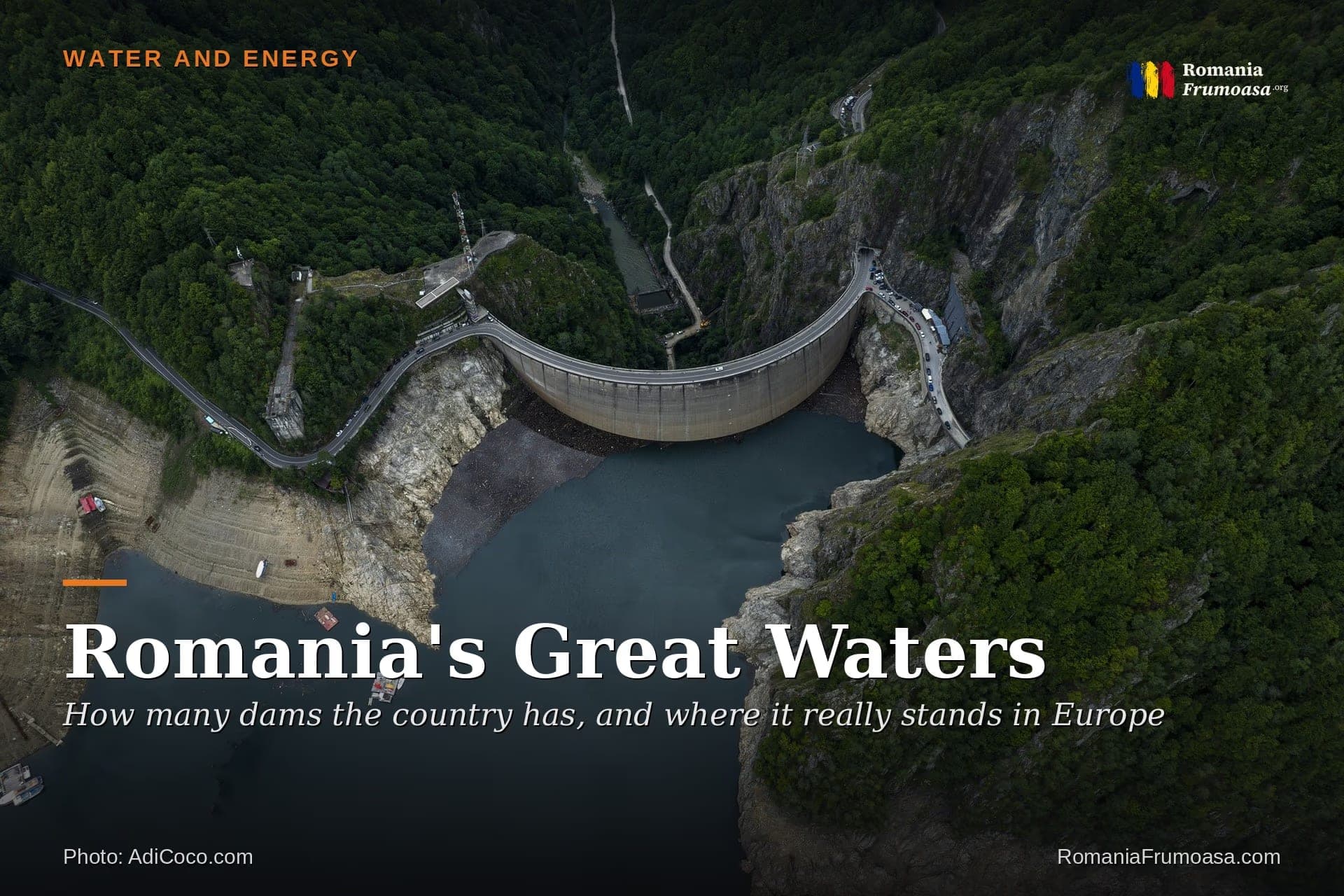
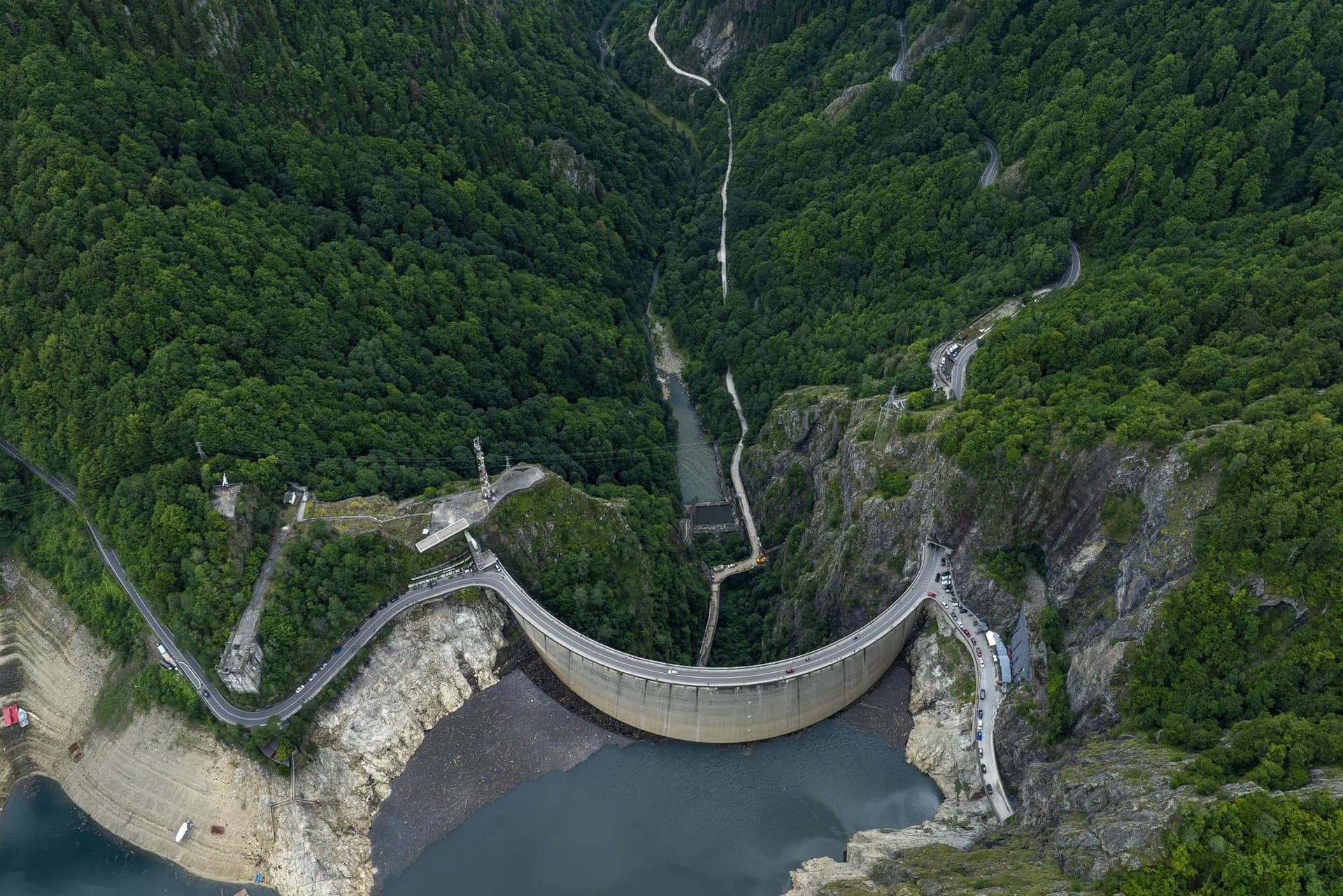
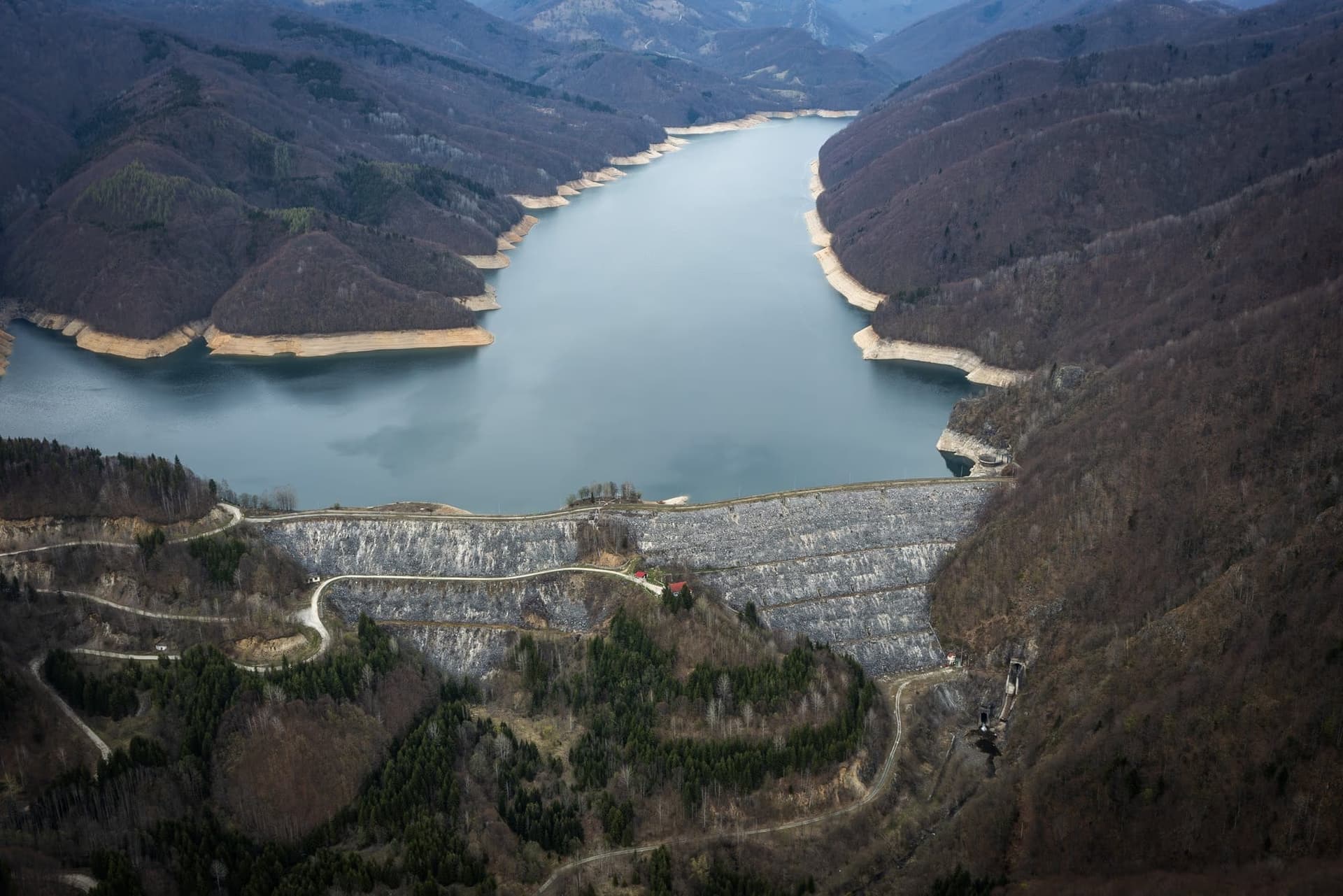
Vidraru (166.6 m) is probably one of the most photographed places in Romania. A thin concrete arch, with a 307-metre crest, wedged between two limestone walls on the Argeș valley, with the Transfăgărășan climbing over it. Impoundment began in March 1966; the power station was inaugurated in December of the same year. The reservoir holds 465 million cubic metres and, according to Apele Române, covers 870 hectares.
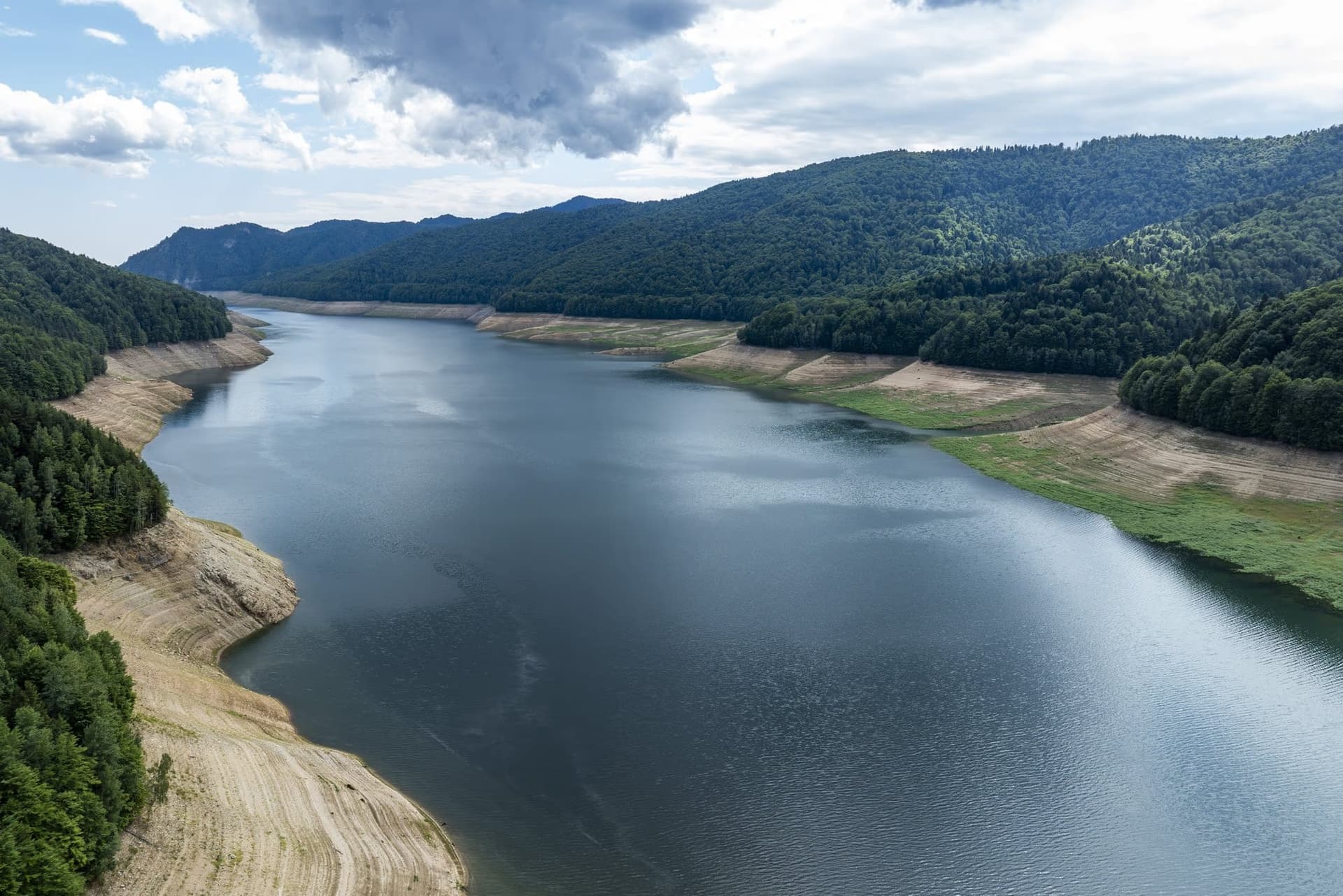
Since August 2025, Vidraru has been drawn down under control — for the first time in almost sixty years — for a refurbishment worth about 188 million euros, contracted only at the sixth tender, after five failed ones. The controlled refill began on 2 April 2026, in stages, at first only through the Topolog intake, with the secondary Limpedea and Valea lui Stan intakes diverted until turbidity drops. The target is minimum operating level in October 2026. On 6 August 2026, the reservoir stood at 46 per cent full.
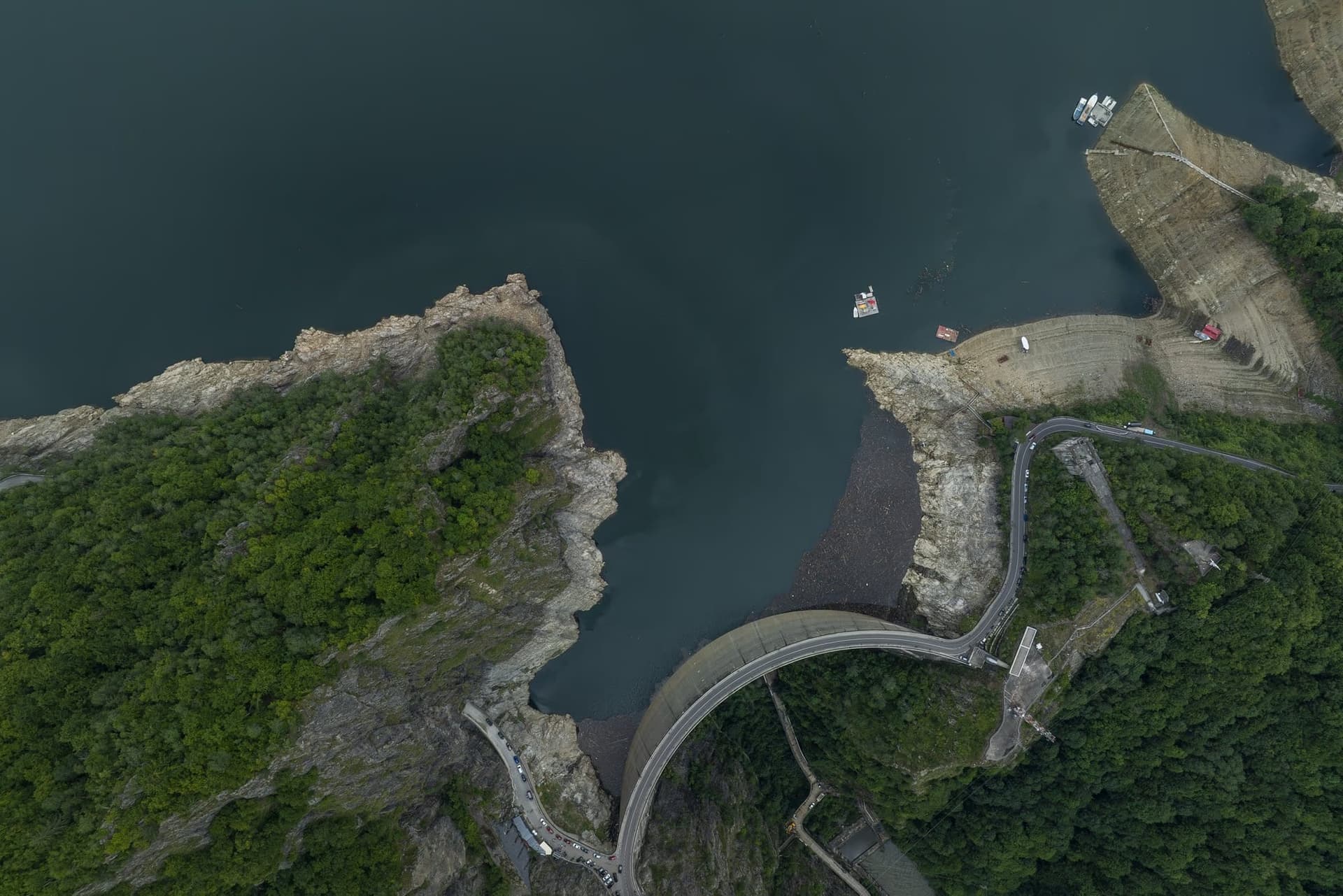
The drawdown was one of the most closely watched infrastructure events of recent years — the images of the uncovered valley circulated widely. What was said less often is that, most likely, none of us will see that sight again: the next drawdown of Vidraru, if there is one, comes decades from now.
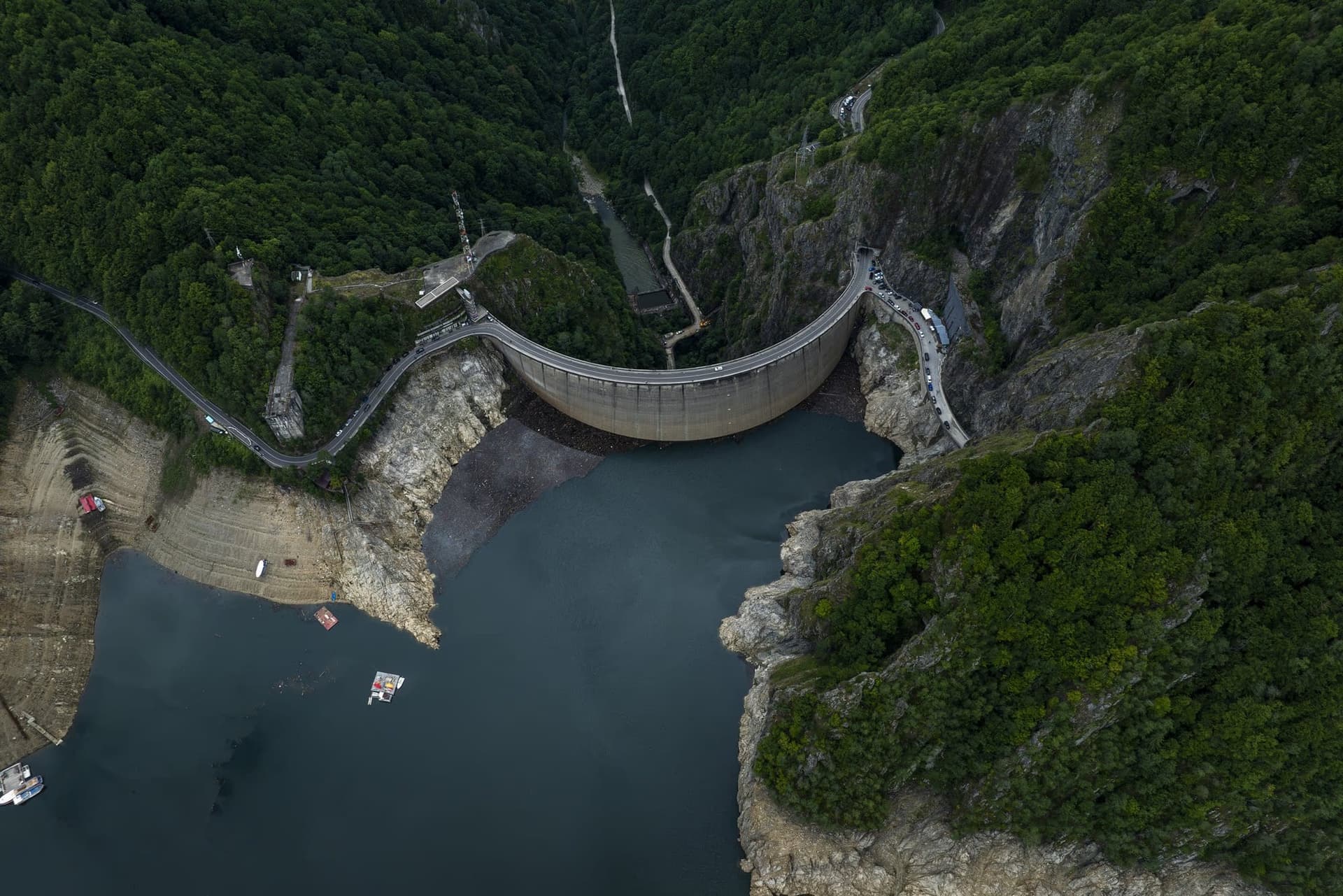
Izvorul Muntelui (127 m) is Vidraru's opposite in engineering terms: a massive concrete gravity dam, built between 1950 and 1960, holding back the largest lake on the country's inland waters. The downstream plant, "Dimitrie Leonida" at Stejaru, has 210 megawatts and was, in its day, the industrial symbol of post-war Romania. Its turbines are now sixty-six years old.
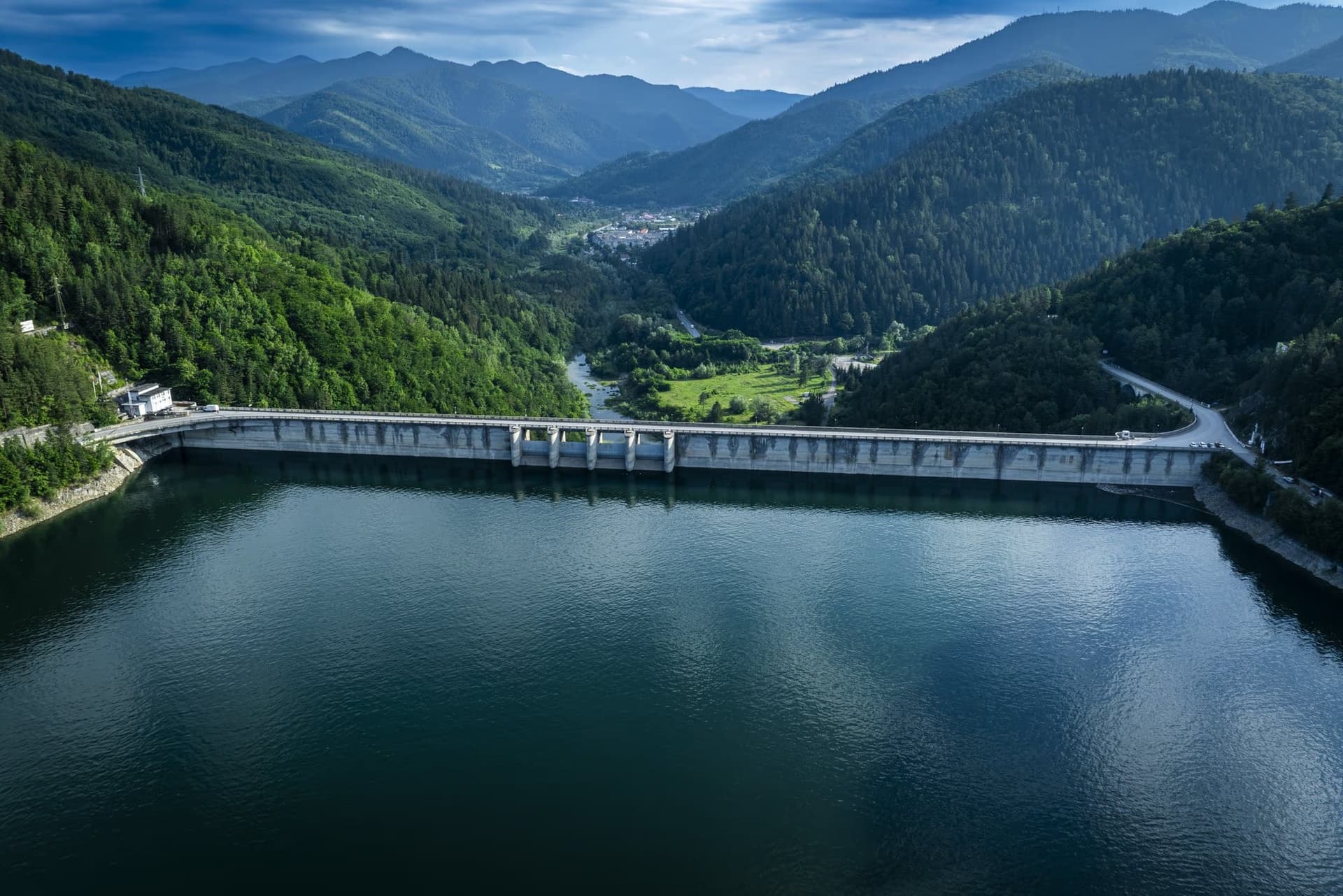
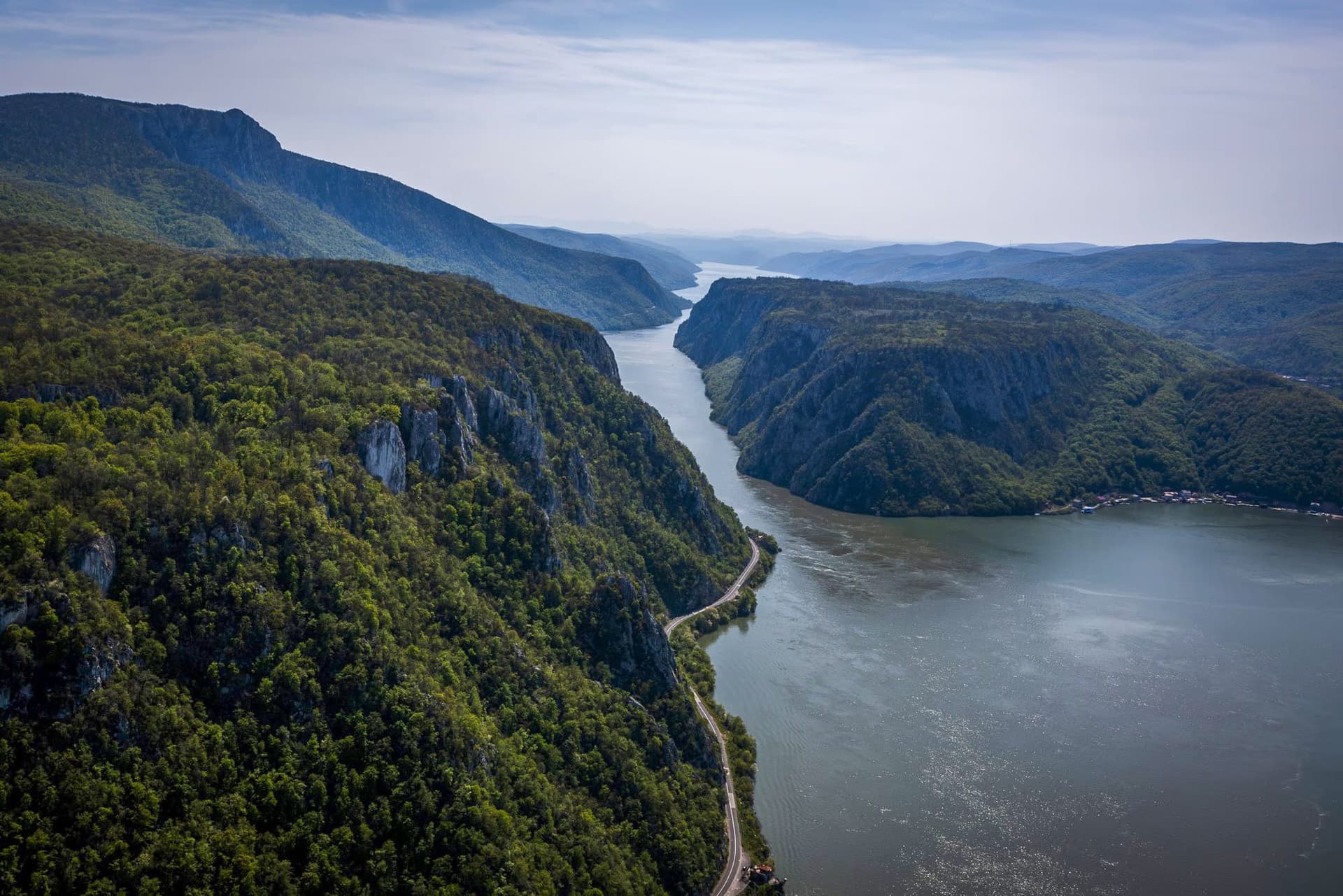
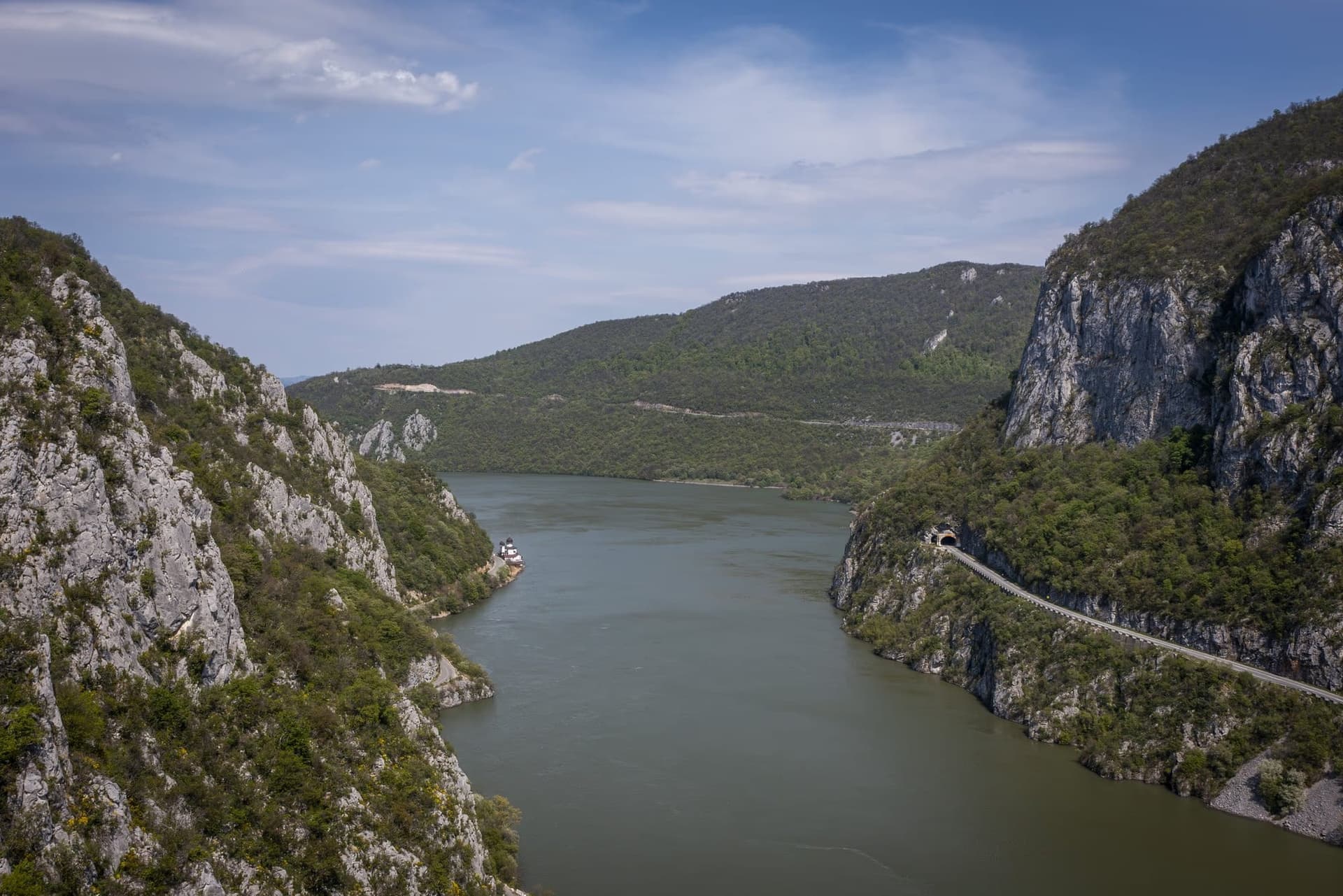
Iron Gates I is the only Romanian scheme of genuinely continental scale. The dam closes the Danube in the gorge, jointly with Serbia; on completion in 1972, the Serbian operator of the scheme placed it among the world's ten largest hydropower plants. The reservoir covers more than a hundred square kilometres. Each of the twelve Kaplan turbines — six Romanian, six Serbian — has a runner nearly ten metres across.
Poiana Mărului (125 m), on the Bistra Mărului in the Banat, is the country's fourth tallest by structural height and probably Romania's least known large dam. Its reservoir holds some 96 million cubic metres.
Siriu (122 m), on the Buzău, is a rockfill dam in a seismic zone — Vrancea. Its operating rules reserve nearly 35 million cubic metres solely to stop a flood before it reaches Nehoiu and Buzău.
Vidra (121 m), on the Lotru, feeds the most spectacular power station in Romania in purely physical terms: Lotru-Ciunget, 510 megawatts, with a gross head of 809 metres. The water falls through penstocks more than twice the height of the Eiffel Tower before hitting three Pelton turbines. It is the country's second largest plant by installed capacity, after the Iron Gates, and the largest on inland rivers.
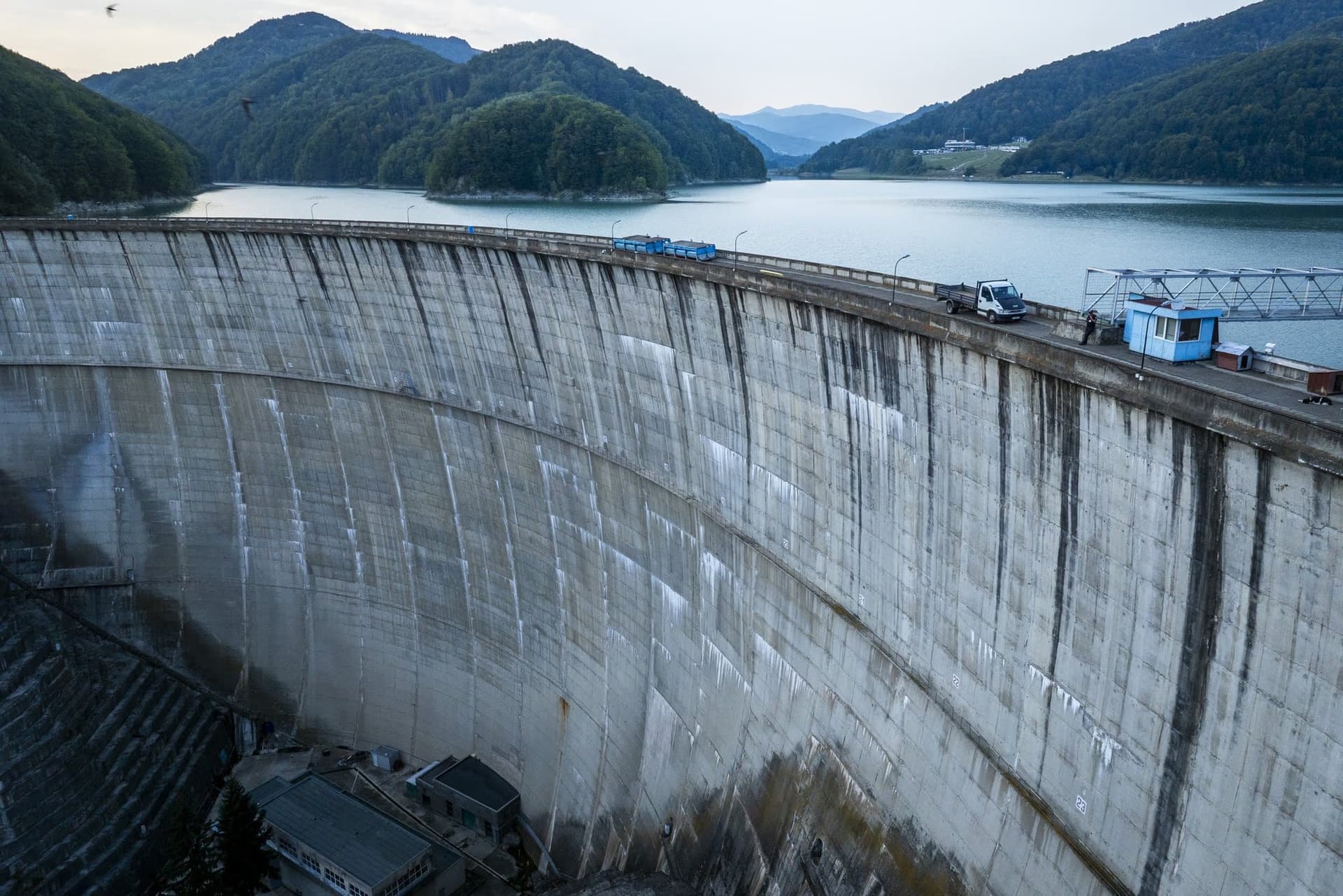
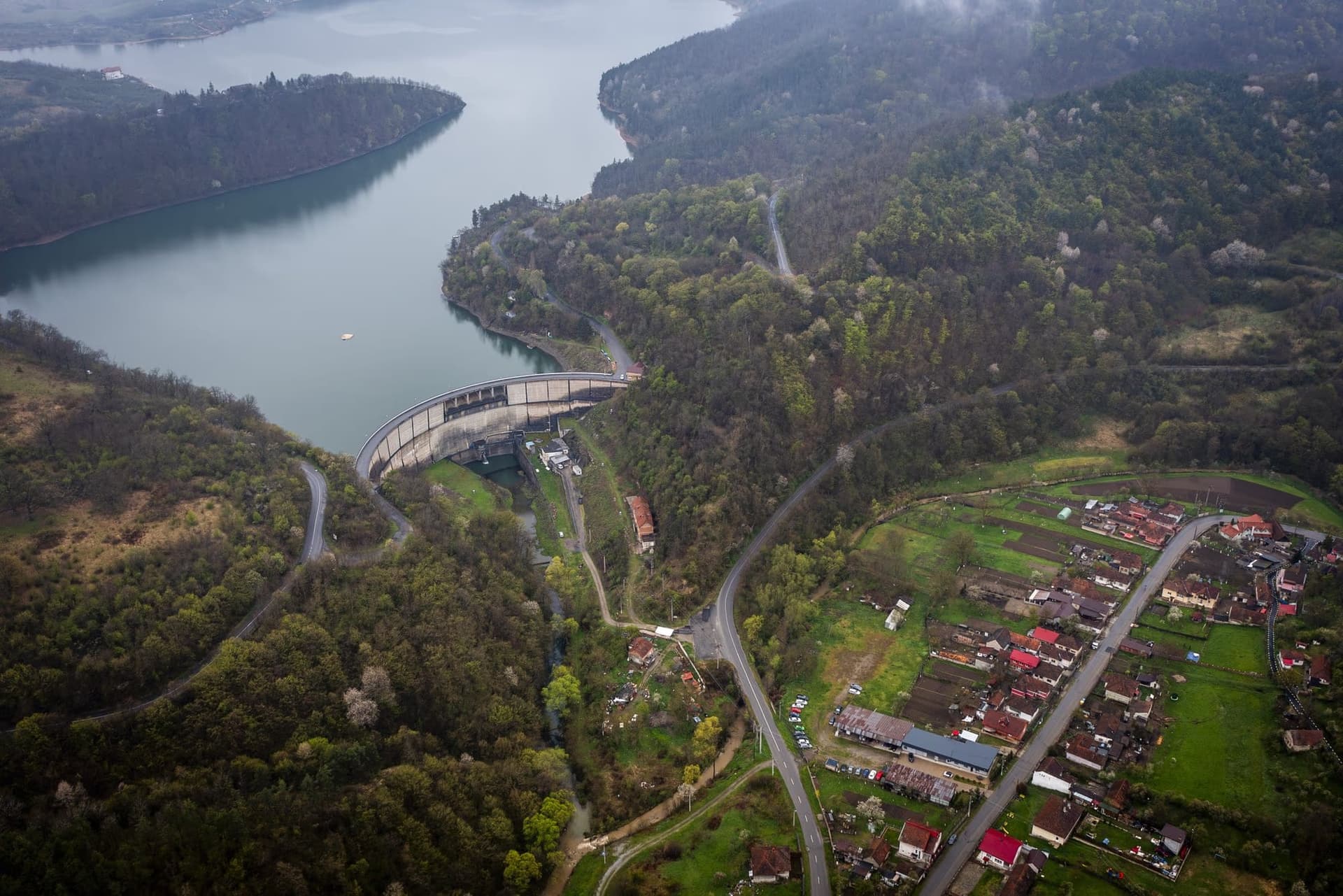
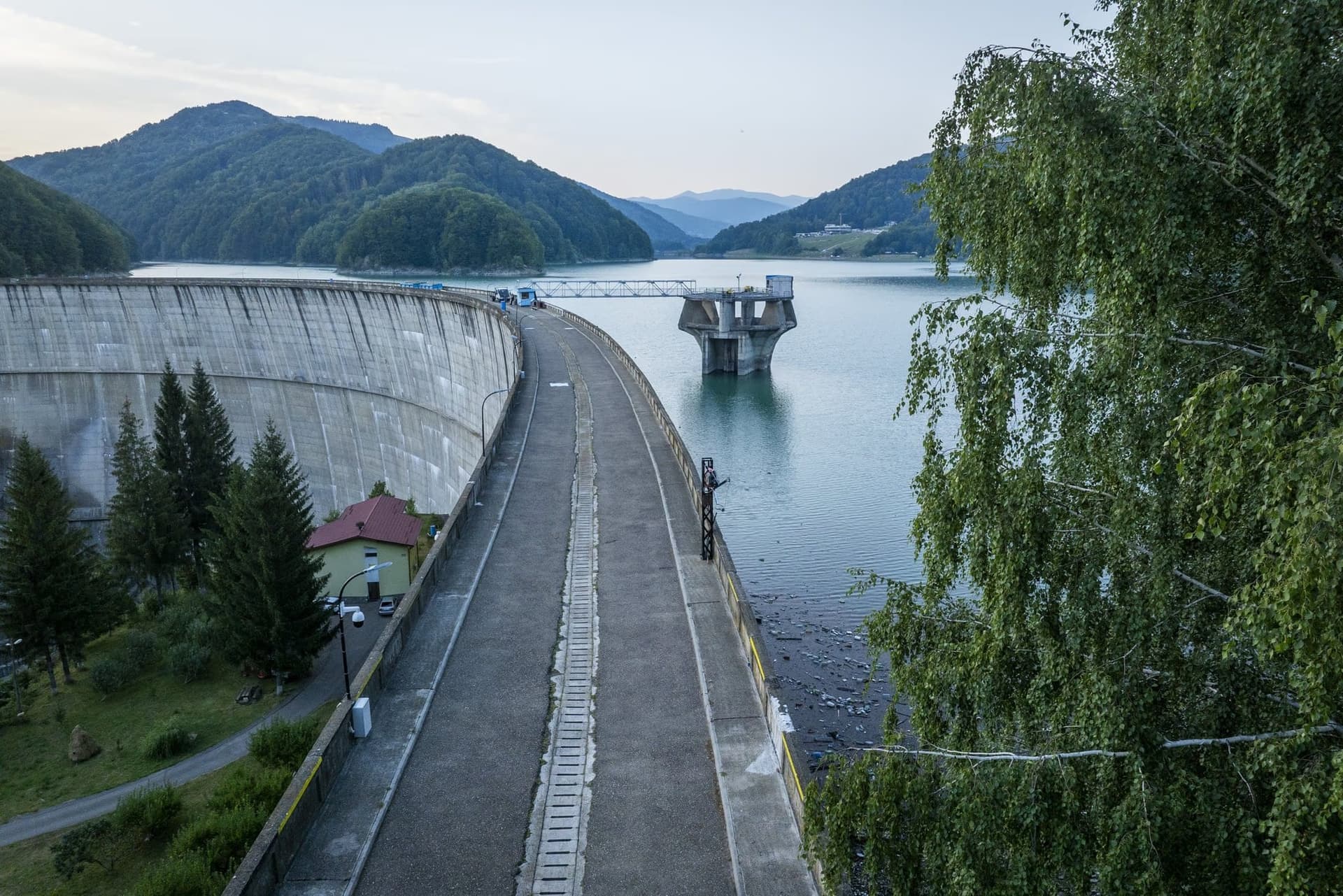
Paltinu (108 m), on the Doftana, is an arch dam with a peripheral joint, commissioned in 1971 — the one that, in the winter of 2025, left more than a hundred thousand people in Prahova and Dâmbovița counties without tap water. The chain of cause deserves to be told properly, because it is more instructive than the image of a simple breakdown: in June 2025, a submerged stoplog came loose and blocked the bottom outlet, leaving the dam with neither outlet working; the safety commission ordered a controlled lowering of the reservoir; the low level exposed the intake zone to siltation; and when the rains at the end of November brought a surge of sediment, the water became too turbid for the treatment plant at Voila, which shut down on 28 November. Twelve localities, among them Câmpina, Breaza and Băicoi, were left without drinking water. The crisis was declared over only on 29 December.
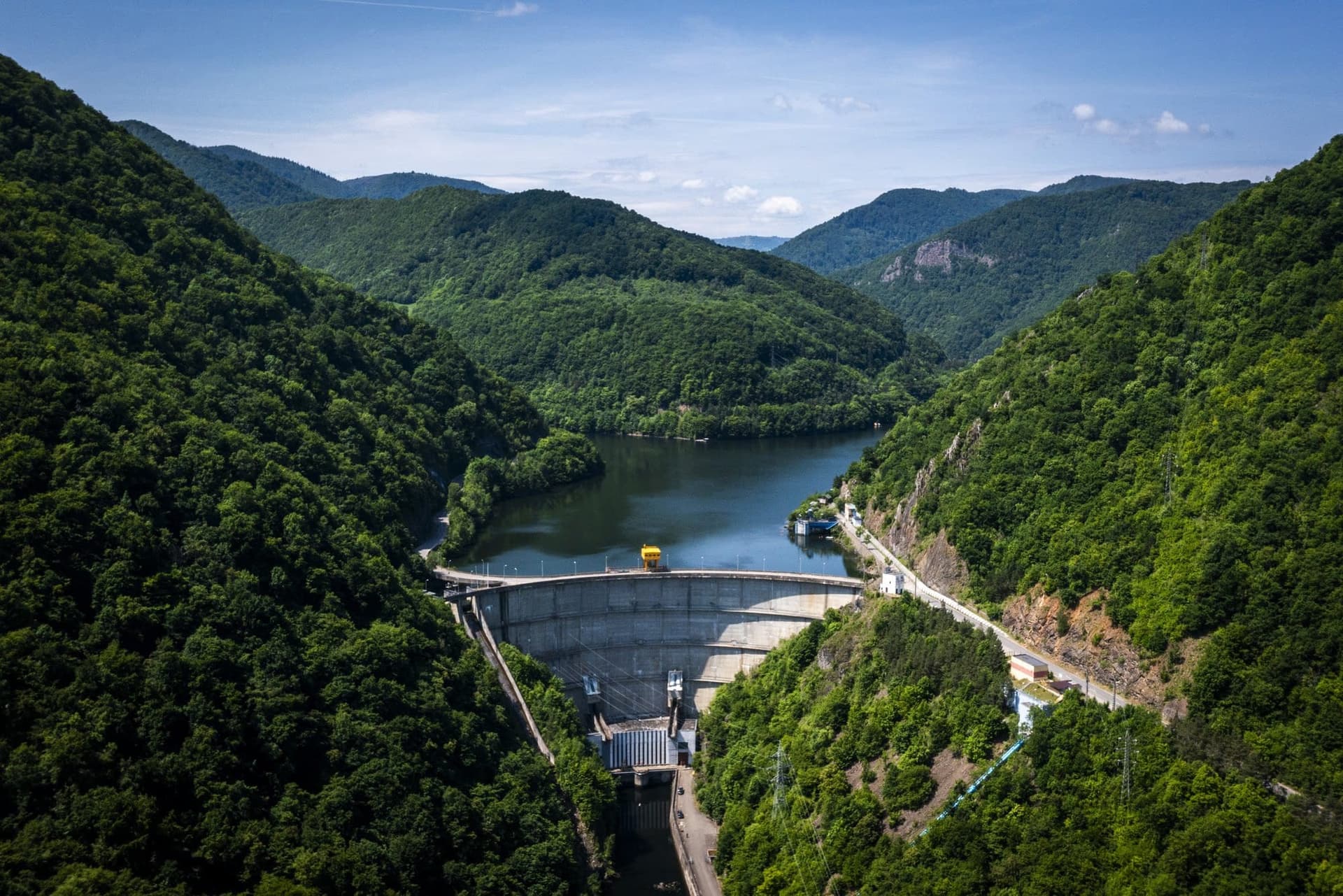
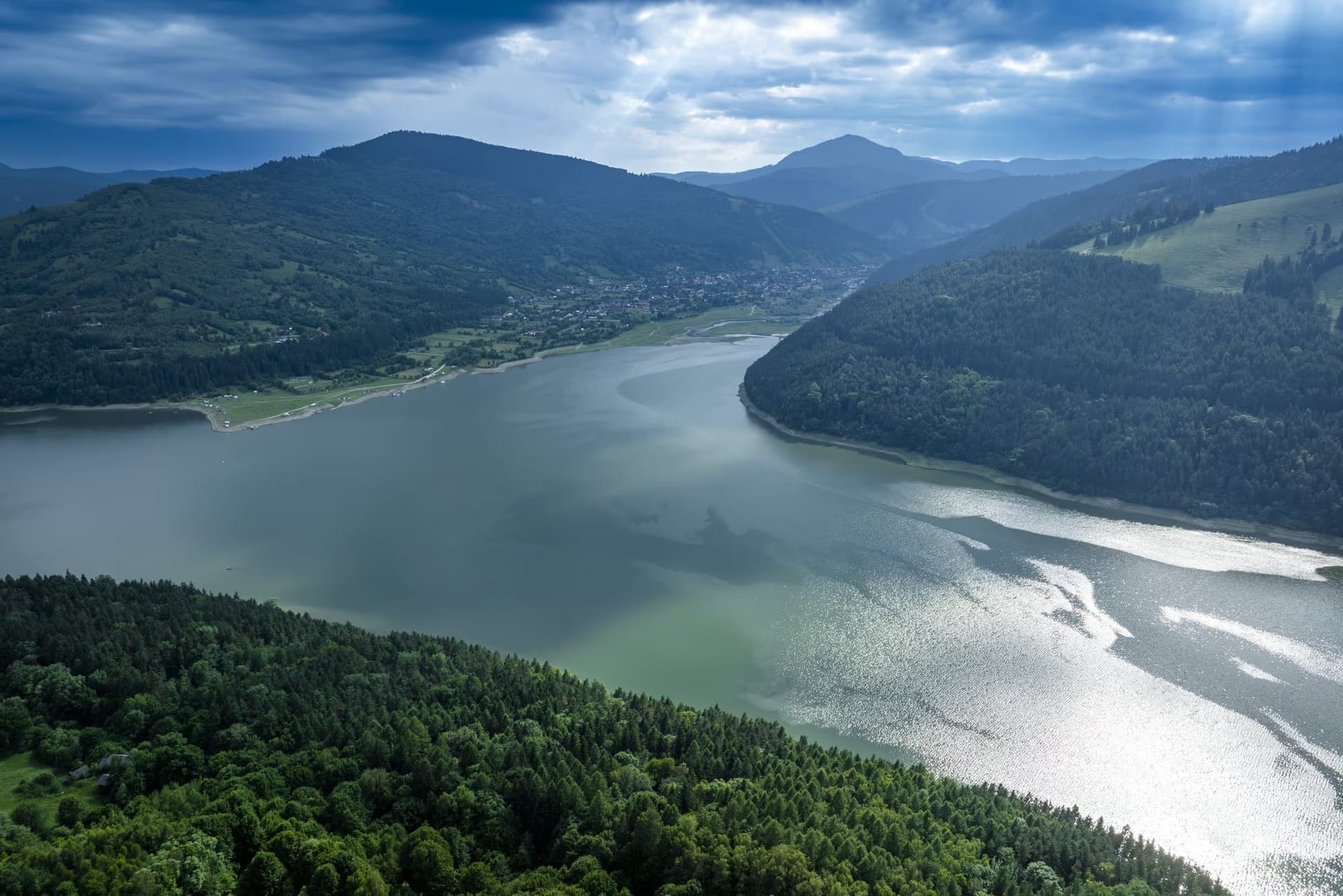
And then there are the ones approaching a hundred metres, which everybody knows from photographs and few know by the numbers: Tarnița (97 m), Fântânele and Colibița (92 m each). Fântânele holds, according to Hidroelectrica, some 213 million cubic metres and feeds the 220-megawatt Mărișelu plant. Colibița, with its lake in the Călimani Mountains, is one of the few Romanian reservoirs that appear consistently in guides to scenic accommodation.
Where they stand, on a European scale
It is worth starting with something easily forgotten:
> At its inauguration in 1966, Vidraru was the fifth tallest dam in Europe and the ninth in the world.
Not "among the largest". The fifth. A country coming out of the Second World War with its economy on the floor built, in twenty years, a structure that ranked in the world's top ten — at the cost of roughly eighty lives lost on site and of the erasure of Cumpăna, the community of traders, shepherds and forestry workers on the Argeș valley, whose remains still show when the water drops.
Today Vidraru sits around sixteenth in Europe. Not because it has shrunk, but because the Alps and the Caucasus kept going: Émosson in 1973, Chirkey and Mratinje in 1976, Kölnbrein in 1977, Zillergründl in the 1980s. The ranking deepened beneath it. The dam is the same.
At the top of the European list stands Grande Dixence, in Switzerland — 285 metres of concrete, the tallest gravity dam in the world. And the comparison with Vidraru is a fine one precisely because the two are contemporaries, and because the answer is not the one you expect.
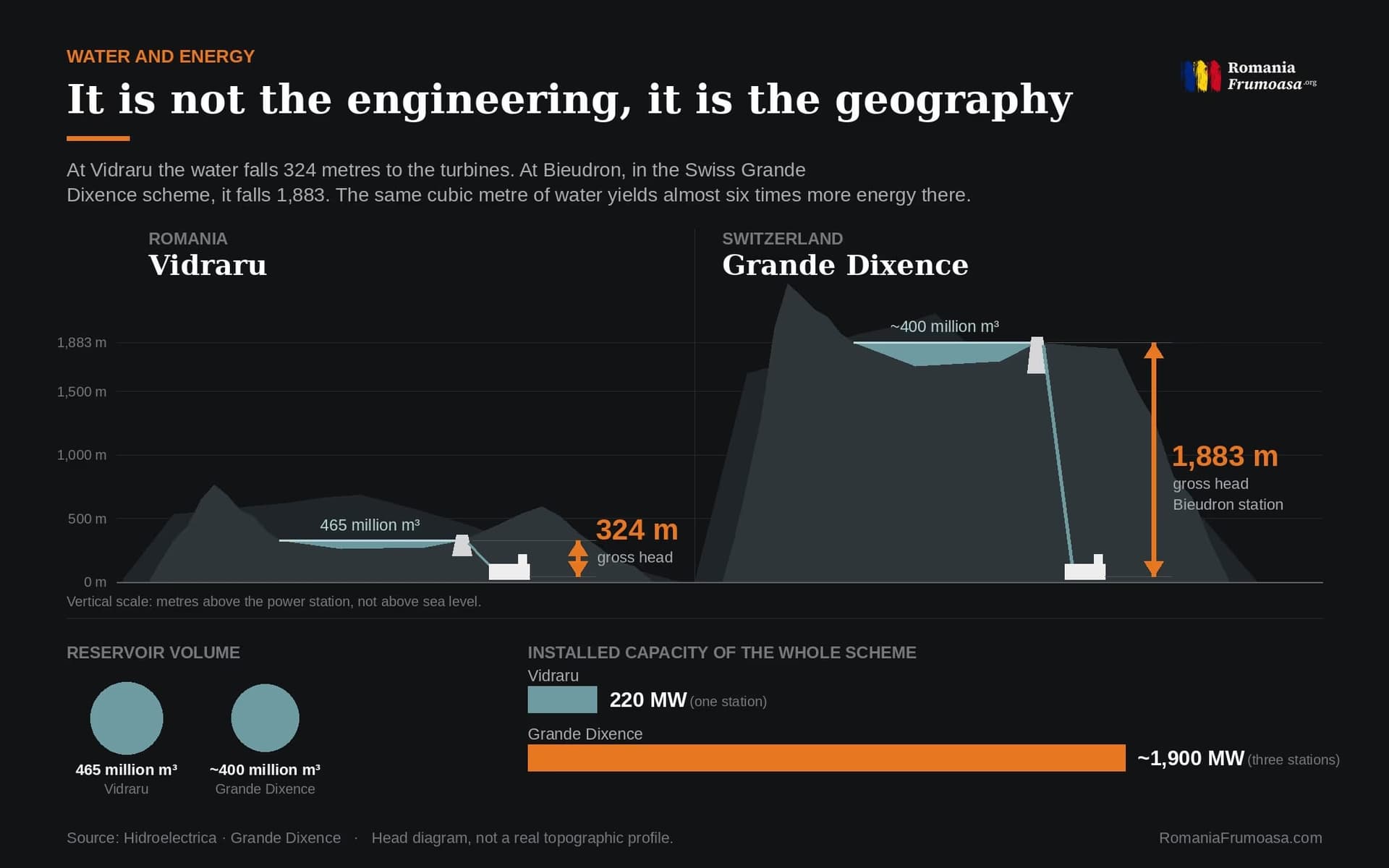
The reservoir at Vidraru is larger than the Swiss one. It yields, however, almost nine times less power than the three plants of the Swiss scheme — because at Vidraru the water falls 324 metres to the turbines, and at Bieudron, 1,883, a world record for a Pelton turbine. It is not the engineering that makes the difference, it is the geography. Our mountains are gentler. That is all.
The same logic shows in volume. Izvorul Muntelui, at 1.25 cubic kilometres, is a medium-sized reservoir on a continental scale — Alqueva, in Portugal, has 250 square kilometres of open water against Bicaz's 32.6, and Kuybyshev, on the Volga, has a volume forty-six times larger. None of which takes anything away from its title of the largest artificial lake on Romania's inland rivers, in a country without Russia's great inland rivers and without the Alentejo.
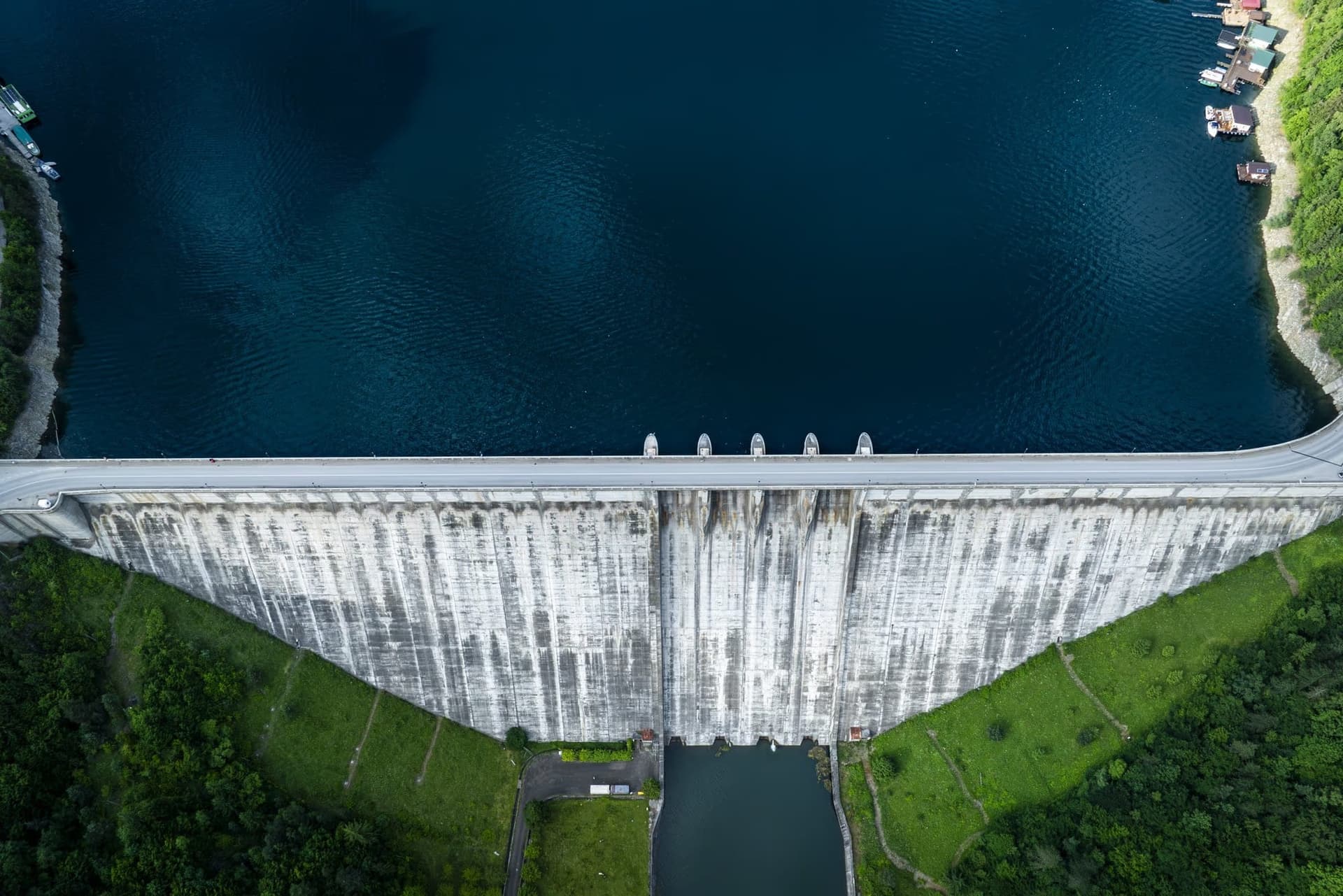
And there is one place where Romania stands, without any reservation, at the head of the European list. Iron Gates I is the largest dam on the Danube — the river's next scheme, Gabčíkovo, has 720 megawatts against more than two thousand for the Romanian-Serbian complex; all eleven Austrian plants on the Danube together produce as much as a single scheme at the Iron Gates. And the Romanian station, with its 1,166 megawatts, is the most powerful conventional hydropower plant in the European Union: the only larger ones in the Union — Grand'Maison in France, Cortes-La Muela in Spain, Vianden in Luxembourg — are pumped-storage plants, which do not produce new energy but move it from one hour to another. The next conventional plant after ours is Sweden's Harsprånget, at 977 megawatts.
That, put end to end, is our place: a handful of structures of European scale, in a country of middling mountains, raised in a single generation.
What lies beneath
Every large reservoir covered something. Here, though, is where care for the truth matters most, because oral tradition and the document mix very easily.
The largest displacement of people in the history of Romanian hydraulic engineering happened at Bicaz, between 1959 and 1960: 2,291 households and 18,760 inhabitants were resettled from the area of the future Izvorul Muntelui reservoir. The villages of Poienari, Hangu, Fârțâgi and Letești were moved in their entirety; others — Secu, Ruginești, Buhalnița, Izvorul Alb, Audia, Răpciuni, Schit, Bistricioara — in part. A little over thirteen thousand people chose to stay near their old settlements, moving up, in effect, village and all, above the waterline.
At the Iron Gates something else disappeared: the island of Ada Kaleh, with its Turkish community, its mosque, its bazaar and its rose gardens, covered by the Danube in 1970. Its inhabitants left, some for Turkey, some for the surrounding towns; an attempt to rebuild the island at Șimian, downstream, never came to life. The town of Orșova was moved at the same time, rebuilt from the foundations on a different site.
The motif of "the church bells you can hear from under the water" is, by contrast, migratory folklore. It turns up at Bicaz, at Colibița, at nearly every reservoir in Romania and in Central Europe. The fact that it is attached to so many different places is itself the proof that it belongs to none of them. It can be told — it is the loveliest part — provided it is clear that it is a legend.
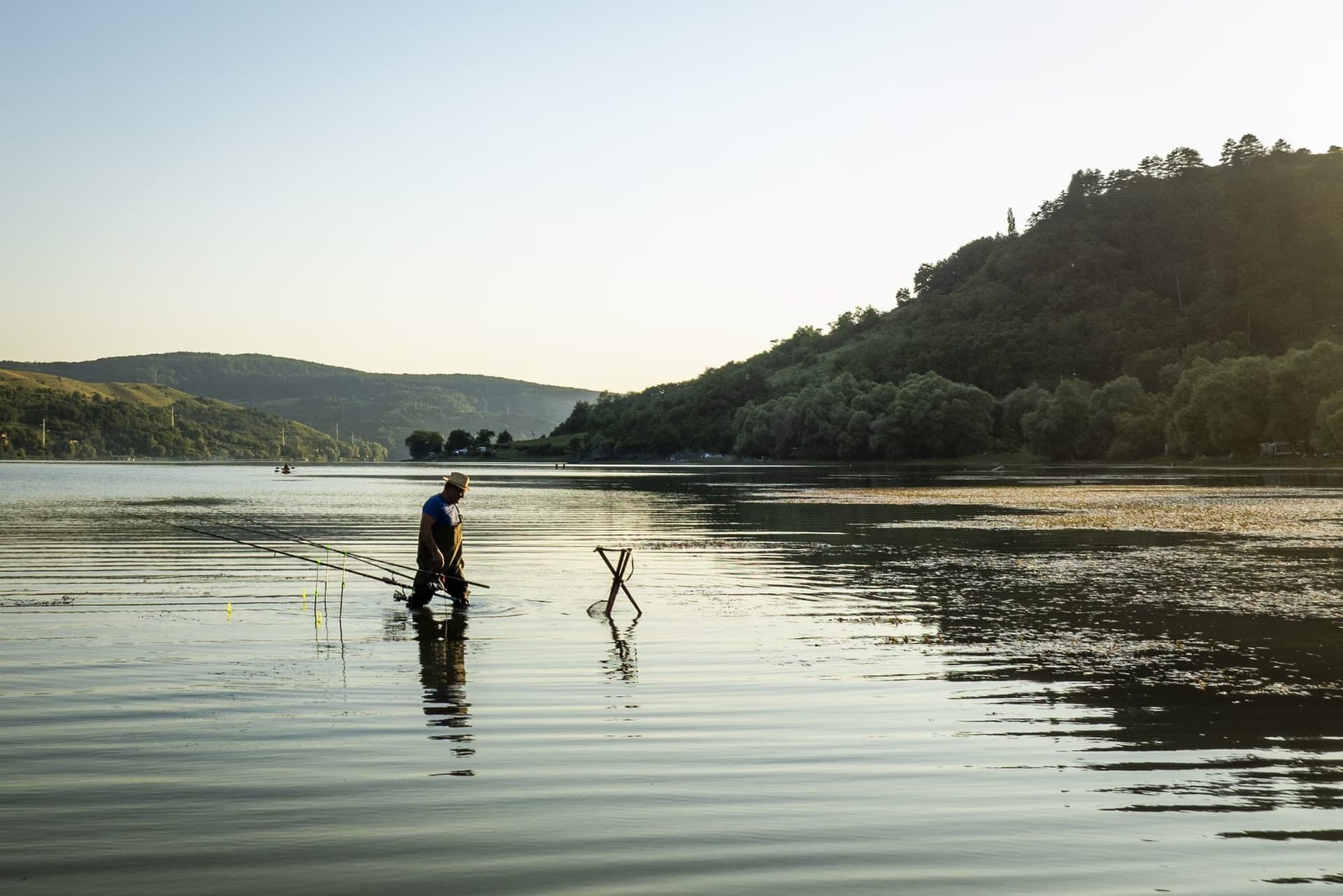
Structures visible at low water are a different matter: they are physical, verifiable facts — and they too have a lifespan. At Bezid, in Mureș county, a whole village lies under the water, flooded in 1988. For twenty-six years the spire of the drowned church stood above the surface and became the image of the place. That spire no longer exists: it collapsed on 29 June 2014. What can be seen at Bezid today is the "Church of Solidarity" — a new structure, consecrated in August 2024, raised on thirty-six concrete piles driven into the lake, exactly on the footprint of the old one. The two are easily confused, including in recent articles that still describe the spire as though it were there.
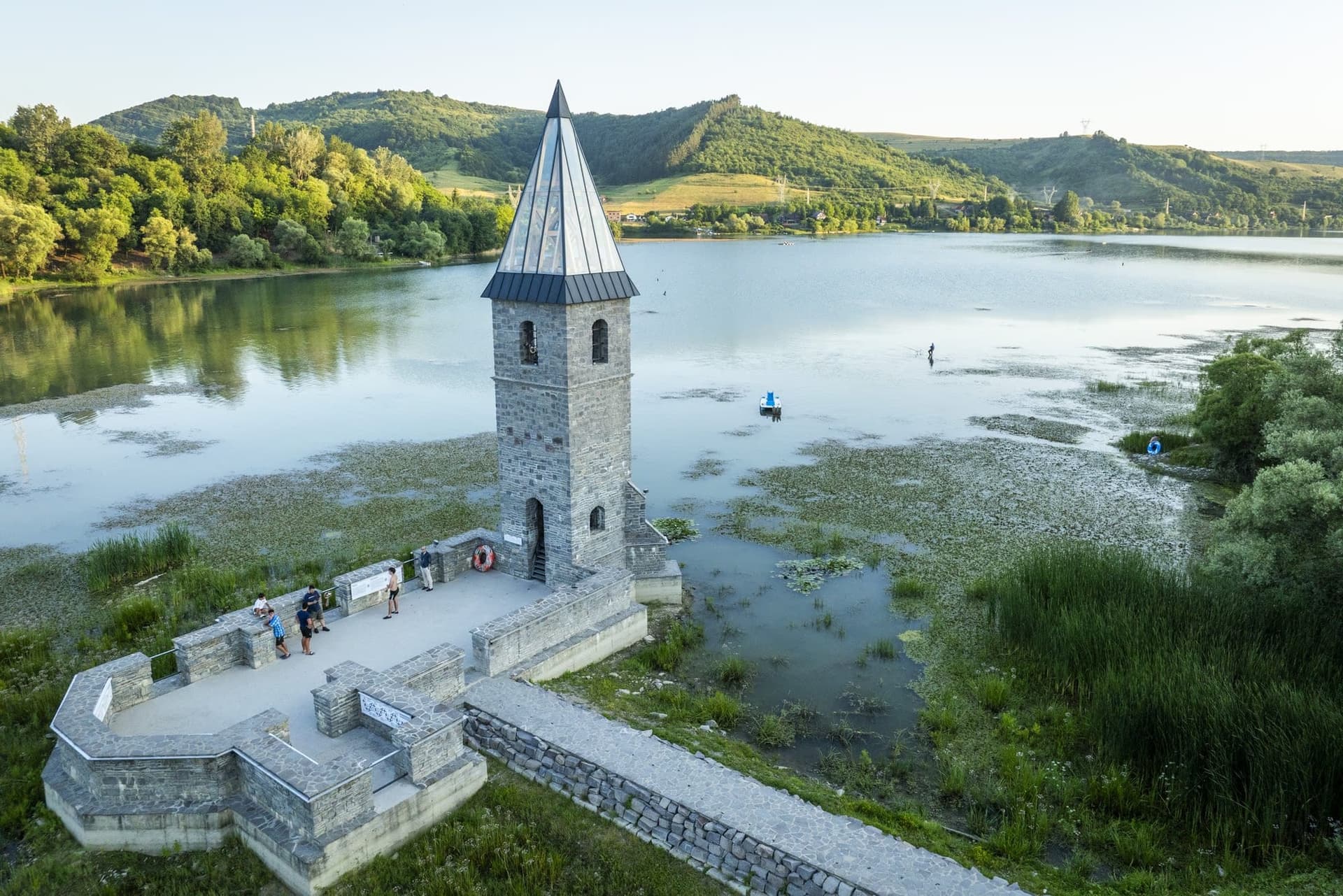
At Beliș-Fântânele people speak of the church tower at Giurcuța de Sus, visible when the reservoir drops. It is exactly the kind of detail that deserves to be photographed and dated before it is published as fact — because, as Bezid shows, the things under the water do not wait.
And the summer of 2026 offers a rare opportunity. The Danube is running at about 1,400 cubic metres a second at Baziaș, against an August average of 3,900, and the mountain reservoirs are low as well — Drăgan-Remeți at 33 per cent on 6 August. With one clarification that Apele Române make explicitly and that usually gets lost in headlines: low levels are not everywhere the effect of drought. At Vidraru, the 46 per cent is the result of a drawdown planned for refurbishment, not of a lack of rain.
Tourism: what exists and what does not
The uncomfortable truth is that, for most of Romania's large reservoirs, there is no public tourism data. Arrival and overnight-stay figures for lake areas sit in the databases of the National Institute of Statistics and have to be extracted by hand; they circulate in no report.
What can be documented is little, and says a great deal:
- At Vidraru, an investor from Argeș is building a four-star hotel on the Transfăgărășan, beside the lake — an investment of roughly 8 million euros. It is the only large private tourism investment directly associated with a major Romanian dam that we were able to confirm.
- At Colibița, the only available market signals are on the demand side: Easter package sales below expectations in 2025, and a constant presence in guides to scenic accommodation.
- For Bicaz, Siriu, Tarnița, Oașa, Beliș-Fântânele, Cinciș and Paltinu we were unable to confirm tourism data from credible sources.
There is also a real tension that explains part of the silence: many of these lakes are sources of drinking water, with everything that follows from it. Tarnița, Colibița, Paltinu, Siriu, Poiana Uzului, Măneciu, Brădișor, Bolboci, Someșul Cald — all carry, in the official records, the "water supply" designation alongside the energy one. Vidraru itself delivers, even now, in the middle of its drawdown, between two and six cubic metres a second to the town of Curtea de Argeș. A lake that provides a town's drinking water cannot be treated as a leisure lake.
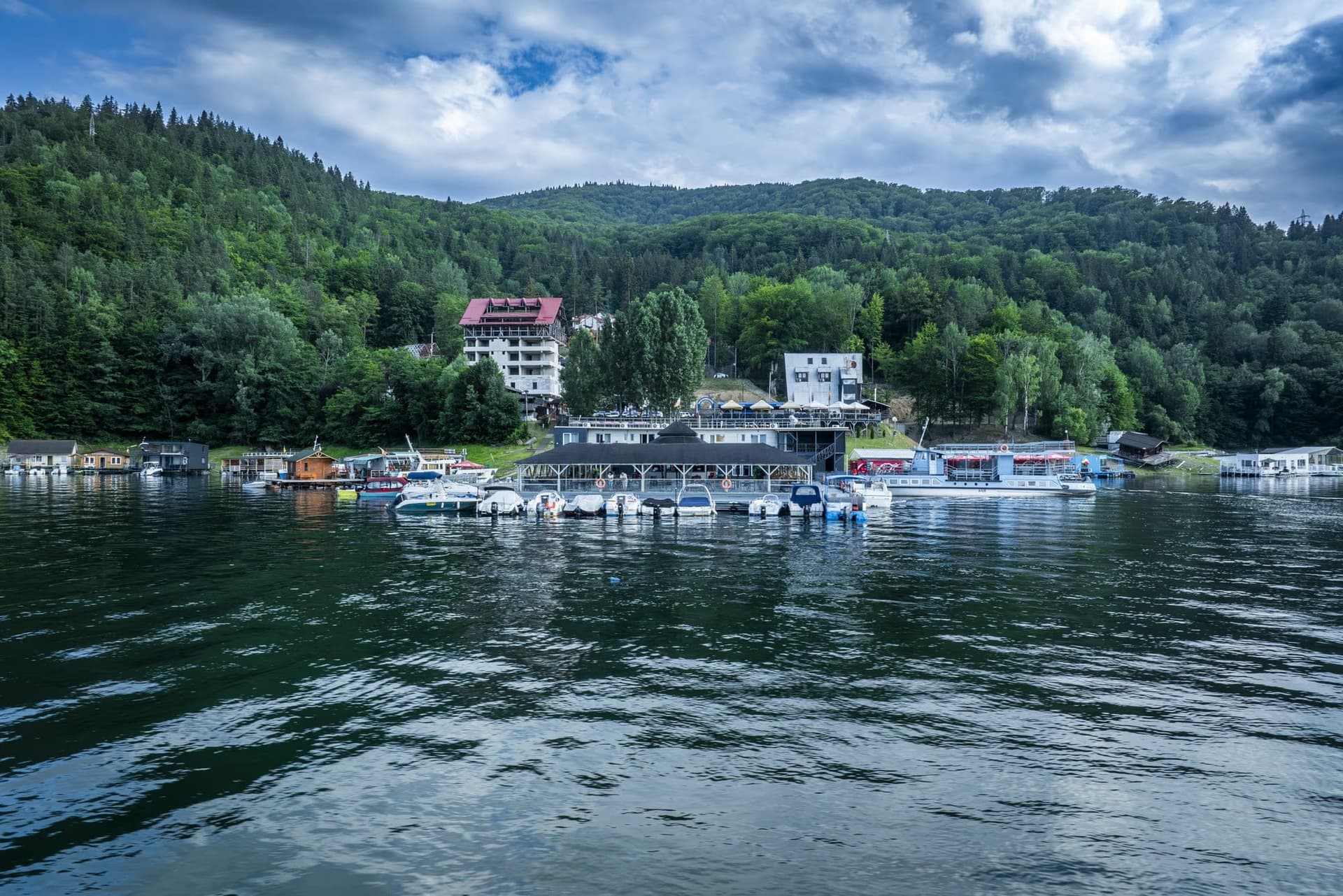
Last winter, at Paltinu, the reverse was on show: when a dual-purpose dam fails, the first thing to stop is not the turbine, it is the tap.
What has never been shown
There remains a list of places that are spectacular in themselves and that Romania has never put on the map.
Gura Apelor, first of all. The country's tallest dam, at the foot of the Retezat, in a massif that already has hiking infrastructure and a national park with a name. A 168-metre dam that needed thirty-five years to reach its design level. The story is better than that of many far more visited sites.
Poiana Mărului, in the Banat — the country's fourth tallest dam, in a mountain area with little tourist traffic and a limestone landscape.
Vidra and the Lotru scheme — a head of 809 metres, an underground power station and a 340-million-cubic-metre reservoir at altitude, in an area already reachable by the Transalpina.
Stânca-Costești, on the Prut — 59 square kilometres of open water, the country's second largest surface after the Iron Gates, in a landscape entirely unlike everything dam tourism means in Romania: not mountains, but the openness of the plain and a border.
Drăgan-Floroiu and Valea lui Iovan, on the Cerna — two mountain reservoirs on which the public documentation is so thin that we could not confirm even the height of the dams.
And Bezid, which does not impress as engineering, but has something none of the others has: a whole village under the water, a new church raised on piles exactly where the old one stood and, for twenty-six years, a spire that broke the surface. Now that the spire has fallen, the place needs something else in order to be told — and that is precisely why it is worth telling now.
These structures are, in large part, the work of a single generation. The Romanian National Committee on Large Dams calls the period 1975–1989 "the most flourishing in the history of dam construction in Romania" and estimates that more than 75 per cent of the dams in operation today were designed and built then. They are cathedrals of concrete and rockfill, set in mountain valleys by people who had neither modern machinery, nor time, nor much choice.
Most of them we drive past, on the way to somewhere else. It is worth stopping the engine, at least once.
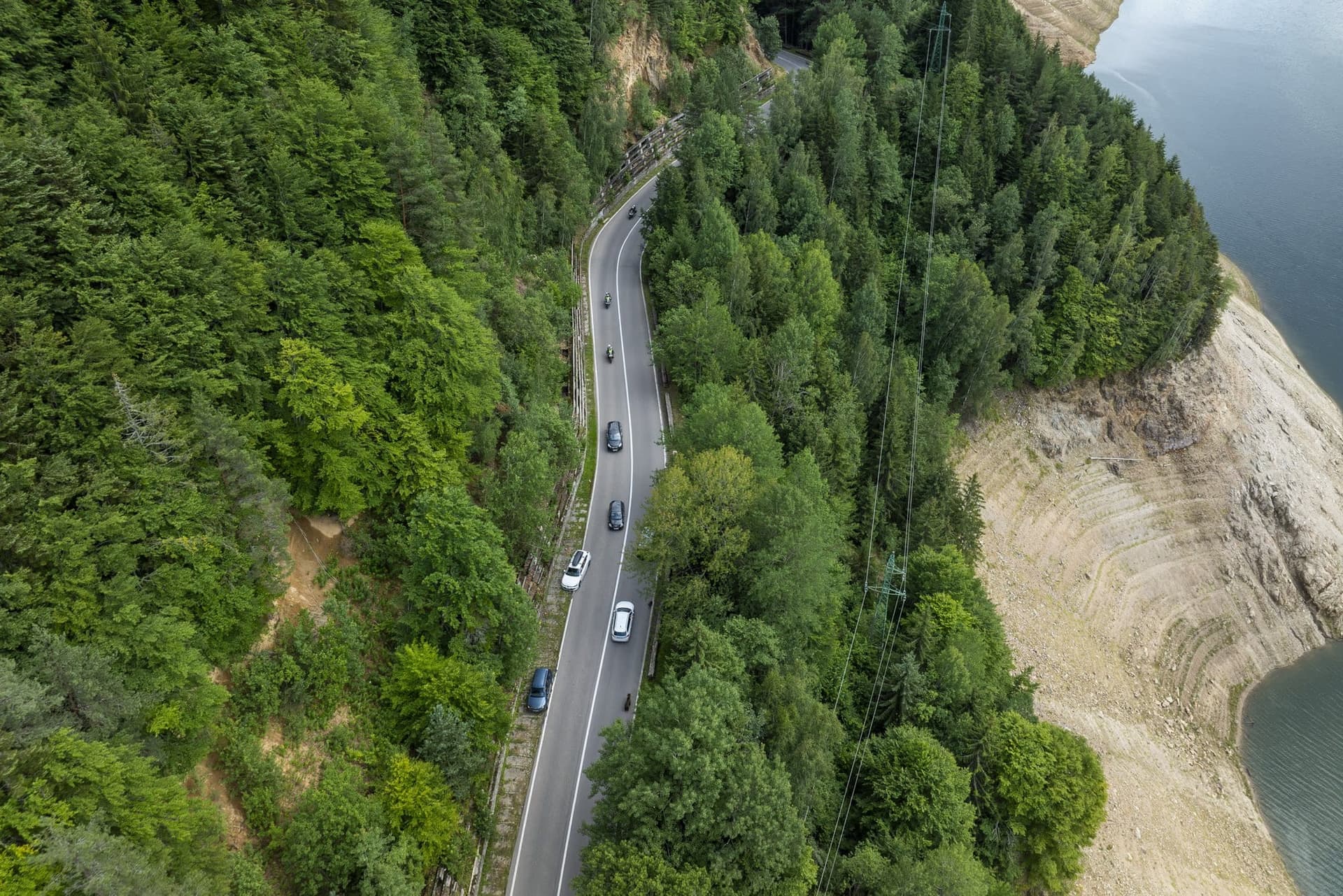
Photographs by the author, taken by drone between April 2021 and August 2026, at Vidraru, Izvorul Muntelui, Paltinu, Tarnița, Cinciș, Bezid, Valea lui Iovan and on the Danube, in the gorge. No trip was made specifically for this article; the year of each frame is given in its caption. The Gura Apelor, Poiana Mărului, Siriu, Vidra and Stânca-Costești dams, discussed in the text, are not illustrated — we have no photographs of our own from there.
Text and photographs: Adi Coco · SeeingRomania — A country slowly seen · Research completed 14 August 2026.