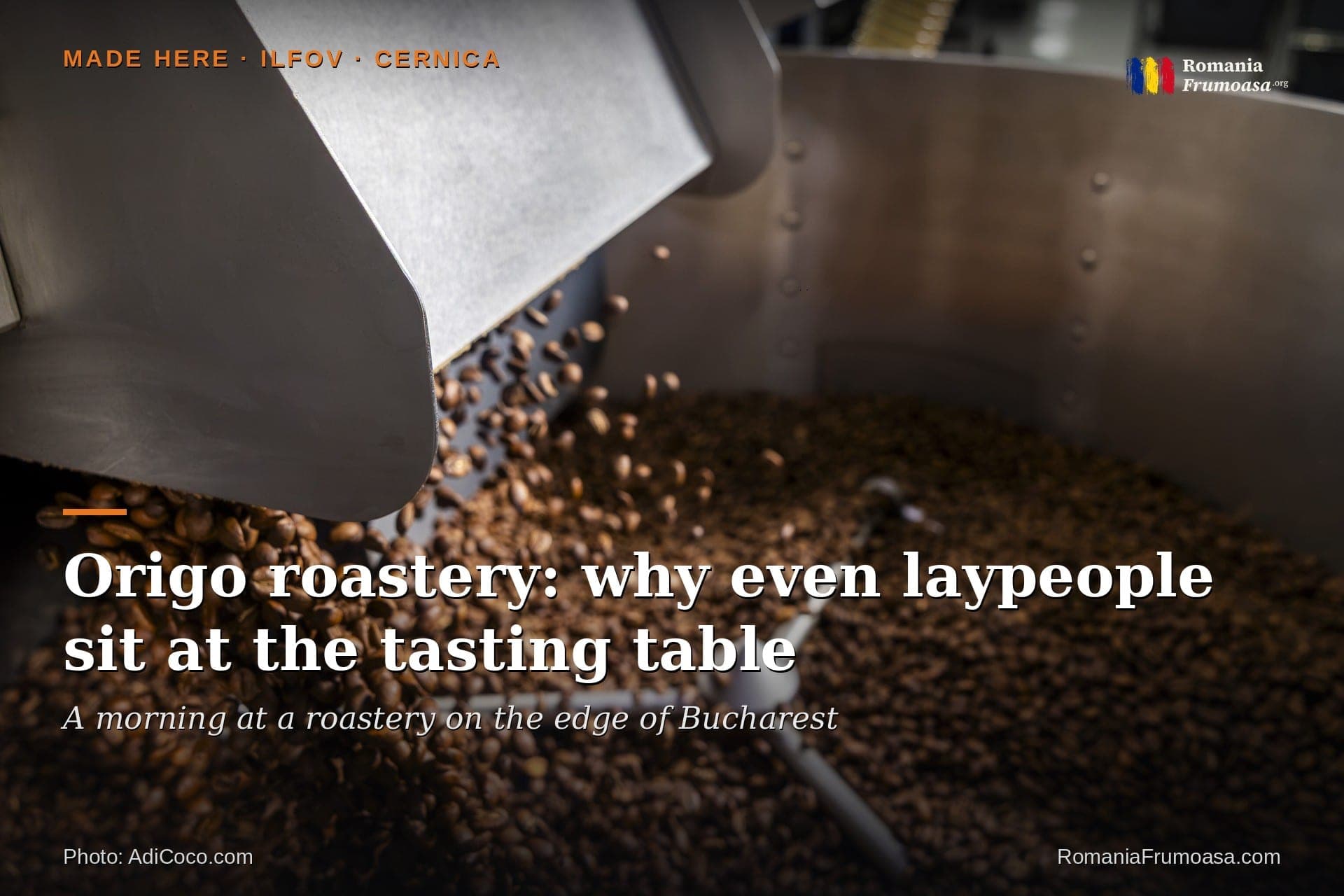
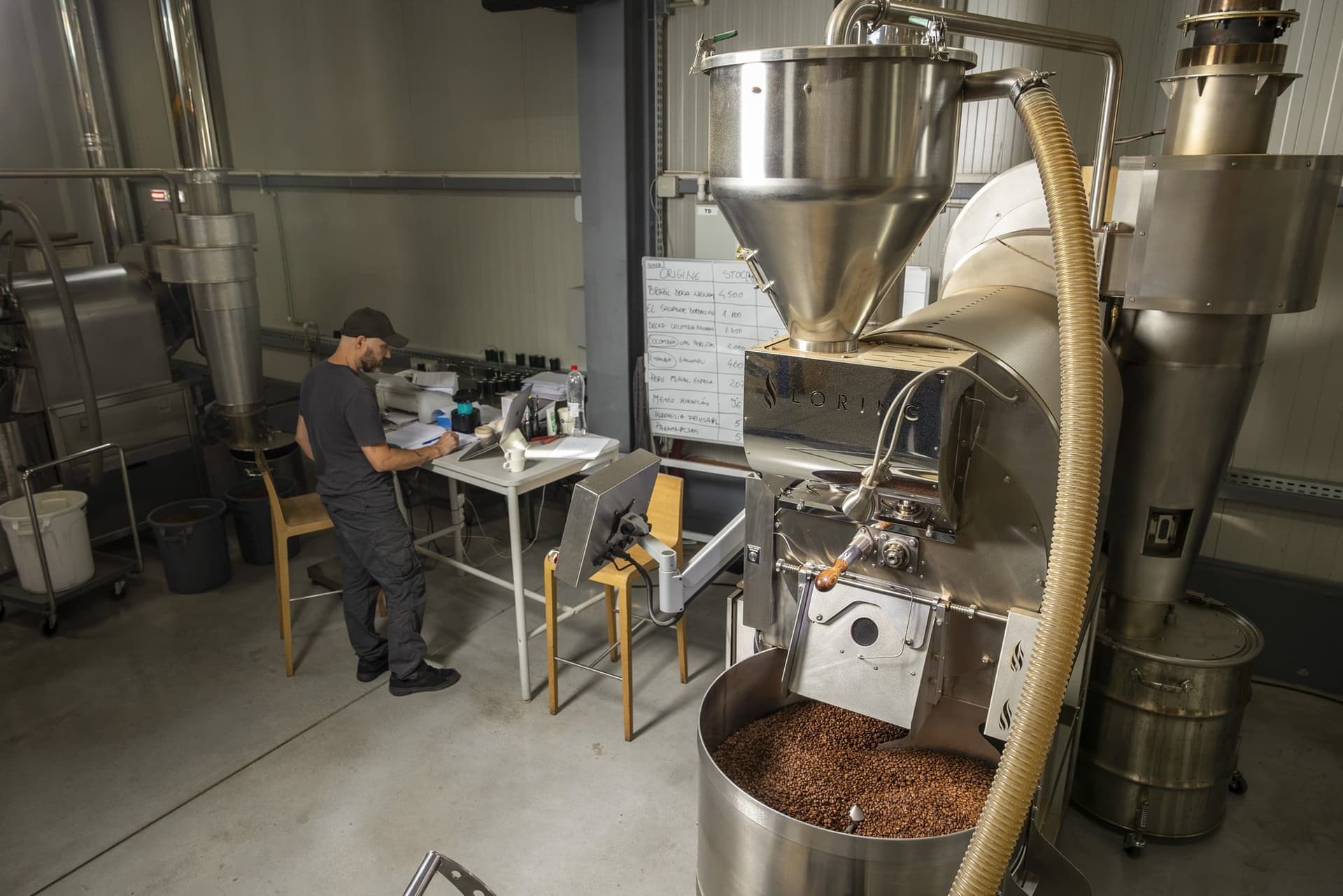
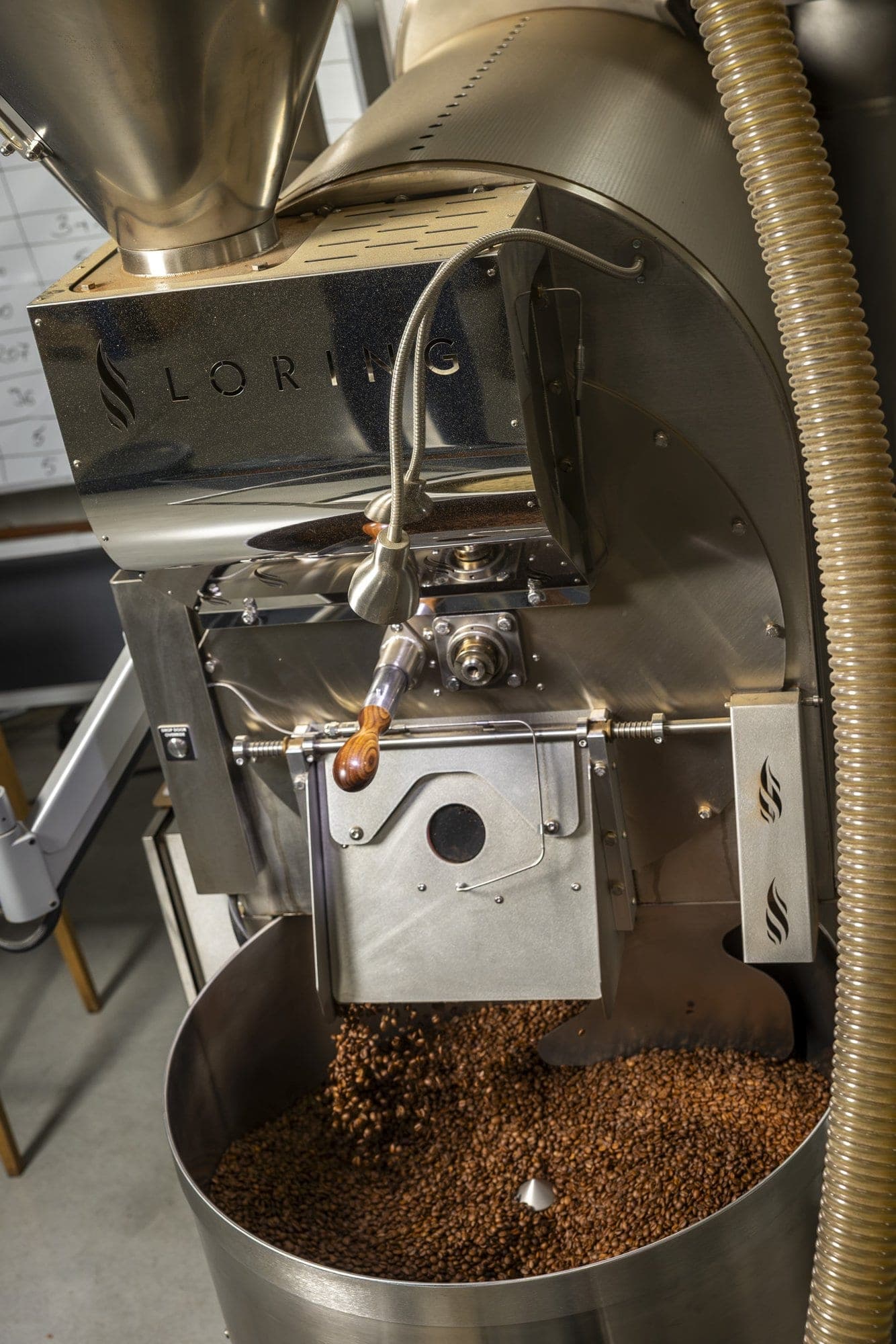
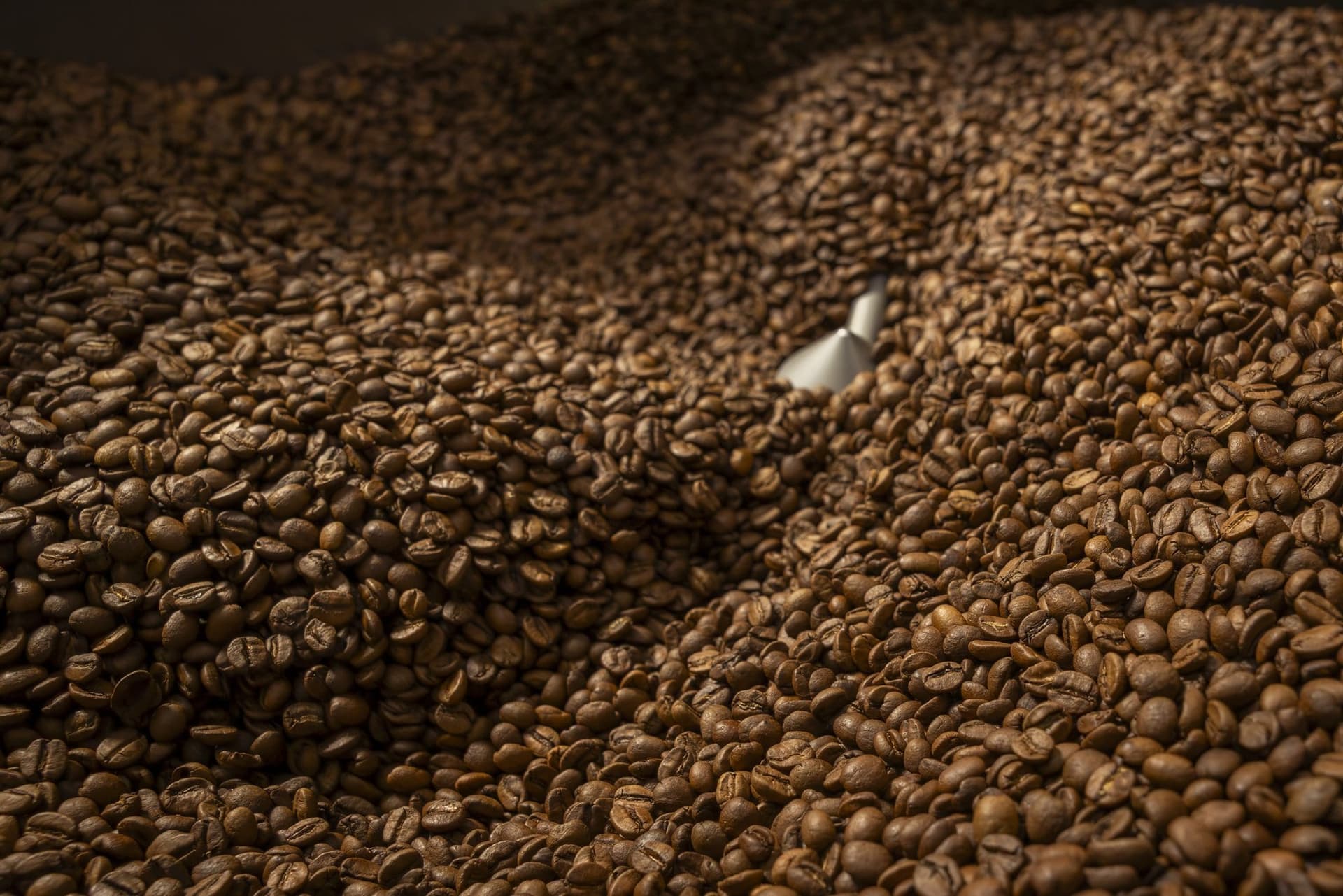
The clearest sound in the roasting room doesn't come from the roaster. The machine runs almost silently, quieter than a hotel-room hair dryer. What you hear instead is the coffee. When a batch is done, the beans drop from a height into the stainless-steel cooling tray, and a mechanical paddle starts turning them so they cool.
The smell comes only when you lean over the tray. Elsewhere in the building you can smell roasted coffee, but less than you'd expect in a roastery. Above the beans just out of the drum it's something else: a strong, dense smell and a gentle heat rising toward your face.
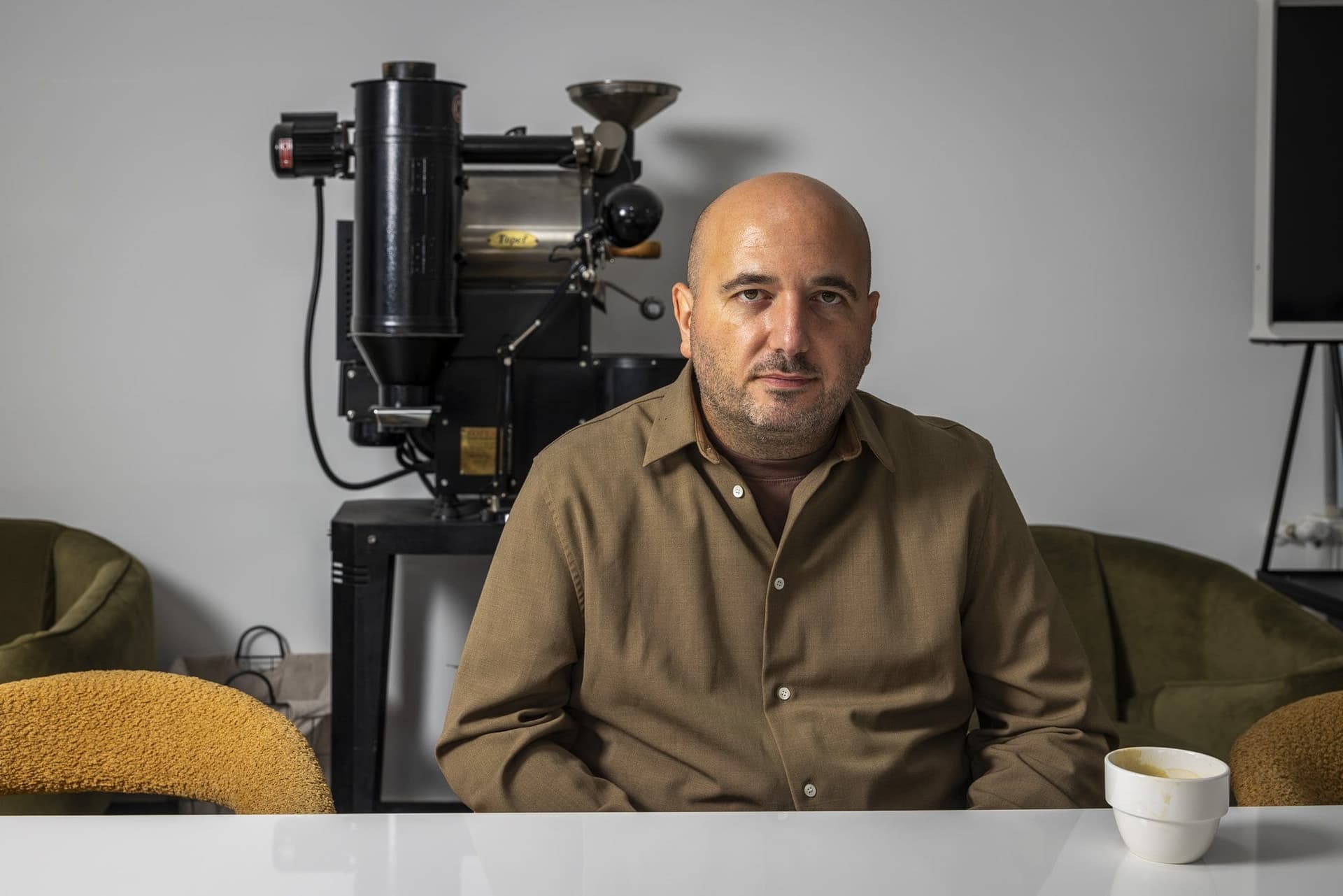
This is where Origo coffee is made, the brand that started in 2013 with a café on Lipscani Street in Bucharest. The café is the part people see. Mihai Panfil, the founder, puts it differently: "For me, Origo Shop was never a business. It was an expression of the roastery." The roastery sits on the eastern edge of the city, and the rule it runs on fits in a single line: what gets roasted today gets tasted tomorrow.
A warehouse at the end of the street
The way to the roastery runs through an area of small industrial units, along a freshly paved dead-end street that sees little traffic as a result. The building is new and well kept, with a barrier gate at the entrance.
Inside, the first room is a lobby with an espresso machine and a few tables. If someone brought you here blindfolded, you'd think you were in a café in central Bucharest.
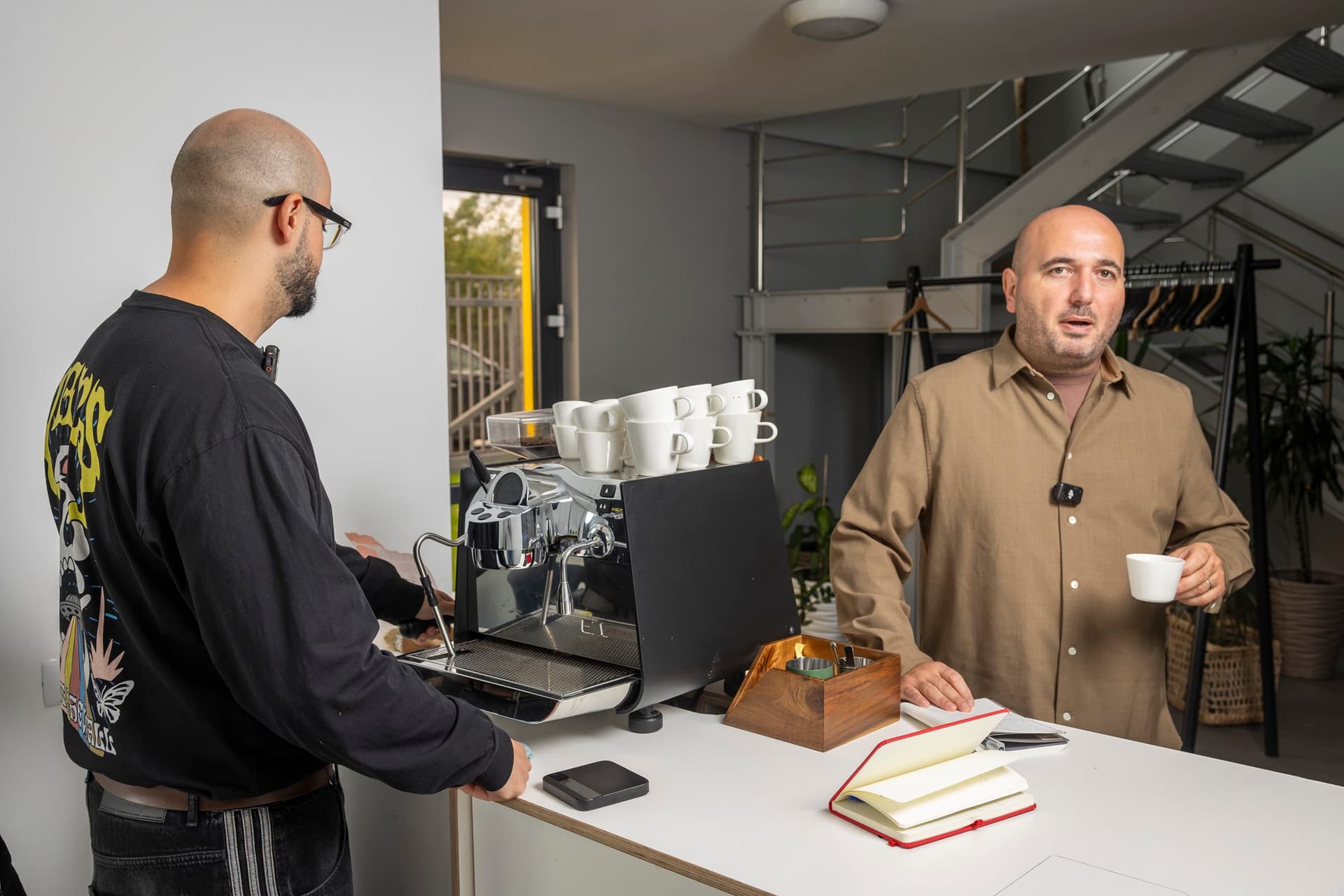
Farther in is the roastery floor proper, clean almost to laboratory standard.
Dried grass, dried peas
The coffee starts out in a tall, cool storeroom, in jute sacks stacked on pallets. Light comes in from one side only and throws deep shadows between the stacks.
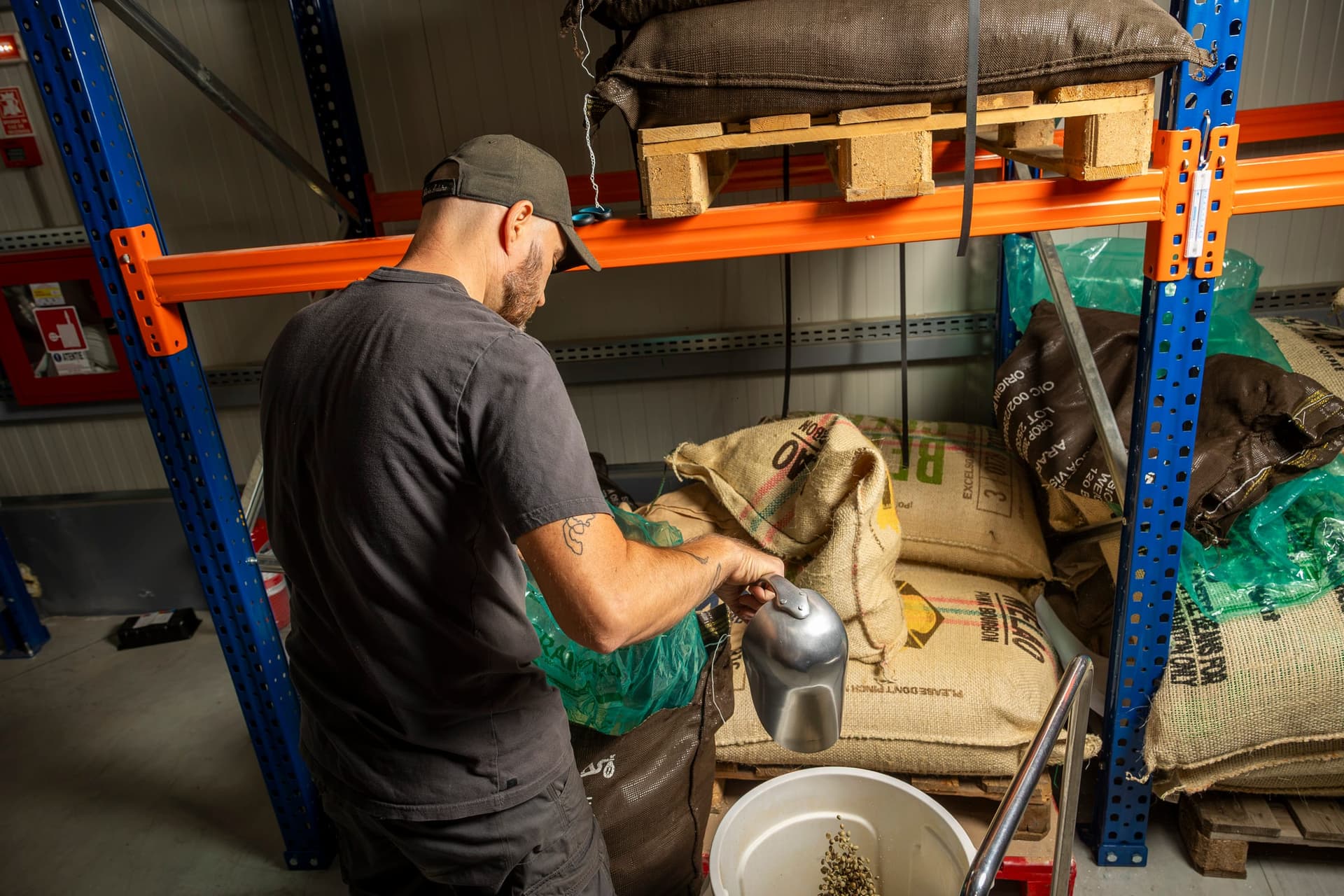
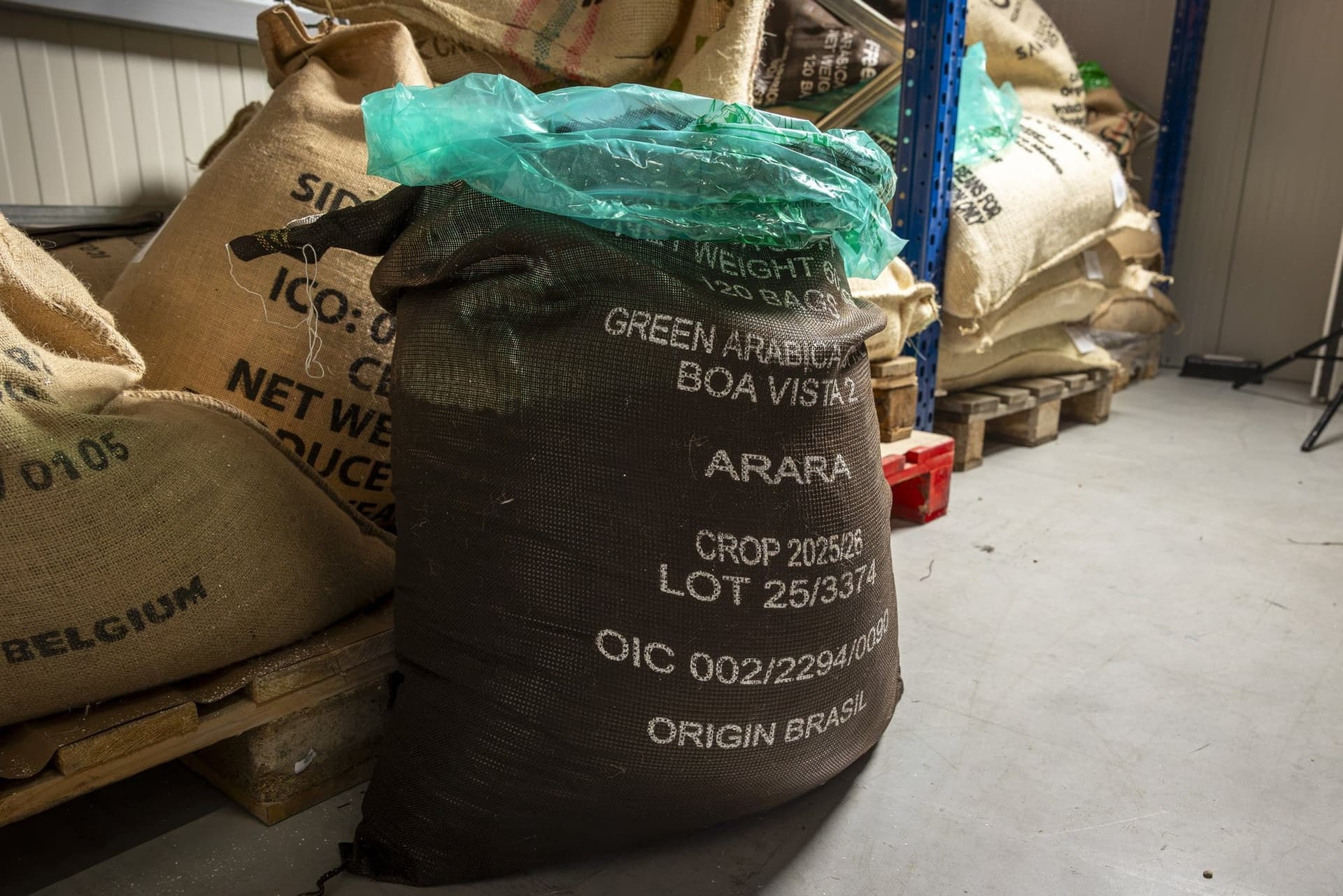
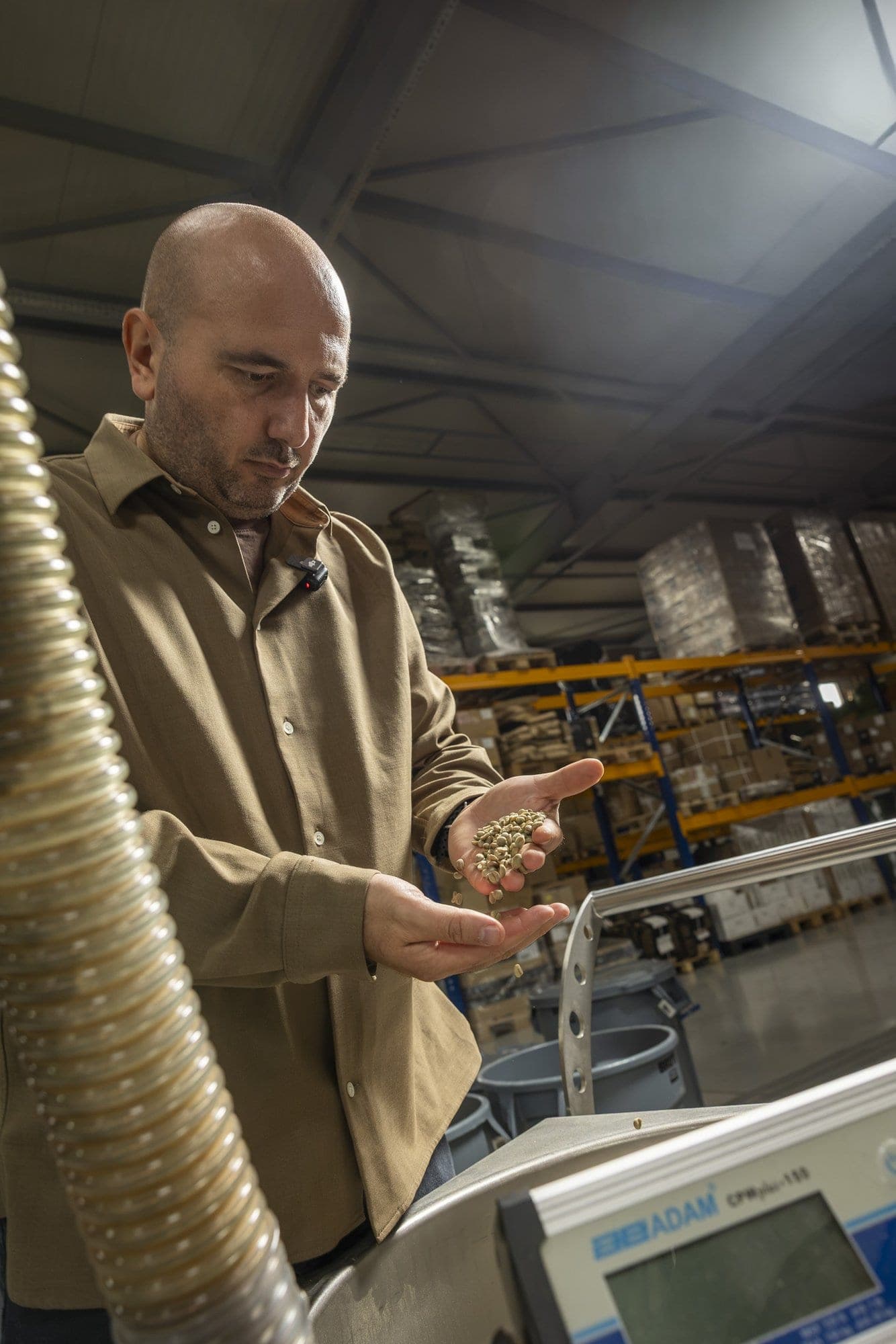
The storeroom doesn't smell of coffee. It smells vegetal, of cut grass, but not fresh grass: grass left out to dry for a few days. The green beans are rough and hard to the touch. If you didn't know what they were, you'd think you were holding a handful of dried peas.
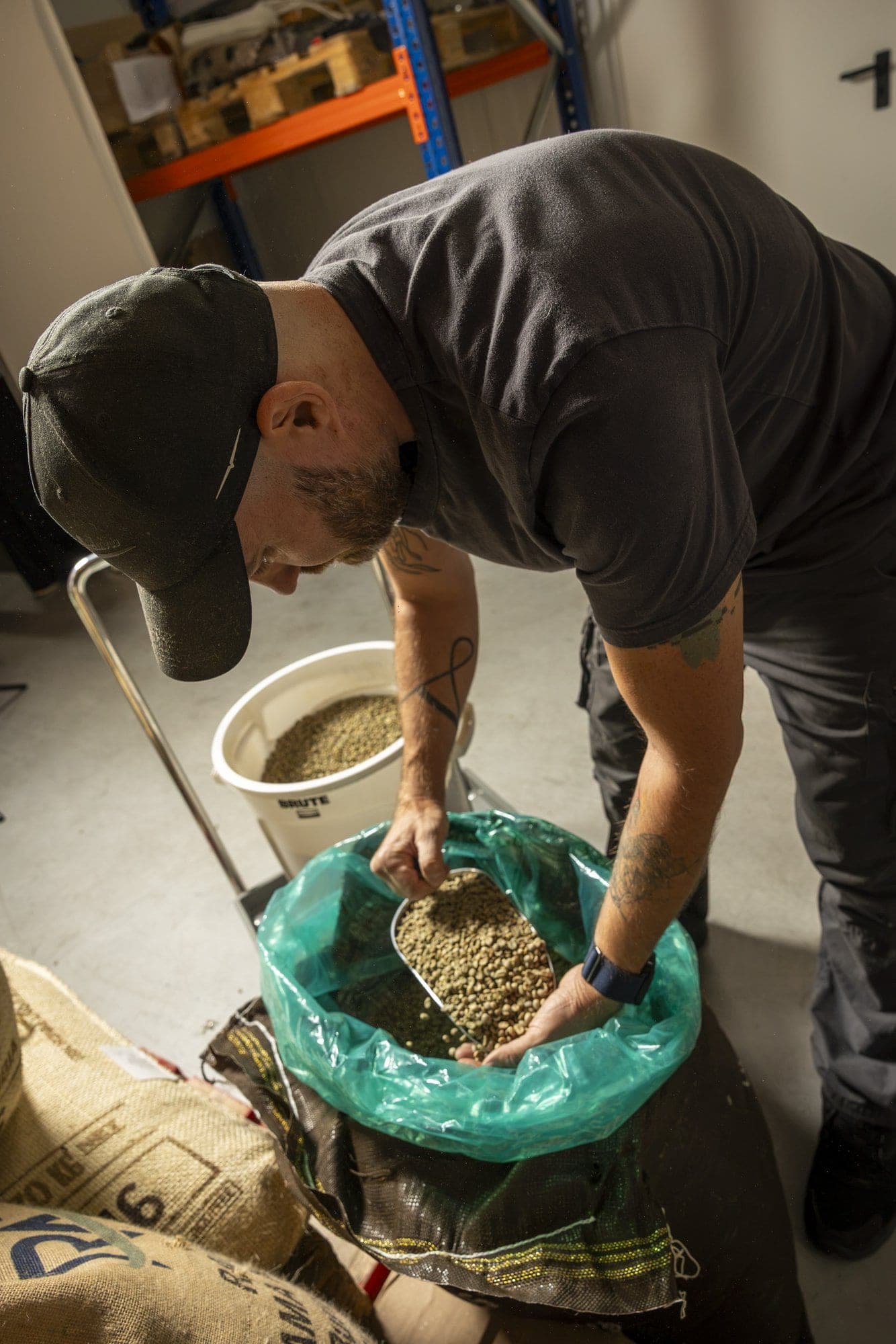
The sacks read Brazil, Mexico, Ethiopia. Mihai Panfil says most of the coffee comes from people he knows by name: "about 70%," from "farmers I actually know." For him, a direct relationship with the grower "means you visit him, it means you know him personally."
The direct relationship has a less visible consequence, too. From a single farmer in Costa Rica, Origo buys one and a half containers of coffee. These farmers, Mihai Panfil explains, don't produce only micro-lots but large lots as well, and to keep buying from them year after year, the roastery has to take those too. That's what the house's second, more affordable brand, Brewzeus, was created for.
The man at the control panel
Vali loads the green beans into a container, carries it to the roaster and draws them into the machine with what amounts to a vacuum. Then he keeps his eyes on the screen. He checks the parameters, jots something in a notebook, turns back to the screen. From loading to emptying the cooling tray takes about half an hour.
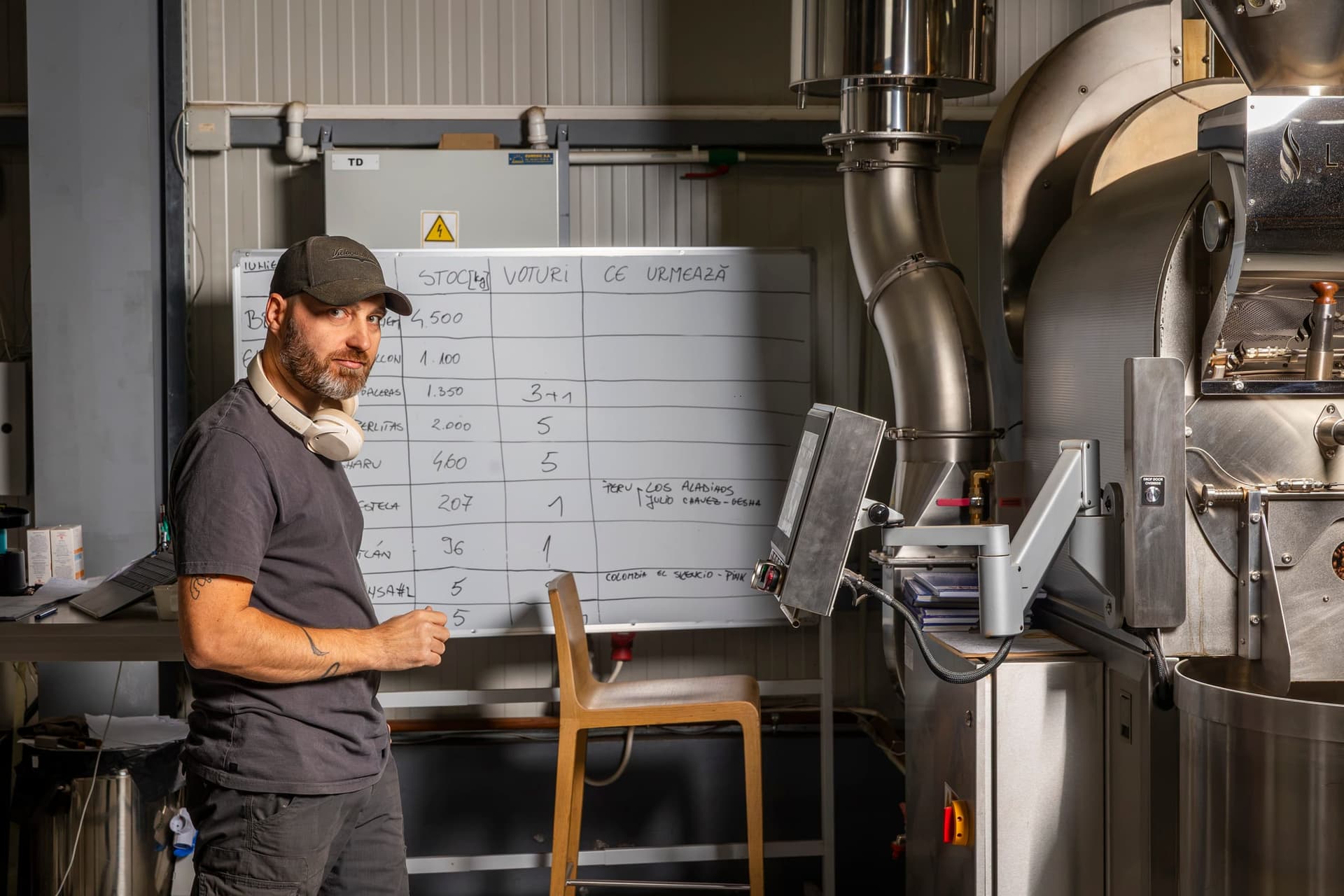
According to Mihai Panfil, Vali is an engineer, and when they met he was an enthusiast with "a 2-meter espresso machine in his own kitchen" and a small roaster at home. "He has roasted all our batches of coffee from day one," says the founder, who admits just as plainly: "I haven't roasted coffee very many times in my life."
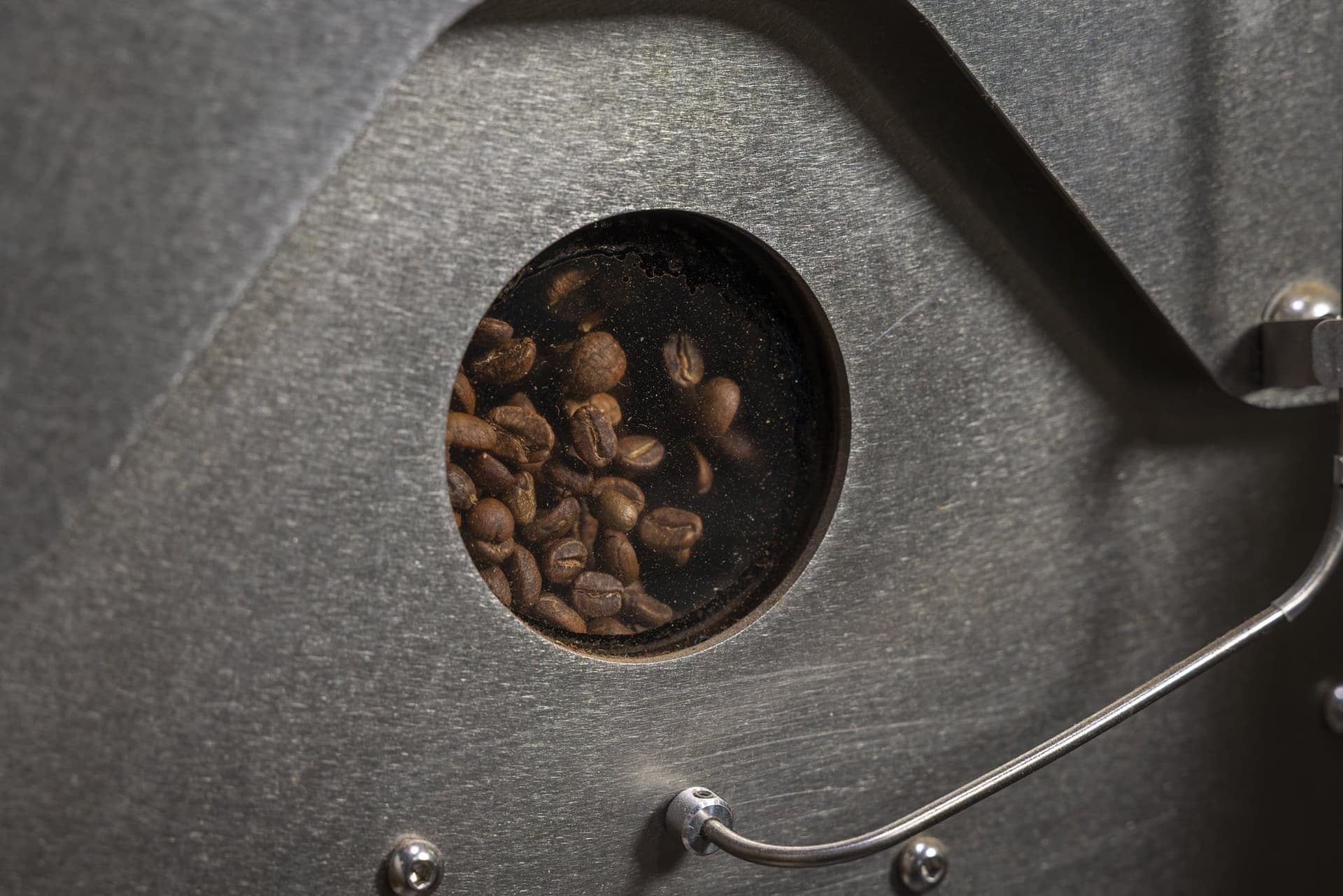
The roasters are Lorings, American machines that Mihai Panfil calls "expensive high performers." The company started with a 15-kilogram roaster, then bought a 35-kilogram one, and, according to him, "a 70 is coming next."
The next day, at the table on wheels
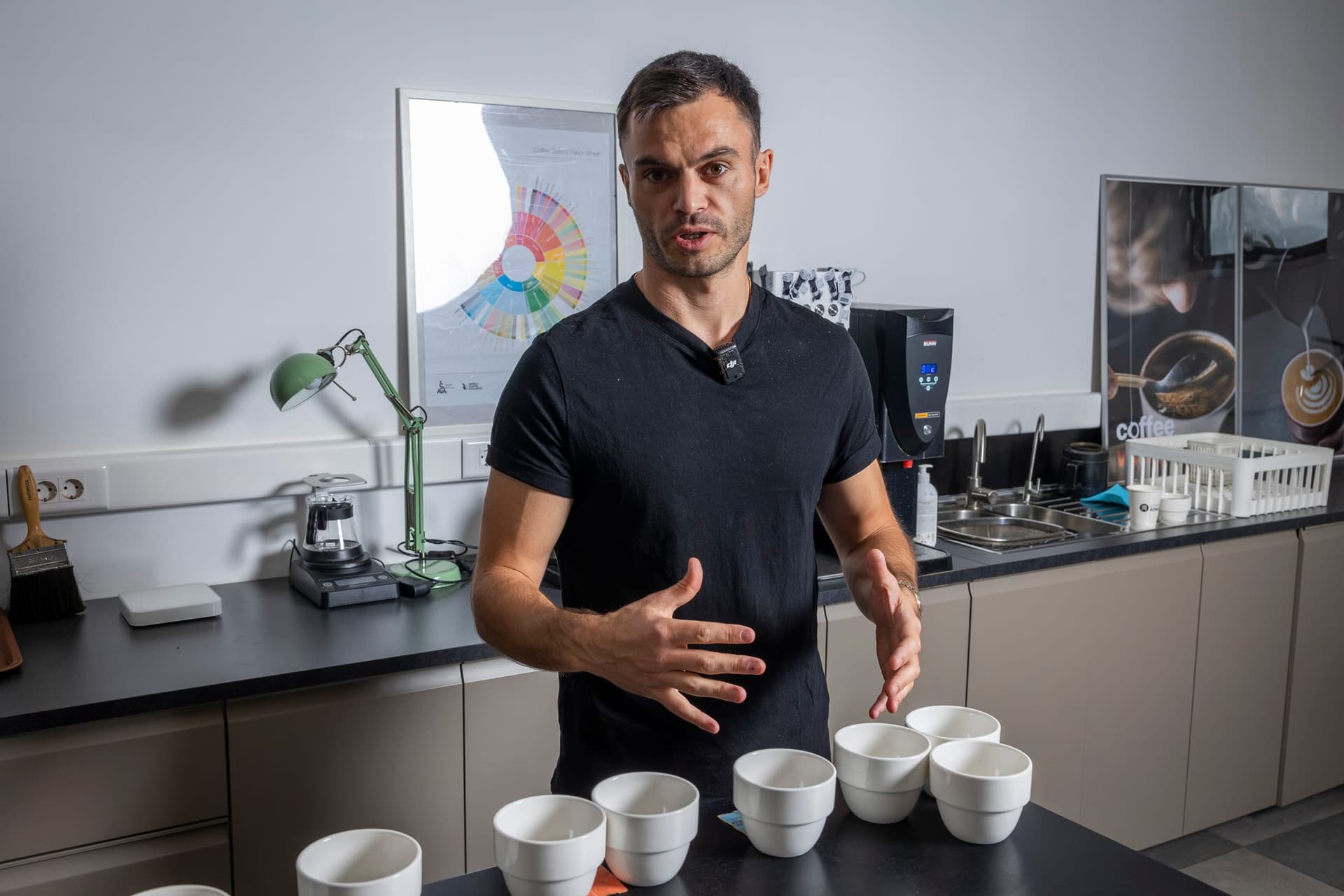
Yesterday's roast reaches the lab today, the room where the cupping is done: a tasting that follows a set protocol. "We check the quality of the coffee we roasted the day before," explains Daniel, who leads the tasting. The goal is consistency: "We want the consumer to get the same quality in every batch of coffee."
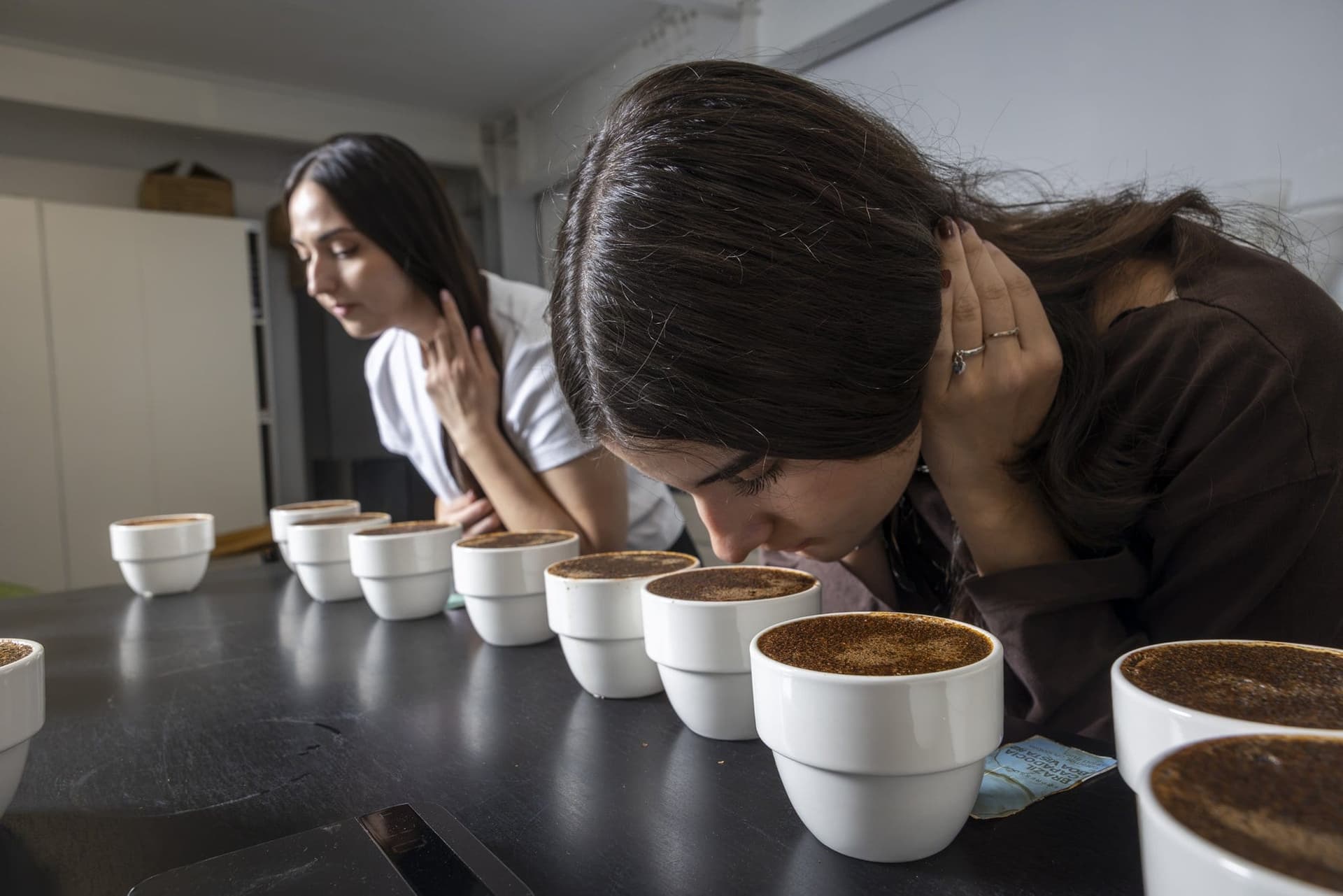
The tasting table is on wheels, so it can be moved closer to the grinders or over toward the sofas. That morning it held 19 cups, arranged in reverse order of aroma intensity, each with a label giving the name of the coffee and its aromas. Among the day's coffees were two lots that had arrived the day before, tasted again to see whether they matched the sample the producer had sent.
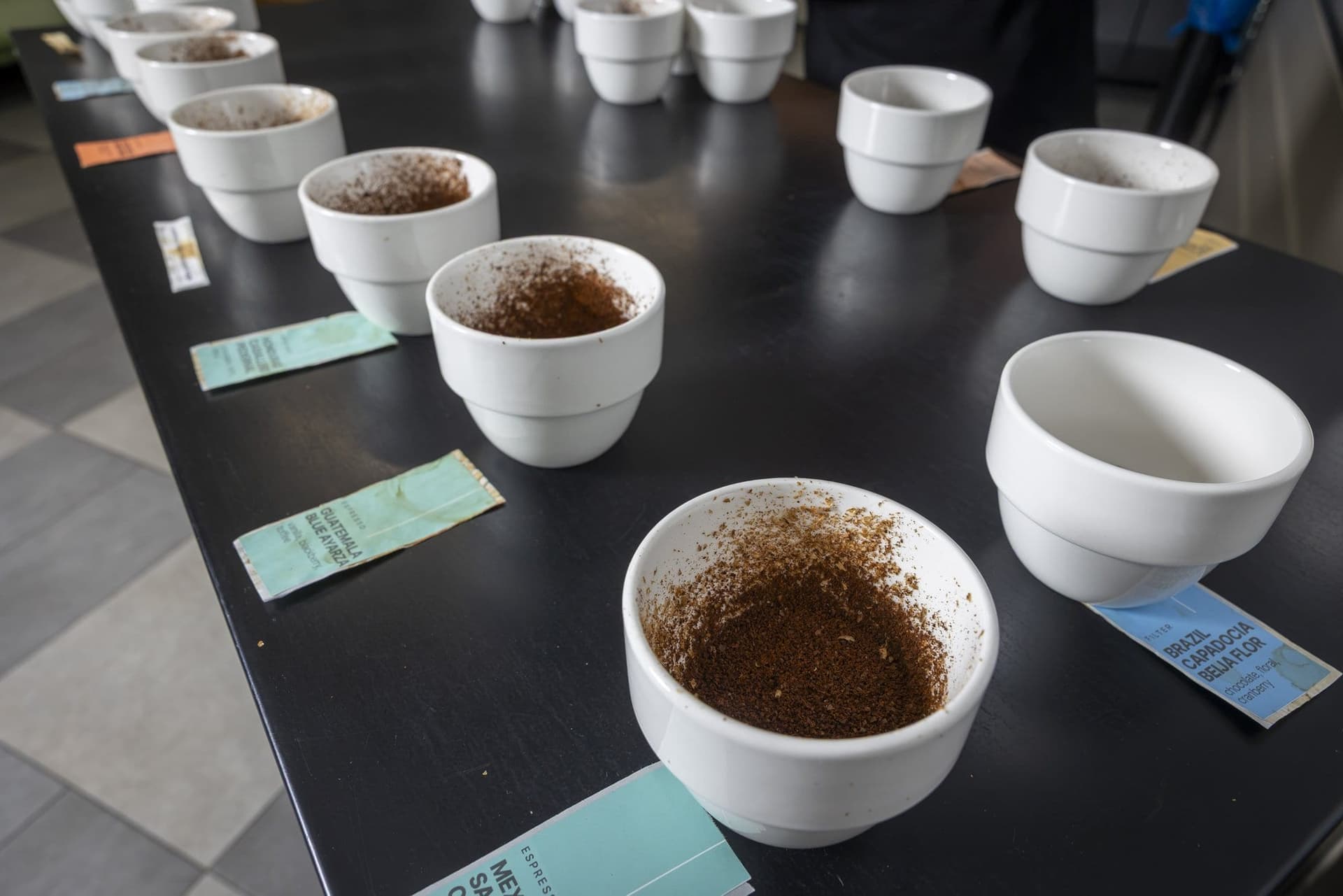
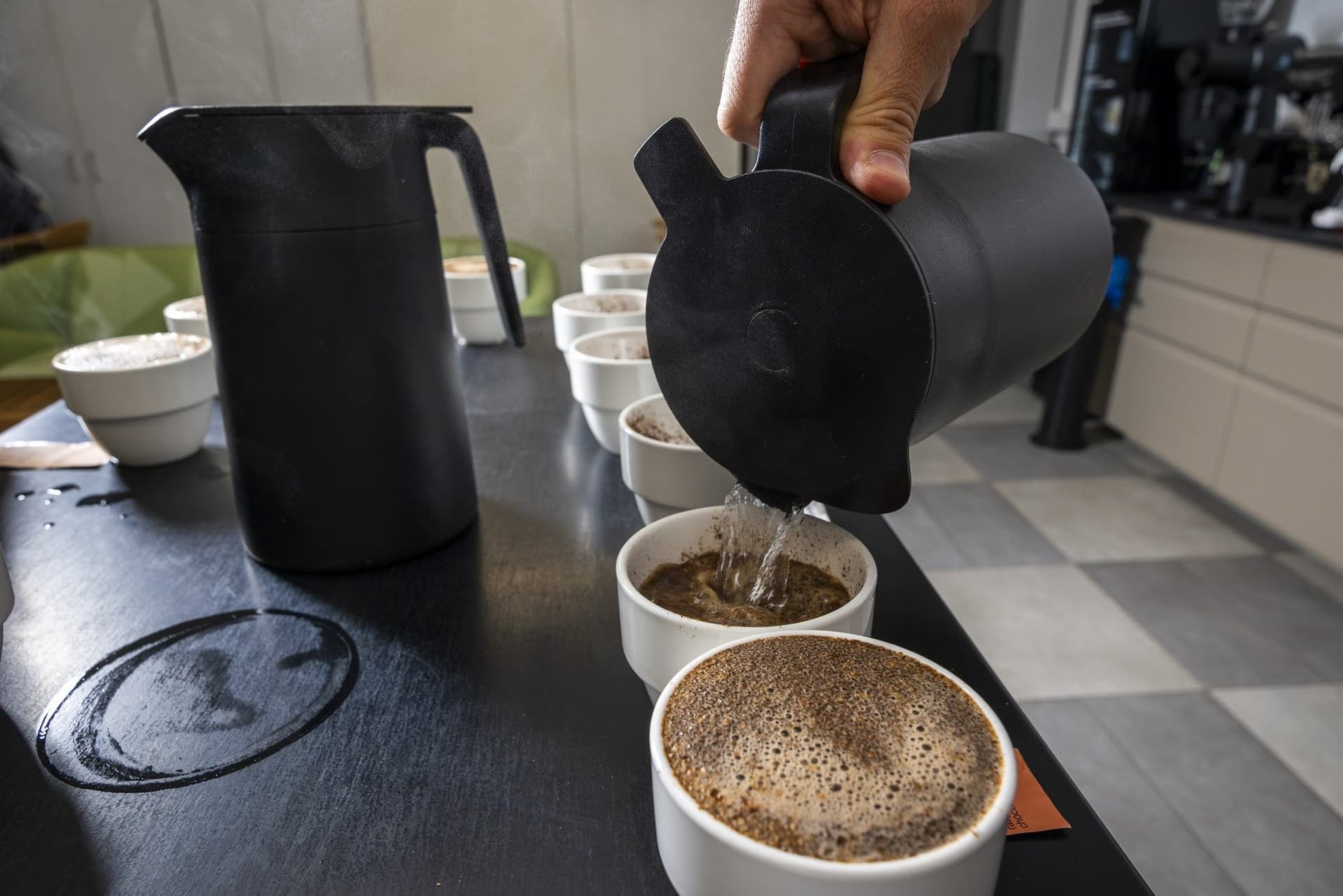
Each cup takes about 11 grams of ground coffee, or 5.5 grams per 100 milliliters of water. First the dry grounds are smelled, straight from the cup. Then hot water is poured over the coffee. At minute four, the crust that has formed on top is broken: two spoons skim off the foam, so the taster gets the aroma of the coffee rather than the concentrated aroma of the foam. Tasting starts at minute 10.
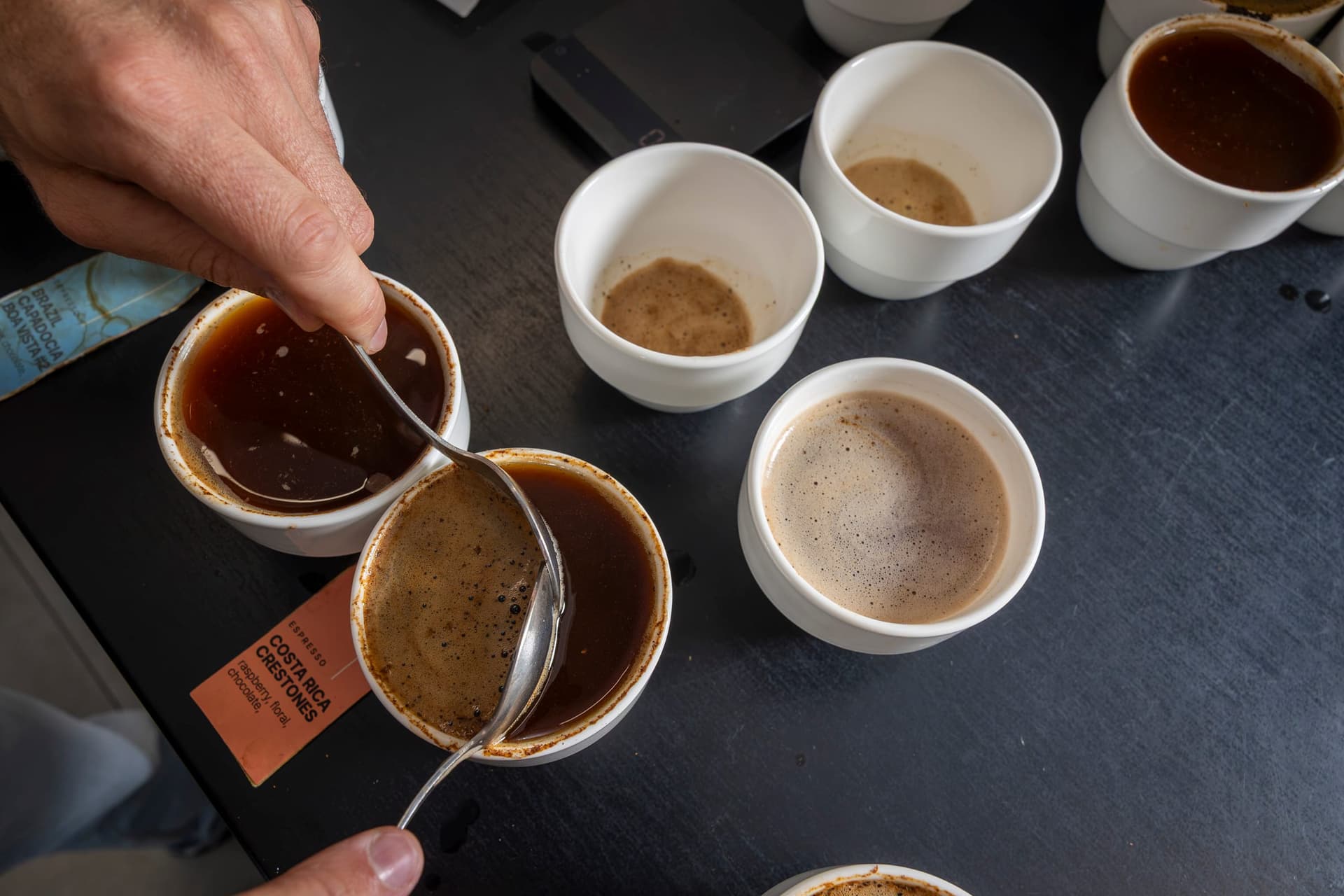
You can hear the tasting. Each person takes a little coffee in the spoon and slurps it loudly, the way children slurp soup that's too hot. The notes go into a phone, on a scoring protocol. From there they end up in a program called Cropster. Mihai Panfil tastes alongside the others and logs his notes on his phone, too.
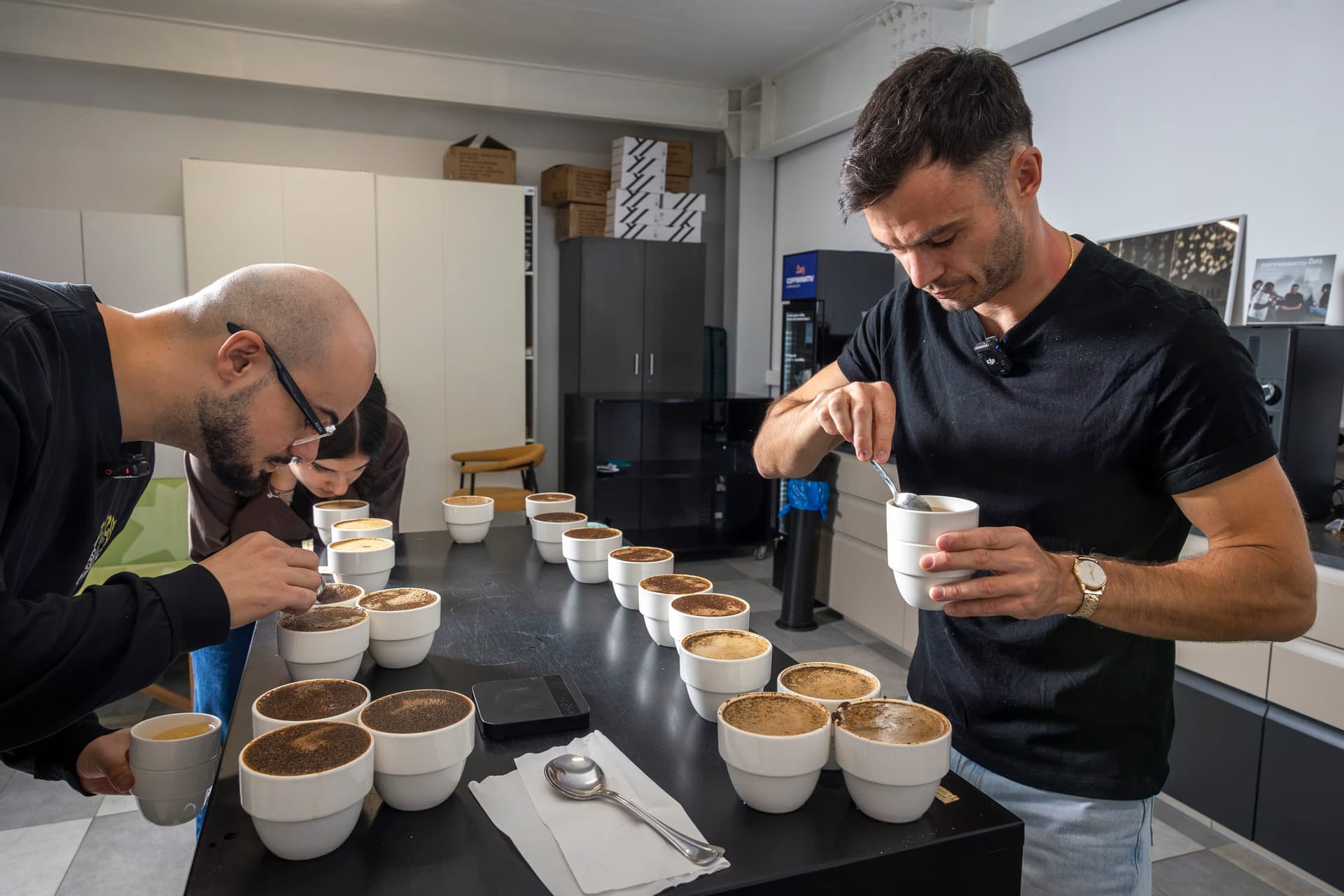
Daniel is a young man from the Republic of Moldova. He grew up in a village near Ungheni, about 20 meters from the Prut River. The village on the other bank was 50 meters away, but to get there he had to make a five-hour detour through the Albița border crossing, he says. He studied in Romania, moved to England and came back. "Before I came here, I had nothing to do with coffee," he says. Within a year he had picked up everything coffee involves, because he was lucky enough to be around "very open people."
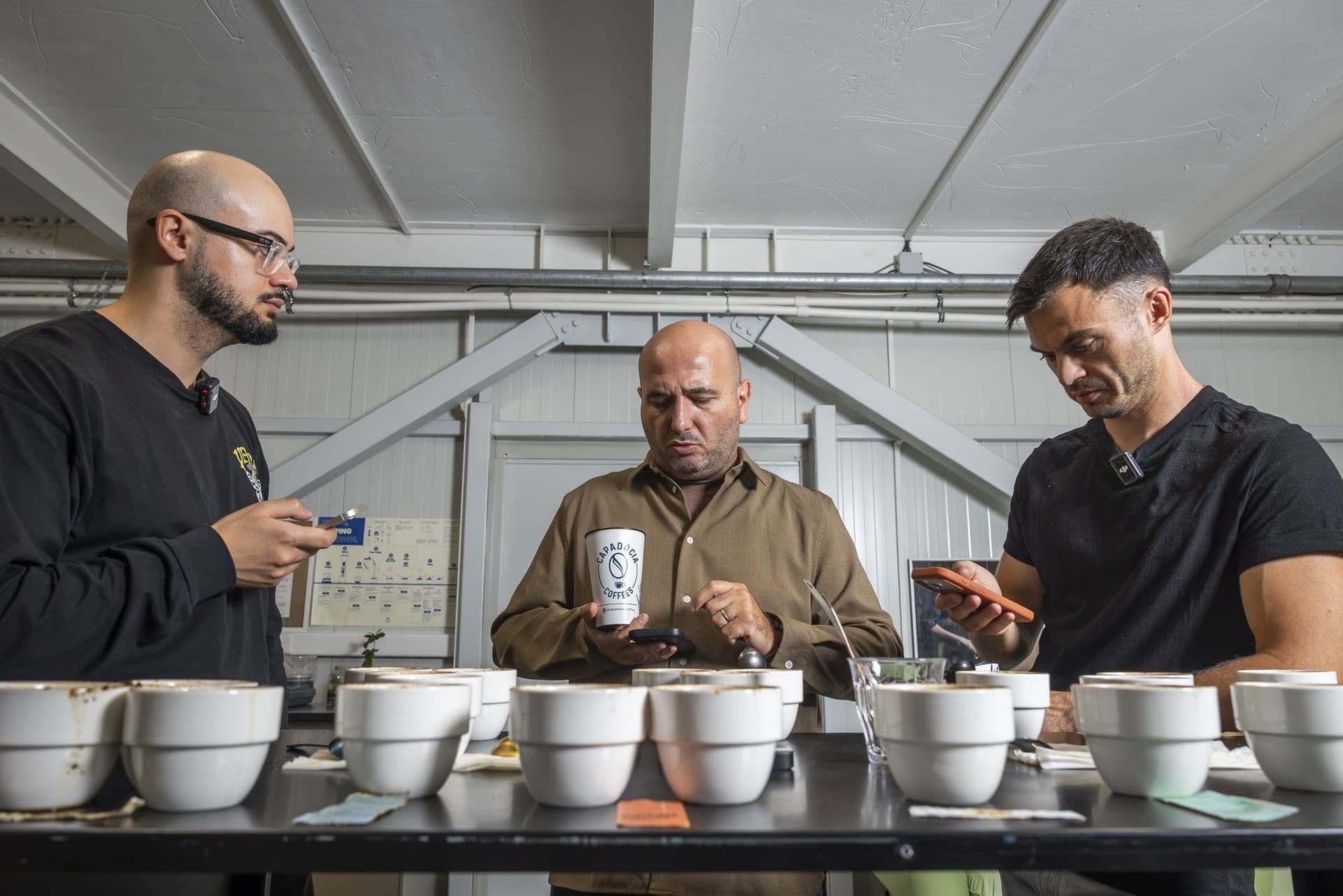
I was invited to the table as well. I drink three or four espressos a day, and there I felt like a layman. I couldn't tell the smells apart, especially between two cups side by side. I tried hard to pick out the flavors they were naming. In the end I thought I'd caught something, but I don't know how much of it was real and how much was my brain straining to taste something. I can't say the taste won me over.
It wasn't the first time that morning. At the tasting in the lobby, two espressos pulled a few tenths of a gram apart had seemed identical to me: a good coffee I couldn't have told from any other good coffee. Nobody had seemed bothered. People who don't know much about coffee sit at their table by design: "Sometimes even a person who doesn't know that much about coffee can tell you exactly whether a consumer is going to like it," Mihai Grosu had said.
Orange and Christmas
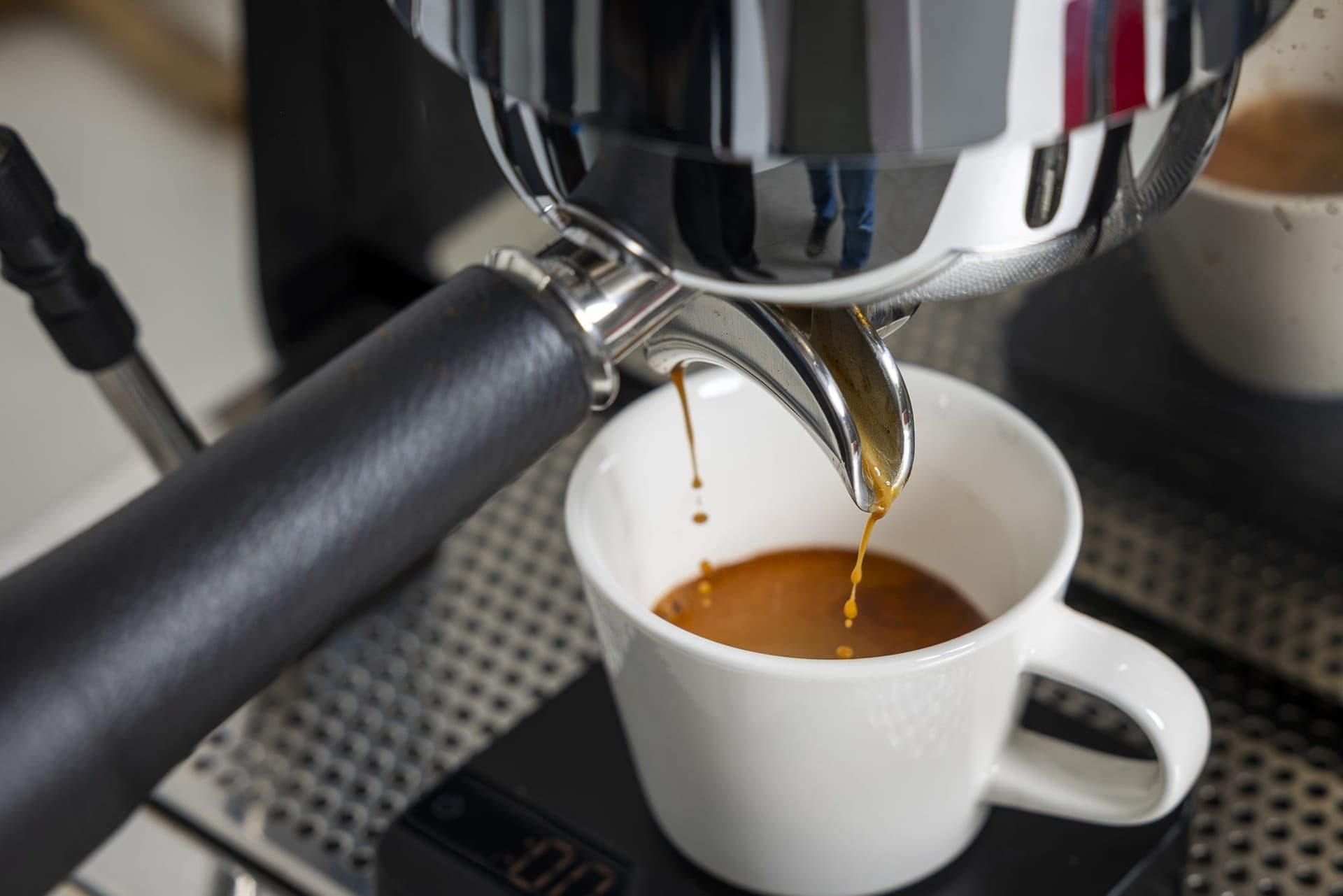
The day had actually started in the lobby, with another tasting. At the espresso machine, they were trying out the Christmas blend for Brewzeus: half Guatemala, a quarter Costa Rica, a quarter Ethiopia. Eighteen grams of ground coffee in the portafilter, about 38 grams of espresso in the cup.
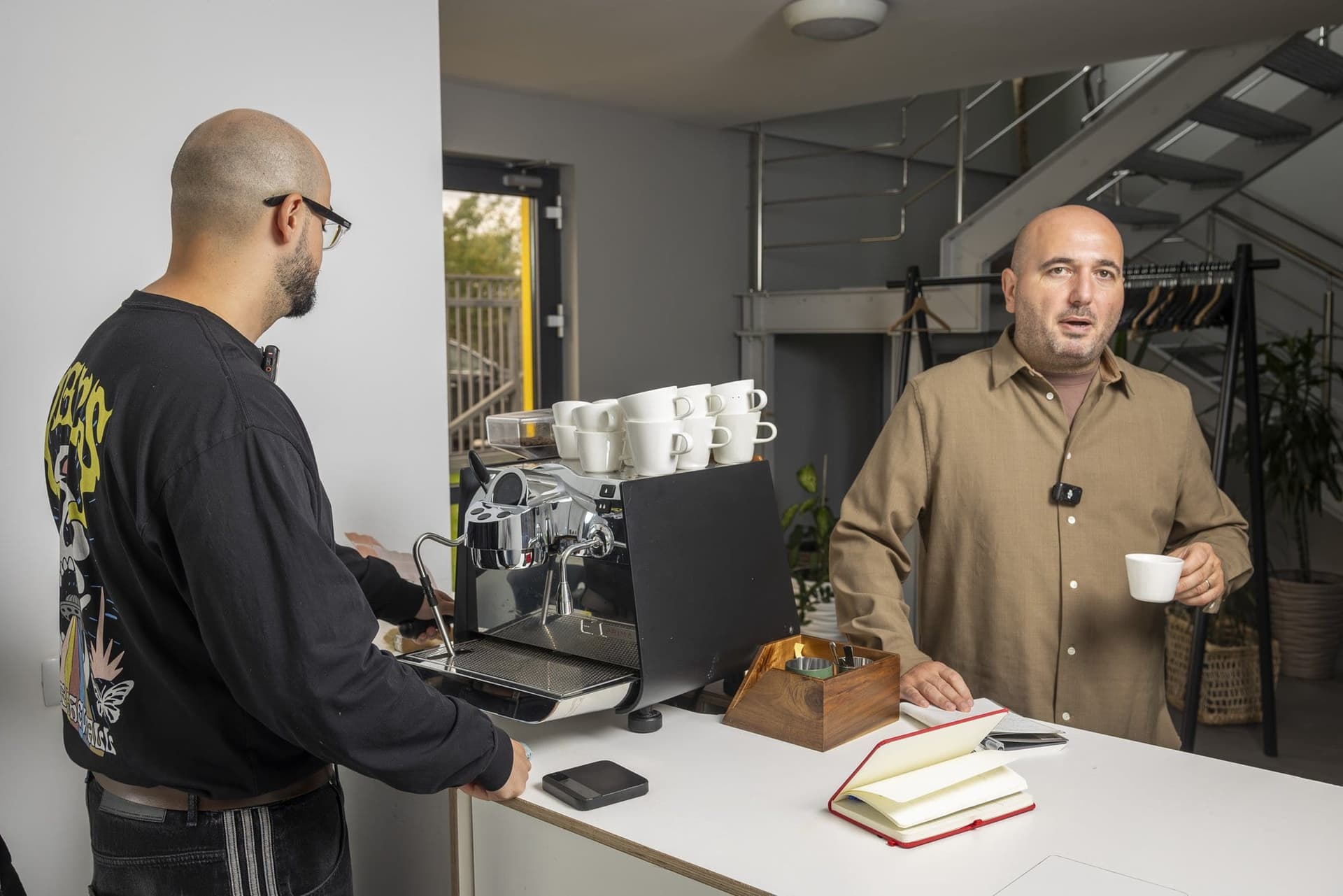
The question Mihai Panfil puts to the table is whether the three coffees together make something better than each does alone. Mihai Grosu is the first to call out the notes: brown sugar, spice, lime zest. Chocolate makes the list, too. For the seasonal blends, Mihai Panfil wants "a little spice" and "a bit of orange, because orange and Christmas always go together."
Same day
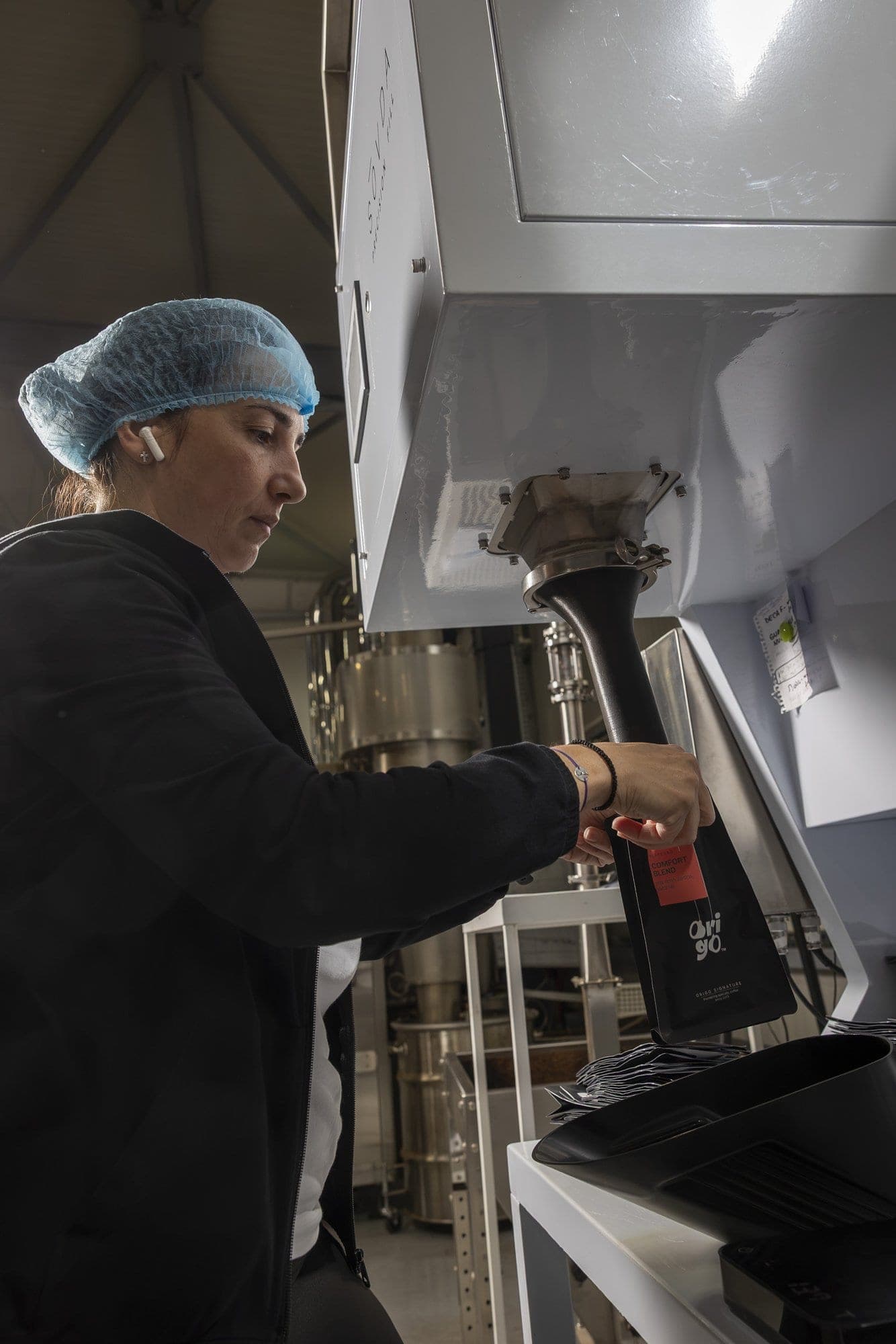
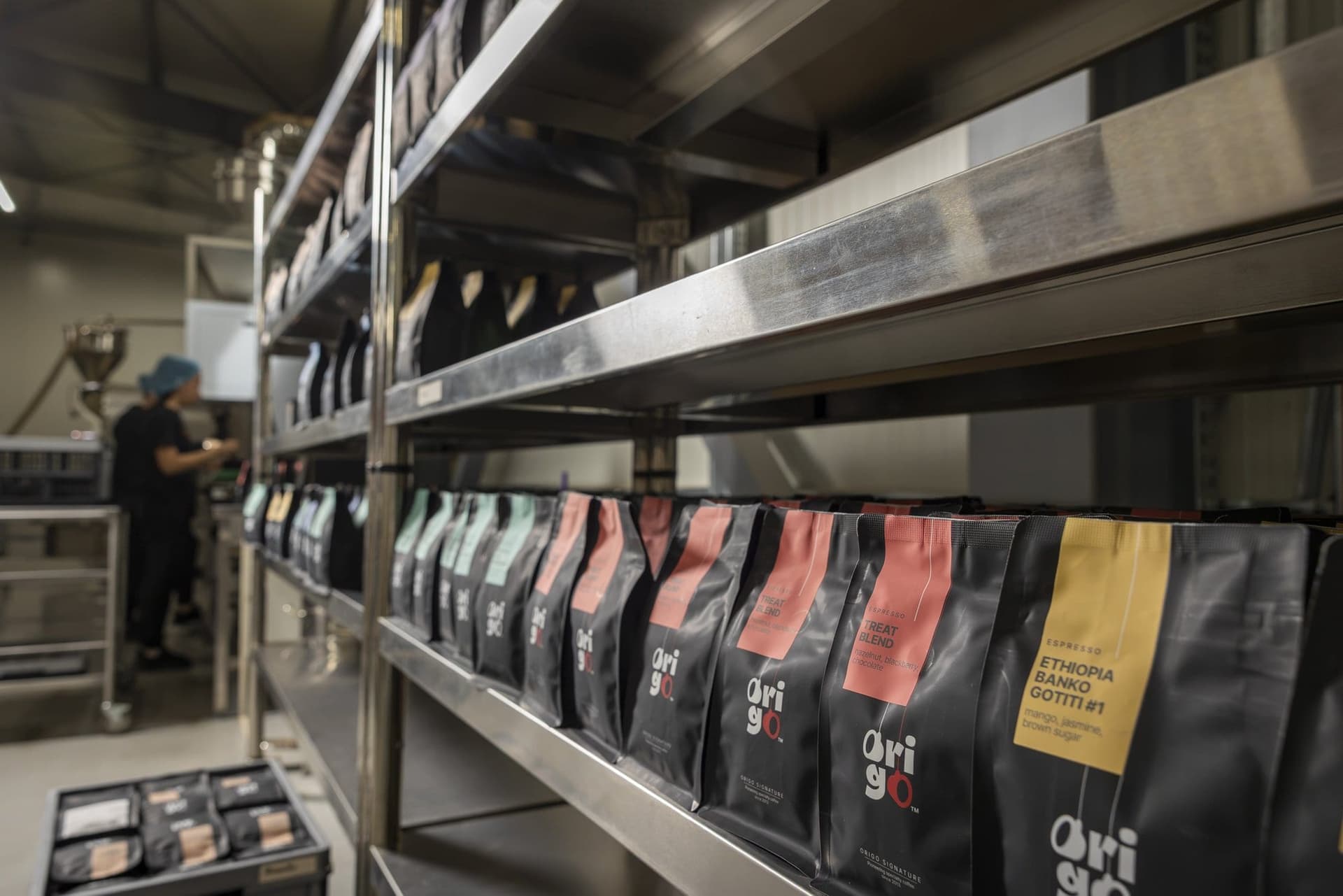
Whatever is roasted gets packed the same day. "Our colleagues in packing pack all the coffee we roast in a day on that same day," says Mihai Panfil. Two women on the team fill the bags from a dosing machine, and each bag then goes through a horizontal sealer.
The showcase
From the building on the edge of the city, the coffee goes out to Origo's cafés, to the partners who serve it and, more and more often, to people's kitchens. "These days the first coffee is drunk at home," says Mihai Panfil. The café on Lipscani Street remains the showcase: the place where you can see the result of a morning like this one.
The full interview with Mihai Panfil, on the roastery, the farmers and the economics of running cafés:
The full interview with Mihai Panfil, on YouTube
On the way out, the daylight made me squint, my eyes used to the half-light inside.
The next day, one image from the whole morning stayed with me: the paddle in the cooling tray, turning beans just out of the drum. For them, the next day was the day that coffee reached the table on wheels.
Automated translation from the Romanian original.