
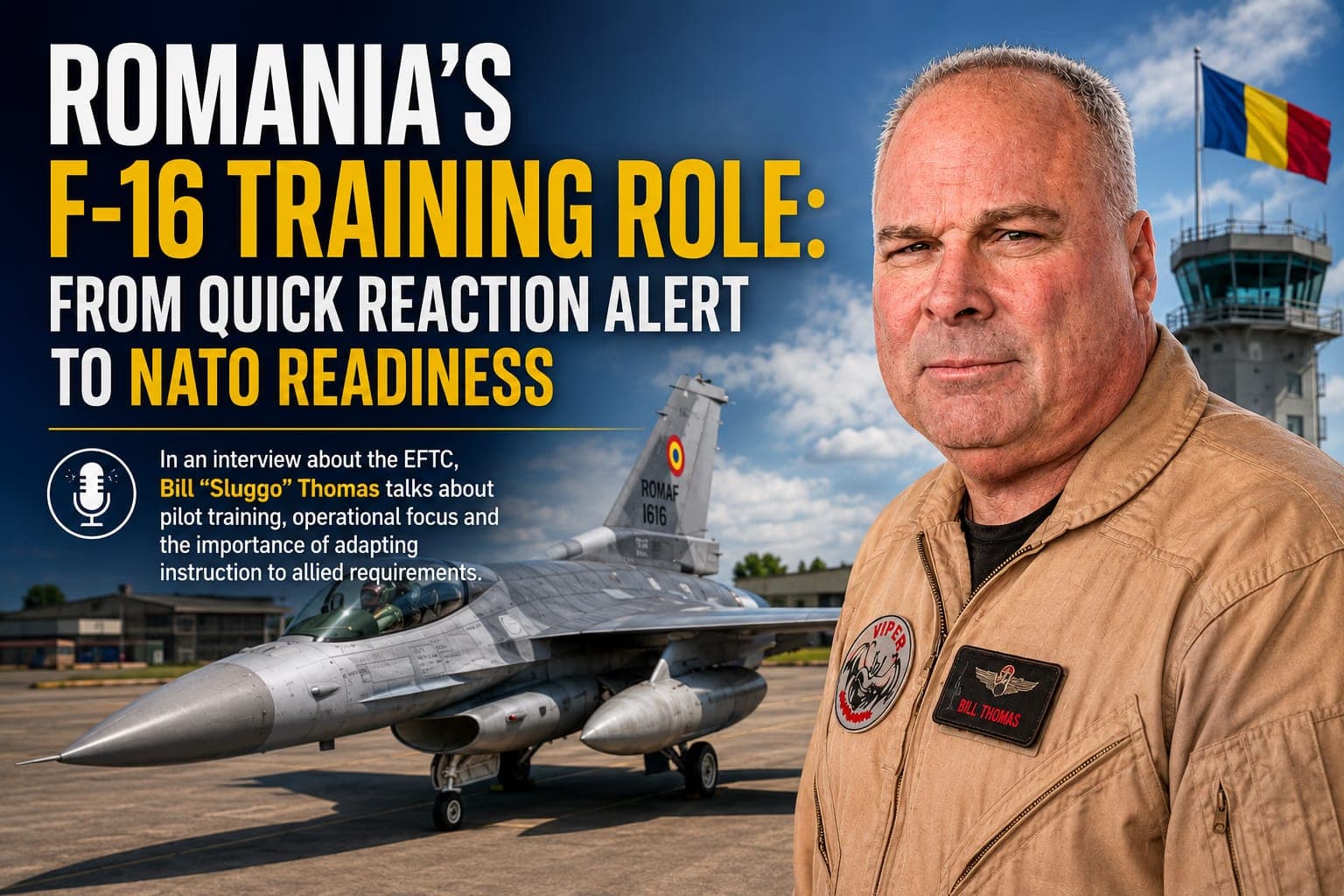
"Last night there was a scramble at the border, with explosions. That keeps the pilots focused."
Bill "Sluggo" Thomas, the operations lead of the European F-16 Training Center (EFTC) at Fetești Air Base, explains what sets the program apart from Tucson, Arizona — the classic training ground for NATO pilots — and what is being done in Romania. On Ukraine, on the lessons learned from recent losses, and on the future of the center after the transition to F-35.
Interview by Adi Coco · Romania Frumoasă · BSDA 2026, Bucharest
Editor's note: this interview was conducted in English and edited for clarity. Bill "Sluggo" Thomas is, per Lockheed Martin, EFTC Site Accountable Manager — the operations lead of the European F-16 Training Center. The center operates at Fetești Air Base and trains both Romanian and Ukrainian pilots.
❦
ROMÂNIA FRUMOASĂ: How does the Romanian training center differ from Tucson, Arizona — in terms of environment, airspace and mission requirements?
BILL "SLUGGO" THOMAS:
I don't think it really comes down to environment — Arizona basically means good flying weather year-round. Our syllabus is very similar to theirs. The difference shows up elsewhere.
There's something we teach here that isn't taught at Tucson: Quick Reaction Alert (QRA) — the rapid-reaction system NATO requires. We teach QRA here because that's what NATO needs from Romanian pilots. Over there, they don't do it at all.
Otherwise, the curriculum is almost identical. The first ten rides — takeoff, landing, instrument flying, flying in weather — are practically the same. Then, once you move into tactics, things start to diverge.
The challenge for the American centers is that they have to train pilots from many different countries at the same time, in the same place. It's hard to change the syllabus there. We, on the other hand, have the freedom to tailor ours to each nation. If a country says, "I don't have those kinds of bombs in my arsenal, I have these," then we train on exactly what they have. It's not just the number of sorties, or the air-to-air versus air-to-ground ratio. The weapon system we use matters too.
More than that: a country can come to us and say, "Originally we thought we needed this, but now we see that in our own airspace we approach training areas differently from how you do it here. The way you do it would build the wrong habits for us back home. Can you change how you teach it?" Our answer is: easy, yes. We tailor exactly to what that country needs.
ROMÂNIA FRUMOASĂ: Does the proximity of the war in Ukraine make the training environment more realistic or more demanding for the pilots?
BILL "SLUGGO" THOMAS:
I don't want to say war is "good" for anything — but from a training standpoint, the proximity makes the pilots pay more attention. To their studies, to their preparation.
It's one thing to be in the middle of the United States and say, "all right, I'm training pilots." Here, it happens that last night, for example, we had a scramble (a response to an identified airborne threat) at the border, with explosions audible just across it. It's much easier to reinforce the lesson under those conditions. We can be in the middle of a training mission when a scramble goes off — and that keeps them focused automatically. In other places, that's hard to come by.
ROMÂNIA FRUMOASĂ: There have been public reports about Ukrainian F-16 losses and pilots killed in combat. Without going into classified details, are such incidents analyzed as part of the lessons-learned process?
BILL "SLUGGO" THOMAS:
Exactly. We do that with all our students. Lockheed Martin has its own process too — anytime we lose an airplane, for any reason, there's a safety analysis and a tactical analysis. Then we brief it.
F-16s fly all over the world. It might be an incident on an instrument approach, it might be a problem in combat. If it's safety-related — meaning we've lost an airplane or something similar — we talk about it, so the other countries learn from it too. We share the lessons learned.
ROMÂNIA FRUMOASĂ: As Romania prepares to introduce the F-35, do you see the training center eventually evolving beyond F-16 training, or will its main role remain focused on the F-16 during the transition period?
BILL "SLUGGO" THOMAS:
That's to be determined by the Romanian government and the U.S. government. All I know is that our contract right now runs for five years, and the Romanian Air Force has talked about extending it considerably, so it overlaps with the F-35 — even the stage when the F-16 and F-35 will be flying at the same time.
❦
GLOSSARY FOR THE UNFAMILIAR READER
Quick Reaction Alert (QRA): a NATO rapid-reaction procedure under which pilots and aircraft are kept in a permanent state of readiness for immediate takeoff in case of an unidentified airborne threat. Romania actively participates in QRA over the Black Sea airspace.
Scramble: the order for an urgent takeoff on a QRA mission. In the current context, scrambles from Fetești and Mihail Kogălniceanu have been frequent, following Russian drone incursions near or onto Romanian territory.
Tucson, Arizona: Morris Air National Guard Base, the main U.S. center for training non-American F-16 pilots. It operates with dozens of NATO allies and partners.