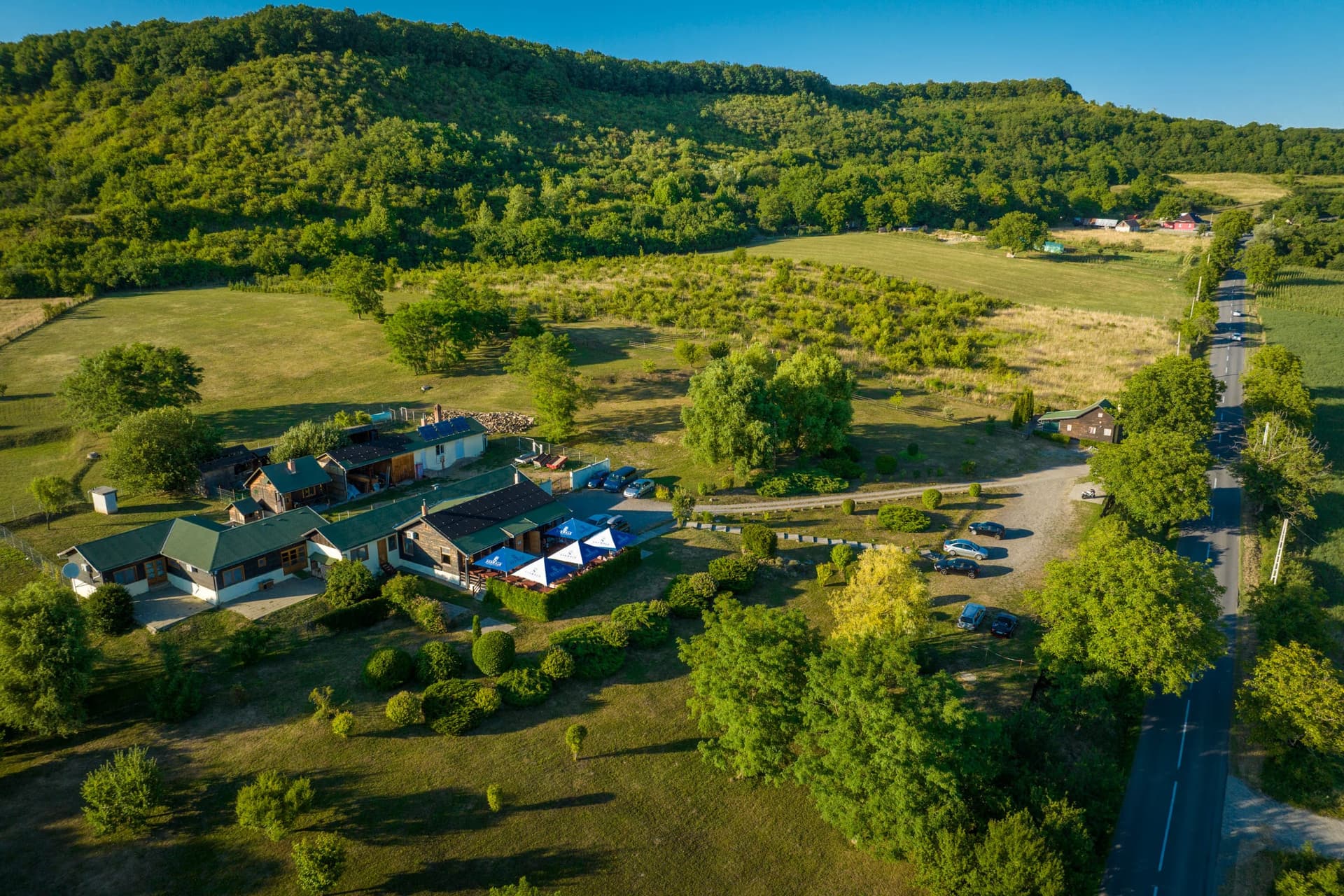
The restaurant, perched among the hills, about 20 kilometers from Târgu Mureș. Photo: AdiCoco.com
There is a moment at the table when the spoon stops in mid-air. It happens the first time you cut into a portion of fried ice cream: on the outside, a golden, warm, crunchy crust fragrant with cinnamon and drenched in a warm chocolate sauce; on the inside, the cold, creamy core — still frozen — that has just passed unscathed through the hot oil. It is one of those small gastronomic miracles that seem to break a law of nature — and that is precisely why we love it.
Gebackenes Eis — or, more precisely in German, frittiertes Speiseeis, "fried ice cream" — is, at its core, a kitchen trick dressed up as a dessert. The whole secret lies in temperature and speed. A scoop of ice cream, usually vanilla, is kept in the freezer until it is rock solid. It is then coated in a thin shell — beaten egg and cornflakes, sweet breadcrumbs, or cookie crumbs — and dropped for a few seconds into boiling oil. The crust browns instantly but has no time to warm the core. The plate arrives at the table immediately, dusted with cinnamon and sugar, often accompanied by whipped cream, a fruit sauce, or a spoonful of honey.
The contrast is the whole show: warm and cold in the same bite, crunchy and creamy, sweet and lightly caramelized. It is the kind of dessert that makes children's eyes go wide and adults smile knowingly, because somewhere in the back of our minds we all sense that it "shouldn't work" — and yet it does. Its very fragility is what makes it precious: it lives for just a few seconds. Too soon and the crust isn't ready; too late and the core gives way. That is why it is a dessert you order and eat on the spot — not one that tolerates waiting.
There is, for that matter, no single "correct" recipe. Every kitchen has its own version: some prefer a cornflake coating that crackles under the spoon, others fine cookie or sponge-cake crumbs that yield a softer crust. Some serve it simply, with just cinnamon and powdered sugar; others drench it in a warm chocolate or raspberry sauce, drizzle it with honey, or add a spoonful of freshly whipped cream alongside. The core is most often classic vanilla — understated, so as to let the temperature contrast take center stage — but nothing stops you from imagining it in chocolate or pistachio. It is a dessert that invites small liberties.
Although we encounter it today on Bavarian and Swabian restaurant menus as a family classic, its origins are surprisingly contested — and nowhere near as "European" as one might expect. The most widely repeated stories send it across the Atlantic: some say it was first served at the World's Fair in Chicago in 1893; others credit a Philadelphia firm in 1894, which already described in print "a firm ball of ice cream wrapped in a thin batter, passed briefly through hot fat and served immediately." What is certain is that the idea traveled, attached itself to the tradition of the warm dessert, and put down deep roots in German cuisine, where it became, over time, a much-anticipated end to a meal.
"Swabian" is not, here, merely a menu label. Schwaben — Swabia — is a region in southwestern Germany, home to the famous Spätzle, soft egg noodles scraped directly into boiling water, and to a hearty, unfussy cuisine designed to feed people who worked the land. From these southern territories, two or three centuries ago, came the waves of settlers who would become the Banat and Satu Mare Swabians — the German communities who brought smoked sausages, braised cabbage, strudel, and a taste for long meals around a wooden table to Romania. A restaurant that takes the name Schwabenhof — "the Swabian farmstead" — places itself, whether it intends to or not, squarely within that tradition.
In the German home kitchen, a warm dessert is not an exception but almost a rule of the cold season: thick apple pancakes, steaming dumplings, pastries pulled from the oven and eaten hot with a dollop of cold vanilla cream. Against this backdrop, fried ice cream feels right at home. It carries forward the same idea — warmth and cold set face to face — in a form that seems modern but in fact speaks the old language of Sunday meals, when dessert was the moment when no one was in a hurry.
And that is exactly how it feels at Schwabenhof. The restaurant was opened in 2012 by a German investor and sits perched on a hill in the village of Isla (Hodoșa commune), Mureș County, about 20 kilometers from Târgu Mureș — on the road toward Sovata, 40–60 minutes from Cluj or Sibiu. It is far enough from the city to make you breathe differently when you step out of the car. The courtyard is picturesque, the terrace looks out over the valley toward the forested hill opposite, and in the evening, when the slopes soften in the light, the place takes on something of the quiet calm of a Gasthaus in southern Germany. Inside it is warm and welcoming, with solid wooden tables and chairs, checked tablecloths, and a wood-burning stove; the waitresses wear traditional dirndl dresses, and Bavarian wheat beer is poured with the ceremony it deserves. Outside, the view does half the work, and the road itself — winding through the hills — is already part of the experience: you arrive with your appetite well and truly open.
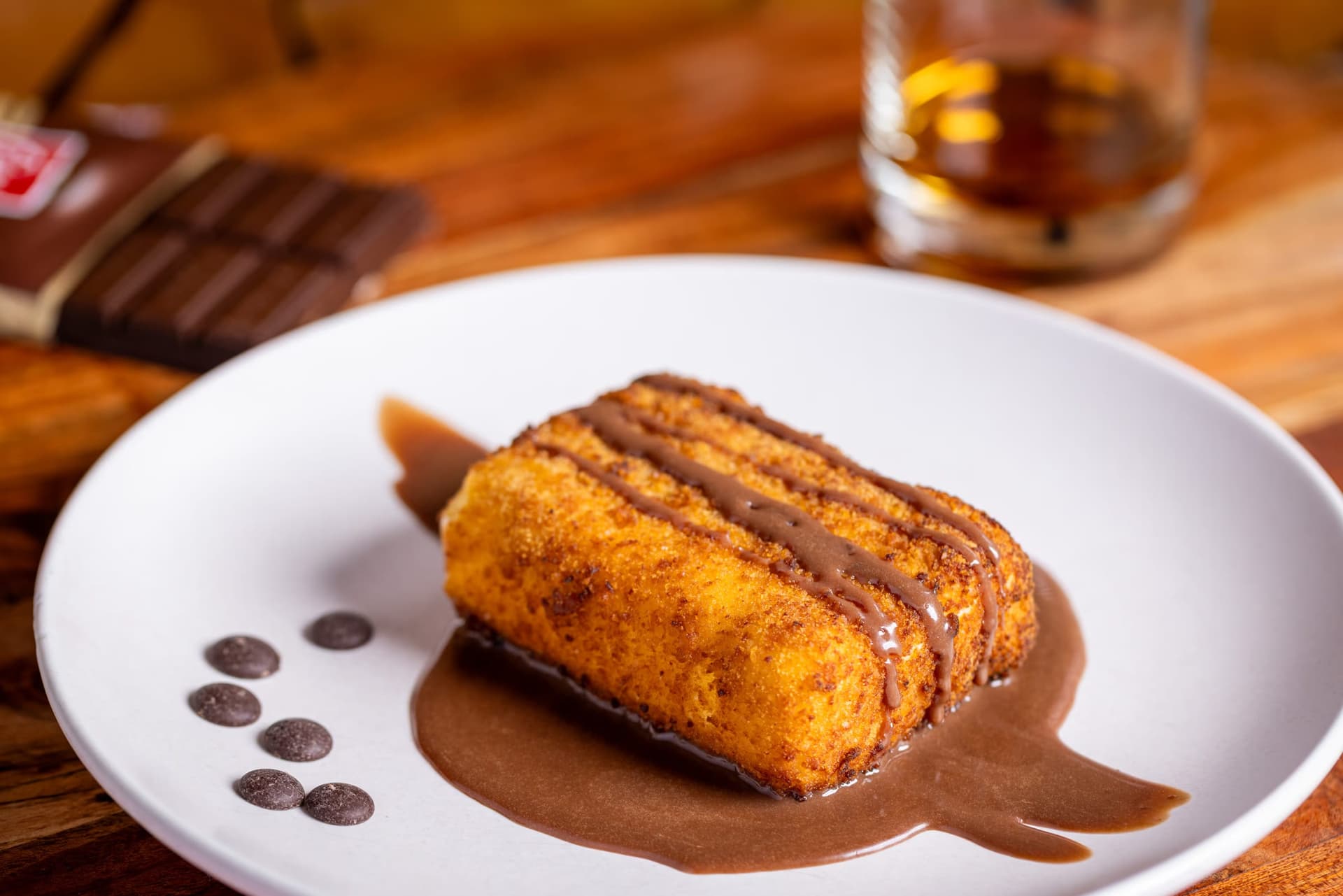
The fried ice cream at Schwabenhof — a warm, golden crust, a cold core, bound together by a warm chocolate sauce. Photo: AdiCoco.com
The kitchen keeps the promise of the name — Bavarian and Swabian, without compromise. The lamb knuckle with potatoes, goulash, and schnitzel prepared to a German recipe are the kind of dishes that demand time and a matching appetite; homemade soups and stews are always on hand, and the Bavarian beer completes the picture. On the sweet side, Kaiserschmarrn — the fluffy shredded pancake dusted with sugar — and homemade cakes have their devoted admirers. But when the fried ice cream finally arrives, it plays the role it knows best: the grand finale, the warm-cold surprise that closes the meal with a brief moment of wonder.
That, in the end, is also the beauty of a meal out in the countryside: the pace. Nobody here rushes you to free up the table. Between the main course and dessert there is room for a pause, a beer finished unhurriedly, a long conversation on the terrace. And the fried ice cream arrives at exactly the right tempo — not as an abrupt ending, but as a last surprise held back for the finale, paired, if you like, with a strong coffee that cuts through the sweetness.
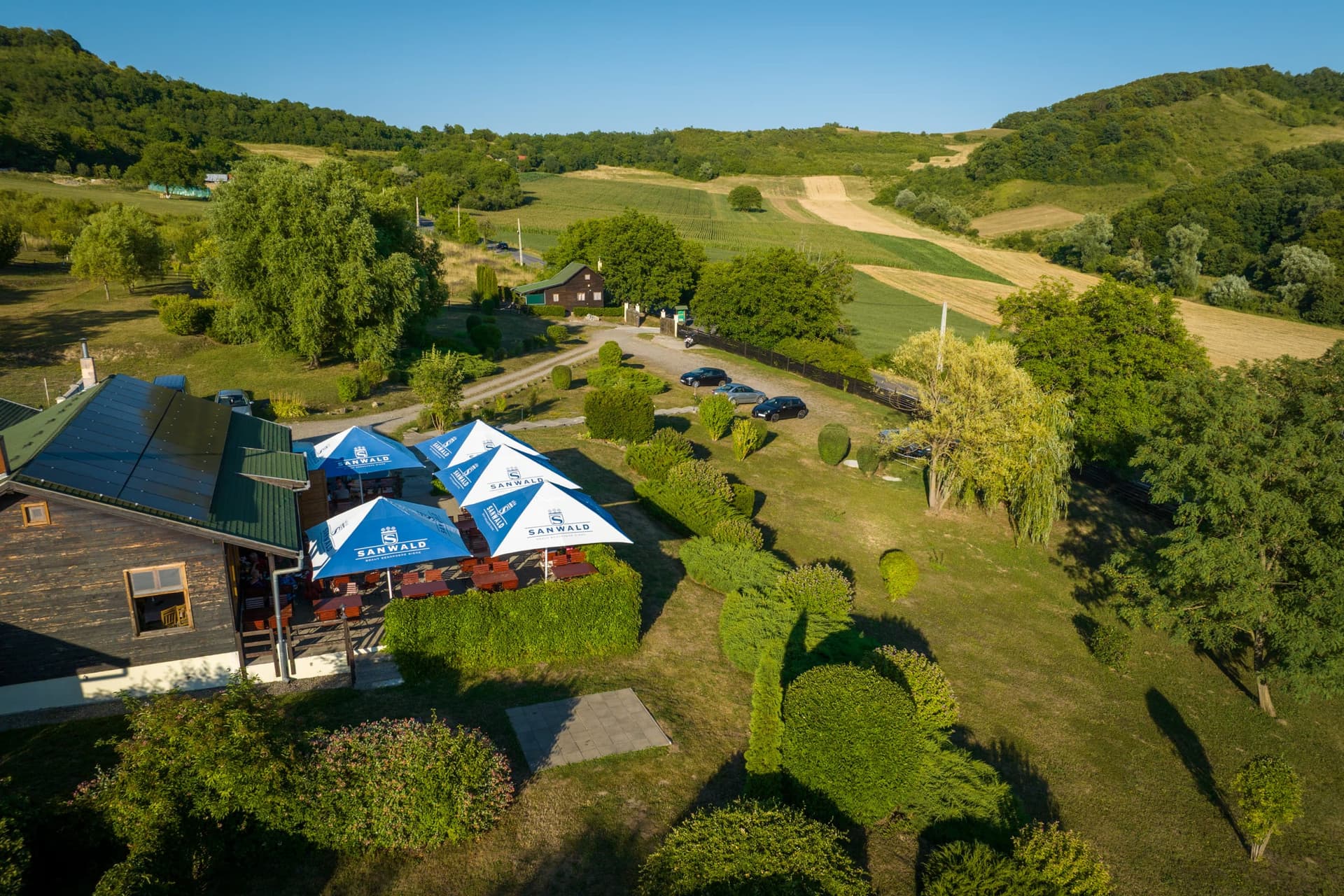
The umbrella-shaded terrace, open to the hills surrounding the village of Isla. Photo: AdiCoco.com
This is a dessert worth ordering "in the moment" and attacking without hesitation, while the crust is still hot and the core still firm. Where the cooking is done in-house and without haste, you have every chance of catching it at precisely the right instant — that brief window when the contrast is perfect. And if the weather is on your side and you manage a table on the terrace at sunset, with the valley spread out below you, the fried ice cream at Schwabenhof becomes the kind of memory you recount later, when someone asks you where to eat well around Mureș.
IN BRIEF
Where: Restaurant Schwabenhof, Principala nr. 1a, 547322 Isla (Hodoșa commune), Mureș County — ~20 km from Târgu Mureș, on the road toward Sovata.
Hours: Tuesday–Sunday, 12:00–22:00 (closed Monday).
Must-order: Lamb knuckle with potatoes, goulash, Kaiserschmarrn, and, above all, the fried ice cream (Gebackenes Eis).
Online: www.schwabenhof.eu · reservations at +40 788 311 429.