
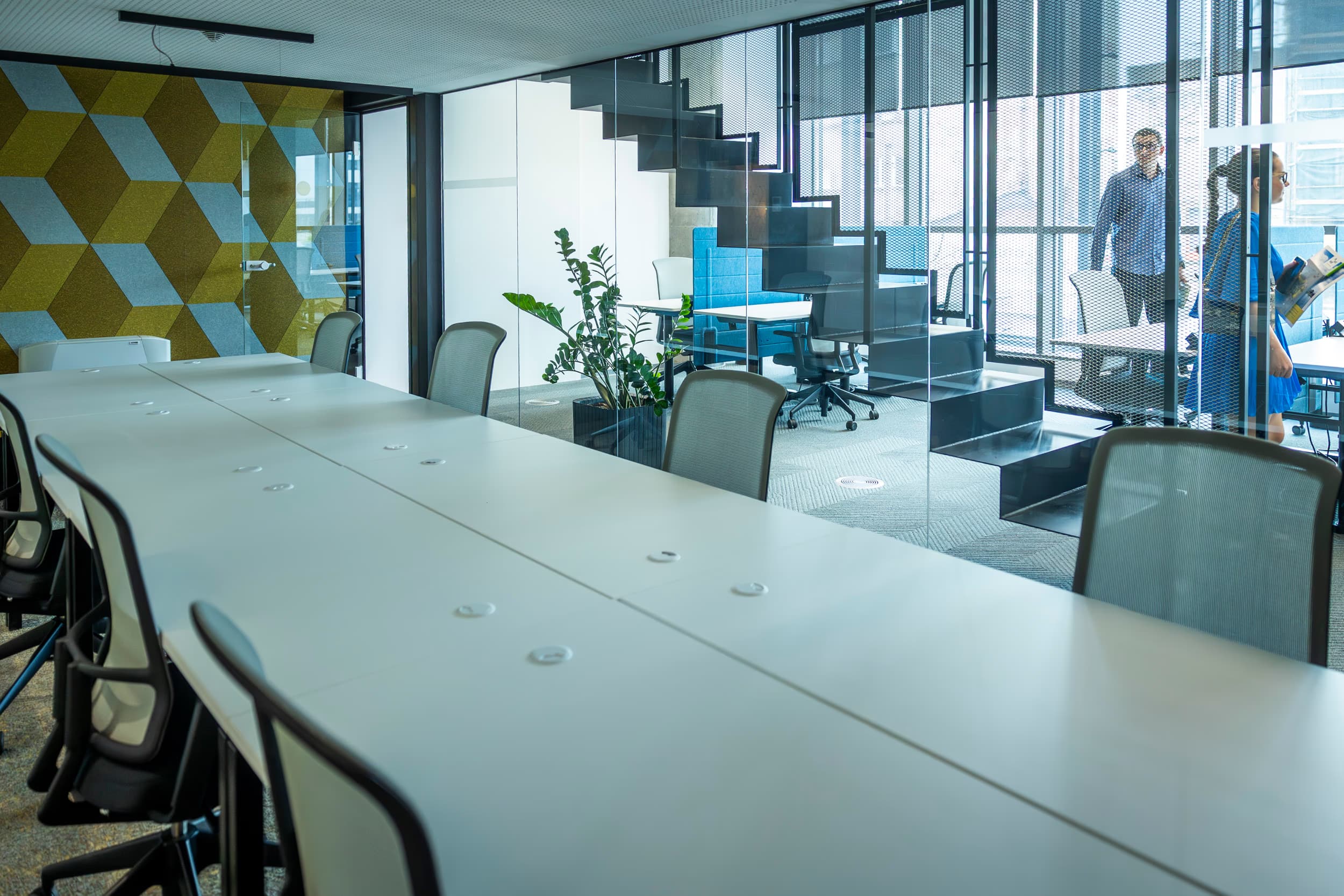
Hotspot, Bucharest's premium flex office operator, is planning the opening of a third location in the north of the capital, as part of a goal to nearly double its portfolio over the next 18 months — from 550 to 1,000 workstations. The positioning argument of its German founder, Andreas Skhlote: artificial intelligence will compress office space at a ratio of five to one, and those who remain will demand Maybach, not Aldi.
The company
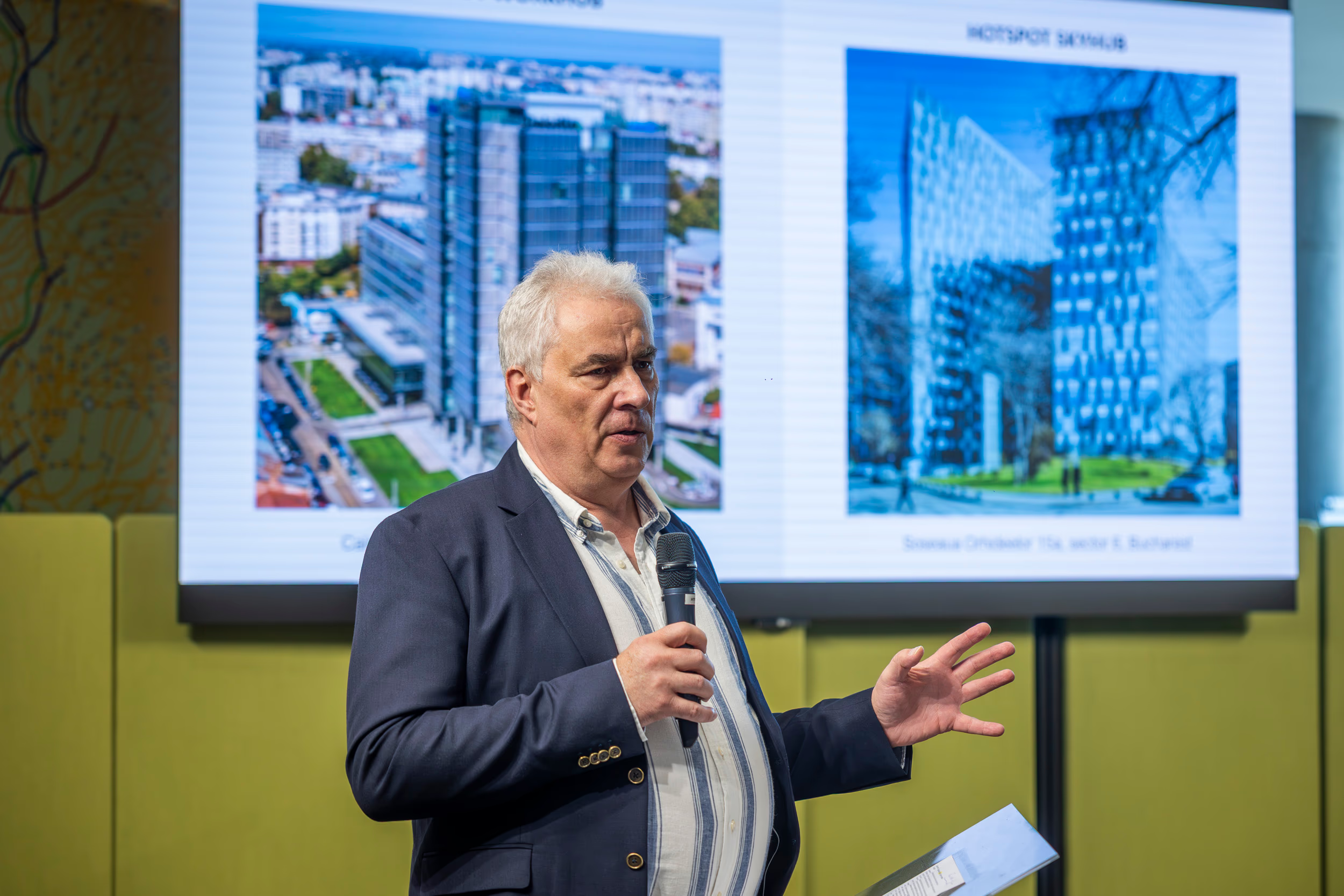
Hotspot currently operates two locations in Bucharest — WorkUp and SkyHub — totalling approximately 20,000 square metres and 550 workstations. The company was founded by Andreas Skhlote, a German workplace strategy consultant, and is run operationally in the local market by Cristina Dumitrescu, Head of Development, with twenty years of experience in the Bucharest real estate market — first at CBRE, then at the IWG group (Regus and Spaces).
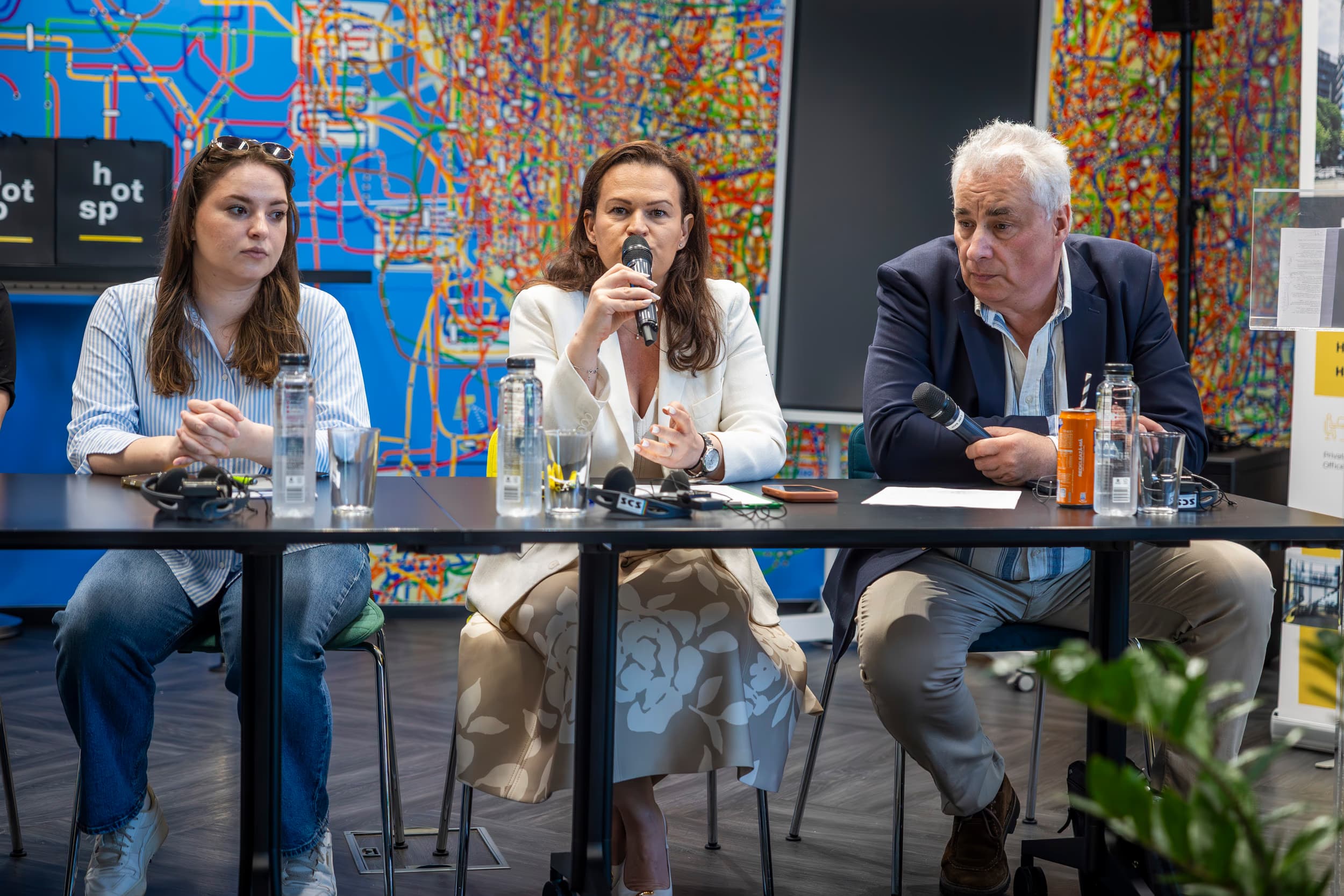
The main location, WorkUp, opened in early 2020 — exactly one week before the pandemic broke out. "Wir hatten durch Covid eine extrem schwierige Zeit" Skhlote acknowledged at today's press conference at WorkUp — "we went through an extremely difficult period, but that's behind us now" . The detail that now marks the end of that phase: the building's owner has granted the company a contract extension for the coming years.
Current occupancy: nearly 100% at WorkUp, slightly below that at SkyHub. Client retention rate, according to Cristina Dumitrescu: 99%.
Pedigree
For the Romanian reader, the name Skhlote means little. For the German reader familiar with the world of workplace consulting, it's another matter.
Skhlote was part of, in the 1980s, Quickborner Team — the German consultancy founded in 1959 that invented the concept of Bürolandschaft (office landscaping), an approach to organising large open-plan offices that redefined corporate space across Western Europe in the 1960s and '70s.
Under the Quickborner Team umbrella, Skhlote and his colleagues planned the relocation of the German federal government from Bonn to Berlin after reunification, the headquarters of the European Central Bank in Frankfurt and the office standards for European Union institutions.
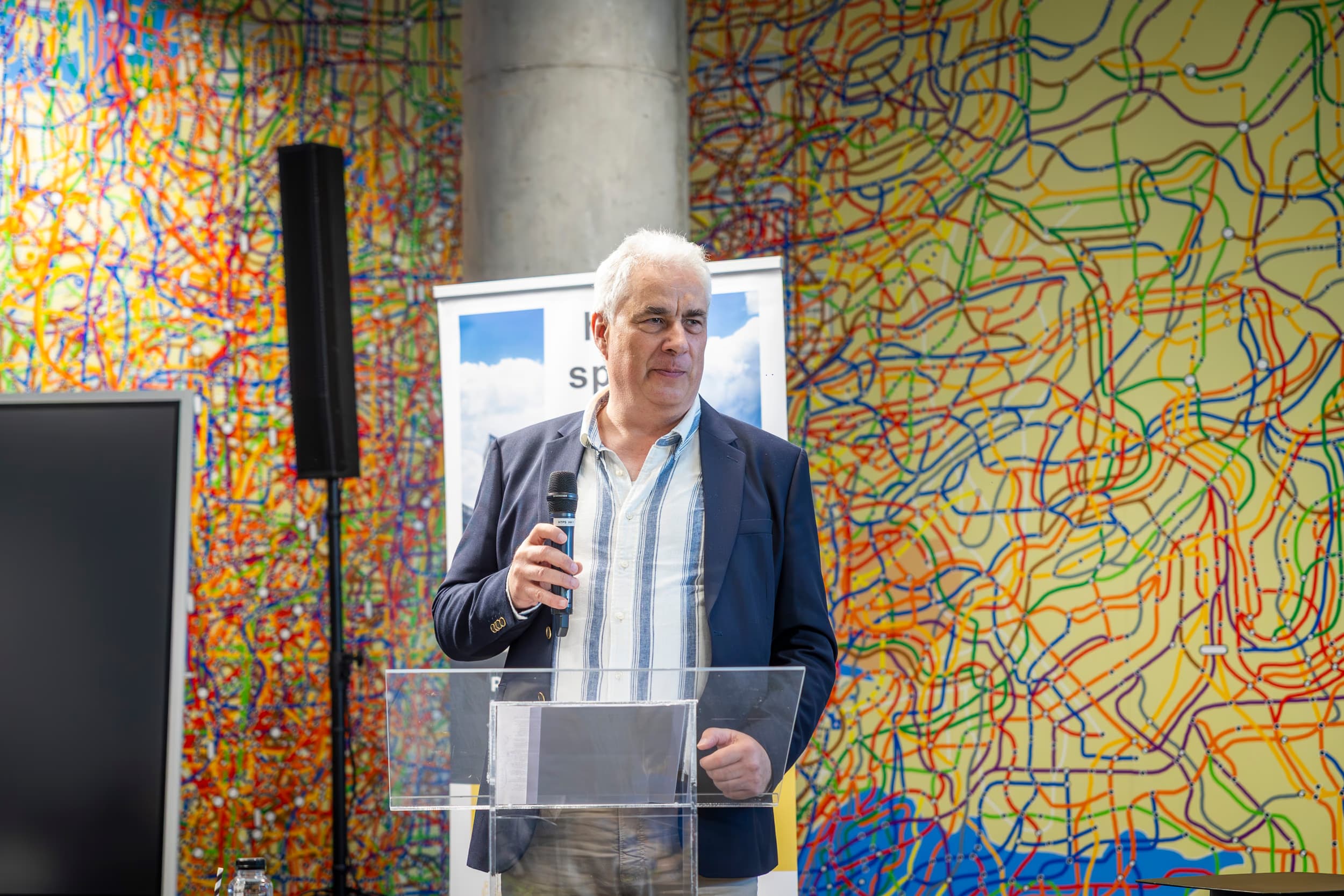
Alongside this, he runs a German architecture firm. At Hotspot he is a founder and holds a majority stake. "My own capital is not high enough", he says with self-deprecating humour when asked whether he intends to acquire the spaces he operates in — the strategy is an organic one.
The Argument: 5 to 1
Skhlote's central argument for the market, which he repeats in several formulations, concerns the compression that artificial intelligence is bringing to bear on office space.
His reference point — anecdotal but concrete — comes from a Hotspot client in banking software, based at SkyHub: "The workplaces, they tell me, it's five to one. Five old, one will be kept. That's all."
Five old workstations become one new one. Four disappear. The difference goes to AI. And the remaining 20% that stays, Skhlote argues, will seek contract terms that the traditional office cannot offer.
"If you go to a landlord and say: please, I want to prolong only for one year — the landlord will say no, it's impossible" he says. "Therefore, they will be pushed into our market."
That is his thesis for flex office: not the hybridisation of work, not entrepreneurial coworking for freelancers, but the radical uncertainty of post-AI organisational structure. Nobody signs five- or ten-year leases anymore when they don't know how many employees they'll have in six months. Hotspot's most recent client — a company with a temporary presence in the local market — signed for six months.
The Bet: Maybach, Not Aldi
The difference between Hotspot and what Skhlote calls "the average market" lies in positioning. He compares the flex office market to retail: there are discounters (Aldi, Lidl) and there is premium. Hotspot has chosen premium — deliberately and explicitly.
The furniture is Vitra — the Swiss-German brand that is the de facto standard for premium European offices. Permanent reception, a massage room, a shared kitchen with unlimited consumption, monthly Community Breakfast and Community Lunch events, phone booths, meeting rooms included in the base package, 24-hour access.
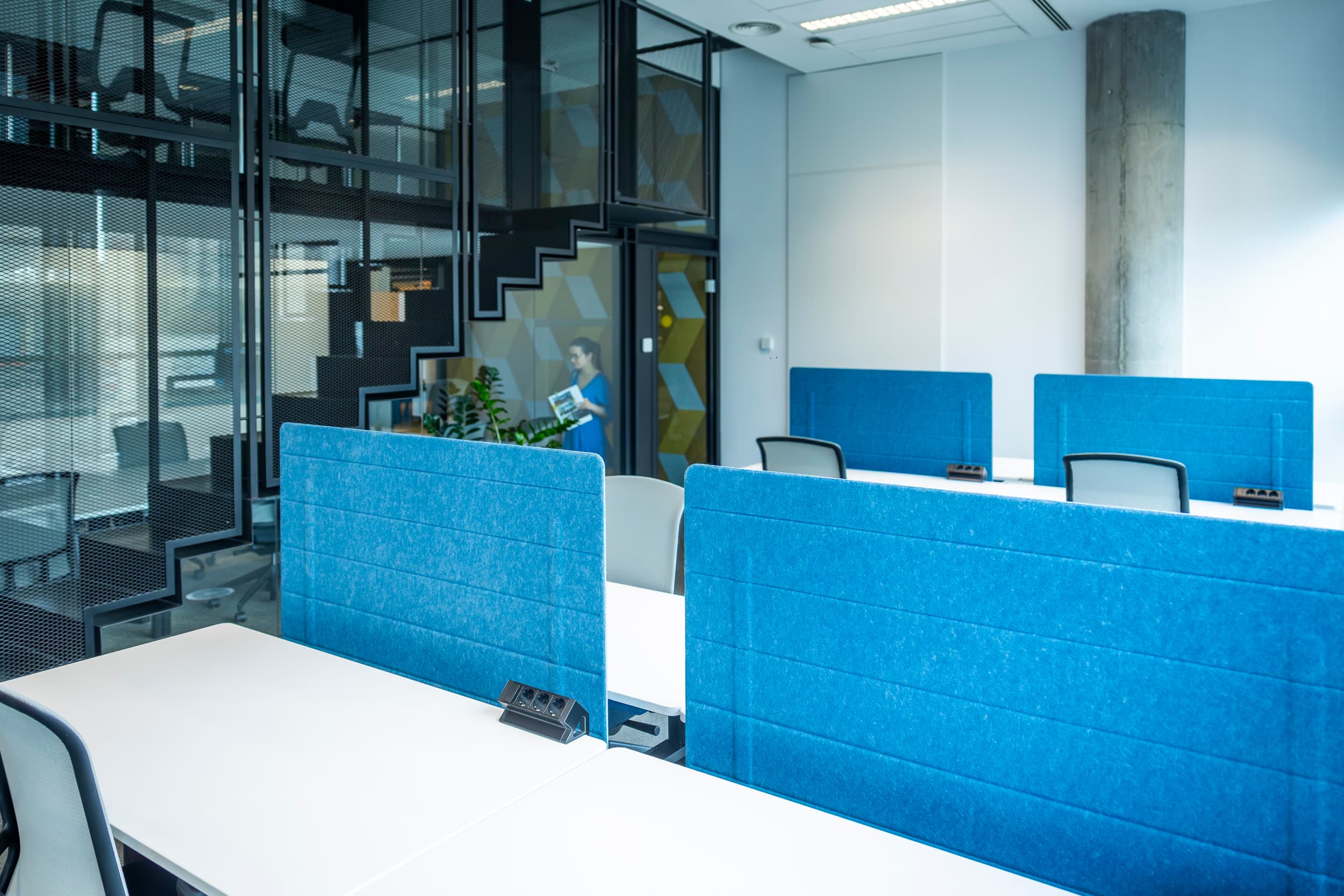
The price, according to Cristina Dumitrescu: €350 per month per workstation (per desk), all inclusive. For a market where traditional offices rent at €15–25/sq m/month excluding services, this requires a particular clientele.
Skhlote uses the luxury car analogy:
"You know Maybach, you know Mercedes S-Class. It's not for everyone. This is what I want to introduce, this is what I want to deliver — nothing else. Best services."
Current clients — a mix of pharma, IT, and banking, plus "a famous bank — but I don't have their permission to name them", says Cristina Dumitrescu. Israeli companies with a global presence, American ones too. The largest clients grow, within the Hotspot setup, to as many as 80 workstations — beyond that, it becomes more cost-effective for them to open their own space. The smallest contract: a 15-square-metre office. Below that, there is a reduced-price coworking formula for individual entrepreneurs.
The Numbers Ahead
The next step announced at the conference: a third location in northern Bucharest, of around 1,500 sq m. The contract is due to be signed next week; Cristina Dumitrescu declines to share details until then. For 2028, the plan is a fourth location in the central area. The stated goal: a presence in every quadrant of Bucharest.
Skhlote's overall target for the next 18 months: from 550 to one thousand workstations. "But it's not about becoming bigger", he adds. "It's about remaining a quality leader."
On the question of expansion to Cluj-Napoca, Iași, or Timișoara, Skhlote is cautious: "Yes, of course. But in a few years." First, he consolidates Bucharest.
On the direct competitor front, Cristina Dumitrescu names just one: Spaces (part of the IWG/Regus group). "Beyond that, I don't think we have competitors. I know the competition — every six months I become a client of theirs, just to see where we're going wrong."
His Bucharest
The conference shifts to a personal register in the pauses between questions, in cultural asides. When asked about comparable European markets, Skhlote doesn't mention Berlin or Munich — he mentions Sofia: "Sofia is, I think, fast — extremely. A little faster now than Bucharest. Yes, you might not like to hear it, but Sofia is very good."
On Germany, the parallel is sharp: "German anxieties — if you do a bad job here, you fix it, stand up, keep going. But in Germany, impossible. People will point fingers at you: 'no, no, bad.' That's a reason Germans won't deliver anything on time. My take is that the Romanians will take over." He then adds: "I have four children. Both my boys want to move to Romania."
It's a line you might be tempted to leave out of the write-up. But in a press conference about the office market, it is exactly the kind of comment that anchors an investment decision. Not the capitalisation of an emerging market — a personal conviction about a country.
What It Means for the Market
Hotspot's conference comes at a moment when the Romanian flex office market is accelerating. Recently published data from iO Partners shows a Bucharest market of approximately 74,000 sq m across 48 locations — over 2% of the modern office stock. The sector grew by 8.1% in 2025 and saw new deliveries increase by 327% compared to the previous year.
In this landscape, Hotspot holds just two of the 48 flex office locations registered by iO Partners in Bucharest (4.2% by number of locations). The precise floor area operated varies depending on how ancillary spaces are measured, but the segment it targets — premium corporate — gives it an influence disproportionate to its physical footprint.
Most operators are building for volume. Skhlote is building for the 20% that remain after AI — and who, in his logic, will want Vitra furniture, a six-month contract, and an operator who understands the difference.
Not Aldi. Maybach.
 1 / 17
Reported by Adi Coco · RomaniaFrumoasă · 8 June 2026.