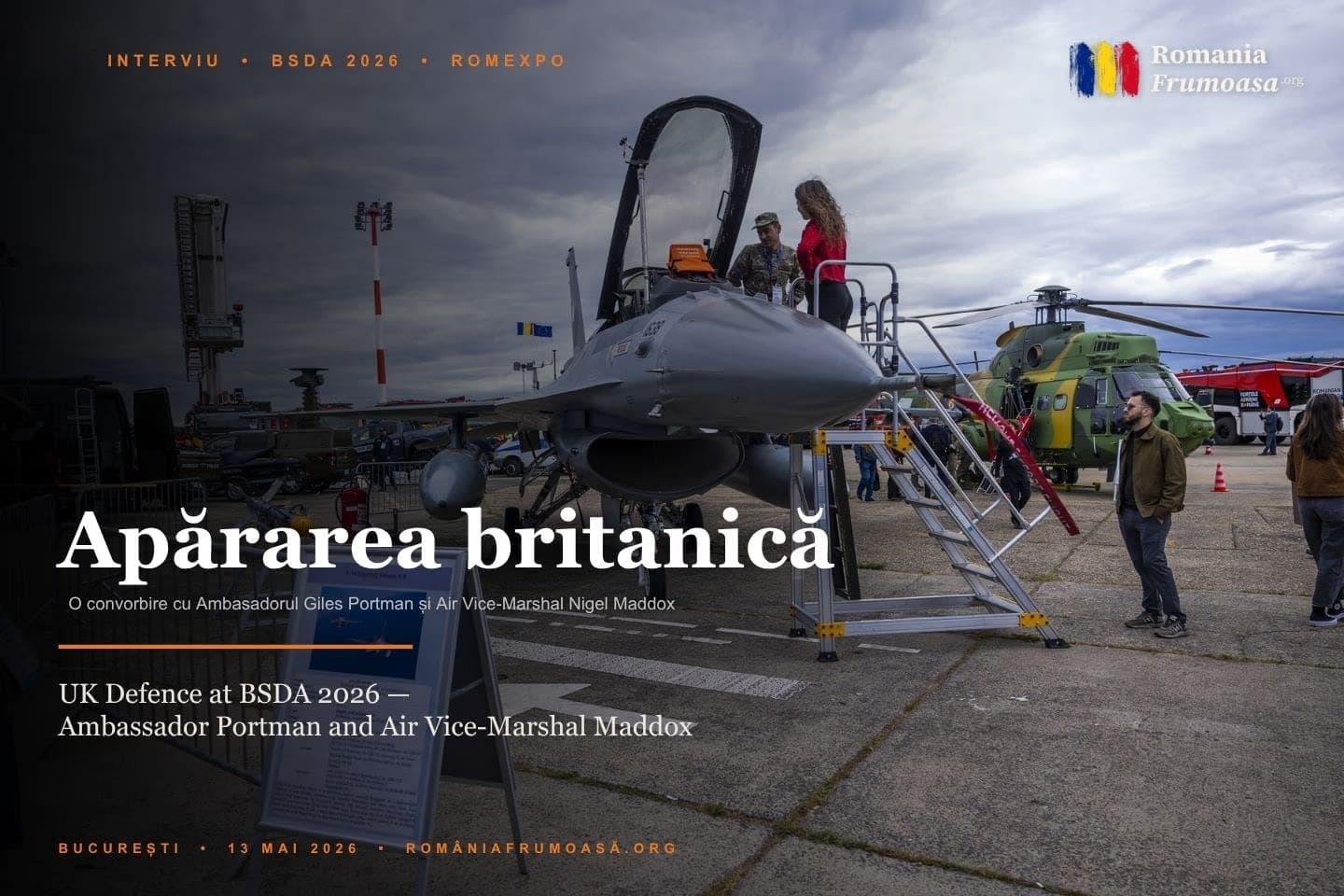
For the first time, the British Ministry of Defence has assembled a national pavilion at the Black Sea Defense and Aerospace Exhibition (BSDA) in Bucharest. Eight British companies share the stand — a mix of global primes and niche, capability-focused firms — while a further twenty-two British companies are present at the exhibition through Romanian partnerships, bringing the total UK industrial footprint at BSDA 2026 to around thirty firms.
We sat down at the UK pavilion with Giles Portman, British Ambassador to Romania since October 2023, and with Air Vice-Marshal Nigel Maddox, head of the United Kingdom delegation to BSDA 2026, to discuss the British offer, the European Union's SAFE defence financing instrument, growing defence budgets, the lessons from the war in Ukraine, and the future of Romanian air power as the country prepares to operate the F-35.
The conversation that follows has been edited for clarity and length.
A first British pavilion at BSDA
Ambassador, this is the first British Ministry of Defence pavilion at BSDA. What is on offer this year?
Ambassador: I'm really pleased to be at the UK stand at BSDA, because for the first time the British Ministry of Defence has put together this pavilion. We have eight fantastic British companies and a truly remarkable mix — some of the big global primes that everyone knows, and some more niche firms with very innovative capabilities. That breadth is one of the strengths of the British offer: a real ecosystem of capabilities.
If you look more widely at BSDA, you'll find around thirty British companies in total, because many are already partnered up with Romanian firms. So it's a strong British presence this year. I encourage everyone to come and visit the stand.
Air Vice-Marshal Maddox, your first impressions of the show — and of Bucharest?
Air Vice-Marshal Maddox: I'm Air Vice-Marshal Nigel Maddox, heading up the United Kingdom delegation to this show. It's a great privilege to be here. It's my first time in Bucharest, and I'm already enjoying it very much. It is good to be among friends — politically, militarily, and with my industrial colleagues.
As the Ambassador said, we already have around thirty British companies doing good business in partnership with Romanian firms, and we want to improve on that. This is a great opportunity for both countries to work together industrially, to the benefit of both economies — and for Romania to become a net exporter in defence in the future.
The SAFE programme — and the alternatives
The UK had hoped to negotiate a special partnership with the European Union's SAFE programme, but talks did not conclude as expected. How do you see the future of British involvement?
Ambassador: The UK wanted to negotiate a special partnership with SAFE, and unfortunately it was not possible — the financial proposal made by the Commission was unrealistic. That is a disappointment.
But it doesn't mean that British companies cannot participate in SAFE. They can participate under normal third-country terms. There are also other routes to financing — UK Export Finance, for example. So this should not be something that holds us back from identifying partnerships between Romania and the United Kingdom.
Air Vice-Marshal Maddox: I think it's still a great opportunity. We are not part of SAFE at the moment, but hopefully in the future we will be — because we want to work within Europe and we want to work with industry in Romania. There is a real success story here.
Defence budgets, in a difficult economic moment
The British government, like many in Europe, is balancing higher defence spending against weak economic growth. Is the trajectory on track?
Ambassador: We are all facing this challenge — having to spend more on defence at a time when we are also struggling to generate economic growth. We are in the same boat.
But we are increasing our defence budgets. Romania is. The UK is. We have made a very clear commitment, and we have all responded to that NATO requirement to spend more on defence.
This argues — once again — for spending that money in the most economically sensible way possible: making sure taxpayers get the maximum value for money, and that means not creating artificial barriers between our defence industries. The UK defence industry is already very integrated with European defence industries, and it is essential that we continue that partnership and integration. That is how we get the best capabilities at the best price.
Ukraine — bravery, learning, and staying the course
Looking back at February 2022, do you see any parallel between Ukraine's resistance and Britain's experience in the Second World War?
Ambassador: I see amazing bravery in Ukraine. And of course this is Putin's disaster — he thought it would take three days, and we are now into the fourth year of war.
What we've seen is not only the bravery of the Ukrainian people, but also the remarkable way in which they have developed their own capabilities. They are now a net contributor to European security, and we learn a great deal from them — particularly on drone and counter-drone warfare.
What we have learned over the last three or four years is also this: the United Kingdom, NATO, and Europe are not going away. We will continue to support Ukraine for as long as it takes.
The Romanian Air Force, the F-35, and a return to NATO interoperability
Air Vice-Marshal Maddox, as an RAF officer, how do you see the development of the Ukrainian Air Force in the last four years — and what can other European air forces learn?
Air Vice-Marshal Maddox: It is a very exciting time. The Romanian Air Force will receive the F-35 within the next three years. We are already an F-35 operator. We have had discussions this morning with the Romanian Chief of Air Force, and we said clearly: we are open to discussions. We have been operating the aircraft for some time now. If there are any questions you would like to put to us — on operations, on procedures — we are more than happy to share that with our friends.
That is the important thing as we move forward.
At the moment, we have detachments coming into the country. Cross-servicing — as we used to do in NATO — is really important. The ability of Romanian engineers to potentially turn around Eurofighters from Germany, Spain, Italy, or the United Kingdom is an important dimension. We are getting back to that sort of glue that kept us all very close within the NATO family. I am very positive about the future. We will work very effectively together.
On the competition between the JAS-39 Gripen and the F-35 — different platforms in different categories, but operationally how do they compare?
Air Vice-Marshal Maddox: On operations, I would not want to comment. We operate the F-35 from our carriers, which is a unique capability. The Romanian Air Force will receive the A model, which is different. We shall see — but the aircraft is superb, and I am sure the Romanian Air Force will make it work very effectively.
Context: where SAFE stands today
The interview was conducted on 13 May 2026. The following context, compiled at the time of publication, places the Ambassador's remarks against the most recent state of the SAFE programme.
The Security Action for Europe (SAFE) instrument was formally adopted by the Council of the European Union on 27 May 2025, establishing a financial vehicle of up to €150 billion to accelerate continental defence readiness.
The Commission has since approved two major waves of national defence plans:
15 January 2026 — first wave for eight Member States.
- 26 January 2026 — second wave for Estonia, Greece, Italy, Latvia, Lithuania, Poland, Slovakia and Finland, worth approximately €74 billion.
- 26 March 2026 — additional approvals for Czechia and France.
Britain's negotiations to participate in SAFE on terms more favourable than standard third-country access concluded without agreement in late 2025. As Ambassador Portman put it in our conversation, the Commission's financial proposal was, in the UK Government's reading, „unrealistic" — a position the UK has not since reversed.
In February 2026, Euronews published an analysis questioning whether the EU's financial requirements for the UK had been disproportionate when compared to Canada's terms — a debate that remains unresolved in public.
British Prime Minister Keir Starmer has nevertheless stated that the United Kingdom would consider applying to participate in a future second edition of SAFE, and the broader EU–UK Security and Defence Partnership — concluded in 2025 — provides a framework for selected UK participation in EU defence-related programmes by mutual agreement.
As of June 2026, British defence firms can still participate in SAFE-funded contracts under standard third-country rules, though no more than 35 percent of total component costs may originate outside the EU, EEA-EFTA countries or Ukraine — a sourcing threshold that defines the practical scope of UK supply opportunities.
The Ambassador's position at BSDA — that the UK should not let SAFE become an obstacle to bilateral and multilateral British-Romanian industrial partnerships — remains, at the time of publication, the operative British posture.
Text & Photo: AdiCoco.com · romaniafrumoasa.org