
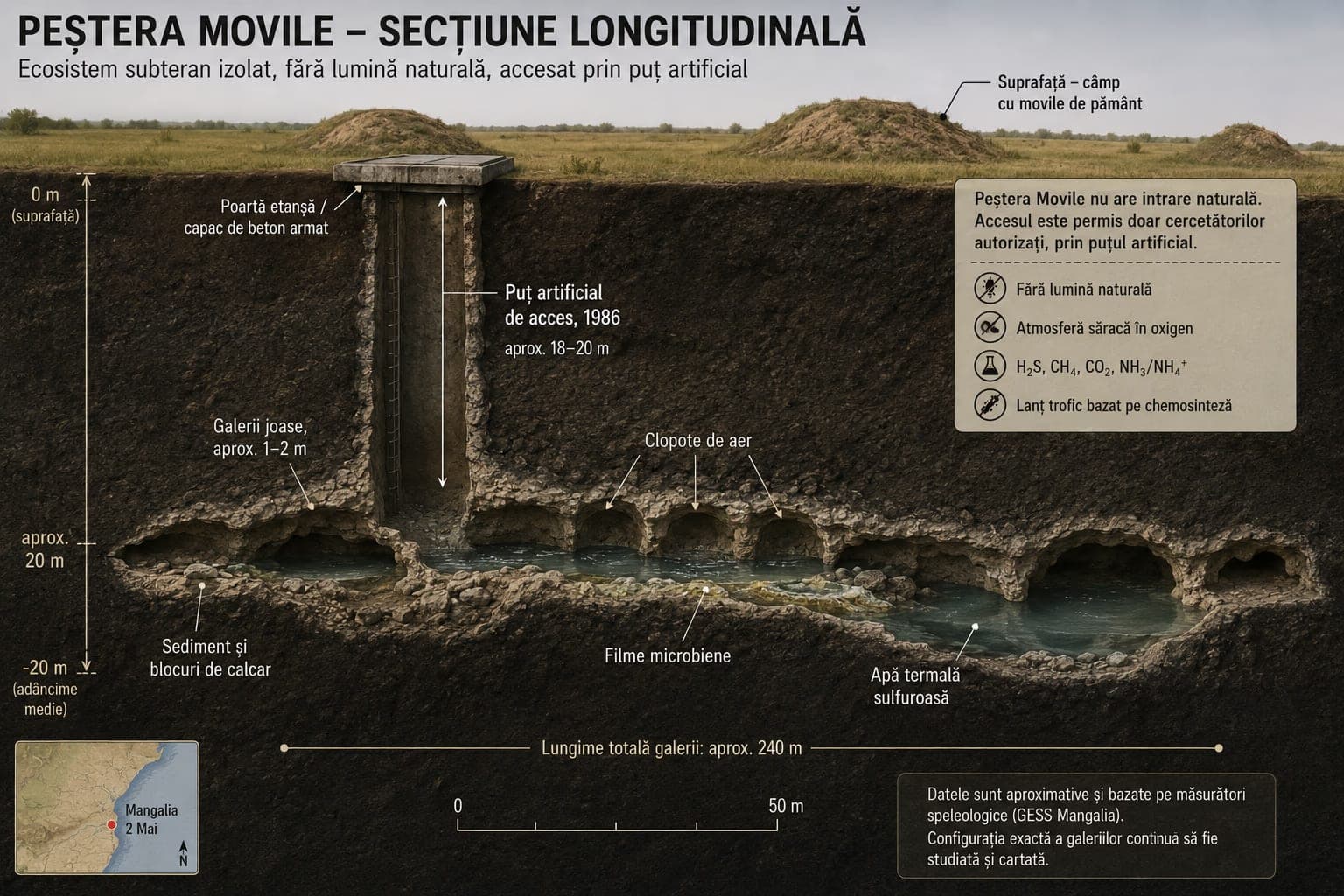
Movile Cave, found by chance in 1986 at the bottom of a shaft drilled for a power plant that was never built, shelters an ecosystem that functions without sunlight. Nearly four decades after the first descent, biologists are still describing species found nowhere else on Earth.
In the spring of 1986, Cristian Lascu, then a young geologist at the Institute of Speleology, descended an approximately eighteen-meter shaft drilled in southern Dobrogea as part of the preliminary survey for a thermoelectric plant. Below the limestone layer, his headlamp lit up something no one had ever seen: walls teeming with pale, eyeless creatures — spiders, myriapods, isopods, leeches. The air smelled of rotten eggs. Oxygen was scarce.
The power plant was never built. The cave found in that shaft, however, would go on to become one of the most studied subterranean ecosystems in the world.
❦
Today the site is known as Movile Cave. It has no natural entrance; access is still through the same shaft Lascu descended, now sealed with a concrete hatch. The atmosphere inside contains hydrogen sulfide, methane, and ammonia at concentrations toxic to humans, with reduced oxygen levels. Sunlight has never reached it. And yet life exists there, organized into a complete food chain.
At the base of this world are chemosynthetic bacteria: microorganisms that extract energy from the oxidation of hydrogen sulfide, methane, and nitrogen compounds, rather than capturing it from light. Feeding on this microbial substrate are invertebrates — worms, snails, crustaceans, aquatic insects of the familyNepidae— commonly, if loosely, called water scorpions — and above them, predators. It is a functioning ecology built on chemistry, not photosynthesis.
Movile is the first subterranean ecosystem of this type ever discovered. It is not the only one: researchers have since identified similar systems at Frasassi in Italy, Ayalon in Israel, and Melissotrypa in Greece. It remains, however, the richest and most thoroughly studied of them all.
❦
The age of the ecosystem is one of the figures most frequently misquoted in the Romanian press. The karst system began forming at the end of the Miocene, approximately 5.5 million years ago — a geological milestone often cited as the duration of isolation. The reality is more nuanced. The Group for Underwater and Speleological Exploration in Mangalia (GESS), which manages the cave, notes that effective sealing from the surface occurred later, during the Quaternary, approximately 2.5 million years ago. The fundamental conclusion holds: that is more than enough time for the species inside to have evolved almost entirely separate from the rest of the biosphere.
And the evolution is visible. A 2021 study by Brad, Iepure, and Sârbu identified 52 invertebrate species at Movile, of which 37 are endemic — roughly 71%. In 2023, a team led by Sanda Iepure of the Cluj-Napoca Branch of the Romanian Academy, together with Polish and Romanian researchers, described a new ostracod crustacean species,Pseudocandona movilaensissp. nov., adapted to the sulfidic environment. The list grows slowly, as taxonomists work through the samples.
❦
The comparison with Mars — frequently invoked in Romanian articles about Movile — deserves some qualification. In the 1990s, the cave attracted the attention of astrobiologists for a straightforward reason: if life can exist in a lightless environment with a toxic atmosphere and chemical energy as its only source, then models of potentially habitable environments on other celestial bodies must change. Movile became a terrestrial analog for questions about the subsurface of Mars and moons such as Europa and Enceladus.
The phrase 'a kind of Mars on Earth,' often attributed directly to NASA researchers, originates largely from popular science writing. The underlying idea — that Movile is relevant to the search for extraterrestrial life — is, however, well supported by recent scientific literature.
❦
A persistent anecdote surrounds the discovery itself: that Nicolae Ceaușescu reportedly indicated the site for the power plant from a helicopter, leading to the drilling. Lascu himself recounted the story in later interviews. What remains firmly documented is simply that the geological work was part of an industrial project of the communist regime, subsequently abandoned. The cave remained — accidentally — one of the most precious scientific legacies of that plan.
❦
Access today is strictly controlled. Only a handful of entries are permitted each year, and the time each team spends inside does not exceed a few hours — both to protect the researchers and to prevent the introduction of outside microorganisms. On April 15, 2024, the site was inscribed on the UNESCO Tentative List under the natural heritage category, on the basis of criteria viii, ix, and x. Inclusion on the actual World Heritage List requires a separate evaluation, which typically takes years.
For Romania, Movile is a rare asset: a scientific argument of global relevance, preserved as close to its original state as possible. The fact that it is not open to tourism is not an administrative failure. It is, paradoxically, the condition of its survival.
SOURCES AND VERIFICATION
Group for Underwater and Speleological Exploration (GESS) Mangalia; Scientific Reports(Iepure et al., 2023); Brad, Iepure & Sârbu, 2021; UNESCO Tentative List, file 15.04.2024 (criteria viii, ix, x); Encyclopædia Britannica; National Geographic România; Historia archive.