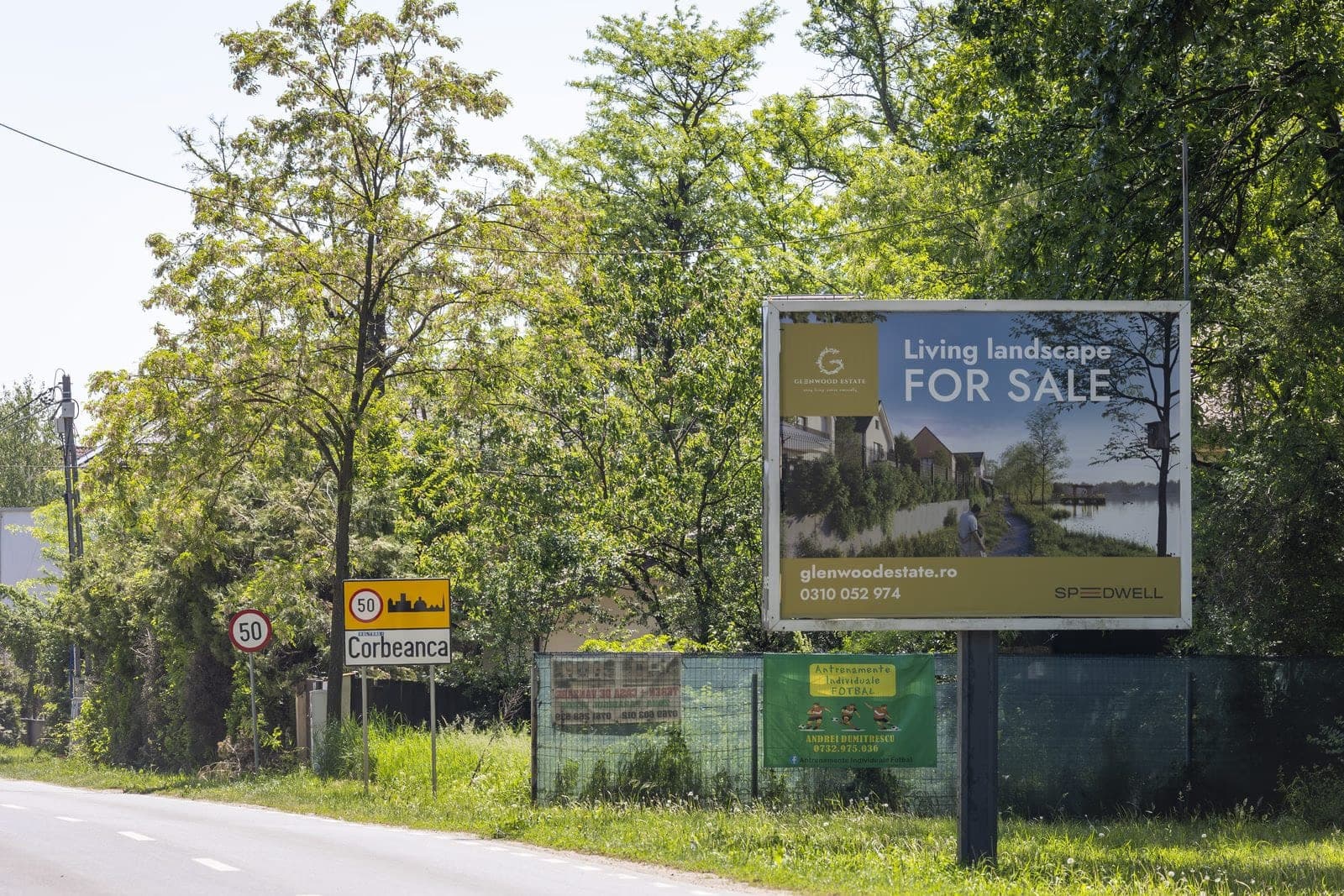
Before 1989, many residents of Corbeanca commune dreamed of a Bucharest address. Today, many Bucharest residents can no longer afford a home in Corbeanca. Between those two sentences lies the entire transformation of a commune in northern Ilfov — once an agricultural district of the capital — into one of the most sought-after and expensive residential areas around Bucharest.
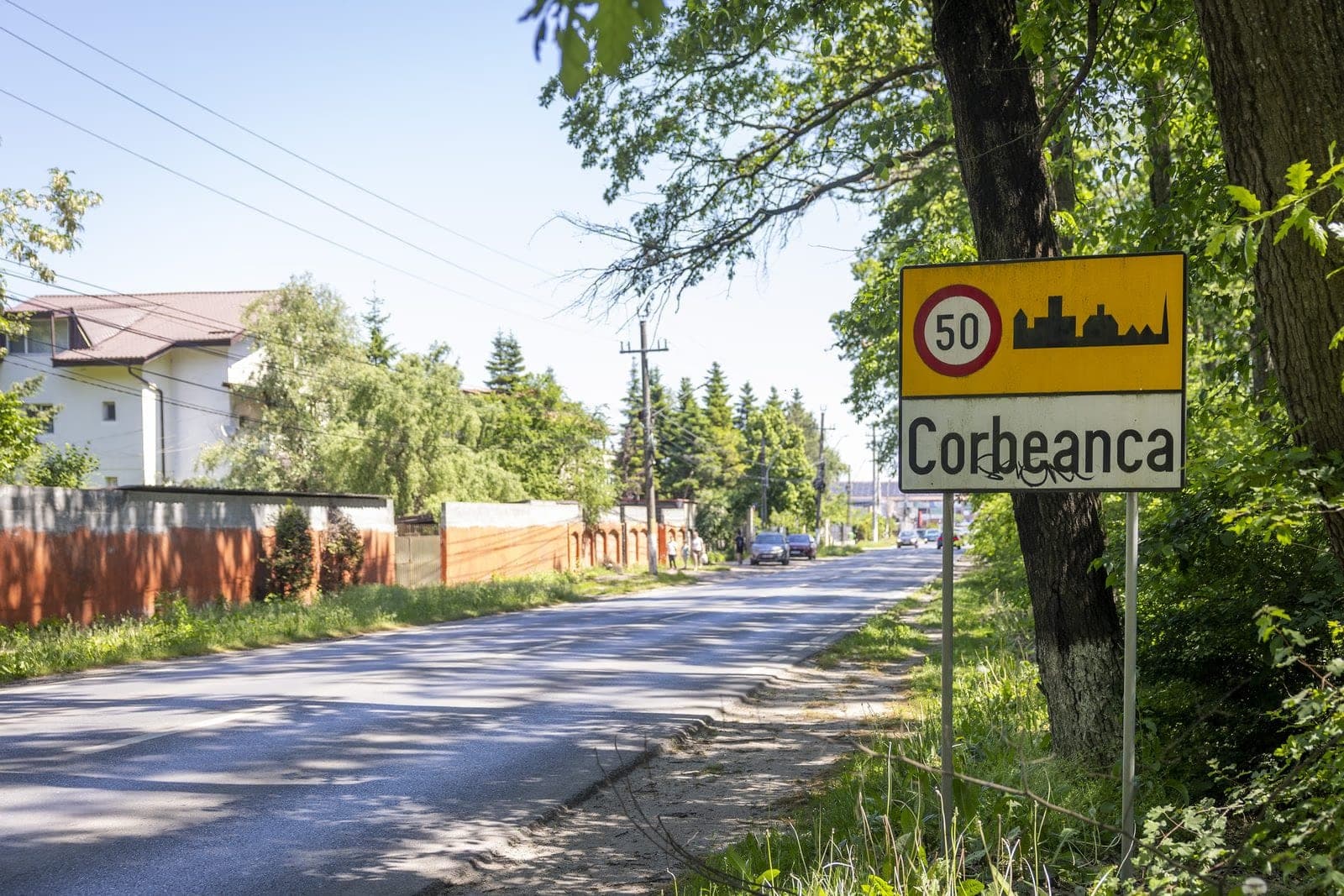
We spoke with Ștefan Apăteanu, the commune's mayor since November 2024 (a former local councillor from 2020 to 2024, with a background in political science), about how Corbeanca got here and where he wants to take it. A single tension runs through everything he says: how do you grow a community without destroying the very thing that draws people to it — the forest, the lake, the quiet, the low-rise buildings? His answer has a name, now adopted as an official development strategy by the Local Council: "Corbeanca – the city in the park."
The interview below reflects the mayor's views and interpretations. The administrative data he cites — population, surface area, the water utility operator, the county's structure — have been verified by our editorial team and confirmed; where the mayor offers estimates, we have kept them as such.
-
The beginnings of real-estate development in Corbeanca
Reporter: Before 1989, the dream of many Corbeanca residents was to obtain a Bucharest address. Today, many Bucharest residents can no longer afford to live in Corbeanca. What do you think was the ground-zero moment when the commune's metamorphosis began?
Ștefan Apăteanu: I think it's hard to pinpoint a single ground-zero moment. What is certain is that there were several steps that, over time, built up to this point. The commune's development is closely tied to the first real-estate entrepreneur who came here and created the first residential neighbourhood, the first closed community — the first gated community.
Ilfov County, as everyone knows, was formerly an agricultural sector of Bucharest. Everything that developed here grew out of the inertia of a land-based economy. This is clearly visible in the way the county is parceled: long, narrow plots that are not well suited to real-estate development. It took entrepreneurship to push through the land-planning process, because local government, unfortunately, was not up to the task.
And that is what you do in any town when you want to develop it: first you survey it — you carry out systematic cadastral registration, so you know who owns what and where. Then you plan the layout — you map the roads. Roads are the most important thing; they are like veins in the human body: blood cannot circulate without them. On that score, certain opportunities were missed — opportunities that various real-estate developers later spotted and exploited. So growth was gradual, and it was driven by the freedom we won after 1989 to do business.
The Challenges of 1990
Reporter:Let's try a thought experiment: you are mayor of Corbeanca commune in 1990. Setting aside everything we now know about Romania's subsequent development and the commune's own growth, how could you have persuaded an entrepreneur to invest here back in 1990?
Ștefan Apăteanu:In 1990 we had plenty of examples from the West to learn from. What we lacked was the courage of those who held that knowledge to step into public administration. The result was that the political class available at the time was, in fact, the old political class under a new label — something that held us back for a very long time.
Demographic and Administrative Structure
Reporter: What is the commune's current economic makeup? How many residents do you have, how many actually live here, how many pay taxes, and how many work within the commune?
Ștefan Apăteanu:Corbeanca is similar to any peri-urban locality. All satellite communities around large cities face the same problems: rapid demographic growth, as people move out of city apartments into houses — but without transferring their official residence. In most cases, they keep their ID registered in the city, in our case Bucharest. The usual excuse is that their children are enrolled in school there. It's a false excuse: your ID is required only once, at enrollment, and the child remains enrolled for the entire school cycle — so the ID can be transferred afterward without any issue.
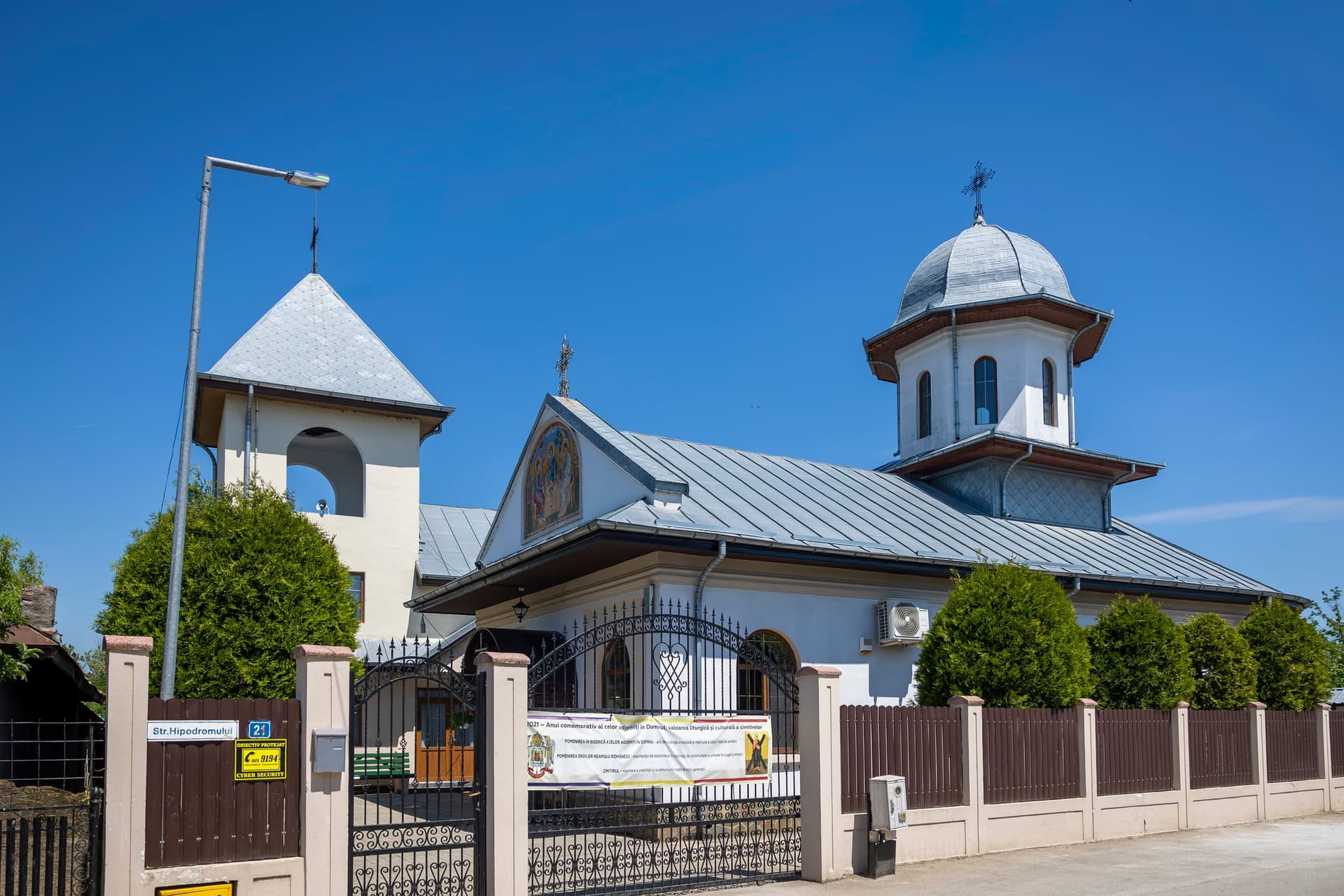
As of January 2026, we have around 12,000 registered residents — that is, people aged 14 and over with an ID registered here — but 25,000 tax records. That means at least twice as many people actually live here as have chosen to register. A tax record is unique per person: whether you own a house, a plot of land, a car, or a scooter, you still have just one tax record. So the multiplier is not misleading — 25,000 tax records means 25,000 people. Some may be legal entities, but over 90% are private individuals.
This is the core challenge for a municipality like ours: not only is the budget calculated based on the number of registered residents, but so is the entire administrative structure — the staffing chart, the organigram. Even the number of local police officers is calculated against the resident population: before this year's administrative reform it was 1 per 1,000 residents; now it's 1 per 1,200.
In general, localities around Ilfov County have a few thousand hectares to manage; we have around 3,000. In terms of size, we compare to a city district — a district that has hundreds, if not thousands, of employees. It's true that a district also has hundreds of thousands of registered residents, but the challenge of covering the territory is similar, because the distances are the same: our development is horizontal. You still have to move around, you still need people. It's a constant challenge to meet all needs, under pressure from those who actually live here — because they are always our reference point. We provide services for everyone, not just registered residents, but we do so with an understaffed administration.
Organic growth runs at around 500 new resident registrations per year. What I want, however, is for us to become a "15-minute town": where you don't need to leave Corbeanca to take your child to school, see a doctor, or play sport. I believe that is where we stand to gain the most in the medium and long term.
Education infrastructure
Reporter: Doesn't the fact that so few people have their official residence here slow you down? I'm thinking of the reality that even the children attending school in Corbeanca are far fewer than those who actually live here — which means heavier traffic, higher costs, and no real economic development drawn into the locality.
Ștefan Apăteanu:"It's true, these are all challenges — but I also see them as opportunities. The ratio of school-age children in Corbeanca is 1 to 4: we can accommodate only one in four children who actually live here in our local schools."
"This year we are inaugurating a school that will double the number of students who can study here — another thousand, on top of the existing thousand. It's a brand-new school, with multiple laboratories, 20 classrooms, an internal elevator, a semi-Olympic pool, changing rooms, a canteen — everything. It would make any private investment envious. Alongside it, we are building a kindergarten with 200 places, and we have submitted a project to the National Investment Company (CNI) for a crèche with 100 places — because that, in fact, is where parents' demand begins. We want families to stop spending a minimum of two hours a day in the car, driving to school and back."
"Unfortunately, I experienced this firsthand: my own children did not attend schools in Corbeanca, and I know exactly what that means — it's far from pleasant. Precisely because I know it so well, I am all the more determined to change things. The fact that, a year and a half to two years into my term, I managed to double the space available for students says a great deal about my commitment to investing in education. In 2025, over 40% of the budget went to education and the construction of this infrastructure."
Urban Vision and Attracting Investment
Ștefan Apăteanu:"Corbeanca is perceived as a deeply residential community. That means most contributors to the local budget are private individuals. To bring in businesses, you need a strong economic sector that creates jobs — because a local government earns revenue from income and VAT allocations."
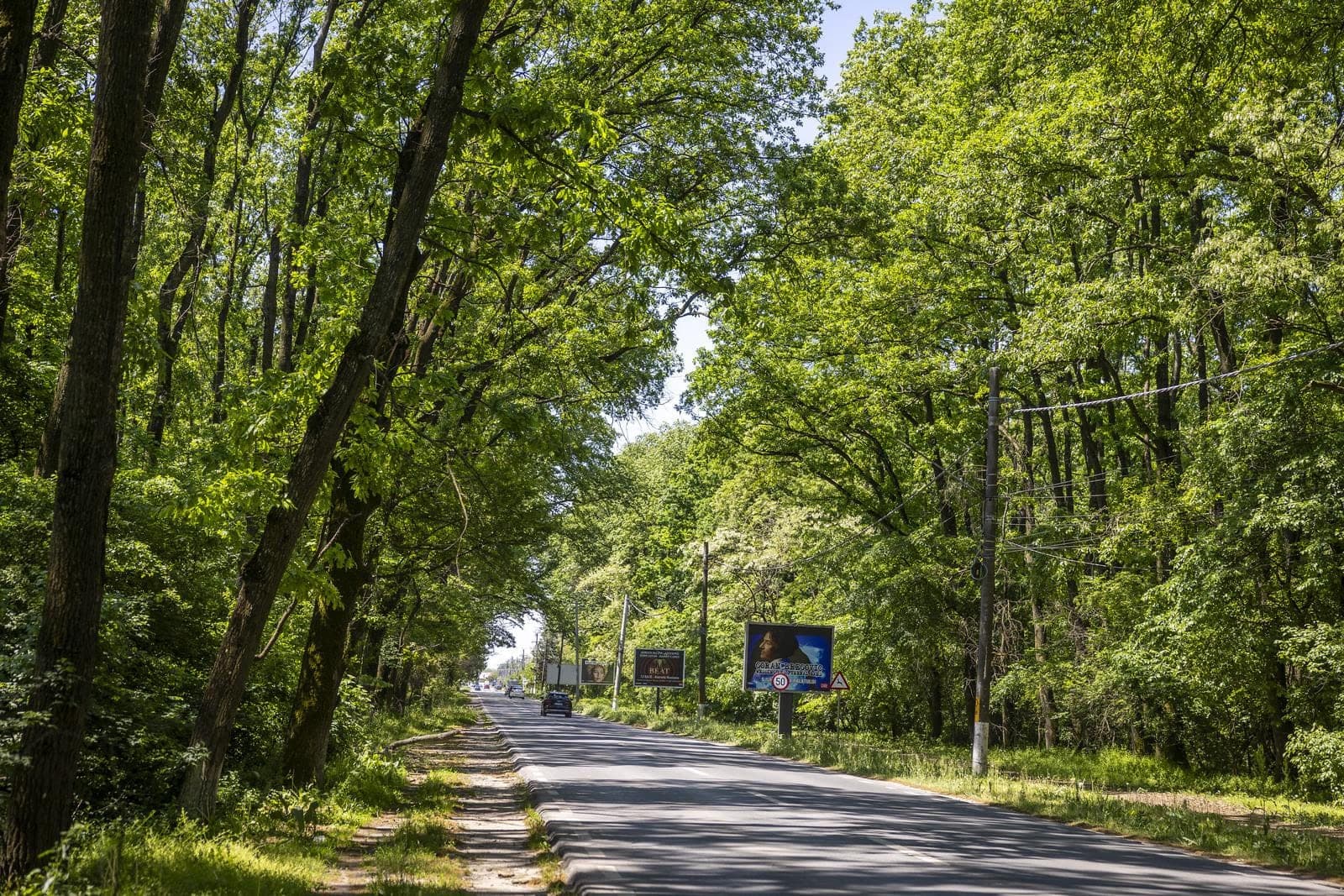
"On the other hand, Corbeanca has something other communities don't: the highest proportion of entrepreneurs relative to its population. That means there is real potential — if we offer them a space here to operate — for them to consider moving their businesses closer to home."
"With that in mind, we designed a proposal for a new general urban plan. We want to create, south of Corbeanca in the A0 zone, an industrial, commercial, and production park: across approximately 300 hectares, we aim to attract businesses. We are close to the airport, well connected via the A0 motorway — which has been operational on our stretch since this year — plus the national roads and the radial road currently planned. That gives us hope that we will attract enough businesses to start shifting the balance of revenues in the local budget."
"A community without substantial income from businesses has no bright future. However hard we mayors try, relying solely on revenues from residents — especially when the reform of property taxation based on real market value is stalled — is a problem. Here is an example: in Corbeanca, a property on 500 square metres with a 150-square-metre house, worth upwards of half a million euros, pays me 500 lei a year. With 500 lei I can barely cover the public lighting. God forbid a bulb burns out: the bulb itself costs 500 lei, plus labour. You cannot rely on property-tax revenues like these to drive development."
"That is why we focus heavily on attracting funding. It's true we drew the short straw — we came in at the tail end of the European programming cycle, when the PNRR had wound down and there was little left to apply for. But we still have the opportunity, through our own actions, to create a framework in which entrepreneurs will come and grow: an entrepreneur has their own financing and doesn't necessarily depend on European funds. Besides, European funds only arrived from 2007 onwards, pre-accession funds aside. I firmly believe that if we build the right framework for development, it will fill up. You know the saying: build the form and it will fill itself."
Reporter:If you develop an industrial zone nearby, won't that drive down property values? People move to Corbeanca for nature, for peace and quiet, for the proximity to forest and lake.
Ștefan Apăteanu: Those roughly 300 hectares I mentioned fall directly beneath the flight corridor. You simply cannot build residential there — as a local administration, you'd be creating a problem for yourself without meaning to. We'd end up with exactly what happened in Bucharest with the Băneasa airport, which had to be closed and now operates under a completely different regime than it did 20 years ago. The area is separated from the rest by the highway; that separation makes it effectively a distinct zone — not industry embedded within the residential fabric. Being completely separate, it has no impact on the residential side.
We've laid all of this out, point by point, in the commune's development strategy, which we drafted and adopted in the Local Council last year. We called it "Corbeanca – the city in the park." Why? Because that's exactly what we're doing: emphasizing a low-density locality, with building types suited to the area — houses. We don't want apartment blocks. One of my goals, even before I entered politics, was to collect as many signatures as possible on petitions warning that we don't want blocks here. We don't want to become a Popești-Leordeni — I have nothing against the people there, but the development model there is entirely different from what we want here.
"The city in the park" means, above all, spending time outdoors. How do we get there? Through a set of local priorities, starting from the smallest details of everyday life. For example, how we get around: in our strategy, the pedestrian comes first. We need to provide proper movement spaces — pavements, paths, and walking routes. With lakes and forests, we can have trails along the lakeshore or through the woods. Hence "the city in the park": everything we want is to preserve what we found here, not to destroy it — not to cut down the forest, but on the contrary to plant more, and to protect the lakeshore. We arrived a little late for some areas, but there is still room to intervene there too.
Because the instinct of some people who move here is to build a jetty in their garden — even though we all know it's illegal: the Romanian Waters Authority (Apele Române) explicitly prohibits it. The towpath must be kept clear, as it is a maintenance road, so nothing may be built up to the flood elevation line. In Ilfov County, that rule has rarely been respected. But it all comes down to local administration.
Let me give you a concrete example. Between 2020 and 2024 I served as a local councillor and took part in meetings where zonal urban plans were voted on. Those plans are, one hundred percent of the time, drawn up by property developers. Usually the town hall is passive — it simply takes note. In our case even more so, because the plans arrive from the County Council already carrying all the required endorsements, and at that point it is very hard to turn them back at local council level: you need a majority. We never managed to form those majorities, and several zonal urban plans went through. One of them, at the time, had private plots running all the way to the lake.
The fortunate thing was that I took over as mayor before the developer had broken ground. I sat down with him and, luckily for me, he was willing to listen. It matters a great deal where a developer comes from, what his culture is — this one was Belgian, with a European sensibility; he understood what I was telling him. He respected something I wanted very much, and that the community wants as well: a path along the lake. I explained that if he built that path, I could extend it further — and that would add value to the whole area, not just to his development. He revised the project: the gardens of those houses no longer run to the water's edge but have been set back some four metres to make room for a pedestrian path. And that is happening right now, in a neighbourhood launched this year.
Utilities infrastructure (water and sewage) and mobility
Reporter: The commune has seen explosive residential growth. How has local infrastructure kept pace with that boom? We understand some of the most valuable real estate in Romania is here, yet not all of it is connected to the sewage network.
Ștefan Apăteanu: Infrastructure breaks down into several categories. The most important is the road network — and here Corbeanca is, unfortunately, in a rather difficult position when it comes to transit. To reach DN1, you have to go through Otopeni or Balotești. The only direct exit point we manage as a municipality is the "radar road" — a very narrow stretch along a forest to the south, which doesn't even serve a large part of the community, sitting as it does south of the A0 motorway, on the far side of the locality.
So everything related to the road layout requires sign-off from neighboring administrative units as well — which can be a challenge, especially when some longer-serving mayors are reluctant to embrace joint projects with younger neighbors. Even so, we've started working on that layout, making the case for why every locality along the proposed routes would benefit. One clear example: to the north, toward Balotești, there are over 1,500 hectares currently locked up — precisely because there are no arterial roads. We could build together a road connecting to the București–Târgoviște expressway; link that up and you essentially connect DN1 to that expressway, which continues as radial road 4. In other words, an alternative route into București bypassing DN1. That's a goldmine, especially when you're talking about over a thousand hectares with real development potential. You simply cannot develop without that circulatory drainage that road networks provide.
Beyond roads come utilities: water, sewage, gas, electricity. This is where the greatest challenges lie — by far the most expensive investments, and they must be completed before any paving, because the law prohibits asphalt if water, sewage, and underground utilities haven't been installed first. People have finally realized how absurd it is to pave a road and then tear it up all over again to start from scratch.
This year, fortunately, the Environmental Fund (AFM) has a budget of over 1.2 billion lei for water and sewage, and we will be applying for a wastewater treatment plant. That's really where you have to start: there's no point extending the network if I have nowhere to treat the effluent. First the treatment plant, then, depending on its capacity, I can think about where to extend the network.
We have a fairly large operator with considerable experience — the same one that serves Buftea, working with several hundred administrative units, so larger than the operator covering Ilfov County, which works with around twenty-odd. That's Raja Constanța. We own the entire network outright; they handle operations. There are things to improve — another four deep wells still need to be drilled, deep meaning around 300 meters, to handle both the flow volume and the water quality delivered to households.
There is a great deal of investment still to be made, and that only underscores how demanding local administration is: from the 500 lei per year that a household pays me, I have to fund this kind of development as well. Without the grant programs we can apply to, we simply wouldn't be able to develop at all. That's why I'm also working to build collaborative pathways with developers — I've introduced into the sustainable urban development principles the option for them to intervene on public land where I have no satisfactory timeline of my own. So as not to hold them back, I allow them to carry out the work themselves, on the understanding that they then hand it over to the municipality for operation. We're constantly looking for ways to accelerate stages wherever possible, in order to reach the outcome: a household connected to utilities, part of a residential fabric interconnected by roads that transition into lake, forest, meadow, cycling paths, and leisure trails. The paths alongside roads are purely functional; the others are at least equally important.
Administrative Reform
Reporter:You've opened two lines of questioning for me. First: how does a company based in Constanța end up managing the network here, near Bucharest?
Ștefan Apăteanu: I think it has to do with the fact that they expanded generally from Constanța southward — and Bucharest, over time, has grown toward the south-east as well. They operate in over 100 localities; they reached this area through an EU-funded project. They contracted their first works about 10 years ago and built the initial networks. It was a fairly ambitious project that looked great on paper: a vacuum sewage system. It works in the European Union — particularly in Germany. Why does it work there? Because the level of civic education is high — you don't find diapers flushed down the toilet. Unfortunately, that's something we still need to work on here. It's a very sensitive system given the conditions we encounter. That's why the extensions we're now building use gravity-fed infrastructure. We're trying not to expand the vacuum system any further, because all it takes is one household not following the rules and another 30 around it suffer. Until we manage to change that — and change comes gradually — you can't rely on this type of technology.
Reporter:The second line you've opened for me is the one about service roads. How does that fit with the 'city in a park' idea? Do you have a municipality fragmented by service roads?
Ștefan Apăteanu: Unfortunately, Corbeanca is no exception to what we see across Ilfov County. Outside of gated communities, infrastructure has been built haphazardly: each owner respected — or didn't respect — the setback from the road, so that barely enough space remains for two cars to pass — if that; as for pavements, that's another story entirely. But this happens because of local-government passivity. You can't expect that, in any given area, 30 property owners who most likely don't even know each other — and even if they do, they won't all agree — will self-organize to leave circulation routes for the benefit of everyone. This is where the municipality must step in, and it has the tools the legislature has given it.
We have the ability to draw up zonal urban plans, to accept donations of roads or square metres, and — beyond that — we have something developers don't have and never will: the power of expropriation. We simply need the courage to own that and to show people it is in their interest — because when you expropriate in order to build a road, all you are doing is increasing the value of the land along that road. As long as you can demonstrate that — and it is very easy to demonstrate — you can count on the understanding of those you are about to expropriate.
Reporter:"There is an administrative threshold for a locality: somewhere between 15,000 and 25,000 residents, a large commune stops being a commune and becomes a small town. Where do you see Corbeanca?"
Ștefan Apăteanu:"By these metrics, Corbeanca already meets the conditions to be a town. The minimum threshold is 10,000 residents — we've passed it, even counting only those with registered addresses here. That's not the issue. The real issue, one we can no longer put off as a country if we want development, is administrative reform. And I don't mean just reclassifying locality rankings, even though we have municipalities with fewer than 10,000 residents and communes with tens of thousands — clearly Parliament needs to step in and redo the rankings, at least as a first step."
"But the real reform has to happen at the national level. What does reform mean, from my perspective? Dividing the country into regions, exactly as all European funding is structured — which flows through eight regions. We need eight regions, full stop. That means abolishing the counties. When you abolish the counties, you abolish a huge number of deconcentrated structures that don't just add pointless bureaucracy to the system — they are actively blocking development."
"Let me give you a concrete example, at county level. In Ilfov we have 40 localities — 8 towns and 32 communes. All have their own local councils: 40 deliberative bodies, each regulating, through council decisions, how that settlement develops. Beyond that, in Bucharest we have another 7: six sectors plus a general council. So across the Bucharest–Ilfov area — which is effectively a metropolitan zone and should have a single body with an overarching vision — we have 47."
"But it's not just a bureaucracy problem — bureaucracy serves a purpose up to a point: to keep records, to impose order, to sometimes act as a brake on changes that come too fast for us to handle. I'm thinking especially of the political dimension. What does it mean for a mayor to get caught up in political games instead of doing executive work? Because that's what a mayor is: an executive. He has to implement the plan he won on, bring in money, and then spend it. In practice, he can end up spending half his time securing a majority on the local council just to get his projects passed. That's not right. We mayors need to focus on execution."
"The same holds at a larger scale. It's one thing to have 42 counties, with 42 arenas for political battles — because that's what we suffer from; it's not others doing us harm, it's self-sabotage, we've proved it time and again. Imagine: with eight regions we'd have eight entities doing regional management, with regional funding. That's a macro perspective on what would actually drive our development as a country. And it explains why, no matter how much you accomplish locally, you eventually hit a wall — because you can't go further on your own. We were talking about roads: they run between localities, and then between counties. How do you build them without a regional vision? You don't. That's where the fragmentation you mentioned comes from."
Reporter:"And where does Corbeanca fit in an administrative reform like that? Do you see it as a standalone locality, or absorbed into a larger entity that might include Balotești and Otopeni?"
Ștefan Apăteanu:"I believe Ilfov County should be abolished entirely, and we should be part of a metropolitan area. If you like, we could keep local mayors along the lines of the French arrondissement model, where the mayor plays a purely executive role and is responsible for implementing a set plan. That kind of approach brings much more clarity: you know what to focus on during your term, and you're no longer at the mercy of circumstance."
Reporter:"But what do you make of a possible expansion of Bucharest outward — absorbing all the surrounding localities into one greater Bucharest?"
Ștefan Apăteanu:"It's very possible, and it would be natural. Looking to the West, we see that all capitals eventually expand, first by incorporating their metropolitan areas. We should be part of a functional metropolitan area too, but unfortunately Ilfov and Bucharest are separate administrative entities, which makes it quite difficult for things to actually happen."
Reporter:"Is there anything you'd like to say that I haven't asked you about?"
Ștefan Apăteanu:"What I'd like to convey is this: where I see a real problem — the reason we've been standing still for so long — is that a large part of the population has stopped hoping. And that is a very bad thing. We need to understand that change comes from each and every one of us — and that's not just a saying. We have to get involved."
Reporter:"Thank you kindly."