At Sala Palatului, on that same Wednesday evening — a few kilometers from James Hetfield's distorted guitars — C.C. Catch and Austrian band Joy delivered a concert that gave 4,000 people an extraordinary atmosphere, a rare emotional intensity, and, ultimately, one of the most memorable images of the year in Romanian live music.

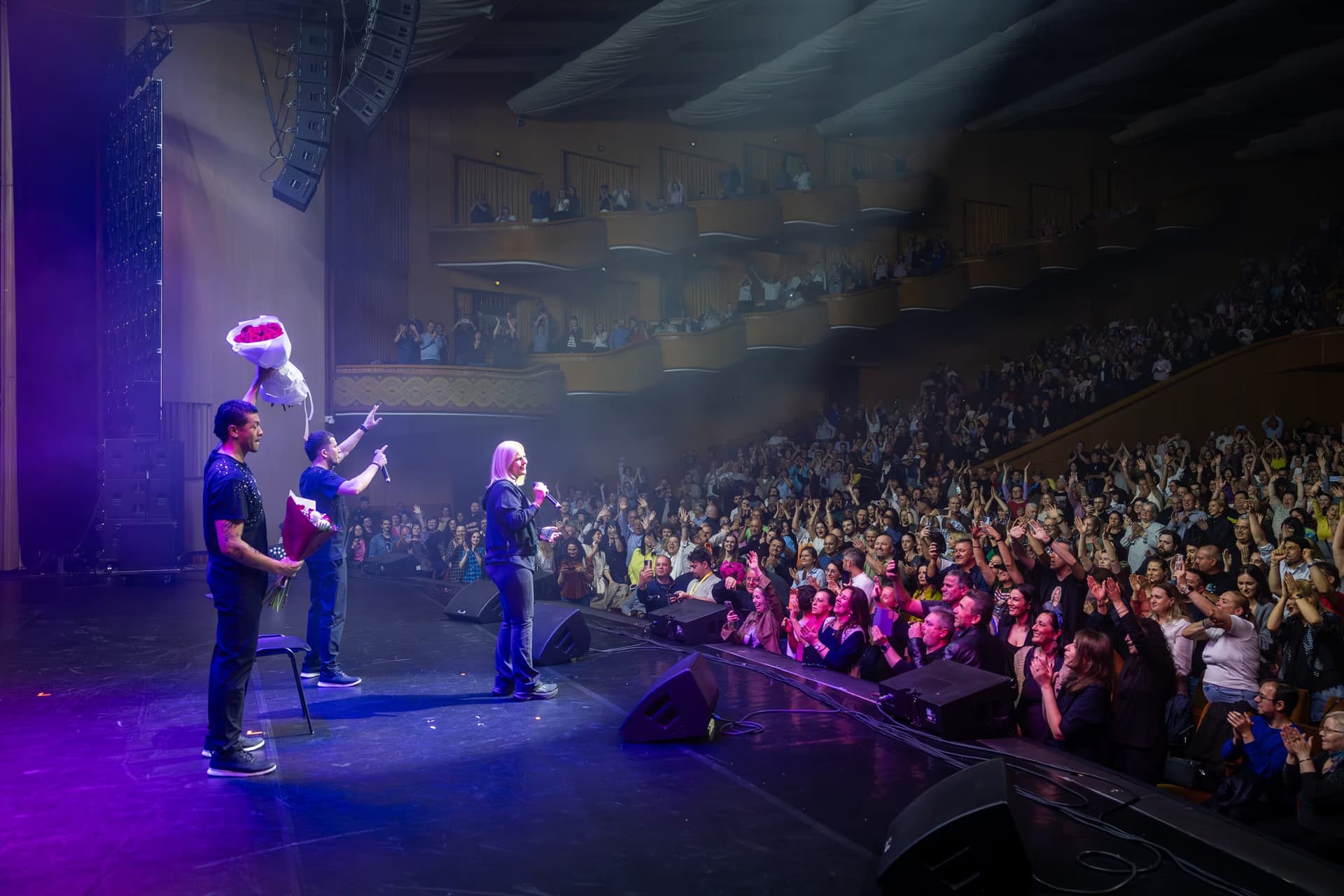
C.C. Catch stood on the Sala Palatului stage with her left hand immobilized — visibly, without trying to hide it. Behind her, a black chair she sat in from time to time, never missing a beat, adapting her choreography to what she could manage. And when the audience began chanting her name — CC Catch! CC Catch! — for long minutes, without letting up, Caroline Catharina Müller, known to the world as C.C. Catch, was visibly overwhelmed. The tears came quietly — without theatrics, caught later by cameras in the front rows — in the silence between two rounds of applause. For a few seconds, '80s eurodisco was no longer a commercial revival, a retro curiosity, or a vehicle for professionally packaged nostalgia. It was something deeply personal — for her, but above all for the nearly four thousand people who, in 1985, had secretly bought hand-copied cassettes passed from person to person, because original records were nowhere to be found and the artists never came.
A Revival That No Longer Surprises Anyone
Wednesday evening's concert is part of Golden Disco Legends, a signature concert series by producer Radu Groza, which has brought to Sala Palatului in recent years names such as Bad Boys Blue, Thomas Anders, Richard Clayderman, Al Di Meola, and Chris Norman.
'80s eurodisco — the synthetic sound, the direct choruses, the 120 BPM beat, the productions of Dieter Bohlen and his school — is living, in 2026, a revival that no longer surprises anyone. Streaming has unearthed the back catalog. TikTok algorithms have recycled the hooks for a generation that hadn't been born when "I Can Lose My Heart Tonight" entered the West German charts in 1985. And the mature audience — those who lived that era firsthand — responds with a hunger for biographical continuity that few other cultural experiences can satisfy.
A Nostalgia With Delayed Access
To be fair, we should acknowledge that, unlike progressive rock or Western punk — which challenged systems — disco was, on the contrary, one of the most tolerated genres of the regime. Considered light, festive, and free of subversive charge, eurodisco circulated relatively freely in Socialist Romania. "Touch by Touch" or "Cause You're Young" could be heard at weddings, student discotheques, or restaurants along the Black Sea coast.
The problem wasn't prohibition. It was access. Original records were not available in stores. A concert with the real artists of the moment was the unattainable dream of an entire generation. Those who wanted to hear music the way the rest of Europe heard it did so on ORWO, AGFA, or TDK cassettes, copied generation after generation until the tape lost its sound quality. Loving C.C. Catch in 1986 was possible — but it was a chimera, forever out of reach.
A second peculiarity: Electrecord, the state record label, exploited the void. Since lyrics in English were banned by censorship from Radio București, and Western copyrights stopped at the border, Electrecord freely recorded Romanian cover versions of international hits without the authors' consent and without paying royalties. It was a form of state-sanctioned piracy, ideologically justified. Numerous Romanian artists of the era tried to satisfy a hunger for Western music through surrogate songs. So, more than an evening of music, Wednesday's concert was also a meeting — delayed by four decades — between an audience that had loved these songs by hearsay and the artists who had actually made them.
Maria Nagy: The Perfect Opening Act
In this context, choosing Maria Nagy as the opening act was no minor detail — it was a deliberate editorial decision by Radu Groza. Born in Harghita in 1957, discovered through Adrian Păunescu's Cenaclul Flacăra cultural circle, she left Romania in 1983 during a tour of Egypt and never came back, going on to perform for more than a decade in Egypt, Morocco, France, and Yemen. Her raspy voice earned her, in the original's absence, the nickname "Romania's Bonnie Tyler" — a label she has, by her own public admission, never truly loved.
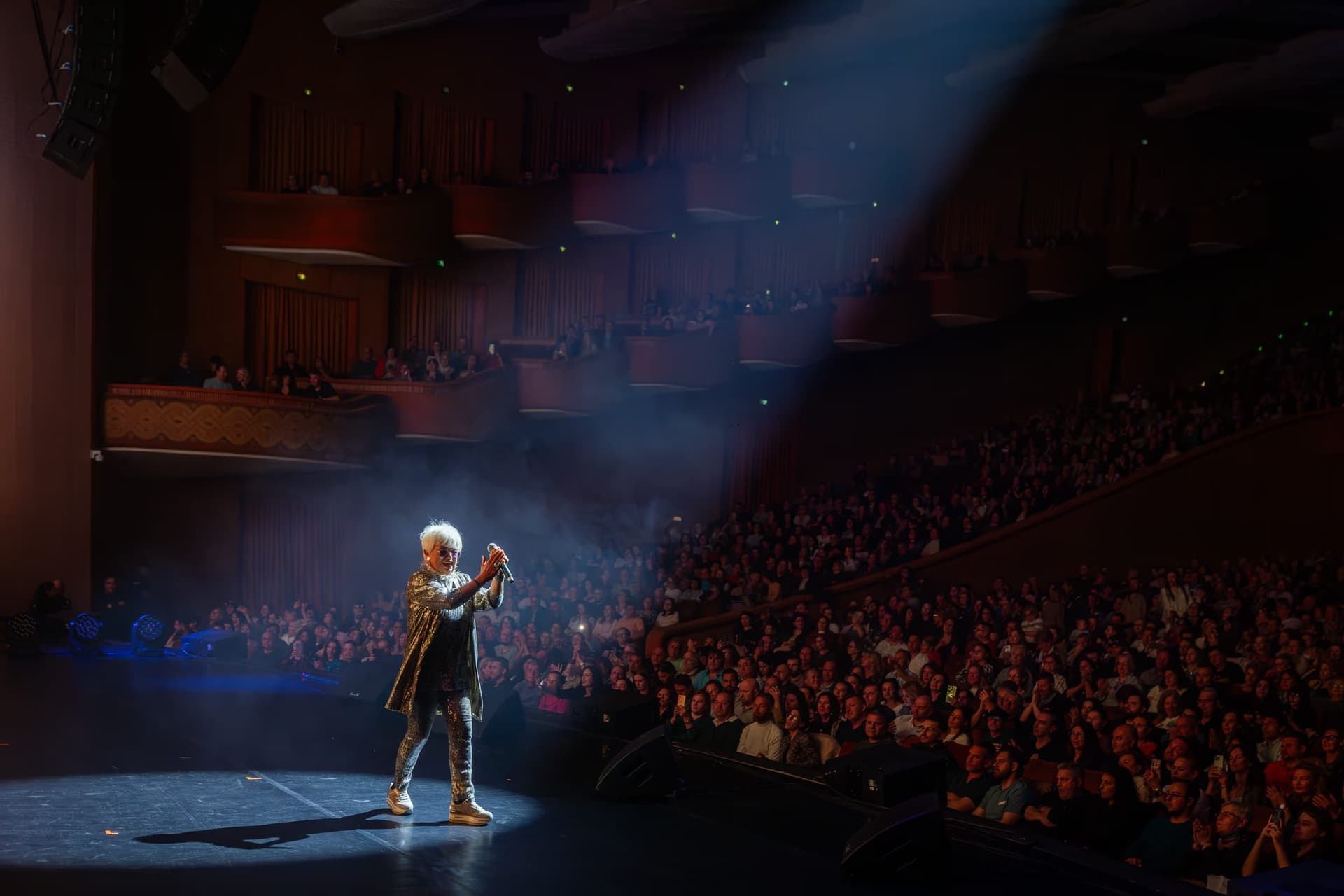
Her entrance onto the stage — leopard-print costume in silver tones, violet tinted glasses, short platinum hair — came with a visual tribute: on the large screen behind her, a mosaic of all the "characters" she has embodied throughout her career. A playful self-portrait, but also a declaration: after more than five decades on stage, Maria Nagy no longer needs to be anyone else.
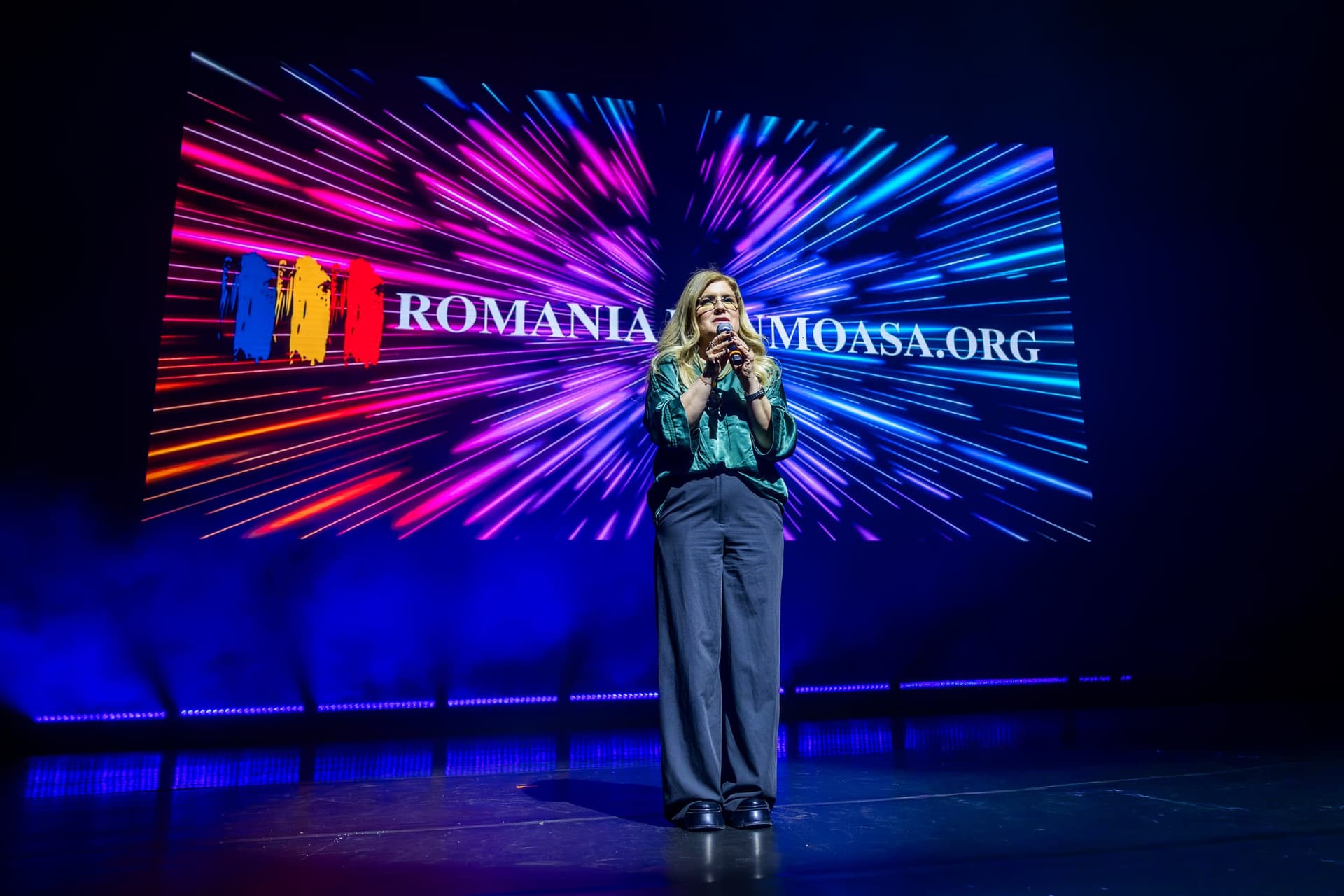
The presentation — warm, professional, and restrained — was handled by Liana Stanciu, one of the most familiar voices on Romanian radio, who guided the transitions without ever placing herself between the artist and the audience.
Joy: the "aha" effect
The Austrian band Joy, founded in 1984, took the stage in a hall already buzzing with anticipation and was greeted with enthusiastic applause from the opening bars. In those first few seconds you could feel the curiosity of an audience no longer certain whether they recognized the name. Then came the chorus. Touch by Touch. Valerie. Hello. And like a wave breaking over the room, the collective penny dropped: so that's who they are!

Two members of the band took the stage at Sala Palatului: Andy Schweitzer — the keyboardist, one of the three founders — instantly recognizable in a gold leopard-print jacket, holding a white AX-Synth with the ease of a veteran who has nothing left to prove; and Michael Scheickl, the lead vocalist, dressed in a red velvet jacket with embroidered cuffs. Of the three founders — Schweitzer, Freddy Jaklitsch, and Manfred Temmel — the last passed away in 2019. Onstage, Schweitzer and Scheickl moved without forcing anything — professionals who understand that the songs are enough, and that an audience, once it finds its footing, asks for nothing more.
The Apparition
The moment C.C. Catch walked on stage, the entire venue rose to its feet — and stayed there. A 61-year-old woman appeared before the crowd dressed simply: black T-shirt, vest, jeans, sneakers, flanked by two dancers. Cause You're Young. Heartbreak Hotel. Strangers by Night. Heaven and Hell. Hit after hit, the audience singing along to every word.
The Chair and the Dignity
The evening's central technical detail — which, far from diminishing the show, charged it with a rare emotional gravity — was a simple black chair placed in the middle of the stage. C.C. Catch sat down on it from time to time, when the pain demanded it, without explanation, without apology, never stopping her singing. But each time she also rose from it again, to continue the simplified choreography alongside her dancers. She gave this concert not in spite of her suffering, but with it — visible, owned, present on stage like a fourth character. In today's music industry, where a bout of flu cancels entire tours, that kind of attitude belongs, quite simply, to another era.
The Ovation
At the end, after the final encore, an enormous bouquet of red roses came from the audience. Since the artist could not use her left hand, one of the dancers stepped forward to receive it.
CC Catch! CC Catch! CC Catch!
Long minutes, without stopping, without fading. Caroline Müller — who, in 1986, had been a ghost in Romania, passed around on hand-copied cassettes — was now receiving, under the spotlights of a hall built for ideological ovations, in the very place where it had been decreed that Western art was dangerous, a genuine, open-stage standing ovation.
She paused, visibly moved. Tears came quietly. The microphone lowered, her head bowed for a second, then raised again to thank the people before her. A moment the naked eye could barely read from a distance, but one the cameras in the front rows caught in full detail.
Two and a Half Hours
There are concert nights that are events, and concert nights that are short circuits in time. Wednesday evening, at Sala Palatului — while, three kilometers away, James Hetfield and Lars Ulrich were doing what they always do, professionally, deafeningly, without surprises — something happened that does not happen every night: four thousand people reclaimed, for two and a half hours, a music they had always loved but had long been able to hear only through intermediaries — copied cassettes, Electrecord covers, radio caught on shortwave.
And the artist who delivered that gift — with one hand bandaged, a spare chair waiting on stage, and tears she hadn't tried to force but hadn't hidden either — received in return exactly what she had come to find: confirmation that, beyond an Iron Curtain that fell 37 years ago, her songs had not merely managed to get through. They had taken root.
1 / 19