On March 27, the world celebrates World Theater Day, initiated by the International Theatre Institute in 1961 and marked annually since 1962. For many countries, it is a day of tribute. For Romania, it should also be a day of honest reckoning. Romanian theater remains one of the few cultural institutions that still simultaneously holds memory, symbolic authority, and a living relationship with its audience. But it is also a system showing signs of wear.
An Old Institution of Romanian Modernity
Theater was not an ornament in Romania. It was one of the forms through which Romanian society learned what it meant to be modern. UNATC traces its origins to 1834, within the Philharmonic School in București. In Iași, 1840 is recognized as the founding moment of the National Theater, when Mihail Kogălniceanu, Costache Negruzzi, and Vasile Alecsandri were appointed directors. In București, the Grand Theater opened in 1852, became a public institution in 1864, received the name Teatrul Național on its façade in 1875, and in 1877 the Theater Law was enacted. Romanian theater is therefore not merely an artistic expression — it is one of the constitutive institutions of the Romanian cultural state.
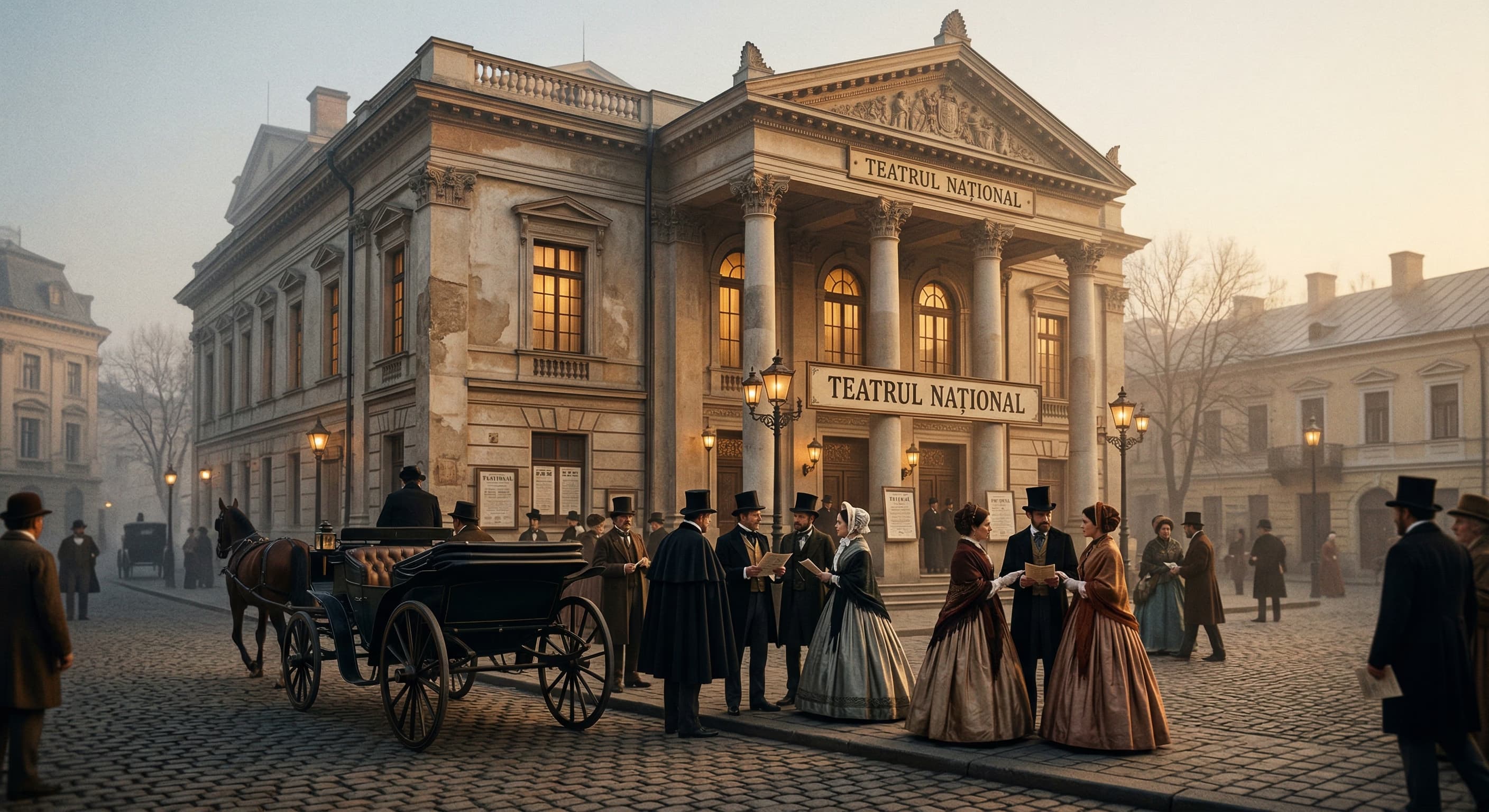
This history also produced a canon. From Vasile Alecsandri to I.L. Caragiale, from classical dramaturgy to the great acting and directing schools of the twentieth century, theater was one of the few art forms that functioned for Romanian audiences as both entertainment and a tool for social reflection. The fact that "O noapte furtunoasă" entered the repertoire of the București National as early as 1879 says something essential: Romanian theater quickly developed not only its own authors but also its own self-awareness.
Romania Still Has a Substantial Theater Network
Despite the prevailing narrative of "cultural decline," theater remains one of the most dense forms of cultural institution in the country. According to the most recent INS breakdown verifiable directly from publicly accessible sources, Romania had 61 dramatic theaters, 15 puppet and marionette theaters, and 3 musical, variety, and operetta theaters — 79 institutions in total classified statistically under the theater category. At the center of the system, six National Theaters operate under the authority of the Ministry of Culture: Teatrul Național "I.L. Caragiale" in București, Teatrul Național "Vasile Alecsandri" in Iași, Teatrul Național "Lucian Blaga" in Cluj-Napoca, Teatrul Național "Mihai Eminescu" in Timișoara, Teatrul Național "Marin Sorescu" in Craiova, and Teatrul Național in Târgu Mureș. If we broaden the definition beyond ministerial subordination and look at title and relevance, Teatrul Național "Radu Stanca" in Sibiu — which falls under local authority — must also be mentioned.
More importantly, audiences have not disappeared. INS data for 2023 show that performing arts institutions and companies attracted 6.148 million spectators, with dramatic theaters drawing the largest share. In an era when almost every cultural industry laments the fragmentation of attention, this is not a marginal figure. It is evidence that theater still matters.
Financially, too, this is far from a symbolic sector. The approved 2024 budgets for the six National Theaters under the Ministry of Culture total approximately 216 million lei. Of this, TNB București has a budget of 79.236 million lei; the National in Iași, 19.880 million lei; the National in Cluj-Napoca, 16.665 million lei; the National in Timișoara, 33.128 million lei; the National in Craiova, 29.804 million lei; and the National in Târgu Mureș, approximately 37.375 million lei. Even viewed dispassionately, these figures show that Romanian theater is not merely symbolic heritage — it is a public system with real budgetary weight.
On revenues and expenditures, the picture is equally telling. At TNB, own revenues stood at 14,594,000 lei; in Iași, the approved 2024 budget shows 19.880 million lei in total expenditure, of which 2.345 million lei came from own revenues, with the remainder covered primarily by subsidies. In Timișoara, the budget indicates 33.128 million lei in total revenues matched by equal expenditure, of which 2.967 million lei were own revenues, 1.526 million lei came from donations and sponsorships, and 30.161 million lei from subsidies. In Târgu Mureș, public reports indicate 37.375 million lei in total revenues, of which only 1.130 million lei were own revenues. The direction is clear: Romanian theatrical prestige remains sustained largely by public money, not by economic self-sufficiency.
But this is precisely where an uncomfortable question arises. If a system has historic institutions, a loyal public, and budgets running into hundreds of millions of lei, why does it remain so vulnerable? Why do prestige and precariousness coexist, international festivals alongside aging infrastructure, landmark stages alongside deep regional inequalities? In other words: the problem of Romanian theater is no longer a lack of importance, but a lack of strategy to turn that importance into a coherent, sustainable system.
Romanian prestige is not an illusion
There is another fact worth stating plainly: the prestige of Romanian theater is not merely domestic, not merely nostalgic, and not merely ceremonial.
The Sibiu International Theatre Festival is officially recognized as one of the largest and most important theater and performing arts festivals in the world. The 2024 edition brought together over 830 events, more than 5,000 artists and participants from 82 countries. The National Theatre Festival, produced by UNITER, is defined as a strategic event of national interest. The UNITER Awards Gala has itself become one of the few cultural ceremonies in Romania that still carries real public and professional weight.
The flagship institutions reinforce this impression. The "Radu Stanca" National Theatre in Sibiu traces its roots to the eighteenth century. The National Theatre Bucharest has more than a century and a half of history and defines itself as a "national cultural brand." The Iași National Theatre explicitly claims the status of Romania's first national theater. None of this is mere self-promotion. It describes a rare fact: theater remains one of the few fields in which Romania can legitimately speak of continuity and reputation.
Beneath the prestige, the system creaks
This is where the part that celebratory discourse almost always sidesteps begins. Romanian theater does not suffer from a shortage of symbols, but from a subtler form of fragility: that of institutions which appear solid precisely because they are old, respected, and still visible. Prestige can conceal the cracks in a system for a long time. It cannot, however, repair them.
At the top, the picture is convincing. There are strong festivals, historic stages, respected artists, serious theater schools, international collaborations, and an institutional memory that few other cultural sectors in Romania can still invoke. But beyond that apex, the system is uneven. The gaps between the major centers and the rest of the country are wide. In a handful of cities, theater functions as an engine of urban identity. In others, it survives administratively — limited resources, a volatile audience, and little capacity to reinvent its purpose.
This is where the central paradox of Romanian theater emerges: it is strong in its pockets of excellence and fragile in its overall structure. In other words, the success of a few institutions can create the illusion that the entire system is healthy.
A second problem is the nature of funding. Budgets exist, and for some institutions they are substantial. But their structure clearly reveals a heavy dependence on public subsidy. That is not, in itself, an anomaly — theater is almost everywhere in Europe an art form supported by public funds. The problem arises when public funding is not accompanied by vision, predictability, and performance criteria suited to the artistic context. Without these, theater risks being treated at times as an administrative service, at times as a ceremonial showcase, and rarely as strategic cultural infrastructure.
There is also the problem of infrastructure, which receives far less attention than its real importance warrants. Some theaters operate in well-restored, well-equipped buildings. Others work in unsuitable spaces — technically outdated stages, insufficient facilities, or premises that have been stuck in a logic of temporariness for years. In a field where the performance space is part of the work itself, infrastructure is not a technical detail. It is a condition of existence.
Then comes the question of the audience. Yes, the audience exists. Yes, theater continues to draw spectators. But the important question is not simply how many come — it is who comes, and whether they return. In many places, theater audiences remain heavily concentrated among already culturally formed segments of the population. The renewal of younger audiences is uneven, and the relationship between institutions and new generations depends enormously on local context, repertoire, educational policy, and each theater's capacity to step outside its own habits.
The relationship between repertoire and the present is no simple matter either. Romanian theater has a solid classical heritage, which is an asset. But that same heritage can become, without a genuine effort at renewal, a form of comfortable conservatism. The question is not whether the classics should be staged — of course they should. The question is whether they are brought back to life or merely administered as obligatory patrimony. Equally, contemporary theater and experimentation cannot be sustained through declarations alone. Without real space for artistic risk, the system will professionalize itself administratively and plateau aesthetically.
There is also the managerial dimension — perhaps the most sensitive of all. In Romania, theater remains, to a considerable degree, caught between two logics that do not always coexist peacefully: the artistic and the bureaucratic. When the two begin to ignore each other, the result is familiar: internal tensions, labor conflicts, a sense of stagnation and, sometimes, a shift of energy away from creation toward institutional survival. In theory, theater is a space of freedom. In practice, it depends on administrative mechanisms that can either sustain that freedom or slowly suffocate it.
None of this means that Romanian theater is in inevitable decline. Quite the contrary. It means that it has enough value to no longer be treated with formulas of complacency. Its problem is not that it no longer matters. Its problem is that it still matters enormously — without always being thought about at the scale of its own importance.
Why this matters more than it seems
Traditionally, theater in Romania has been seen as an art of the elites, or at best of the educated urban classes. But that tells only half the story. The other half is that theater has functioned, historically, as a space of civic education, of shared language, of tension between power and society, between text and reality.
A country that weakens its theater does not only lose performances. It loses a form of public memory.
That is precisely why World Theater Day should not be merely a day of tributes. It should also be a day of serious questions: how many of our theater institutions are truly prepared for the next two decades? How many are still living off accumulated prestige, and how many are investing in the future? How many have become genuine cultural engines for their cities, and how many are simply surviving administratively?
A living heritage — but not a guaranteed one
The greatest strength of Romanian theatre is that it has not yet become a relic. It still has an audience. It still produces events. It still generates debate. It still has figures and institutions that matter. But this very vitality can be deceptive. It can delay uncomfortable conclusions.
The reality is that Romanian theatre remains one of the great institutions of national culture, yet it can no longer survive on the weight of its famous names, the appeal of the classics, or a handful of internationally renowned festivals.
It needs more than reverence. It needs functional buildings, smart funding, genuine autonomy, competent management, new audiences, and a clear sense of its place in society.
What is at stake is not merely the survival of an art form. It is the survival of an institution of public reflection. Theatre does not only produce performances. It produces shared language, memory, confrontation, nuance. At its best, it forces a society to look at itself without makeup. That is precisely why the weakening of theatre would be not only a cultural loss — it would be a civic one.
Romania has no shortage of proof that theatre can perform. It already has examples of excellence. The question is whether it wants to build a system around them, or whether it is content to admire them as happy exceptions.
This is, perhaps, the true test of Romanian theatre as an institution. Not whether it has a past — it has a past in abundance. But whether it can transform accumulated prestige into future capacity.
If it does not, it will continue to be both respected and vulnerable at the same time.
If it does, then Romanian theatre can remain not merely a heritage to be celebrated, but a living force of Romanian culture.
Editorial note:
*This article is analytical in nature and includes both factual information drawn from public documents available at the time of writing and the author's editorial interpretations. Figures and institutional information were compiled from identified public sources verified at the time of research. Depending on subsequent updates, budget revisions, final execution reports, administrative changes, or differences in reporting between institutions, some values may be subject to change.
**The images accompanying this article are digitally generated, illustrative in nature, and should not be interpreted as documentary photographs.