Bucharest is not the only European capital without a complete motorway ring. But it is probably one of the best examples that Romania has left behind the era of accidental ribbon-cuttings and has finally entered a phase of large-scale construction.
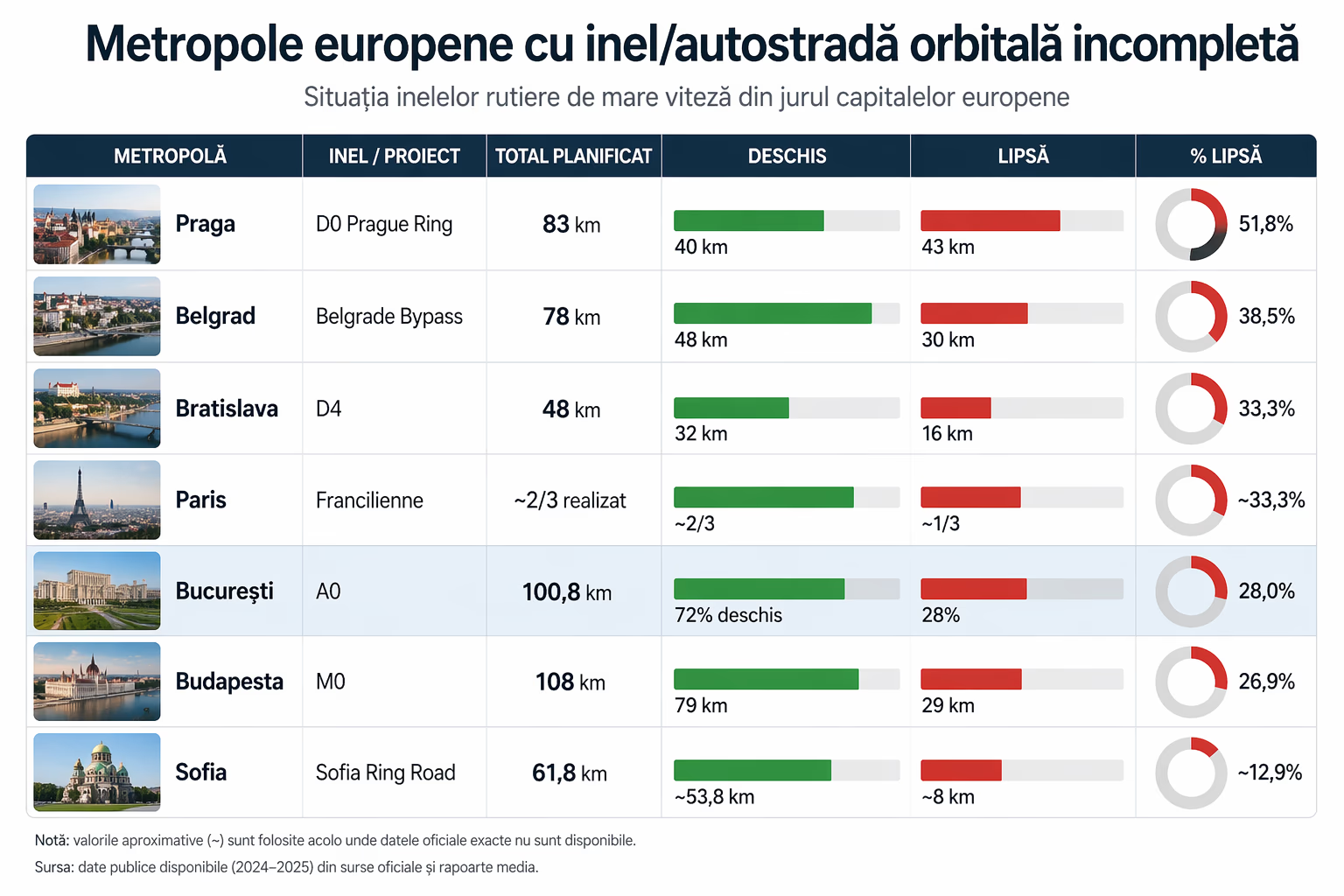
For years, an urban legend has been making the rounds: "Bucharest is the only European capital without a motorway bypass." It isn't true. Prague's D0 is incomplete, with roughly 40 km in operation out of a planned 83 km. Budapest's M0 is incomplete, with 79 km built out of 108 km planned. Bratislava's D4 is incomplete, with 32 km of 48 km. Belgrade's bypass is also unfinished, with 48 km open out of 78 km. Paris still doesn't have a complete Francilienne, and recent public sources indicate that Sofia is at roughly 85% completion — meaning its ring isn't fully closed either. Bucharest, via the A0, is about 72% open and 28% still under construction. And it looks like the Romanian capital is actually the one with a real chance of closing its entire ring by the end of the year.
For years, Romania talked a great deal about motorways and delivered very little. By 2017, only 745 km had been opened to traffic, of which 113 km had been built before 1989. In 2017, just one new section was inaugurated, about 15 km. In 2018, 58.44 km opened. In 2019, 43.3 km. In 2020, 60.6 km. In 2021, 30.3 km. Even without dramatizing, the picture is clear: few openings, scattered in time, with long stretches when the system survived on the occasional isolated stretch.
After that, the pace begins to shift visibly. In 2022, Romania opened 14.17 km of motorway and 39.85 km of express road, for a total of 54.02 km of high-speed road infrastructure. In 2023, the total rose to 80.49 km. In 2024, it reached 200.51 km, an all-time record. In 2025, another 146 km opened. That means in the 2022–2025 window alone, Romania added more than 481 km of motorway and express road, and the four-year average has surpassed 120 km per year. By comparison, the annual average between 2017 and 2021 was around 41.5 km. The difference is no longer one of nuance. It is one of scale.
More important than kilometres inaugurated, however, are the kilometres actually under construction. That is where you can tell whether a real systemic shift is happening. At the end of 2019, 130km.ro listed roughly 172 km of motorway under construction. By the end of 2025, the network of motorways and express roads under construction had reached 837 km. And by the end of March 2026, the same source reported 884 km under construction and 486 km out to tender. That explains why Romania no longer depends on a single "lucky stretch" or a year-end ribbon-cutting, but is starting to build a critical mass of construction sites that can feed a steady stream of openings.
The A0 is perhaps the best symbol of this shift. The capital's motorway ring is not yet finished, but here the public myth breaks down against reality. In 2023, the first significant segments opened on the southern and northern sides. In 2024 came further openings on A0 South and A0 North. In 2025, Section 3 of the southern side was inaugurated, making the southern semicircle fully operational between the A2 and the A1. On the north, the situation remains partial, but with a strong chance that the ring will be fully closed by year's end. Saying that Bucharest is "the only European capital without a ring motorway" is just an urban myth — and it doesn't hold up.
In fact, the right comparison isn't between an idealized Bucharest and today's Bucharest, but between the Romania of before and the Romania of now. Until recently, major projects were buried under paperwork, legal challenges and promises. Today, even if delays haven't disappeared, you have the A0, the A1 Sibiu–Pitești, large portions of the A7, sections of the A3, new express road connections and, above all, a working front on a scale never seen before. The fact that in 2024 tenders were launched for around 689 km of motorways and express roads, and that in 2025 new contracts were signed for another 360 km, shows that this is no longer just about catching up on backlogs — it's a shift in volume.
This doesn't mean Romania has solved its infrastructure problem. It hasn't. Bucharest still doesn't have a complete ring, the major mountain crossings aren't finished, and Moldova doesn't yet have its full high-speed spine. But it does mean something else, equally important: the accurate phrase about the present is no longer "nothing is being done," but "a lot is being done, just not yet enough." And in Romanian infrastructure, that is already a historic difference.