


On May 9, 1877, Romania proclaimed its independence in Parliament. What followed was a year in which the country won statehood on the battlefield, lost southern Bessarabia, received in exchange a province its government in Bucharest had never asked for — northern Dobrogea — and was compelled to amend its Constitution before international recognition could be secured. The true story of Independence is not a solemn tableau; it is a sequence of decisions negotiated under pressure.
On the morning ofMay 9, 1877 — by the Julian calendar; May 21 in the chanceries of Paris, London, and Berlin —Mihail Kogălniceanu rose to the podium of the Chamber of Deputies in Bucharest. The foreign minister was 59 years old — a jurist, a historian, and one of the most consequential politicians of the generation of 1848. He was responding to an interpellation from Deputy Nicolae Fleva, who had demanded that the government clarify Romania's status in relation to the Sublime Porte.
The speech was long and deliberate. He argued from a legal standpoint — the recognition of a state of war automatically severed the tributary bonds with Constantinople — then broadened into a plea for the historic existence of the Romanian nation. At a certain moment came the sentence for which the entire Assembly had been holding its breath:
"We are independent; we are a nation unto ourselves."
The motion acknowledging the proclamation of independence was passed with 79 votes in favor and 2 abstentions. That same evening, the Senate adopted a motion of similar content. Also on May 9, Parliament voted to redirect 914,000 lei — budgeted as a "tribute to the Sublime Porte" — to the Ministry of War. The Senate that same evening also passed legislation establishing the country's first major national decoration. The following day, May 10, 1877, Carol I sanctioned the declaration of independence and promulgated the law — in the definitive form of the Order of the Star of Romania (Ordinul Steaua României), a name proposed by Kogălniceanu himself, who had initially preferred "Star of the Danube."
None of the major European capitals recognized the independence immediately. The Ottoman Empire ignored the declaration. Russia, Romania's military partner at the time, merely took note. France, Germany, and Austria-Hungary deferred any official pronouncement, while Britain remained wary of any shift in the Balkans that might strengthen Russia's position. What the Romanian parliament had decreed as a fait accompli would, over the next eighteen months, become a bargaining chip at diplomatic tables to which Romania was not admitted as a signatory power.
And for that, the country paid. At Plevna, in present-day Bulgaria, under fire from the Turkish redoubts, the Romanian army suffered approximately 4,300 dead and missing, more than 3,300 wounded, and nearly 20,000 soldiers struck down by typhus and dysentery — roughly 27,000 casualties in all, out of more than 58,000 men mobilized. At home, the press of Mihai Eminescu became a tribune of national fury over the way the Russian ally was negotiating Romania's fate over Bucharest's head. In the end, Romania won international recognition — but lost southern Bessarabia, received in return northern Dobrogea (a territory the Romanian government had never sought), and was compelled to amend its Constitution to grant civil rights to Jews.
This story — the real story of Independence — has too often been reduced to a single founding moment in public memory. In truth, it unfolded across eighteen months of hard decisions that transformed a tributary principality into a European kingdom. What follows is a reconstruction of those decisions, drawn from Romanian archives, period press, and historiographical scholarship.
I. The Road to the Grandstand
In the autumn of 1875, Bosnia and Herzegovina rose up against the Porte. A year later, Bulgaria followed. Ottoman massacres of the Bulgarian Christian population were inflaming public opinion across Europe. Serbia and Montenegro declared war. Tsar Alexander II, who saw himself as the protector of Balkan Orthodoxy, began moving troops toward the borders of the Ottoman Empire.
For the United Principalities — which had become a unified state in 1862 and had been ruled since 1866 by Carol of Hohenzollern-Sigmaringen, yet remained formally under Ottoman suzerainty — the moment was decisive. The Liberal politicians around Ion C. Brătianu, the prime minister, saw the coming Russo-Turkish war as the only historical opening through which to break free from Ottoman suzerainty. The Conservatives — among them P.P. Carp and Titu Maiorescu — were more cautious. And Mihai Eminescu, who would join the editorial staff of "Timpul" in the autumn of 1877, was soon to polarize the public debate still further.
On April 4, 1877 (Old Style; April 16, New Style), in Bucharest, Kogălniceanu — acting as foreign minister — signed an agreement with Baron Dimitri Stuart, Russia's diplomatic agent and consul general, allowing Tsarist troops to cross Romanian territory. In return, Russia pledged "to maintain and uphold the political rights of the Romanian state, as established by its internal laws and existing treaties, and to defend Romania's current territorial integrity."
This clause would be contradicted in practice when Russia claimed southern Bessarabia a year later. But in April 1877, it seemed the ultimate guarantee.
On April 12/24, Russia declared war on the Ottoman Empire. Tsarist troops crossed into Moldova over the Prut River at Ungheni — via the metal bridge still popularly attributed to Gustave Eiffel, though more recent technical research credits the Russian engineer Nikolai Belelubsky. On April 26, Romanian artillery shelled Vidin in response to Ottoman attacks on Calafat, Brăila, and Galați. Memoir tradition holds that Carol I, present at Calafat, remarked, "This is the music I like" — a plausible anecdote, though no primary source documents it.
On April 29 (Old Style) / May 11 (New Style), following a question from Deputy Anastase Stolojan, the Chamber of Deputies voted on the motion proposed by Dimitrie Ghica: 58 in favor, 29 against. Romania officially recognized its state of war with the Ottoman Empire.
One final legal step remained — the declaration of independence. It came ten days later, through Kogălniceanu's address.
II. The Day Itself
The stenographic record of the May 9, 1877 session is preserved in the Chamber's archive. Kogălniceanu's speech lasts nearly 40 minutes. It opens with a legal argument — recognition of a state of war automatically severs the tributary bonds with the Porte — and gradually becomes a plea for the historical existence of the Romanian nation. He reads from documents, quotes the British Parliament, and attacks the diplomatic notes of Savfet Pașa.
Then comes the canonical phrase:
"Therefore, gentlemen deputies, I have not the slightest doubt or fear in declaring, before the national representation, that we are a free and independent nation."
The Chamber erupts in applause. But Kogălniceanu does not stop there. He continues with what is, perhaps, the most important part of the speech — and the least quoted: the warning.
"Now the difficulties begin, for our new condition, with the definition of our independence… must be accepted by Europe. This is the question; here is where patriotism is demanded, here prudence is demanded, here a cool head is demanded."
He was right. A cool head would not be enough. But in that moment, the Assembly voted. So did the Senate, that same evening. The Romanian Parliament also decreed — on that same day — that the 914,000-lei tribute owed to the Porte would be redirected to the Ministry of War, and the Senate approved the law establishing the Order. The next day, May 10/22, the Chamber ratified the final name — "Steaua României" (Star of Romania), at Kogălniceanu's proposal — and Carol I sanctioned, by Royal Decree, the first great decoration of the independent Romanian state. Four days later, on the plains of Cotroceni, the prince decorated 27 soldiers, among them two ordinary privates — Ochian Costache and Enache Dinu, heroes from Oltenița — the first Knights of the Order of the Star of Romania — alongside General Manu, commander of the 4th Division, and other officers distinguished with the "Virtutea Militară" (Military Virtue) decoration.
What the tribute was worth
The 914,000 lei sounds abstract. But it can be converted. The Romanian leu, established by the monetary law of 1867 on the model of the Latin Monetary Union, was defined on a bimetallic standard: 1 leu = 0.29032 grams of fine gold (or silver equivalent). The tribute therefore corresponded to 265.35 kg of gold — which, at the gold price of May 2026 (approximately €129.64 per gram), amounts to roughly €34.4 million. This is, however, a metal-based conversion, not a precise measure of the sum's purchasing power in the economy of 1877. The significance of the gesture was symbolic: on that May 9, the Romanian state declared it would no longer accept the condition of tribute-payer.
III. The Blood at Plevna
Parliamentary independence came easily. Recognition of it came at a cost. At the end of July 1877, after bloody Russian defeats at Plevna, Grand Duke Nicolae sent a telegram to Carol I:
"The Turks, massing their largest forces at Plevna, are crushing us. I ask for a junction, a demonstration, and, if possible, a crossing of the Danube — which you wish to make — between Jiu and Corabia. This demonstration is indispensable to facilitate my movements."
It was a plea for rescue. Carol I agreed, but on his own terms — the Romanian army would remain under its own command, not be absorbed into tsarist formations. After a meeting between Tsar Alexander II, the Grand Duke, and the Romanian prince, Carol was given command of the Russo-Romanian army at Plevna, with Russian General Pavel Zotov as chief of staff. Under pressure, Romania had won the diplomatic battle.
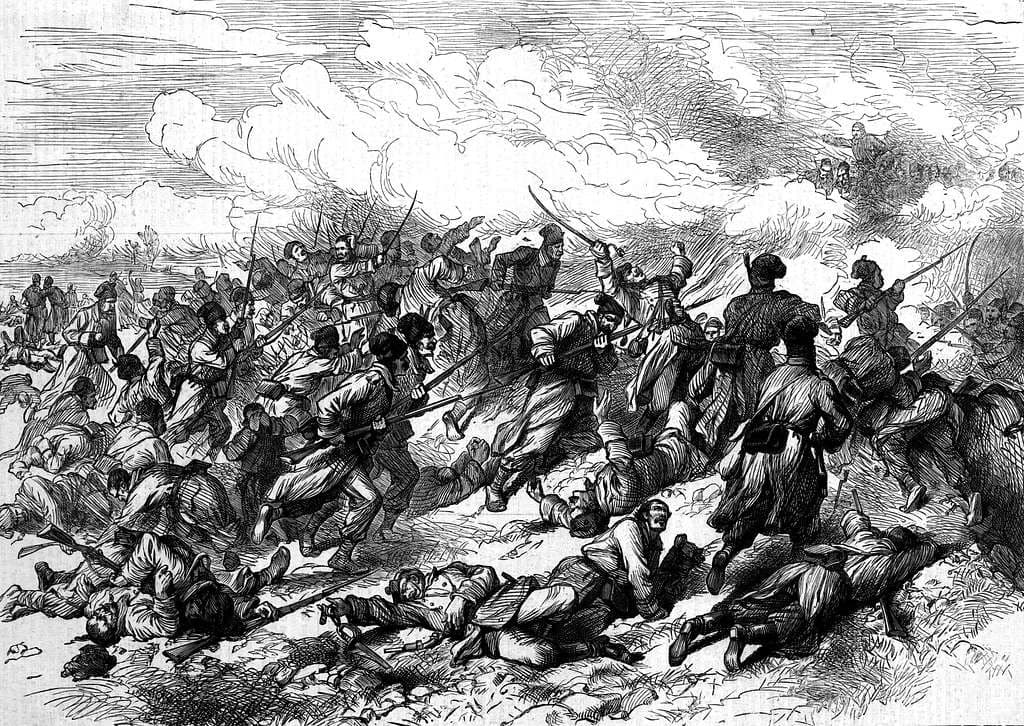
The cost was heavy. Redoubt Grivița 1, stormed at terrible cost on 30 August/11 September 1877. Rahova, taken solely by the Romanian army between 7/19 and 9/21 November. Plevna, which fell on 28 November/10 December when Osman Pasha surrendered to Romanian Colonel Mihail Cerchez and Russian General Ivan Ganețki. Smârdan, in January 1878. Across the campaign, Romania suffered approximately 10,000 direct military losses — killed, missing, and wounded — along with nearly 20,000 soldiers incapacitated by illness.
In The Illustrated London News, London followed the war week by week. The British publication ran numerous engravings from the theatre of operations, including scenes of Romanian troops and the assault on Redoubt Grivița. Among them, the supplement of 6 October 1877 featured a double-page engraving titled "The War: Storming the Grivitza Redoubt before Plevna, Sept. 11. Facsimile of a sketch by our special artist with the Allied Russian and Roumanian Army." For British readers, the Romanian infantrymen (dorobanți) had suddenly become a visual reality.
Against this backdrop, in December 1877 and January 1878, the fronts began to collapse. The Ottomans were seeking an armistice. And Russia was preparing to negotiate peace — without inviting Bucharest to the table.
IV. San Stefano: a fait accompli
On 19 February/3 March 1878, in a village called San Stefano (today Yeșilköy, a suburb of Istanbul), Russia and the Ottoman Empire signed a bilateral treaty. Romania had sent a representative — Colonel Eraclie Arion. Brătianu had given him clear instructions: to accept no document in whose negotiation Romania had not participated. Arion was not admitted as a participant in the Russo-Ottoman talks, despite Romania's military contribution to the war.
The text formally recognised Romania's independence. At the same time, it required the country to cede southern Bessarabia — the counties of Cahul, Bolgrad, and Ismail — to Russia, with Russia in turn transferring to Romania a portion of Dobrogea, until then an Ottoman province (which Russia itself was to receive officially from the Porte). The three Bessarabian counties had been reintegrated into Moldova only in 1856, under the Treaty of Paris. Lost for 44 years, then reclaimed — now lost again. This time, the blow came not from an enemy, but from an ally.
In Bucharest, the news was received with consternation. Carol I demanded explanations. Brătianu protested. Kogălniceanu — the same man who had signed the Convention with Russia a year earlier — denounced in parliamentary committees what he called a "breach of the given word." But the major European powers — Britain and Austria-Hungary above all — had other concerns. It was not the cession of southern Bessarabia that worried them, but the fact that the Treaty of San Stefano created a "Greater Bulgaria" set to become a Russian satellite. In London and Vienna, calls grew for a new European congress to be convened.
And the congress came.
V. In Berlin, Under Bismarck's Baton
Between June 1/13 and July 1/13, 1878, in the former Radziwill residence in Berlin, Otto von Bismarck presided over a congress that redrew the map of the Balkans. It was the peak of his career — the "honest broker," as the press called him, though in reality he was carefully playing Germany's own hand. Around the table: Great Britain (Disraeli, now Earl of Beaconsfield), Austria-Hungary (Count Andrassy), Russia (Chancellor Gorchakov), France (Waddington), Italy, and the Ottoman Empire.
Romania did not participate as a signatory power. Brătianu and Kogălniceanu requested an audience. They were received, heard, and then informed of the decision.
Article 43 of the Treaty of Berlin, signed on July 1/13, 1878, recognized Romania's independence. Article 44, however, demanded as its price a revision of the Constitution: the removal of religious discrimination from Article 7, which in practice barred Jews from naturalization. And the territorial exchange confirmed at San Stefano remained in force. Romania had ceded southern Bessarabia. In return, it received Northern Dobruja, the Danube Delta, and Snake Island.
The two Romanian negotiators left Berlin bitter. They still had to explain to a furious public back home two things: why Bessarabia had been lost, and why Jews were to be granted Romanian citizenship.
VI. Article 7: Citizenship as the Price of Recognition
Article 7 of the 1866 Constitution stipulated that "only foreigners of Christian rite may obtain naturalization." This restrictive clause effectively blocked the naturalization of native-born Jews — communities present in Moldova for centuries, yet legally classified as "foreigners." Naturalization by exception was possible only through special acts and remained extremely rare until 1879.
In Berlin, pressure for change came from all sides. Lord Salisbury (Great Britain), Waddington (France), and above all Bismarck himself insisted on it. The German chancellor also had a personal interest: the banker Gerson Bleichröder, who was Jewish, had financed the buyback of railway bonds in Romania and was applying direct pressure on the chancellor. Meanwhile, the Alliance Israélite Universelle in Paris had submitted a memorandum to the Congress on June 9, 1878. The "Jewish question" had officially become a European question.
Back home, the announcement triggered one of the most heated public debates in Romania's modern history. Almost the entire political class — liberals and conservatives alike — initially opposed the European demand. In Bucharest, in the spring of 1879, thousands of people gathered in public squares, at Sala Bossel, and in front of the University. Virulent antisemitic pamphlets circulated in the provinces. Newspapers devoted entire pages to this "national question."
Eminescu — editor at "Timpul" from the autumn of 1877 and editor-in-chief from 1880 — attacked the subject in dozens of articles. Vasile Conta, philosopher and Minister of Religious Affairs, became the harshest voice against unconditional naturalization. And yet Brătianu, who understood that international recognition of the state depended on this amendment, steered through the Constituent Assembly convened in 1879 a compromise that German historian Dietmar Müller would later call a "clever stratagem."
On October 13, 1879, Article 7 was rewritten:
"Differences of religious belief and denomination, of ethnic origin, and of language do not constitute in Romania an obstacle to acquiring and exercising civil and political rights. Only naturalization places the foreigner on an equal footing with the Romanian in the exercise of political rights."
It looked like an emancipation. In practice, it was a restrictive bureaucratic procedure. Naturalization had to be obtained individually, by special law, voted by Parliament on a case-by-case basis, after a mandatory ten-year residency and a file that included declarations of assets, profession, and investment intentions.
The concrete outcome: before the First World War, Parliament individually naturalized a few hundred Jews. The one moving exception was the collective naturalization of 883 Jewish volunteers in the War of Independence — recognized in a single act for the blood shed at Plevna and Grivița. For the rest, the "Jewish question" remained, until 1923, an unfulfilled promise.
Western chancelleries considered the solution inadequate. Bismarck, in particular, felt deceived — and for nearly a year, German recognition of Romanian independence was withheld, until Bucharest agreed to the effective naturalization of several key figures from Bleichröder's circle.
Only the Constitution of 1923, under pressure from the Minorities Treaty of 1919 (signed by Alexandru Vaida-Voevod, even though Prime Minister Ionel Brătianu had refused to ratify it), would transform Article 7 into Article 133 and finally grant Jews equal civil and political rights.
VII. Eminescu, Basarabia, and Passion as Journalism
Almost simultaneously with the debate over Article 7, another press battle was unfolding in Romania — over the cession of southern Basarabia. Here too, the loudest, most prolific, most anguished voice belonged to a 28-year-old poet working as an editor at "Timpul", the organ of the Conservative Party, with its offices in Palatul Dacia on Calea Victoriei.
Between January and March 1878, Mihai Eminescu wrote dozens of articles about Basarabia. The "Basarabia" series ran in "Timpul" across six consecutive issues — on March 3, 4, 7, 8, 10, and 14, 1878 — and remains, to this day, one of the highest points ever reached by Romanian political journalism in the nineteenth century. It is a text of almost implausible density, in which a poet suddenly becomes historian, jurist, geographer, and advocate for statehood.
On January 25, 1878, Eminescu wrote:
"Romania is the only state that today faces the danger of being dismembered by its very ally, after concluding with that ally a convention guaranteeing its territorial integrity."
On February 14:
"Russia wishes to take Basarabia at any price: we will accept no price. To accept a price would be to sell; and we sell nothing!"
On March 1, the article "The Chief Argument":
"Neither Bucovina was taken from the Austrians by the sword, nor Basarabia from the Russians — both were taken by fraud."
"Românul", the paper of C.A. Rosetti's liberals, argued in the government's official reply that Dobrogea represented "sufficient compensation". Eminescu's response carried an almost religious severity:
"There is no compensation for Basarabia, just as there is never any payment for even a single palm's breadth of the homeland's soil. These are sacred things, which are lost and won through the force of history, but can neither be sold, nor bought, nor exchanged."
It was, at once, journalism and political literature of the highest order. Behind Eminescu's prose, however, lay a brutal reality: the three counties — Cahul, Bolgrad, and Ismail, roughly 8,694 km², with some 163,000 inhabitants — were to be ceded regardless of what the poet wrote in "Timpul". Romania was too weak, the Great Powers too preoccupied with other matters, Russia too determined.
VIII. What Happened to the People
In southern Bessarabia: a population that stayed
The roughly 163,000 inhabitants of the three counties came back under tsarist administration in 1878. There was no organized population exchange. There were no mass relocations. The vast majority of people — Moldovan peasants, Bulgarians, Gagauz, Ukrainians, Lipovan Russians, Jews, Germans — remained on their land.
The three counties had a complex ethnic makeup, shaped by colonization programs that followed 1812: in Bolgrad, Romanians/Moldovans had remained the majority, but their share had fallen sharply in Cahul and Ismail. For them, the change meant the sudden loss of political rights they had barely begun to enjoy under the United Principalities. Russian became once again the official language in schools, churches, courts, and public administration. Russification accelerated after 1880 through organized settlement of Ukrainians and Russians from other guberniyas. Several hundred prosperous families, civil servants, and officers liquidated their properties and withdrew across the Prut into Moldova/Romania. The peasants — the overwhelming majority — stayed. According to the Russian census of 1897, the proportion of Romanians in the ceded counties had fallen significantly compared to 1878.
Southern Bessarabia would return to Romania in 1918 with the Great Union. In 1940, annexed by the USSR under the Molotov–Ribbentrop Pact, it was assigned not to the Moldavian SSR but to the Ukrainian SSR. Today the region forms part of Odesa Oblast in Ukraine, known by its historical name of Bugeac.
In northern Dobrogea: mass emigration and parallel colonization
Here things were more complicated. Carol I entered Dobrogea on 14 November 1878, at the head of the army. At Brăila, before crossing the Danube, he issued a proclamation that read:
"Your religion, your family, will be protected equally with those of the Christians. The affairs of the church and of the family will be entrusted, for you, to the protection of muftis and judges chosen from your own people and religious confession."
The message was directed at the Muslim population — Turks and Tatars — who made up a major share of northern Dobrogea's inhabitants. And to the letter, the Romanian state kept its promise. A muftiate was established, Turkish-language schools were retained, and religious autonomy was guaranteed (until 1924 under the jurisdiction of the Şeyhülislam in Istanbul; thereafter under the Romanian state). In Medgidia and Constanța, monumental mosques were built — the Carol I Mosque in Constanța, opened in 1910, still stands today.
And yet the Muslim population of Dobrogea began emigrating en masse from the very first years after 1878. The causes were multiple: the loss of their dominant status, economic pressures, religious appeals from the Sublime Porte urging a return to the sultan's "well-protected territories," and land sold at low prices during a period of instability. At the start of the interwar period, more than 180,000 Turks and Tatars still lived in Dobrogea. By 1940, only 40,000–50,000 remained. The 1923 Treaty of Lausanne opened the door to organized emigration toward Kemalist Turkey, and Ankara actively encouraged Balkan Muslims to settle in the new Turkish Republic.
In their place, Dobrogea was colonized — not through any coherent state plan, but through successive waves. Mihail Kogălniceanu proposed granting land in Dobrogea to veterans of the 1877 war as recognition of their military sacrifice. Then came the mocani — Transylvanian shepherds from the Sibiu area who had for generations practiced seasonal transhumance in Ottoman Dobrogea, paying tribute to the Porte for grazing rights. Now they were settling permanently. Between 1882 and 1889, organized waves of peasants arrived from Transylvania, Oltenia, and Muntenia. After the customs war with Austro-Hungary in 1886 and 1891, more Transylvanian emigrants followed. In 1904–1905, another wave of mocani. In 1923–1924, settlers from the Old Kingdom following agrarian reform.
The result was a major demographic transformation. By 1900, Dobrogea had approximately 300,000 inhabitants. According to the statistics of I.N. Roman (Dobrogea și drepturile politice ale locuitorilor ei, 1905), a landmark study for the period, Romanians had become the largest community, alongside Bulgarians, Lipovan Russians, Tatars, Turks, Greeks, Germans, Gagauz, Armenians, and other groups. In roughly 25 years, the demographic balance of power had shifted fundamentally.
The chronicler Ioan Adam, in "Constanța pitorească cu împrejurimile ei" (Editura Minerva, 1908), noted with a certain bitterness that "our state and its politicians of the time followed no conscious plan" and that "the victory remained ours solely thanks to the first Romanian colonists, who crossed into Dobrogea and knew how to conquer it economically as well." The transformation had been, in large part, organic.
A Special Legal Status
For the people of Dobrogea, integration into the Romanian state did not mean full citizenship. The province was governed between 1878 and 1880 by ad-hoc regulations — government-issued acts carrying the force of law. Then, through the Law on the Organization of Dobrogea of 9 March 1880, its inhabitants received what historian Metin Omer calls "a local type of citizenship" — without full political rights and without the right to own property outside the province. It was a hybrid, extra-constitutional regime that would last 35 years.
Only in 1913, following the Second Balkan War and the annexation of the Cadrilateral, did the population of northern Dobrogea receive full political rights, identical to those in the Old Kingdom. For Dobrogea's Jewish community, special laws passed in 1880, 1909, 1910, and 1912 created a distinct path to naturalization — one that would preserve their citizenship even under the racial legislation of the Antonescu regime (Decree-Law no. 2650 of 8 August 1940).
IX. What Dobrogea Actually Is
To understand what Romania received in 1878, a step back is necessary.
Dobrogea — Добруджа in Bulgarian, Dobruca in Turkish — is the territory between the Danube and the Black Sea. Geographically, it is a peninsula: the river to the north and west, the sea to the east, and an artificial border cutting across an agricultural plateau to the south. Taken as a whole, historic Dobrogea encompasses today, in Romania, Tulcea and Constanța counties, and in Bulgaria, the Dobrich and Silistra regions. Its total area exceeds 23,000 km².
What Romania received in 1878 was the northern portion — northern Dobrogea — approximately 15,500 km², including the Danube Delta and Snake Island. The rest of the historic province — the Cadrilateral, or southern Dobrogea — would be annexed by Romania in 1913 as the direct result of military intervention. In July 1913, taking advantage of the outbreak of the Second Balkan War, in which Bulgaria had come into conflict with Serbia, Greece, and Montenegro, the Romanian army crossed the Danube and invaded Bulgaria. Sofia, diplomatically isolated and simultaneously threatened from the north, west, and south, sued for peace. Under the Treaty of Bucharest, signed on 28 July/10 August 1913, Bulgaria ceded the Cadrilateral to Romania — approximately 6,960 km² and some 286,000 inhabitants, predominantly Turco-Tatars and Bulgarians, with a Romanian minority of around 10%. Romania would lose it again in 1940, under German and Italian pressure, through the Treaty of Craiova. The current border reflects that final decision.
And if we were asked to whom this territory has "belonged throughout history," the answer is a dizzying chronology.
Five millennia in one page
At its origins, Dobrogea was the territory of Thraco-Getic tribes. Herodotus, in 514 BC., already described the Getic tribes as "the bravest and most righteous of the Thracians." Then came the Greeks — colonists from Miletus, Heraclea Pontica, and Megara — who, from the seventh century BConward, founded along the Black Sea coast the port cities that would become the centers of the Pontic world: Histria (traditionally dated to around 657 BC, today Istria, Constanța County), Tomis (today Constanța), Callatis (today Mangalia). They were emporia— trading hubs between the Greek world and the Dacian tribes to the north and inland.
It was a key frontier of the Danubian limes. And a place of exile. At Tomis, in the year 8 AD., the emperor Augustus sent into exile a fifty-year-old poet named Publius Ovidius Naso. There, among the Getae, far from Rome, Ovid would write Tristia and Epistulae ex Ponto— works that fixed Tomis as a landmark on the literary map of the ancient world and that continue, to this day, to lend their author's name to Piața Ovidiu in the old centre of Constanța. At Adamclisi, further inland, the triumphal monument Tropaeum Traiani— erected in 109AD. — still stands today, restored, as a testament to Roman rule.
After the Empire was divided in 395, Dobrogea passed to the Eastern Roman Empire — Byzantium. Emperor Justinian I rebuilt more than 50 fortresses along the Danube in the sixth century, according to De aedificiisby Procopius. A long period of instability followed — invasions by the Goths, Huns, Slavs, Bulgars, and Pechenegs. In the ninth and tenth centuries, Dobrogea was contested between Byzantium and the First Bulgarian Empire; in the eleventh century it was reoccupied by Byzantium; in 1185, following the restoration of the Bulgarian Empire by the Asen brothers, it came back under Bulgarian influence.
In 1241, the great Mongol invasion destroyed the region's political structures. Later, in the fourteenth century, a distinct political entity emerged — the Despotate of Dobrogea, ruled by Balica, then by Dobrotici (from whose name, according to many sources, the province itself takes its name) and his son Ivanco. Dobrotici was recognized by Byzantium, minted his own coins, and maintained diplomatic relations with Wallachia, Genoa, and the Christian states of the Balkans. The capital was at Cărvuna(today Kavarna, Bulgaria), with the seat of power at Caliacra.
In the late fourteenth century, during the reign of Mircea cel Bătrân, Wallachia extended its authority over Dobrogea amid a fluid political landscape shaped by Ottoman pressure and fragmented local power. It was the first time the territory had come under Romanian rule. In the first half of the fifteenth century, the Ottoman sultans brought the province under lasting control.
On November 14, 1878, as Carol I made his triumphal entry into Constanța, it marked the first return of Romanian political authority to Dobrogea after nearly four and a half centuries of Ottoman rule. he had declared in his proclamation at Brăila. It was a continuity that was willed — historically, politically, symbolically — across a very real discontinuity.
X. Constanța: How a Port City Was Reborn
When the Romanian army entered Constanța in November 1878, the city was a modest settlement of fewer than 5,000 inhabitants. People still called it, after the Turks, "Köstence. The main street was Calea Victoriei (today Bulevardul Tomis), the port was a natural inlet with a few rickety pontoons, and the population was a mixed one — Greeks, Tatars, Turks, Bulgarians, Lipovans, a handful of Armenians and Jews. The ancient Tomis of Ovid — the great port of the classical Pontus Euxinus — had long since vanished. Today, its archaeological remains are preserved in the park surrounding the Sfinții Apostoli Petru și Pavel Cathedral on the old peninsula.
And yet, in less than a quarter of a century, this settlement would become in the words of Carol I.
Paradoxically, it all began under the Ottomans. In 1857, the Sublime Porte granted concessions for the construction of a port at Constanța and a railway line between Cernavodă and Constanța to a British company, the Danube and Black Sea Railway and Kustendge Harbour Company Ltd. The line, inaugurated in 1860, was the first railway in Dobrogea and one of the first on what is now Romanian territory (the Oravița–Baziaș line, in the then-Austrian Banat, had opened to passengers in 1856). Its purpose was to export Romanian and Balkan grain to Britain. Under Ottoman administration, the port operated — modestly — until 1878. The Romanian state would buy back the concession in 1882.
The Cathedral of the Holy Apostles Peter and Paul, built between 1883 and 1895 to designs by architect Alexandru Orăscu and site supervisor Carol Benesch — with interiors designed by Ion Mincu and executed in Paris — became the first large-scale Orthodox church built in Dobrogea after the region's liberation from Ottoman rule.
Carol I — convinced, after overcoming considerable resistance from Bucharest's political class, that the country's economic future depended on direct access to the Black Sea — was pushing two projects simultaneously: a bridge over the Danube to connect the Old Kingdom to Dobrogea, and a modern port at Constanța. For both, the king turned to an engineer whose parents had emigrated from Alsace to Moldova in the mid-nineteenth century. His name was Anghel Saligny.
In 1890, Saligny broke ground on what would become the longest bridge in Europe at the time — the Cernavodă Bridge. Inaugurated in September 1895 in the presence of King Carol I, the bridge-and-viaduct complex stretched over 4 kilometers in total. It was a technological triumph. It brought Banat iron, Jiu Valley coal, and Bărăgan wheat directly to the Black Sea. Constanța was now connected to the rest of the country.
On 16 October 1896, Carol I laid the foundation stone of the modern port. The document buried within the stone spoke of "the founding of a port on the shores of the ancient Pontus Euxinus, where since the most distant centuries commerce has found a place of shelter, where so many historical monuments remind us of the ancient dominion of our Roman ancestors, and where the poet Ovid drew his last breath." It was a direct, deliberate link between Tomis and modern Constanța.
Construction began under I.B. Cantacuzino's design and continued with modifications introduced by Gheorghe Duca. In 1899, after a two-month tour of the major European ports, Saligny took over as director of the project. He redesigned the plan and applied technologies he had refined at the Cernavodă bridge — among them the use of reinforced concrete, then a novelty in port construction. He built the outer breakwater (1,377 metres), the southern jetty (1,497 metres), six basins, vertical quays with a depth of 8.28 metres, warehouses, a port railway, and oil storage tanks.
Then he did something that would remain, to this day, his signature on the Constanța skyline: the grain silos. Working alongside architect Petre Antonescu, Saligny designed four silos (three of which were completed by 1915), standing over 45 meters tall, each with a capacity of 30,000 tonnes of grain. At the time, they ranked among the largest industrial structures in Europe — neoclassical facades with stone pilasters, reinforced concrete frames, more than 250 compartments, and a simultaneous loading-and-unloading system.
On 27 September 1909, Carol I officially inaugurated the modern port of Constanța. Romania was becoming a major wheat exporter on European markets. The "Eastern Line" of the Romanian Maritime Service connected Constanța with Istanbul and Alexandria. The "Western Line" ran to Marseille and Rotterdam. The "Archipelago Line" reached Piraeus and Thessaloniki.
In 1900, Constanța had roughly 12,000 inhabitants. By 1916, that figure had risen to over 27,000. The Casino, designed by Swiss architect Daniel Renard in Art Nouveau style and opened in 1910, became a symbol of Europe on the Black Sea. The spa resorts of Mamaia, Eforie, and Techirghiol were beginning to draw elites from Central and Eastern Europe.
Then came the twentieth century — World War I, the German-Bulgarian occupation (1916–1918) that destroyed half the city's historic buildings; the interwar period, when 70% of Romania's maritime traffic passed through Constanța; World War II, with over 120 Soviet air raids on the port; Sovietization, nationalization, and the massive industrial development of the 1960s–1980s; and the Danube–Black Sea Canal, inaugurated in 1984.
At its peak in 1988, the port handled 62.3 million tonnes of cargo per year. Today, after successive expansions, the port's total area exceeds 3,900 hectares, and Constanța remains one of the largest ports on the Black Sea and Romania's principal maritime gateway.
All of this began, however, with a geopolitical coincidence — the forced exchange of 1878, in which the country received a territory it never wanted — and with a state-building project driven by a king who believed that nations are built through ports, bridges, and railways.
XI. Taking Stock: An Independence with Many Faces
On May 9, 1877, Mihail Kogălniceanu spoke a sentence that lodged itself in the national memory. But the real Independence — the legal one, recognized across Europe, consolidated administratively — came gradually and at a steep price. Roughly 10,000 direct military casualties at Plevna, Grivița, Rahova, and Smârdan, plus another 20,000 fallen ill. The cession of southern Bessarabia, despite the convention Russia had signed a year earlier. The redefinition of civil rights under European pressure. The integration of a multiethnic province — northern Dobrogea — that the Romanian government had never sought but was forced to accept as the only available form of territorial compensation. The gradual departure of entire communities of Turks and Tatars who abandoned lands they had held for nearly five centuries. And, in parallel, the transformation of a poorly integrated coastline into one of the great ports of southeastern Europe.
Three and a half decades later, in July 1913, taking advantage of the outbreak of the Second Balkan War, Romania crossed the Danube and annexed, by force of arms and through the Treaty of Bucharest, the Quadrilateral — a southern province that diplomacy claimed as an "outstanding debt" from the 1878 peace, but which, ethnically, was even less Romanian than northern Dobrogea. It would be lost again in 1940. Public memory has generally retained from all of this only May 9 and the victory at Plevna.
The press of the day documented every phase, however. The enthusiasm of România Liberă. The critical lucidity of Eminescu. The engravings in The Illustrated London News. The diplomatic silences of The Times. Article 7 as a subject of European scandal. The bitter compromise of individual naturalization. Plevna on the Parisian pages of L'Illustration.
Independence was not a straightforward triumph. It was an obligation assumed under pressure, paid for in lives, concluded with an imposed territorial exchange, and completed by a constitutional reform demanded from outside. The country that came into legal existence in May 1877 went on building itself — slowly, and at great cost — for generations.
May 9 remains a founding date. Not because it was simple. Precisely because it was not.
NOTES AND SOURCES
Primary sources: Official Gazette of Romania, no. 119/28 May 1877 (Decree no. 1192/24 May 1877) and no. 128/8 June 1877 (Decree no. 1263/30 May 1877), Biblioteca Metropolitană București; stenographic records of the Chamber of Deputies and Senate, May 1877, the Romanian Academy Library; Documents on the History of Romania: The War of Independence— 8 volumes, Romanian Academy Publishing House (Editura Academiei RPR), 1954; Carol I, Reminiscences of the King of Roumania (ed. Sidney Whitman), Harper & Brothers, 1899; The Illustrated London News, 1877; Mihai Eminescu, articles from "Timpul" (January–March 1878), reprinted in Opere, critical edition by Perpessicius.
Academic works: Nicolae Iorga, Romania's War of Independence', Editura Albatros, 1998; Constantin C. Giurescu and Dinu C. Giurescu, 'A History of the Romanians', Humanitas, 2000; Florin Constantiniu, 'An Honest History of the Romanian People', Univers Enciclopedic, 2008; Apostol Stan, 'Political Power and Democracy in Romania, 1859–1918'; Dietmar Müller, "Citizenship and Nation 1878–1882," in 'Ethnic Minorities in Romania in the Nineteenth Century' (eds. V. & V. Achim), 2010; Tudor Mateescu, 'Romanian Permanence and Continuity in Dobrogea, State Archives, 1979; I.N. Roman, Dobrogea and the Political Rights of Its Inhabitants, Constanța, 1905; Răzvan Limona, Dobrogea's Population in the Interwar Period, Semănătorul.
Period press: "Românul," "Timpul," "Pressa," "Telegraphul," "Resboiul," "Dorobanțul," "România Liberă" (Bucharest), "Familia" (Oradea), "Gazeta Transilvaniei" (Brașov); The Illustrated London News, The Times, Le Figaro, Le Temps, L'Illustration nouvelle.
Foreign archives for further research: British Newspaper Archive (London); Bibliothèque nationale de France/Gallica (Paris); Foreign Office Archives, Kew (Ambassador Layard's correspondence from Constantinople); Archives du Ministère des Affaires Étrangères, La Courneuve (Frédéric Debains's reports from București); Haus-, Hof- und Staatsarchiv (Vienna).
— ROMÂNIA FRUMOASĂ · MAY 2026 —