In many countries, Easter has become primarily a mix of holiday time, festive meals, and seasonal decor. In Romania, things are more complicated. Here, Easter remains one of the few celebrations that still binds together, in a recognizable way, church, family, village, city, fasting, food, and collective memory. It is not merely a date on the calendar. It is a system of gestures, rhythms, and meanings that begins long before Resurrection Sunday. The Bucharest Municipality Museum sums up this structure well: the Easter holidays bring together both a liturgical dimension and a rich layer of folk traditions and beliefs.
In Romania, Easter is still a sequence of thresholds
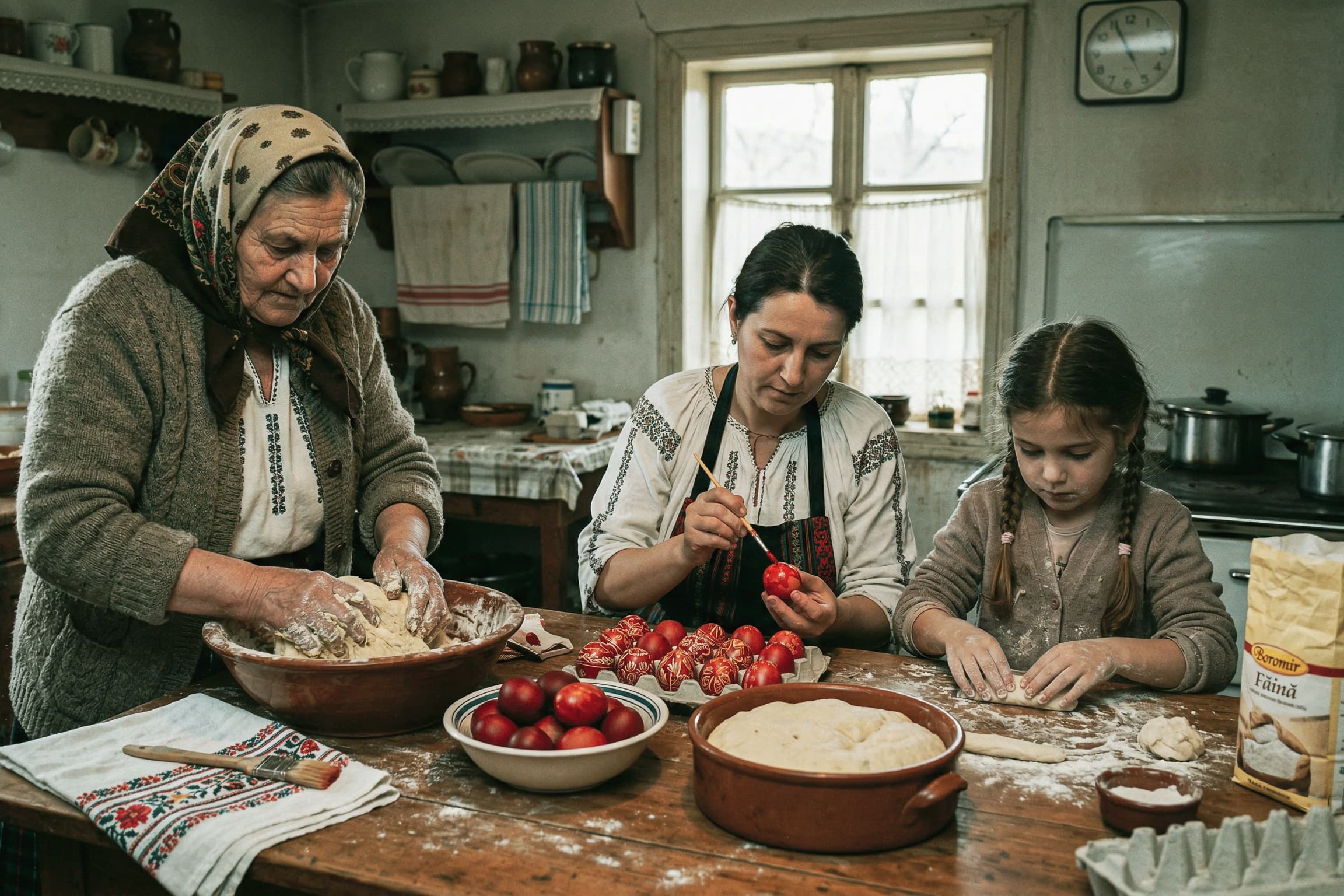
What sets Romanian Easter apart from its commercial, Westernized form is that it still preserves the idea of a journey. Traditionally, the celebration does not begin on Easter Sunday but is built up through Lent (Postul Mare), through Holy Week, through Maundy Thursday (Joia Mare), Good Friday (Vinerea Mare), Holy Saturday (Sâmbăta Mare), and only then through the night of the Resurrection. Even culinary and household customs are folded into this chronology: in many places, Easter eggs were chosen well in advance, and dyeing them was traditionally done on Maundy Thursday, not Good Friday.
This staged structure says something essential about how Romanians have understood the holiday: not as a quick consumption of symbols, but as a preparation. In village life, preparation meant cleaning, order, food, remembrance, and religious participation. In today's urban world, many of these layers have been simplified, but the reflex remains. For many people, Easter continues to be a holiday for which one "prepares," not just one to be marked.
Red eggs: the most resilient symbol
If there is one object that captures Romanian Easter, it is the red egg. In folk and religious tradition, it is not just a festive ornament but a symbol of life, renewal, and the Resurrection. The egg-tapping ritual, as recorded by ethnographic and religious sources, follows precise rules: on the first day, "top to top"; on the second, "bottom to bottom"; and the exchange of "Christ has risen" / "Truly He has risen" turns the gesture into a small ritual of communal affirmation.
The fact that this custom has survived almost intact says a great deal about Easter in Romania. In an era when many traditions have faded or been reduced to mere decorative pretexts, the red egg has remained a living symbol, understood alike by child, grandparent, and city dweller. It is perhaps the most democratic form of cultural continuity.
The Easter table is not just about food
In the public imagination, Romanian Easter is inevitably tied to sweet bread (cozonac), Easter bread (pască), lamb, red eggs, and lamb haggis (drob). But the Easter table also has a dimension that goes beyond gastronomy. It marks the end of the fast, the return to abundance, and, in many communities, the reuniting of the family. In folk tradition there are also gestures linked to remembering the dead, sharing certain dishes, and the idea that the holiday is not only for the living but also for the memory of those who have passed. The Dictionary of Romanian Traditional Symbols and Beliefs records, for example, commemorative practices in Banat and Muntenia, including the sharing of red eggs and round breads (colaci).
This double nature — festive and commemorative — explains why the Easter table in Romania carries a different weight than a good weekend meal. In many families, it is a blend of joy, ritual, and emotional reconnection.
Regions still hold on to their differences
Romanian Easter is not perfectly uniform. Some of its most interesting traditions appear precisely in regional differences. In the Székely region, for instance, the sprinkling of girls on Easter Monday continues to be documented by ethnographic sources as an important local custom, especially around Covasna. In other regions, the emphasis falls more on remembrance, on rituals involving water, on cleansing, or on local forms of Easter hospitality.
This diversity matters. It shows that Easter has never been merely a standard package of customs, but a holiday lived inside different communities, each with its own sensibility.
Why Easter holds up better than other holidays
Perhaps the most interesting question is not which Easter customs still exist, but why they endure. The answer probably lies in the fact that Easter brings together several mutually reinforcing layers: faith, family, food, symbol, season, homecoming. Christmas can be easily commercialized. Easter is harder to reduce to consumption, because it still has a strong ritual backbone.
In Romania, that backbone is still visible. From attending the Resurrection service and receiving the Easter bread (Paștile), to red eggs, the shared meal, and the remembrance of the dead, the holiday retains a density of meaning that few other moments in the calendar still possess. That is precisely why ethnographic museums and archives treat it not merely as a religious event but as a synthesis of beliefs, practices, and communal identity.
In the end, Romanian Easter is a form of continuity
In a society that changes quickly and forgets quickly, Easter remains one of the few celebrations in which Romania still resembles itself. Not because everything has stayed the same. It hasn't. But because, beyond new forms, urbanization, and the contemporary pace, a few essential gestures have survived: the light taken from the church, the red egg, the shared meal, the idea of preparation, the idea of renewal.
And perhaps this is where its strength lies: Easter is not just a tradition. It is one of the last occasions on which Romanian culture still sees itself not as spectacle, but as order.