
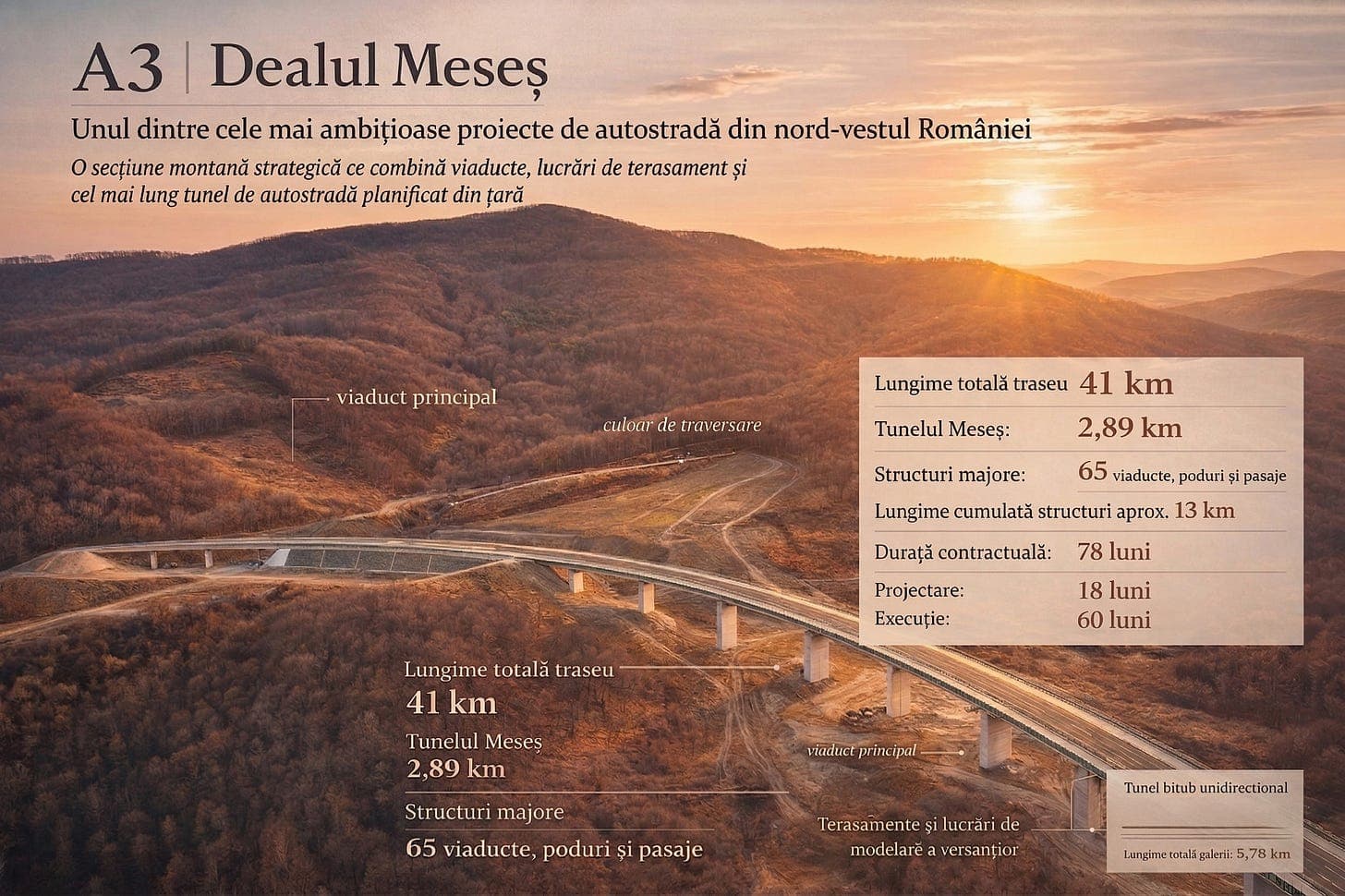
On paper, the Transylvania Motorway seems to have finally entered the phase where the promise begins to resemble a real route. On the ground, the picture is more nuanced: in 2026, A3 may become far more useful between Târgu Mureș and the west of the country, but it will not yet be a continuous motorway all the way to the Hungarian border. The piece holding the entire corridor back remains Meseș Hill, the 41-km section between Poarta Sălajului and Nușfalău, with a 2.89-km tunnel that has pushed the realistic deadline toward 2031.
The raw image of the route explains why officials and contractors now speak more about "usability" than "completion." Today, roughly 113 km are already open between Târgu Mureș and Nădășelu, plus 13.55 km between Nușfalău and Suplacu de Barcău and 5.35 km between Biharia and Borș. To these, CNAIR head Cristian Pistol adds a target of another 68 km on A3 in 2026. His phrasing — "we will have 200 km of motorway between Târgu Mureș and the Hungarian border" — is correct only in cumulative terms, not necessarily continuous: the 68 new kilometers correspond essentially to the Nădășelu–Zimbor, Zimbor–Poarta Sălajului and Suplacu de Barcău–Chiribiș sections, which brings the total opened to around 201 km, but still leaves major breaks along the route.
What can open in 2026
On the eastern segment, between Nădășelu and Poarta Sălajului, things have advanced visibly. On 27 March 2026, Cristian Pistol announced that the Nădășelu–Zimbor section (30.6 km) had reached 94%, with 500 workers and 131 pieces of equipment mobilized, while Zimbor–Poarta Sălajului (12.24 km) had passed 98%. The problem is that this section cannot function on its own: it depends on the two critical viaducts at Topa Mică and Nădășelu, which are part of a separate contract, and on the Românași Interchange, which must channel traffic onto DN1F and DJ108A until the Meseș section is finished.
That makes 2026 a very important year, but not necessarily a decisive one. If the viaducts and the interchange are finished on time, drivers will be able to travel by motorway from Târgu Mureș to Poarta Sălajului/Românași, roughly 155 km. But here begins the less spectacular part of the story: just as A3 finally becomes a credible alternative for getting out of Transylvania, it dumps drivers off right before the most difficult terrain obstacle.
Meseș Hill: the section that explains the delays
The Poarta Sălajului–Zalău–Nușfalău section is not only the most difficult, but also the most expensive road infrastructure contract ever signed by CNAIR: 6.62 billion lei excluding VAT, for 41 km, 65 bridges, overpasses and viaducts totaling about 13 km, and the longest motorway tunnel in Romania. The contract with the Makyol–Özaltın consortium was signed in April 2025, with a duration of 18 months for design plus 60 months for execution, meaning completion no earlier than 2031. In other words, A3 is no longer held up by a lack of contracts, but by the nature of the work itself.
If we look at the long history of the project, the first major contract that also covered the Transylvania Motorway route through this area was signed with Bechtel in 2003 and terminated in 2013. After that failure, for the Meseș section in its current configuration — Poarta Sălajului–Zalău–Nușfalău — CNAIR subsequently ran two separate tenders: the first, launched in November 2020, was canceled in January 2023; the second was relaunched in February 2023, and after evaluation and challenges led to the contract being signed only in April 2025 with the Makyol–Özaltın consortium. In other words, including the parent Bechtel contract, the Meseș route has gone through two major contract awards (2003 and 2025), one termination (2013), two modern tender procedures and one canceled tender before actually entering its current execution phase — which explains why this segment has ended up pushing the full completion of A3 toward 2031.
The western motorway: closer to the finish line than it seems
West of Meseș, the situation is better than a year ago. Suplacu de Barcău–Chiribiș (26.35 km), built by Erbașu, has an updated deadline of around July 2026, after delays caused by the late approval of the technical design and by the order to actually start work being issued only in January 2025. In parallel, Chiribiș–Biharia (28.55 km) has a contractual deadline of May 2027, and Economedia, citing the Pro Infrastructure Association, mentions an ultra-optimistic scenario in which the section could be inaugurated as early as December 2026, about five months ahead of schedule.
From this comes the most important practical conclusion: the rest of A3, without Meseș, has serious chances of being ready in 2027 and limited chances of being fully ready as early as 2026. If Erbașu delivers in 2026 and Chiribiș–Biharia stays on the contractual deadline, then the entire western stretch, from Nușfalău to Borș, becomes realistic for 2027. But if the Chiribiș–Biharia section accelerates unexpectedly and falls into the ultra-optimistic December 2026 scenario, then by the end of next year Romania would have a functional motorway from the Hungarian border to Nușfalău, and from the east as far as Poarta Sălajului — with only the "crown jewel" missing: Meseș.
How A3 will be used until then
This is where the discussion becomes concrete for drivers. If the sections currently above 90% completion open in 2026 and the Românași Interchange is finished, the logical route from Târgu Mureș / Cluj toward the west will be this: drive on A3 to Poarta Sălajului, then exit via the Românași Interchange onto DN1F and DJ108A. Bypassing Meseș Hill, until rejoining the motorway, will not be a simple local detour, but a road trip of roughly 54 km between the Românași exit and the Nușfalău interchange. In other words, until the Meseș section opens, drivers coming from Cluj or Târgu Mureș will exit at Românași/Poarta Sălajului, cross the Zalău area on the old route, and rejoin A3 at the Nușfalău interchange.
CNAIR itself states explicitly that the interchange will handle the exit traffic for the entire Târgu Mureș–Poarta Sălajului stretch (155 km) until the Poarta Sălajului–Zalău section, including the Meseș tunnel, is completed.
From there, to continue toward Hungary before the Meseș section is ready, the most logical route remains the old corridor through Zalău: DN1F / E81 toward Zalău and across the Meseș area, then DN1H toward Nușfalău, where traffic can rejoin A3. There is also a useful local relief valve: the Zalău Bypass, opened in December 2025, runs 5.35 km and connects DN1F to DJ191C; in addition, DJ191C has been rehabilitated on the Nușfalău–Crasna–Zalău–Creaca stretch.
On the western side, the key point remains the Nușfalău Interchange, where A3 meets DN1H. Once there, drivers can rejoin the motorway toward Suplacu de Barcău and, depending on the status of the sections in Bihor, continue on to Chiribiș, Biharia and Borș. If Chiribiș–Biharia is not ready in 2026, there will still be a break in Bihor. If it is ready — or if it falls into the ultra-optimistic year-end scenario — then drivers will be able to travel uninterrupted by motorway from Nușfalău to the Hungarian border.
What this actually means
In terms of mobility, A3 is approaching an important threshold: that of strategic usefulness. In 2026, if all the sections currently in very advanced stages are delivered, drivers will have at their disposal two large motorway sequences: one of about 155 km from Târgu Mureș to Poarta Sălajului, and another that could reach, at best, nearly 74 km from Nușfalău to Borș. Between them, however, will remain precisely the stretch that makes the difference between "a useful motorway" and "a complete motorway": Meseș Hill.
This means the real leap for A3 will not be measured in the kilometers inaugurated in 2026, but in how well the fragmented motorway will function until 2031. Romania is close to a much faster western road corridor. But not yet to the continuous corridor we have been promised for more than two decades!