In many European capitals, people are shopping more cautiously: consumer confidence is fragile, and every wave of "crisis" headlines can dampen the appetite to spend. In Romania, however, retail is sending a different signal: the market is not just holding up — it is entering a phase of accelerated maturity. We are no longer talking only about square meters, but about a shift in logic: from "come in, buy, leave" to an ecosystem where you spend your time.
This was the idea that tied together the discussions in the Business Mark panel: Real Estate & Construction Forum – Focus on Retail Panel: retail is no longer just about selling, but about time well spent — and that changes everything, from architecture to tenant mix and brand strategy.
1) The market is growing: the 5-million-sqm milestone and a busy 2026
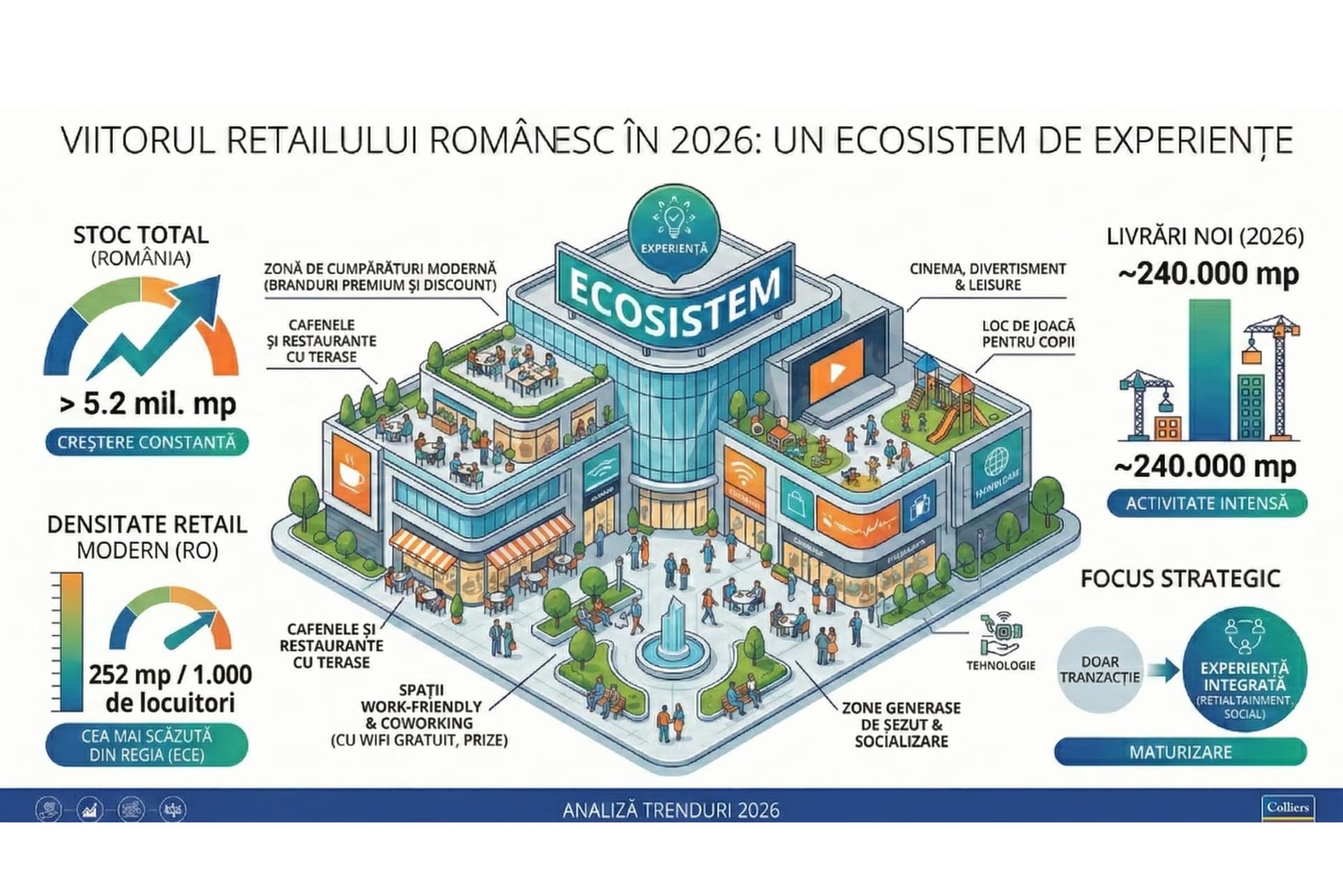
In 2025, Romania crossed the psychological threshold of 5 million square meters of modern retail space, consolidating its status as a "regional hub." And 2026 brings an estimate of roughly ~240,000 sqm in new deliveries — a volume that shows developers still bet on consumer appetite.
Where this growth is happening also matters: while a decade ago almost everything was concentrated in Bucharest, the map is now visibly diversifying.
Colliers' analysis points out that 2025 deliveries exceeded the five-year average — a sign that the market remains active, even if inflation has cooled and left its mark on buying behavior.
2) 2026 brings an interesting "polarization": discount + experience
At first glance, the market seems pulled in two different directions, but in reality they coexist perfectly:
A) Volume retail (value-for-money)
The discount model is on the rise: retailer Action plans to open at least 8 new units. In a European context where "crisis messaging" has become a permanent backdrop, the Romanian consumer has turned into a savvy bargain hunter: comparing, choosing more carefully, but not necessarily giving up the visits.
B) Destination retail (lifestyle)
At the same time, the shopping centers that perform are no longer "concrete boxes" full of stores. It is becoming increasingly clear that the good mall is a community hub: socializing, cafés, food, entertainment — in other words, real reasons to come even when you don't "strictly need" anything.
3) The mall as ecosystem: from "spontaneous traffic" to "quality time invested"
The big shift of 2026 is the move from the idea of "traffic" to the idea of time. The developers gaining ground are those who treat the shopping center as a living ecosystem, where the mix of spaces looks roughly like this:
What was said in the panel: the real problems and the way forward
Omer Susli (Praktiker Real Estate Romania): bureaucracy and the effect of "alarmist news"
In the panel, Omer Susli emphasized the administrative brake: permits can take months, and during that time projects produce nothing, while the state collects no taxes from the activity that should exist. He also mentioned that imports from Turkey have reportedly dropped by 22% since the beginning of the year (a statement made in the panel; I cannot confirm it here from an official source).
But perhaps the most powerful idea was a different one: alarmist news scares people and makes them spend less. And his answer, from an investment perspective, was contrarian: when many say "there's a crisis," he sees "a good moment to invest."
Roxana Stănciulescu (AFI România): online is not a threat, it's a complement
Roxana Stănciulescu argued that online is not "killing" physical retail. On the contrary, it forces it to be better and complements it. The mall remains a place for shopping + socializing, cafés and food & leisure.
She gave concrete examples of continuous adaptation:
Cornelia Nicolae (Fashion House Outlet Centre): entertainment can change the rules
Cornelia Nicolae brought up the idea of an amusement park integrated into retail, which she sees as an element that can "revolutionize" shopping. She also mentioned the dynamics of new brands such as GAP and Jack & Jones, as part of a strategy of attraction and renewal.
Venera Munjev (Catinvest Eastern Europe): socializing becomes infrastructure, especially in large projects
Venera Munjev stressed that in projects over 100,000 sqm, social spaces are essential. Not just cafés, but also lobby-type areas, where you can sit with your laptop and socialize without having to rely on the idea of "consumption."
She also highlighted the role of online for brands: it helps them reach small towns where they can't immediately open stores. It's not online vs. offline — it's complementarity, with a single keyword running through everything: continuous adaptation.
Conclusion: the one who adapts faster wins
Europe remains cautious, and consumers keep a close eye on their wallets. Romania, by contrast, shows the kind of resilience typical of consolidating markets: investments continue, spaces grow, and retail is being reshaped from the ground up.
In 2026, the question is no longer "how much you sell per square meter," but how long you can keep people in the ecosystem — with places to sit, reasons to socialize, good food, entertainment, and experiences worth their time.
 1 / 8
1 / 8