
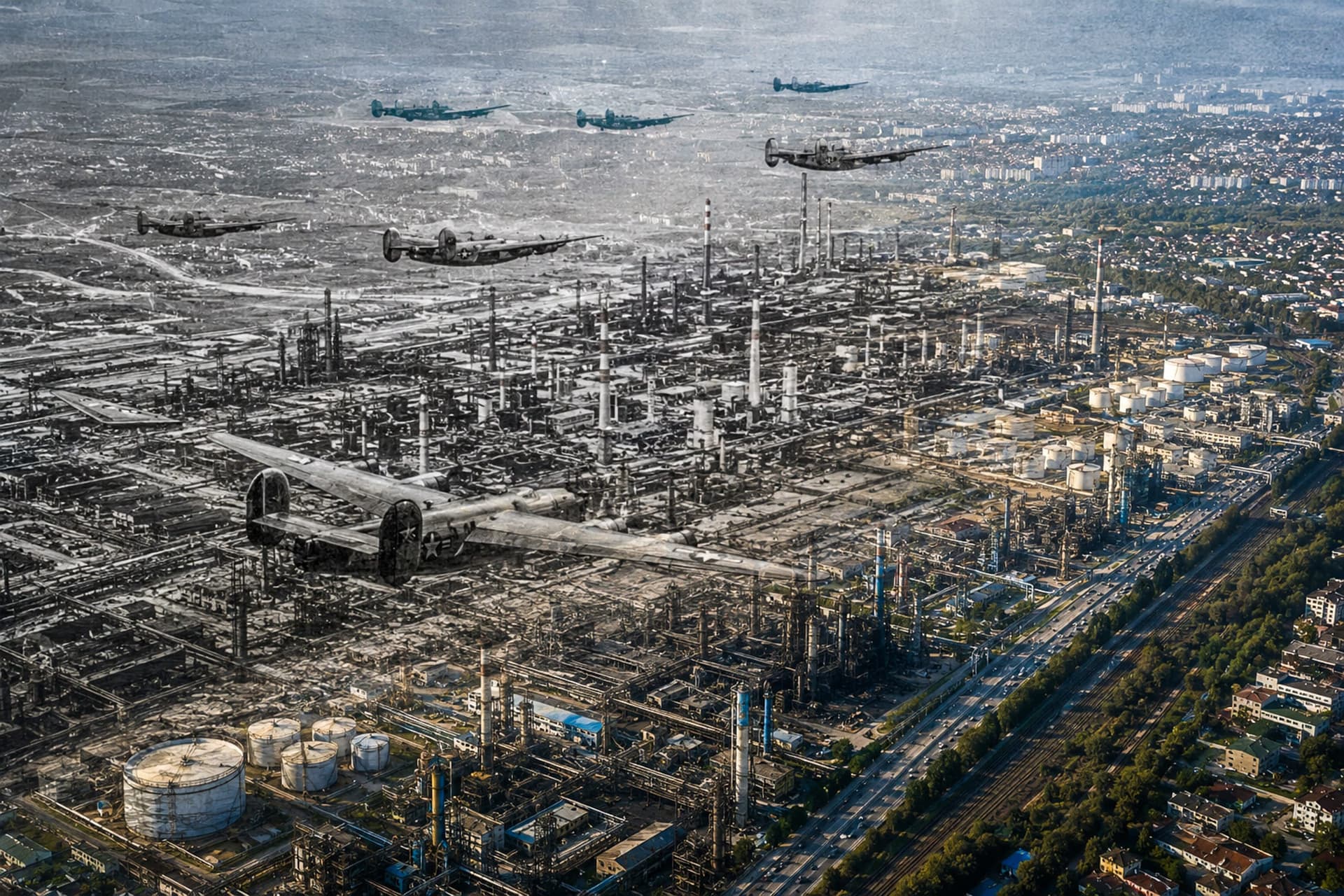
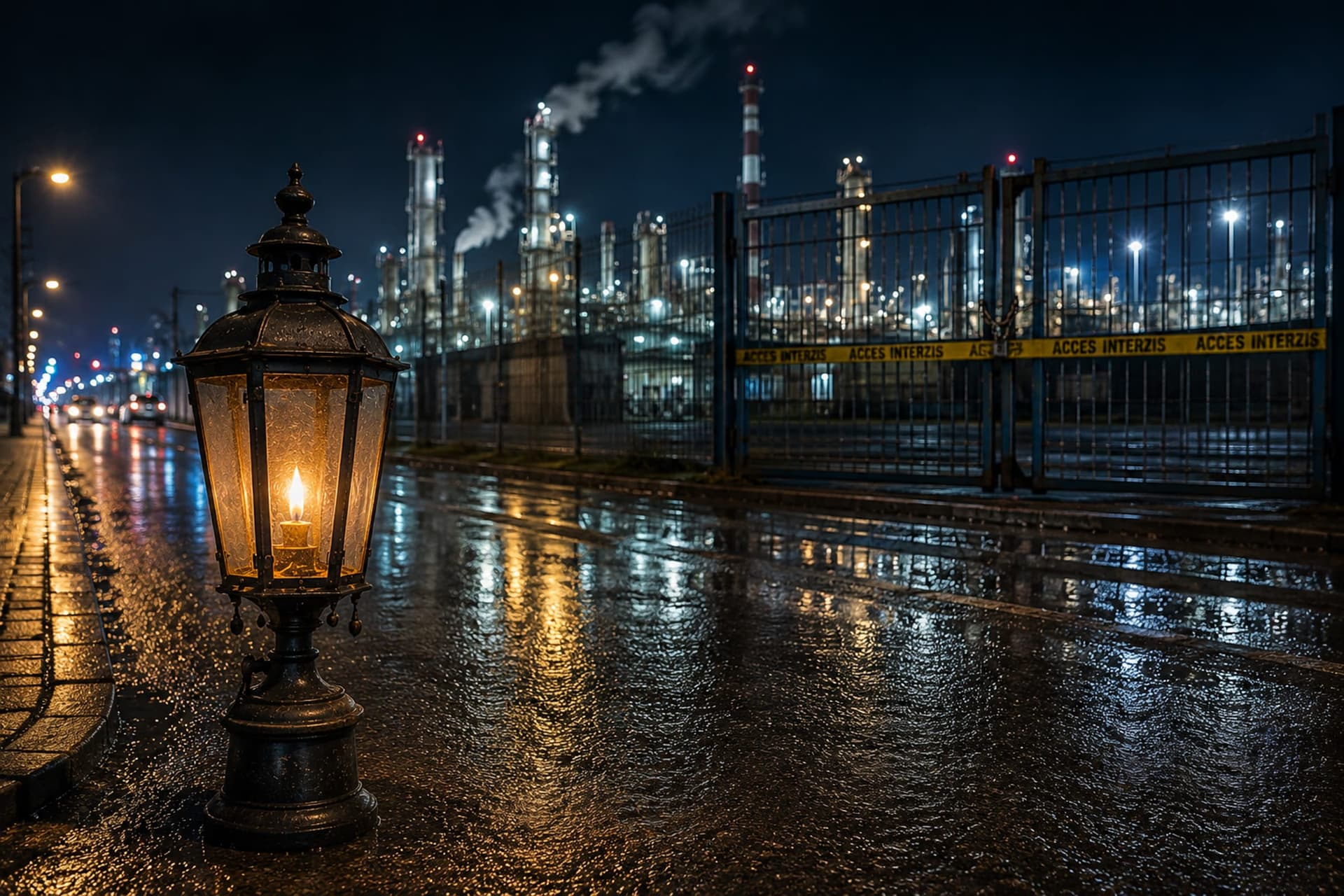
In May 2026, the main gate of the Petrotel-Lukoil refinery at 235 Strada Mihai Bravu in Ploiești is closed. It has been shut since November 21, 2025, the day American sanctions against Lukoil came into force. A few kilometers away, toward the Ploiești-Sud railway station, stands the spot where, in the spring of 1857, the Mehedințeanu brothers started up a rudimentary distillation plant that would change the way the world was lit. Between these two places lie 169 years and three moments in which Ploiești stood at the center of the global energy order — 1857, 1943, 2026. Each time, someone paid the price.
275 tonnes and a gas factory
In 1857, international statistics recorded for the first time a country's national oil output: 275 tonnes, of which 220 came from Prahova County and the rest from Dâmbovița. The country was Wallachia. The United States would appear in those statistics two years later, Italy after three, Canada after five, Russia after six. "The Science of Petroleum," the authoritative reference work published at Oxford in 1938, established this chronology as a world first — and it has remained unchallenged ever since.
In that same spring of 1857, brothers Teodor and Marin Mehedințeanu started up a crude-oil distillation plant on the outskirts of Ploiești — a "gas factory," as it was then called. Four hectares, equipment ordered from the Hamburg firm Moltrecht, capacity of 2,710 tonnes per year. The lamp oil (lampant) it produced was colorless, odorless, burned with a steady flame, leaving no smoke and no residue. With it, the Mehedințeanu brothers won the tender for Bucharest's street lighting, beating out rivals who proposed tallow and rapeseed oil. In April 1857, the capital became the first city in the world to have public street lighting powered by kerosene — approximately 1,000 lamps. Iași followed in 1858. Vienna, the first major European city to do so, not until 1859.
Here, however, the nuances begin. The Mehedințeanu achievement was long repeated as "the world's first refinery," but the claim is disputed. Poland asserts the priority of Ignacy Łukasiewicz's installation at Ulaszowice, near Jasło, opened in 1856 — a year before Râfov. Polish Wikipedia and official institutions call it "the world's first industrial oil refinery." British historian Maurice Pearton, in "Oil and the Romanian State" (Oxford, Clarendon Press, 1971), attributes the distinction to a distillery at Lucăcești, Bacău County, attested as early as 1840. And Romanian historian Dorin Stănescu, writing in "Historia" in April 2020, noted that the Mehedințeanu installation is technically an advanced distillery rather than a classic refinery, and called the idea of "the world's first refinery at Ploiești" a fashionable error.
What remains uncontested: Wallachia enters the world history of oil in 1857, first. And from that spring onward, Ploiești becomes the capital of an industry that did not yet know how much it would come to matter.
The Oil Capital of the World
Output grows slowly, then explosively: 15,900 tonnes in 1880; 80,000 in 1895; 250,000 in 1900; 614,790 in 1905; 1,352,407 in 1910; 1,885,619 tonnes in 1913. At the outbreak of the First World War, Romania ranked fourth in the world in crude oil production, behind the United States, Russia, and Mexico — though its actual share of global output was under 4 percent.
The engine of this growth was the Mining Law of 1895, which opened the door to foreign capital. In 1897, Steaua Română — founded with Deutsche Bank capital — built at Câmpina, in an area where it held 305 hectares of oil fields, the largest and most modern refinery in Europe at that time, with a capacity of 1,200 tonnes per day. In 1904, Rockefeller's Standard Oil established Societatea Româno-Americană. In 1905, the Rothschild group opened Aquila Franco-Română, and Vega Ploiești began operations. In 1910, Astra Română was founded, eventually becoming the Romanian subsidiary of the Royal Dutch-Shell colossus.
The distribution of capital in 1914 reveals everything about who controlled the industry: 47.9% Anglo-Dutch, 27.4% German, 8.6% Franco-Belgian, 8.1% Romanian, 6.2% American, 1.8% Italian. Domestic capital held less than 10% of its own oil industry. And yet — or perhaps precisely because of that — Romania ranked among the world's top producers.
Foreign capital brought technology. In the first decade of the twentieth century, Câmpina became home to the world's first training school for drilling and refining foremen; its graduates would be sought after abroad. Engineer Lazăr Edeleanu invented the process of selective solvent extraction of hydrocarbons using sulfur dioxide — an industrial method adopted worldwide that earned him the title of "founder of Romanian and universal petrochemistry." In 1934, a well at Chițorani reached a depth of 3,330 meters — the second deepest drilling in the world at that time. That same year, Romanian company Creditul Minier began construction of the Brazi refinery, the most modern in Europe at the time.
The interwar peak came in 1936: 8.7 million tonnes of crude extracted, first in Europe, sixth in the world. Ninety-five percent of the crude was processed domestically, in more than 30 large refineries. Petroleum product exports regularly exceeded 50% of total output. Romanian industry grew at an annual rate of 5.4% during the interwar period — among the highest in the world.
It was the apex. What followed would be decided, even as the First World War unfolded, by others.
The Battle for Romanian Oil
In November 1916, as the Central Powers advanced on Ploiești, British intelligence services organized — with the agreement of Romanian authorities — a massive sabotage operation. Wells and refineries were blown up to prevent them from falling into German hands. The strategy worked in part: the Germans reopened Steaua Română in 1917 under occupation, but postwar production reached only half of prewar levels.
Then came peace — and with it, a question. Who did Romania's oil belong to? In 1920, the I.I.C. Brătianu government placed 23 former enemy petroleum companies — those with German and Austro-Hungarian capital — under sequestration. Britain and France, as allies, invoked the San Remo Convention and demanded their share. After rounds of negotiations under the Averescu government, the companies were divided: a majority stake went to Romanian capital, the remainder split equally between the French and the British. Anglo-Persian Oil took over a large portion of Steaua Română. Royal Dutch-Shell consolidated its hold over Astra Română.
It was in this context that the "By Ourselves" (Prin noi înșine) doctrine emerged, formulated by Vintilă Brătianu — Ionel's younger brother, a multiple-term finance minister and prime minister from 1927 to 1928. The idea, first put forward in an article in Voința Națională in 1905, became state policy after 1922: Romania's development must be driven primarily by Romanian capital. On July 4, 1924, Parliament passed the Mining Law, one of the most ambitious pieces of economic legislation of the interwar era. Companies exploiting subsurface resources were required to have at least 60% Romanian capital, 75% Romanian staff, and two-thirds Romanian representation on their boards of directors, including the chairmanship.
The reaction from the major powers was immediate. The United States, Great Britain, and France threatened to break off diplomatic relations with Romania if the law were applied as written. International oil companies flatly rejected its provisions. Under pressure from these threats, in December 1925, the Liberal government backed down, reducing the Romanian capital requirement to 50.1%. "By Ourselves" had become, within months, "By us and them."
The true economic cost was debated long afterward. Critical historians note that although global prices were high in the early 1920s and Romania needed capital to rapidly expand production, the fixation on the primacy of Romanian capitalists slowed the recovery and growth of output. Defenders of the doctrine, however, argue that it created the conditions for building, in the following decade, the great Romanian industrial projects — Petrobrazi, Creditul Minier, the Reșița Works. The final judgment depends on what one considers the priority: speed of recovery or structural autonomy.
What truly matters, however, is something else. In 1924, Romania made its first attempt to wrest its oil industry from the grip of foreign capital. It succeeded only halfway. And it learned a lesson it would be forced to relearn many times over: the higher the geopolitical stakes, the narrower the room to maneuver.
Bloody Sunday
In the summer of 1943, Ploiești was producing roughly one-third of the oil used by Nazi Germany. Nine refineries — Astra Română, Concordia Vega, Româno-Americană, Steaua Română, Unirea Orion, Columbia Aquila, Creditul Minier (Brazi), Standard Petrol Block, and Unirea Speranța — formed the densest oil-processing hub in Axis-controlled Europe. For the Americans, it was a major strategic target. For the Germans, it was one of the most heavily defended industrial sites on the continent.
General Alfred Gerstenberg, the Luftwaffe commander in Romania, had built a layered air-defense system around Ploiești that included 36 heavy 88 mm batteries, 16 light and medium batteries, 15 Würzburg radar stations, smoke generators, and barrage balloons trailing steel cables capable of shearing off a bomber's wings. On the ground, near the refineries, approximately 57 German, Romanian, and Bulgarian fighter aircraft stood ready — Bf 109s, Bf 110s, and IAR 80s.
On the morning of August 1, 1943, 178 B-24 Liberator bombers took off from airfields near Benghazi, Libya. The mission was called Operation Tidal Wave. A crew of 1,726 men departed under the command of General Uzal G. Ent. The strategy was radical: instead of high-altitude bombing, the planes would attack at just 60–200 meters above the ground — to evade German radar and improve accuracy. The aircraft crossed the Mediterranean, skirted Corfu, flew over the Pindus Mountains, and entered Romania from the southwest.
From the mountains on, the plan began to unravel. Cloud cover broke up the formations. The lead aircraft took a wrong turn toward București before the pilot realized his mistake. German defenses, now on alert, opened fire at close range. The bombers that managed to reach their targets did so through a hell of flames, smoke, and converging fire. One Liberator — — crashed into the women's prison in Ploiești. Three floors erupted in flames. All ten American crew members were killed, along with most of the women held inside.
By day's end, according to the National Museum of the United States Air Force: 54 bombers permanently lost, 310 American airmen killed, 186 captured. The Romanian death toll — civilians and military personnel manning the anti-aircraft batteries — exceeded 100, more than half of them at the women's prison. The proportional American losses — 30.3% of the aircraft that had departed Libya — made Tidal Wave one of the costliest Allied air missions of the war. In recognition of their crews' courage, the Americans awarded five Medals of Honor — more than had ever been given for a single day's mission. "Bloody Sunday," some Americans called it. "Black Sunday," in other accounts.
The real strategic effect was far more modest. Production at the struck refineries was restored within weeks. General Gerstenberg, in his report to Berlin, wrote that the damage would not significantly reduce Germany's fuel supply. The United States did not attempt another major raid on Ploiești for eight months — not until April 1944, when they returned with systematic high-altitude bombing campaigns. Romanian oil continued to flow into Wehrmacht engines until the Red Army reached the Prahova oil fields in August 1944.
Memory Without a Museum
Ploiești has a single museum dedicated to oil. It opened on October 8, 1961, to mark the centenary of the industry. Housed in a historic building — the Buzianu Manor — it holds around 8,000 exhibits: scale models, geological maps, oil lamps from the Bucharest of Mehedințeanu's era, panels on the Edeleanu process, photographs, and patents. In 2017, ownership passed from OMV Petrom to Prahova County Council, which now administers it as a branch of the County Museum of Natural Sciences.
For a country that has appeared in global oil statistics since 1857, that is the institutional memory that has been built. By comparison, in Poland, the Oil Museum in Bóbrka — the site where Łukasiewicz opened the world's first industrial well in 1854 — is a major technology tourism destination, integrated into a complex that includes the old refinery, monuments, schools, and festivals.
In Prahova, the material memory of Operation Tidal Wave is scattered across the villages surrounding Ploiești. At Corlățești, a modest monument commemorates the Romanian crew of an 88 mm anti-aircraft battery over which the B-24 "Old Baldy" crashed — a singular case in which an American bomber fell directly onto the position that had shot it down. At Tătărani, in the open fields, lies the spot where "Brewery Wagon" made a forced landing — the first B-24 to be downed over Romania. At Ploiești's Bolovan cemetery, the Heroes section still shelters graves inscribed "unknown" — American airmen buried there in 1943 who could not be identified.
Identifications continue. The Defense POW/MIA Accounting Agency, the U.S. body responsible for recovering missing service members, launched the "Ploiesti Project" in 2017 — a program dedicated to unidentified airmen from Tidal Wave and the 1944 raids. Between August 2023 and August 2024 alone, the agency confirmed the identities of 14 airmen. Eighty-one years after the bombing.
The Industry Today
In 2026, four active refineries operate in Romania, with a combined capacity of approximately 12.5 million tonnes per year. Three of them are in or around Ploiești.
Petromidia, at Năvodari, is the largest — with a capacity of 5.9 million tonnes per year, representing 46.3% of national capacity. It belongs to KMG International, controlled by KazMunayGas, Kazakhstan's state oil company.
Petrobrazi, near Ploiești, is the second largest — 4.5 million tonnes per year, covering roughly 35% of domestic fuel demand. It was founded in 1934 by the Romanian company Creditul Minier. Today it belongs to OMV Petrom, whose majority shareholder is the Austrian group OMV.
Vega, in Ploiești, is the smallest — 350,000 tonnes per year. It was commissioned in 1905 under Deutsche Bank capital and is arguably the oldest still-active refinery in Romania. It is the country's sole producer of normal hexane, eco-friendly solvents, and refined white spirit. It belongs to Rompetrol Rafinare, and thus also to KMG International.
Petrotel, on the outskirts of Ploiești, is the third largest — 2.4–2.5 million tonnes per year, approximately 21% of national fuel output. Until 1948 it belonged to the Româno-Americană company, founded by Standard Oil. After nationalization it was renamed Teleajen. In 1998 it was privatized and acquired by Russian giant Lukoil.
Not one of the four refineries remains in Romanian hands. The capital is Austrian, Kazakhstani, and — in the case of Petrotel — Russian.
The Circle Closes
On October 22, 2025, the U.S. Treasury added Lukoil to its list of sanctioned entities, alongside Rosneft. The sanctions took effect on November 21, 2025. That same day, Petrotel — the only Romanian refinery owned by Lukoil — shut down its units, having already entered a major overhaul on October 17, scheduled to run through November 30.
Bulgaria, home to Lukoil's largest refinery in southeastern Europe — Neftochim Burgas — responded swiftly. On November 7, 2025, the Sofia parliament passed emergency legislation allowing the state to take control of Lukoil's assets on its territory through special administrators. Romania chose a different path: rather than seizing control, it sought a diplomatic waiver.
On April 14, 2026, Energy Minister Bogdan Ivan, on an official visit to Washington, announced that Romania had received confirmation of the waiver. "The fact that we have received official confirmation from the American government for the sanctions waiver on Lukoil, allowing Romania to restart the Petrotel-Lukoil refinery, is enormous news for our country," the minister said. Restart was estimated to be possible within 45 days — sometime in the summer of 2026.
There were two nuances that didn't make the headlines. First: at the time of the announcement, the U.S. Treasury's Office of Foreign Assets Control (OFAC) had not published a named license for Petrotel; there were diplomatic confirmations and the Romanian minister's official statement, but the public document was missing. Second: in the weeks that followed, Minister Bogdan Ivan was no longer a minister. When he confirmed again that the letter had arrived, he was the "former Energy Minister."
In May 2026, as this article is written, the main gate of Petrotel-Lukoil in Ploiești is still closed.
What It Means, in the End, to Be Ploiești
Three sites exist today that connect all three moments. Bariera Râfov, on the outskirts of Ploiești near the Ploiești-Sud railway station, where Mehedințeanu brought his gas factory online in 1857 — now an ordinary neighborhood, with no markers. Cimitirul Bolovan, in the Heroes section, where graves of American airmen from Operation Tidal Wave lie, some still inscribed "unknown" — close to the city center, open to the public. And the main gate of Petrotel-Lukoil on Strada Mihai Bravu — closed since November 2025, visible to anyone passing by.
Between those three places lie 169 years.
The timeline reads in a few sentences. In 1857, Wallachia enters the world's petroleum statistics and Bucharest becomes the first city with public street lighting powered by kerosene. Between 1880 and 1939, foreign capital turns the industry into a European leader — first in Europe, sixth in the world; Romania extracts 8.7 million tonnes in 1936. In 1924, the Romanian state makes its first attempt to wrest the industry from foreign capital; it abandons the claim in 1925, following diplomatic pressure from Washington, London, and Paris. In 1943, Ploiești becomes the target of an American mission that costs the U.S. proportional losses unmatched anywhere in the European campaign. In 1948, the Romanian state nationalizes everything; in 1976, under communism, output reaches an all-time peak of 15 million tonnes — not a feat, but an act of exhaustion, followed by a steady collapse in production. Today, the refineries are again in foreign hands — Austrian, Kazakh, Russian — while Romania's own fields yield roughly a third of what they did in 1936. In April 2026, a Romanian minister flies to Washington to secure a waiver allowing a refinery in Ploiești to restart.
The question this story leaves open is not who owns the oil, but whether ownership ever mattered. Romania was a world leader when it was saturated with foreign capital, and faded from global rankings precisely when it became fully autonomous. Communism bled the deposits dry to feed a vast refining capacity; post-communist capitalism privatized whatever remained. In 2026, not one of the refineries in Ploiești still bears a name that sounds Romanian.
And the gas plant at the Râfov barrier, where it all began in the spring of 1857, no longer exists. In its place stand apartment blocks and a filling station. No monument, no plaque. Only a street called "Buna Vestire," on the edge of a city that once lit up the world.
Relevant sources
Books and academic studies
The Science of Petroleum: A Comprehensive Treatise of the Principles and Practice of the Production, Refining, Transport and Distribution of Mineral Oil, ed. A. E. Dunstan, A. W. Nash, B. T. Brooks, H. Tizard, Oxford University Press, London, 1938 — a key reference for the early chronology of world oil production, including the figure of 275 tonnes for Romania in 1857.
Maurice Pearton, Oil and the Romanian State, 1895–1948, Oxford: Clarendon Press, 1971 — a foundational academic work on the Romanian oil industry, foreign capital, the Romanian state, and petroleum policy.
Philippe Marguerat, Le IIIe Reich et le pétrole roumain, 1938–1940, Leiden: A. W. Sijthoff / Geneva: Institut universitaire de hautes études internationales, 1977 — for the context of the relationship between Nazi Germany and Romanian oil in the period leading up to Operation Tidal Wave.
Jay A. Stout, Fortress Ploesti: The Campaign to Destroy Hitler's Oil Supply,Casemate, 2003— for the American air campaigns against Ploiești.
Gheorghe Buzatu, <em>O istorie a petrolului românesc</em>,Editura Enciclopedică, București, 1998— for the evolution of the Romanian oil industry, state policies, and domestic historical context.
Articles and Historical Analyses
Dorin Stănescu, "'The Gas Factory' of the Mehedințeanu Brothers. The History of Romania's First Refinery", <em>Historia</em> — for the Mehedințeanu installation, the term 'gas factory,' and the dispute over the 'first refinery.'
Dorin Stănescu, "Who Founded the World's First Oil Refinery? A Romanian-Polish-American Battle", <em>Historia</em> — for a nuanced look at the Romania–Poland–United States dispute over historical priority.
Petre Opriș, "Petrolul, agricultura şi datoria externă a României (1979–1981)" [Petroleum, Agriculture and Romania's Foreign Debt (1979–1981)], Contributors.ro, May 24, 2021" — for the context of Romanian oil during the communist era and its connection to the foreign debt."
Petre Opriș, "Discussions on Oil Prices in Communist States and Fuel Rationing Methods in Hungary and Romania (1962–1979)", Contributors.ro, September 12, 2021 — for energy policy, the fuel crisis, and rationing during the communist era.
Official, Institutional, and Memoir Sources
National Museum of the United States Air Force— for the official tally of Operation Tidal Wave: 178 B-24s, 1,726 crew members, 54 aircraft lost, 310 killed, 186 captured.
Defense POW/MIA Accounting Agency (DPAA)— for the Ploiesti Project and the identification process for American airmen missing in the raids on Ploiești.
Memorial Ploiești— for information about the monument at Corlățești, the "Old Baldy" crew, and the local memory of Operation Tidal Wave.
National Oil Museum of Ploiești (Muzeul Național al Petrolului din Ploiești)— for the museum's history, collections, and the memory of Romania's oil industry.
Festung Ploesti— a specialized database on Allied raids over Ploiești, useful for details on crews, aircraft, and crash sites.
Sources for the current industry, 2025–2026
KMG International / Rompetrol— for official data on Petromidia and Vega.
OMV Petrom — for official data on Petrobrazi.
U.S. Treasury / Office of Foreign Assets Control (OFAC) — for U.S. sanctions against Lukoil and official documents on the sanctions regime.
Reuters, Agerpres, HotNews.ro, Profit.ro — for the public timeline of the Petrotel-Lukoil case, the derogation announced by Romanian authorities, and the sanctions context.
Primary Sources and Legal Contexts
The Mining Law of July 4, 1924— for the "Through Our Own Means" policy and the Romanian state's attempt to assert Romanian control over the exploitation of subsoil resources.
Vintilă I. C. Brătianu, "Prin noi înșine!" (By Our Own Means!), Voința Națională, 3/16 May 1905, plus parliamentary speeches and debates from 1922–1925 — for the liberal economic doctrine behind the Mining Law.