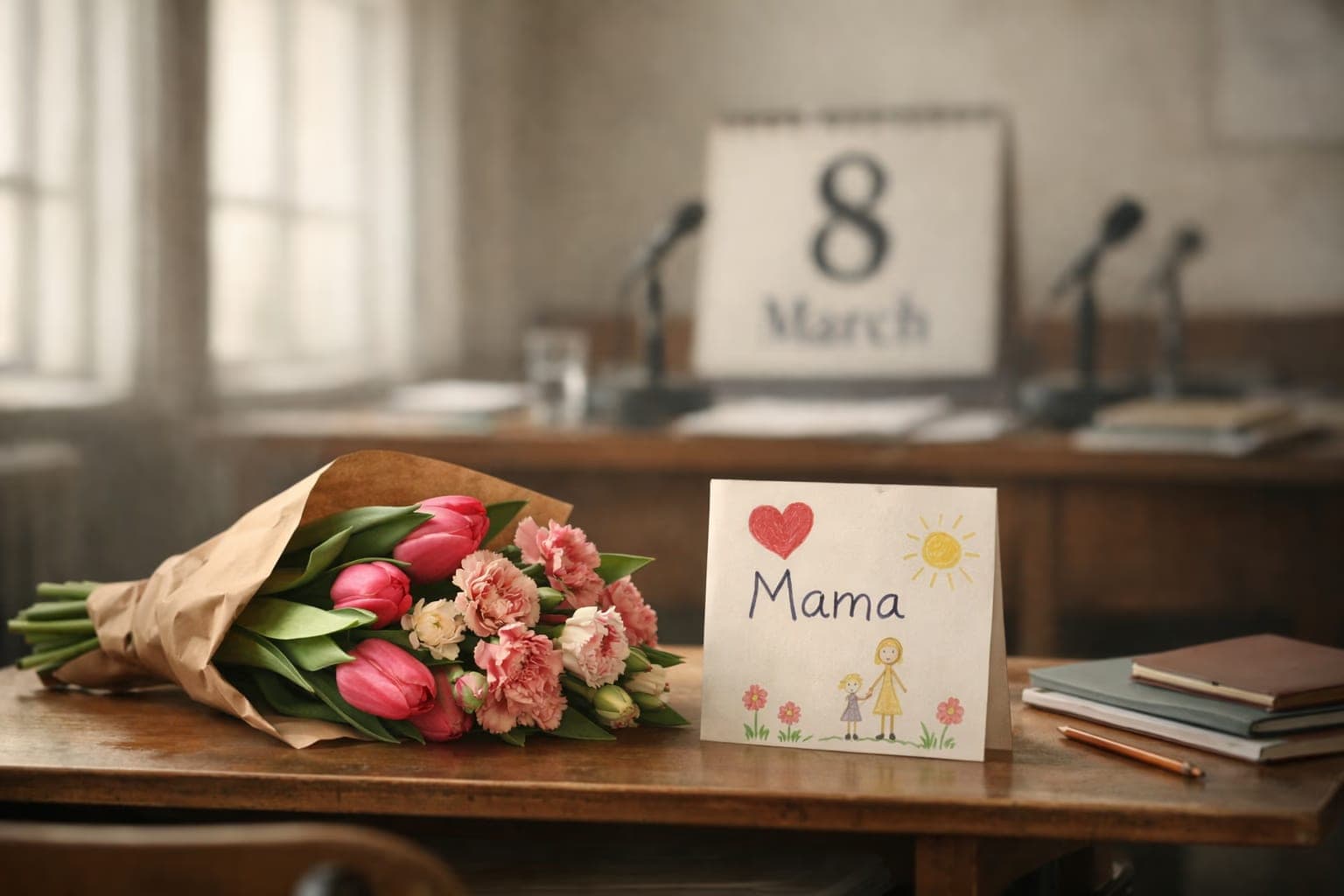
In Romania, March 8 has long been more than International Women's Day. For entire generations, especially during communism and the early years after 1989, it was also lived as a day for mothers. Today, even though Mother's Day is officially set on the first Sunday of May, the cultural reflex of giving flowers on March 8 remains strong.
On March 8, Europe slips into a familiar ritual: flowers, ceremonious messages, declarations about equality, statistics on pay gaps, public campaigns and, inevitably, a surplus of rhetoric. Few dates on the calendar manage to be at once so popular and so politically loaded. International Women's Day remains one of them. Beneath the appearance of a warm, consensual celebration lies an uncomfortable history tied to labor, representation, rights and power.
This tension explains why March 8 cannot be reduced either to the elegant formula of a festive day or to the austere language of a civic demand. Its origins are well known: the labor and feminist movements of the early twentieth century, and then its transformation into a global political marker. Even if, in many places, the day's meaning has been domesticated by time and ritual, its historical core has not vanished. March 8 still speaks about the status of women in a society and about how that society distributes recognition, authority and privilege.
Romania and the Sentimental Exception
In Romania, however, the social history of the day has produced an additional meaning. For decades, particularly during the communist era and the first years after 1989, March 8 was perceived not only as Women's Day but also, in popular usage, as a day dedicated to mothers. In schools and kindergartens, children learned poems, made greeting cards and brought flowers home for their mothers. Repeated year after year, this ritual did more than accompany the holiday: it altered its social meaning.
Hence the Romanian particularity. While in many countries March 8 has remained primarily a day about women in a public, general sense, in Romania it was partially absorbed into the family register. Not officially, but through habit. Not by law, but through pedagogy, school and collective memory. For millions of Romanians, year after year, March 8 has meant — almost instinctively — Mother's Day as well.
This overlap has not disappeared even today. Even now, when the legal distinction exists, many continue to give flowers to their mothers on March 8, to congratulate them and to treat the day in an affective key, not merely a symbolic one. Officially, it is Women's Day. In practice, for a significant share of the public, it remains the day of mothers as well.
When the Law Comes After the Custom
The formal separation of the two markers came late. Through Law no. 319/2009, Romania officially established the first Sunday of May as Mother's Day and the second Sunday of May as Father's Day, in force from 2010. Legislatively, the ambiguity was resolved. Culturally, far less so.
This is where one of the great differences between the legal calendar and the real calendar becomes visible. The state can fix a date. It cannot instantly rewrite social reflexes built up over decades. In Romania, March 8 had already settled as a day on which mothers held a central place. The new Mother's Day entered the official calendar, but it did not manage to displace the old custom. It changed the norm; it did not replace the memory.
This, in fact, is why the discussion about March 8 in Romania is not merely a matter of protocol but one of cultural layering. We have an international holiday with political origins, a local tradition with strong emotional weight, and a relatively recent legislative intervention attempting to bring order between them. The result is not a clean separation but a coexistence of meanings.
Between Mother's Day and Civic Europe
The comparison with the United States makes the difference even clearer. In American culture, Mother's Day is the major celebration of motherhood, with a distinct, strong profile, separate from March 8. The emphasis falls on the family, on the bond between children and mother, on private gestures of gratitude. March 8 does not occupy the same place in the American public imagination.
In Romania, for a long time, things stood almost the other way around. In the absence of a separately regulated Mother's Day, March 8 tacitly took on that function as well. It was not only a day about women, but also about the mother as the central figure of family affection. Hence the persistence of a confusion that is not, in fact, a confusion but the trace of a tradition.
At the European level, the landscape remains fragmented. In many Western countries, March 8 is above all a civic and institutional marker, used to bring back into public debate issues such as gender-based violence, political representation, economic inequalities or access to power. In the eastern half of the continent, it more clearly retains its social and ceremonial component. Romania occupies an interesting place between these two models: connected enough to the global discourse of equality, yet still faithful to a cultural reflex in which the mother remains, for many, the true recipient of the flowers.
Perhaps that is precisely why March 8 continues to carry a particular weight here. It is not simply a day for women, in the abstract sense, nor merely a day for mothers, in the domestic sense. It is a date on which political history, school custom, affective memory and public protocol all converge. In Romania, that combination has never been fully sorted out. But it is precisely its lack of clarity that makes it so resilient.
Flowers cannot hide the politics. But in Romania, for a long time, they have managed to soften it. And of all the transformations March 8 has undergone, this is perhaps the most revealing: not that it changed its meaning, but that it has come to carry several meanings at once.